Why the Korean Simplified Taxpayer
VAT Gap Costs You More Than You Realize
The single most misleading number on a Korean simplified taxpayer (간이과세자) invoice is the one that looks most familiar: the VAT amount (부가세액). Printed at 10% of the supply value, it appears to tell you exactly what tax applies to that transaction. But for the over 3 million Korean microbusinesses operating under the simplified taxpayer system, that number and what they actually owe are two different figures — and the gap between them creates a confusion that compounds every January.
Key Takeaways
- The 10% VAT printed on your simplified taxpayer invoice is not what you owe — your effective rate is between 1.5% and 4% depending on your industry code.
- The 2.5× to 6.7× gap between printed VAT and your actual liability is a structural feature of the 간이과세자 system that the government never explains to business owners.
- Stop copying the 부가세액 column — what you actually need for annual filing is just the supply value and your industry's value-added ratio.
The Number on Your Invoice Is Not What You Pay
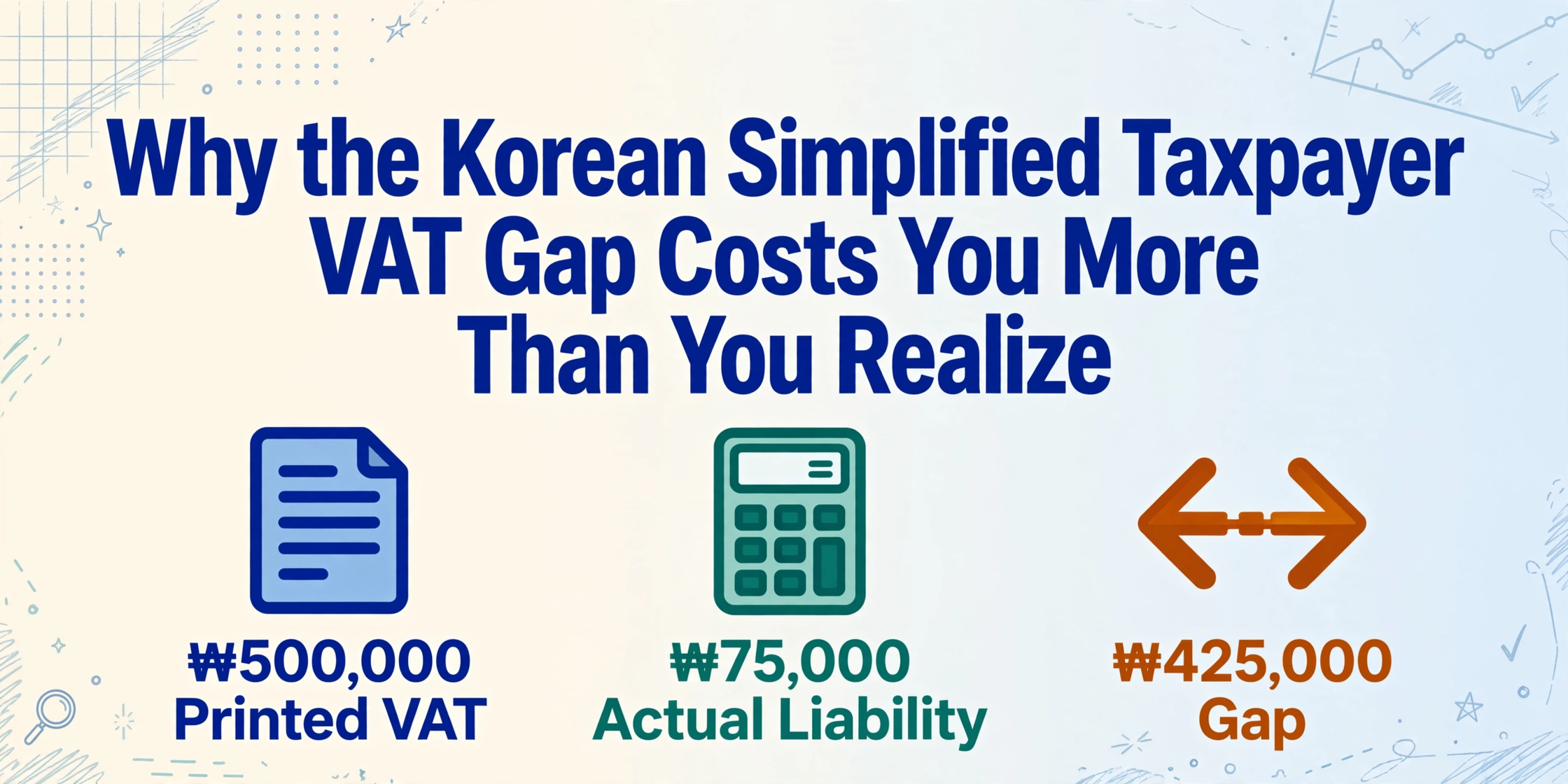
Imagine you run a small restaurant in Seoul. A food supplier sends you an invoice: processed ingredients worth ₩5,000,000 in supply value (공급가액), with ₩500,000 printed as VAT (부가세액). The total at the bottom is ₩5,500,000. You look at the VAT column, see ₩500,000, and assume that is the tax amount tied to this transaction. It seems straightforward — just like any VAT system around the world.
But when January's annual VAT filing comes, you discover that the ₩500,000 printed on the invoice has little to do with what you actually owe. Your restaurant is a simplified taxpayer (간이과세자), and its industry classification — food service (음식점업) — carries a value-added ratio (부가가치율) of 15%. That means your effective VAT rate is 1.5%, not 10%. The ₩500,000 on the invoice was calculated at 10%, but your tax liability on this transaction is closer to ₩75,000. The ₩425,000 difference is not a refund or a credit — it represents a fundamental misunderstanding of how your tax system works.
This gap is not unique to restaurants. It affects every one of the 3+ million Korean businesses operating under the simplified taxpayer regime — from convenience stores and small manufacturers to freelance consultants and construction contractors. For a business owner who processes 200 to 400 invoices a year, the mismatch between the printed VAT amount and the actual liability creates confusion at two levels: first, in understanding what number to use for planning and budgeting, and second, in preparing data correctly when the annual filing deadline arrives. If you primarily work with general taxpayer invoices, the simpler arithmetic of the 일반과세자 system — output VAT minus input VAT, both at a flat 10% — means this particular confusion never arises.
The gap between the VAT printed on your invoice and what you owe is not a tax quirk. It is a structural feature of the simplified taxpayer system — and it creates a data problem every January.
Why a Single Invoice Carries Two Different VAT Numbers
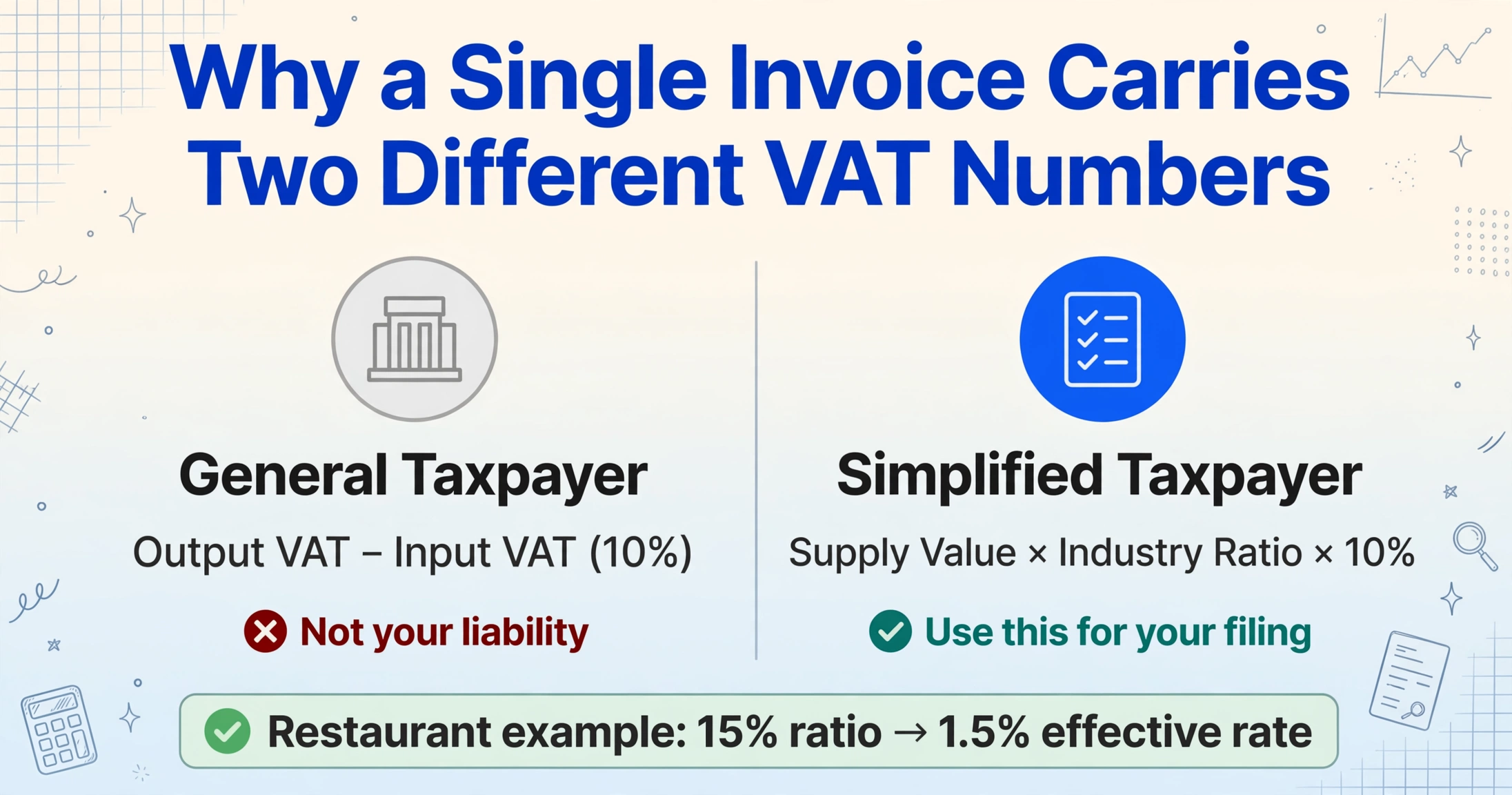
To understand why the printed VAT amount and your actual liability differ, you need to understand the mechanism at the heart of the simplified taxpayer system — the industry-specific value-added ratio (업종별 부가가치율).
Under the Value-Added Tax Act (부가가치세법), a general taxpayer (일반과세자) calculates VAT as: output VAT (매출세액) − input VAT (매입세액). Both are calculated at the standard 10% rate. The math is linear: every transaction carries 10% VAT in and out. A simplified taxpayer (간이과세자) uses a different formula, governed by Articles 32–36 of the Value-Added Tax Act:
VAT payable = (supply consideration × industry value-added ratio × 10%) − limited input tax credit
The value-added ratio (부가가치율) is the percentage of a transaction that the tax system assumes represents genuine value added by the business — as opposed to costs passed through from suppliers. This ratio varies by industry because different business types have fundamentally different cost structures. A restaurant's primary cost is ingredients (high pass-through), so its ratio is low. A consultant's primary cost is their own expertise (low pass-through), so its ratio is high. The NTS classifies businesses into the following ratio brackets under the amended schedule effective July 2021:
| Industry Category | Value-Add Ratio | Effective VAT Rate | Examples |
|---|---|---|---|
| Retail, Food service, Scrap collection | 15% | 1.5% | Convenience stores, restaurants, recyclers |
| Manufacturing, Agriculture, Fisheries, Parcel delivery | 20% | 2.0% | Small factories, farms, courier services |
| Accommodation | 25% | 2.5% | Hotels, motels, guesthouses |
| Construction, Transport, IT/Telecom, Other services | 30% | 3.0% | Contractors, logistics firms, developers, hair salons |
| Finance/Insurance, Professional services, Real estate rental | 40% | 4.0% | Consultants, accountants, property lessors |
The printed VAT amount on every tax invoice — whether issued by a general or simplified taxpayer — is calculated at the standard 10% rate. That is the number that appears in the 부가세액 field. But for the simplified taxpayer who receives the invoice, the relevant figure for their own tax calculation is the supply consideration (공급대가), not the printed VAT amount. The liability depends on their own industry ratio, which is entirely independent of what is printed on the document.
This is not a minor technical detail. A business owner who sums the 부가세액 column from their annual invoices and uses that total to estimate their VAT bill will be off by a factor of 2.5 to 6.7 times — depending on their industry. That kind of miscalculation does not just skew cash flow planning. It can lead to incorrect reserve allocation, missed payments, and the kind of last-minute scramble that defines a stressful filing season.
And the limited input tax credit (공제세액) adds another layer. Simplified taxpayers can only deduct 0.5% of purchase amounts from their VAT liability — compared to the full 10% input VAT deduction available to general taxpayers. This means a simplified taxpayer with significant purchases (a restaurant buying ingredients, a manufacturer buying materials) carries a higher net tax burden than the headline 1.5–4% effective rate might suggest, because the input side is barely creditable. A 2022 academic study published in the Korean Journal of Business Research found that the current value-added ratio brackets create significant horizontal equity issues across industries, with food service businesses receiving a disproportionate share of the tax benefit while professional services receive far less — a structural imbalance that individual business owners cannot adjust for on their own.
How Annual Filing Turns This Confusion Into a Data Crisis
The confusion between printed VAT and actual liability would be manageable if it only applied to a handful of invoices. But the simplified taxpayer's filing rhythm transforms it into a systemic problem.
General taxpayers file VAT returns twice a year — by July 25 and January 25 — each covering six months of transactions. Simplified taxpayers file once a year, by January 25, covering the entire previous calendar year under Article 67 of the Value-Added Tax Act (부가가치세법 제67조).
That single return represents 365 days of transactions. For a small business with 30 to 50 active suppliers, it means organizing 200 to 500 invoices into a single dataset, all within the first three weeks of January — when many businesses are also managing inventory counts, year-end closings, and the post-holiday operational rush.
The data preparation workflow for most small business owners looks like this: collect paper slips from a filing cabinet, download PDFs from email, save photos from KakaoTalk, open each document one by one, locate the relevant fields (공급가액, 공급자 사업자등록번호, 작성일자), and type them into a spreadsheet. At three minutes per invoice — a conservative estimate when you factor in locating the document, reading the fields, and typing without errors — 300 invoices consume 15 hours of concentrated manual labor. For the broader set of Korean tax documents these workflows touch — including cash receipts and delivery notes — our Korean VAT invoice extraction shows how one column set replaces that manual pass across every format.
But the time cost is only half the problem. The other half is that the simplified taxpayer system's unique rate structure means the data you type into your spreadsheet is not the data you need for your return. The 공급가액 is relevant. The 부가세액 as printed is not — it must be recalculated using the industry ratio. And the 업종코드 (industry code) — which determines which ratio applies — is not always printed on the invoice. Many paper invoices from small suppliers omit it entirely. A business owner who does not realize this and simply copies the 부가세액 column into their filing will produce a VAT return that bears no relationship to their actual liability.
The gap between what is printed on the invoice and what is needed for filing is not visible to the person doing the data entry. Both numbers sit on the same document, side by side. Most small business owners do not know they are using the wrong one.
This is the core of the trap. The 간이과세자 system was designed to simplify tax administration for small businesses — lower rates, fewer filings, reduced bookkeeping requirements. But the simplification came at the cost of transparency. A general taxpayer's invoice data maps directly to their return: what you see is what you owe. A simplified taxpayer's invoice data requires a translation step that the system never explicitly explains.
If you are processing invoices from suppliers who use a mix of general and simplified taxpayer status — which is common — the confusion compounds. Some invoices carry VAT at 10% (from general taxpayer suppliers), and those amounts are fully relevant for your records. Others carry VAT at 10% on the face but represent a 1.5–4% liability once the industry ratio is applied. Sorting which is which requires knowing each supplier's tax status and industry code. That is not information that arrives with the invoice.
The Hidden Cost: Time, Errors, and Missed Deductions
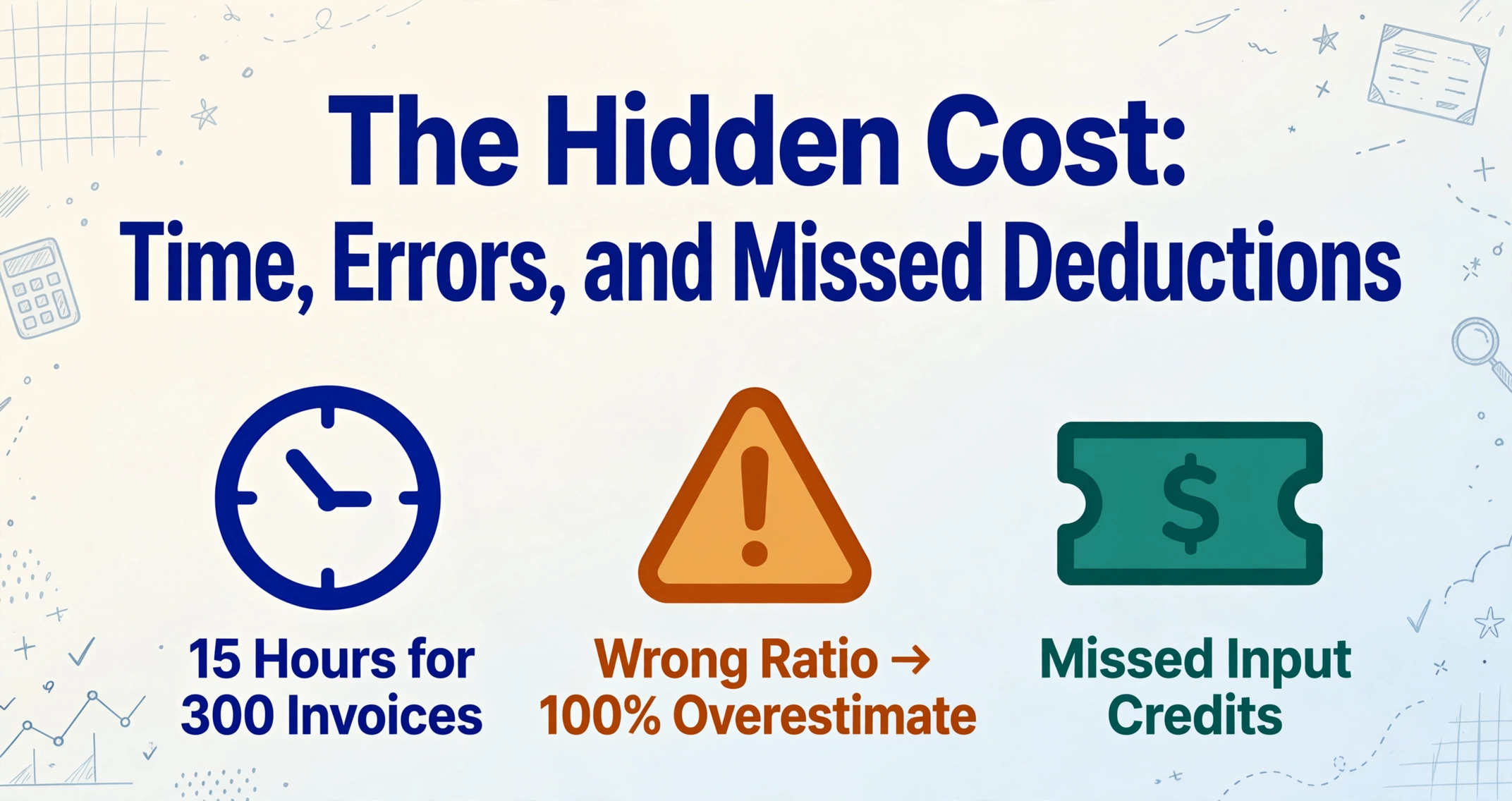
The confusion between invoice-face VAT and actual liability produces three distinct costs for Korean small business owners, most of which go unnoticed until filing season is already underway.
1. Time lost to manual re-entry and verification. At 15 hours for 300 invoices, the January data preparation window is essentially a full-time work week carved out of a month when most business owners are already overextended. And that 15 hours assumes everything goes smoothly. When an invoice is blurry, when a handwriting is hard to read, when a 사업자등록번호 has been mis-typed and must be corrected — the time adds up. A 2024 analysis of Korean SME administrative burden by the Korea Small Business Institute found that tax compliance tasks consume an average of 34 hours per year for micro-businesses, with VAT filing preparation accounting for the largest single block. For simplified taxpayers who process their own invoices, the actual number is likely higher because the data extraction is entirely manual.
2. Error risk from misapplied industry ratios. The most insidious error in simplified taxpayer data preparation is not typing the wrong number — it is applying the wrong ratio. A convenience store owner (15% ratio) who mistakenly uses the 30% rate for a construction supplier's invoice will overestimate their liability on that transaction by 100%. A freelance consultant (40% ratio) who does not realize their rate is different from their retail supplier's 15% rate will underestimate their liability. The NTS does not provide a simple lookup tool that cross-references a supplier's business registration number with their assigned value-added ratio. The business owner must know their own industry classification and apply the correct ratio consistently across every invoice in their dataset. Academic research published in the Journal of Korean Taxation Research found that the current three-tier ratio system (15%, 20%, 30%, plus a 40% tier for services) does not accurately reflect actual value-added rates across most industries, creating systematic over- and under-taxation that individual businesses cannot detect without professional analysis.
3. Missed input tax credits. The 0.5% input tax credit is small — ₩25,000 on a ₩5,000,000 purchase — but over 300 invoices it adds up to ₩7,500,000 in potential deductions. To claim it, every purchase invoice must be properly documented and its supply value accurately entered. In the rush of January filing, invoices that are missing, poorly photographed, or incorrectly categorized are simply left out. Each missing invoice represents a ₩500 deduction per ₩100,000 of supply value that the business owner is entitled to but does not claim. The cumulative effect over a year can be meaningful for a business operating on thin margins.
The structural problem is not that the simplified taxpayer system is unfair. It is that the system creates an information gap between what the invoice shows and what the business owner owes — and then requires the business owner to bridge that gap with manual data entry, under time pressure, without clear guidance on which numbers to use.
If all of this sounds familiar, you may have encountered similar manual processing bottlenecks even with general Korean tax invoices. Our article on why Korea's 99% e-invoice rate hasn't eliminated manual data entry examines the broader structural reasons why Korean finance teams still retype data that already exists in digital form.
What Correct Data Preparation Actually Requires
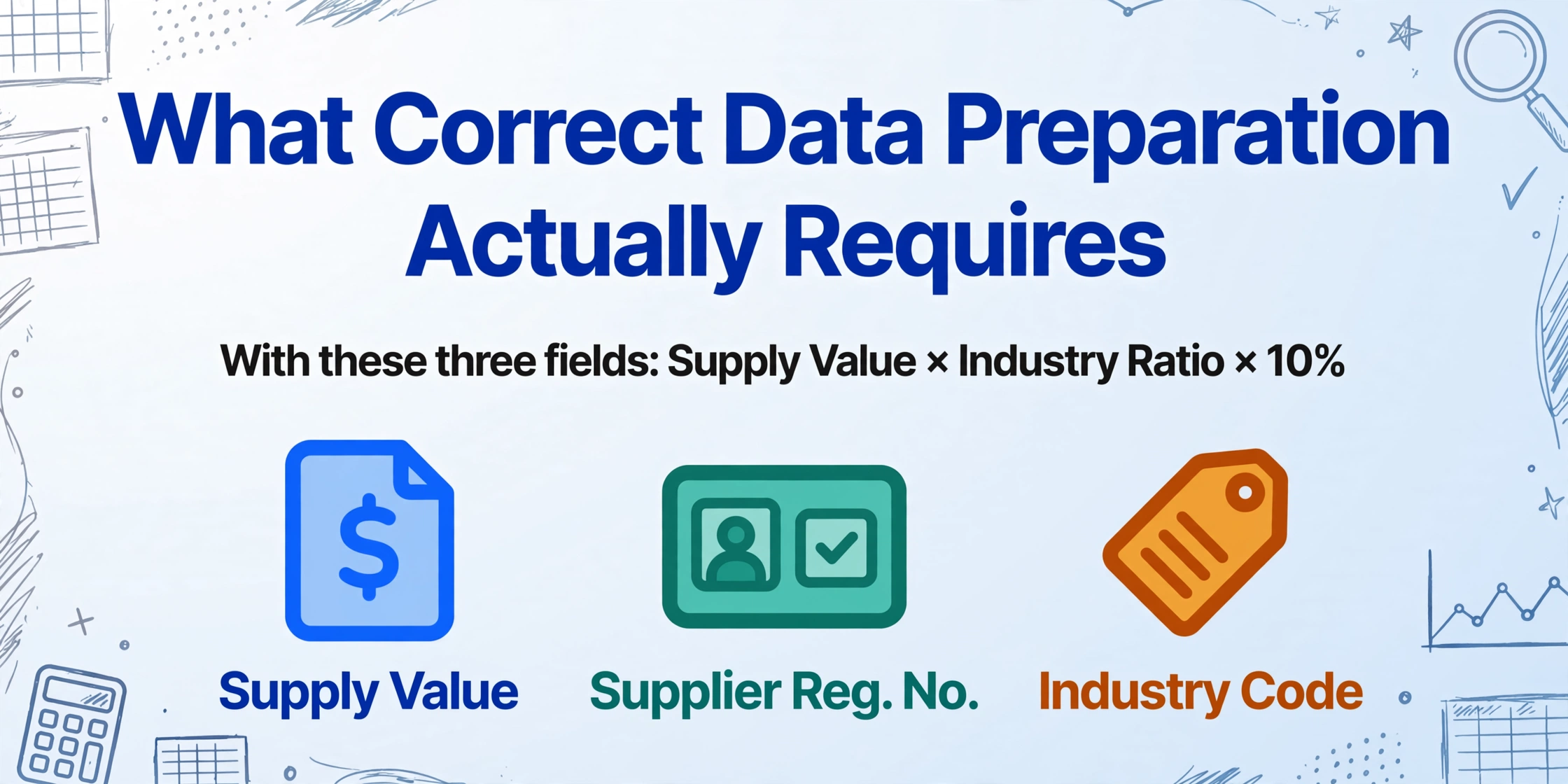
Once you understand that the printed 부가세액 is not the number you need, the next question is: what data should you actually extract from your invoices?
The answer is three fields that map directly to the simplified taxpayer's VAT calculation formula:
- Supply value (공급가액) — The net transaction amount, before VAT. This is the starting point for your liability calculation.
- Supplier business registration number (공급자 사업자등록번호) — Identifies the supplier and allows you to cross-reference their tax status and industry classification through the NTS database or your internal records.
- Industry type / business code (업종/업종코드) — Determines which value-added ratio applies. If the invoice does not print this code, you may need to look it up based on the supplier's known business type.
The issue date (작성일자) also matters for grouping invoices into the correct tax year, but the calculation itself depends on the first three fields. With these three data points, you can compute your estimated VAT liability for any invoice as: 공급가액 × applicable industry ratio × 10%.
If you are working with a tax accountant (세무사) — as most 간이과세자 businesses in Korea do — providing your accountant with a clean spreadsheet that contains these three fields for every invoice is vastly more efficient than handing over a stack of paper slips and photographs. Your accountant already knows the industry ratios and can apply them to the dataset. What they need from you is accurate, complete raw data.
This is where data extraction tools change the picture. Rather than opening each invoice one by one and typing the fields into a spreadsheet, Custom Column Extraction — the core mechanism of ImageToTable.ai — lets you define the columns you want (공급가액, 사업자등록번호, 작성일자) and extract them from every document in a single pass, regardless of whether the invoice is a PDF from HomeTax, a scanned paper slip, or a photo forwarded through KakaoTalk. For a complete walkthrough of the extraction workflow — including how to add an inferred column for 업종코드 and a computed column that calculates estimated VAT using the correct industry ratio — see our step-by-step guide to extracting 간이과세자 세금계산서 data for annual VAT filing.
Try it on one of your own invoices below — no login required:
Files are processed securely and not stored.
For business owners who need to process a full year's invoices — not just a handful — the batch workflow changes the arithmetic entirely. Our guide to batch-processing Korean simplified taxpayer invoices covers how to consolidate 200–400 invoices into a single spreadsheet with the industry ratio already applied, ready for your tax accountant or HomeTax filing.
Frequently Asked Questions
If the VAT on my invoice is wrong (not what I owe), why does it print that way?
The VAT amount (부가세액) on a tax invoice is always calculated at the standard 10% rate — this is a requirement under the Value-Added Tax Act. It applies to invoices issued by both general and simplified taxpayers. The simplified taxpayer's actual liability is not calculated from this printed number but from their own industry ratio applied to the supply consideration. The invoice is not wrong — the 10% figure is the correct face-value tax. It is just not the number the simplified taxpayer uses for their own filing.
Do I still need to track the VAT amount (부가세액) column?
Yes — but for reconciliation, not for your liability calculation. The 부가세액 column helps you verify that the supply value was correctly extracted (공급가액 × 10% should equal 부가세액 on valid invoices). It is also relevant if you sell goods to general taxpayers, since they claim the full 10% as input VAT. For your own filing, the supply value (공급가액) is the operative number.
How do I find out which industry ratio applies to my business?
Your 업종코드 (industry code) is registered with the NTS at the time of business registration. You can check it through HomeTax (홈택스) under your business registration details. If you operate in multiple business categories, the ratio for your primary 업종 applies to all transactions unless you maintain separate records for each category. The NTS publishes the full rate schedule on their website, or your 세무사 can confirm your classification.
What happens if I file using the printed VAT amount (부가세액) instead of the ratio-adjusted amount?
The HomeTax filing system for simplified taxpayers uses the industry ratio in its own calculation — it does not simply accept the printed 부가세액 from each invoice. If you enter inflated numbers based on the 10% face value, the system will flag a discrepancy between your reported data and the calculated liability. In practice, most small business owners who make this error are corrected by their tax accountant during the filing process, but the back-and-forth wastes time and may result in a correction filing if the error is caught after submission.
Can an AI extraction tool apply the industry ratio automatically?
If you add a computed column during extraction — like Estimated VAT (공급가액 × 업종별 15% × 10%) — the AI calculates the ratio-adjusted amount during processing, so your output spreadsheet already reflects the correct liability estimate. The inferred column feature can also attempt to identify industry type from document context. However, the industry ratio is a regulatory classification tied to the supplier's registered business type, which may not appear on every invoice. For accurate filing, you should always verify the assigned ratio against your supplier records or consult your tax accountant.
Does the gap between printed and actual VAT apply to invoices I receive from general taxpayer suppliers?
Yes. The printed VAT amount on any invoice is always 10%. As a simplified taxpayer, your liability on every purchase — regardless of the supplier's tax status — is calculated using your own industry ratio. The supplier's tax status affects their issuance obligations, not your liability calculation. This means every invoice in your dataset needs the same ratio adjustment, whether the supplier is a general taxpayer (일반과세자) or a simplified taxpayer (간이과세자).
If my annual revenue is under ₩48 million, am I exempt from VAT entirely?
Yes — 간이과세자 with annual supply consideration below ₩48 million are exempt from VAT payment. However, you are still required to file a return. The exemption applies only to the payment obligation. If you receive tax invoices from suppliers, keeping organized records still matters for future years when your revenue may exceed the threshold.
The January 25 Deadline Does Not Change — But Your Data Preparation Can
The core insight of this article is not that the simplified taxpayer system is complicated. It is that the system produces a gap between the numbers on your invoices and the numbers you need for filing — and most content about Korean VAT does not acknowledge that gap exists. If you are a small business owner manually entering invoice data every January, you have been working with the wrong frame of reference: treating the printed VAT amount as meaningful when it is the supply value and industry ratio that determine what you owe.
Once you know which numbers matter, the data preparation task becomes simpler, not harder. Extract the 공급가액, identify the 업종코드, apply the ratio — every invoice follows the same three-step logic. The only variable is how many invoices you have. For a business owner looking at a pile of 300 documents and a January 25 deadline, the difference between staring at the wrong number and knowing exactly which field to pull from each document is the difference between a stressful month and a manageable one. Upload one of your invoices and see whether the correct fields land in the right columns on the first pass.