ISO 9001 Lab Data Compliance
What QC Managers Need to Know Before the Next Audit
Here's a question that turns every QC manager's stomach: your ISO auditor opens a binder of last month's batch release records, flips to a tensile-strength result, and says "show me where this number came from — not the typed value, the original instrument reading." If your answer leads them through a trail of handwritten logbooks, browser printouts, and an Excel workbook that six analysts share without access controls, you're looking at a finding. Probably a major one. Because under ISO 9001:2015 and its regulatory cousins, data doesn't just have to be right. It has to be provably right — attributable, legible, contemporaneous, original, and accurate, from the moment an instrument spits out a number to the moment someone signs a certificate of analysis.
Key Takeaways
- 469 out of 470 FDA warning letters in 2025 cited documentation failures, and in a typical QC lab, every manual transcription from instrument to Excel creates a traceability gap an auditor is trained to exploit.
- An Excel workbook shared by six analysts with no edit history isn't a quality record — it's a scratchpad that stores batch release decisions, and every auditor knows to ask who edited cell C47 last week and why.
- You don't need a $100,000 LIMS to close this gap — automating just the instrument-output-to-structured-data handoff eliminates the highest-risk transcription step and costs less than $50 a month.
What ISO 9001:2015 Clause 7.5 Actually Requires for Lab Data
The clause most auditors reach for when they open a QC lab's records is 7.5.3 — Control of Documented Information. It's the reason your calibration certificates need version numbers and why a sticky note with a handwritten correction next to a chart recorder trace won't survive external audit. But the umbrella is broader than version control.
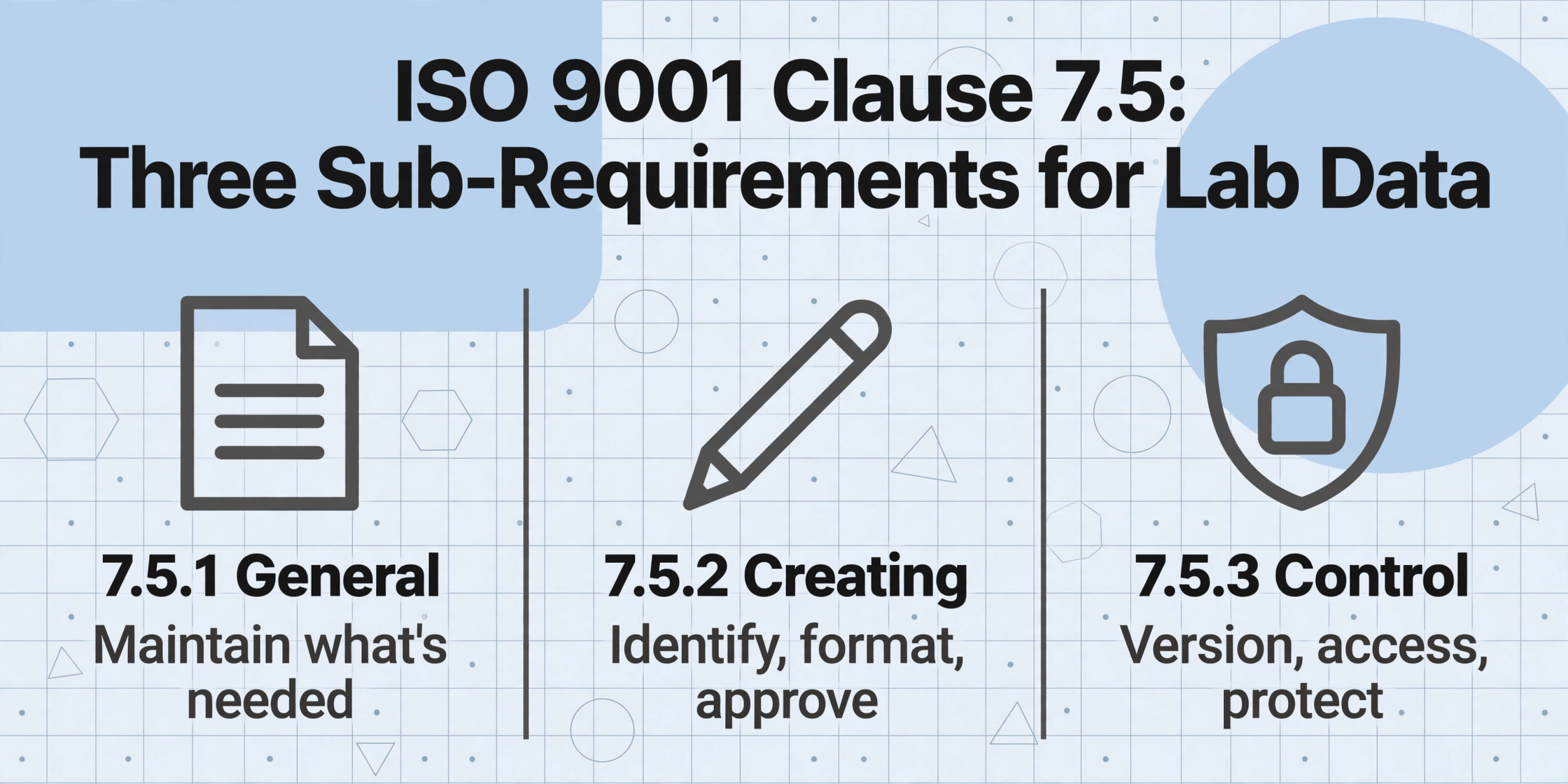
ISO 9001:2015 merged the old "documents" and "records" into one category — documented information — and Clause 7.5 breaks into three sub-requirements, all of which land on a QC lab's workflow:
7.5.1 — General. The organization shall maintain documented information required by the standard and any additional information it determines necessary for QMS effectiveness. In a QC lab, that second half is the one that surprises people. The standard itself mandates quality policy, scope, objectives (per ISO/TC 176/SC2 guidance). But if your organization decides — or an auditor decides on your behalf — that traceability from raw instrument data to final CoA is "necessary for effectiveness," it becomes auditable. You don't get to argue it's optional.
7.5.2 — Creating and Updating. Every piece of documented information must be adequately identified (title, date, author, reference number), formatted for its audience, and reviewed and approved before use. This is where paper lab notebooks get tricky: a QC analyst's logbook entry with no date, no signature, and a scribbled correction without a single-line strike-through and initials? That's a nonconformity on creation alone.
7.5.3 — Control. This is the section auditors love. Documented information must be available where and when needed, adequately protected from loss of confidentiality or integrity, and controlled through distribution, access, retrieval, retention, and — critically — change control. For electronic records, this is where the question "who can edit this Excel file?" becomes a compliance problem. In ISO 9001 audit data compiled by DNV GL, Clause 7.5.3 consistently appears among the top 10 nonconformities globally. Unauthorized changes, failure to identify obsolete versions, and lack of an adequate document control procedure are the recurring themes (per simpleQuE analysis of DNV GL findings).
The bottom line for QC managers: if your lab generates data — and every QC lab does — Clause 7.5 doesn't just apply to the quality manual and SOP binder. It applies to instrument printouts, analysts' notebooks, Excel calculation sheets, and the final CoA. The standard draws no boundary between "administrative" and "technical" documents — both must be controlled.
The Manual Transcription Gap: Where Data Integrity Breaks Down
Most manufacturers under 200 employees run their QC data through a workflow that hasn't fundamentally changed since the 1990s. It looks like this:
- Instrument generates a result (tensile tester prints a strip-chart, spectrophotometer exports a CSV, pH meter shows a reading)
- Analyst transcribes the result into a paper logbook or directly into an Excel sheet
- That Excel sheet feeds a weekly SPC chart in another workbook
- At batch release, someone assembles the relevant test results into a Certificate of Analysis or batch record
- The batch record is reviewed and signed
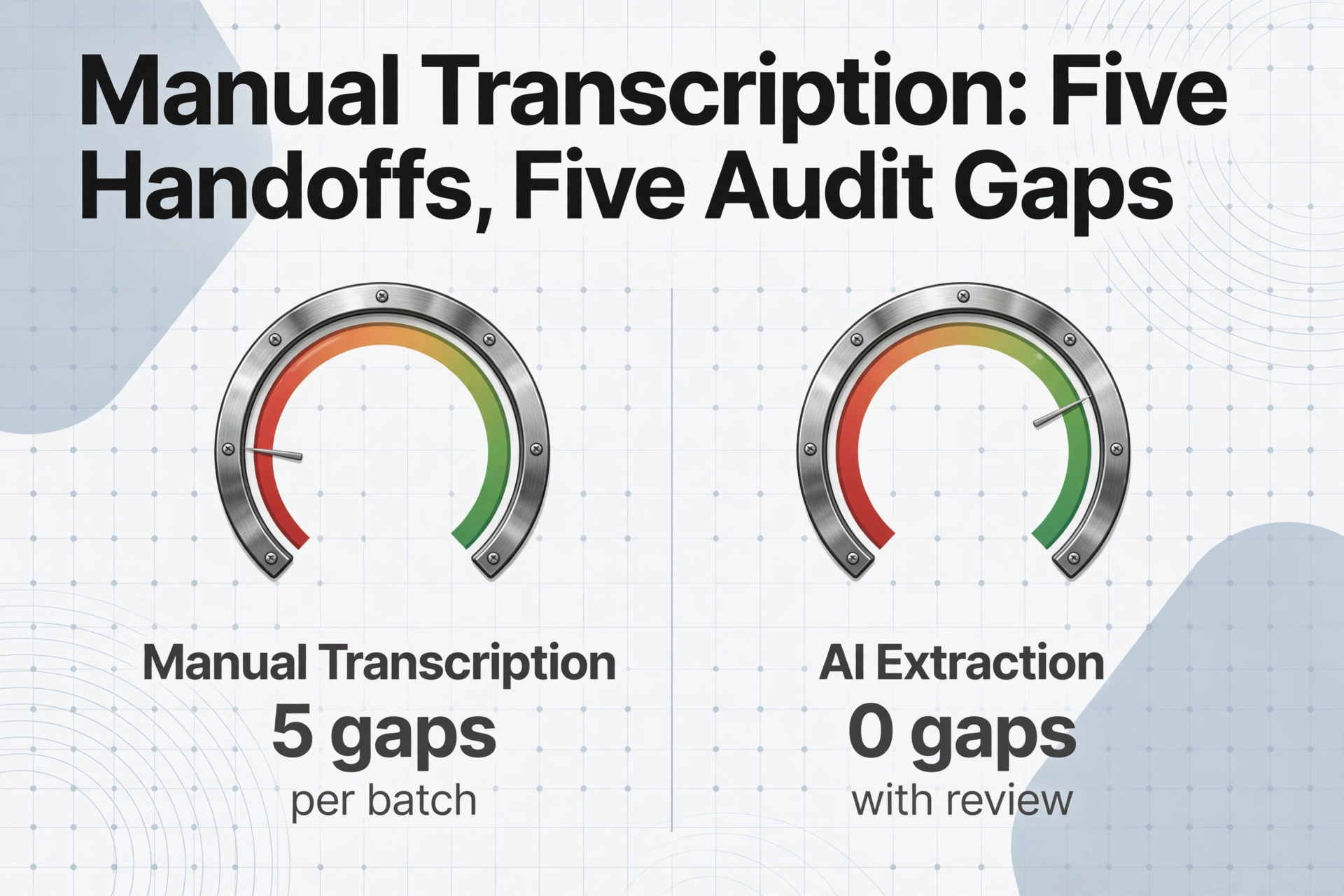
Five handoffs. Each handoff is a data integrity event. And under ALCOA+ — the framework used by both ISO 17025 auditors and FDA inspectors to evaluate data integrity — every one of them creates an auditable gap.
| Step | ALCOA+ Principle at Risk | What an Auditor Sees |
|---|---|---|
| Instrument → Analyst's reading | Original | The typed number is a copy. Is the original strip-chart or instrument output retained? Can you produce it? |
| Reading → Logbook/Excel entry | Contemporaneous, Attributable | Was this recorded at the time of testing or hours later? Which analyst entered it — is there a timestamp and identity? |
| Logbook → Excel SPC sheet | Accurate | Is there a second-person verification that the transcribed value matches the original? Or is it a copy of a copy? |
| Excel → Batch record / CoA | Attributable, Legible | Who assembled the batch record? Was it reviewed? Are all values traceable back to individual test results? |
| Batch record → Sign-off and archive | Enduring, Available | Can you retrieve this exact batch record in 5 years? Is the Excel file the CoA was built from still accessible and versioned? |
The problem isn't that any single step is guaranteed to fail. It's that in a manual chain of five handoffs, the probability that at least one link is missing — a lost instrument printout, an unsigned entry, an Excel cell edited without audit trail — approaches certainty over enough audits.
A 2025 analysis of FDA warning letters found that 469 out of 470 letters cited documentation or records management failures. One hundred cited validation failures — specifically including unvalidated Excel spreadsheets used for critical QC calculations. In several cases, the FDA found "analysts had unrestricted access to modify or delete" spreadsheet files (per QBench analysis of FDA FY2025 data). When every analyst can edit the same Excel workbook and there's no version history or change log, you don't have document control. You have a shared scratchpad that happens to store batch release data.
This is why 21 CFR 211.22(d) — failure to follow quality unit procedures — has been the top FDA 483 observation four years running (per RAPS). The violation isn't that products are bad. It's that the quality unit can't prove they're good.
Beyond ISO 9001: When 21 CFR Part 11, ISO 17025, and ISO 13485 Raise the Bar
ISO 9001 is the floor, not the ceiling. Depending on what your lab tests and which markets you sell into, additional standards stack on top of Clause 7.5 with stricter requirements for electronic records and data integrity. A QC manager needs to know which ones apply before an auditor points them out.
| Standard | Key Clauses | What It Adds Beyond ISO 9001 | Who It Applies To |
|---|---|---|---|
| 21 CFR Part 11 (FDA) | 11.10, 11.100, 11.200 | Electronic records must carry the same legal weight as paper. Requires validated systems, secure audit trails, unique user credentials, and electronic signatures that are legally binding. Shared logins are a violation. Audit trails must be reviewable and cannot be altered — even by admins. | Any QC lab supporting pharmaceutical, medical device, biologic, or food products sold in the US. Also applies to contract testing labs whose data appears in FDA submissions. |
| ISO/IEC 17025:2017 | 7.5 (Technical Records), 8.4 (Control of Records) | Requires technical records to contain "sufficient information to establish an audit trail" — original observations, derived data, personnel identity, date, and equipment used. Clause 7.11 additionally requires validation of all data management systems (software and hardware) before use. | Testing and calibration laboratories seeking accreditation, particularly third-party labs and those whose data supports regulatory submissions. |
| ISO 13485:2016 | 4.2.4, 4.2.5 | Broadens document control to explicitly include external-origin documents. Records must demonstrate that product meets specifications — with full traceability back to raw test data. A CoA without the underlying test record chain is incomplete documentation. | Medical device manufacturers. Increasingly overlaps with QMSR requirements (FDA's alignment of 21 CFR 820 with ISO 13485). |
The common thread across all three is ALCOA+: Attributable (who did it), Legible (can you read it), Contemporaneous (recorded at the time, not reconstructed later), Original (the raw data, not a cleaned-up copy), and Accurate (error-free and truthful). The "+" adds Complete, Consistent, Enduring, and Available. This framework appears in the FDA's 2018 Data Integrity and Compliance with Drug CGMP guidance (FDA, December 2018) and underpins how both ISO and FDA auditors evaluate laboratory records.
21 CFR Part 11 in particular creates a hard requirement that catches QC labs by surprise: validated systems. It's not enough to have a procedure saying "Excel files are checked." The system itself must be validated to perform reliably and consistently, with controls that prevent unauthorized changes. An unvalidated Excel workbook shared across a QC team with no version history and no access controls meets none of Part 11's requirements — and FDA inspectors are trained to spot exactly this pattern.
What Auditors Actually Flag: The Data Points Behind the Findings
Audit findings aren't random. They cluster around predictable failure modes in manual QC data workflows. Understanding what gets cited — and how frequently — is the difference between a prepared lab and one that's scrambling during the closing meeting.
From the 2025 FDA warning letter data collected by industry analysts:
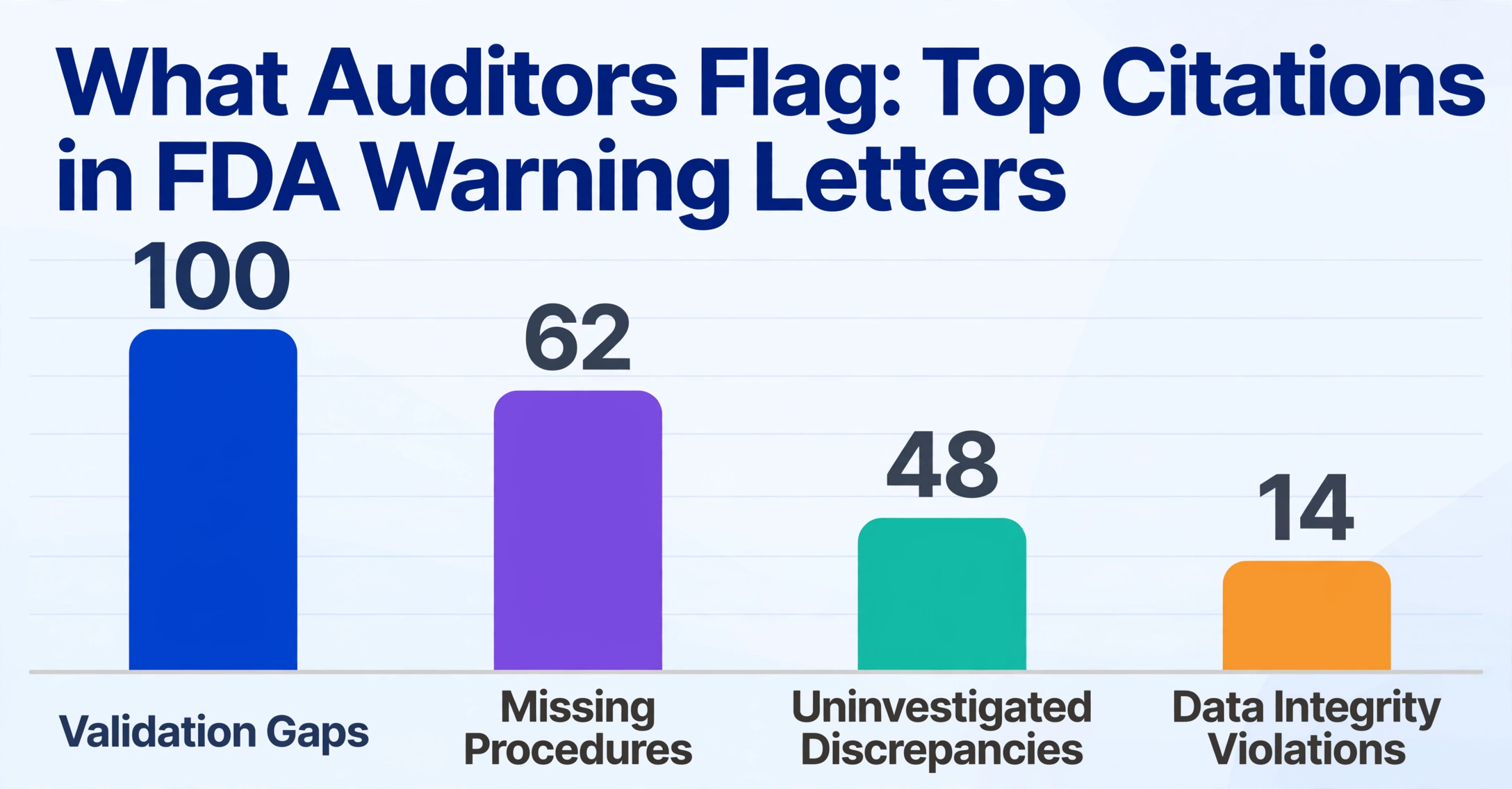
- Validation gaps were cited in 100 of 470 warning letters — the single most common specific category of citation. These include unvalidated spreadsheets used for critical calculations, unvalidated analytical methods, and equipment qualification gaps.
- Incomplete or missing written procedures appeared in 62 letters. In QC labs, this often manifests as "the lab has an SOP for the test method, but no documented procedure for how test data moves from instrument to batch record."
- Failure to investigate discrepancies — 48 letters. When an analyst enters an out-of-specification result into Excel and the SPC chart flags it, is there a documented investigation? Or does the analyst just retest and overwrite the value?
- Data integrity violations — 14 letters cited specific acts of alteration, deletion, or uncontrolled records. The FDA's language in the SV Labs Corporation warning letter captures the concern: "The observed lapses, including but not limited to laboratory controls, documentation practices, and data integrity controls, indicate fundamental weaknesses in the QU's oversight function."
A retrospective study of FDA warning letters from 2010–2020 published in the Journal of Pharmaceutical Innovation found that documentation practices (data integrity) accounted for 21% of all CGMP-related warning letters — second only to process validation at 26% (PMC 9377664). This is not a new trend. It's the single most durable pattern in FDA enforcement history.
For ISO 9001 specifically, document control findings aren't about missing procedures — they're about procedures that exist on paper but don't reach the lab bench. Auditors look for:
- Documents with no approval signature or date
- Obsolete versions of SOPs still posted at workstations
- Corrections to records that don't show the original entry (single-line strike-through, initials, date)
- External documents — instrument manuals, supplier CoAs, regulatory standards — that aren't included in the document control system
- Excel files without change history, being used as the master data repository for batch release decisions
April 2026 brought a new development: the FDA issued its first warning letter citing AI misuse in CGMP documentation. The agency's position is clear — AI-generated content used in cGMP records requires authorized human review before it becomes a controlled record (per Certainty Software analysis). This matters for QC labs evaluating AI-based extraction tools: the output must be integrated into a validated, reviewable workflow, not accepted blindly.
LIMS vs AI Extraction: Building an Audit Trail at the Right Price
When a QC manager concludes that manual transcription is an audit risk, the traditional next step is to evaluate a Laboratory Information Management System (LIMS). The pitch is compelling: a LIMS captures instrument data directly, enforces data entry controls, maintains a timestamped audit trail, and manages electronic signatures in a 21 CFR Part 11-compliant wrapper. LabWare, STARLIMS (an Abbott company), and LabVantage collectively hold roughly 80% of the enterprise LIMS market.
The problem is the price. Enterprise LIMS deployments run $250,000+ in setup with $100,000+ annual licensing. Mid-range deployments — which small and medium manufacturers would need — still cost $50,000–250,000 to set up and $25,000–100,000 per year (per QBench 2026 LIMS pricing analysis). Implementation timelines stretch to months. And the G2 reviews tell a revealing story: LabWare users describe it as "not intuitive at all" with "very little OOTB functionality," while STARLIMS is noted to require "significant implementation effort." These are tools built for labs with dedicated IT staff.
For a 50-person manufacturer running 20 QC tests a day, a $75,000 LIMS deployment isn't a realistic option. The alternative — sticking with manual transcription — is equally unsustainable from a compliance standpoint. This is where AI-based extraction tools occupy a middle ground that didn't exist five years ago.
An AI extraction tool doesn't replace a LIMS. It doesn't manage sample tracking, inventory, or instrument calibration schedules. What it does — and what matters for Clause 7.5 and Part 11 compliance — is eliminate the manual transcription step at the data entry point. Instead of an analyst reading a spectrophotometer printout and typing numbers into Excel, the instrument output (saved as PDF, or even photographed as a printout) is ingested by the AI. The tool reads the values — tensile strength, elongation, hardness, whatever the test generated — and outputs them as structured data. Every extraction is a timestamped event with a record of what was extracted from which source document.
The compliance difference is threefold:
- Attributable and contemporaneous: The extraction timestamp plus the analyst's login creates a record of who processed which data and when — meeting the ALCOA+ "contemporaneous" and "attributable" tests that manual logbooks struggle with.
- Original preserved: The source file (instrument PDF or image) remains available alongside the extracted data. An auditor can pull up the original instrument output and compare it to the extracted values — the "show me the raw data" test becomes answerable.
- No manual re-keying: The compliance risk shifts from "did the analyst type the right number?" to "is the extraction output verified?" The latter is a review step — a controlled activity that produces its own audit trail — rather than a transcription act with no inherent record.
For labs that extract individual QC lab reports into Excel and then batch-process them into SPC dashboards, the data flow becomes: instrument output → AI extraction → structured data → SPC analysis → batch record. The extraction step is automated and traceable. The audit trail at that step is machine-generated, not dependent on an analyst remembering to sign and date a logbook entry.
The cost differential is stark. While a mid-range LIMS deployment runs $50,000+, AI extraction tools in this category operate on per-document or subscription pricing that's orders of magnitude lower — typically under $50/month for the volumes a small QC lab processes. The trade-off is scope: you get data ingestion and audit trail at the entry point, but not the comprehensive sample management, inventory tracking, and instrument integration that a full LIMS provides. For the smaller manufacturer whose primary compliance exposure is the manual transcription step — and that's the majority — that trade-off is often the right one.
From Instrument Printout to Audit-Ready Record: A Practical Framework
Compliance isn't a tool purchase — it's a workflow design exercise. The tool enables the workflow, but the workflow itself is what an auditor evaluates. Here's a six-step framework for getting from where most QC labs are today to a defensible data integrity posture.
Step 1: Map your current data chain
Draw a literal flow chart from instrument output to final batch record. For every handoff — instrument to analyst, analyst to logbook, logbook to Excel, Excel to CoA — ask: Can I prove when this happened, who did it, and that the number didn't change? Mark every "no" in red. Those are your compliance gaps.
Step 2: Determine which standards apply
If you sell medical devices into the US, you need ISO 13485 + Part 11. If you're a third-party testing lab, ISO 17025 is the governing standard. If you're a general manufacturer with ISO 9001 certification, Clause 7.5 is your baseline. Write down the specific clause numbers that apply to your operation. An auditor will cite them by number — you should know them too.
Step 3: Choose your control point
The most impactful compliance decision you'll make is where you eliminate the manual transcription link. For many small and mid-sized manufacturers, the instrument-output-to-structured-data step is the highest-risk handoff and the one easiest to automate. If full LIMS integration is out of scope, this is where you invest.
Step 4: Build the review step into the workflow
Automated extraction doesn't mean un-reviewed extraction. A second person — or the QC supervisor — must verify that extracted values match the source document before the data enters the batch record. This verification itself must be documented (date, reviewer identity, result of review). The FDA's April 2026 position on AI in cGMP documentation makes this explicit: automated output is not a controlled record until a qualified human reviews it.
Step 5: Retain the originals
ISO 17025 Clause 7.5 and FDA data integrity guidance both require retention of original observations. The instrument PDF, chart recorder trace, or raw data file you fed into extraction software must be retained and retrievable — with a date, test method reference, equipment ID, and analyst identifier — for the full retention period.
Step 6: Document the workflow itself
Create an SOP titled "Control of QC Test Data from Generation to Batch Record." Describe the workflow you built in Steps 1–5. Identify the tools used, the review step, the retention location, and the access controls. This SOP is what turns an implied process into an auditable one. Without it, you could have the best extraction pipeline in the world and still get a finding for failing to document how data is controlled.
Frequently Asked Questions
Does ISO 9001 require electronic record-keeping, or are paper records acceptable?
Paper records are still acceptable under ISO 9001:2015 — the standard is format-neutral. Paper records become a problem when they lack the control elements Clause 7.5 requires: signatures and dates on every entry, single-line strike-throughs with initials on corrections, and a system that prevents loss or unauthorized access. The practical reality is that paper records meeting these requirements consistently are labor-intensive to maintain. Many labs move to electronic systems not because paper is disallowed, but because electronic systems enforce the controls — audit trails, access restrictions, timestamps — that paper relies on human discipline to achieve.
What's the difference between 21 CFR Part 11 and ISO 9001 document control?
ISO 9001 Clause 7.5 says "control your documents" but doesn't prescribe how. 21 CFR Part 11 prescribes exactly how electronic records must be managed to be legally equivalent to paper: validated systems, unique user IDs, secure audit trails, electronic signatures with identity verification, and data retention with metadata intact. A spreadsheet with a password meets ISO 9001's spirit if you have a procedure for it. It does not meet Part 11 — which requires system-level controls that a password alone doesn't provide.
Can I use an AI extraction tool and still pass a Part 11 audit?
An AI extraction tool does not need to be a Part 11-validated system if (a) the extracted output is reviewed and approved by a qualified person before it enters the batch record, (b) the review step is documented, and (c) the original source document is retained as the official record. The FDA's emerging position on AI in cGMP documentation (first warning letter citing AI misuse, April 2026) makes human review the key requirement. The tool's role is to produce a draft — the human review converts it into a controlled record. If your workflow documents this review step, you're on solid ground.
Is an Excel spreadsheet with password protection enough for ISO 9001?
For ISO 9001 alone — technically yes, if you have a documented procedure for access control, version management, and change tracking. In practice, password-protected Excel files rarely survive audit scrutiny because auditors ask the follow-up: "How many people know the password? Can you show me who edited cell C47 last week, and why?" If the answer is "we can't track that level of detail," you have a documentation control gap. For labs under Part 11 or ISO 17025, password-protected Excel is definitively insufficient — both standards require audit trails that password protection alone cannot provide.
How do I know if my lab needs ISO 17025 accreditation on top of ISO 9001?
You need ISO 17025 if your lab provides testing or calibration results to external customers who rely on those results for their own quality decisions — or if your customers' contracts or regulatory submissions require testing from an accredited lab. A manufacturer's internal QC lab testing its own products before release typically does not need ISO 17025 (ISO 9001 or ISO 13485 suffices). A third-party contract testing lab whose CoAs go into a pharmaceutical company's FDA submission almost certainly does. If your customers are asking for "ISO 17025-accredited lab results," the decision has been made for you.
What's the most common document-control finding in an ISO 9001 lab audit?
Based on DNV GL's aggregated audit data and corroborated by multiple certification bodies, the most frequent laboratory-specific document control findings are: (1) corrections to records that don't preserve the original entry — a number crossed out completely instead of single-line-strikethrough with initials/date; (2) test results entered into a spreadsheet that has no change history and is shared without access controls; (3) instrument printouts that are treated as "scratch paper" and discarded after the value is transcribed. That third one is the most expensive to fix retroactively — you can't recreate a thermal printer output that went into the bin six months ago.
The thread that runs through every compliance standard discussed here is the same: you don't need the fanciest system on the market. You need a data flow where every value can be traced back to its origin, every change is documented, and every record is attributable to a specific person at a specific time. Whether you achieve that with a $100K LIMS, an AI extraction tool at the data entry point, or a meticulously maintained paper system with a double-signature protocol — the auditor will evaluate the integrity of the chain, not the price tag of the tools. Build the chain first. Choose the tools to support it.
For more on how QC labs are approaching data extraction, see the how-to guide for extracting manufacturing QC lab reports into Excel and the batch-processing workflow for SPC dashboards. For a broader evaluation of tools in this space, check the manufacturing document extraction tools comparison.
The quickest path to an audit-ready QC data workflow: upload a lab report to the demo tool, define the columns you need extracted (specimen ID, test parameter, result value, specification limit, pass/fail), and see what a traceable, machine-generated data record looks like. The output — not the process — is what your auditor will compare against the original instrument data.