SPED ECF June Deadline Checklist
What Brazilian Finance Teams Need Before the Filing Cutoff
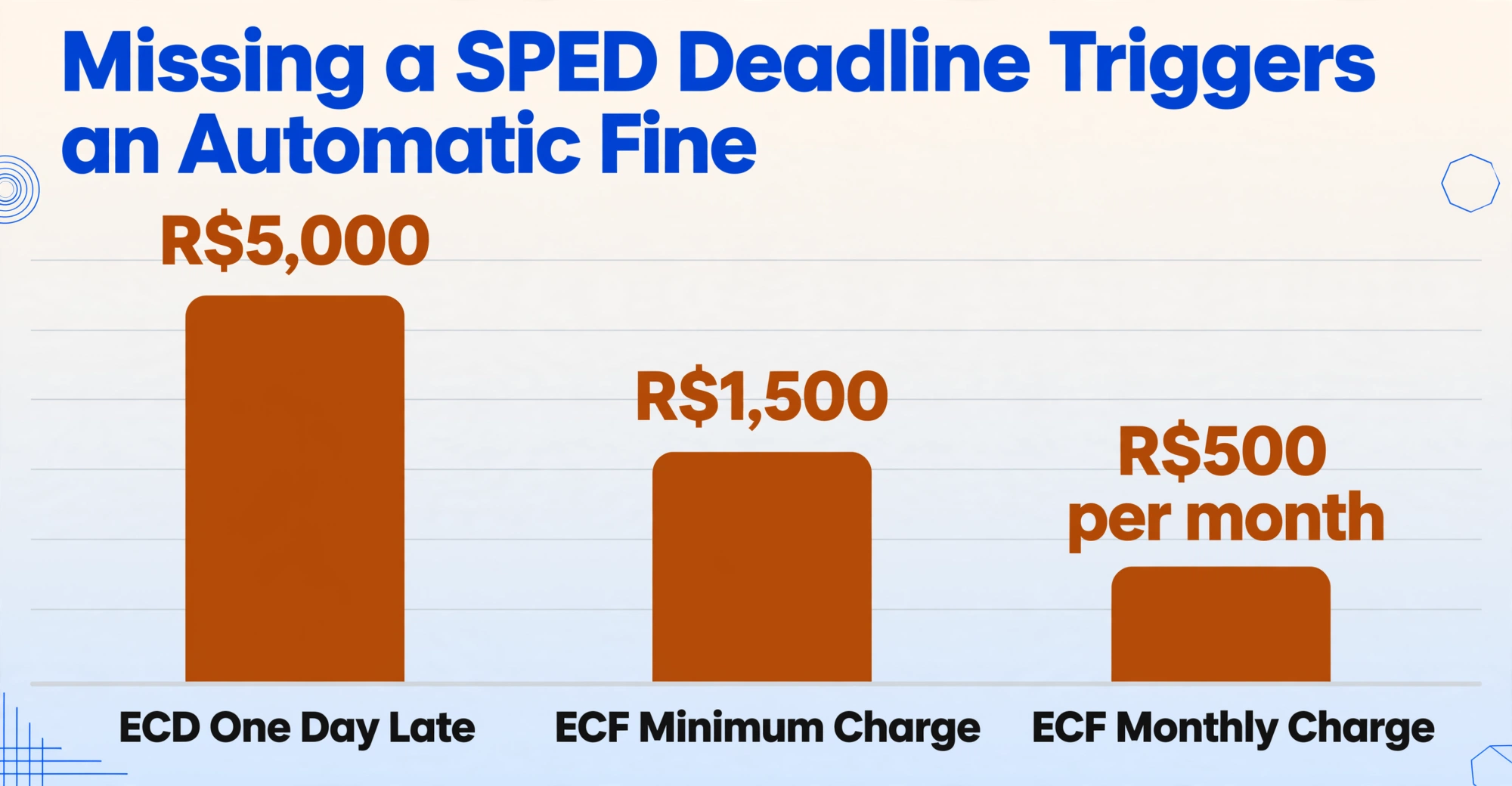
The mid-year compliance calendar for Brazilian companies is anchored by two immovable deadlines. The Digital Accounting Bookkeeping (Escrituração Contábil Digital, or ECD) must be submitted by the last business day of June — June 30, 2026, for calendar year 2025 data. The Digital Tax Bookkeeping (Escrituração Contábil Fiscal, or ECF) follows one month later, on July 31. The two deadlines are not independent: the ECF depends on the ECD for its accounting basis, meaning a delay or error in the June submission cascades directly into the July filing. Missing either deadline triggers automatic penalties — R$5,000 per month for the ECD, R$500 per month (minimum R$1,500) for the ECF — but the real cost is the compressed correction window when something goes wrong in the final weeks.
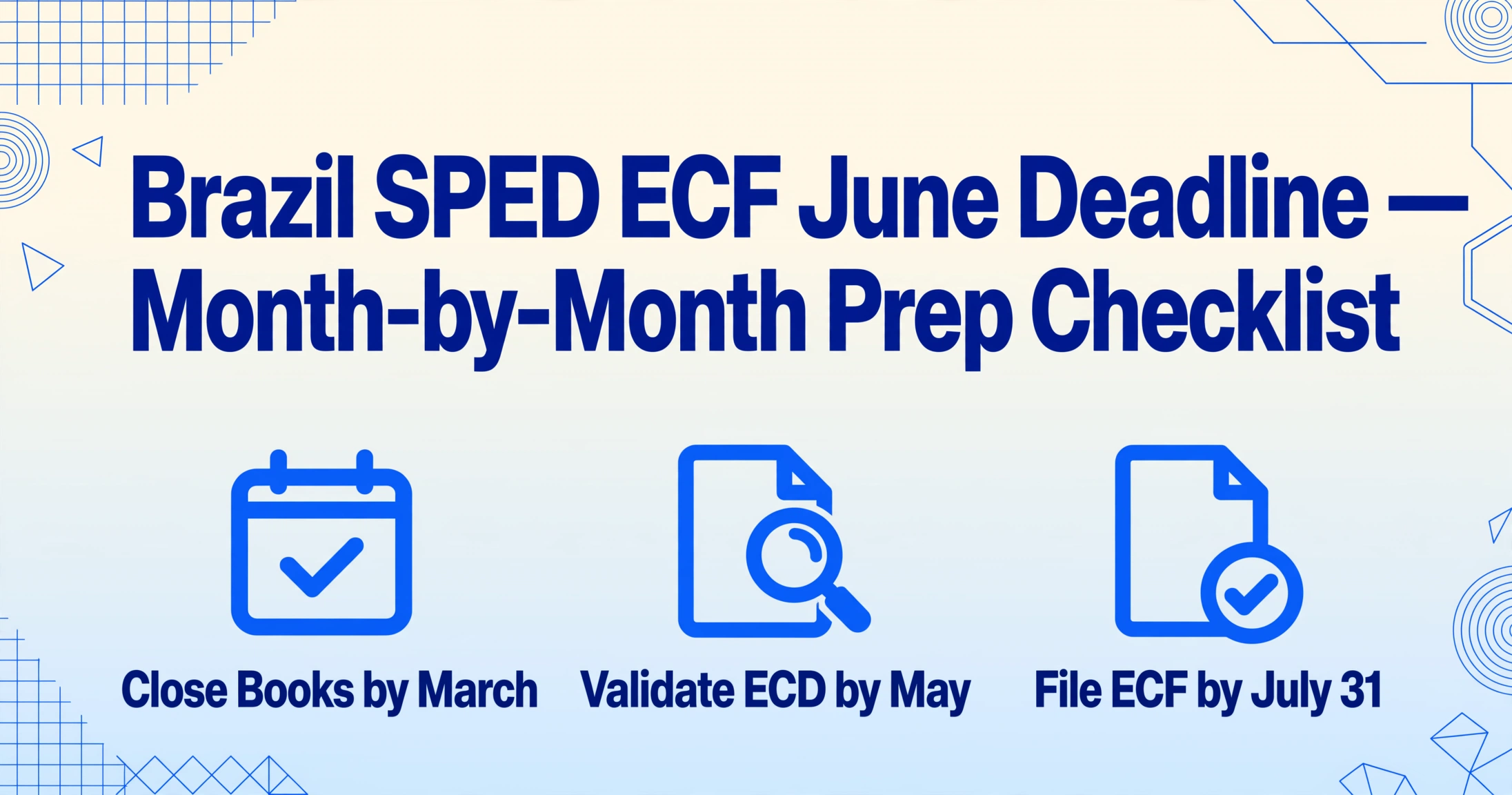
This checklist is organized by the phases that lead up to the twin deadlines: the book closure period (February–March), the ECD generation and validation window (April–May), the ECD submission (June), and the ECF preparation and filing (July). Each phase includes specific actions, validation steps, and common pitfalls to avoid. The goal is not to explain what the ECD or ECF contains — that is covered in the companion guide to extracting SPED accounting data. The goal is to give finance teams a structured calendar they can follow, week by week, from book close through the final ECF transmission.
February–March: Close the Books Before You Can File
SPED compliance begins not in June, but when the prior year's books are closed. The ECD cannot be generated until the annual accounting records are finalized — chart of accounts balanced, trial balances confirmed, journal entries posted and reviewed. A company that enters April with unresolved reconciling items or uncleared intercompany accounts will carry that drag into every subsequent phase.
All journal entries posted, all accounts reconciled, trial balances balanced to the penny. This is the foundation the entire SPED file rests on. Late-posting events (dividend declarations, tax provision adjustments, impairment assessments) should be finalized in this window.
Confirm that all balance sheet accounts tie to supporting schedules (bank confirmations, accounts receivable aging, fixed asset registers) and that the P&L matches the cost center reports used for management reporting. Any discrepancy found here will appear in the ECD and must be corrected before file generation.
The ECD's C050 and C051 Registros map your company's internal accounts to the Receita Federal's standardized reference account codes. A misclassified account here propagates to every subsequent report. Verify that any accounts added or restructured during the year are correctly mapped. Companies with recent mergers, acquisitions, or cost center reorganizations should prioritize this step.
Both the ECD and ECF must be digitally signed by the company's legal representative and the accountant using ICP-Brasil certificates. Check the expiry dates now. A certificate that expires in mid-July, after the ECD is submitted but before the ECF is signed, creates a last-minute scramble. Renew if needed. Both A1 (software-based) and A3 (token) certificates are accepted, as long as they are ICP-Brasil accredited.
April–May: Generate and Validate the ECD File
With the books closed and the COA mapping verified, the next phase is generating the ECD file from the accounting system. Most Brazilian ERPs — SAP TDF, Oracle NetSuite, Senior, Domínio, Omie, Conta Azul — have SPED ECD export modules that produce the .txt file in the correct layout. The key activity in this phase is not generation (which is automated) but validation and correction.
Use the official PVA (Programa Validador e Assinador) for ECD — download the latest version from the SPED portal. Run the validation and save the full error log. Do not filter or ignore warnings at this stage; every error flagged by the PVA must be resolved. Common issues in the first pass: missing mandatory Registros, field length mismatches after system updates, and incorrect CPF/CNPJ format for signatories.
Each correction requires a fresh file generation and a fresh validation pass. Plan for 3-5 validation cycles. Companies with complex structures (multiple establishments, departmental books in Bloco K, partial periods due to mergers) typically require more iterations. The PVA's error messages are specific — do not guess; consult the validation guide manual for the current Leiaute version.
PVA validation does not catch data inconsistencies — it validates format. Extract the C155 trial balance and verify that opening balances match the prior year's ECD closing balances, that debit and credit movements are reasonably balanced, and that the final balance report (Registro C157 or J150) reconciles to the general ledger. If you find a C155 balance that does not match the general ledger, trace it to a posting period or account that was not closed correctly. This is the step that takes the most time when done manually — and it is also the step where extraction tools provide the most leverage.
Before the ECD is submitted, identify the permanent and temporary differences that will flow into the ECF's Bloco M. Permanent differences (e.g., goodwill amortization add-back, donations not deductible) go into M300 Part A and are tracked in M305 Part B. Temporary differences (e.g., provisions for tax contingencies) go into M350 Part A and M355 Part B. Preparing these schedules in April–May — while the accounting data is fresh — avoids the common trap of underestimating adjustment items during the compressed July window.
June: Submit ECD and Begin ECF Preparation
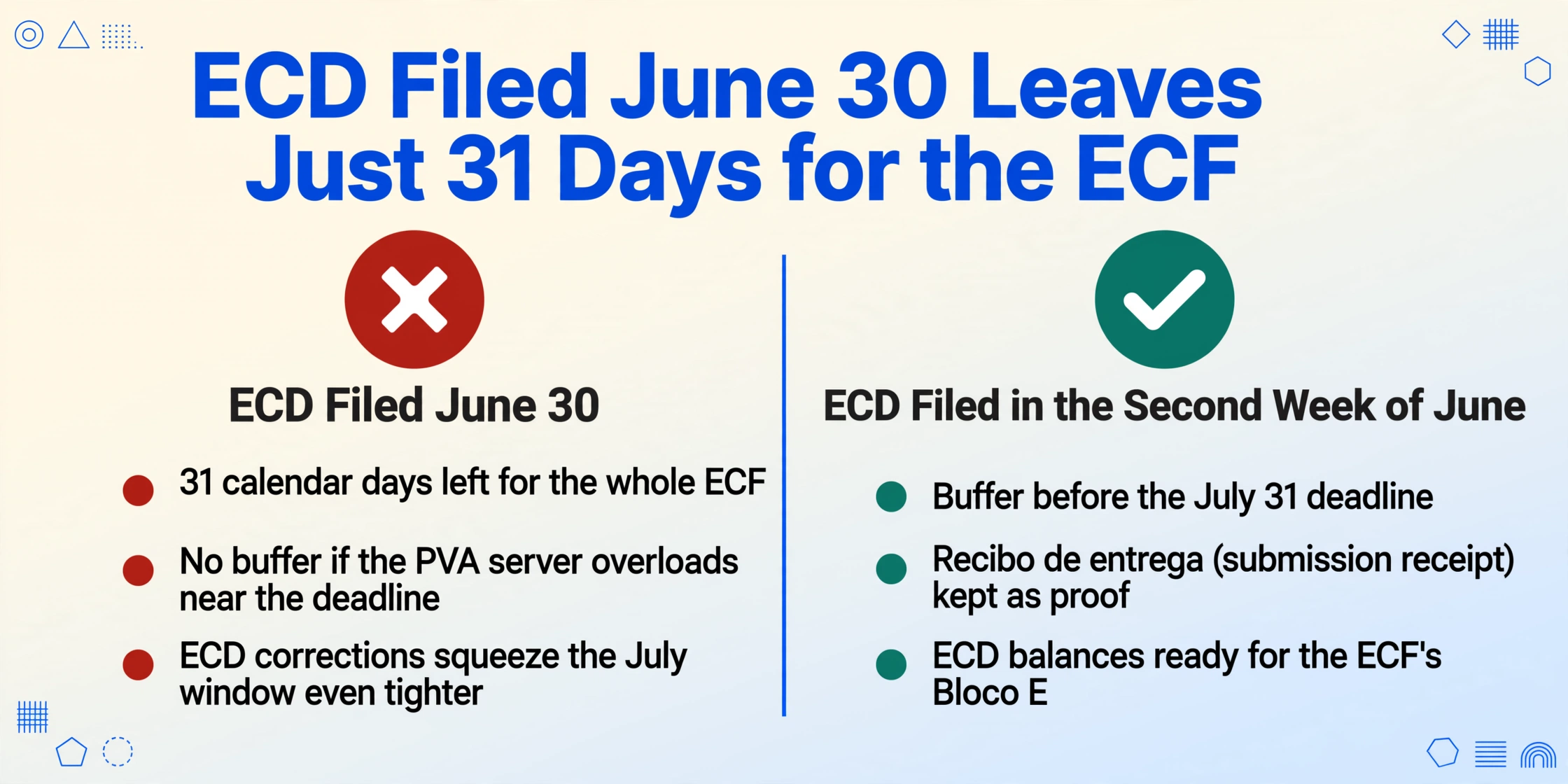
June is the highest-stakes month of the SPED cycle. The ECD must be transmitted by the last business day. Simultaneously, the ECF preparation must begin using the submitted ECD data as its foundation. A company that completes the ECD on June 30 and only starts ECF work in July has just 31 calendar days to prepare, validate, and submit the more complex of the two filings.
Aim for the second week of June, not the last day. Early submission gives you a buffer if the PVA's transmission server experiences high load near the deadline — a recurring issue every year. Save the recibo de entrega (submission receipt) and confirm the file's status in the SPED portal. The receipt is your proof of on-time filing for the next five years.
The ECF's Bloco E (E010, E015) needs the ECD's final account balances and the cross-reference mapping between the company's internal accounts and the reference chart of accounts. Extract these from the submitted ECD file. This is your starting point for the ECF's tax calculation. Any discrepancy between the ECD data and what you carry into the ECF will appear as an inconsistency in the Receita Federal's post-submission cross-check.
Before starting the ECF file generation, verify that the ECD's closing balances (C155) match the opening balances you plan to use in the ECF's E010 recovery records. Check that the E015 mapped account table is complete — every account that appears in the ECF must have a corresponding entry. Flag any account where the balance differs by more than a de minimis threshold (e.g., R$1,000). Each difference must be explained and documented before proceeding.
July: The Final Push — ECF Validation and Submission
The ECF is the more complex of the two filings. It covers IRPJ and CSLL calculation, e-Lalur/e-Lacs adjustments, related-party transactions (Bloco Y), and transfer pricing documentation. The PVA for ECF performs format validation, but — like the ECD PVA — it does not cross-check against the submitted ECD data. The responsibility for consistency rests entirely with the filer.
The ECF generation module in your ERP (SAP TDF, NetSuite, Senior, etc.) will ask for the ECD submission year and reference numbers. It loads Bloco E (E010) with the ECD's final balances and Bloco J with the account mappings. Verify that the imported numbers match the extracted ECD data before proceeding to the tax calculation blocks.
Input the permanent and temporary differences identified in April–May into the M300/M305 and M350/M355 Registros. Verify that each adjustment has a supporting reference (accounting provision, legal document, court proceeding number). The IRPJ (25%) and CSLL (9%) rates are fixed, but the effective rate changes based on adjustments, incentives, and compensation of prior-year losses. Confirm the computation by reconstructing the effective rate manually from the Bloco K output.
The ECF PVA (current version 12.1.6 as of May 2026 for the 2025 calendar year) performs over 500 validation checks. Run it early — the first week of July. Plan for 2-3 validation cycles. The Y730 record for transfer pricing is a common source of errors for companies with cross-border transactions. If the file rejects, check the specific error code against the PVA-ECF manual before regenerating.
Use the ICP-Brasil certificates confirmed in February. Submit before the last business day of July — ideally in the third week, leaving a buffer for server issues. Save both the recibo de entrega and the signed ECF file. These must be retained for at least five years per RFB retention requirements.
What Happens When You Miss a Step
The penalties for missing either deadline are automatic and escalate. A company that misses the ECD deadline by even one day incurs R$5,000 in fines. Missing the ECF deadline adds R$500 per month (minimum R$1,500) for Lucro Real entities. But the financial penalties are the smaller risk. A submission with undiscovered inconsistencies — an ECD balance that does not match the ECF's recovery record, a M300 adjustment without supporting documentation — stays in the Receita Federal's database indefinitely. The RFB's cross-reference engine, enhanced with AI-based pattern detection since 2026, compares every submission against the company's prior filings and against other declarations (DCTF, EFD-Contribuições). An unexplained variance that survives the manual review step becomes a permanent audit signal.
The most effective risk mitigation is not more last-minute effort. It is starting early enough that each phase has a buffer, and using extraction tools that convert the raw SPED text into structured tables for verification — turning a 40-hour manual cross-check into a focused review of the output that matters.
A Note on Data Preparation: Why Your ECD Input Quality Determines Your ECF Outcome
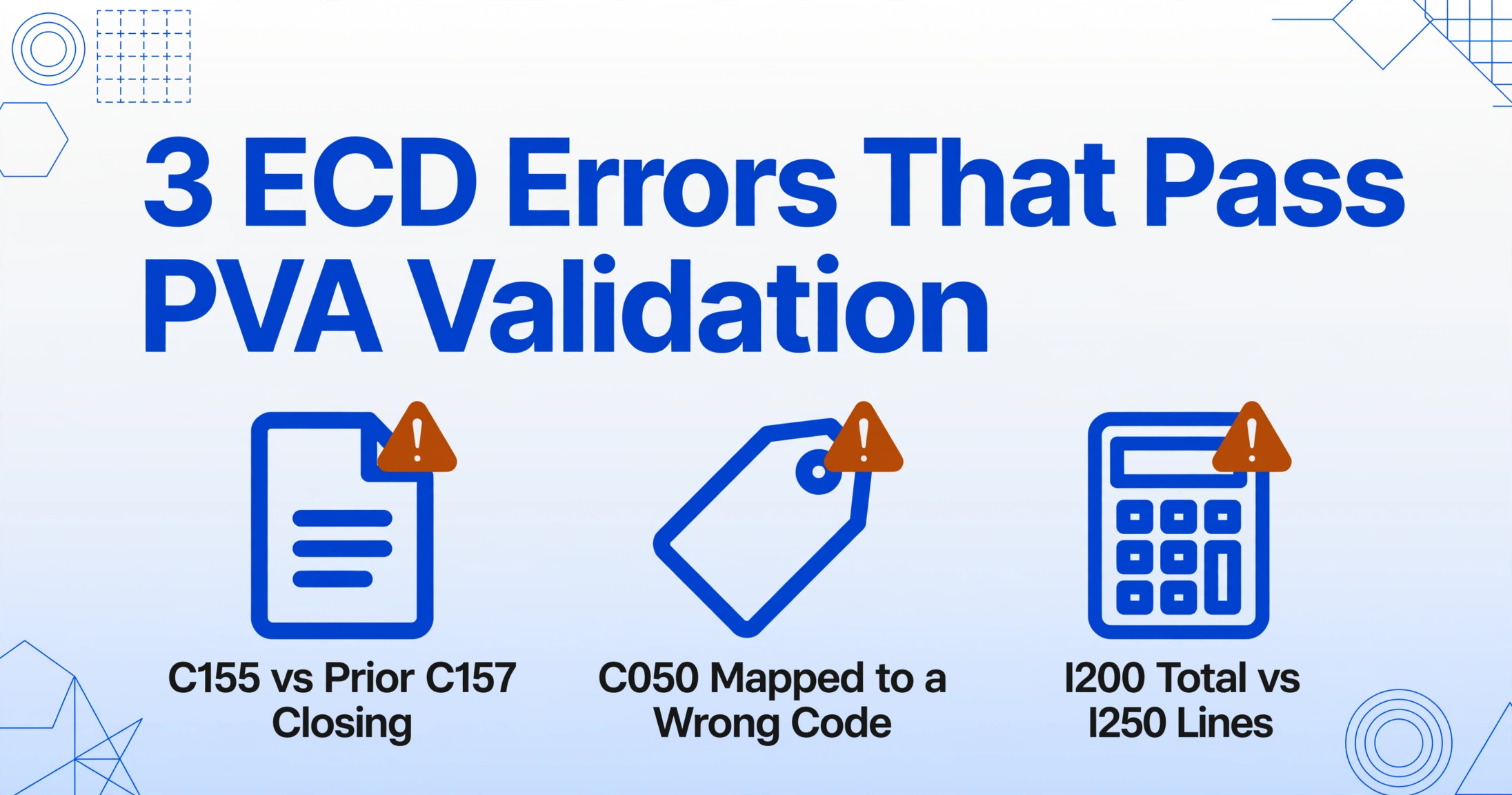
The single most common source of ECF delays is not ECF-specific complexity. It is issues in the ECD data that are only discovered when the ECF preparation begins. An ECD file that passes PVA validation with format-correct but semantically inconsistent data — a C155 opening balance that does not match the prior year's C157 closing balance, a C050 account mapped to the wrong reference code, an I200 journal entry total that does not match the sum of its I250 lines — will produce an ECF that is either wrong or late in correction.
The solution is to run a data-quality check on the ECD output before submission. Extract the key Registro groups (C050, C155, C157, I200/I250) into structured tables — either manually or with an extraction tool — and cross-reference the totals and balances against the general ledger. This check takes 2-3 hours with the right extraction setup, compared to 15-20 hours of manual filtering in Excel. Every hour invested in ECD data quality in April–May saves three hours of cascading rework in July when ECF preparation reveals mismatches.
For a detailed walkthrough of how to extract the trial balance and e-Lalur adjustments from your SPED files into structured Excel tables, see the guide to extracting SPED ECD/ECF data to Excel.
Frequently Asked Questions
Q: What is the exact deadline for ECF 2026 (calendar year 2025)?
The ECF must be transmitted to the SPED system by the last business day of July 2026 — falling on July 31, 2026, at 23:59:59 Brasília time. The PVA-ECF version 12.1.6, released May 25, 2026, is the current valid version for this filing. Always check the SPED portal (sped.rfb.gov.br) for last-minute updates.
Q: Who is required to file the ECF?
All legal entities taxed under Lucro Real (Actual Profit), Lucro Presumido (Presumed Profit), or Lucro Arbitrado (Arbitrated Profit) must file the ECF annually. Simples Nacional companies are exempt. The ECF replaces the former DIPJ (Declaração de Informações Econômico-Fiscais da Pessoa Jurídica). Inactive companies that had any movement during the calendar year are also required to file.
Q: Can the ECF be filed before the ECD is submitted?
No. The ECF depends on the ECD's data — specifically Bloco E, which recovers the closing balances and mapped accounts from the ECD. The ECD must be transmitted first. This dependency is enforced by the SPED validation system. A company that misses the ECD deadline (June 30) cannot submit the ECF (July 31) until the ECD is resolved, compressing the already tight July window.
Q: What is new in the ECF Leiaute 12 for 2026?
Leiaute 12, published by IN RFB 2.004/2021 with updates for the 2025 calendar year, introduced changes primarily to the Y730 record (related-party and transfer pricing information), updated validation rules for the M300/M305 e-Lalur blocks, and new cross-check fields in Bloco E that carry additional ECD reference data. The PVA-ECF version 12.1.6 reflects these updates. Companies with cross-border related-party transactions should review the Y730 changes carefully, as the new layout requires more granular identification of counterparties.
Q: What documents need to be retained after ECF submission?
The signed ECF file, the submission receipt (recibo de entrega), the supporting ECD file, and the underlying accounting records must be retained for a minimum of five years. Additionally, keep the e-Lalur/e-Lacs adjustment schedules (with supporting documentation for each permanent and temporary difference) and the transfer pricing documentation (for companies with cross-border transactions). The Receita Federal can request these in an audit.
Q: How does the Receita Federal cross-check ECD and ECF data after submission?
The RFB's automated systems compare the ECD's closing balances (from Bloco C) against the ECF's recovered balances (Bloco E) and the tax adjustments declared in Bloco M. They also cross-reference ECF data against DCTF (monthly tax return) and EFD-Contribuições (social contributions). Any variance that exceeds automated tolerance thresholds generates an audit flag. Since 2026, the RFB has enhanced this cross-checking with AI-based pattern recognition, which can identify inconsistencies that rule-based checks would miss — such as multi-year trends in adjustment ratios that deviate from industry norms.
Plan This Year's Filing, Build Next Year's Foundation
The ECF filing cycle follows a predictable calendar, but the quality of each year's submission depends on work done in the months before the deadline — not the days. A company that closes its books by March, validates its ECD by May, and has e-Lalur schedules ready before the June ECD submission will find that the July ECF deadline, while still compressed, is manageable. A company that begins ECF preparation in mid-July is working against the calendar with no margin for error.
Beyond the compliance benefit, the ECD and ECF files together represent the most complete annual record of a company's financial and tax position. A team that builds the extraction workflow once — converting the SPED text output into structured tables for verification and analysis — creates a reusable process that serves both this year's compliance deadline and next year's cross-year analysis. The time invested in the data preparation phase is not a cost. It is an asset that compounds across filing cycles.