Japanese Tax Return Filing Checklist:
What Freelancers Need Before the March 15 Deadline
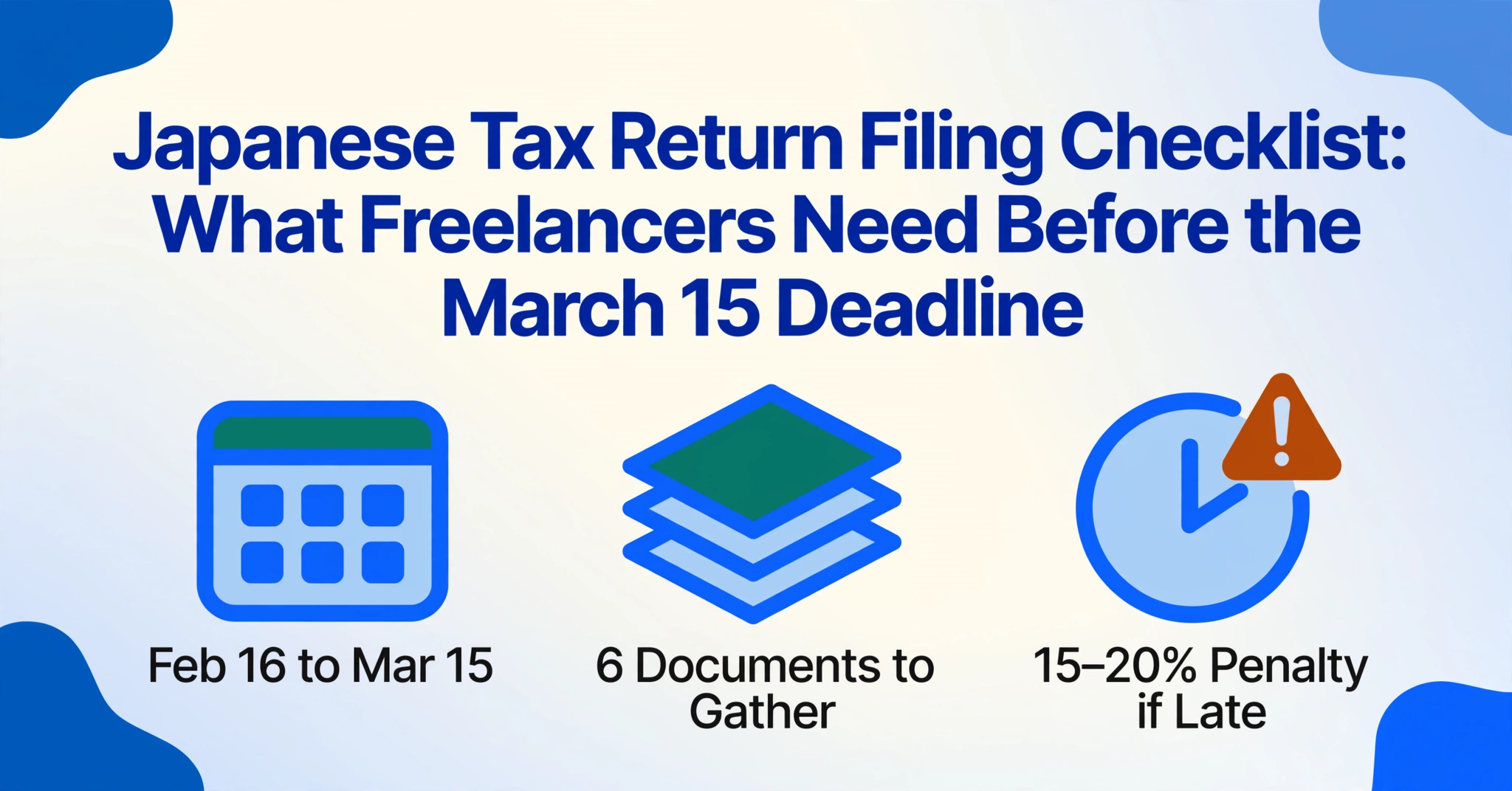
The filing window for a 確定申告 (kakutei shinkoku, final tax return) opens on February 16 and closes on March 15 — or the next business day if the 15th falls on a weekend, as it did in 2026 when the deadline moved to March 16. For roughly 4 million sole proprietors (個人事業主, kojin jigyō nushi) and freelancers, those four weeks are not about filling in a form — they are about assembling what the form needs. A single return draws data from a bank passbook (通帳, tsūchō), a year of receipts sorted by expense category (経費, keihi), three to seven insurance deduction certificates (控除証明書) that arrive by mail across December and January, last year's return for carried-forward figures, and any employment withholding slips (源泉徴収票) from side work. Missing the deadline is not a clerical oversight — it triggers a penalty of 15% to 20% of the unpaid tax under the National Tax Violation Act (国税通則法), plus daily-accruing delinquency interest at 2.4% for the first two months and 8.7% thereafter, per the National Tax Agency's (国税庁, NTA) published rates. This is the checklist that turns a vague "I need to do my taxes" into a finite sequence of steps you can finish before the penalty clock starts.
Key Takeaways
- Opening Form B on February 16 feels like starting 確定申告 — but the tax return takes a day to complete, and the 15% late-filing penalty plus daily interest accrues on a deadline that was already three weeks deep in document gathering.
- A single return draws data from five document types — bank passbook, receipts sorted by 勘定科目, insurance certificates in different formats, last year's return, and withholding slips — each figure read by eye and typed by hand into a different field on Form B.
- Upload the passbook, receipts, certificates, and last year's return as one batch, name your columns, and let the AI read each document by what its fields mean — the gathering collapses from weeks to one verification pass, and you file because the return is ready.
The Penalty Clock: What "Late" Actually Costs
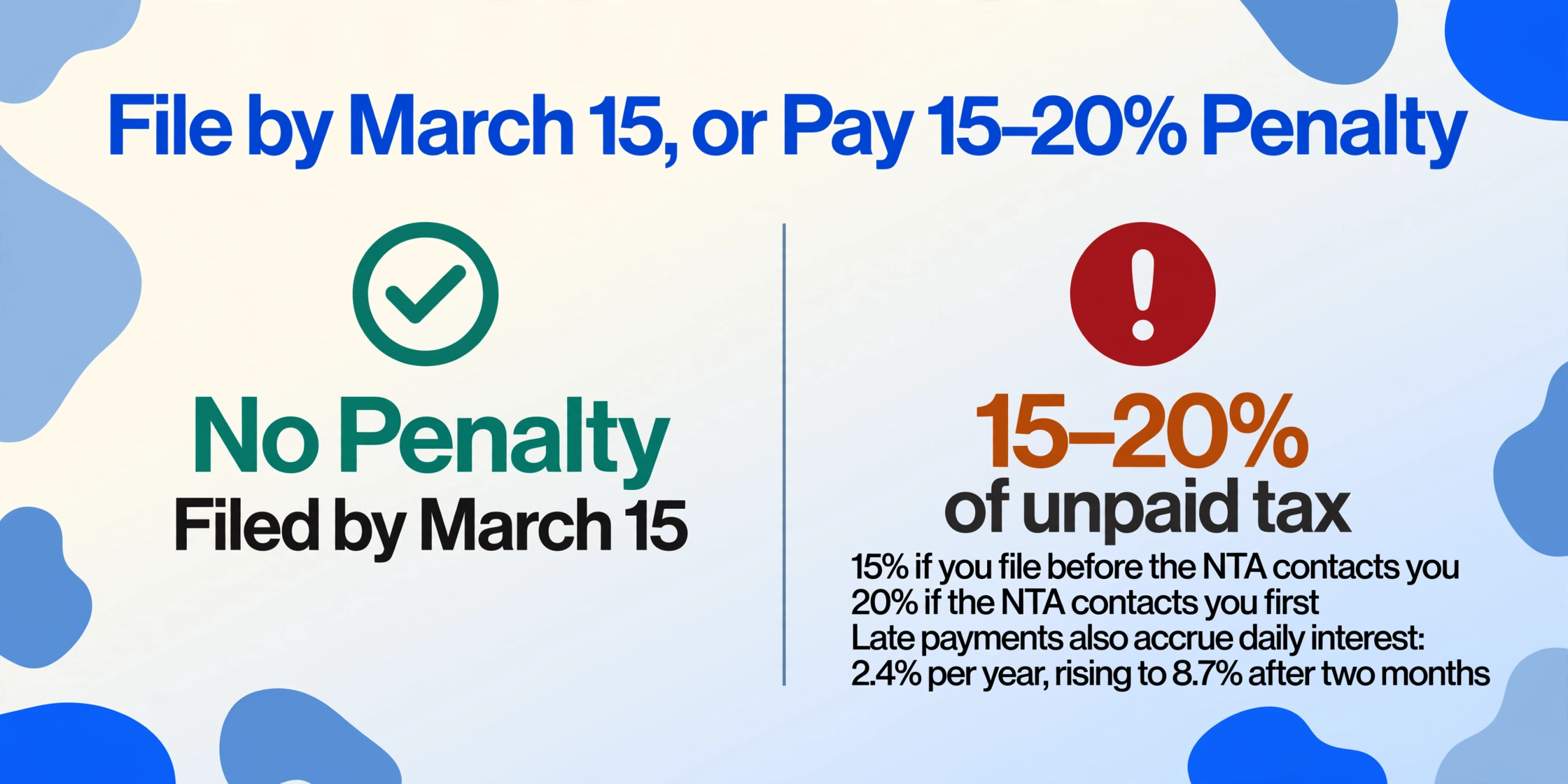
Before the checklist itself, know what you are racing. The filing window is set by the Income Tax Act Article 120 (所得税法第120条): February 16 to March 15 for income earned during the previous calendar year. The deadline is rigid — the extension provisions available in other jurisdictions do not exist here — and the consequences are published.
Late-filing penalty (無申告加算税, mushinkoku kasanzei). If you file after the deadline but before the tax office contacts you about the missing return, the penalty is 15% of the unpaid tax. If the NTA initiates contact before you file, it rises to 20%. For returns filed voluntarily within one month of the deadline with a genuine intent to comply, the penalty may not apply — but that is a narrow window and an uncertain safety net. The rate structure differs from the commonly cited 5% figure, which applies to corporate returns and voluntary pre-notice filings under specific conditions; for individual sole proprietors, PwC's Japan tax administration summary confirms the 15–20% range.
Delinquency tax (延滞税, entai zei). Separate from the late-filing penalty, interest on unpaid tax accrues daily from the day after the deadline. For the period covering income earned in 2025 and filed in 2026, the rate is 2.4% per annum for the first two months past the due date, rising to 8.7% per annum thereafter, per NTA Tax Answer No.9205. A freelancer who files three months late on ¥200,000 of unpaid tax owes roughly ¥4,800 in delinquency interest — on top of the 15% late-filing penalty of ¥30,000. The gap between filing and payment is its own risk: even if the return is filed, paying late triggers separate charges.
The penalty prices the filing step, not the gathering step. A return three months late with ¥200,000 unpaid can attract ¥30,000 in late-filing penalty plus ¥4,800 in interest before the principal tax itself — and the weeks you lose to assembling documents before you can even open the form are free to the clock.
The Six-Step Pre-Filing Checklist
What follows is ordered by what takes the longest to gather — not by what appears first on the form. Front-load the slow physical dependencies and the last week becomes about verification and submission, not scrambling for a passbook page.
Step 1 — Gather Your Bank Passbook (通帳) and Account Statements
If you are a freelancer with a single business account and one personal account, locate both passbooks. For each account, identify the twelve months of the tax year and mark or copy every deposit that represents business revenue — client payments, platform payouts, honoraria. Cross-reference deposits against the invoices (請求書, seikyūsho) you issued during the year. An unrecognised deposit is a risk: if it is a personal transfer (事業主借, jigyō nushi kari) miscategorised as revenue, your income total is overstated and your tax calculation follows.
If your accounts have online banking records instead of — or in addition to — a physical passbook, print or download the statement PDFs for the full tax year. A digital record is easier to search, but the fields the return wants — date (日付), description (摘要), deposit amount (お預り金額), withdrawal amount (お支払金額) — are the same regardless of the format.
Target: Have passbook pages or statement PDFs covering all twelve months in hand at least two weeks before the deadline. If the passbook has not been updated since April, run it through the bank's passbook-update machine (通帳記帳機) to catch up — every branch has one, and it takes five minutes.
Step 2 — Sort Receipts by Expense Category (経費)
A year of business receipts lives in a drawer, an envelope, or a folder that has not been opened since the previous filing season. Each receipt must be sorted into its expense category (勘定科目, kanjō kamoku) — 旅費交通費 (travel and transport), 消耗品費 (supplies), 通信費 (communications), 接待交際費 (client entertainment), 減価償却費 (depreciation), and any other category specific to your business. Each receipt must also carry its consumption tax rate identifier (8% or 10% under the Invoice System, インボイス制度) if you are a qualified invoice issuer. Thermal-paper receipts from convenience stores fade over the year — sort them first and copy any that are already hard to read.
The subtotal per category feeds directly into the income statement (収支内訳書 for a white return, 青色申告決算書 for a blue return), and an error here — a bento box taxed at 8% categorised at 10%, or a personal expense mislabelled as business — creates a mismatch the NTA's matching system can flag.
Target: Sort and subtotal by category at least ten days before the deadline. The sorting is the time-intensive part — the tally comes once everything is in piles.
Step 3 — Collect Insurance and Deduction Certificates (控除証明書)
Between December and January, five to seven envelopes arrive by postal mail from different institutions, each containing a deduction certificate formatted differently:
- National Pension (国民年金) payment certificate — from the Japan Pension Service
- National Health Insurance (国民健康保険) premium statement — from your municipality
- Life insurance deduction certificate (生命保険料控除証明書) — from each insurance provider, possibly split between old contracts (旧契約, pre-2012) and new contracts (新契約, post-2012) with different deduction formulas
- Earthquake insurance certificate (地震保険料控除証明書)
- iDeCo (イデコ) contribution statement — from your iDeCo provider
- Medical expense receipts (医療費領収書) — if you are claiming the medical expense deduction (医療費控除)
The key detail on each certificate is the payment amount (支払金額), not the deduction amount (控除額), which the return calculates from the payment figure. Transcribe each one into the correct row on Form B (B様式) — social insurance (社会保険料控除) on row 7, life insurance (生命保険料控除) on row 9, earthquake insurance (地震保険料控除) on row 10 — and verify the total against the printed sum on Sheet 1. A certificate that has not arrived by late January needs chasing; the insurance company can reissue it, but the reprint takes time you do not have in February.
Target: All certificates collected and their payment amounts noted by the end of January. If a certificate is missing, request a reissue immediately — the NTA will not accept "I did not receive it" as a reason to file without the deduction and amend later without penalty.
Step 4 — Calculate Your Deductions and Verify the Thresholds
Several Japanese deductions depend on income thresholds that change year to year, and the calculation error that results from assuming last year's number still applies is among the most common causes of an incorrect return.
- Medical expense deduction (医療費控除). The formula depends on your total income. If total income is ¥2,000,000 or more: deduction = (total medical expenses paid) − (insurance reimbursements) − ¥100,000. If total income is under ¥2,000,000: deduction = (total medical expenses) − (insurance reimbursements) − (5% of total income). The 5% threshold produces a different deduction than the ¥100,000 floor, and switching between them incorrectly is a common error.
- Spouse deduction (配偶者控除). Your spouse's total income must be ¥480,000 or below (for 2025 income filed in 2026) for the full deduction to apply. Between ¥480,001 and ¥1,330,000, the spouse special deduction (配偶者特別控除) phases in at varying amounts. Your own total income must be ¥10,000,000 or below for either to apply. The ¥1.03 million figure often cited refers to the employment income (給与所得) threshold — after the ¥550,000 employment income deduction — and is not the same as total income.
- Basic deduction (基礎控除). For 2025 income filed in 2026, the basic deduction is ¥480,000 for taxpayers with total income of ¥24,000,000 or below, phasing down to zero at ¥25,000,000. The deduction you claimed last year may not match this year's bracket if your income changed significantly.
Target: Run each deduction calculation against the current-year thresholds at least one week before filing. Do not reuse last year's threshold figures — they change.
Step 5 — Prepare Form B (B様式) and the Income Statement
With the source documents gathered and the deduction figures calculated, the form itself is the assembly step. For a blue return (青色申告) filer, you need:
- Form B Sheet 1 (第一表) — the summary: income categories, total income, all deductions, taxable income, tax calculation, prepaid tax credits, and the final balance of tax due or refund.
- Form B Sheet 2 (第二表) — the detail: income sources broken down by type, deduction detail rows, and supplementary information.
- Blue return income statement (青色申告決算書) — a four-page document covering the balance sheet (貸借対照表), profit and loss statement (損益計算書), and supporting schedules. The double-entry totals on the P&L must reconcile with the income and expense totals carried onto Form B.
A white return (白色申告) filer substitutes the simplified income and expense statement (収支内訳書) — a two-page document listing income by category and expenses by category with no balance sheet requirement. The trade-off is the deduction: ¥100,000 for white return versus ¥650,000 for blue return (rising to ¥750,000 from 2027 for e-Tax filers with excellent electronic records).
The most common structural error at this stage is a mismatch between the income and expense totals on the supplementary statement and the figures carried forward to Form B. Every figure that flows from one document to the other must be checked in both directions.
Target: Complete the form assembly by the first week of March, leaving at least one week for verification and the filing mechanics.
Step 6 — File: e-Tax or Paper
The filing itself is the shortest step, but it has its own checklist:
- e-Tax (国税電子申告・納税システム). Requires a My Number Card (マイナンバーカード) and the associated password, a compatible IC card reader or a smartphone with NFC, and the e-Tax software installed (or the browser-based version). The initial setup — installing the software, configuring the card reader, verifying the digital certificate — should be tested at least a week before you plan to file, not on the day. e-Tax filing is a prerequisite for the ¥650,000 blue return deduction; filing by paper with a blue return drops the deduction to ¥550,000 for 2025 income and, from 2027, to ¥100,000.
- Paper filing. Print the completed forms, attach the necessary supporting documents — the blue return income statement or the white return income and expense statement is mandatory; deduction certificates are not submitted but must be retained — and mail to your local tax office (所轄税務署) or submit in person. The postmark date counts as the filing date, so a paper return mailed by March 15 is on time even if it arrives later.
- Payment. Tax due can be paid via bank transfer, at a convenience store (for amounts up to ¥300,000), by credit card through the NTA's online payment system, or by direct debit if you registered in advance. Payment must reach the NTA by March 15 — filing on time but paying late triggers a separate penalty clock at 5% of the unpaid amount at 30 days, plus daily delinquency interest.
Target: File by March 7–10 if possible, leaving a buffer for system issues, card-reader problems, or a certificate that has not arrived. The NTA's e-Tax servers slow down in the final days, and waiting until the last hour trades hours of preparation risk for minutes of submission time.
The checklist works backwards from the deadline: Step 1 by late January, Steps 2–4 by mid-February, Step 5 by the first week of March, Step 6 by March 10. Each step front-loads the part that cannot be rushed — locating physical documents, sorting paper receipts, chasing missing certificates — so the final week is about verification and submission, not discovery.
e-Tax vs. Paper Filing: What the Choice Actually Changes
The e-Tax versus paper decision matters because it changes the blue return deduction amount, and the deduction is the single largest lever on a freelancer's tax bill. For 2025 income filed in 2026, the blue return special deduction (青色申告特別控除) is:
- ¥650,000 — e-Tax filing plus double-entry books (複式簿記)
- ¥550,000 — paper filing plus double-entry books
- ¥100,000 — simplified bookkeeping (簡易簿記), regardless of filing method
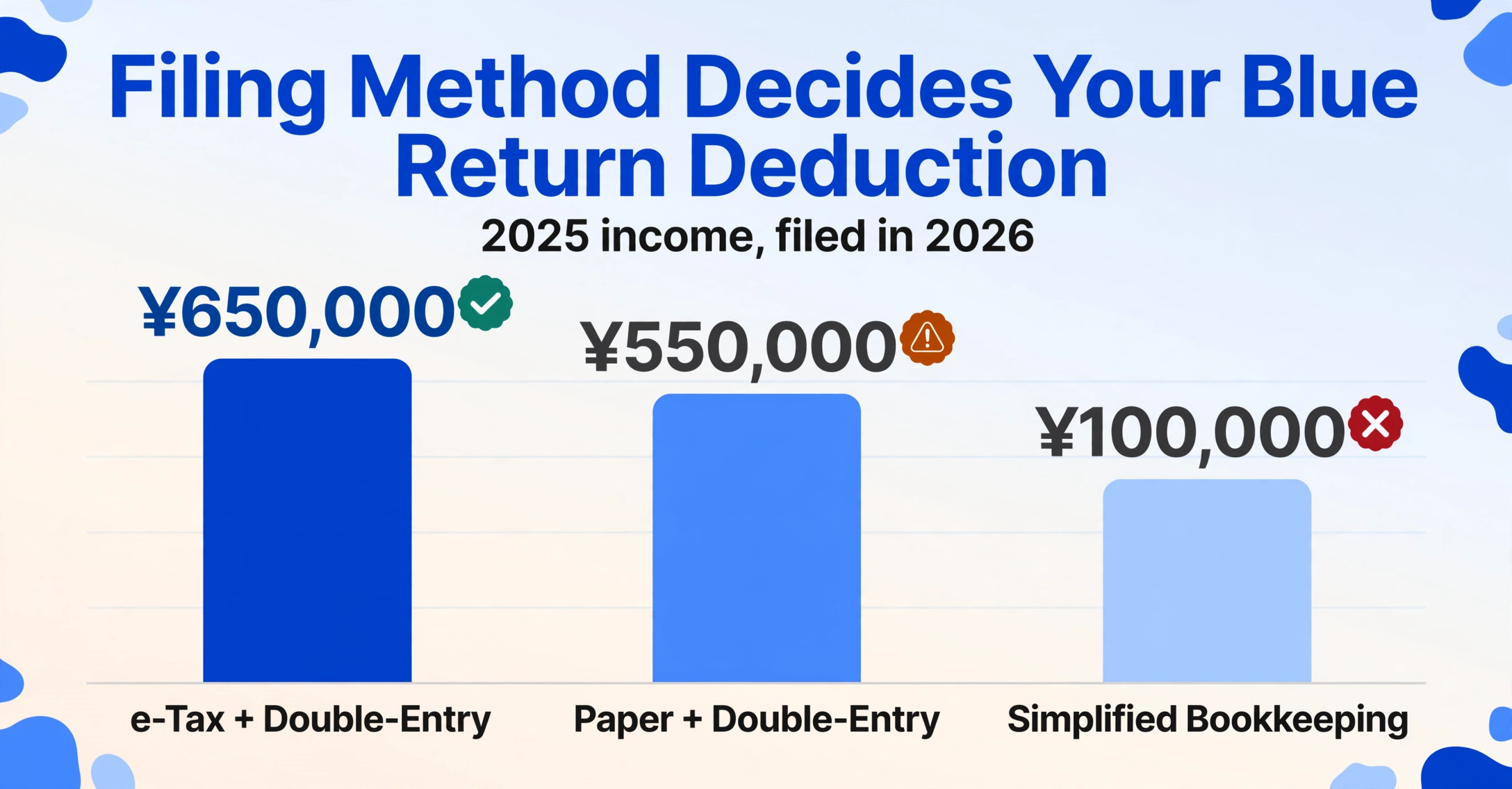
From 2027 (令和9年分), the tiers shift under the NTA's updated guidance on No.2072: e-Tax with excellent electronic records (優良な電子帳簿) qualifies for ¥750,000, e-Tax with standard electronic records qualifies for ¥650,000, and paper filing with any record type drops to ¥100,000. A freelancer filing by paper with double-entry books loses ¥550,000 of deduction — and at a 20% income tax bracket plus approximately 10% resident tax, that gap costs roughly ¥165,000 in additional tax. The e-Tax setup is a one-time inconvenience; forfeiting the deduction is an annual cost.
Beyond the deduction amount, e-Tax changes what the NTA can see. A return filed electronically is pre-validated against certain error checks before submission — arithmetic inconsistencies, missing mandatory fields, deduction totals that exceed statutory limits. Paper returns receive these checks after submission, and an error caught post-submission triggers a correction cycle (修正申告 or 更正の請求) that can take weeks. The mechanics of extraction for Form B data — turning passbook pages, receipts, and certificates into spreadsheet rows that feed directly into whichever filing method you choose — are covered in the guide to extracting 確定申告 data to Excel.
Collapsing the Gather: From Four Document Stacks to One Spreadsheet
The checklist above makes the timeline problem explicit: Steps 1 through 4 are all about reading figures off physical documents and transcribing them somewhere else. The passbook holds the revenue numbers; you read them and type them. The receipts hold the expense numbers; you sort them and type them. The insurance certificates hold the deduction numbers; you read them and type them. The form assembly in Step 5 — the part everyone pictures as "filing tax" — is actually the shortest step, because it only starts once the reading and typing is done.
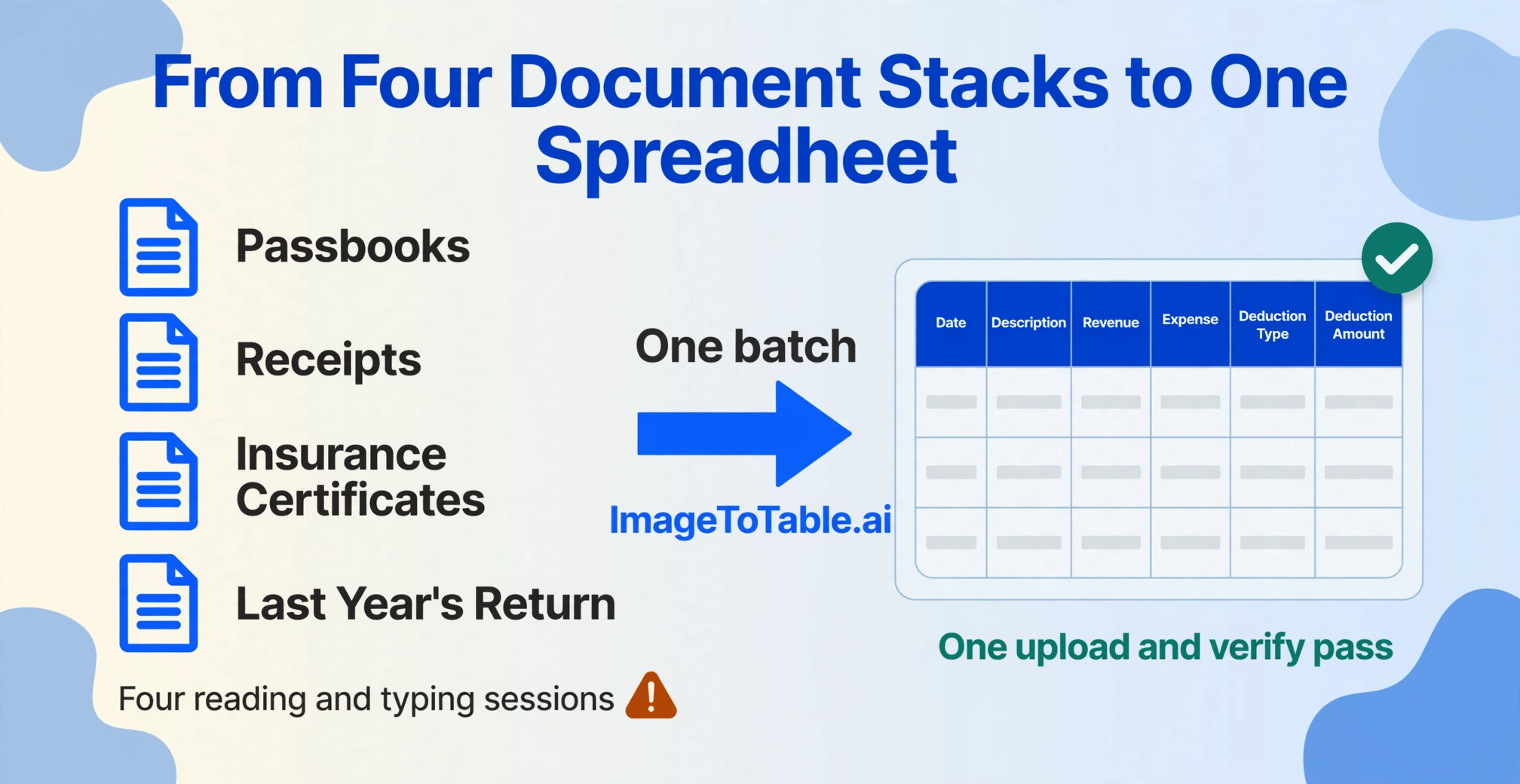
A different approach to Steps 1 through 4 changes the arithmetic. Instead of reading each document by eye and typing each figure by hand, you upload the documents and name the columns you want. ImageToTable.ai reads each document by understanding what a field means — 収入金額 (revenue), 必要経費 (necessary expenses), 社会保険料控除 (social insurance deduction) — and locates the value regardless of where it sits on the page. A bank passbook page, a freee-generated PDF, a Yayoi printout with different font spacing, and a scanned paper return from two years ago all resolve to the same set of columns: Date, Description, Revenue, Expense, Deduction Type, Deduction Amount. What was four separate reading-and-typing sessions becomes one upload-and-verify pass.
Because the tool is batch-first, you do not process one document at a time. You upload the passbook pages, the receipt photos, the insurance certificates, and last year's return as a single batch, and the output is one spreadsheet where every document's data sits in the same column structure. The step that previously took an afternoon of sorting — assigning each receipt to its correct 勘定科目 — becomes a single inferred column: define a column named Expense Category (options: 旅費交通費/消耗品費/通信費/接待交際費/減価償却費/その他経費), and the AI assigns each receipt to its category by reading its content, not its label. A computed column then adds up the individual deduction fields and compares the total to the printed deduction sum on Sheet 1, outputting "OK" or "CHECK" — catching the most common arithmetic error before the return reaches the NTA.
None of this changes the return — the 確定申告 form is the same, and the tax office still wants a filed return. What changes is how much of the four-week filing window you spend gathering and typing versus verifying and submitting. For the full demonstration of the extraction workflow, the hub article walks through extracting Form B data column by column. For the scenario where an accountant is processing returns for multiple clients, the guide to batch-processing client tax returns into one summary spreadsheet covers the scaled version of the same approach.
Files are processed securely and not stored.
What to Do If You Miss the Deadline
If March 15 passes and you have not filed, the situation is not irrecoverable — but every day adds cost, so the response is to file, not to freeze. A voluntary late filing (期限後申告) submitted before the tax office contacts you attracts the 15% late-filing penalty rather than the 20% post-notice rate, and you may qualify for penalty relief if the delay was due to circumstances beyond your control — hospitalisation, a natural disaster — and you file voluntarily within a reasonable period.
The longer-term fix is structural. The reason March 15 becomes a crisis is that the preceding four weeks concentrate every document at once. Spreading the gather across the year — reconciling the passbook monthly, sorting receipts quarterly, filing certificates as they arrive — distributes the work and removes the single-point-of-failure quality of a February scramble. The same extraction approach that compresses a four-week gather into hours during filing season can compress the quarterly catch-up into minutes if you run it as a standing process.
The problem side of this — the structural reasons the assembly phase breaks for so many freelancers every February — is explored in the companion piece on why Japanese freelancers still hand-enter 確定申告 data every filing season. The cost side — what those hours of manual assembly actually cost when priced at a freelance hourly rate — is quantified in the article on the real cost of manual 確定申告 assembly. The same seasonal pressure shows up in other tax systems on different dates — UK freelancers hit their own version in January with the SA100 January deadline checklist, driven by the same problem of gathering documents that were never designed to be added together.
Frequently Asked Questions
What is the Final Tax Return (確定申告) filing deadline for 2026?
For income earned during the 2025 calendar year, the filing period is February 16 to March 16, 2026 — the deadline shifts to the next business day when March 15 falls on a Sunday. The e-Tax system accepts returns from early January, and filing early (before the window opens) has no penalty — the return date is treated as February 16 regardless.
What is the penalty for missing the March 15 deadline?
A late-filing penalty (無申告加算税) of 15% to 20% of the unpaid tax applies depending on whether you file voluntarily before the NTA contacts you (15%) or after receiving a notice (20%). Separately, delinquency tax (延滞税) accrues daily at 2.4% per annum for the first two months past the deadline and 8.7% per annum thereafter. A return three months late on ¥200,000 of unpaid tax can attract approximately ¥30,000 in late-filing penalty plus ¥4,800 in delinquency interest.
What documents do I need to gather before filing 確定申告?
The core six: bank passbook pages or statement PDFs covering the full tax year, all business receipts sorted by expense category (勘定科目), insurance deduction certificates (国民年金, 国民健康保険, 生命保険料控除証明書, 地震保険料控除証明書, iDeCo), last year's return for carried-forward figures, any employment withholding slips (源泉徴収票) from side work, and medical expense receipts if claiming 医療費控除. Each feeds a specific part of Form B and the attached income statement.
Should I file by e-Tax or paper?
e-Tax, if you can. The blue return special deduction is ¥650,000 for e-Tax filers with double-entry books versus ¥550,000 for paper filers — a ¥100,000 deduction gap worth roughly ¥30,000 in tax at the 20% bracket. From 2027, paper filing drops to ¥100,000, making the gap ¥550,000 or more. e-Tax requires a My Number Card with an active digital certificate and a compatible card reader or NFC-equipped smartphone — set these up and test them at least a week before you plan to file.
Can I extract data from my passbook and receipts instead of typing every figure?
Yes. Upload passbook pages, receipt photos, insurance certificates, and last year's return as a single batch, name your columns (日付, 摘要, 収入金額, 必要経費, 社会保険料控除, etc.), and the AI reads each document by understanding what each field means — not where it sits on the page. An inferred column can assign expense categories automatically, and a computed column can cross-check deduction totals. The output is a spreadsheet whose columns map directly to the fields on Form B — you still file the return, but the gathering step collapses from weeks to minutes.
What if I am missing an insurance deduction certificate?
Contact the insurance provider immediately and request a reissue. The certificate can be reissued within days, but delays compound during filing season when providers receive a high volume of reissue requests. If the certificate does not arrive by the deadline, file the return without the deduction and file a correction (更正の請求) once the certificate arrives — you have five years from the original filing deadline to claim an overlooked deduction.
The six steps are finite. The minutes you spend reading figures off a passbook page or sorting a shoebox of receipts are not. Front-load the gather, collapse the transcription, and file not because the penalty is coming — file because the return is ready.
Prepare Your Tax Documents Now