W-2 Box 1 vs Paystub YTD:
Why the Gap Is Normal
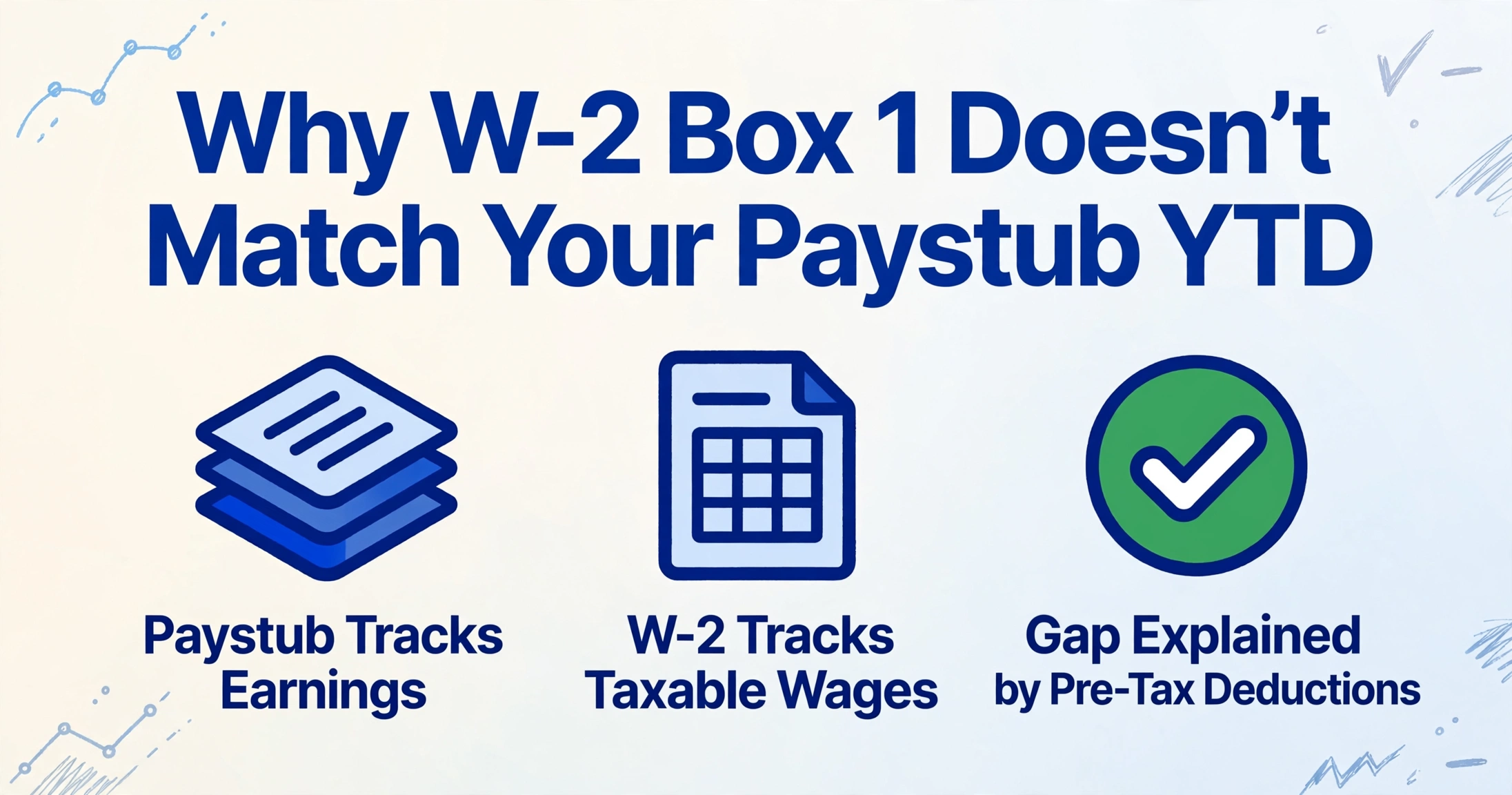
Every January, payroll teams answer the same question. A payroll specialist in r/Payroll described the routine with three exclamation marks: "I can't tell you how many times I have employees call me inquiring about why their W2 Box 1 doesn't match their ytd gross on the last stub!!!" (r/Payroll). An employee adds up a year of paychecks and gets one number. The W-2 arrives with another. The instinct is to assume someone made a mistake, but most of the time both documents are right, because they are answering two different questions.
Key Takeaways
- A W-2 Box 1 that sits thousands below your paystub YTD gross is usually not an error.
- The gap is exactly the pre-tax money you elected, and a $72,000 paystub with a $60,000 Box 1 reconciles to the cent.
- A traditional 401(k) lowers Box 1 only, while a Section 125 health premium lowers Boxes 1, 3, and 5 at once, so a $0.00 unexplained gap proves the difference is expected.
The Paystub Tracks Earnings. The W-2 Tracks Taxable Wages.
The gap is not a defect in either document. A paystub and a W-2 measure different things, and only one of them is built around tax rules.
A paystub is the per-period record of a single payment. Its YTD column is a running total, year to date, that adds every value from January 1 through the current pay period. The YTD gross figure is the plain sum of what was earned before any deduction is taken out. It is an operating record, produced by the payroll system every time people get paid.
Box 1 on Form W-2 is labeled "Wages, tips, other compensation," and it reports the part of that pay that is subject to federal income tax for the calendar year. The IRS General Instructions for Forms W-2 and W-3 define what belongs in each box, and the boxes do not use the same definition (IRS).
Two more numbers use different rules again. Box 3 reports Social Security wages, which are capped at an annual wage base of $184,500 for 2026 (SSA). Box 5 reports Medicare wages, which have no cap. Both are FICA wages. Neither is the same thing as income-tax wages.
A paystub answers "what did I earn this year." Box 1 answers "what is subject to federal income tax this year." Those totals diverge on purpose, and the amount they diverge by is the part most people have never added up.
Once you see the two documents as an earnings record and a tax summary, the next question is mechanical: which deductions pull which number down, and by how much. That is where the tax code stops treating every pre-tax dollar the same way.
Which Pre-Tax Deductions Move Which Boxes
The size of the gap is the sum of your pre-tax deductions, and which box moves depends on the kind of deduction. Box 1 subtracts every pre-tax amount. Boxes 3 and 5 subtract only the amounts that are also exempt from Social Security and Medicare tax.
A traditional 401(k) shows why the difference matters. Money deferred into a 401(k) is not taxed as income now, but it is still counted as wages for Social Security and Medicare. The IRS instructions handle this directly: when reporting Box 1, do not include "elective deferrals (such as employee contributions to a section 401(k) or 403(b) plan)." The deferral leaves Box 1 and stays in FICA wages.
A Section 125 cafeteria plan works the other way. It is a written employer plan that lets employees choose between cash and qualified benefits, such as health, dental, and vision premiums. Salary reductions made through it "are not considered wages for federal income tax purposes" and "generally are not subject to FICA and FUTA" (IRS cafeteria plan guidance). Those premiums come out of Box 1, Box 3, and Box 5 at the same time. An HSA contribution made through the cafeteria plan is treated the same way and reported in Box 12 with code W, while a benefit processed outside the plan does not reduce FICA wages at all (IRS Publication 15-B).
| Deduction taken from pay | Box 1 (federal income tax wages) | Box 3 (Social Security wages) | Box 5 (Medicare wages) |
|---|---|---|---|
| Traditional 401(k) or 403(b) elective deferral | Reduced | Not reduced | Not reduced |
| Section 125 health, dental, and vision premiums | Reduced | Reduced | Reduced |
| Health FSA or dependent care FSA under Section 125 | Reduced | Reduced | Reduced |
| HSA contribution through a Section 125 cafeteria plan | Reduced | Reduced | Reduced |
| Pre-tax commuter or parking benefit under Section 132(f) | Reduced | Reduced | Reduced |
| Roth 401(k) or Roth 403(b) deferral | Not reduced | Not reduced | Not reduced |
| Employer 401(k) match or employer HSA contribution | Not reduced | Not reduced | Not reduced |
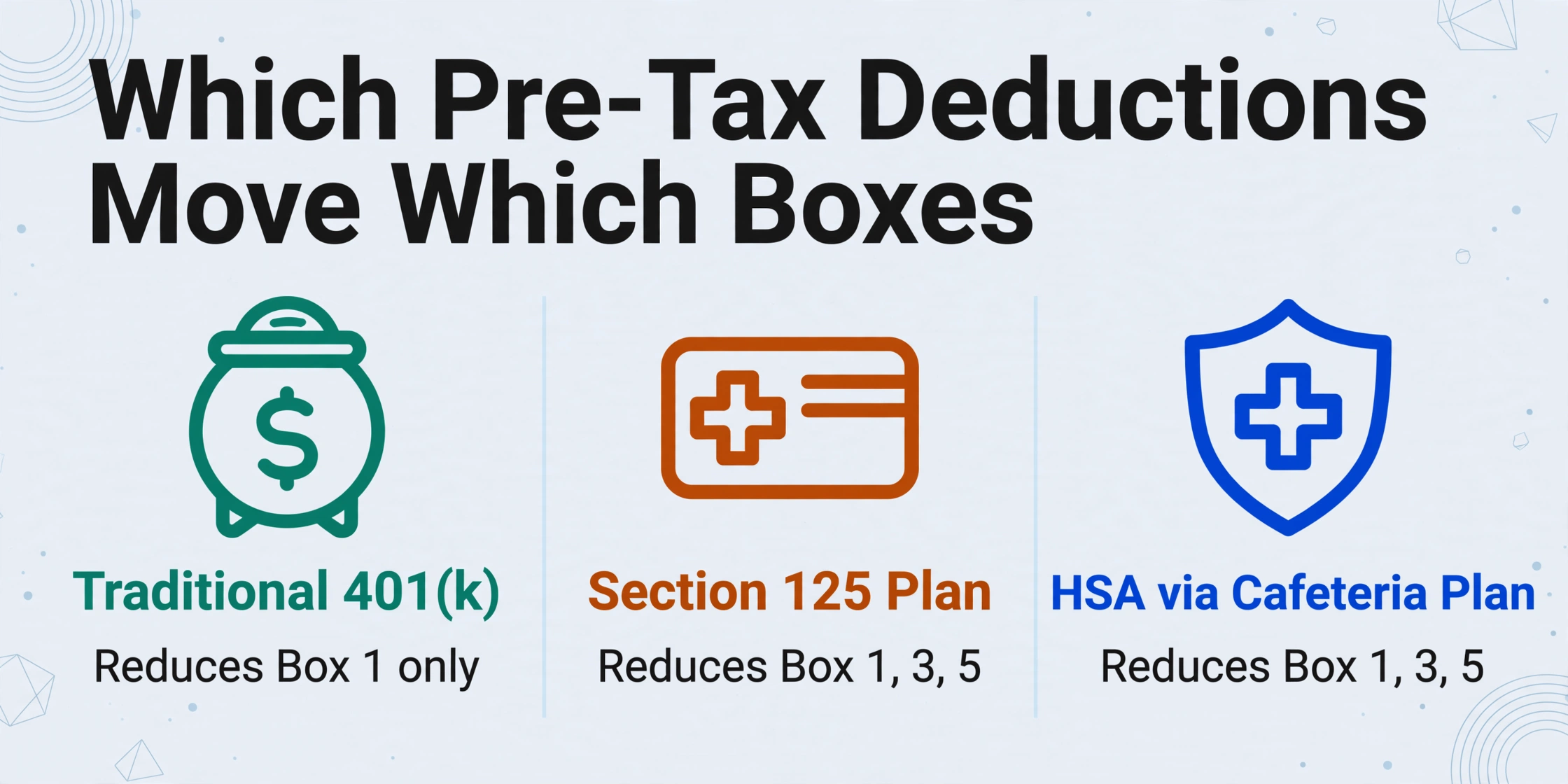
The 401(k) line is the one that explains most Box 1 versus Box 5 puzzles. For 2026 the elective deferral limit on a 401(k), 403(b), or governmental 457(b) plan is $24,500, up from $23,500 in 2025 (IRS). One employee who fills that limit can push Box 5 roughly $24,500 above Box 1, while the same employee's cafeteria-plan health premiums push all three boxes down together.
Two entries on that table catch people most often. A Roth 401(k) deferral is made with after-tax money, so it does not create a Box 1 gap. An employer match or employer HSA contribution was never your wage, so it does not reduce anything. When someone says their 401(k) "should have" lowered Box 1 and it did not, the usual answer is a Roth election or an employer deposit. The field-by-field version of this mapping is covered in the W-2 and 1099 extraction guide.
A $72,000 Paystub and a $60,000 Box 1
One set of numbers shows why the difference is arithmetic rather than an error. The reconciliation is subtraction, and it balances to the cent when the deduction list is complete.
Take an employee whose final paystub shows $72,000 in YTD gross earnings. Over the year the employee elected $3,600 in Section 125 health, dental, and vision premiums, $6,000 in traditional 401(k) deferrals, and $2,400 in HSA contributions through the cafeteria plan. The three wage boxes come out as follows.
| Line | Amount | Why |
|---|---|---|
| Paystub YTD gross | $72,000 | Total earnings before any deduction |
| Less Section 125 premiums | $3,600 | Reduces Box 1, Box 3, and Box 5 |
| Less traditional 401(k) | $6,000 | Reduces Box 1 only |
| Less HSA through the cafeteria plan | $2,400 | Reduces Box 1, Box 3, and Box 5 |
| Box 1 | $60,000 | $72,000 minus all pre-tax deductions |
| Box 3 and Box 5 | $66,000 | $72,000 minus the FICA-exempt deductions only |
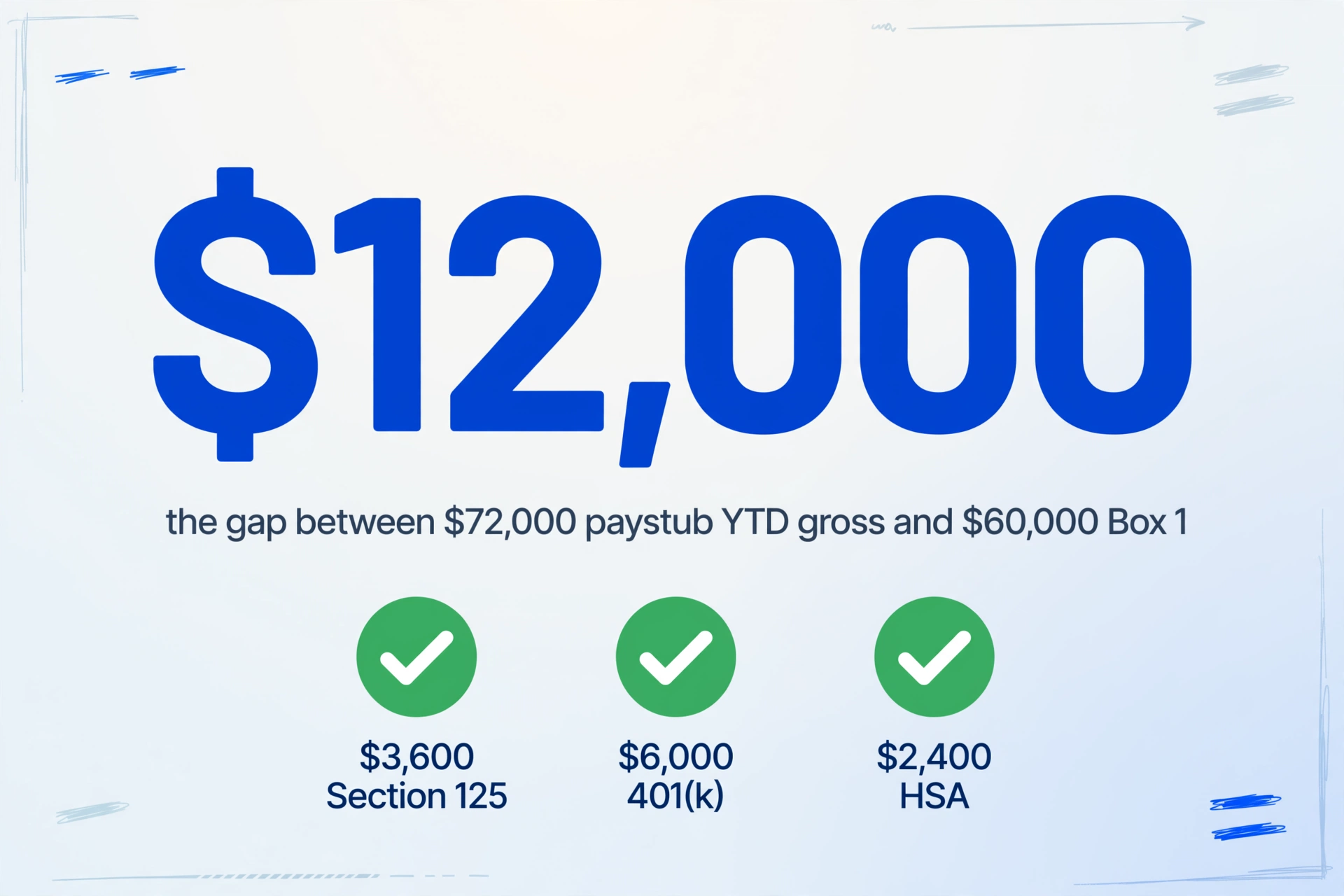
Box 1 sits $12,000 below the paystub, and it sits $6,000 below Box 5. Both gaps are fully explained by the elections. The $12,000 is every pre-tax dollar the employee chose. The $6,000 is just the 401(k), the one deduction that lowered income-tax wages without lowering FICA wages.
The comparison only holds when you compare like with like. Many paystubs print a separate YTD "taxable wages" or "FICA wages" line in addition to YTD gross. The taxable line should line up with Box 1, and the FICA line should line up with Box 3 or Box 5. Comparing YTD gross to Box 1 is what produces the alarming number in the first place. The arithmetic that ties a payslip's own figures together is worked through in the guide to payslip YTD and net pay verification, and the single-document version is covered in the pay stub to Excel guide.
The reverse case is real too. Box 1 can land higher than the paystub. Group-term life insurance coverage above $50,000 is imputed income, added to Boxes 1, 3, and 5 even though no cash reaches the employee. If Box 1 comes in above YTD gross, imputed income is the first thing to check, not the last.
How to Confirm the Gap Is the Expected One
Confirming the gap is a comparison, so the first step is putting the W-2 and the paystub on the same columns in one sheet. That is the part payroll teams still do by hand: open the W-2, open the final paystub, find the matching numbers, subtract, then repeat for every employee on the list.
Custom Column Extraction changes the direction of that work. Instead of uploading a W-2 and taking whatever fields the tool decides to return, you type the column names you need, for example Employee, Document Type, Tax Year, YTD Gross, Box 1, Box 3, Box 5, Federal Withholding, Traditional 401(k), Section 125 Premiums, HSA, and YTD Net Pay. The AI locates each value by what it means, so a printed box on a W-2 and a YTD line on a paystub land in the same columns even though the two documents look nothing alike.
Because the tool is built batch-first, you can upload the W-2 and the final paystub for each employee as one batch and get a single table back, one row per employee per document type. Upload a client list and the same sheet holds all of them.
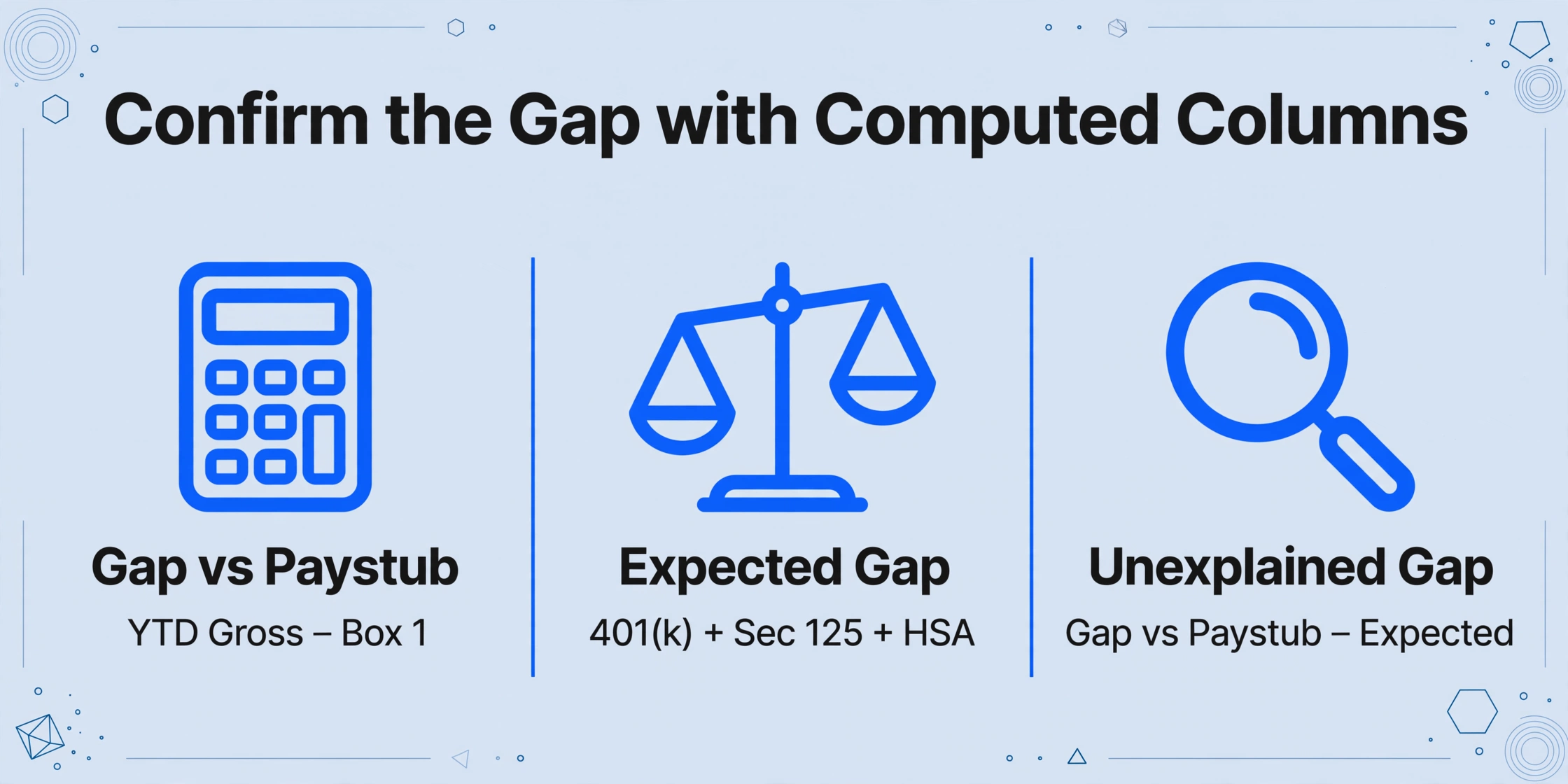
The sheet becomes a check once you add arithmetic to it. Set a Format Requirement so amounts are numbers with two decimals, then add computed columns that make the comparison visible: Gap vs Paystub (YTD Gross - Box 1), Expected Gap (Traditional 401k + Section 125 Premiums + HSA), and Unexplained Gap (Gap vs Paystub - Expected Gap). When the unexplained gap is $0.00, the difference is the expected one. When it is not, you have a specific row to take to payroll instead of a vague worry.
Review Mode with Bbox answers the follow-up question: is the number I compared actually what the document says? Hover or click any extracted cell and the original file highlights the region the value came from, and clicking a region on the page jumps back to the matching cell. For a Box 1 figure that ends up on a tax return, tracing the value to its source is the difference between a number you copied and a number you verified.
Files are processed securely and not stored.
The goal is not to force the two numbers to match. It is to show that the difference equals the sum of the pre-tax elections, and to surface the rows where it does not.
What Would Actually Be an Error
A gap the pre-tax deductions explain is normal. A gap they cannot explain is the one worth a phone call, and a short list separates the two. If any of the following shows up on your reconciliation, it is worth escalating before you file.
- The gap is larger than the sum of your pre-tax elections. If Box 1 sits $20,000 below the paystub YTD gross and your deferrals plus benefit premiums total $12,000, the remaining $8,000 has no home. Ask payroll for a deduction audit.
- Box 1 is higher than expected despite pre-tax elections. A benefit processed as post-tax means you paid income tax on money that should have been shielded. This is the mismatch most likely to require a corrected form.
- Box 3 sits above the annual wage base. Box 3 cannot exceed $184,500 for 2026. A larger figure is a reporting error on its face.
- Box 12 is missing code D or code W. A deferral that was funded but never reported is an error the IRS can detect by matching payroll records.
- The difference is exactly one paycheck. Wages are reported when they are paid, not when they are earned, so a check dated in early January belongs to the next year's W-2 and the December paystub will not include it (California State Controller's Office).
When the difference is a genuine reporting error, the fix is Form W-2c, and the employer files it. An employee cannot correct a W-2 by filing a return with different numbers, which is why the first step is always a conversation with payroll rather than an adjustment on the return.
One boundary belongs in plain language. This comparison is a data and verification aid, not tax advice. It does not compute withholding, does not determine what you owe, and does not prepare or file a return. It also cannot see how payroll classified a deduction. If the payroll system applied a benefit pre-tax or post-tax, the extraction reads whichever treatment the documents already show. Handwriting and poor scans lower accuracy, which is why the review step exists for the values that feed a filing. And when the question is which numbers to trust, the tradeoffs between importing into tax software and extracting independently are laid out in the import versus extraction comparison.
FAQ
Why is my W-2 Box 1 lower than my paystub YTD?
Box 1 reports wages subject to federal income tax, and it subtracts every pre-tax deduction. Your paystub YTD gross reports total earnings before those deductions. The difference is normally the sum of your traditional 401(k) deferrals, Section 125 benefit premiums, FSA contributions, HSA contributions, and any pre-tax commuter benefit. The IRS General Instructions for Forms W-2 and W-3 exclude elective deferrals from Box 1 by rule.
Why is Box 1 different from Box 3 and Box 5?
Each box applies its own rules to the same paychecks. Box 1 subtracts pre-tax retirement and cafeteria-plan benefits. Box 3 ignores retirement deferrals, subtracts the FICA-exempt benefits, and caps at the annual Social Security wage base, which is $184,500 for 2026. Box 5 ignores retirement deferrals, subtracts the same FICA-exempt benefits, and has no cap. A maxed-out traditional 401(k) alone can leave Box 5 far above Box 1.
Does a 401(k) contribution reduce Box 1?
A traditional 401(k) or 403(b) elective deferral reduces Box 1, but it does not reduce Boxes 3 or 5, because that money remains subject to Social Security and Medicare tax. A Roth 401(k) deferral is made with after-tax money and does not reduce Box 1 at all. An employer match is not your wage, so it reduces nothing.
Can W-2 Box 1 be higher than my paystub?
Yes. The most common reason is imputed income, such as the taxable cost of group-term life insurance coverage above $50,000. That value is added to Boxes 1, 3, and 5 even though no cash reaches the employee. A payment issued after the final pay period, or a correction run late in the year, can also move Box 1 above the last paystub's YTD figure.
Should I ask my employer for a corrected W-2?
Only when the difference cannot be explained by pre-tax deductions, imputed income, or a timing difference around January. If the unexplained amount is real, the employer files Form W-2c. Filing with a W-2 you know is wrong is not a fix, and the correction has to come from the employer because the same form goes to the Social Security Administration and the IRS.
The useful shift is to stop reading the difference as a problem to solve and start reading it as a list to check off. Box 1 sits below the paystub by the amount you chose to shield from income tax, and the boxes differ from each other by the amount the tax code treats differently. When those two sentences balance, the forms are doing exactly what they were built to do.