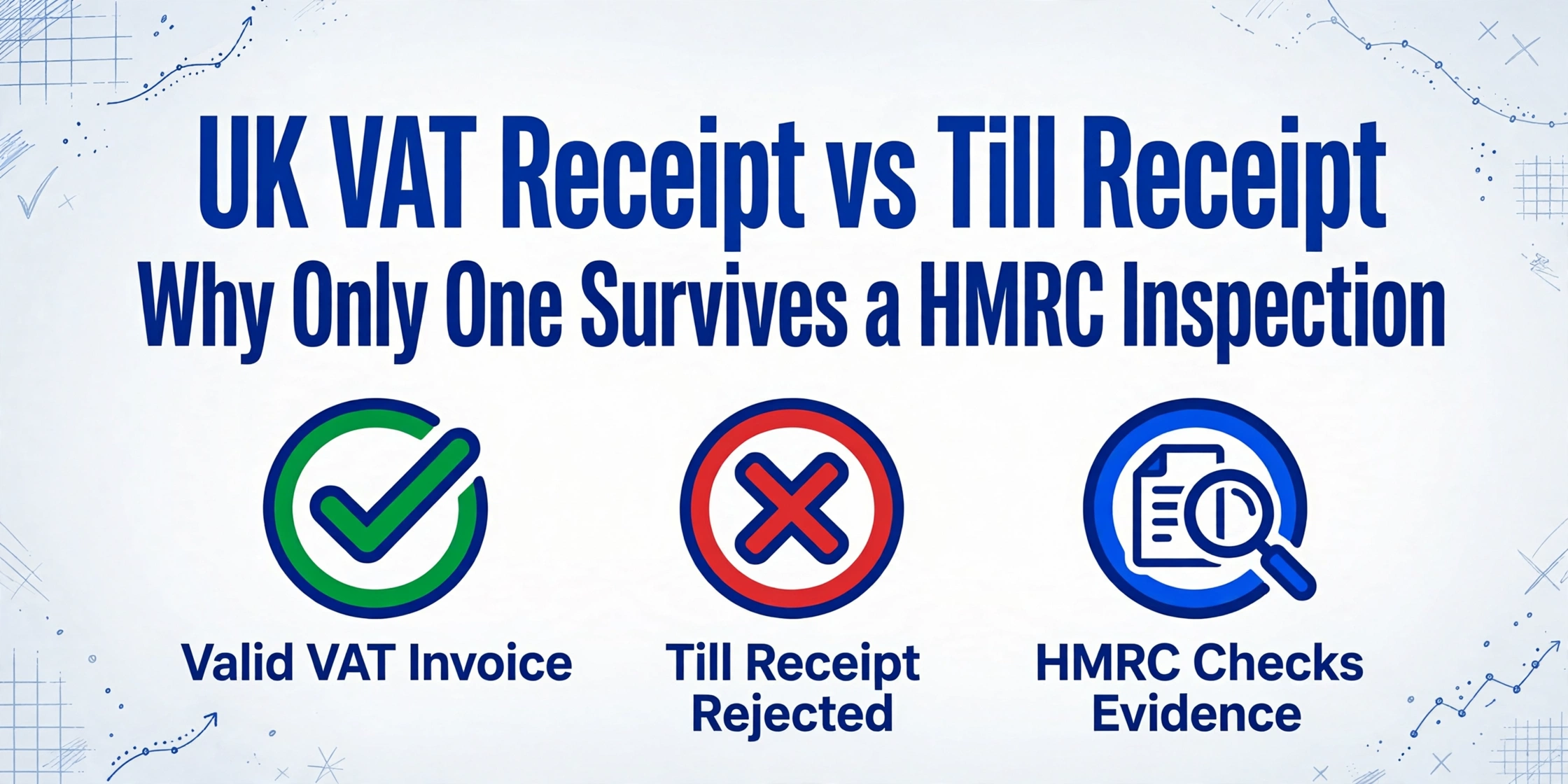
UK VAT Receipt vs Till Receipt
Why Only One Survives a HMRC Inspection
In the 2023–24 tax year, HMRC's VAT gap — the difference between what should have been collected and what was — stood at an estimated £5.5 billion. A significant slice of that gap comes from input tax claims that fail because the taxpayer has the wrong piece of paper. Not a missing receipt. Not a fraudulent claim. Just the wrong type of receipt: a till receipt instead of a VAT receipt. For a UK tradesperson or small business owner buying £500 worth of materials at Screwfix, that single receipt error means £83.33 in input VAT that HMRC won't honour. Multiply that across a month of supplier runs, and a 4-year HMRC lookback period, and the number runs into thousands. Yet most business owners don't discover the distinction until an inspector points it out — and by then it's too late to fix.
Key Takeaways
- £21,504 in VAT claims are at risk over HMRC's 4-year lookback — not from missing receipts, but from holding till receipts that prove payment yet lack the one field HMRC requires: the supplier's VAT registration number.
- No trade counter in the UK defaults to printing a VAT receipt at checkout, and neither Screwfix nor HMRC will warn you — the compliance gap only surfaces when an inspector cross-checks four years of your returns.
- The fix at the counter is one sentence — “Can I have a VAT receipt, please?” — and AI extraction turns a month's receipts into an HMRC-ready spreadsheet in under two minutes, no manual typing required.
The One Sentence Your Receipt Is Missing — and Why It Matters
Walk into any Screwfix, Toolstation, or Wickes counter, pay for materials, and the cashier hands you a slip of thermal paper. You glance at it: date, items, total — looks fine. You stuff it in the glovebox and move on.
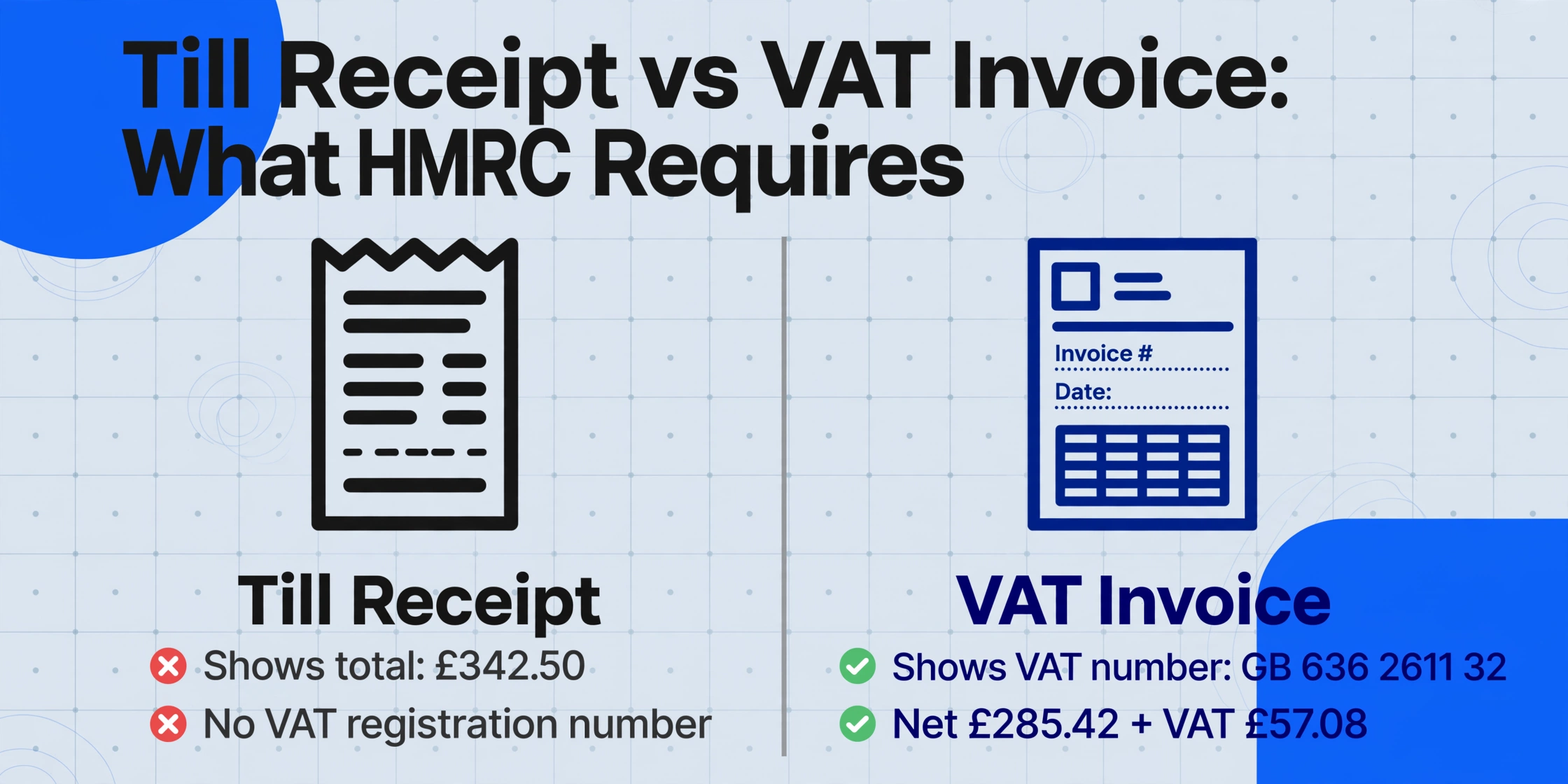
That slip is a till receipt. It proves you paid for something. But it almost certainly does not prove you paid VAT on it — and for HMRC, that's the only thing that matters.
A valid VAT receipt — what HMRC calls a "VAT invoice" — must contain, at minimum, the supplier's VAT registration number and a breakdown of the VAT amount charged. Your till receipt from Screwfix shows a total of £342.50 and tells you the card machine approved the payment. What it does not show is Screwfix's VAT registration number (GB 636 2611 32), the net amount before VAT (£285.42), the VAT charged at 20% (£57.08), and the VAT rate applied to each item. Those four data points are the difference between £57.08 back in your VAT return and £57.08 permanently gone.
Under VAT Notice 700/21, the VAT invoices you receive are "the primary evidence for you to recover VAT you have incurred as input tax." The word "primary" is doing all the work: without that document, you don't have a claim. A till receipt — no matter how detailed the item list — is simply not a VAT invoice under HMRC's definition. It lacks the legal identifiers that transform a payment record into a tax evidence document.
This is not a grey area. HMRC's guidance is unambiguous: to reclaim input tax, you must hold "valid evidence that you have received a taxable supply" (VAT Notice 700, §10.6). A till receipt doesn't meet that bar. The question isn't whether your accountant can "make it work" — it's whether the receipt contains the fields HMRC requires.
How a £250 Threshold Creates a £1,500+ VAT Claim Problem
There is one exception — and it's where most small business owners get caught out even when they think they're covered.
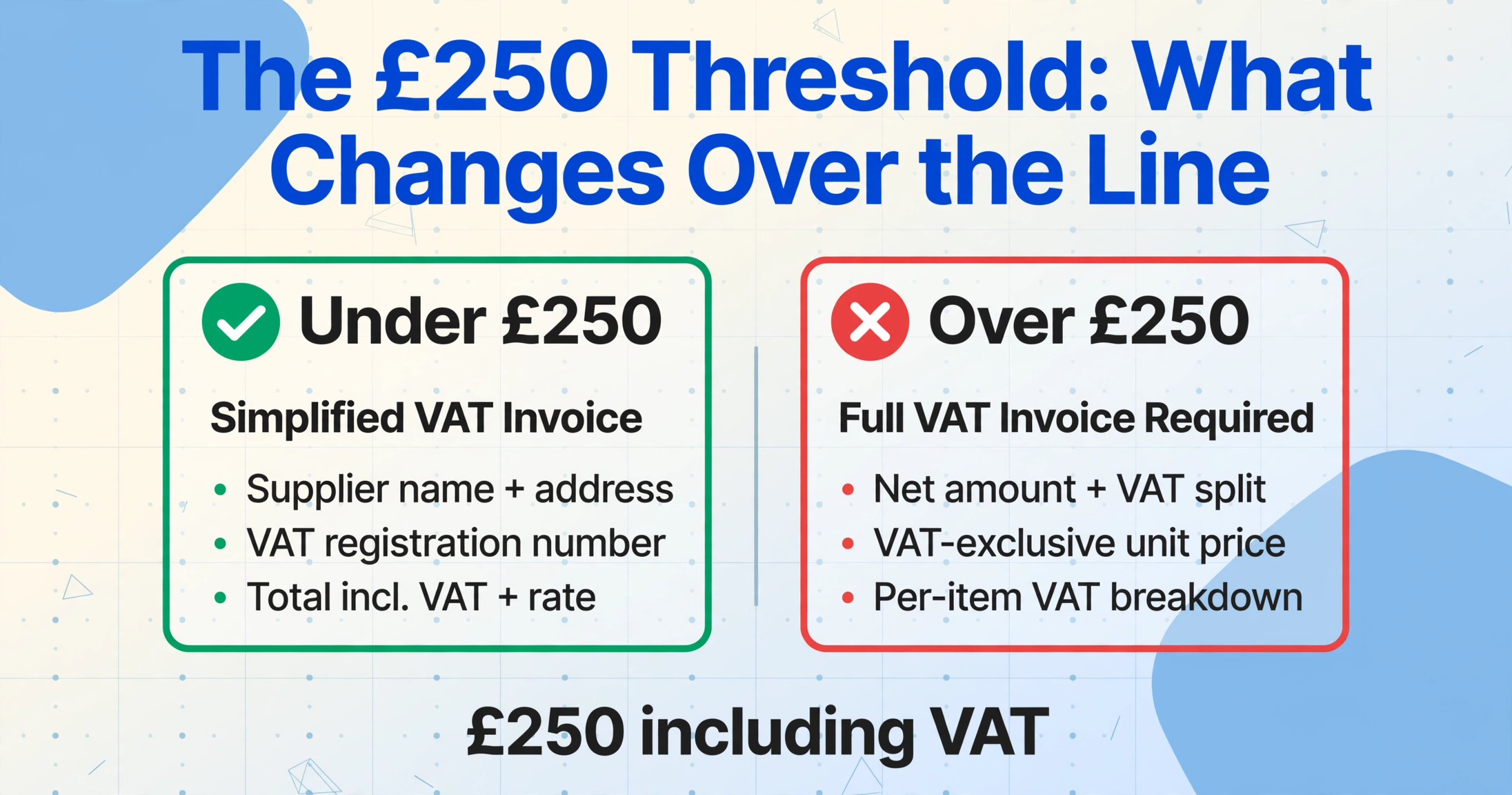
HMRC permits a simplified VAT invoice for retail transactions under £250 including VAT (VAT Notice 700/21, §4.5). A simplified receipt needs fewer details: supplier name and address, VAT registration number, date, description of goods, total including VAT, and the VAT rate. Crucially, it does not need to show the VAT-exclusive amount or the buyer's name. If your trip to Screwfix totals £180 — a roll of cable, a box of screws, some wall plugs — a simplified receipt with the VAT number and the "VAT at 20%" indicator is sufficient.
But cross the £250 line — which, for anyone buying building materials, happens constantly — and the rules shift. For purchases exceeding £250 including VAT, you need a full VAT invoice or a modified VAT invoice. These must show the net amount, the VAT-exclusive unit price, and a per-item VAT breakdown. Your default till receipt — even if it happened to include the supplier's VAT number — almost certainly won't include a net/VAT split, so it fails on multiple required fields.
Here is what that means in practice for a typical self-employed builder or decorator:
| Month | Over-£250 purchases | VAT at 20% | Receipt type | Input VAT at risk |
|---|---|---|---|---|
| January | 8 receipts (Screwfix, Wickes, Travis Perkins) | £53 avg per receipt | Till receipts — no VAT breakdown | £424 |
| February | 6 receipts | £47 avg | Till receipts | £282 |
| March (busy) | 11 receipts | £58 avg | Till receipts | £638 |
| Single quarter total | £1,344 | |||
| Over the full 4-year HMRC lookback | £21,504 | |||
The £1,344 figure for a single quarter is not a worst-case scenario — it's a realistic estimate for a tradesperson who buys materials from trade counters 2–3 times per week and hasn't been asking for proper VAT receipts. The 4-year figure assumes a steady pattern and neglects any growth, so it's conservative. What makes this genuinely dangerous is that the business owner may have been filing VAT returns for years, claiming these input amounts, never questioned — until the inspection. At which point, the entire four-year trail gets re-examined.
Why Suppliers Default to Till Receipts — and Why They Won't Warn You
The absence of a VAT receipt from Screwfix or Toolstation isn't a mistake — it's a deliberate default, built into the checkout flow for efficiency reasons that have nothing to do with your tax compliance.
A trade counter like Screwfix processes thousands of transactions per day across 900+ UK stores. The checkout operator's workflow is optimised for speed: scan items, take payment, hand over a till receipt. That till receipt is a payment confirmation — it proves the card machine worked and the customer got what they paid for. Printing a full VAT receipt takes an extra step in the POS system, slows the queue, and consumes more thermal paper for a document most retail customers (home DIY buyers) will never need.
The same dynamic plays out at Wickes, Toolstation, Travis Perkins, Jewson, and B&Q TradePoint — the six trade suppliers where the majority of UK construction material purchases happen. Every single one of them can issue a VAT receipt. Every single one of them defaults to a till receipt unless asked. And none of them display a sign at the counter saying "If you're VAT-registered, request a VAT receipt."
The result is a structural information asymmetry: the supplier has no incentive to tell you, because the compliance burden falls entirely on the buyer. HMRC's rule is clear — it is the claimant's responsibility to hold valid evidence. If you filed a VAT return claiming input tax on a till receipt, the error is yours, not Screwfix's.
There is a practical workaround, and it's simpler than most people assume: ask for a VAT receipt at the point of sale. Every trade counter operator can print one — they may need to select a different option in the till interface or print a separate document. Some suppliers, such as Travis Perkins, allow you to set a default on your trade account so that VAT receipts are generated automatically. For online orders, most trade suppliers send a VAT invoice by email after dispatch — but check whether the email attachment says "invoice" (with VAT breakdown) or "order confirmation" (which is not a VAT document). If it's the latter, log in to your account and download the actual VAT invoice from the order history.
What HMRC Actually Checks During a VAT Inspection
HMRC conducts VAT inspections — officially called "compliance checks" — to verify that a business is charging, recording, and reclaiming VAT correctly. The trigger can be anything from a large repayment claim to a random selection, but in practice, certain patterns attract attention: fluctuating VAT liabilities, returns that don't align with industry norms, and — critically — input tax claims that look high relative to declared output tax.
During an inspection, HMRC officers do not take your word for it. They will request the actual supporting documents — purchase invoices, expense receipts, bank statements — and cross-check them against your VAT return. The standard lookback period is 4 years. If errors are identified, HMRC can issue assessments for unpaid VAT plus interest. For cases involving deliberate errors or fraud, the lookback extends to 20 years. The penalties are behaviour-based, which means they scale: a careless error attracts a lower penalty than a deliberate one, and early disclosure + cooperation can reduce the penalty significantly. But the underlying principle remains: if you claimed input tax without a valid VAT receipt, that input tax is disallowed — and you owe it back, plus interest, for every year of the lookback.
Industry reports confirm an upward trend in inspection activity. Laura Chipp, a VAT specialist with nearly 20 years' experience, noted in 2025 that her firm alone was handling 7 active VAT audits simultaneously with 5 recently concluded — "a clear uptick" from the near-zero random inspections of the previous 15 years. HMRC has publicly stated its intention to inspect every VAT-registered business periodically, and its Connect data-matching system now cross-references billions of data points to flag discrepancies.
The specific vulnerability for trades and small businesses is straightforward: if 30% of your purchase receipts are till receipts rather than VAT receipts, then 30% of your input tax claims are technically unsupported. An inspector won't need to look hard to find the pattern. One receipt without a VAT number raises the question; ten receipts without VAT numbers confirms it. And once the pattern is established, HMRC can extrapolate backward across the full 4-year window — not just the period that triggered the inspection.
MTD Adds a New Layer: Why Paper Receipts Aren't Enough
Since April 2022, all VAT-registered UK businesses have been required to comply with Making Tax Digital (MTD) for VAT. This means keeping digital records and submitting VAT returns through MTD-compatible software — FreeAgent, Xero, QuickBooks, Sage, or an HMRC-recognised bridging solution. Paper records alone are no longer sufficient to satisfy HMRC's record-keeping requirements.
The MTD mandate creates a compounding problem for receipt management. Even if you do collect proper VAT receipts, storing them as a pile of thermal paper in a shoebox no longer meets the compliance standard. You need those receipts in a digital format — supplier name, date, net amount, VAT amount, total — entered into your accounting software before you can file your return. For a tradesperson coming back from a day on site, the last thing they want to do at 7pm is type 15 receipts into FreeAgent one field at a time.
This is where the workflow breaks: the friction of manual data entry means receipts pile up, VAT returns get filed late or with estimated figures, and the digital audit trail that MTD requires never gets built. The problem isn't a lack of will — it's that bridging the gap between "receipt in hand" and "row in accounting software" has, until recently, required tedious keyboard work with no realistic shortcut.
From Shoebox to Spreadsheet Without the Manual Entry
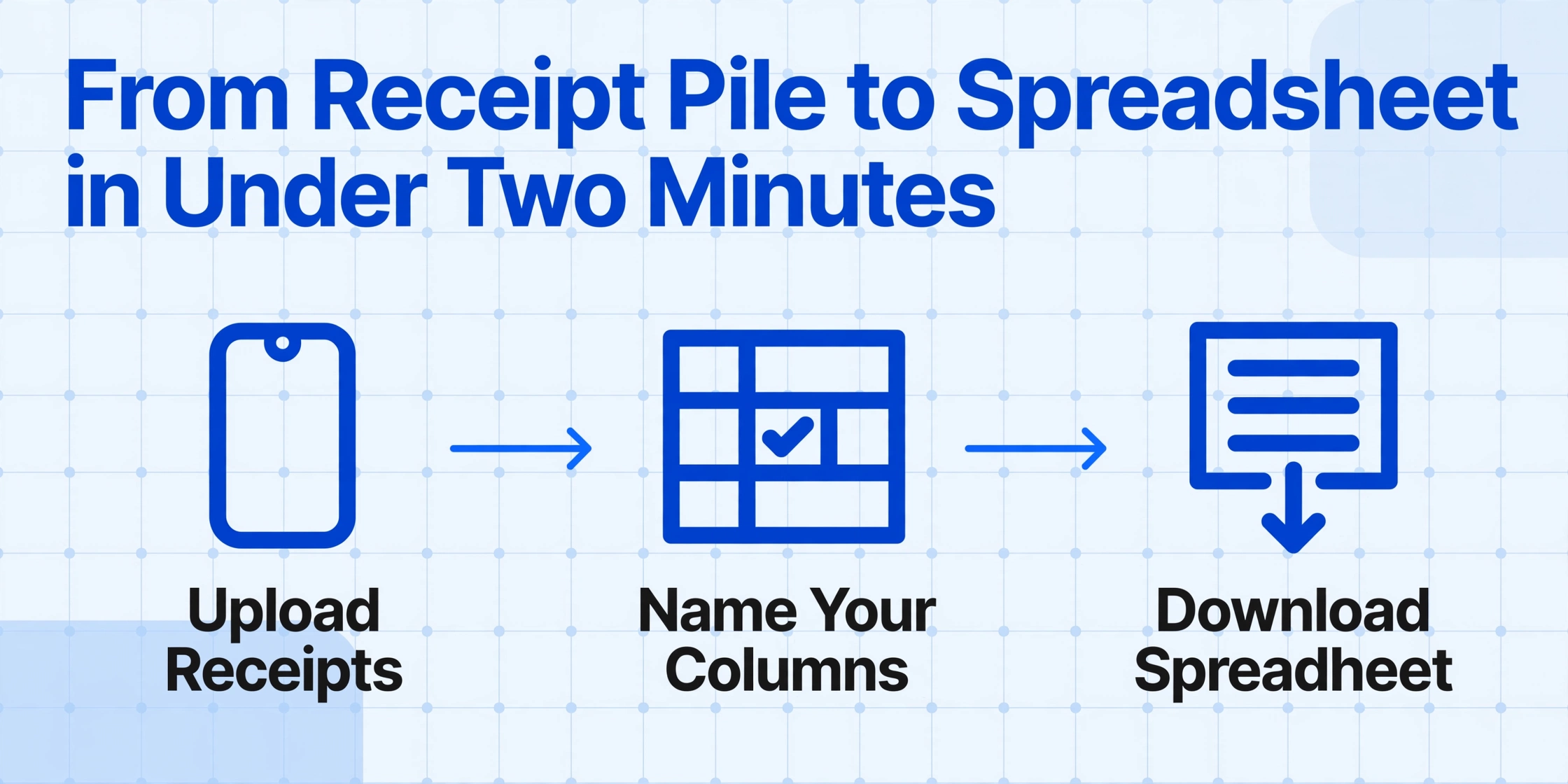
The default workflow for most small business owners is to photograph or scan their receipts, store them in a folder, and then — eventually — type the key fields into a spreadsheet or accounting app. This is the step where accuracy degrades and backlog accumulates. But there is a different approach: instead of typing each field, describe the columns you want, and let the AI read the receipt and fill them in.
ImageToTable.ai uses Custom Column Extraction — you type the column names you want (e.g. "Supplier Name", "Date", "Net Amount", "VAT Amount", "Total"), and the AI locates the corresponding values on each receipt by understanding what the fields mean, not where they sit on the page. Unlike template-based tools that require you to draw zones around each field or train a model per supplier format, Custom Column Extraction works across any receipt layout — Screwfix's compact thermal print, Travis Perkins' A4 invoice, a handwritten supplier note — without setup or configuration. Upload a batch of receipts, name your columns once, and get a single spreadsheet with every receipt as a row.
Files are processed securely and not stored.
This approach changes the compliance arithmetic. A month's worth of 25 receipts that previously took an hour of manual typing can be processed in under two minutes: upload the photos, confirm the column names, and download a spreadsheet with every supplier name, date, net amount, VAT amount, and total in a structured table. That table becomes your digital record — the exact audit trail that MTD requires, ready to import into FreeAgent, Xero, or QuickBooks.
For a full walkthrough of the VAT receipt extraction workflow — from column design to HMRC-ready spreadsheet — see the step-by-step guide to extracting UK VAT receipt data into Excel. If you're handling receipts across multiple categories, batch-processing business receipts into a tax spreadsheet covers the bulk workflow. And for the broader picture of what AI receipt extraction can do, the complete guide to receipt extraction is the reference hub.
One final note on the till receipt side: even when a till receipt is sufficient — a sub-£250 Simplified VAT receipt from a supplier that included their VAT number — it can still be useful to extract the line-item data. A till receipt from Screwfix might list 12 different SKUs. Extracting those into a spreadsheet lets you track material costs per job, cross-reference with quotes, and build a purchase history that informs future pricing. The data is still valuable even if the receipt isn't a valid VAT document — it just serves a different purpose.
Frequently Asked Questions
Can I reclaim VAT with a till receipt?
Only if the till receipt meets the requirements of a Simplified VAT invoice under VAT Notice 700/21 — and only for purchases ≤£250 including VAT. To qualify, the till receipt must show the supplier's name and address, their VAT registration number, the date of supply, a description of the goods, the total including VAT, and the VAT rate charged. Most retail till receipts omit the VAT registration number and the VAT rate, making them invalid as evidence. For purchases over £250, a till receipt is never sufficient — you need a full or modified VAT invoice.
What exactly is the difference between a till receipt and a VAT receipt?
A till receipt (also called a card receipt, payment receipt, or sales receipt) confirms that a payment was made — it typically shows the date, items purchased, total amount, and payment method. A VAT receipt (legally a "VAT invoice") is a distinct document that serves as evidence for input tax recovery. It must include the supplier's VAT registration number and a breakdown of the VAT charged. In practical terms: if the piece of paper shows a VAT registration number (beginning "GB") and separates the VAT amount from the net amount, it's a VAT receipt. If it only shows a total and a card payment confirmation, it's a till receipt — insufficient for VAT recovery.
Do I need a VAT receipt for purchases under £250?
For purchases ≤£250 including VAT, a Simplified VAT receipt is acceptable — and it requires fewer fields than a full VAT invoice. However, the Simplified receipt must still include the supplier's VAT registration number and the VAT rate applied. A standard card receipt from a trade counter will not include these, so you still need to ask for the VAT version. The under-£250 threshold reduces the amount of detail required — it does not eliminate the requirement for a VAT receipt entirely.
How far back can HMRC check my VAT receipts?
HMRC can inspect VAT records covering the past 4 years as standard. If they identify careless errors — which includes claiming input tax without valid VAT receipts — the 4-year window applies. If HMRC determines the errors were deliberate, the lookback can extend to 20 years. The key point: if you've been claiming input tax on till receipts for 3 years, all 3 years of claims are at risk in a single inspection.
Can I use bank statements as evidence instead of VAT receipts?
Generally, no. HMRC's guidance states that the VAT invoice is the primary evidence for input tax recovery. There is an "alternative evidence" route for cases where you are genuinely unable to obtain a VAT invoice, but this is discretionary — HMRC is not obligated to accept it — and it requires you to demonstrate that you made every reasonable effort to obtain the proper document. Relying on bank statements as a substitute, when the supplier can easily provide a VAT receipt on request, is not a defensible position during an inspection.
What should I do if I've already claimed VAT on till receipts?
Start by reviewing your past VAT returns — identify which input tax claims are supported by valid VAT receipts and which are backed only by till receipts. Focus on purchases over £250, as these have the highest risk of being disallowed. If you identify gaps, you can make a voluntary disclosure to HMRC — this typically results in lower penalties than waiting for an inspection to uncover the errors. Then put a process in place: ask for VAT receipts at the point of sale going forward, and build a digital record of all receipts using extraction tools so you have a clean audit trail for future returns. An accountant experienced in VAT compliance can advise on the specifics of your situation — this is not a step to DIY without professional input.