Why Job-Site Receipt Chaos Costs
More Than Contractors Realize
If construction project margins were a physical object, they'd be tissue paper—and the biggest tear isn't coming from the direction most GCs are watching. Material prices dominate the headlines and AGC conference panels. Labor shortages get the boardroom attention. But sitting between the superintendent's truck dashboard and the controller's general ledger is the quietest margin eroder in the business: the receipt. Not the concept of receipts. The physical object—a thin strip of chemically coated paper that starts degrading the moment it leaves the Home Depot register, exists in a dozen different job sites at once, and carries a legal obligation that most field teams don't know exists until an auditor asks for it.
Key Takeaways
- $73K of reimbursable expenses vanishes from a mid-size GC's books each year — not because anyone stole it but because thermal-paper receipts fade before anyone can match them to a job and cost code.
- A receipt sitting in a truck dashboard fades to illegibility within three weeks under summer heat — the paper literally self-destructs while the superintendent who knows the cost code is already on the next job site.
- The fix doesn't ask a superintendent to become a bookkeeper — it asks for a three-second photo capture at the checkout counter and lets extraction map line items to cost codes before the paper has time to fade.
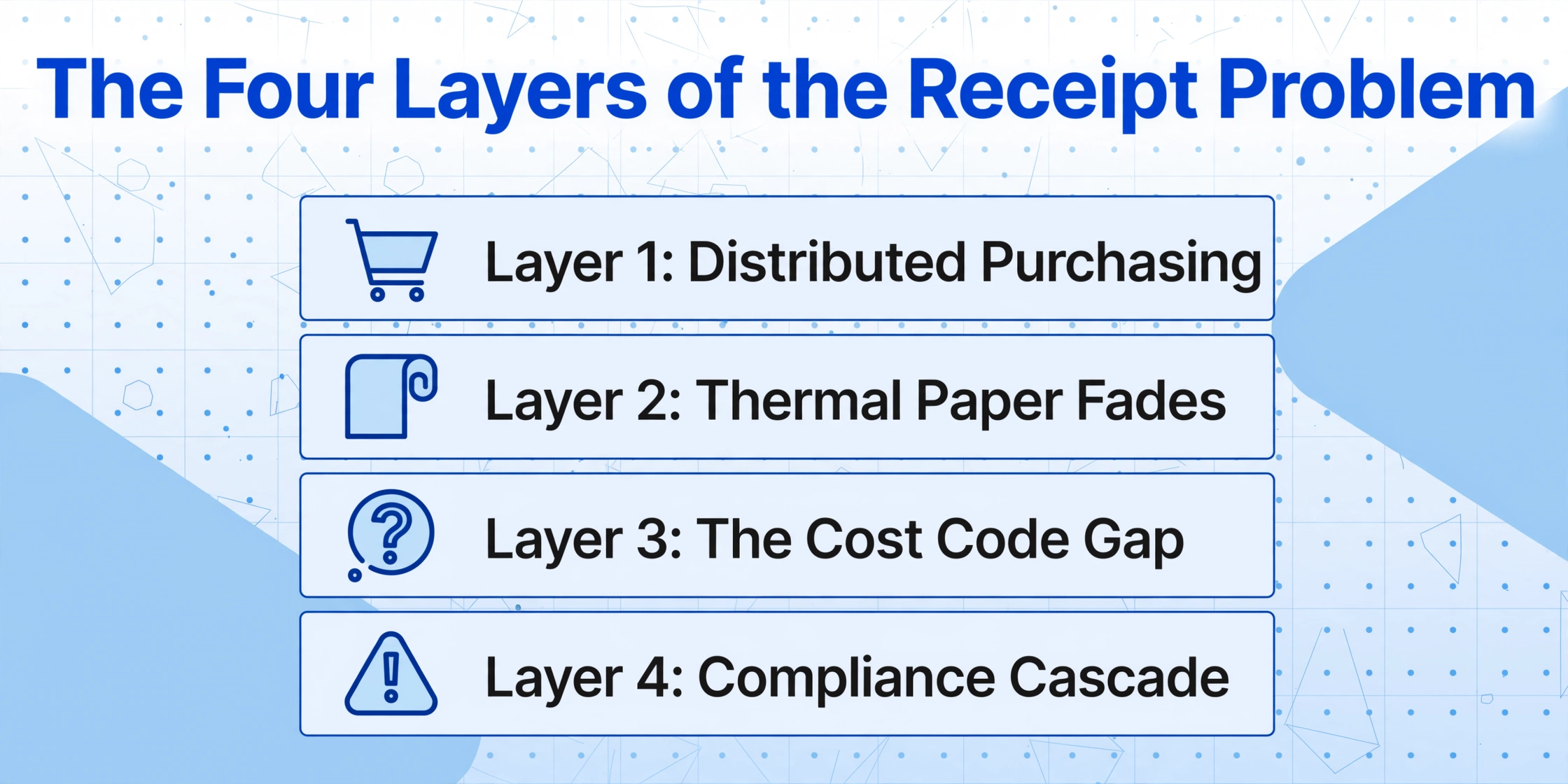
The Four Layers of the Receipt Problem That Nobody Talks About
Most discussions of construction receipt management stop at the symptom: "field workers lose receipts." That's like saying a bridge collapse was caused by "metal fatigue." True but useless—it tells you nothing about the design decisions, material choices, and stress concentrations that made fatigue inevitable.
The construction receipt problem isn't one problem. It's four distinct structural failures stacked on top of each other. Each layer would be manageable on its own. Stacked together, they create a system where losing 3-5% of reimbursable costs isn't a mistake—it's the expected output of the machinery.
Layer 1: The Purchasing Model. Construction doesn't have centralized procurement. A mid-size GC running twelve concurrent projects has twelve different people buying materials—superintendents, foremen, project managers—each making purchases at different suppliers, on different payment methods, recording expenses with different levels of diligence. This isn't a process failure. It's a structural requirement of how construction projects run. The people who know what's needed on site are on site, and the purchasing decisions happen there.
Layer 2: The Paper. Nearly every receipt issued at a construction supplier—Home Depot, Lowe's, White Cap, Builders FirstSource—is thermal paper. Thermal paper doesn't use ink. It uses a heat-sensitive chemical coating that darkens when exposed to the printer's thermal head. The same chemistry that makes it print without ink makes it catastrophically unstable. Heat, sunlight, humidity, friction, even the oils from human skin accelerate degradation. A receipt that sits on a truck dashboard—where interior temperatures in July can exceed 140°F—can become unreadable in weeks, not months. The National Archives of Australia classifies thermal paper as having "no permanence" and unsuited to any long-term documentation.
Layer 3: The Cost Code Structure. A receipt from a job-site hardware run says "$247.33 — Lumber & Fasteners." The accounting system needs to know: Job 21-07, Cost Code 06 10 00 (Rough Carpentry), Phase 2, Purchase Type: Direct Material. The CSI MasterFormat, the industry-standard cost coding system maintained by the Construction Specifications Institute, organizes construction work into 50 divisions with six-digit hierarchical codes—and your company's ERP is built around it. The superintendent who bought the lumber knows it's for "framing the east wing." The accountant needs it in the language of MasterFormat. These are two different languages, spoken by two different people who rarely occupy the same room.
Layer 4: The Compliance Obligation. Under Treas. Reg. §1.274-5T, any business expenditure of $75 or more requires documentary evidence—a receipt, paid bill, or similar—sufficient to establish the amount, date, place, and essential character of the expenditure. The regulation is explicit: "Written evidence has considerably more probative value than oral evidence alone." A faded receipt with an illegible date and amount fails this test. For federally funded construction projects, the stakes compound: Davis-Bacon certified payroll requirements add a layer of worker classification documentation, and IRS Publication 5522 (Construction Industry Audit Technique Guide) confirms that the IRS maintains a specialized audit program specifically targeting construction firms.
Each of these four layers interacts with the others. The purchasing model (Layer 1) means receipts are generated by people who aren't accountants. The paper chemistry (Layer 2) means the evidence literally degrades. The cost code gap (Layer 3) means even intact receipts require translation. And the compliance framework (Layer 4) means the whole system is periodically subjected to adversarial review. Let's look at each layer in detail.
The Distributed Purchasing Model Is a Feature, Not a Bug—and That's the Problem
Construction's purchasing model is fundamentally different from any other industry's. An office-based company can centralize procurement: corporate cards with spending limits, pre-approved vendor catalogs, automated receipt capture linked to every transaction. The person who needs a new monitor doesn't drive to Best Buy with a personal credit card. They submit a request through a procurement portal, and accounting handles the rest.
Construction can't work this way. When a framing crew discovers at 7:15 AM that they're short on joist hangers, the superintendent doesn't have three days to route a purchase request through central procurement. The option is: buy now and keep the crew working, or wait for approval and lose a day of productivity across eight workers.
This isn't a process flaw to be fixed. It's the correct economic decision at the field level. A crew of eight carpenters idled for a day costs roughly $3,000-$4,000 in direct labor alone, not counting the downstream schedule impacts that cascade through every trade. The $87 trip to Home Depot is unambiguously the right call. The problem is that the same structural logic that makes distributed purchasing economically correct also makes it an accounting nightmare.
As construction firms grow, the problem compounds geometrically, not linearly. A small operation with two job sites and a hands-on owner can track receipts in a folder. A mid-size GC with twelve sites, each generating 15-30 individual purchases per week, is processing 180-360 discrete receipt events weekly—each one needing to be matched to the correct job, cost code, purchase type, and payment method before it can be entered into the accounting system.
This is why corporate card programs—the standard solution in office environments—don't solve the problem in construction. A corporate card captures the transaction amount and vendor name, but it doesn't capture the cost code, the job number, or the purchase context. And it certainly doesn't solve the receipt problem: the IRS doesn't accept a credit card statement as documentary evidence. It requires the itemized receipt. So a corporate card program in construction simply adds another reconciliation layer—matching card transactions to paper receipts—without removing the underlying problem.
The software gap here is telling. Procore, the dominant construction project management platform, tracks commitments, budgets, and direct costs with precision—but has no native receipt capture or expense management functionality. Expense data must enter Procore from a third-party tool before it can be allocated against budget lines. Sage 300 CRE (formerly Timberline), the accounting backbone for many mid-to-large GCs, handles job costing and general ledger with depth—but the field-level data entry that feeds it remains a manual process. Between the superintendent's phone camera and the controller's month-end close sits a vacuum that the major platforms chose not to fill.
The Chemistry of Disappearing Evidence

The default receipt stock at virtually every construction supplier is thermal paper. This is not an arbitrary choice—thermal printers are fast, require no ink cartridges, need minimal maintenance, and the paper is cheap. For a big-box retailer processing millions of transactions annually, the economics are overwhelming. For the general contractor who needs that receipt as audit evidence six months later, the same chemistry is a ticking clock.
Thermal paper works via a chemical reaction between a leuco dye and a developer (typically BPA or BPS) embedded in a coating on the paper surface. When the printer's thermal head applies heat, the dye and developer react and the coating turns dark. The image is not ink bonded to fiber—it's a temporary chemical state that reverts under the right conditions. The primary reversal triggers are the same environmental factors present on every construction site: heat (a vehicle dashboard in summer), sunlight (UV radiation accelerates degradation), humidity (concrete curing releases moisture), and chemical exposure (drywall dust, solvents, the oils from a worker's hands).
How fast does this happen? Under ideal archival storage—cool, dark, dry, chemically inert—thermal paper can remain legible for five to seven years. Under construction job-site conditions, the timeline compresses dramatically. A receipt left in a truck cab through a summer week in Texas or Arizona can fade to near-illegibility within two to three weeks. A receipt stuffed in a wallet for a month, subjected to body heat and friction, will show measurable degradation. Even receipts stored in a job-site trailer—where daytime temperatures routinely exceed 90°F in summer months—will show visible fading within three to six months.
The attempted solutions are revealing. One bookkeeper with seven years of experience, posting in a public forum about receipt management, noted: "Using a highlighter will actually make it fade faster (speaking from experience). Best way to preserve a receipt is to photocopy it." In other words, the established field practice for preserving receipt data is to create a second paper document—a photocopy—that won't fade. The receipt itself, the original documentary evidence, is acknowledged by practitioners as doomed.
This matters because the IRS requirement isn't abstract. Under Treas. Reg. §1.274-5T(c)(2)(iii), documentary evidence is required for any expenditure of $75 or more. The evidence must establish the amount, date, place, and essential character of the expenditure. When a construction company's receipts are thermal paper stored in job-site conditions, the evidence self-destructs. The IRS doesn't make exceptions for "the receipt was in the truck." The contractor bears the burden of proof.
The Cost Code Canyon: What a Superintendent Knows vs. What an Accountant Needs
Here's a typical transaction on a mid-size commercial project: a superintendent stops at Home Depot on the way to the site and buys $247.33 worth of pressure-treated lumber and galvanized fasteners for the exterior framing crew. The receipt says "LUMBER 2X6X12 PT" and "JOIST HANGER GALV" and a total. The superintendent knows: this is for the deck framing on Building C, Phase 2. He shoves the receipt in the center console and drives to the site.
Two weeks later, when the receipt makes it to the office, an accounting clerk needs to code it. The choices on screen look like this:
Job: Metro Health Office Building (21-07)
Cost Code: 06 10 00 — Rough Carpentry or 06 15 00 — Wood Decking?
Cost Type: Material / Subcontract / Equipment / Labor / Other
Purchase Type: PO / Direct / Credit Card / Reimbursement
Phase: 1 — Foundation / 2 — Framing / 3 — Close-in
The CSI MasterFormat assigns every construction activity a six-digit hierarchical code. Division 06 covers Wood, Plastics, and Composites. 06 10 00 is Rough Carpentry (structural framing). 06 15 00 is Wood Decking (surface sheathing). The difference matters for cost tracking—a project's framing budget is separate from its decking budget. But the receipt doesn't say which it is. The superintendent knows. The accountant doesn't. And in the two weeks between purchase and data entry, the superintendent has moved on to the next fire to put out.
This is the translation gap: the person who holds the context (what was purchased, for what phase, on which job) and the person who operates the accounting software are different people, in different locations, working on different timelines. The receipt is the only physical artifact that bridges them. And the receipt is fading, losing context with every passing day.
A 2024 BDO report on construction financial controls found that charts of accounts with more than 1,000 lines have triple the coding error rate of leaner structures—and a typical mid-size GC's chart of accounts easily exceeds that threshold when you multiply jobs by cost codes by cost types. The CFMA's 2024 benchmark data indicates that cost administration consumes 5.4% of project revenue for the average US general contractor. On a $30 million project, that's $1.6 million spent reconciling numbers that, in a functioning system, should have matched the first time.
The Compliance Cascade: One Missing Receipt Doesn't Stay One Missing Receipt
In a simple expense-reporting environment, a missing receipt means a small-dollar reimbursement gets denied. The employee eats the $43.67, and life continues. Construction doesn't work this way.
A receipt isn't just proof of an expense. It's evidence in multiple independent compliance frameworks that all draw on the same underlying documentation. When a GC can't produce a receipt, the failure cascades:
IRS income tax audit. The IRS maintains a dedicated Construction Industry Audit Technique Guide (Publication 5522) because construction firms face a higher-than-average audit rate. The guide walks IRS examiners through how to examine contractor financials, including material costs, subcontractor payments, and job-cost allocation. Receipt substantiation is a primary examination area. Unsubstantiated expenses are disallowed, resulting in back taxes, interest, and penalties.
Davis-Bacon compliance. For federally funded projects exceeding $2,000, contractors must pay prevailing wages and submit weekly certified payroll reports (Form WH-347). These reports must itemize every worker's classification, hours, and wages. Material receipts substantiate the non-labor portion of project costs. A Davis-Bacon violation carries civil penalties of up to $13,508 per violation and can trigger debarment from federal contracts for up to three years. Prime contractors are strictly liable for subcontractor violations—meaning a sub's missing receipt becomes the GC's problem.
Workers' compensation audit. Your workers' comp insurer audits payroll and subcontractor payments annually. The audit determines your premium—and if you can't produce receipts proving that certain workers were subcontractors (not employees), their payroll gets reclassified under your policy, triggering a premium adjustment that can reach six figures for a mid-size GC.
State sales tax audit. Construction firms face elevated sales tax audit risk because the tax treatment of materials varies by state and by contract type (lump-sum vs. time-and-materials, new construction vs. renovation). A receipt that doesn't clearly distinguish between taxable materials and exempt materials is an audit exposure point.
Lien law compliance. Mechanic's lien rights depend on proving that materials were actually delivered to and incorporated into the project. Receipts with delivery dates and material descriptions are the primary evidence. A contractor who can't produce receipts compromises their lien rights—and in construction, lien rights are the ultimate leverage for getting paid.
The key insight: these five frameworks don't operate independently. They draw from the same pool of documentation. A GC with weak receipt management isn't risking one audit failure. They're carrying exposure across five simultaneous compliance dimensions—any one of which can trigger a costly review when an adjacent one flags a discrepancy.
What This Costs: The Arithmetic of the Invisible Leak
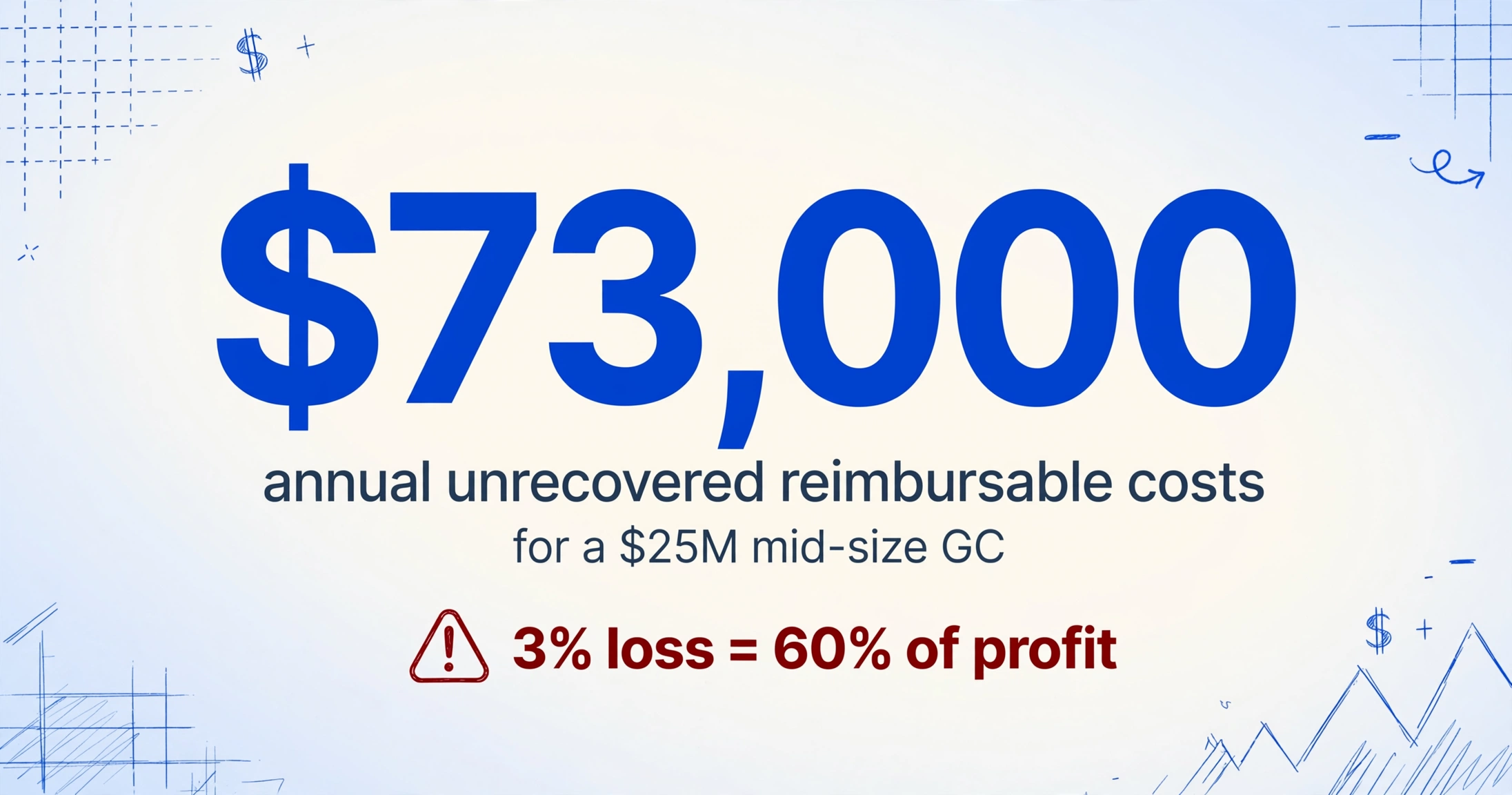
Construction profit margins are thin by any standard. AGC data from 2022 puts contractor net margins between 3.5% and 5%. CFMA and FMI benchmarking data consistently support a range that rarely breaks into double digits. Every dollar of unrecovered reimbursable cost doesn't just reduce revenue—it consumes margin at close to a 1:1 ratio. Losing 3% of reimbursable costs on a project with 5% net margin means losing 60% of the profit on those costs.
Let's put numbers to it. Consider a mid-size GC doing $25 million in annual revenue with 65% of that as direct project costs ($16.25 million). If even 15% of those direct costs are field purchases that require receipt substantiation ($2.44 million), and the substantiation failure rate is a conservative 3%, the annual unrecovered amount is $73,000. At 4.5% net margin, that's equivalent to the profit on $1.6 million in additional revenue.
But the direct unrecovered cost is only the visible portion. The indirect costs are larger:
- Administrative labor. The CFMA's 5.4% cost administration benchmark—$1.35 million annually on a $25M revenue base—includes the hours spent chasing receipts, reconciling cost codes, and re-entering data that should have been captured at the point of purchase. Field supervisors lose an estimated 2-3 hours per week on receipt-related administrative work, time taken from crew management and production oversight.
- Delayed billing. When month-end close is delayed because receipts haven't been coded and entered, client invoicing is delayed. Delayed invoicing means delayed payment. On a cost-plus or T&M contract where the GC's cash outlay precedes reimbursement by 30-45 days, every additional week of delay in submission is a week of financing the project on the GC's working capital.
- Audit exposure. A single IRS audit finding of unsupported expenses on a multi-year lookback can result in six-figure adjustments plus penalties and interest. The cost isn't just the tax—it's the professional fees to defend the audit, the management distraction, and the precedent it sets for future examinations.
- Lost margin signals. When cost data is miscoded or entered late, the project manager's budget-vs-actual reports are wrong. Decisions about change orders, subcontractor negotiations, and resource allocation are made on bad data. The costs of bad decisions compound over the project lifecycle in ways that don't appear on any receipt line.
This is why the receipt problem is a margin problem—not just an annoyance. It's not about "manual entry is slow." It's about a structural gap between how construction projects spend money and how construction companies account for money, and the gap is wide enough for 3-5% of reimbursable costs to fall through every year without anyone being able to point to a single transaction and say "there, that's the one."
Why Excel and Procore Alone Can't Close This Gap
The construction industry's response to this problem has been characteristically resourceful and characteristically insufficient. Between the superintendent's receipt and the ERP's general ledger sits a layer of stopgap solutions: Excel spreadsheets maintained by project administrators, shared Dropbox folders of receipt photos, email chains with subject lines like "receipts week of 6/15," and the universal backup plan of driving receipts to the office in a manila folder.
These stopgaps solve the immediate symptom—the receipt exists somewhere—without touching the underlying structural problem. The Excel spreadsheet that tracks receipts still requires someone to manually type vendor names, amounts, dates, and cost codes from a photo of a receipt. The Dropbox folder full of receipt photos is only as organized as the person who named the files. The email chain is discoverable only if someone remembers the right keywords four months later.
Procore, for all its project management depth, was designed to track commitments and budgets once cost data is captured—not to capture cost data at the point of purchase. Its direct cost module accepts entries but doesn't read receipts. Its integration with Sage 300 CRE is powerful for syncing approved costs to the general ledger but silent on how those costs get approved in the first place.
The gap isn't a missing feature. It's a missing layer. The construction software ecosystem has excellent tools for what happens after cost data is structured (job costing, budget tracking, lien waiver management) and adequate tools for what happens before (estimating, bidding, procurement planning). The dark zone is the moment of transition—when unstructured cost data (a receipt photo) needs to become structured cost data (a coded expense entry).
This is where the difference between template-based OCR and semantic extraction becomes critical—and where the problem stops being a complaint and starts having a defined technical solution. We explore the practical solution in our guide to extracting job-site receipt data into Excel by construction cost code and our walkthrough on batch-processing a week's construction receipts into a job cost allocation spreadsheet. The short version: the same semantic AI that can read a receipt and understand "$247.33" is a total and "2X6X12 PT" is an item description can also be told what your cost codes are and which job each receipt belongs to—turning the superintendent's dashboard pile into structured data without a manual translation step.
Files are processed securely and not stored.
Frequently Asked Questions
Why can't construction companies just give superintendents company credit cards?
Many do. But a credit card statement isn't IRS-compliant documentary evidence—you still need the itemized receipt. A corporate card captures the vendor name and amount but not the line items, cost codes, or job allocation. Adding corporate cards to a construction operation without also solving receipt capture creates a reconciliation layer (matching card statements to paper receipts) without removing the underlying problem. The receipt still needs to be captured, coded, and stored.
How long do thermal paper receipts actually last on a construction site?
Under ideal archival conditions (cool, dark, dry), five to seven years. In a job-site trailer exposed to summer heat, three to six months before visible fading begins. On a truck dashboard in direct sunlight, two to three weeks to near-illegibility. In a wallet subjected to body heat and friction, measurable degradation within a month. The only reliable preservation method is immediate digitization—a photo or scan taken at the point of receipt.
Does Procore handle receipt management?
No. Procore tracks commitments, budgets, and direct costs once expense data is entered, but it does not include native receipt capture, OCR, or expense management functionality. Expense data must be captured in a third-party tool and then synced to Procore via API or manual entry. This is by design—Procore is a project management platform, not an expense management tool—but it creates a gap that most GCs fill with spreadsheets and manual processes.
What's the IRS threshold for requiring a receipt?
Under Treas. Reg. §1.274-5T, documentary evidence (a receipt, paid bill, or similar) is required for any business expenditure of $75 or more. The evidence must establish the amount, date, place, and essential character of the expenditure. For expenditures under $75, a contemporaneous log or written record may suffice—but the safe practice is to maintain receipts for all job-costed expenses, regardless of amount, because cost-plus contract billing and workers' comp audits don't follow the $75 threshold.
Can AI extraction handle handwritten receipts from smaller suppliers?
Yes. Semantic AI extraction—the approach ImageToTable.ai uses via Custom Column Extraction, where you define the fields you want (Date, Vendor, Amount, Cost Code) and the AI locates each value by understanding what it means rather than reading character by character—works on handwritten receipts, faded receipts, and mixed-format documents. It functions differently from traditional OCR, which scans for character patterns and struggles with irregular handwriting or degraded print. That said, severely damaged receipts where text is physically absent (not just faint) are beyond any tool's capability—which is why capturing the receipt image before degradation occurs is the critical step.
What's the connection between receipt management and Davis-Bacon compliance?
Davis-Bacon requires certified payroll reports (Form WH-347) documenting every worker's classification, hours, wages, and fringe benefits on federally funded projects. While the form itself doesn't require receipts, the project's overall cost documentation—including material purchases and subcontractor payments—must be auditable as a whole. When a DOL wage-and-hour investigator reviews certified payrolls and finds discrepancies, the investigation typically expands to the contractor's entire project documentation, including material receipts. Receipt substantiation failure in one area can trigger a broader audit. Penalties include fines up to $13,508 per violation and debarment from federal contracts for up to three years.
The Real Cost Isn't the Lost Receipt—It's the System That Accepts It
The construction receipt problem persists not because nobody has noticed it but because each layer of the problem is someone else's job to solve. The superintendent is hired to build, not to do data entry. The accountant is hired to close the books, not to chase field crews. The project manager is hired to deliver the project, not to reconcile cost codes. The CFO is watching margins, not individual receipts. The problem lives in the seams between roles, and seams are where industrial problems go to become permanent.
The good news is that the same structural analysis that makes the problem visible also makes the solution clear. The fix isn't getting superintendents to be better at paperwork or accountants to be faster at data entry. It's removing the manual translation step that sits between the receipt photo (which the superintendent can provide in three seconds) and the coded expense entry (which the accounting software requires). When the extraction layer can read a receipt semantically—understanding that "2X6X12 PT" is a line item and "$247.33" is the total, and mapping those to the cost codes you've already defined—the four-layer problem collapses. The purchasing model doesn't change; the paper still fades; the cost code structure stays complicated; the compliance requirements remain. But the gap between them closes.
If you'd like to see what this looks like in practice, our detailed guide walks through extracting job-site receipts into Excel organized by cost code and project phase—and our batch processing guide covers processing a full week's receipts into a single job cost allocation spreadsheet.