Why Most Document Extraction APIs
Fail Compliance Reviews
An accuracy benchmark will not save a document extraction API in a compliance review. The review rarely turns on whether the model read a number correctly. It turns on whether anyone can show where that number came from. A vendor can report 99% field accuracy and still hand back a clean JSON object with no thread to the page, paragraph, or pixel it was read from, and a missing thread is what stops the workflow.
"Compliance" gets used as a single requirement, and it is at least three. Traceability, auditability, and governance each ask for something different, and a tool can be strong on one and silent on the others. This article separates them, shows why extraction APIs fail the review, and gives a checklist you can take to a vendor call. It also states plainly which of the three ImageToTable.ai covers, and which it does not.
Key Takeaways
- 99% field accuracy will not save an extraction API in a compliance review, because the reviewer checks where the number came from rather than whether it is right.
- Compliance is really three separate layers, and traceability, auditability, and governance each answer a different question that the other two cannot cover.
- ImageToTable.ai delivers field-level traceability with Review Mode and Bbox, while audit logs and SOC 2 call for an enterprise-grade platform instead.
Traceability, Auditability, and Governance Are Not the Same Thing
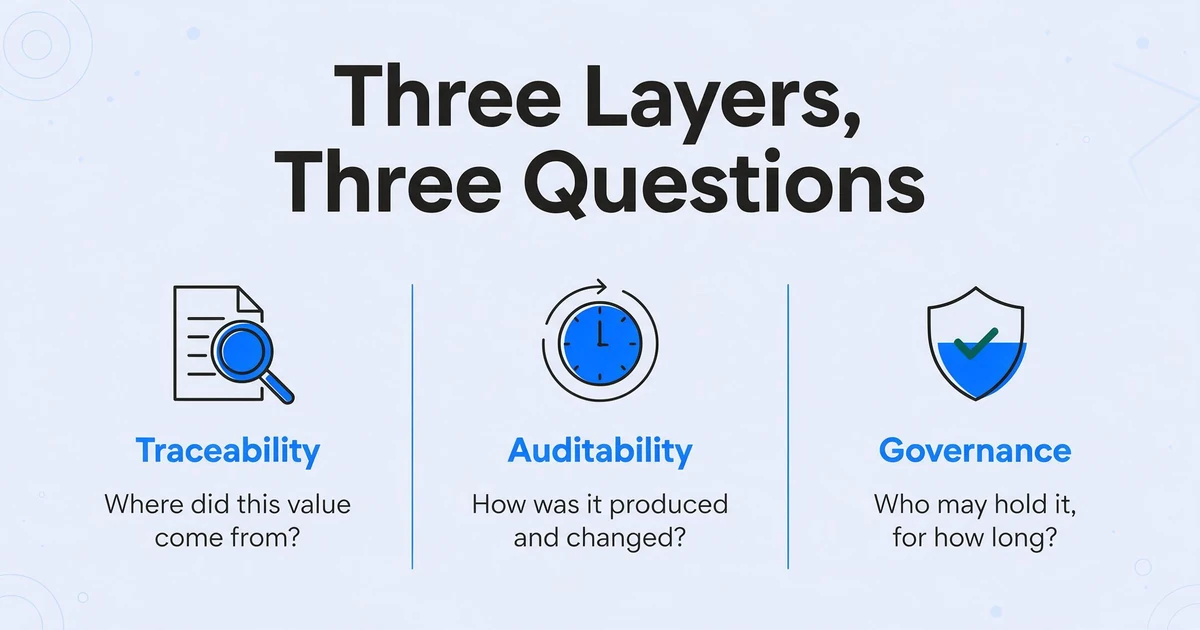
The three words travel together on vendor pages, and they describe separate layers of a system. Naming them apart is the first useful move, because the controls do not substitute for each other.
| Layer | The question it answers | What it requires |
|---|---|---|
| Traceability | Where did this value come from? | A per-field link back to the source: page, region (a bounding box or text span), and usually a confidence score. It lives in the extraction output itself. |
| Auditability | How was this value produced, and what happened to it since? | An extraction job ID, the model and configuration version behind it, a timestamp, the reviewer's identity, any correction, and an append-only history that can reconstruct the original. |
| Governance | Who may hold this, for how long, where does it live, and against which standard? | Access control, retention and data-residency controls, encryption, a defined deployment model, and certifications such as SOC 2, HIPAA, or GDPR terms. |
The layering matters because a compliance reviewer will ask for all three at different moments. A SOC 2 report does not tell you where a disputed field came from. A bounding box does not tell you who changed a value a month later. Teams that treat the three as interchangeable either over-buy a certification they never needed or discover mid-audit that the one layer they skipped is the one the auditor asks about.
Traceability answers where a value came from. Auditability answers what happened to it. Governance answers who may hold it and for how long. No one of these proves the others.
Why Extraction APIs Fail a Compliance Review
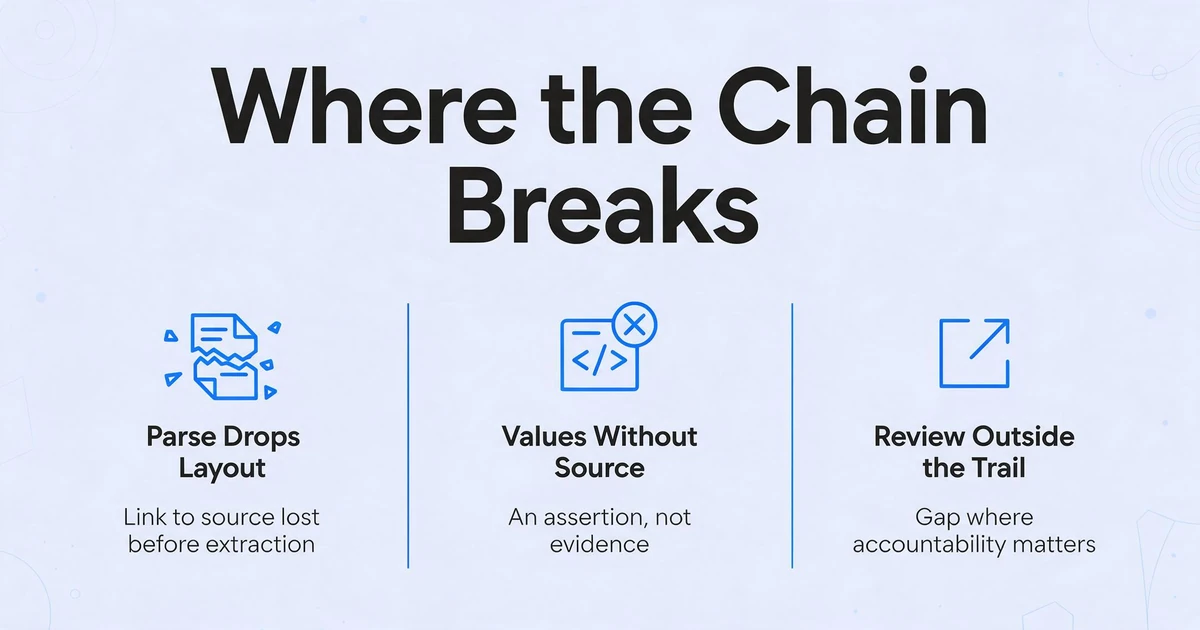
The failure is structural, not a matter of picking a weaker model. A typical API is optimized around the shape of its output: send a document, receive structured fields. The provenance a reviewer needs is often discarded earlier, at the parsing step, before extraction runs. There are three places the chain usually breaks.
The parse step drops the link to the original layout. When a pipeline converts a page to plain text or Markdown and throws away the coordinates, the connection between a value and its source is gone before extraction starts. It cannot be rebuilt later, because the link was never captured.
Extraction returns values without a source reference. A JSON object that contains "total": 52340 but not which region of the page produced it is an assertion, not evidence. An auditor can confirm the system recorded a number. They cannot confirm the number was printed on the document.
The review and the final decision happen outside the trail. Many deployments hand extracted data to a separate workflow tool or ERP. If the record stops at the handoff, the human correction and the approval sit in a different system, and the chain from document to decision has a gap exactly where accountability matters most.
Regulators do not ask whether the AI was accurate. They ask how you can prove it. HIPAA's Security Rule makes this explicit: the audit-controls standard requires covered entities to "implement hardware, software, and/or procedural mechanisms that record and examine activity in information systems that contain or use electronic protected health information" (45 CFR §164.312(b)). In securities recordkeeping, SEC Rule 17a-4's audit-trail alternative requires a complete time-stamped audit trail covering every modification and deletion, with the date, time, and identity behind each, in a form that permits re-creation of the original record (SEC.gov). Both ask for the same thing a compliance reviewer asks for: not an accurate number, but a reconstructable one.
Practitioners describe the same gap from the other side. An engineer building compliance document pipelines put it directly: "If your document extraction pipelines just dump raw text without tracking structure or provenance, you're going to fail your next compliance audit" (r/computervision, May 2026). The remark is blunt because the failure is not subtle. Once a pipeline has dropped the link between a value and its page, no reviewer downstream can rebuild it, and the team is left reconstructing evidence after the audit request arrives.
An API that returns the value but not its source forces the compliance team to rebuild evidence after the fact. That reconstruction is where audit risk lives.
The Evaluation Checklist: What to Ask Every Vendor
Before comparing products, write down what your workflow has to prove. The questions below turn the three layers into items you can check. The goal is not to find one vendor that answers yes to all of them. It is to know which "no" your process can absorb and which one it cannot.
| Requirement | What good looks like | Layer |
|---|---|---|
| Per-field confidence | Each extracted field carries a score, not only a document-level score. | Traceability |
| Source citation | Each field links to a page and a region, as a bounding box or text span. | Traceability |
| Extraction metadata | Job ID, model and configuration version, and timestamp travel with the result. | Auditability |
| Reviewer record | Who reviewed it, when, what they changed, and the original value kept. | Auditability |
| Append-only history | Changes and deletions are recorded and can be reconstructed, not overwritten. | Auditability |
| Schema versioning | A result is explained against the configuration in force when it was produced. | Auditability / Governance |
| Evaluation sets | Accuracy is measured on your labeled documents, and regressions are caught before production. | Governance |
| Retention and deletion | Retention defaults are documented; an early-delete API or zero-retention option exists. | Governance |
| Certifications and terms | SOC 2, HIPAA eligibility with a BAA, and GDPR terms are available in writing. | Governance |
| Deployment model | Cloud, VPC, or on-premises, matched to your residency requirement. | Governance |
Two of these rows decide most reviews. If the output carries no per-field source reference, no certification lets a reviewer verify a disputed value, and the team falls back to cross-checking by eye. Confidence matters just as much, once it drives routing: high-confidence fields can move through automation, borderline fields get a second look against their cited region, and low-confidence fields go to a person. The thresholds have to be calibrated against your own labeled documents, because a confidence score is a signal, not a promise that the value is correct.
Retention is the row most often assumed rather than verified, and it is not uniform across providers. The answer also lives at the endpoint level. A synchronous call and a batch job can carry different storage behavior inside the same product, so a team that verified the retention answer during a pilot can silently invalidate it by moving to batch in production. Confirm the retention answer for each endpoint you actually use, and confirm it again whenever the integration changes shape.
Where the Mainstream APIs Stand on Traceability
The largest platforms approach this from infrastructure rather than governance, and they differ in how much of the traceability layer they hand you.
AWS Textract returns a graph of blocks (words, lines, tables, key-value pairs) and leaves the mapping from that graph to your own fields as code you write and maintain. API-level activity logging is available through the surrounding AWS services, and field-level provenance is the mapping layer you build. Google Document AI is a processor-based service that is the natural choice when your stack already runs on Google Cloud. Azure AI Document Intelligence exposes the traceability primitives most directly: its documentation describes per-field confidence and grounding, where grounding attaches source information (page number and spatial coordinates) and spans to every extracted field, and it frames grounding as the requirement for traceability and compliance rather than a nice-to-have (Microsoft Learn). That is the clearest public statement that field-level provenance is now a baseline expectation, not a differentiator.
Above the cloud APIs sits a separate class. Enterprise IDP platforms such as Rossum and ABBYY are built around review, validation, and downstream integration, and they exist precisely because the governance layer is a product in its own right. The tradeoff is procurement weight: they are aimed at high-volume operations with the budget and the audit obligations to match.
For the APIs compared on accuracy, price, and SDK support rather than compliance criteria, our OCR API comparison covers that ground. If your regulated documents are shipping, customs, or warehouse records, the field-level tradeoffs shift, and our logistics document extraction roundup covers the options built for that paperwork.
Where ImageToTable.ai Fits: The Traceability Layer
ImageToTable.ai is not a governance platform, and it does not present itself as one. What it provides maps onto the first layer. Extraction is template-free: you type the column names you want, such as "Invoice Number" or "Effective Date", and the AI locates each value anywhere on the page by understanding what the field means rather than where it sits. That matters for compliance work because the documents usually change shape, and a position-based template breaks the first time a supplier or a regulator updates a form.
For teams wiring extraction into their own system, the v1 API is a REST interface that accepts document uploads and batch jobs and returns structured JSON. A webhook lets your server receive a POST the moment processing finishes, so your application does not have to poll for status or guess when a batch is done. The API is the integration point; the compliance value is in what it returns and what the review step can show.
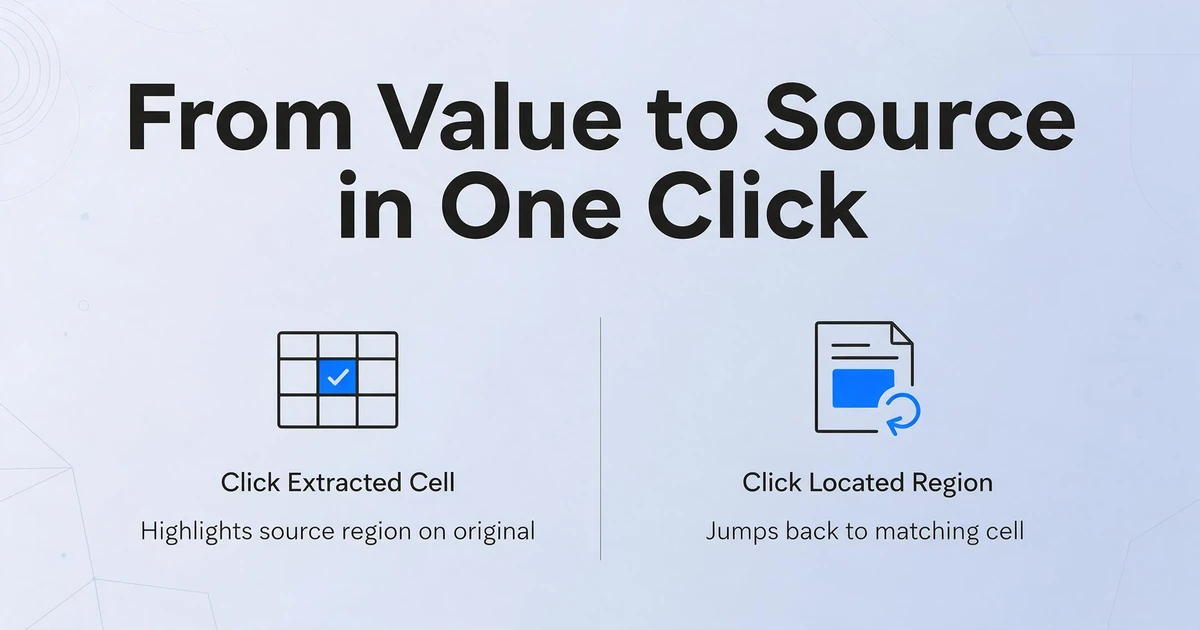
Review Mode with Bbox verification adds the field-level traceability layer. Hover or click any extracted cell and the tool highlights exactly where that value came from on the original image. The link runs in reverse too: click a located region on the page and it jumps back to the matching table cell. A bounding box, or bbox, is the rectangle drawn around the source region. If a field was edited, one click reveals the AI's original value and lets you restore it. A reviewer can confirm a disputed value against its source in seconds instead of re-reading the whole document by eye, which is the practical test of traceability.
Files are processed securely and not stored.
The Honest Capability Boundary
Now the part most vendor pages leave out. If your workflow has to survive a HIPAA, SOC 2, or GDPR audit, or a regulator may ask for field-level evidence across six months of transactions, you need auditability and governance, and you should choose differently. ImageToTable.ai does not provide a SOC 2 certification, an audit log, schema versioning, evaluation sets, or a human-in-the-loop review UI in the sense of a governance platform. Review Mode gives a reviewer field-level source traceability. It is a verification aid, not the audit trail itself.
Where governance requirements are high, the honest answer is an enterprise-grade IDP platform, or a cloud provider's document API plus the governance layer you build around it. Those bring the immutability, version history, contractual retention and residency controls, and certifications a regulated review expects. If you want to see what that end-to-end stack looks like before deciding, our guide to enterprise document automation maps the pieces.
The table below is the shortest version of the decision. Match the requirement to the class of tool, and be specific about which layer you actually need.
| Your requirement | The honest fit |
|---|---|
| Field-level source traceability for review, across varied document formats, without building a pipeline | ImageToTable.ai (v1 API + webhook, Review Mode + Bbox) |
| Per-field confidence and citations with schema-defined JSON, and you will own the governance build | A cloud document API (Textract, Document AI, Azure) plus your own controls |
| Audit logs, schema versioning, human review, and certifications as one suite | An enterprise-grade IDP or compliance extraction platform |
| On-premises or air-gapped deployment, or a signed BAA and zero-retention contract | An enterprise deployment; verify the exact terms in writing |
A rejection at procurement rarely means the tool was bad. It usually means the tool was answering a different layer than the one the reviewer was asking about. Knowing which layer you are buying is the difference between a fast decision and a rebuild six months in.
Frequently Asked Questions
What does traceability mean in a document extraction API?
Traceability means every extracted value carries a reference back to the exact place it came from in the source document, typically a page and a region (a bounding box or text span), usually with a confidence score. It lets a reviewer verify a specific value against the original instead of trusting that the system read it correctly.
Do I need SOC 2 for a compliance extraction workflow?
It depends on what you have to prove. SOC 2 speaks to how a provider controls its systems; it does not show where a disputed field came from. If your procurement requires a certification, treat it as a gate and still ask for per-field source citations, reviewer history, and retention terms. A certification without field-level provenance still leaves a reviewer unable to verify a value.
Is a bounding-box citation enough to satisfy an auditor?
Usually it is necessary and not sufficient. A bounding box answers where a value came from, which is the layer auditors test first. An auditor may also ask how the value was produced and changed over time, which needs extraction metadata, reviewer records, and an append-only history. Store the citation together with that metadata rather than only in the review screen.
What is the difference between a source citation and an audit log?
A source citation links a value to a location in the document. An audit log records events: who did what, when, and to which record. A citation lets a reviewer check a value; an audit log lets an auditor reconstruct the decision chain. One is evidence about the document, the other is evidence about the process.
Does ImageToTable.ai provide an audit log or SOC 2 certification?
No. ImageToTable.ai provides field-level source traceability through Review Mode and Bbox verification, plus a v1 API with webhook notifications and structured JSON output. It does not provide an audit log, schema versioning, evaluation sets, or a governance-grade human review platform. For workflows that require those, choose an enterprise-grade platform.
Which document extraction API should I choose for HIPAA data?
Start from the contract, not the feature list. You need a signed BAA, a documented retention answer for each endpoint you use, and field-level provenance so a reviewer can verify a value. A cloud provider's document API can be eligible, but verify the BAA, region, and retention terms directly. If you also need a built-in audit trail and versioned configurations, an enterprise IDP platform is the fit.
The compliance question is not which API is most accurate. It is whether you can show where every value came from, and prove how it was handled afterward. Traceability, the source-level layer, is something you can buy today, and Bbox review is the fastest way to see whether a candidate tool actually delivers it. Auditability and governance are the layers that decide the high end of the market, and those you build or buy from an enterprise platform. Know which one your workflow is really asking for before you sign.