Why Carrier COI Expirations Slip Through
Freight Broker Compliance
The most dangerous document in a freight brokerage isn't a cargo claim. It's a one-page ACORD 25 certificate of insurance — also known as a COI, the form that proves a motor carrier carries the legally required liability coverage — sitting in a compliance inbox with an expiration date that passed three weeks ago. Most brokers don't discover this until one of two things happens: a carrier audit forces a spreadsheet reconciliation, or worse, an accident involving a truck that, on paper, was insured.
Key Takeaways
- Sixty-six carrier COIs expire every month across a 200-carrier network — and the broker is always the last person in a three-party relay to learn a policy has lapsed.
- A jury returned an $18.15 million verdict against a broker whose carrier had a coverage gap — not because the broker caused the crash but because they dispatched a carrier whose insurance status they could not verify.
- Fixing this does not require carriers or insurance agents to change how they operate — it only requires eliminating the 3 minutes of manual data entry per COI that creates the detection gap where lapsed coverage hides.
The Math Problem Nobody Wants to Solve
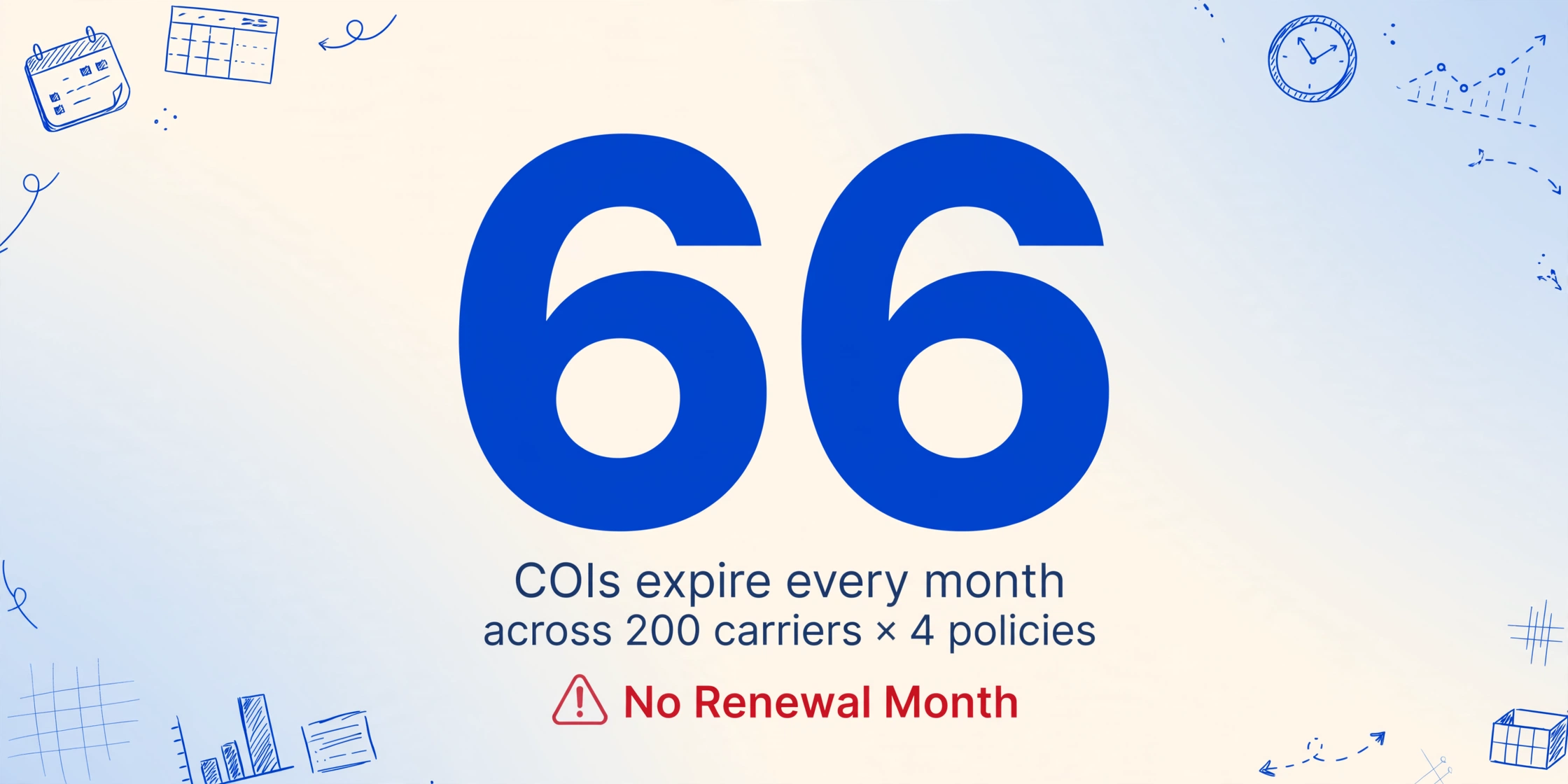
Let's put a number on what "managing carrier COIs at scale" actually means. A mid-size freight brokerage running 200 active carriers isn't unusual. Every carrier carries multiple policies: auto liability (required by federal law), cargo insurance (required by most shipper contracts), general liability, and in many cases workers' compensation or umbrella excess. That's four policy types per carrier, minimum. Each policy runs on a 12-month cycle.
Here's where the math gets uncomfortable: those 12-month cycles are not calendar-aligned. Carrier A's auto liability renews March 15. Carrier B's cargo insurance renews September 7. Carrier C's general liability renews November 23. Unlike tax season or open enrollment, there is no "COI renewal month" where everything comes due at once. Across 200 carriers with 4 policies each, you're tracking 800 individual data points — and roughly 66 of them expire every single month.
Now consider what happens when a policy expires: the carrier's insurance agent generates a renewal COI and emails it to the carrier. The carrier may or may not forward it to the broker. The broker's compliance person opens the COI PDF, reads the coverage limits, types the policy number, effective date, expiration date, and carrier name into a spreadsheet, then cross-checks against minimum requirements. At 3 minutes per COI for a careful read-and-enter, 66 COIs a month means over 3 hours of pure data transcription — before any actual compliance analysis begins. And that assumes every carrier sends the renewal on time, which brings us to the real problem.
The Three-Handed Relay Where Nobody Passes the Baton
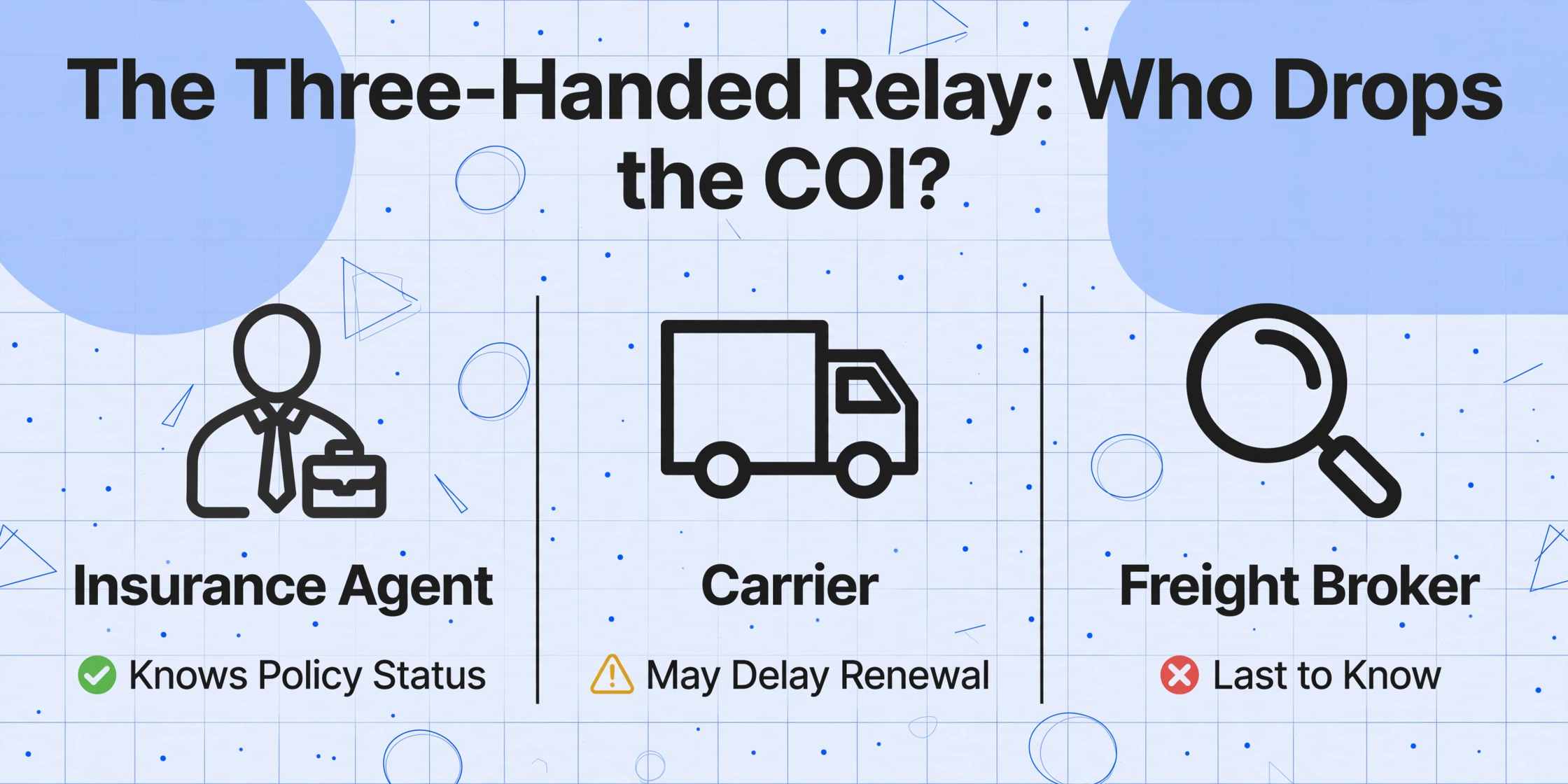
COI renewal is a three-party handoff with a fatal design flaw: the person who bears the consequences of a missed handoff has no direct line to the person holding the document.
The insurance agent — the only party who definitively knows the policy status — has a contractual relationship with the carrier, not the broker. When a carrier's auto liability renews, the agent sends the new COI to the carrier. That's where their obligation ends. The agent has no duty to notify the broker, no obligation to cc the broker's compliance inbox, and no agreement that says "please let the freight broker know if this carrier drops their coverage mid-term." The carrier is the agent's client. The broker is not.
The carrier, meanwhile, has a business incentive to keep hauling loads. A carrier whose insurance is about to expire isn't eager to broadcast that information to the broker who controls their freight. As one broker put it on r/FreightBrokers: "Then the carrier technically was uninsured the entire length of the policy and now has a gap when they go looking for a new policy." Carriers facing premium increases — and with commercial auto rates rising 37.8% per mile from 2014 to 2024 according to the American Transportation Research Institute — have financial pressure to delay renewal or shop around. Every day they spend comparing quotes is a day the broker has an uninsured carrier in the dispatch queue.
And the broker? The broker is the last to know. Because nobody in this relay has an obligation to tell them. The COI doesn't arrive in their inbox until the carrier decides to send it, by which point the renewal may have been sitting in the carrier's email for two weeks. The gap between "COI generated by agent" and "COI entered into broker's compliance system" is entirely unmonitored — and that gap is where lapsed coverage lives.
This isn't a hypothetical edge case. A broker on Reddit described a real-world consequence: "It got to the point that if a carrier had an expired COI in our system and the shipment had to load that day, we would tell them we couldn't." That's the moment when the relay fails and the broker is forced to choose between a business relationship and a compliance risk — a choice that should never exist in the first place.
Your TMS Tracks Dispatch to the Dollar. It Has No Idea Your Carrier Is Uninsured.
Freight brokers run on transportation management systems (TMS) — platforms like McLeod, Mercurygate, Turvo, and AscendTMS that handle the operational backbone of a brokerage: load tendering, carrier payment, route tracking, freight audit. These systems can tell you a carrier's on-time percentage, their average rate per mile, and exactly when a shipment was delivered. What they cannot tell you: whether that same carrier's auto liability policy expired 12 days ago.
This is not a bug. It's a capability gap baked into the architecture of every major TMS. TMS platforms were built to manage transportation execution — the movement of freight from pickup to delivery. Compliance monitoring, particularly around insurance expiry, was never a core design requirement. The result is that the single most business-critical document in carrier compliance — the COI — lives entirely outside the system brokers use every hour of every day.
In response, a layer of carrier-vetting add-ons has emerged: Highway, Carrier411, RMIS, OnRamp. These tools verify carrier authority, monitor safety ratings, and check insurance status at onboarding. But their model is point-in-time verification, not continuous monitoring. A carrier might pass the insurance check during onboarding in January. By April, their cargo policy has renewed — but nobody in the broker's office knows whether the new limits meet the shipper's contract requirements until someone asks for an updated COI, reads the PDF, and enters the data. OnRamp's own product documentation is straightforward about this: it's "the workflow layer that sits above your compliance verification tools — not a replacement for them."
The FMCSA's SAFER System — the government database brokers use to check active insurance filings — is another point-in-time snapshot. It confirms that, at the moment of query, the carrier has a policy on file with FMCSA. It does not tell you: whether that policy is 90 days from expiration, whether the limits meet your contract requirements, or whether the carrier also carries cargo coverage (which FMCSA does not mandate but every shipper contract does). And checking SAFER for 200 carriers daily is not a realistic workflow for a brokerage with two compliance staff.
Think of it this way: your TMS knows exactly how much you paid Carrier 147 last quarter, what their average transit time is, and how many claims they've had. But it cannot tell you the one piece of information that, if wrong, could cost your brokerage millions in liability — whether Carrier 147's insurance is actually active at the moment of dispatch.
The Asymmetry Problem: Carrier's Responsibility, Broker's Liability
Under federal law, the obligation to maintain insurance falls squarely on the motor carrier. 49 CFR §387.7 states unequivocally that no motor carrier may operate a commercial vehicle until it has in effect the minimum levels of financial responsibility — and those minimums are non-negotiable: $750,000 in public liability for general freight, $1,000,000 for hazardous materials, $5,000,000 for explosives or poison gas (49 CFR §387.9). The current FMCSA penalty for operating without required insurance is up to $21,114 per day of violation (49 CFR Part 386, Appendix B, 2025 adjusted).
So the carrier is responsible for maintaining coverage. But here is where the asymmetry becomes a broker's problem: under the legal theory of negligent selection, a broker who dispatches a carrier with lapsed, inadequate, or unverifiable coverage can be held liable for accidents caused by that carrier — even though maintaining coverage was the carrier's duty. The logic is straightforward. The broker chose the carrier. The broker had a duty to verify the carrier was compliant. The broker failed that duty.
In 2023, the Illinois Appellate Court wrestled with this exact question in Cornejo v. Alliance Shippers. A jury returned an $18,150,750 verdict against a freight broker — finding the motor carrier was an agent of the broker and that the broker bore vicarious liability for the driver's negligence (2023 IL App.1st No. 220633). The appellate court ultimately reversed on the agency question — but the fact that a jury was persuaded to treat broker and carrier as one entity tells you where the liability debate is heading.
And that debate is about to hit the U.S. Supreme Court. Montgomery v. Caribe Transport II, pending a decision expected by summer 2026, will determine whether the Federal Aviation Administration Authorization Act (FAAAA) preempts state-law negligent selection claims against brokers. If the Court rules that brokers can be sued at the state level for negligent carrier selection, the legal exposure for every broker who cannot demonstrate systematic COI verification becomes immediate and severe. As the plaintiff's bar has already signaled: "In every serious trucking accident case going forward, the first question your attorney should ask is: Was a broker involved in dispatching this truck?"
Now connect the dots: a broker managing 200 carriers is statistically seeing 66 COI expiry events per month. The COI renewal relay has no mechanism to ensure the broker receives the new certificate. The TMS doesn't monitor insurance status. And if a carrier with a lapsed policy causes an accident, the broker faces exposure not for causing the accident — but for selecting a carrier whose coverage they couldn't verify. The system is designed so that the party with the least real-time visibility bears the greatest legal exposure.
The 14-Year Story Insurance Companies Are Trying to Fix With Premiums, Not Prevention
There's a macro-economic layer to this problem that makes carrier COI tracking harder every year, and it has nothing to do with broker compliance programs.
Commercial auto insurance has been unprofitable for fourteen consecutive years. In 2024, the combined ratio hit 107.2 — meaning insurers paid out $1.07 in claims and expenses for every $1.00 they collected in premiums. Among the top 20 commercial auto insurers, 14 posted combined ratios above 100. The line has accumulated more than $10 billion in net underwriting losses in just the last two years. Trucking insurance premiums, meanwhile, surged to a record $0.102 per mile in 2024 — a 37.8% increase in a decade when the general inflation rate rose roughly half as fast (ATRI Operational Costs of Trucking, 2025).
And here's the critical fact: crash rates declined during this same period. Heavy-duty truck crash rates fell 2.6% from 2021 to 2024. Accidents went down. Premiums went up. The insurance industry's losses aren't coming from more crashes — they're coming from larger claims (so-called "nuclear verdicts"), aggressive plaintiff litigation, and medical cost inflation.
For brokers tracking carrier COIs, the insurance industry's response to this unprofitability has a direct downstream effect: carrier churn. When premiums rise, small carriers — who operate on thin margins and make up a significant percentage of many broker networks — face a brutal choice: pay the higher premium, reduce coverage, or let the policy lapse. A carrier that was fully compliant last year may drop from $1M to $750K in liability coverage to manage costs — and that new limit falls below many shipper contract requirements. Or they may let the policy lapse for 30 days while seeking a cheaper provider, creating a coverage gap that the broker's tracking system won't catch unless someone is actively monitoring. A lapse in coverage can put a carrier in the non-standard insurance market for years, where premiums are 30% to 50% higher for the same limits.
Transportation accounts for 72.6% of all domestic freight tonnage (CRC Group, 2025). Every piece of that 72.6% moves under a carrier whose COI status the broker is expected to know. When the insurance market makes carrier coverage more volatile, the broker's COI tracking workload becomes correspondingly more urgent — with the same tools and the same staff.
Closing the Gap: What a Broker CAN Control
If the previous sections paint a picture of structural forces arrayed against broker compliance — and they do — the question becomes: what can a broker actually do about it?
The single highest-leverage change available today is not buying a new COI tracking platform, adding compliance headcount, or demanding carriers adopt new technology (good luck). It's reducing the time between "COI received in inbox" and "COI data in spreadsheet where it can be checked." The gap between receipt and entry is where expired coverage goes undetected, and closing that gap doesn't require changing how carriers or insurance agents behave. It only requires changing how the broker processes what they already receive.
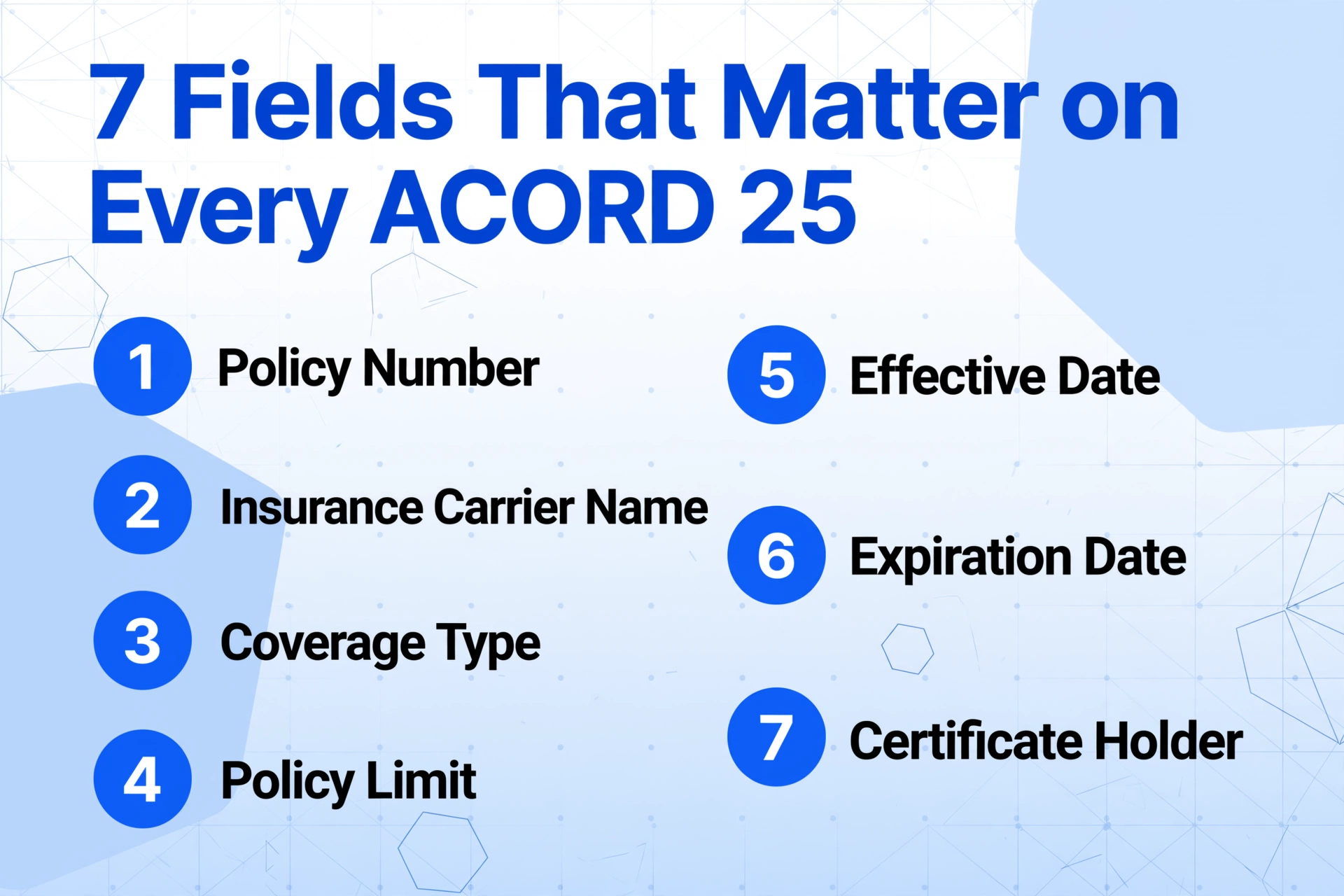
The data points that matter on every ACORD 25 COI are finite and predictable: Policy Number, Insurance Carrier Name, Coverage Type (Auto/Cargo/GL/WC), Policy Limit, Effective Date, Expiration Date, and Certificate Holder. Seven fields. That's it. Everything else on the 129-field ACORD 25 form is noise for compliance purposes — useful to the insurance industry, irrelevant for a broker verifying that a carrier meets the minimums.
Extracting those seven fields from a PDF doesn't require a managed compliance service or a per-seat software subscription. What it requires is a tool that reads the COI like a human reads it — by understanding what each field means, not where it sits on the page. Because COIs from different insurance carriers use different layouts, fonts, and field placements, a template-based or position-based extraction approach breaks the moment a carrier sends a COI from a new insurance company. This is what Custom Column Extraction solves: you name the columns you want — "Auto Liability Limit," "Expiration Date," "Certificate Holder" — and the AI locates each value anywhere on the document by understanding what it means, not by remembering a template. If you're new to this concept, start with our overview of COI data extraction, and the complete guide to COI extraction covers applicability across industries.
The practical workflow for a mid-size brokerage looks like this:
Collect all carrier COI PDFs
Whether they arrive by email, through a carrier portal, or from a compliance tool export — gather them into one folder. If you're already using Highway or Carrier411, you can batch-download the COIs carriers submitted during onboarding.
Extract the compliance fields
Set your target columns — Carrier Name, Policy Number, Auto Liability Limit, Cargo Limit, GL Limit, Effective Date, Expiration Date — and process the batch. All COIs extract into a single Excel table in one pass, regardless of which insurance company issued each form. For a step-by-step walkthrough, see how to extract carrier COI data for freight compliance.
Flag the problems automatically
Use Excel conditional formatting to highlight: (a) any Expiration Date within 30 days, (b) any Auto Liability Limit below $750,000 (or your contract minimum), (c) any missing Certificate Holder name. Compliance review becomes a Monday morning sort-and-check that finishes in minutes, not a multi-hour data entry session.
This workflow doesn't replace your TMS, your carrier-vetting tool, or your compliance process. It replaces the slowest, most error-prone, and least automatable step — the manual extraction of data from PDFs. Everything downstream (the conditional formatting, the expiry flags, the limit checks) already works. It was just waiting for data that someone had to type in first.
The construction industry deals with a parallel version of this problem — subcontractor COI tracking at scale — and the same extraction approach applies there too. If your compliance challenges span multiple industries, scaling COI tracking across 200+ subcontractors walks through the construction-specific version, and the construction industry's COI tracking problem analyzes the deeper structural parallels.
Frequently Asked Questions
Does this work with scanned COI PDFs, not just digital originals?
Yes. ImageToTable.ai processes both native PDFs and scanned/image-based PDFs — it reads the document visually, the same way a human would look at a scanned page. A COI that was printed, signed, and scanned back in is handled identically to a digitally generated one. Printed text, handwritten annotations in the margins, and stamped endorsements are all readable.
Our carriers send COIs from dozens of different insurance companies, all with different layouts. Will extraction still work?
Yes. The template-free nature of the extraction is specifically designed for this scenario. Because the AI locates fields by understanding what they mean (for example, the "Expiration Date" is always the date farthest into the future in the policy period section), it works across any ACORD 25 variant regardless of which insurance carrier's letterhead, layout, or font is used.
We already use a COI tracking platform like myCOI. Do we still need this?
COI tracking platforms automate reminders, flag expired certificates, and maintain compliance dashboards — but they still require someone to enter the data from the COI PDF into the platform. The extraction step is upstream of the tracking platform. You can extract COI data to a spreadsheet and import it into any tracking system, eliminating the manual data-entry bottleneck that exists before any automation can take over.
What if a COI has handwritten notes or stamped endorsements?
The AI reads handwriting, stamps, and annotations on the COI alongside the printed text. A manually written effective date or a stamp indicating additional insured status is captured just as a printed field would be. This is particularly important for COIs where the insurance agent has hand-corrected a limit or added an endorsement reference in the margins.
How do you handle the difference between "occurrence" and "claims-made" policy types on the COI?
The extraction captures the policy type exactly as stated on the COI. The distinction between occurrence-based and claims-made coverage matters for risk analysis — a claims-made policy that expires leaves a different kind of gap than an occurrence policy — but the extraction step is data capture, not interpretation. The spreadsheet or tracking system downstream handles the analysis; the extraction makes sure the data gets there accurately.
Can this integrate with our TMS?
Extracted data lands in Excel (XLSX) or CSV format, which is importable into every major TMS — McLeod, Mercurygate, Turvo, AscendTMS — as well as COI tracking platforms like myCOI and SmartCompliance. There's no direct API integration, but the XLSX/CSV output serves as a universal bridge format that any system with an import function can consume. The practical flow is: extract COIs to Excel → review and validate → import into your TMS or compliance system.
What you track is your business. Whether you can prove you tracked it — and have the documentation to show a court — is what separates compliant brokerages from exposed ones. The fastest way to close the gap between receiving a COI and verifying it is to eliminate the step where someone types data from a PDF into a spreadsheet. Try it on a batch of your current carrier COIs and see how many minutes per certificate you get back.