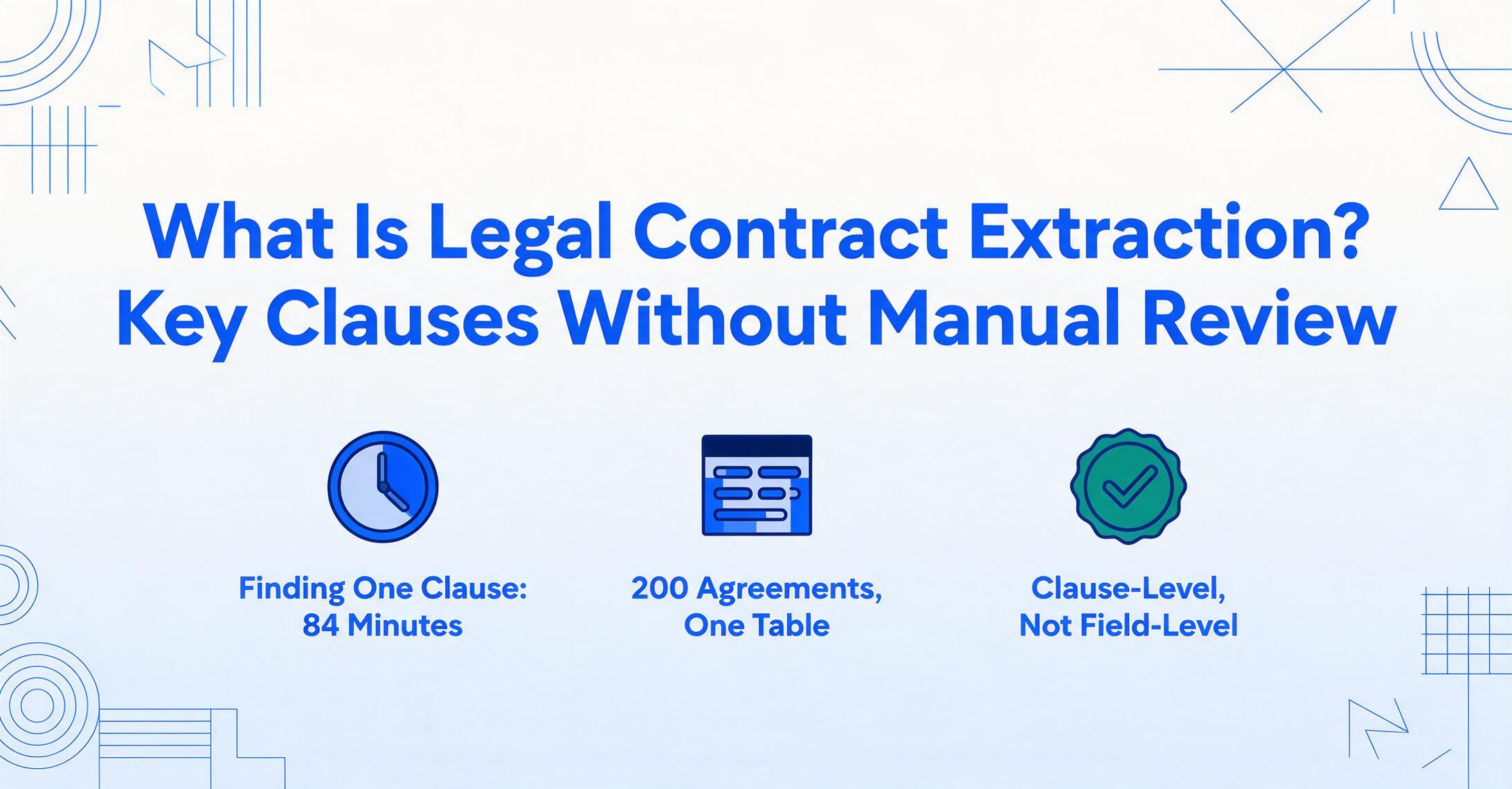
What Is Legal Contract Extraction?
Key Clauses Without Manual Review
Legal contract data extraction is the automated process of identifying and pulling key clauses — governing law, indemnification, limitation of liability, assignment, termination, confidentiality, and force majeure — from contracts and agreements into a structured format. Unlike general contract data extraction, which targets counterparty names, effective dates, and dollar values, legal extraction operates at the clause level: it reads dense legal provisions that span multiple paragraphs, determines their scope and boundaries, and outputs them as sortable, filterable data organized by matter, counterparty, or risk profile.
Key Takeaways
- 84 minutes per clause — and it has nothing to do with how fast you read.
- When every firm drafts the same provision under a different heading, searching manually isn't diligence. It's a retrieval problem disguised as a legal task.
- AI that reads contracts by what clauses do rather than what they're called transforms you from clause-hunter to risk analyst.
What Legal Contract Data Extraction Actually Means — and Why Clause-Level Matters
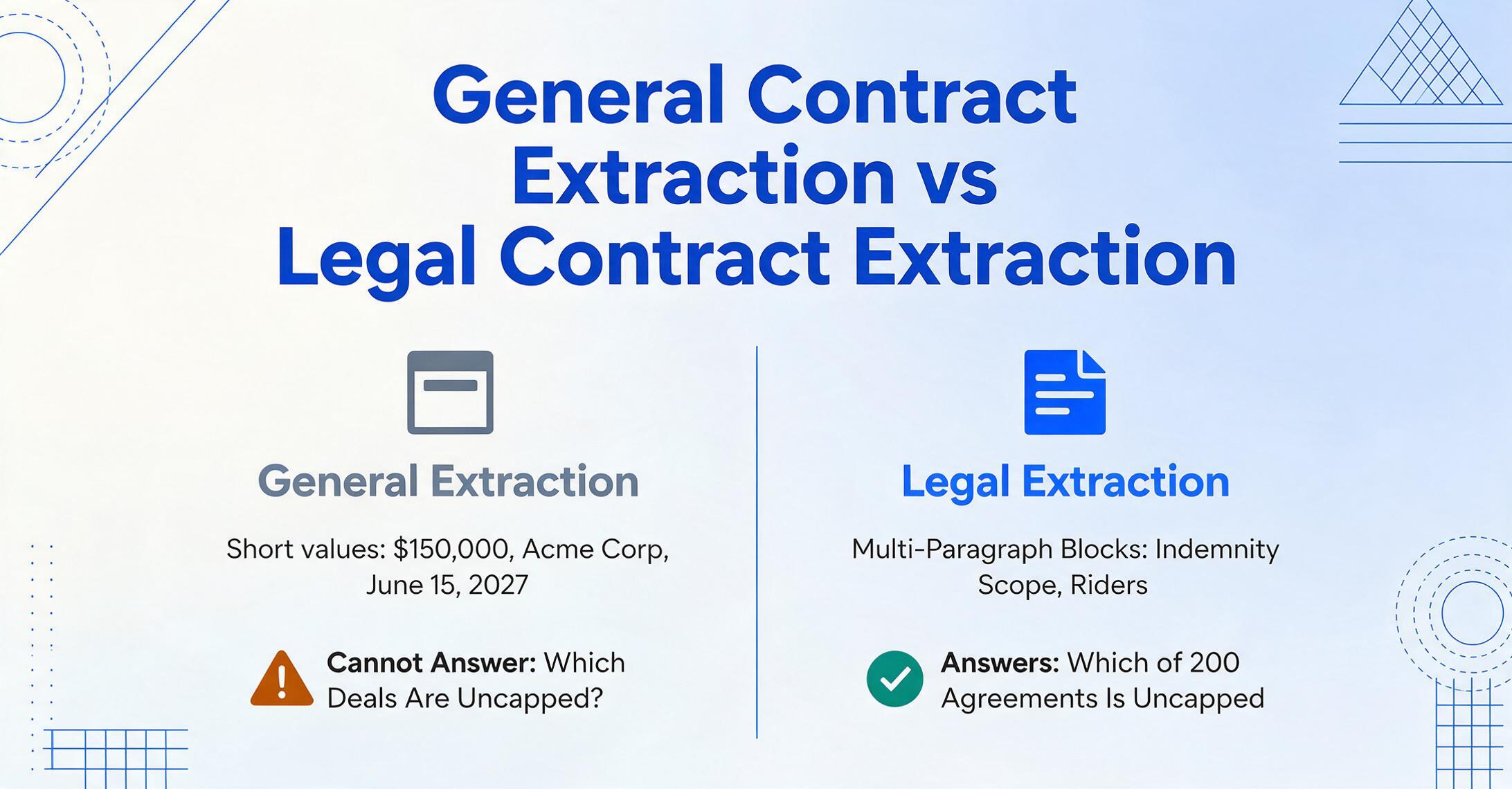
For law firms, the distinction between general contract data extraction and legal contract data extraction is not semantic — it defines what questions you can answer. General extraction answers portfolio questions: "what is the contract value?" Legal extraction answers risk questions: "which of our 200 agreements contain an uncapped indemnification clause?"
The extraction targets differ fundamentally in complexity. General extraction fields are short, discrete values — "$150,000," "Acme Corp," "June 15, 2027" — that fit neatly in a spreadsheet cell. Legal extraction targets are multi-paragraph blocks of legal language whose boundaries shift across agreements. An indemnification provision might span three sections, reference defined terms from page 2, and be modified by a rider in Exhibit C. The AI must determine not just "is this clause present" but "where does it begin and end, and does a later amendment override it?"
General Contract Extraction
- Counterparty names
- Effective and termination dates
- Contract value / total consideration
- Payment terms
Output: portfolio management
Legal Contract Extraction
- Indemnification scope and caps
- Limitation of liability provisions
- Force majeure triggers and carve-outs
- Arbitration / dispute resolution
- Non-compete / assignment restrictions
- Governing law + venue + jurisdiction
Output: risk analysis
The CLOC State of the Industry survey found that locating a single clause in a contract takes an average of 84 minutes, and legal teams average three hours per contract review. For a department handling 500 contracts a year, that means 188 of 250 working days vanish into retrieval before any legal analysis begins.
What Legal Contract Extraction Is — and What It Isn't
Four terms in legal technology describe related but different activities, and conflating them is the most common reason law firms buy the wrong tool.
e-Discovery finds documents in a collection — it answers "which files are responsive to a discovery request?" It does not output clause-level data. A firm running e-discovery on a contract-heavy matter still needs extraction to build the structured obligation map.
Contract Lifecycle Management (CLM) platforms manage drafting, storage, and renewal. Many include extraction, but it exists to populate the CLM's own database, not to give you a standalone spreadsheet. The ILTA 2025 survey (580 firms) found 31% cite technology cost as a top concern — CLM implementations that take months are part of that pressure.
AI Contract Review — Spellbook, LegalOn, LexCheck — analyzes content and flags risky clauses. Review answers "should I sign this?" Extraction answers "what's in these 200 agreements?" You need extraction first. For more, see contract review software vs AI extraction.
Legal contract extraction is the data step: it reads agreements and outputs clause-level content into structured tables. For extraction across all document types, see the AI document extraction overview.
How AI Clause Recognition Works — Semantic Extraction for Legal Language
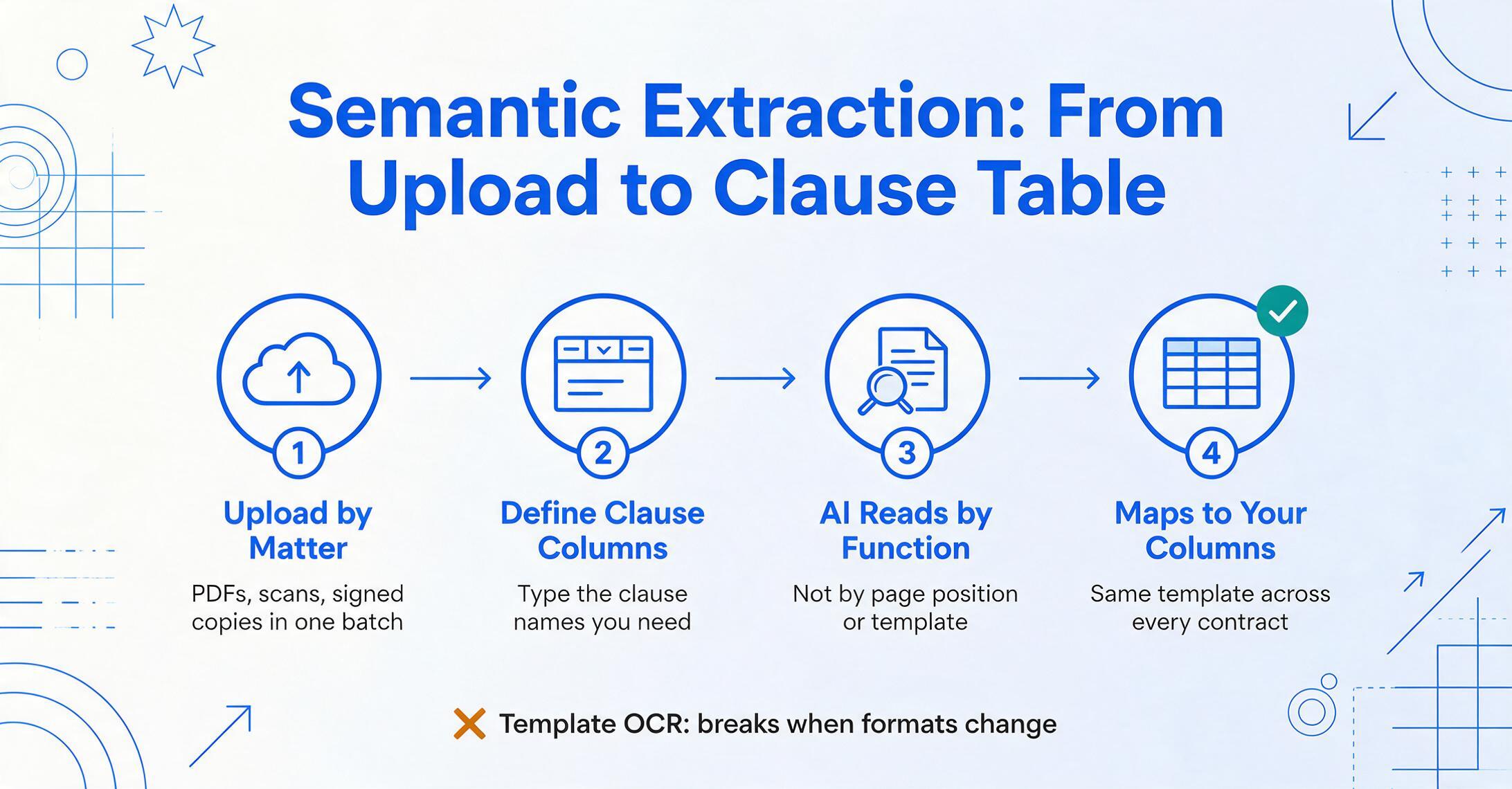
The shift from position-based to semantic extraction is what makes clause-level extraction possible at scale.
The old approach: template OCR. Traditional tools require you to define where each clause lives on the page — "the indemnification section starts after 'the parties agree as follows.'" But every contract uses different language, and every firm drafts differently. A merger agreement from Kirkland & Ellis structures its indemnification provision differently from a vendor agreement drafted by a boutique firm. Templates break silently when formats change, and maintenance costs grow with each new counterparty.
The modern approach: semantic extraction. AI-based tools read contracts by meaning, not by position. You define the output columns — "Indemnification Clause," "Governing Law," "Force Majeure" — and the AI reads every page of every contract, identifies each provision by understanding its legal function, and maps matches to the right column. This is Custom Column Extraction: you type the clause names you need, and the AI locates matching content anywhere in the document by understanding legal language semantically — regardless of which law firm drafted it. The same extraction template works across every contract in a matter.
Upload Contracts by Matter
Drop PDFs organized by matter — multi-page agreements, scanned contracts, digitally signed PDFs all go in together. No pre-sorting, no renaming.
Define the Clauses You Need
Type column names: "Indemnification Clause," "Limitation of Liability Cap," "Governing Law," "Force Majeure Triggers." These become your output spreadsheet headers. No template setup, no training samples.
AI Identifies Clauses by Legal Function
The vision model scans every page, identifies clause blocks by meaning, and maps each to the correct output column. The indemnification on page 15 and the same provision buried in a rider on page 42 both land in the same column.
Export and Analyze by Risk
Download as Excel, CSV, or JSON — or write into Google Sheets. Sort by governing law, filter for uncapped indemnification, pivot by counterparty. One unified spreadsheet for the entire matter.
Files are processed securely and not stored.
When Law Firms and Legal Teams Need Clause Extraction
1. M&A due diligence. A mid-market deal involves 100 to 300 contracts. Associates spend 80% of the review window just finding change-of-control provisions and assignment restrictions. Extraction collapses that: 200 contracts output clause-level data in minutes, shifting the team from searching to analyzing. The ABA's 2024 survey found 31% of attorneys now use generative AI at work, and ACC/Everlaw reports corporate legal AI adoption doubling from 23% to 52% — but for firms still doing manual diligence, extraction is the highest-ROI entry point.
2. Lease abstraction and portfolio review. Forty commercial leases means forty 40-to-60-page documents with renewal dates, escalation formulas, and use restrictions buried inside. Extraction turns the portfolio into one spreadsheet — every clause in columns you can sort and compare without opening a single file.
3. Ongoing obligation tracking. Post-signing obligations — notice deadlines, reporting requirements, compliance certifications — are scattered across different clauses. Tracking manually means re-reading each contract at each deadline. Extraction populates an obligation register once. For the batch workflow, see batch contract clause extraction.
4. Compliance audits and regulatory response. A regulatory inquiry requires identifying every contract with specific clause types — GDPR provisions, anti-corruption reps, export control language. Manual review means reading everything. Extraction means filtering a spreadsheet. For scanned pre-digital contracts alongside modern PDFs, see OCR for legal documents.
Key Clause Types That Legal Extraction Covers
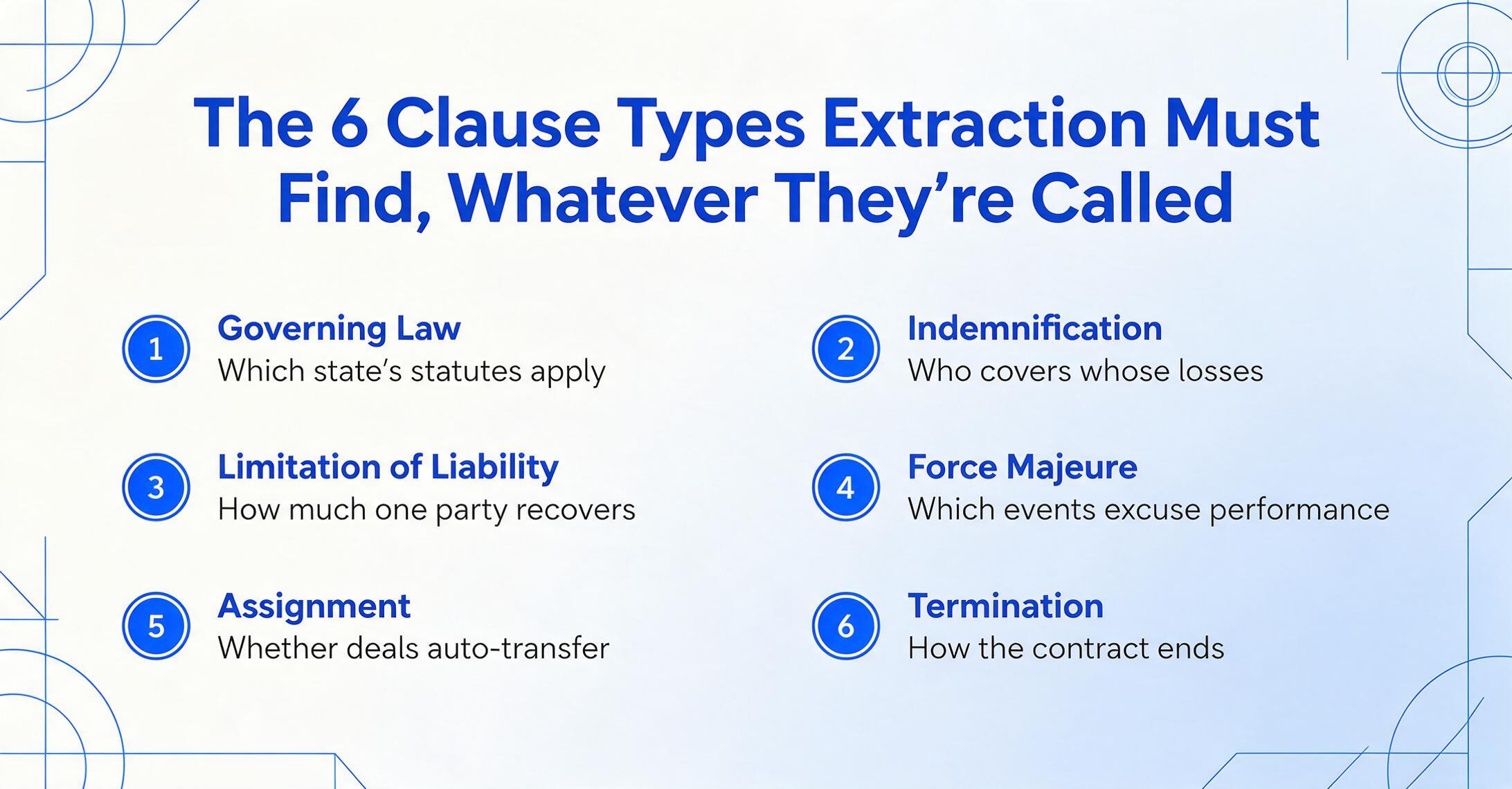
One challenge in legal contract extraction is that clause names are not standardized. What one agreement calls "Limitation of Liability" might appear as "Cap on Damages" in another. Extraction tools must recognize clauses by legal function, not section title.
Governing Law
Specifies which jurisdiction's laws interpret the contract. "This agreement shall be governed by the laws of the State of New York." Determines how disputes are resolved and what statutes apply.
Indemnification
One party agrees to cover the other's losses if a specified event occurs — a data breach, IP infringement, regulatory violation. The scope (uncapped vs capped, broad vs narrow triggers) is the primary driver of financial risk in a transaction.
Limitation of Liability
Caps the dollar amount one party can recover, often excluding consequential or punitive damages. The interaction between this clause and the indemnification provision is the most scrutinized area in contract review.
Force Majeure
Excuses performance when extraordinary events beyond either party's control occur — natural disasters, war, pandemics. Whether "pandemic" or "supply chain disruption" is explicitly listed became a critical review point after COVID-19.
Assignment
Controls whether a party can transfer its rights or obligations to another entity. In M&A due diligence, assignment clauses determine whether contracts automatically transfer to the acquirer or require counterparty consent.
Termination
Defines how the contract ends — for cause, for convenience (without cause), upon expiration, or on specified events. Termination for convenience provisions create material deal risk in long-term agreements.
Confidentiality
Defines what information is confidential, how it must be handled, and the duration of obligations. In cross-border deals, non-standard exceptions to confidentiality can create material risk.
Arbitration & Dispute Resolution
Specifies whether disputes go to court or arbitration, the forum (AAA, JAMS, ICC), and the seat. Mandatory arbitration clauses with class action waivers are common but increasingly scrutinized in commercial agreements.
These eight clause types represent the most commonly extracted provisions. The reliable extraction of each depends on the AI's ability to recognize a clause by its function even when the heading is missing or non-standard. For a practical guide, see how to extract specific fields from contracts.
What to Look For in a Legal Contract Extraction Tool
Clause-level capability, not just field extraction. A tool that extracts "Counterparty" and "Effective Date" but cannot identify an indemnification clause is a general extraction tool, not a legal one. Test with your actual contracts: can it find a limitation of liability cap across agreements drafted by 10 different firms with 10 different numbering conventions? For a side-by-side look at which tools handle clause-level extraction — and which are built for field data only — see our comparison of 9 contract extraction tools.
Template-free and training-free. If a vendor says "we need to train a model on your contract formats," you're buying setup overhead. A legal-grade tool should handle a contract from a counterparty it has never seen, in a format it has never encountered, on the first attempt — by reading semantically, not by matching a template.
Multi-section and exhibit handling. Legal contracts are 30 to 100 pages with exhibits, schedules, and amendments containing provisions the main body references. A tool that reads only the first 10 pages will miss the indemnification cap in Exhibit D. The tool must read the entire document as a logical unit.
Batch processing by matter. A batch upload of 50 contracts for one deal should produce one unified spreadsheet — one row per contract, columns for every clause — that feeds directly into the matter's due diligence checklist or review protocol.
Honest accuracy by clause type. "99% accuracy" usually refers to header fields on clean digital PDFs. Clause-level extraction is harder, and accuracy varies by clause type and contract complexity. The only meaningful test is running your firm's actual agreements — especially the ones with dense legalese, cross-referenced riders, and scanned signatures — through the tool before committing.
Frequently Asked Questions
Can legal contract extraction replace attorney review?
No. Extraction outputs structured clause data. Review assesses risk and advises on whether to sign. Extraction removes the retrieval burden — the 84 minutes per clause — so attorneys spend time on analysis, not hunting. With 67% of firms still billing hourly, extraction shifts hours from low-value retrieval to high-value legal judgment.
How is legal contract extraction different from e-discovery?
e-Discovery identifies relevant documents in a collection. Extraction reads the documents you already know are relevant and outputs clause-level data. For contract-heavy litigation, you need both: e-discovery to find the files, extraction to build the structured obligation map.
Can AI distinguish between an indemnification clause and a limitation of liability clause?
Generally yes, for clearly distinct provisions — they use different legal language and serve different purposes. Accuracy drops when both appear in the same section, are interwoven in dense boilerplate, or cross-reference definitions from earlier sections. For high-stakes agreements, human verification remains the correct practice.
Does legal contract extraction handle scanned PDFs?
Yes. Vision-based AI models read scanned PDFs by analyzing visual page content, not by extracting a text layer. A scanned 2010 merger agreement, a digitally signed engagement letter, and a phone photo of a printed term sheet all get the same treatment. The limit is image quality: if a human paralegal would struggle to read it, the AI will too.
What clause types are hardest for AI extraction?
The most reliably extracted clauses follow consistent drafting patterns: governing law, arbitration, force majeure, and limitation of liability. Less reliable are highly negotiated bespoke provisions, clauses that span multiple sections without clear boundaries, and provisions defined through cross-references to exhibits or external documents.
Can I process 200 contracts at once?
Yes — batch processing is the standard workflow for legal due diligence. Define your clause columns once, upload 50 to 200 contracts, and receive one spreadsheet with every clause populated across every contract. Each contract takes seconds to process, which moves due diligence from "weeks of associate time" to "an afternoon of review."
Where to Go From Here
Legal contract extraction addresses a quantifiable bottleneck: 84 minutes to locate a single clause, three hours per contract review, 75% of working days spent on retrieval when handling 500 contracts annually. For law firms — where time is inventory — extraction shifts hours from searching for clauses to analyzing what they mean for the client.
The technology exists today, and it does not require an enterprise CLM or months of configuration. If your firm handles more than a few dozen contracts per matter and regularly needs to answer "which agreements contain uncapped indemnification?", extraction turns those questions from multi-day research into spreadsheet filters. Start with the AI document extraction overview — or upload a sample contract and see clause-level extraction on your own documents.