The UAE E-Invoicing Mandate Leaves
PDFs in Your AP Inbox
The UAE e-invoicing mandate is written around the invoice your business issues. For the finance team that pays suppliers, the change that decides the workload is the invoice your business receives. From 1 January 2027, the largest UAE businesses must exchange B2B and B2G invoices as structured PINT AE XML across the Peppol network, and everyone else follows by 1 July 2027. That deadline rewrites how a compliant invoice is created. It does not stop suppliers from sending you PDFs, and a Ministry of Finance transition rule requires some of them to keep doing exactly that.
Key Takeaways
- Your inbox will not go paperless in 2027, because the deadline only rewrites the invoices you issue.
- A supplier can be fully compliant and still legally required to send you a PDF while you are not onboarded.
- Your suppliers will stay split across three groups for years, so turn every received PDF into the same rows your accounting system expects.
The UAE e-invoicing mandate in one table
The UAE is moving to a decentralised continuous transaction control model it calls the Electronic Invoicing System. Invoices and credit notes for B2B and B2G transactions must be issued as structured XML in PINT AE, the UAE localisation of the Peppol International Invoice standard, and exchanged through an Accredited Service Provider (ASP) approved by the Ministry of Finance. The rules sit in Ministerial Decision No. 243 of 2025 (the framework) and Ministerial Decision No. 244 of 2025 (the timeline), with operational detail in the Ministry of Finance Electronic Invoicing Guidelines.
Three scope points matter before the dates. The mandate follows your Tax Registration Number, so it applies whether or not you are VAT registered. It covers free zone businesses unless they fall in a named exclusion. Business-to-consumer sales are out of scope for now, and so are sovereign government activity, international airline services, and VAT-exempt or zero-rated financial services.
| Phase | Applies to | Appoint an ASP by | Go live |
|---|---|---|---|
| Voluntary pilot | Any business that opts in | Not required | From 1 July 2026 |
| Wave 1 | Revenue of AED 50 million or more | 30 October 2026 | 1 January 2027 |
| Wave 2 | Revenue below AED 50 million | 31 March 2027 | 1 July 2027 |
| B2G | Government entities | 31 March 2027 | 1 October 2027 |
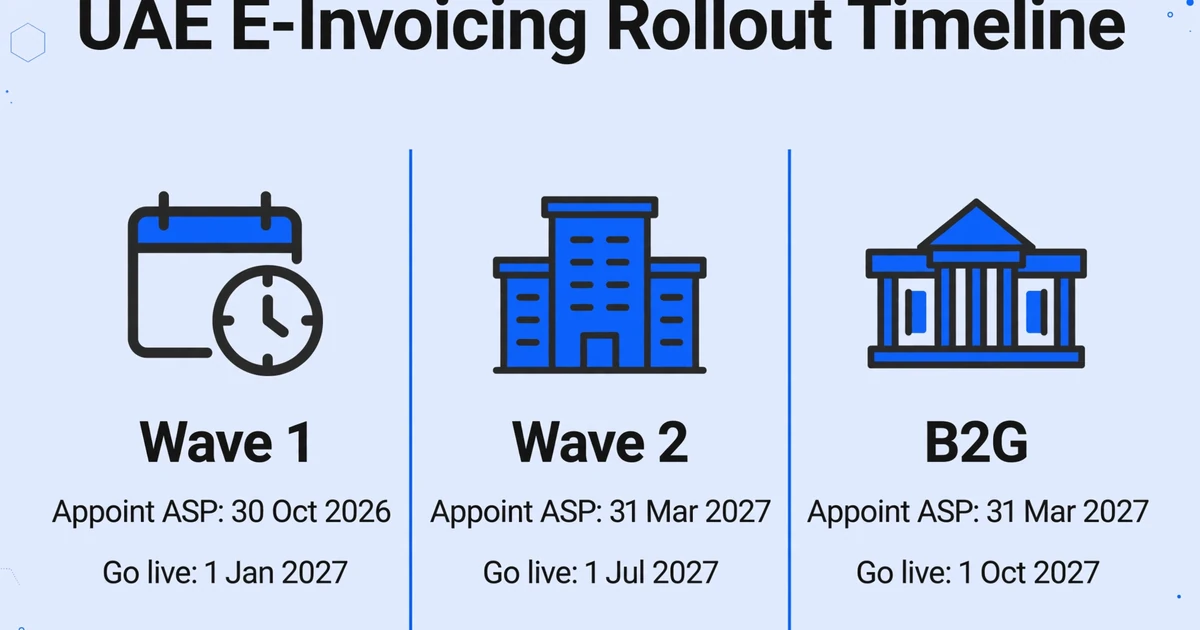
The Wave 1 appointment date moved once already. Ministerial Decision No. 66 of 2026 pushed it from 31 July 2026 to 30 October 2026, while leaving the 1 January 2027 go-live untouched. The extra time is for choosing a provider, not for starting the project later. Once your phase begins, an invoice must be issued within 14 days of the taxable event, and a system failure has to be reported to the Federal Tax Authority within two business days.
Penalties are cumulative and start on your go-live date: AED 5,000 for each month or part of a month without implementation or an appointed ASP, AED 100 for each invoice or credit note not issued electronically (capped at AED 5,000 per calendar month), and AED 1,000 per day for an unreported system failure or for failing to update your ASP on registered data changes, under Cabinet Decision No. 106 of 2025.
What PINT AE changes about an invoice
PINT AE is a structured document, and the difference from a PDF has nothing to do with how clean the page looks. Every value sits in a field with a defined name and a defined type, so a receiving system can locate the supplier's Tax Registration Number, the invoice date, the VAT breakdown, and the totals without a human or an OCR engine interpreting a picture. The Federal Tax Authority is explicit that PDFs, Word documents, images, scanned copies, and emails are not e-invoices, before or after digitisation.
The exchange runs on a five-corner model. The supplier produces the invoice data, the supplier's ASP validates it and converts it to PINT AE XML, the buyer's ASP receives it over Peppol and delivers it to the buyer, and the Federal Tax Authority receives the tax-relevant data as the fifth corner. Only providers accredited by the Ministry of Finance can connect to this network, and the published accreditation list is the only source of legitimate ASPs. The FTA's E-Billing System is a repository for tax data, not a validation layer; schema and business-rule validation happens at the ASP. If you want the underlying network explained, our Peppol e-invoicing explainer covers what an access point does and how the UAE model differs from the European one.
One consequence is easy to miss. A compliant supplier does not need your consent to send a structured invoice, but neither supplier nor buyer can complete the exchange alone. Both sides need an onboarded ASP, which means a single not-yet-ready party blocks the structured route and pushes the transaction back to an unstructured one.
Why PDFs keep arriving after your compliance date
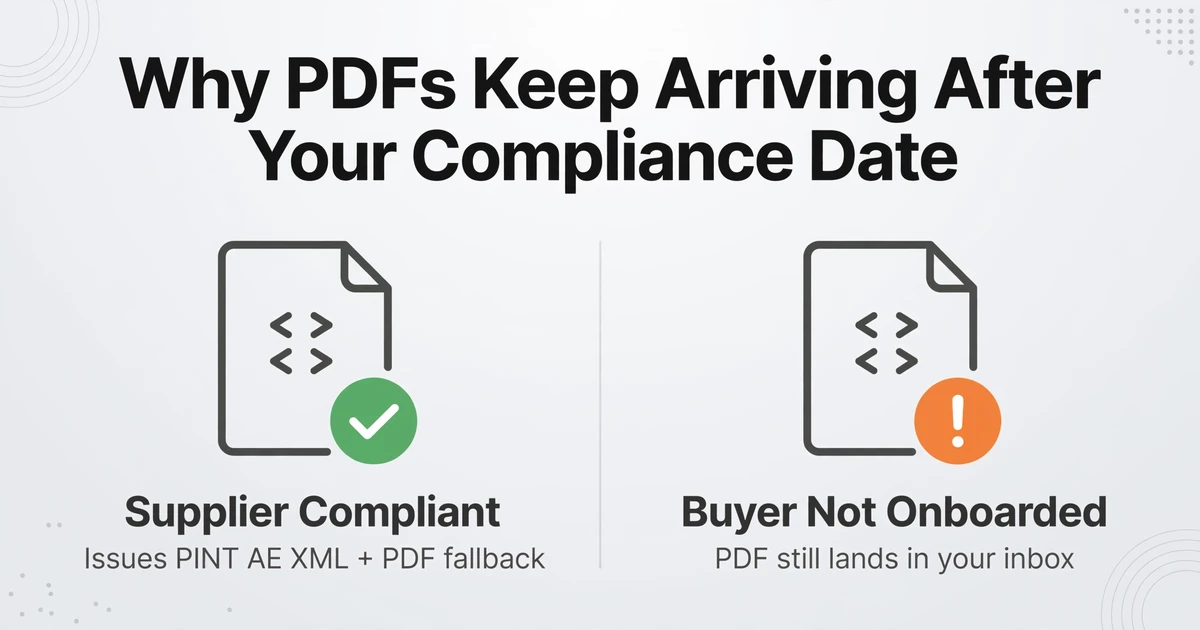
The Ministry of Finance built an explicit transition rule into the Electronic Invoicing Guidelines, and it is the single most useful fact for an accounts payable team. If the buyer has not yet implemented e-invoicing, the supplier should issue both a traditional VAT-compliant tax invoice, such as a PDF, and an electronic tax invoice in XML using a predefined fallback endpoint. A supplier can therefore be fully compliant while still placing a PDF in your inbox, for as long as you are not onboarded.
That rule sits alongside three more sources of paper. Wave 2 businesses do not go live until 1 July 2027, and adoption within a phase is rarely instant. Suppliers established outside the UAE are in scope only where they are required to issue a UAE tax invoice, so cross-border invoices from overseas vendors keep arriving as they always did. Business-to-consumer and excluded transactions stay outside the system entirely. In practice, your supplier base will be split across three groups for years: those already exchanging PINT AE, those still on the mandate's transition path, and those who will never be in scope.
The e-invoicing mandate changes what a valid invoice is. It does not remove the PDFs, and the transition rule is the reason the inbox stays mixed long after your own go-live date.
For companies that also handle European suppliers, the same pattern plays out on a larger scale. Our Europe e-invoicing timeline tracks how each member state phases in structured exchange while legacy formats persist during the transition.
Where received invoice data gets stuck
Receiving is only half the obligation. The other half is what happens after the invoice lands. A PINT AE document delivers data your accounting system can post. A PDF delivers a picture your team has to read. When a company has the structured route working but no design for the inbound side, the common failure is that staff convert the structured invoice back into a visual document, print it or open it on screen, and key the fields in by hand. The format improved and the process did not.
Either way, the same fields have to leave the document and reach your books. For an accounts payable workflow those are the supplier name, the supplier's Tax Registration Number, the invoice number, the invoice date, the value before VAT, the VAT amount, the gross total, the currency, and a reference such as a purchase order number for matching. A structured invoice supplies them directly. A PDF or a scan supplies them only when someone, or something, reads the page. Most UAE teams then key those fields into Zoho Books, QuickBooks, Xero, or Tally by hand, which is why the format of the inbound document still decides the day's workload.
The pressure shows up in the smaller businesses first. On r/SmallBusinessUAE, an owner of a small IT company wrote that he had "just come to know the FTA mandate of E-Invoicing" only as the deadline approached. If the senders are still catching up on the rules, the receivers cannot assume a clean stream of structured invoices on day one. The steady middle of this transition is a folder of received PDFs that still has to become a set of rows someone can approve, post, and keep.
Running two processes in parallel makes the problem worse. A team that posts structured invoices one way and PDF invoices another ends up with two cycle times, two error rates, and one reconciliation task that falls to whoever has the least time. The practical move is to give the unstructured invoices a direct route to the same structured output, so the batch does not depend on every supplier onboarding at once. Our wider e-invoicing compliance guide covers the same mixed-format problem across markets.
Turning received invoices into rows you can post
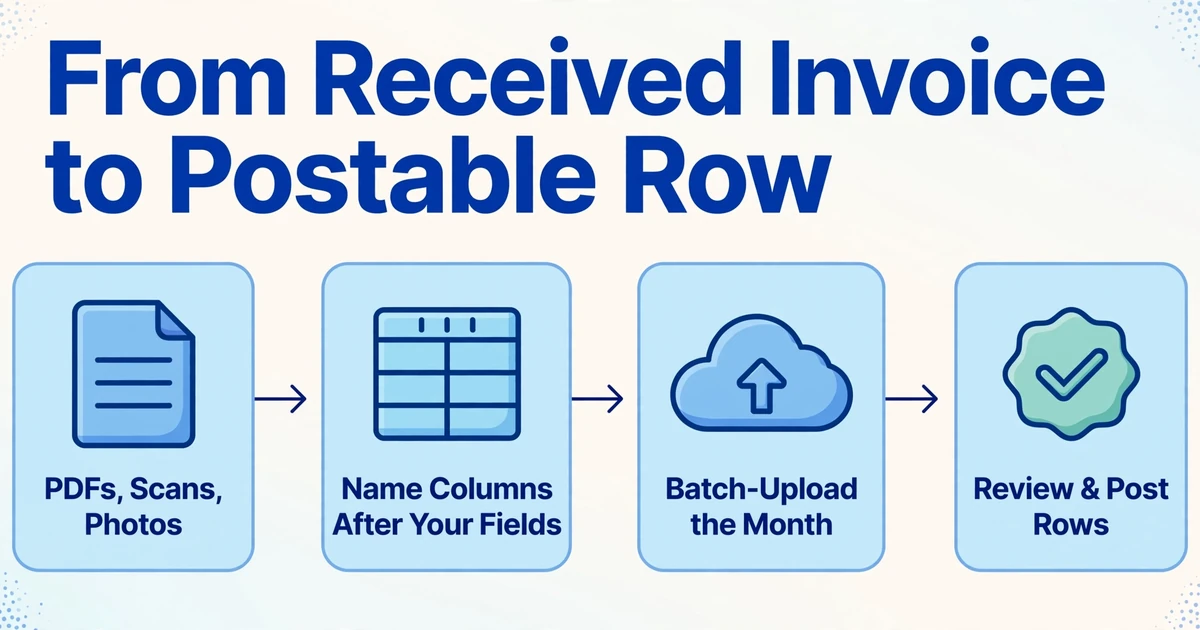
The extraction step is narrow and specific: take the invoices that arrive as PDFs, scans, or photos, and produce the fields your AP workflow already uses, one row per document. ImageToTable.ai does this with Custom Column Extraction. Instead of drawing boxes around fields or building a template for each supplier layout, you type the column names you want, and the AI reads each document and locates the matching value by what it means rather than where it sits. The column names you type become the headers of the output table.
Because the output is defined by your columns, the cleanest approach is to name them after the fields you post: "Supplier Name", "Supplier TRN", "Invoice Number", "Invoice Date", "Net Amount", "VAT Amount", "Total Amount", and "Currency". A supplier who prints "Tax Invoice No." and another who prints "Invoice #" both resolve to the same column, so the output arrives shaped like your review sheet rather than like an invoice dump. If you simply want a working spreadsheet first, you can extract invoice data into Excel and rename the columns later.
For one period of received invoices, the preparation runs in this order.
Name the columns after the fields you post
Type "Supplier Name", "Supplier TRN", "Invoice Number", "Invoice Date", "Net Amount", "VAT Amount", "Total Amount", and "Currency" as your output columns, so the sheet arrives shaped like your AP review.
Batch-upload the month's received invoices
Upload the whole period in one batch. The tool is batch-first: it processes the files together and merges them into a single sheet, one row per document. It accepts PDF, JPG, PNG, WebP, AVIF, and screenshots, including password-protected PDFs.
Add the working columns that catch errors
Add a computed column such as VAT Check (Net Amount × 5% = VAT Amount?) to flag rows where the printed VAT does not match the UAE standard rate, and an inferred Document Type (options: Tax Invoice/Credit Note) column so credit notes separate from purchases in one pass.
Standardize dates and amounts
Set dates to one format and confirm "Net Amount" holds the figure before VAT, not the total. Data standardization cleans dates, amounts, and reference numbers during extraction, so the sheet is ready to import rather than ready to tidy.
Review by exception, not row by row
Bbox-assisted review highlights where a value came from on the original invoice when you click that cell, so a wrong TRN or a VAT amount taken from the wrong line is visible without re-reading the page. Sort by the VAT Check column, inspect the flagged rows, and scan for blank Supplier TRN or Invoice Number cells.
Keep a source trail with the rows
Add a Source File column and a status column in your review workbook so every row traces back to an invoice. The import file carries the posting fields; the workbook is what lets you prove a record months later.
What this does and does not do
The boundary matters as much as the capability. Extraction produces the rows: supplier name, TRN, invoice number and date, net, VAT, total, and currency, in columns named for your workflow, with source tracing and checks attached. That is where the responsibility ends.
It does not issue e-invoices, generate PINT AE XML, connect to the Peppol network, act as an Accredited Service Provider, transmit anything to the Federal Tax Authority, or provide compliance archiving and filing. It does not read the PINT AE XML file itself; a structured e-invoice arriving through your ASP is your accounting system's job. The tool works on the visual documents in the transition: PDFs, scans, photos, and screenshots of invoices. It also does not decide whether input VAT is deductible or whether a purchase matches its purchase order, because those are accounting judgments about the supply, not extraction questions.
Accuracy on clean printed invoices is high, and it is lower on faint scans and dense handwriting, so a review step stays in place for those. Printed table data is recognised at up to 99% accuracy and a page is processed in five to ten seconds, against roughly three minutes of manual entry. The honest summary is that extraction closes the gap between an unstructured invoice and a structured record. It does not close the gap between you and your ASP.
How long you must keep what you receive
Record-keeping obligations apply to the invoices you receive, not only the ones you issue. Under Article 78 of Federal Decree-Law No. 8 of 2017, VAT records are kept for five years from the end of the relevant tax period (Federal Tax Authority). Corporate tax records run for seven years, and records tied to real estate under the Capital Assets Scheme run for fifteen. When one purchase invoice supports both a VAT claim and a corporate tax deduction, the longer period governs.
Two clarifications from the guidelines change how teams plan. Data may be stored inside or outside the UAE, including in the cloud, provided the records stay complete, readable, reproducible, and available to the FTA on request. And the duty to produce those records stays with the taxpayer even when archiving is outsourced to an ASP, so a provider change does not move the obligation with it.
Extraction does not archive anything for you, and it is not a filing system. What a structured review workbook does is make the record easier to reproduce: a Source File column ties every row to its invoice, and the sheet is already machine-readable if an auditor asks for a period's purchases. The retention clock and the audit response remain yours.
Frequently asked questions
Is a PDF invoice still valid in the UAE after the e-invoicing mandate?
A PDF does not qualify as an e-invoice, but it can still be a valid tax invoice during the transition. If the buyer has not implemented e-invoicing, the supplier is expected to issue both a conventional VAT-compliant invoice, such as a PDF, and an XML e-invoice. Once both parties are onboarded, the structured invoice becomes the document of record and a PDF is only a human-readable copy.
Do I need an Accredited Service Provider if I only receive invoices?
Yes, if you are in scope. Buyers receive PINT AE invoices through their own ASP, so a supplier and a buyer each need an onboarded provider for the structured exchange to complete. If your supplier's ASP is ready and yours is not, the invoice cannot travel the structured route.
What is PINT AE?
PINT AE is the UAE's localisation of the Peppol International Invoice specification, transmitted as UBL 2.1 XML. It defines which fields an e-invoice carries, which are mandatory, conditional, or optional, and how tax information is presented, so any Accredited Service Provider can validate the document and any buyer's system can read it without re-keying.
Can ImageToTable.ai read a PINT AE XML e-invoice?
No. The tool reads visual documents such as PDFs, scans, photos, and screenshots. A PINT AE XML file is a structured document handled by your ASP and accounting system. The extraction step is for the unstructured invoices that arrive alongside or outside the Peppol network during the transition.
My suppliers are small and will not be onboarded by 2027. What do I do with their PDFs?
Keep processing them, but give them the same destination as your structured invoices. Extract the fields your AP workflow posts into a sheet, name the columns after those fields, and add a source column so every row traces to an invoice. The goal is one output schema for both routes, so a supplier's format decision does not fork your process.
How long must I keep supplier invoices I receive?
Five years for VAT records from the end of the relevant tax period, seven years for corporate tax records, and fifteen years for real estate records under the Capital Assets Scheme. Where one invoice supports both VAT and corporate tax, use the longer period. The duty to produce the records stays with you even if an ASP stores them.
Does the mandate apply to free zone companies and non-VAT-registered businesses?
The system follows your Tax Registration Number, so it is not limited to VAT-registered mainland companies. Free zone businesses are in scope unless they fall within a named exclusion, and a business that is not VAT registered can still be in scope for B2B and B2G transactions. Excluded cases include holding companies that earn only passive income.
The invoice you receive is still the work
The headline of the UAE mandate is a change to how invoices are issued, and the go-live dates are what get the attention. For an AP team, the operative fact is quieter: a large share of the invoices you receive will keep arriving as PDFs and scans well past your compliance date, and those documents still have to become rows you can approve, post, and keep. The e-invoicing deadline does not do that part for you.
Try it on a month of received supplier invoices. Upload the batch, name the columns after the fields your AP workflow uses, and check the resulting rows against the invoices before you rely on them.
Start with your own invoices