France Factur-X Mandate 2026:
What Finance Teams Need Before September
France's B2B e-invoicing mandate activates on 1 September 2026 — the first large-scale European mandate built around a hybrid format that embeds structured XML inside a human-readable PDF. The hybrid design, called Factur-X, was intended to make the transition smoother for businesses of all sizes. In practice, it creates a two-layer compliance challenge: your receiving systems must handle both the visual PDF layer and the structured XML layer, often from the same invoice — and the data depth in each layer can differ.
Key Takeaways
- E-invoicing mandates are meant to eliminate manual data extraction, but the French Factur-X mandate will do the opposite for at least three years — small suppliers will send MINIMUM-profile invoices whose XML carries only header data, while line items exist exclusively in the visual PDF layer.
- The format designed to bridge structured and unstructured worlds — Factur-X's hybrid PDF/A-3 + XML — creates a two-layer processing burden that pure-XML regimes avoid: your AP team will run one pipeline for complete XML invoices and another for PDFs needing visual extraction, often from the same supplier on different days.
- A single extraction tool that reads both the XML layer and the visual PDF layer using the same column definitions makes the invoice profile level irrelevant — MINIMUM, EN 16931, or plain PDF, every invoice feeds the same AP workflow.
What the French Factur-X Mandate Requires
The French e-invoicing reform, formally established by Article 26 of the Amending Finance Law No. 2022-1157 of 16 August 2022 and detailed in Ordinance No. 2021-1190, amends Articles 289 bis and 290 of the Code Général des Impôts (CGI) to require that all domestic B2B invoices between VAT-registered entities be exchanged as structured electronic documents. The mandate was later refined by Article 91 of Finance Law No. 2023-1322 and most recently by Article 123 of the Finance Law for 2026 (Law No. 2026-103 of 19 February 2026), which finalised the enforcement timeline, penalty structure, and platform architecture.
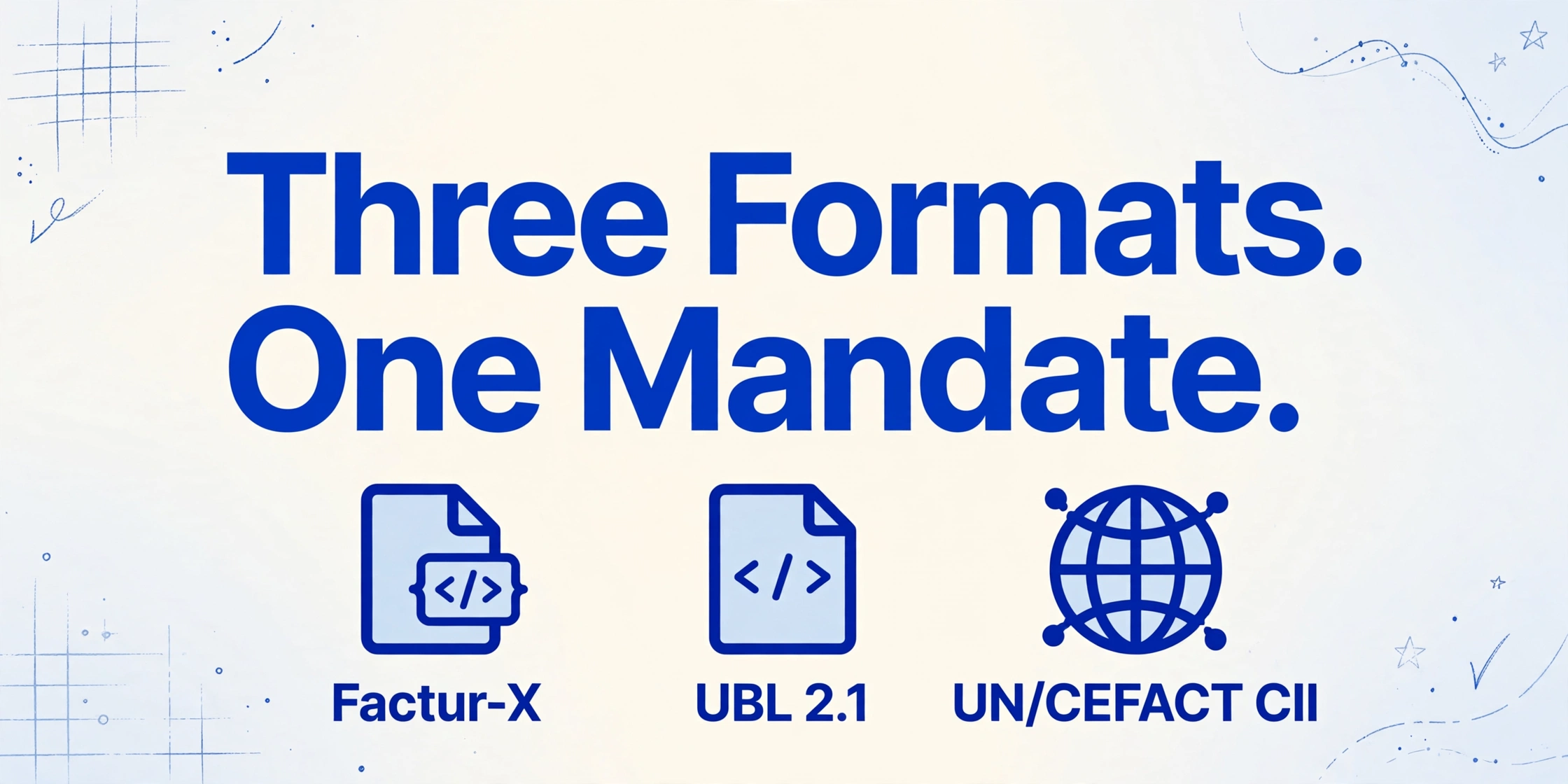
Three structured formats are permitted: Factur-X (a hybrid PDF/A-3 with embedded XML), UBL 2.1, and UN/CEFACT CII (Cross Industry Invoice). All must conform to the European semantic standard EN 16931. Paper invoices and plain PDF attachments sent via email will no longer be legally valid for domestic B2B transactions once the mandate applies to the issuing entity.
The mandate introduces two parallel obligations. E-invoicing covers the exchange of structured invoices for domestic B2B transactions. E-reporting is a separate requirement to transmit transaction data for B2C sales and cross-border B2B supplies to the tax authority (DGFiP) — even if those transactions do not result in a structured invoice. The two obligations follow the same phased timeline.
Legal foundation: Law No. 2022-1157 (Article 26), Ordinance No. 2021-1190, Decree No. 2022-1299, and Article 123 of Law No. 2026-103. These texts establish the DGFiP's authority to mandate structured e-invoicing, set the penalty framework (€15 per non-compliant invoice, capped at €15,000/year), and define the role of approved third-party platforms.
Who Is Affected
Every VAT-registered business established in France is in scope. The obligations apply to both the issuing and receiving ends, but the deadlines differ by company size. The DGFiP uses four categories based on headcount, annual turnover, and total balance sheet, following the European Commission's SME definition framework:
| Category | Headcount | Annual Turnover (excl. VAT) | Total Balance Sheet |
|---|---|---|---|
| GE (Grande Entreprise) | >5,000 | >€1.5 billion | >€2 billion |
| ETI (Entreprise de Taille Intermédiaire) | 250–4,999 | ≤€1.5 billion | ≤€2 billion |
| PME (Petite ou Moyenne Entreprise) | <250 | ≤€50 million | ≤€43 million |
| TPE (Très Petite Entreprise / Micro) | <10 | ≤€2 million | ≤€2 million |
Foreign companies that are VAT-registered in France also fall under the mandate. If your organisation is not domiciled in France but holds a French VAT number — for example, because you sell goods stored in a French warehouse — you must comply with both e-invoicing (for B2B) and e-reporting (for B2C and cross-border) on the same schedule as domestic businesses.
Phased Timeline: What Happens When
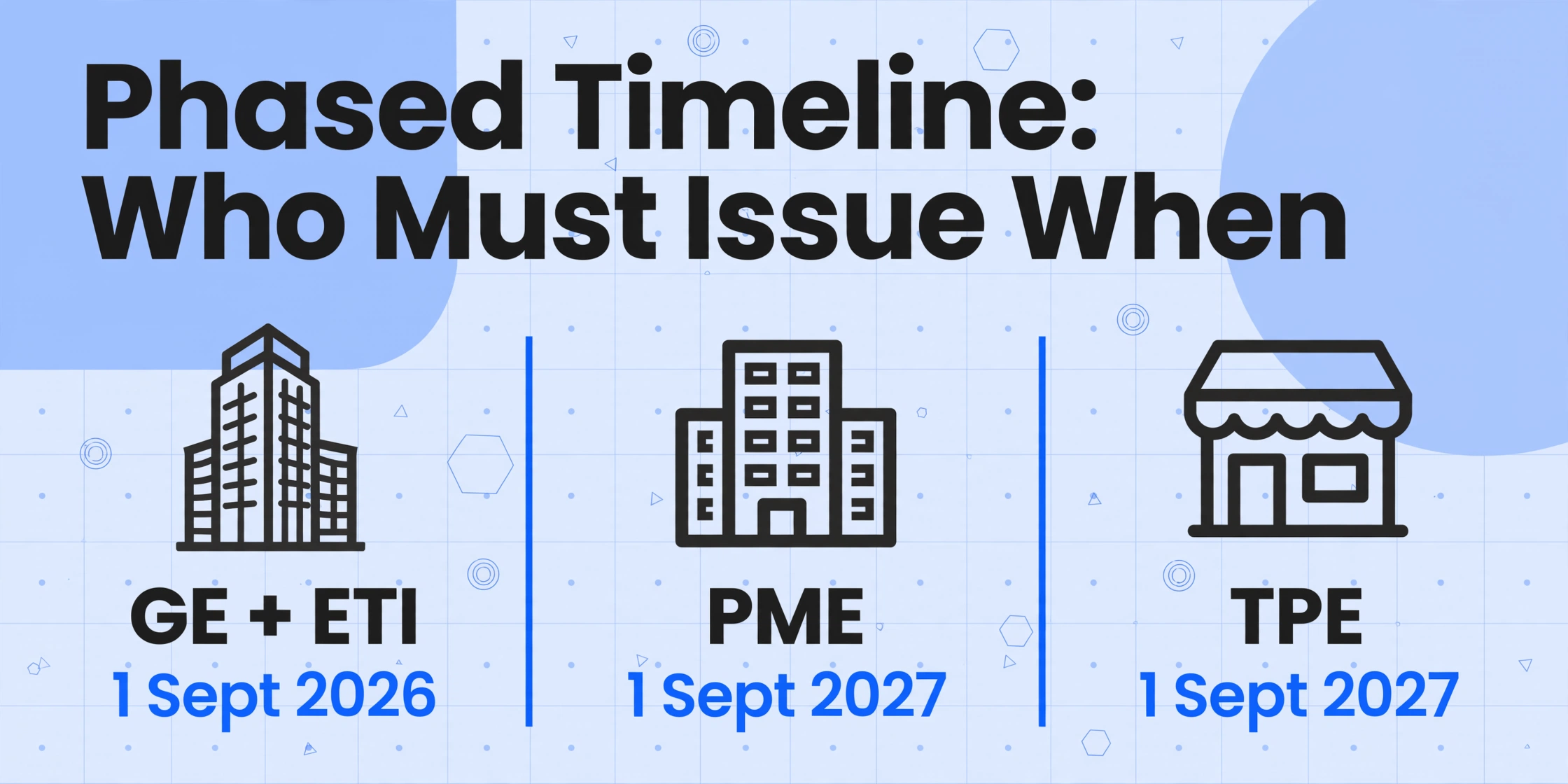
The rollout follows a two-wave structure. All businesses must be capable of receiving e-invoices from day one. The obligation to issue e-invoices (and comply with e-reporting) phases in by company size. The pilot phase for testing B2B exchanges with production data began on 23 February 2026, and the DGFiP published its first official register of approved platforms on 17 January 2026.
| Date | Affected Entities | Receive Obligation | Issue Obligation | E-Reporting |
|---|---|---|---|---|
| 1 Sept 2026 | All VAT-registered businesses | Mandatory | — | — |
| 1 Sept 2026 | Large enterprises (GE) + Intermediate-sized (ETI) | Mandatory | Mandatory | Mandatory |
| 1 Sept 2027 | SMEs (PME) + Micro-enterprises (TPE) | Mandatory | Mandatory | Mandatory |
The French government has indicated that both the September 2026 and September 2027 deadlines may be postponed by one quarter (to December of their respective years) if the platform ecosystem is not fully ready. Businesses should plan for September but build a buffer that accommodates a potential shift.
If your organisation is a large enterprise or ETI, the issuing deadline is roughly 60 days from today. The receiving deadline is the same date for everyone — and "receiving capability" means having a registered platform, a configured ERP or accounting system, and confirmed interoperability with your trading partners before 1 September.
What Is Factur-X and Why It Matters
Factur-X is a Franco-German hybrid e-invoice format developed jointly by France's Forum National de la Facture Électronique (FNFE-MPE) and Germany's Forum elektronische Rechnung Deutschland (FeRD). It is technically identical to ZUGFeRD 2.x since version 2.0 — the same XML schema, the same five profiles, the same PDF/A-3 container structure. The only difference is the embedded XML filename: factur-x.xml in France, zugferd-invoice.xml in Germany.
The format combines two representations of the same invoice in a single file. The PDF/A-3 layer provides a human-readable, printable document that looks like any traditional invoice PDF. The embedded XML layer (conforming to UN/CEFACT CII syntax) carries the same data in structured form, enabling automated processing without OCR or manual re-entry. Because PDF/A-3 allows attachments of any file type, the XML is stored as an embedded file with metadata marking it as the structured invoice data for the hybrid document.
The Five Factur-X Profiles
Not every Factur-X invoice carries the same depth of structured data. The standard defines five compliance profiles, each adding more fields. The profile level determines how much machine-readable data the receiving system can extract directly from the XML.
| Profile | Content | EN 16931 Compliant? | Mandate-Ready? |
|---|---|---|---|
| MINIMUM | Invoice number, date, seller/buyer names & identifiers (SIRET, VAT), total amount, VAT total | No | No |
| BASIC WL (Without Lines) | MINIMUM + extended header data, no line-item detail | No | No |
| BASIC | BASIC WL + invoice line items with quantities and prices | No | No |
| EN 16931 (aka COMFORT) | All mandatory EN 16931 fields: line items, VAT breakdown, payment terms, bank details, complete buyer/seller info, delivery details | Yes | Yes |
| EXTENDED | EN 16931 + delivery detail, multi-party roles, contract references, sector-specific fields | Yes | Yes |
Critical distinction: Only the EN 16931 (Comfort) profile and the EXTENDED profile satisfy the European standard. If your supplier sends a Factur-X invoice at MINIMUM or BASIC profile, the embedded XML alone does not contain enough structured data for full automated processing — even though the invoice may be legally valid. Your AP team must either extract the missing data from the visual PDF layer or request a higher-profile invoice.
For the B2B mandate, the DGFiP requires at least the EN 16931 profile for Factur-X invoices exchanged through approved platforms. In practice, most enterprise-grade accounting software in France (such as Cegid, Sage France, EBP, or Pennylane) can generate the EN 16931 profile. The challenge is on the receiving side, especially if your organisation uses a different ERP that cannot parse CII XML natively.
The Y-Model: PPF and Plateformes Agréées
France operates a "Y-model" architecture for e-invoicing transmission. Unlike the clearance model used in Poland or Italy (where every invoice passes through a single government platform for validation before it becomes valid), the French model uses private approved platforms as intermediaries, with the public platform acting as the central hub and directory.
Two types of platforms participate in the system:
- PPF (Portail Public de Facturation) — The public platform, an evolution of the existing Chorus Pro portal that has handled B2G invoicing since 2017. The PPF acts as the national invoice directory, the reporting conduit to DGFiP, and a free fallback option for low-volume issuers. Businesses may transmit invoices directly through the PPF without engaging a private platform.
- PA (Plateforme Agréée, formerly called PDP) — Government-approved private platforms that send, receive, and route e-invoices between businesses. PAs handle format conversion, Schematron validation, and forward required data to the tax administration. Businesses may choose any registered PA, and PAs exchange invoices with each other through the PPF hub.
Direct invoice exchange between companies (sending a PDF by email or a paper invoice) will no longer be permitted for in-scope transactions once the mandate applies. Every invoice must pass through either the PPF or a PA. The DGFiP published the first official list of approved PAs on 17 January 2026, with over 40 platforms registered as of June 2026, including services from Avalara, SEEBURGER, EDICOM, and specialised French operators.
E-Reporting: The Obligation That's Easy to Miss
Most compliance discussions focus on e-invoicing, but the French mandate includes a separate e-reporting obligation that applies to a broader set of transactions. E-reporting requires businesses to transmit transaction data to DGFiP for:
- B2C transactions — Sales to non-VAT-registered individuals must be reported with transaction-level data, even though no structured invoice is required.
- Cross-border B2B transactions — Supplies to or from VAT-registered entities outside France must be reported, including the counterparty's VAT number, the transaction value, and applicable VAT treatment.
- Payment data — For certain transactions where VAT is payable on receipt rather than on issuance, payment information must be transmitted to DGFiP.
E-reporting follows the same phased timeline as e-invoicing: GE/ETI entities must comply from September 2026, and all other businesses from September 2027. The penalty for non-compliant e-reporting is €250 per transmission, capped at €15,000 per calendar year.
For organisations that do B2C business in France (e-commerce, retail, hospitality) or have cross-border transactions with French entities, e-reporting may be the more operationally challenging obligation. Unlike e-invoicing — where the structured format handles the data flow automatically — e-reporting often requires aggregating transaction data from systems that were never designed to output structured tax reports.
Practical Compliance Checklist
The following steps apply whether your organisation needs to issue e-invoices, receive them, or both. The checklist is ordered by dependency: each step assumes the previous one is complete.
What Happens to the Visual Layer: When XML Isn't Enough
A common assumption about e-invoicing mandates is that structured XML eliminates the need for document extraction tools. When every invoice arrives as clean XML with all required fields populated, the argument goes, there is nothing to "extract." In reality, the transition to full structured e-invoicing will take years, and even after the mandate is fully in force, a significant portion of incoming invoices will arrive with incomplete or missing structured data.
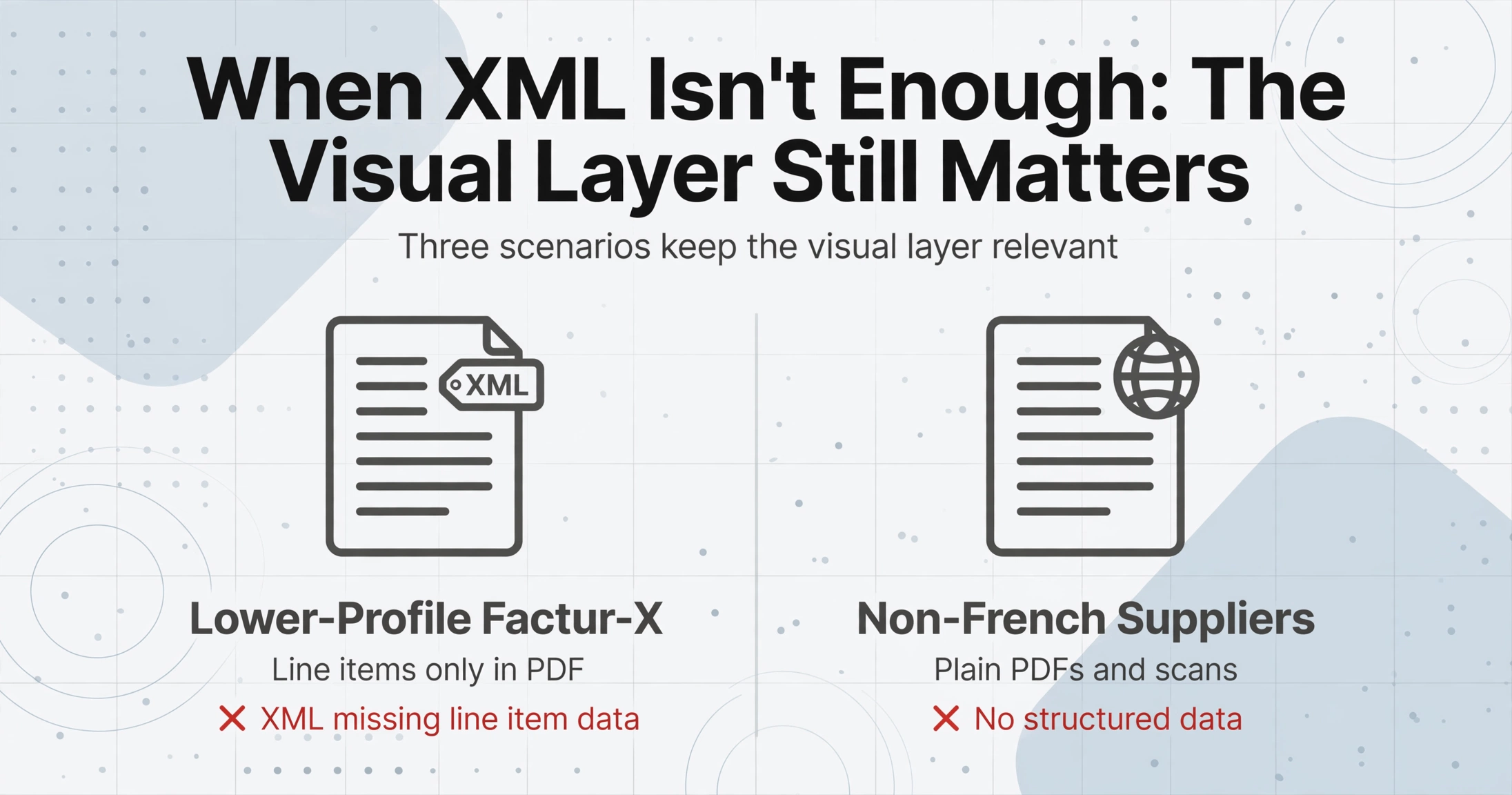
Three scenarios keep the visual layer relevant:
1. Lower-profile Factur-X invoices from small suppliers. A micro-enterprise using the PPF's free conversion service may send Factur-X invoices at the MINIMUM or BASIC WL profile. The XML will carry the invoice total and VAT amount, but line-item details will live only in the PDF visual layer. Extracting that data requires reading the PDF image — which is where an AI extraction tool becomes necessary.
2. Invoices from non-French suppliers who do not use structured formats. The mandate applies only to domestic B2B transactions between French VAT-registered entities. Invoices from EU or international suppliers will continue to arrive as plain PDFs, scanned images, or emails. These invoices must still be processed — and they must feed the same AP workflow as the structured ones.
3. Historical and audit-related PDFs. Archival invoices and supplier records predating the mandate exist as PDFs or paper. AP teams need to extract data from these documents for audits, reconciliation, or migration into new systems.
The practical consequence: most AP teams will run two parallel invoice processing streams for at least three to five years after the mandate — one for structured XML invoices (processed automatically through the ERP) and one for PDF-based invoices that require extraction. The team that can unify these two streams with a single tool-set saves months of reconciliation work.
This is where semantic-based extraction differs from the position-based OCR approach that many AP automation vendors offer. Custom Column Extraction — where you define the data fields you want and the AI locates them by understanding what each field means, not where it sits on the page — works on any visual input, whether it is a scanned PDF, a mobile photo of a paper invoice, or the visual layer of a Factur-X hybrid document. The same column definitions that map to your ERP fields for structured XML invoices can be applied to PDF invoices, producing output in the same schema.
ImageToTable.ai, for instance, is designed for this exact gap. It accepts PDF, JPG, and PNG inputs — including the PDF layer of a Factur-X document — and extracts the data you specify into structured tables that match your existing AP workflow. Rather than requiring a separate OCR pipeline for the PDF stream and an XML parser for the structured stream, a single batch-first processing workflow handles both, and the results merge into one unified output.
For a broader view of how the French mandate fits into the global e-invoicing landscape, see Global E-Invoicing Compliance 2026: What Finance Teams Need to Know. For a step-by-step readiness plan that covers multiple jurisdictions, 90 Days to E-Invoicing Compliance: An AP Readiness Checklist provides a phased calendar across the 2026–2027 mandate cycle.
Frequently Asked Questions
Is Factur-X the same as ZUGFeRD?
Yes, since ZUGFeRD 2.0 (2019), Factur-X and ZUGFeRD have been technically identical standards. They share the same UN/CEFACT CII XML schema, the same five profiles, and the same PDF/A-3 container. The only difference is the branding and the embedded XML filename. A Factur-X EN 16931 invoice is interchangeable with a ZUGFeRD 2.x COMFORT invoice.
What happens if we receive a Basic WL Factur-X invoice from a supplier?
The invoice is legally valid (French law does not invalidate invoices at lower profiles), but the embedded XML will not contain line-item data. You must either (a) request that the supplier send invoices at the EN 16931 profile or higher, or (b) extract the line-item details from the PDF visual layer using extraction software. Your approved platform may also offer a format enrichment service, though this may incur additional fees.
Does the mandate apply to us if we are a foreign company with a French VAT number?
Yes. Any business holding a French VAT number must comply with all e-invoicing and e-reporting obligations on the same schedule as domestic French entities. This commonly affects non-EU companies storing goods in French warehouses (fulfilment centres) and EU companies selling into France above the distance-selling threshold.
What is the penalty for non-compliance?
Ordinance No. 2021-1190 establishes a penalty of €15 per non-compliant e-invoice, capped at €15,000 per calendar year. For e-reporting violations, the penalty is €250 per non-compliant transmission, also capped at €15,000 per year. The penalty may be waived for first-time infractions if remedied within 30 days. As of the Finance Law 2026, the DGFiP has additional authority to issue formal notices and impose escalating fines for repeated non-compliance.
Can we use an approved platform registered in another EU country?
No. Only PAs registered with the DGFiP and published on the official register can handle French B2B e-invoices. However, a number of international e-invoicing providers (including Avalara, SEEBURGER, and EDICOM) have obtained PA status in France. If your existing e-invoicing partner is already registered, you can continue working with them. The DGFiP published the first register in January 2026, with regular updates.
What if my supplier is too small to generate structured Factur-X invoices?
The PPF offers a free service where small suppliers can upload a plain PDF invoice, and the platform converts it to Factur-X using OCR. The resulting invoice typically uses the MINIMUM profile, which means the XML contains only basic header data. For complete data extraction, you may still need to process the PDF visual layer. The mandate provides a transitional tolerance for micro-enterprises, but by September 2027, all suppliers must send structured invoices.
The Bottom Line
France's Factur-X mandate is not just another e-invoicing compliance deadline. It is the first major European mandate built on a hybrid format that intentionally bridges structured and unstructured worlds — and that hybrid nature means the transition period will be messier than in pure-XML regimes. Your AP team will receive some invoices as complete structured data and others as PDFs with partial or absent XML, often from the same supplier on different days.
The teams that navigate this transition most smoothly will be those that stop treating structured and unstructured invoices as separate workflows. When your extraction tool can read the visual layer of a Factur-X PDF with the same field definitions your ERP uses for UBL or CII XML, the profile level of an incoming invoice stops mattering — every invoice feeds the same process.
Test your receiving infrastructure before September. Confirm your PA registration. Map your e-reporting data sources. And for the invoices that arrive without complete XML — which will be many, for longer than anyone expects — have a visual extraction path ready. The mandate starts in one deadline, but the format transition runs for years.