Financial Statement Spreading
Is a Mapping Job
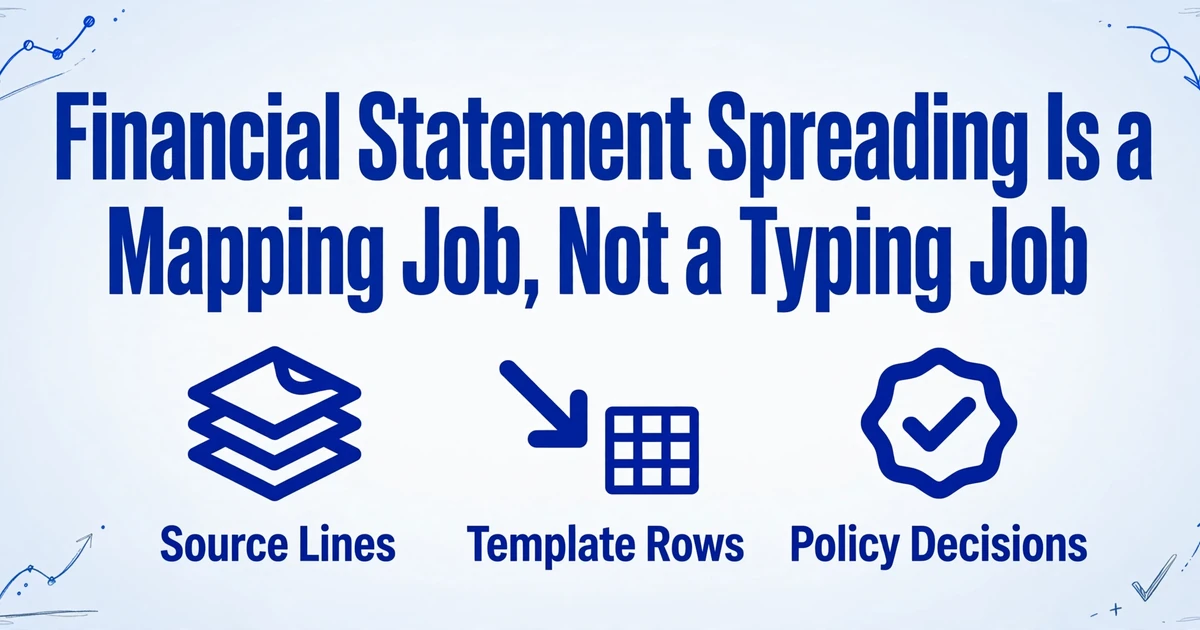
Most attempts to speed up financial statement spreading attack the typing. The typing is not what costs the afternoon. A commercial credit analyst can key a three-year spread in a few hours. What makes the file late is the rereading: deciding whether "Due from stockholders" is a current asset this year, whether the statement is in thousands, and whether the right-hand column is the fiscal year or the trailing twelve months.
Those are mapping decisions, and a spread template is mostly made of them. An extraction pass can move the numbers together with the labels, units and page references that carry those decisions. It cannot make the decisions.
Key Takeaways
- 打字从来不是那个下午的成本,重读才是:一位信贷分析师几小时就能敲完一份三年报表,剩下的时间都在决定哪一行该归到哪个科目。
- 模板里的很多行在报表上根本没有对应项:预付费保险按 GAAP 算流动资产,银行按政策把它放进非流动资产,而这个决定藏在任何数字里都看不出来。
- 让提取顺带把标签和页码一起搬过来,科目归属的判断留给人,这样得到的暂存表才经得起委员会追问。
What Financial Statement Spreading Is
Financial statement spreading is the transfer of a borrower's balance sheet, income statement and cash flow statement into the lender's own template, one period per column, with each source line assigned to a template row that means the same thing for every borrower. The Risk Management Association describes the same transfer and treats the result as the input to the ratio report and cash flow that the credit write-up depends on (RMA, 2022).
The template makes a borrower's presentation comparable across deals and years, which is why banks publish internal spreading standards and expect the same line to land in the same row every time.
The work splits by institution size. At a larger bank a credit analyst or portfolio manager spreads, an underwriter builds ratios, a committee approves, and loan review re-performs parts later. At a community bank the lender may do all of it: "We spread the financials, complete the cash flows and global analysis, build the debt schedule" (r/Banking, 2025).
A spread is the lender's restatement of the borrower's numbers. The template row is a credit category, and that category often has no matching line on the page.
The Template Asks for Decisions the Statement Does Not Contain
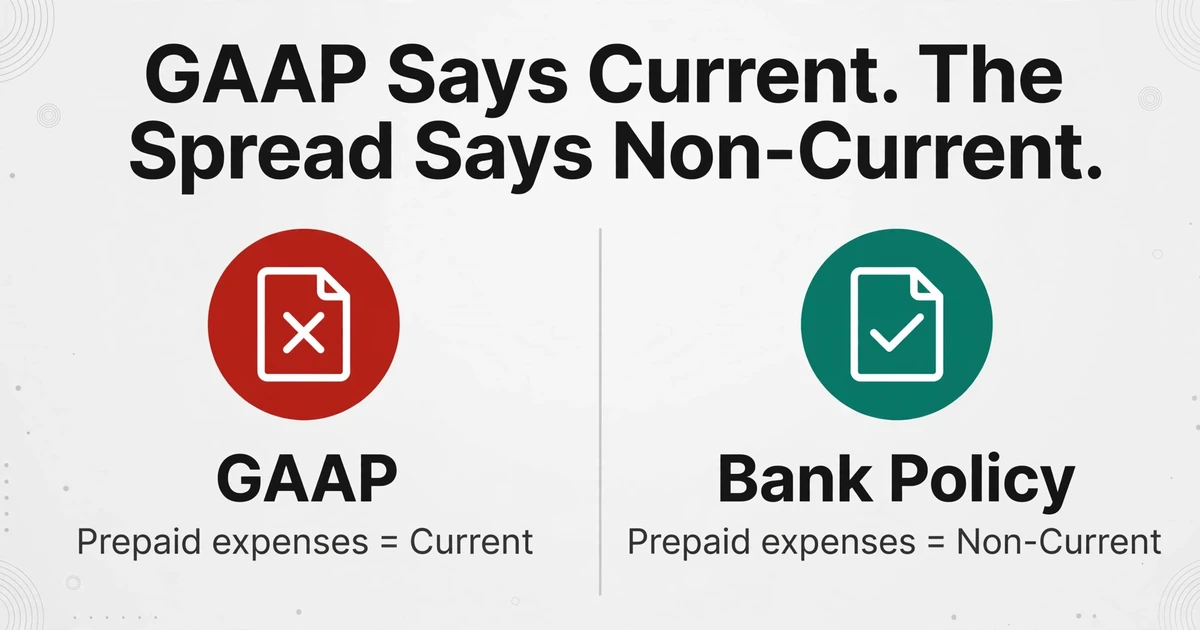
Two lenders can spread the same borrower differently and each be correct under its own policy, because a bank spread answers a repayment question rather than reproducing GAAP. The RMA guide is explicit about the deviations: prepaid expenses are spread as non-current even though GAAP calls them current, and long-term debt owed to the owner is spread as current unless it is subordinated to the bank.
None of those reclassifications is visible in the number. Each is a policy decision applied to a label, and labels are ambiguous: "Due from stockholders" and "Notes receivable, related party" can describe the same relationship, and the analyst must decide whether it is trade related before choosing a row. Ex-Im Bank's guidance tells analysts to combine small accounts, up to roughly 5% or 10%, so the generated cash flow statement stays readable (U.S. Export-Import Bank, rev. 2012).
The template also reaches beyond one entity. The OCC's 2022 commercial real estate lending handbook expects the evaluation to cover the borrower's or guarantor's global financial condition, global cash flow, and direct and contingent liabilities (OCC Comptroller's Handbook, March 2022). A borrowing group, a guarantor's personal financial statement and the operating companies feed one view.
Policy decides that a prepaid insurance premium belongs in non-current assets. Character recognition cannot make that call, because the page does not contain the answer.
What Fails to Carry Into the Template
The values usually arrive intact. The structure that gives them meaning is what goes missing, in the same few places on every file.
| Source element | What the template needs | What a value-only copy leaves behind |
|---|---|---|
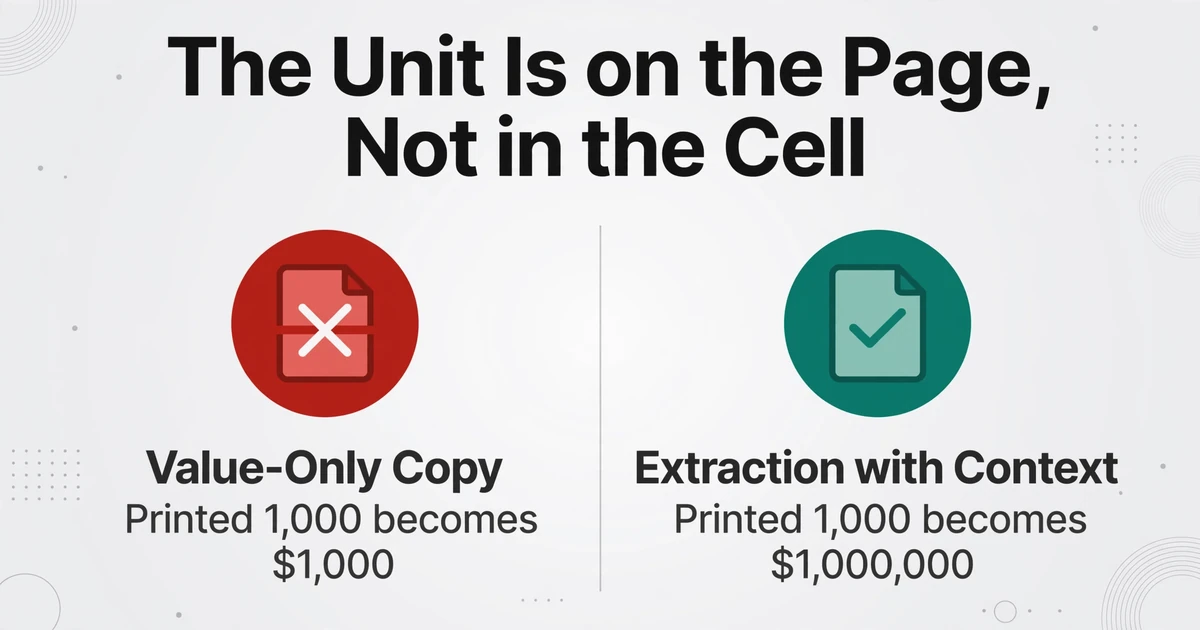
| Unit declaration ("$ in thousands") | Each figure scaled once, with the scale recorded | Correct digits, values 1,000 times off |
| Period headers (fiscal year, interim, T-12) | The right column tied to the right period | A new column pasted over last year's |
| Parentheses around a figure | The negative applied to the line | A deficit that reads as retained earnings |
| Section hierarchy and subtotals | The line placed in a section, the subtotal recomputed | A column sum that counts current assets twice |
| Line label and note reference | The evidence for the mapping decision | A number with no argument attached |
| A line the statement omits | A template row that still has to be filled | A zero, or a plug that hides the gap |
The unit is the clearest case. Ex-Im Bank tells analysts to record on each page the currency and whether figures are actual, thousands or millions, because the page carries the scale and the cell does not.
Periods fail for the same reason: the header sits above the grid. A June fiscal year, a stub period, or a trailing twelve month column will not line up with a calendar-year template. Paste by column position and the newest period overwrites the oldest. Signs and subtotals fail at the level of arithmetic, and the unit, sign and subtotal mechanics in statement extraction are covered separately.
Labels fail through renaming. A borrower replaces "Officer compensation" with "Management fees," and the officer compensation row still matters because the underwriter adjusts it for sustainable cash flow. Match by row order and the number lands one row off, with the total still correct.
Some template lines are never printed. Ex-Im notes that the current portion of long-term debt has to be asked for in almost every country it reviews, because borrowers fold it into short-term bank debt. Extract only what the page shows and the row stays empty, which is worse than a wrong value because nothing flags it.
The cash flow statement is the last place this appears. Spreading software can derive one from balance sheet changes, and Ex-Im warns that the derived version misstates stock dividends, revaluations and assets acquired with debt. Extract the printed statement and treat the derived version as a cross-check.
A unit error produces a page of digits that are individually correct and collectively wrong by a factor of a thousand.
Why the Error Survives the Review
The errors that reach a credit memo are the ones that still look reasonable. A dropped unit scales every line the same way, so the balance sheet still balances and every ratio is unchanged. A contra line entered as positive inflates assets and leaves equity looking stronger, and an analyst checking whether the extracted table ties to itself will not see it. A mis-mapped line keeps the total intact and moves one ratio.
Deadline behavior makes this worse. When the committee date is fixed, mapping gets done by position and label similarity, and a related-party note is read only if the label says "related party." Those are the conditions under which the policy deviations matter most. The error is designed to pass the check the analyst has time to run.
This is why automated spreading projects have a mixed record. Analysts in a 2023 thread describe large banks still spreading manually in Excel, banks running Moody's CreditLens, and auto-spreaders that created more correction work than the manual process: "I end up having to spend more time correcting the spreads then it would've taken me to do them myself in the first place" (r/FinancialCareers, 2023). The complaint is placement, not reading.
Volume explains why the last few percent matter. A five-year spread across three statements at 40 rows each is about 600 figures for one borrower. At 99% per-field accuracy, the ceiling we publish for printed tables, six cells are still wrong on average.
Automated spreading tends to fail on placement rather than recognition, and placement is the part the analyst was hired to get right.
The Extraction Step That Feeds the Template
Extraction removes the keying and preserves the structure that keying throws away, and it stops at the edge of the template. Extract source lines as evidence, then map them where the policy decisions belong.
ImageToTable.ai works through Custom Column Extraction: you type the column names you want, and the AI locates the value anywhere on the page by understanding what the field means rather than where it sits. Your column names become the output headers. For a spread, name the columns the template's decisions depend on: Line Label, Statement, Section, Period, Unit, Currency, Amount as Printed, Source Page.
Batch processing keeps a package together. Three years of statements, the interim period, the tax return and the guarantor's personal financial statement go in as one batch and come out as one table. Where a statement spans pages, Multi-Page Merge groups them into one record by period, entity or reference number.
A computed column handles one check well. Define Balance Check (Total Assets minus Total Liabilities and Equity) and the output gives the difference for each period. A non-zero value points to a transcription problem. It will not catch a line mapped to the wrong category while the statement still balances. Review mode speeds the remaining value checks: hovering a cell highlights where the value came from, so confirming a unit or a label takes a glance instead of a hunt through a 40-page PDF.
What comes out is a staging table, not a spread. The tool does not know your template, does not decide that "Due from stockholders" belongs in non-current assets, and does not calculate ratios, global cash flow or covenants. If you are weighing this against capture tools, the difference between posting to a ledger and taking your column names is set out in the comparison of financial document extraction tools.
The output is a staging table of labeled source lines. The spread is the set of decisions you make on top of it.
A Sequence That Holds Up Under Deadline
Keeping reconciliation ahead of mapping is what makes the sequence survive a deadline, because a control total is cheaper to fix than a committee memo.
Define the columns from the template's questions
Start with the rows your template must fill, then name the source columns that support them. Extracting only amounts recreates the copy-paste problem.
Pull the whole package in one batch
Statements, tax returns, interim periods and the guarantor's personal financial statement belong in the same run. Entities and periods stay aligned.
Reconcile before you map
Check assets against liabilities plus equity, net income against retained earnings, and the printed cash flow statement against the extracted one. A computed difference column makes the exception visible early.
Map once, and record the call
For every line you move, note the reason: related party, prepaid, current portion of long-term debt, small account consolidated. That note is the audit trail.
Review by exception, then write
Spend review time on cells that failed a control total and lines with ambiguous labels. Confirm them against the source, then write with the arithmetic settled.
What the Analyst Still Owns, and Where Extraction Stops
Every decision the template encodes stays with the analyst. The mapping calls are yours: whether a receivable is trade or related party, whether an expense is one-off, whether a small account should be folded into another. The add-backs are yours, including officer compensation. Global cash flow is yours, because it requires deciding which entities and guarantors belong in the borrowing group. Risk rating, covenant testing and the memo stay with credit.
The limits belong in the same breath. Handwritten statements, unusual layouts and tax returns with K-1s need more review, and a higher tier improves recognition rather than judgment. The tool cannot read a footnote and decide that a related-party balance is discretionary.
Frequently Asked Questions
What is financial statement spreading in simple terms?
It is moving a borrower's balance sheet, income statement and cash flow statement into the lender's standard template, period by period, so the same ratios can be calculated the same way for every borrower. The template row is a credit category, so the work involves judgment as well as data entry.
How long does it take to spread financial statements?
It depends on periods, entities and statement quality, and there is no independent benchmark worth quoting. Practitioners describe multi-hour work for a committee-ready package, and a clean three-year spread for one entity runs faster than a borrowing group with guarantors.
Can AI spread financial statements automatically?
Software can extract line items and place them in a template, and several lending platforms sell automated spreading. Practitioners report placement errors that require correction, especially with related-party accounts, subsidiary income and borrowers with multiple rental properties. The technology helps at extraction and still needs a reviewer at the mapping layer.
Can ImageToTable.ai fill our spreading template directly?
No. It extracts source lines into a structured table with labels, units, periods and page references attached, which you then map into your own template. It has no lender template, no institution mapping rules, and no ratio or covenant calculations. The table is clean input to that work, in Excel, CSV or Google Sheets.
The Spread Is the Argument, Not the Arithmetic
A spread that ties is not necessarily right. The unit, the period, the sign and the category can all be wrong while every total balances. The defensible version of this workflow separates the two jobs: let extraction carry the labeled numbers and their provenance, and keep the policy calls where a person can explain them.
Test the extraction layer on one borrower's statement package. Count the cells you did not have to key, then count the cells you still had to decide. The second number is the work that was always yours.