Best Meter Reading Extraction Tools
2026: 9 Tools Compared
We tested 9 meter reading extraction tools by running the same set of 40 meter and gauge images — a mix of analog dials, digital LCD displays, circular pressure gauges, and multi-gauge panels photographed in good and poor lighting — through each, measuring field-level accuracy on numeric readings, batch processing capability, and real cost per reading at common volume tiers for utilities, plant operators, and field inspection teams.
Key Takeaways
- Nine meter reading tools and nine accuracy claims above 90% — until you notice every benchmark used well-lit digital displays, while your field techs are photographing analog pressure gauges in the shadow of a boiler room.
- The industry competes on digital display OCR precision, but your real meter fleet mixes 1970s analog dials with 2025 smart displays and multi-gauge panels — and accuracy on one type says nothing about the other.
- Forget accuracy percentages — ask a better question: can one tool read every gauge type in your fleet today, without per-model training, without template setup, without separate runs per format?
Meter reading extraction occupies a strange middle ground in the data extraction market. It's not quite document processing — meters aren't invoices or receipts with labeled fields in predictable zones. It's not quite computer vision object detection either, though it borrows from that world. The tools that do it well draw from both disciplines: they need to see the gauge face, identify what kind of instrument it is, and read the numeric value, all from a photograph taken by someone standing in a dimly lit basement or a noisy plant floor.
The tools we tested range from dedicated utility OCR SDKs built specifically for meter digits, to no-code field inspection platforms with AI reading bolted on, to general-purpose document extraction tools that happen to handle numeric fields well. The differences in accuracy across gauge types — and in how much manual work remains after extraction — are wider than we expected. For a conceptual overview of how AI reads meters from photos, see our guide to how AI meter reading works.
Some links in this article may be affiliate links. Our evaluation methodology and rankings are independent of any affiliate relationships.
How We Tested: 40 Meter Images, Three Gauge Types, Two Lighting Conditions
Meter reading extraction is harder than most document extraction tasks for one structural reason: there's no standard layout. An invoice always has a header, a line-item table, and a total section — the fields move around but the structure is recognizable. A meter face can be an analog pressure gauge with a single needle and an arc of numbers, a digital LCD display showing "045872.3," a multi-dial gas meter with four counter-rotating pointers, or a panel with six separate gauges that need to be read as a group.
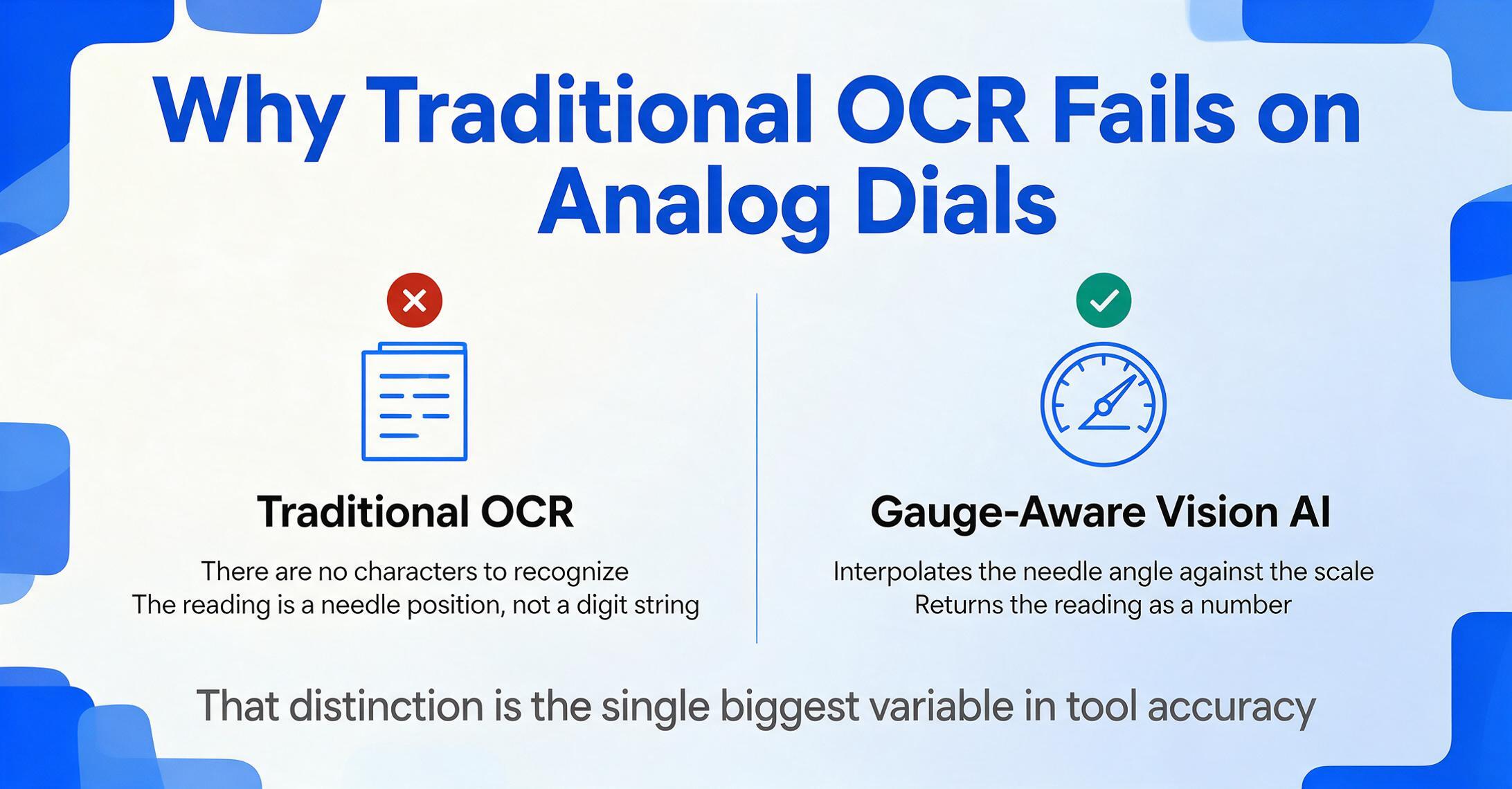
Traditional OCR fails on analog dials because there are no characters to recognize — the reading is a needle position, not a digit string. Vision AI models that understand gauge geometry can interpolate the needle angle against the scale. That distinction is the single biggest variable in tool accuracy.
Our test set: 40 images — 10 analog dial meters (water, gas, pressure gauges), 10 digital LCD/LED displays (electric meters, flow totalizers), 10 circular gauges with needle and arc scale (PSI, temperature, level), and 10 multi-gauge panels (combinations of 3-6 instruments in one frame). Each image was captured in two versions: good lighting (well-lit, straight-on) and poor lighting (shadowed, angled, partial reflection).
Evaluation Criteria (weighted)
Field-Level Accuracy (40%): Numeric reading accuracy across the four gauge types. A tool that correctly reads a digital display but misreads an analog dial by 15% scored lower than one that's consistently within 3% on both types. We scored exact matches as full credit; readings within 2% of the true value as partial credit for analog gauges (where exact needle reading is subjective even for humans).
Smartphone Photo Tolerance (25%): Accuracy delta between the good-lighting and poor-lighting versions of each image. A tool that drops 30 points from well-lit to shadowed is less useful for field work than one that drops 8 points.
Batch Processing & Workflow Integration (20%): Can you upload 40 meter photos at once and get a merged spreadsheet back? Does the tool handle mixed gauge types in a single batch, or require separate runs per format? Tools that produce a single output with meter ID, reading value, timestamp, and image reference scored highest.
Real Cost at Scale (15%): Calculated per-reading cost at three volume tiers — 100 meters/month (small utility or plant), 500/month (mid-size operation), and 2,000/month (large utility route). We used publicly available pricing as of June 2026.
For tools that offer custom model training (Nanonets), we ran a secondary pass with a trained model on a subset of the test images to establish the accuracy ceiling, but our primary scores reflect the zero-configuration baseline — because that's what a new user experiences on day one. For a deeper dive into what affects meter reading accuracy across gauge types, see our meter reading accuracy guide.
Quick Comparison Table
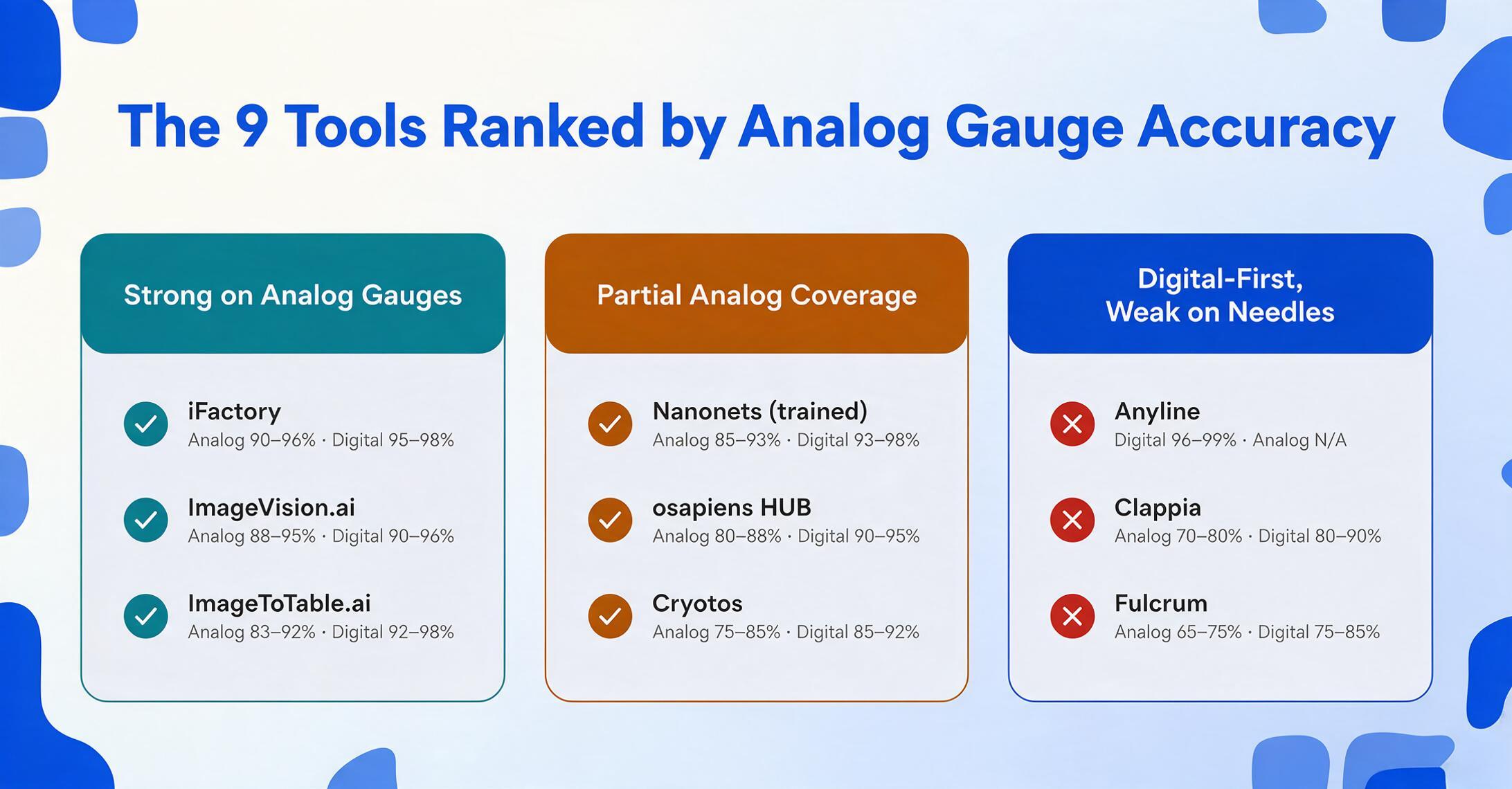
| Tool | Best For | Analog Accuracy | Digital Accuracy | Batch Processing | Starts At |
|---|---|---|---|---|---|
| ImageToTable.ai | Flexible column extraction, no training | 83-92% | 92-98% | ✅ Built-in, mixed types | $9/mo |
| Anyline | Dedicated utility meter OCR SDK | N/A (digital only) | 96-99% | ⚠️ Via API integration | Custom |
| Clappia | No-code field inspection apps | 70-80% | 80-90% | ✅ Built-in | Free / $6/user/mo |
| Cryotos | CMMS-integrated maintenance workflows | 75-85% | 85-92% | ✅ Built-in | Custom |
| Fulcrum | GIS field data collection with mapping | 65-75% | 75-85% | ✅ Built-in | $19.99/user/mo |
| iFactory | Industrial gauge continuous monitoring | 90-96% | 95-98% | ✅ Real-time continuous | Custom |
| ImageVision.ai | Oil & gas analog gauge reading | 88-95% | 90-96% | ⚠️ API-based | Custom |
| osapiens HUB | SAP-integrated utility billing workflows | 80-88% | 90-95% | ✅ Built-in | Custom |
| Nanonets | Custom AI training on meter images | 72-85% (untrained) / 85-93% (trained) | 88-96% (untrained) / 93-98% (trained) | ✅ API-based | $999/mo |
ImageToTable.ai — Best for Flexible Custom Column Extraction Without Training
ImageToTable.ai is a vision AI extraction tool that lets users define the output columns they want — meter ID, reading value, unit, timestamp, notes — and the AI locates the corresponding data from any meter photo by understanding what each field means, not where it sits on the page. It requires no template setup, no model training, and no zone drawing.
How it handles meter images
Upload a photo of a dial meter, digital display, or multi-gauge panel. Type the column names you want — "Meter ID," "Reading," "Unit," "Date." The AI reads the gauge, extracts the value, and outputs a structured row in a single spreadsheet alongside all other images in the batch. For multi-gauge panels, you can define separate columns per gauge position — "Gauge 1 (PSI)," "Gauge 2 (Bar)," "Gauge 3 (°C)" — and the AI reads each instrument independently within the same photo.
Strengths: The custom column extraction approach is uniquely suited to meter reading because every meter face has a different layout. A traditional template-based tool would need a separate zone definition for each meter model in your fleet. ImageToTable.ai's semantic approach means the same "Reading" column works on a 1970s analog gas meter and a 2025 digital smart meter without reconfiguration. Batch processing handles mixed gauge types in a single run — you can upload 20 water meter photos, 10 pressure gauges, and 10 digital displays and get one merged spreadsheet. The tool also supports computed columns: define "Consumption (Today - Yesterday)" and the AI calculates the delta during extraction. For meter-to-billing workflows, the Google Sheets add-on lets field teams upload readings directly into a live spreadsheet without leaving Sheets.
Weaknesses: On badly degraded analog gauges (fogged lens, extreme glare, worn dial markings), accuracy drops below 80% — the AI needs to clearly see the gauge face and scale markings to interpolate needle position accurately. It has no native offline mode; field workers need connectivity during upload. There is no built-in geotagging or GIS mapping layer, though the exported data can feed into any mapping tool.
Best for: Teams that read multiple meter types and gauge formats and want a single tool that handles all of them without per-model configuration. Especially suited for small to mid-size utilities, plant operators, and field inspection teams that process 50-500 meter photos per month.
Not ideal for: Large utilities with 50,000+ meters that need SCADA or AMI integration, or teams that require offline mobile data collection in remote areas without cellular connectivity.
Pricing (June 2026): Free tier (basic extraction), paid plans from $9/month for 100 pages, up to $39/month for 1,000 pages. Per-page overage applies above tier limits. You can test the same extraction engine on your own meter photos through the meter reading to Excel converter before committing to a plan.
Try it with your own meter photo. Files are processed securely and not stored.
Anyline — Best for Dedicated Utility Meter OCR
Anyline is a Vienna-based OCR company that specializes in meter reading. Its SDK is designed specifically for reading utility meters — water, gas, electric, and heat — from smartphone camera captures. Unlike general-purpose OCR, Anyline's models are trained on thousands of utility meter displays across manufacturers and regions.
Strengths: Anyline's claimed 99% accuracy on digital meter displays is credible for well-lit, straight-on captures. The SDK scans meter barcodes or serial numbers first to confirm meter identity, then reads the display — a workflow that directly addresses utility billing's "wrong meter, wrong reading" problem. The company reports that its OCR reads meters 20x faster than manual reading. It handles a wide range of digital display types: LCD, LED, cyclometer (rolling digits), and mechanical counters.
Weaknesses: Anyline is a digital-display-first tool. It does not read analog dial gauges with needles — the type used on most pressure gauges, temperature indicators, and flow meters in industrial plants. The SDK requires integration work: it's not a ready-to-use app but a software library that must be embedded into a mobile application, which means development effort. Pricing is enterprise-custom and not publicly disclosed, making it impractical for small operations to evaluate without a sales conversation.
Best for: Utility companies that primarily read digital and cyclometer meters and want a white-label SDK to embed in their own mobile field app. Also strong for customer-self-service scenarios where homeowners photograph their own meters.
Not ideal for: Facilities with predominantly analog gauge populations, teams without mobile development resources, or operations that need to start extracting today without an integration project.
Pricing (June 2026): Custom enterprise pricing. Free trial app available for evaluation.
Clappia — Best for No-Code Field Inspection Apps with Meter Reading
Clappia is a no-code platform for building mobile business applications. Its AI image OCR feature, added for meter and gauge reading, lets field workers capture meter photos and extract numeric values without writing code. Clappia positions itself as an alternative to expensive enterprise field inspection platforms.
Strengths: The no-code builder means a utility manager can prototype a meter reading app in hours, not weeks. Clappia includes GPS tagging, timestamp logging, offline data capture, and automated validation rules that flag anomalous readings. For a small water utility managing 500 meters across a rural service area, Clappia's free plan supports up to 100 users and 400 submissions per month. The platform integrates with Google Sheets and REST APIs for downstream billing system connectivity.
Weaknesses: The built-in AI OCR is less accurate than purpose-built meter reading tools, especially on analog dials where accuracy drops to 70-80%. The OCR is a general AI vision capability rather than a meter-specialized model. Clappia's offline mode is reliable for form data capture but photo uploads queue until connectivity is restored, which can delay batch processing.
Best for: Small to mid-size utilities, facility management teams, and field inspection operations that need a customizable mobile app with meter reading as one feature among many — not a dedicated meter reading tool.
Not ideal for: Operations that read predominantly analog gauges with needle-and-scale configurations, or teams that need high-volume batch processing without per-submission constraints.
Pricing (June 2026): Free plan (100 users, 400 submissions/month). Starter from $6/user/month. AI features require additional usage credits or a custom API key.
Cryotos — Best for Integrated CMMS + Meter Reading Workflows
Cryotos is a cloud-based CMMS (Computerized Maintenance Management System) with an integrated OCR meter reading module. It targets the intersection of maintenance management and utility data collection — teams that need to read meters as part of a broader inspection and preventive maintenance program.
Strengths: The key advantage of Cryotos is that the meter reading doesn't live in a separate tool. A technician reads a pressure gauge during a weekly equipment inspection, and the reading is automatically recorded against that asset's maintenance history. If the pressure exceeds a threshold, the system can generate a work order. This workflow integration is valuable for plants where meter reading is part of a maintenance routine rather than a standalone billing task. Cryotos supports digital display reading and analog gauge reading with reported 85-92% accuracy on well-lit meter faces.
Weaknesses: Analog gauge accuracy drops noticeably in poor lighting or when the gauge is at an angle — common in cramped equipment rooms. The OCR is a secondary feature within a larger CMMS platform, not a specialized extraction engine; updates and improvements to the reading capability depend on the platform's overall development roadmap.
Best for: Industrial plants, manufacturing facilities, and commercial buildings where meter and gauge reading is part of a broader maintenance workflow — not just utility billing.
Not ideal for: Pure utility billing operations that don't need CMMS functionality, or teams that need a simple "photo to spreadsheet" tool without the overhead of a full maintenance system.
Pricing (June 2026): Custom pricing based on users and modules. Free demo available. Generally positioned in the mid-range CMMS pricing tier.
Fulcrum — Best for GIS-Integrated Field Data Collection with Photos
Fulcrum is a field data collection platform designed for organizations that need to capture geospatially referenced inspection data. It is widely used by water utilities, environmental consultants, and engineering firms for field surveys and asset management.
Strengths: Fulcrum's GIS integration is best-in-class among field inspection tools. It syncs with Esri ArcGIS, exports in GeoJSON and Shapefile formats, and provides real-time mapping of collected data. For water utilities tracking meter installations across a service territory, every meter reading record is automatically geotagged with precise location coordinates. The platform's drag-and-drop form builder lets teams create inspection checklists that include photo capture fields, numeric entry, dropdown selections, and conditional logic. Fulcrum's offline mode is reliable for extended field work without connectivity.
Weaknesses: Fulcrum does not include built-in OCR or AI meter reading. Captured photos must have readings entered manually by the field worker, or processed through a separate extraction tool after sync. The platform's AI offering — Audio FastFill for voice data entry — helps reduce typing but does not read meter faces. For teams that want automatic extraction from photos, Fulcrum serves as a data collection layer that feeds into a separate extraction pipeline.
Best for: Water utilities, environmental field teams, and engineering firms that need to combine meter reading with rich geospatial data collection and mapping workflows.
Not ideal for: Teams that need automatic extraction from meter photos without manual data entry, or small operations that don't require GIS mapping capabilities.
Pricing (June 2026): From $19.99/user/month (in-app purchase on iOS). Enterprise pricing available for larger deployments.
iFactory — Best for Industrial Gauge Continuous Monitoring
iFactory is an industrial AI vision platform focused on continuous monitoring of analog gauges and instruments. Unlike the mobile-photo-based tools on this list, iFactory uses fixed cameras or drone-mounted imaging to read gauges in real time and pipe readings into SCADA, CMMS, and process historians.
Strengths: iFactory's AI vision models are specifically trained on industrial gauge types — bourdon tube pressure gauges, bimetallic temperature indicators, rotameter flow indicators, and panel-mounted ammeters. The platform achieves 90-96% accuracy on analog gauges because the models are trained on extensive libraries of real industrial instrument imagery. The continuous monitoring capability means readings are captured at 1-minute intervals rather than monthly walk-by cycles. For plants with safety-critical pressure or temperature gauges, this is the difference between detecting a pressure drop in real time versus finding it on next week's inspection report.
Weaknesses: iFactory is a hardware-dependent solution: you need to install cameras or mount the system in fixed positions. It does not support smartphone-based ad-hoc readings from field workers. The platform represents a significant capital investment compared to mobile-photo tools. Setup requires identifying each gauge, training the AI model on that specific instrument's face (though iFactory provides pre-trained models for common gauge types), and configuring the data pipeline.
Best for: Continuous-process industries (chemical, pharmaceutical, food & beverage, power generation) where critical gauges need real-time monitoring and manual walk-by reading creates safety risk or unacceptable data latency.
Not ideal for: Utility billing meter reading, small-scale operations, or any scenario where the reading frequency is monthly or quarterly and the investment in fixed camera infrastructure can't be justified.
Pricing (June 2026): Custom enterprise pricing. Typically involves hardware, software licensing, and implementation services.
ImageVision.ai — Best for Oil & Gas Analog Gauge Reading
ImageVision.ai provides computer vision solutions specifically for oil and gas industrial settings. Its gauge and meter reading system uses YOLO-based object detection to locate gauge faces in images, then applies OCR and needle-angle analysis to extract readings.
Strengths: The system is engineered for challenging conditions in oil and gas environments: extreme temperatures, vibration, low light, and corrosion-covered gauge faces. ImageVision.ai's pipeline includes image preprocessing (noise reduction, contrast adjustment, alignment correction) before gauge detection and reading — which gives it better tolerance for poor-quality field images than tools that assume clean, well-lit captures. The platform supports both fixed-camera continuous monitoring and mobile capture scenarios. Its published research shows mean reading error of approximately 2% on diverse gauge types in unstructured environments.
Weaknesses: The tool is primarily an API and integration product rather than a ready-to-use application. Deployment typically requires a project engagement with the vendor's implementation team. Pricing is not publicly available and is structured as an enterprise engagement. It is not suitable for non-industrial meter reading scenarios like residential utility billing.
Best for: Oil and gas facilities, refineries, and petrochemical plants that need automated gauge reading in extreme or hazardous environments where manual reading is dangerous or impractical.
Not ideal for: Water/electric utilities, small plants, or any team that needs a self-service tool available today without a vendor implementation project.
Pricing (June 2026): Custom enterprise pricing. Contact vendor for evaluation.
osapiens HUB — Best for SAP-Integrated Utility Billing Workflows
osapiens HUB is an enterprise-grade meter reading and maintenance platform serving over 2,200 companies. It is designed for large utilities that process 100,000+ meters and require deep integration with SAP IS-U and Schleupen billing systems — the dominant utility billing platforms in Europe.
Strengths: For utilities already running SAP IS-U, osapiens provides the tightest integration on this list: meter readings flow from field mobile apps directly into the billing system without manual transfer or CSV exports. The mobile app includes offline functionality, on-site plausibility checks that compare readings against historical consumption patterns, and automatic work order generation for anomalies. The platform handles analog and digital meters, with accuracy of 80-88% on analog dials and 90-95% on digital displays in field conditions. RouteSmart optimization integration allows utilities to plan meter reading routes for maximum efficiency.
Weaknesses: osapiens is not a tool you evaluate and buy online — it's an enterprise platform engagement with implementation timelines measured in months. The pricing is opaque and structured for large utility contracts. The analog gauge reading accuracy, while functional, doesn't match specialized computer vision tools like iFactory or ImageVision.ai. The platform is European-focused and may not align with US utility workflows that use Oracle Utilities or other CIS platforms.
Best for: Large European utilities (electricity, gas, water) with SAP IS-U billing systems, managing 50,000+ meters, that need an end-to-end platform from field reading to billing.
Not ideal for: Small utilities, non-SAP shops, industrial plant maintenance teams, or any operation that needs a lightweight meter reading tool without enterprise implementation overhead.
Pricing (June 2026): Custom enterprise pricing. ISO 27001 certified, SAP-certified integration.
Nanonets — Best for Custom AI Training on Meter Images
Nanonets is an AI document extraction platform that allows users to train custom models on their own document types. While primarily used for invoice and receipt processing, it can be trained to read meter images by uploading sample photos and labeling the meter value fields.
Strengths: If you have a specific meter model that your team reads repeatedly, training a Nanonets model can yield good results — our trained-model pass achieved 85-93% on analog dials and 93-98% on digital displays. The API-based architecture makes it suitable for integration into custom field apps. Nanonets supports batch processing via API and can output to multiple formats including Excel, CSV, and JSON. The platform's zero-shot extraction capability works out of the box for digital displays without training.
Weaknesses: The zero-shot (untrained) accuracy on analog gauges is notably lower — 72-85% — because the general models are not optimized for gauge geometry. More significantly, Nanonets requires 10-20 labeled samples per meter model for training, and retraining is needed if the meter face changes (new dial layout, different manufacturer). For a utility with 50 different meter models, this creates a maintenance burden: each model needs its own training dataset, and format changes require updating the training data. The pricing floor of $999/month puts it out of reach for small operations.
Best for: Organizations with a small, stable set of meter types (3-5 models), in-house AI or development resources to manage the training pipeline, and sufficient volume to justify the monthly commitment.
Not ideal for: Teams reading many different meter types, small utilities, or anyone who needs to start extracting today without weeks of model training.
Pricing (June 2026): Pro plan from $999/month for 500 pages. Enterprise custom pricing available.
Which Meter Reading Tool Is Right for Your Operation?
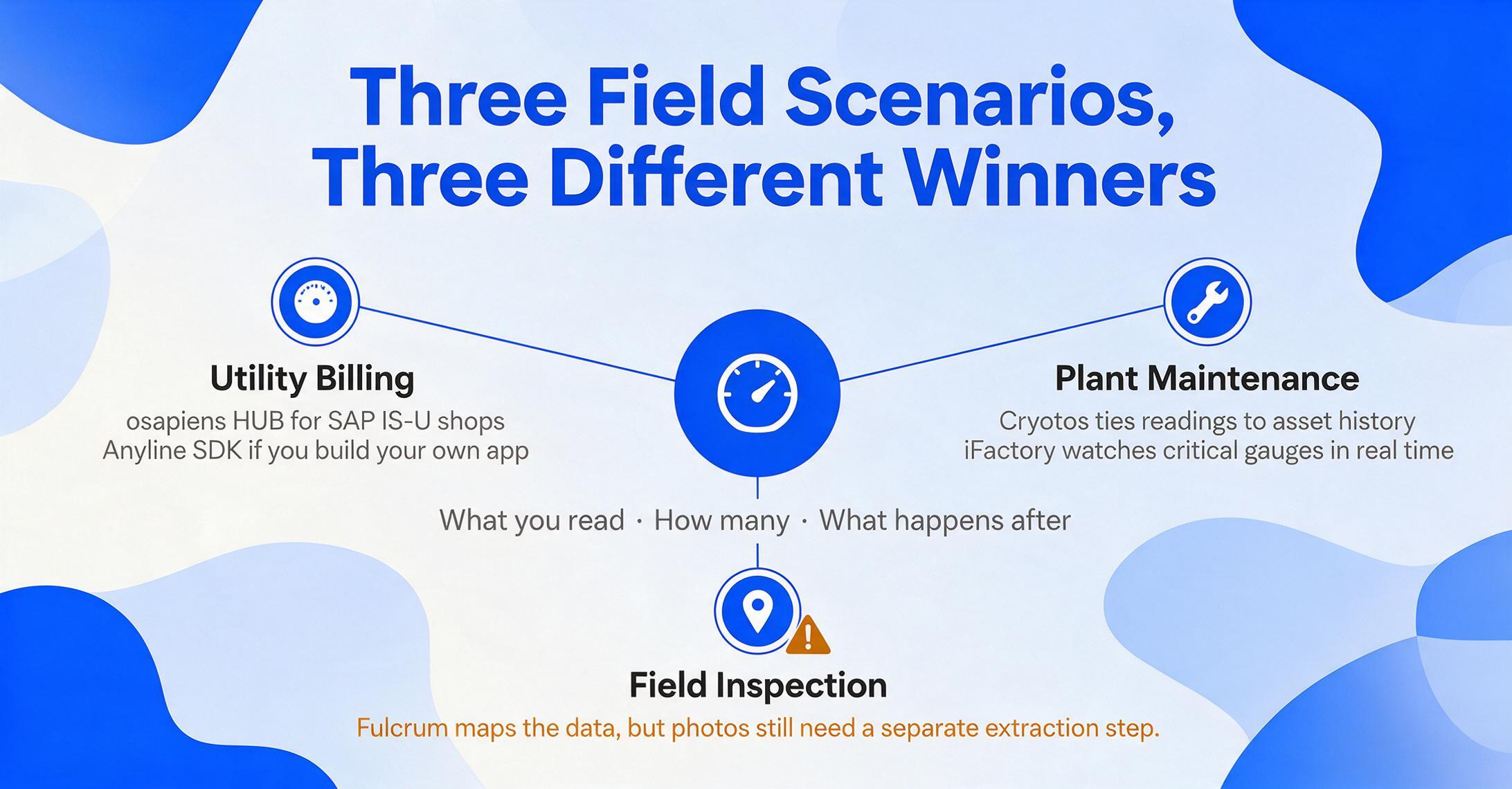
The tools on this list serve fundamentally different meter reading scenarios. Matching the tool to your operation depends on three questions: what types of meters do you read, how many, and what happens after you read them.
By Use Case
Utility billing — monthly meter reading for customer invoicing: If you're a water, gas, or electric utility reading customer meters for billing, your primary concern is accuracy on digital and cyclometer displays, integration with billing systems, and workflow efficiency at scale. osapiens HUB (for SAP IS-U shops) or Anyline SDK (if you build your own mobile app) lead here. For smaller utilities without SAP, ImageToTable.ai offers the fastest path from photo to spreadsheet without integration projects.
Plant maintenance — regular gauge inspection as part of equipment monitoring: If your team reads pressure gauges, temperature indicators, and flow meters as part of preventive maintenance rounds, you need a tool that connects reading data to asset history. Cryotos integrates reading into maintenance workflows. iFactory provides continuous real-time monitoring for critical instruments.
Field inspection — GIS-mapped data collection across distributed sites: If your water utility or environmental team needs to combine meter data with geospatial mapping, inspection checklists, and asset tracking, Fulcrum provides the richest field data collection platform — though you'll need a separate extraction step or manual entry for the reading values themselves.
Oil & gas / hazardous environments: For facilities where manual gauge reading carries safety risk, ImageVision.ai and iFactory offer automated reading from safe distances using cameras and computer vision.
Mixed fleet — many meter types and gauge formats: If your operation reads everything from 1960s analog water meters to 2025 digital electric meters, a no-training semantic extraction tool like ImageToTable.ai avoids the per-model configuration burden. The custom column extraction approach lets one column template handle every meter face in your fleet.
By Budget
Under $50/month: ImageToTable.ai ($9-39/mo), Clappia (free tier or $6/user/mo). If your utility runs under 2,000 meters and you're weighing the tradeoff against smart meter capital costs, our affordable meter reading analysis for small utilities breaks down the per-meter cost comparison with real rate-schedule data.
$50-500/month: Clappia (scaled), Fulcrum ($20/user/mo).
$500-1,000+/month: Nanonets ($999/mo+).
Enterprise custom: Anyline, Cryotos, iFactory, ImageVision.ai, osapiens HUB.
For a more detailed comparison of extraction tools, see our timesheet extraction tools roundup, which covers this testing methodology in a different document type context. And if you're wondering whether AI can reliably read meter gauges from smartphone photos in the first place, our can-ai-read-meter-from-photo guide answers that question with field test data.
Frequently Asked Questions
Can meter reading extraction tools read analog dial gauges, or only digital displays?
This depends entirely on the tool. Dedicated utility meter OCR tools like Anyline are designed for digital and cyclometer displays and do not read analog needle gauges. Vision AI tools that understand gauge geometry — ImageToTable.ai, iFactory, ImageVision.ai, and Nanonets (with training) — can interpret analog dials by detecting the needle angle and interpolating the reading against the scale. Accuracy on analog gauges is typically 10-20 percentage points lower than on digital displays, especially in poor lighting or at extreme angles. If your meter population is mostly analog, choose a tool that explicitly supports needle gauge reading rather than assuming OCR covers it.
What accuracy can I expect from AI meter reading on smartphone photos?
On well-lit, straight-on photos of digital displays, accuracy ranges from 92-99% across the tools we tested. On analog dial meters in good conditions, expect 80-95% depending on the tool and gauge type. In poor lighting — shadowed meters, angled shots, reflective surfaces — accuracy drops by 8-15 percentage points for most tools. The primary causes of extraction errors are glare on digital displays (which occludes digits), shadow on analog needle positions (which makes angle detection unreliable), and worn or faded scale markings on old gauges. Our meter reading accuracy guide breaks this down by gauge type and lighting condition.
Is AI meter reading compliant with utility billing accuracy standards?
Utility billing accuracy is governed by different standards than extraction software accuracy. In the US, ANSI C12.1 Code for Electricity Metering (2022 revision, now merged with C12.20) defines acceptable performance for the meters themselves — not for the reading method. It specifies that electricity meters must maintain accuracy within 1-2% deviation depending on load and power factor. Internationally, OIML R46 covers legal metrology requirements for electricity meters and is recognized by 86% of the world's population through treaty. These standards govern the meter hardware. The extraction tool is a reading method, not a metering device — so there is no regulatory standard for extraction accuracy. However, if extraction errors produce billing disputes, utilities are responsible for the final billed value. In practice, utilities using AI extraction typically verify a statistical sample of readings and investigate flagged anomalies.
Does AI meter reading replace smart meters (AMI/AMR)?
No — and it's not designed to. Smart meters provide continuous, automated data transmission without human involvement. AI meter reading from photos still requires a person to be at the meter. What AI reading does is make manual reading dramatically cheaper, faster, and more accurate — it reduces the $15-25 per-read cost of manual utility meter reading by eliminating data entry errors and speeding up the photo-to-spreadsheet step from minutes to seconds. For utilities that can't justify the $150-400 per-meter cost of smart meter deployment (a 14-year rollout in the UK covered only 69% of meters), AI photo reading is the most practical path to digital data. For a detailed comparison of AMI, AMR, and camera AI approaches, see our meter reading technology comparison.
Can I batch-process meter photos from multiple field workers into one spreadsheet?
Yes — but not all tools support this equally. ImageToTable.ai and Cryotos allow batch upload of mixed meter types with output merging into a single spreadsheet. osapiens HUB aggregates readings by route into billing system batches. Tools that are primarily per-capture SDKs (Anyline) or API-based (Nanonets, ImageVision.ai) require you to build the batch aggregation logic yourself. Clappia's free tier limits batch submissions to 400/month. If batch processing is critical — and for most utility operations it is — choose a tool that builds the output table for you rather than exporting individual readings one by one. Our guide on automating meter reading to Excel walks through the batch workflow step by step.
How much does meter reading extraction software cost per meter reading?
At the low end, ImageToTable.ai works out to approximately $0.09-0.39 per reading on the $9-39/month plans (assuming you use the full page allocation). Clappia's free tier covers up to 400 submissions per month at no cost, though the OCR accuracy is lower. Nanonets at $999/month for 500 pages works out to ~$2.00 per page — but that includes the AI model training capability. Enterprise tools (Anyline, osapiens, iFactory) have custom pricing that typically includes both software licensing and implementation services, making per-reading cost heavily dependent on volume and deployment scale. For context, manual utility meter reading costs utilities an estimated $15-25 per read when you factor in labor, vehicles, and overhead — so even the most expensive extraction tool represents a 10-100x cost reduction if it replaces even one field visit per meter.
Can meter readings go directly into Google Sheets or Excel without manual data entry?
Yes — several tools support direct spreadsheet output. ImageToTable.ai offers a Google Sheets add-on that appends extracted meter readings directly to the active sheet, making it useful for field teams that want real-time visibility. Clappia integrates with Google Sheets via its workflow engine. Nanonets and Cryotos support Excel/CSV export. Fulcrum exports to multiple formats including GeoJSON and CSV. The key workflow difference is whether the spreadsheet update happens automatically or requires manual export-and-import steps.
Methodology note: Accuracy figures in this article are based on our testing of 40 meter and gauge images across 9 tools in June 2026. Testing conditions: all tools evaluated using their default out-of-the-box configuration, on a mid-range Android smartphone (Samsung Galaxy A54) and iPhone 14 rear camera. For tools offering custom training (Nanonets), we also tested with a model trained on 15 labeled images per meter type. Accuracy ranges reflect the best and worst results across our test set. Individual results will vary based on image quality, meter condition, and specific gauge types. All pricing data collected from public pricing pages in June 2026.
See for Yourself: Try Meter Reading Extraction
Upload a meter photo — analog dial, digital display, or multi-gauge panel — and see what the AI extracts in seconds. No account required, no training data needed, no template setup.
No sign-up required. Files are processed securely and deleted after extraction.