What Is AI Meter Reading, How Does It Work,
and When Does It Make Sense?
AI meter reading is the general term for using computer vision to turn a photo of a meter or gauge into a structured, usable number — no smart-grid hardware required. It matters because hardware-based automation is moving slower than the meters that still need reading: in the UK, 30% of domestic meters are still traditional units requiring a physical visit, and in the US, over 120 million smart meters had been installed as of 2022, yet millions of analog meters remain in basements, behind locked gates, and in rural territories where full replacement is still years away. Utilities are starting to price that gap directly — Eugene Water & Electric Board's 2025 proposal to add a $20 monthly surcharge for manual-read customers is one early example. This article explains what AI meter reading actually means, how it fits into the technology landscape, and when it makes sense for your operation — whether you run a utility with 50,000 meters or a factory floor with 200 analog gauges.
What Is AI Meter Reading, Really?
At its simplest, AI meter reading is software that extracts a numeric reading from an image of a meter or gauge — without a human looking at the dials. But that definition is deceptively narrow. In practice, "AI meter reading" isn't one technology. It's a family of approaches that share a single principle: use software to convert a visual reading into structured digital data.
The meter itself doesn't change. What changes is how the reading gets from the dial to the database. A field technician can take a smartphone photo of a water meter with rolling digits. A homeowner can snap their gas meter's four analog dials. A maintenance tech can photograph a pressure gauge in a pump room. The AI processes each image the same way — it sees the gauge face, understands the scale and pointer position or digit sequence, and outputs the reading as a number.
This is fundamentally different from the automated meter reading technologies that have been around for decades. Those rely on installing communication hardware on every meter — radio transmitters, cellular modules, or networked endpoints. AI meter reading, in its camera-based form, requires no hardware at all beyond the smartphone that took the photo. For operations that can't afford or can't wait for a full hardware rollout, that distinction is everything.
Core insight: AI meter reading is not a single product you buy. It's a category — and understanding which flavor of it applies to your meters, your budget, and your timeline is the purpose of this guide.
The Meter Reading Technology Landscape — From Manual to AI
Most utilities and facilities only know about two options: manual reading and smart meters. There are actually five distinct approaches, each with a different operational model, cost profile, deployment speed, and type of data output. Understanding them as a spectrum — rather than a binary choice — is what lets you match the right approach to your situation.
| Approach | What It Is | Hardware Required | Deployment Speed | Data Frequency |
|---|---|---|---|---|
| 1. Manual | Person walks route, reads dials, records reading | Clipboard or handheld device | Immediate (existing) | Monthly or quarterly |
| 2. AMR (Automated Meter Reading) | Radio endpoint added to existing meter; walk-by or drive-by collection | Endpoint per meter + handheld/vehicle receiver | Weeks to months (endpoint install) | Monthly (or daily with drive-by) |
| 3. AMI / Smart Meters | Full meter replacement; two-way communication; 15-min interval data; remote disconnect | New meter at every service point + fixed network infrastructure | Years to decades (meter-by-meter swap) | Every 15 minutes, near-real-time |
| 4. Camera AI (Smartphone) | Take photo of any meter/gauge with a phone; AI extracts reading | Smartphone (already owned) | Same day | Per photo (on-demand) |
| 5. Mounted Camera + Edge AI | Camera permanently installed facing gauge; local AI processes images on schedule | Camera module per gauge + edge computing device | Days to weeks per location | Configurable (hourly, daily) |
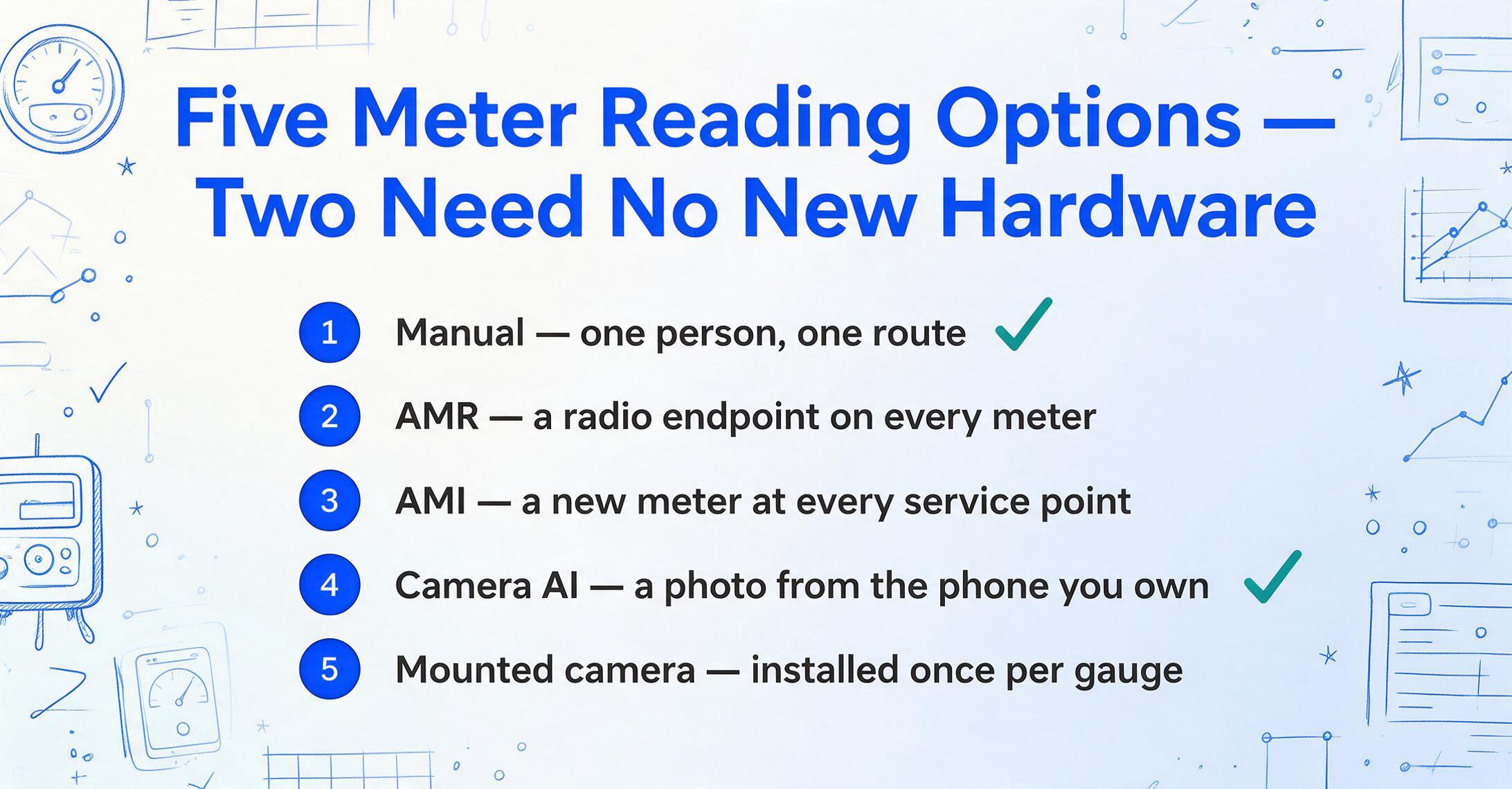
AMR was the first step beyond manual — it eliminated the need to physically see the dial by attaching a radio module that broadcasts the reading. But someone still has to drive or walk within range with a receiver. AMI is the full upgrade: a two-way networked meter that reports automatically, supports remote disconnect, and delivers interval data for demand management and leak detection. It's the end state most utilities are aiming for. The problem is the timeline. Replacing every meter in a service territory means sending a technician to every address — at a utility with 50,000 meters, that's years, not months. Itron, which has shipped over 100 million AMR and AMI endpoints, still acknowledges that the physical installation bottleneck hasn't gone away.
Camera AI reading — approaches 4 and 5 — sits in a different category entirely. It works on meters that are already installed, regardless of age, manufacturer, or communication capability. The tradeoff is data frequency: you get a reading when someone takes a photo, not every 15 minutes. For billing, that's often sufficient. For real-time grid management, it's not. This distinction — billing-grade data vs operations-grade data — is central to understanding where each approach fits.
Why Utilities Are Looking Beyond Manual Reading
Manual meter reading has three structural problems, and each is getting worse. The first is labor cost and availability. A water meter reader on Reddit described a typical day: "Each single day I have to do 700–900 water meters. It's mandatory that I finish it. I'm by myself on each route. Finding the meters is a task on its own" (r/Wastewater). That's a physically demanding job in an environment where hiring is difficult and turnover is high. Large European utilities report saving €1–2 million per year after eliminating manual reads.
The second is error rates. Manually collected meter data is error-prone at multiple points — misread dials, transposed digits, illegible handwriting on log sheets. Studies indicate roughly 1 in 10 utility bills contain mistakes. Even customer-submitted readings have an error rate of up to 10%. Analog meters themselves degrade over time: PG&E reports that analog meters fail at a rate of approximately 3%, compared to 0.08% for smart meters — roughly 40 times higher.
The third problem is what you can't see. A monthly or quarterly meter read tells you the cumulative consumption since the last read. It doesn't tell you that a leak developed on day two and has been wasting water for 28 days. The US EPA estimates 1.7 trillion gallons of potable water are lost annually in the United States, representing approximately $2.6 billion in lost revenue. Manual reading catches leaks when the bill spikes — weeks or months after the fact. AMI catches them in hours.
These three forces — rising labor costs, inherent error rates, and the operational blindness of infrequent reads — are pushing utilities toward automation regardless of their smart meter deployment status. The question isn't whether to move beyond manual reading. It's which path fits your timeline and budget.
How Camera AI Reading Actually Works
Camera AI meter reading uses a vision large model — the same class of AI that can describe a photograph in natural language — applied to structured data extraction. When the model sees an analog dial with a pointer resting between 4 and 5 on a scale marked 0–9, it doesn't need to calculate pointer angles or run edge-detection algorithms. It visually understands the gauge the way a human does: the needle is pointing to approximately 4.3. When it sees a digital display showing 0554876, it reads the digits in sequence, even from a photo taken at a slight angle in low light.
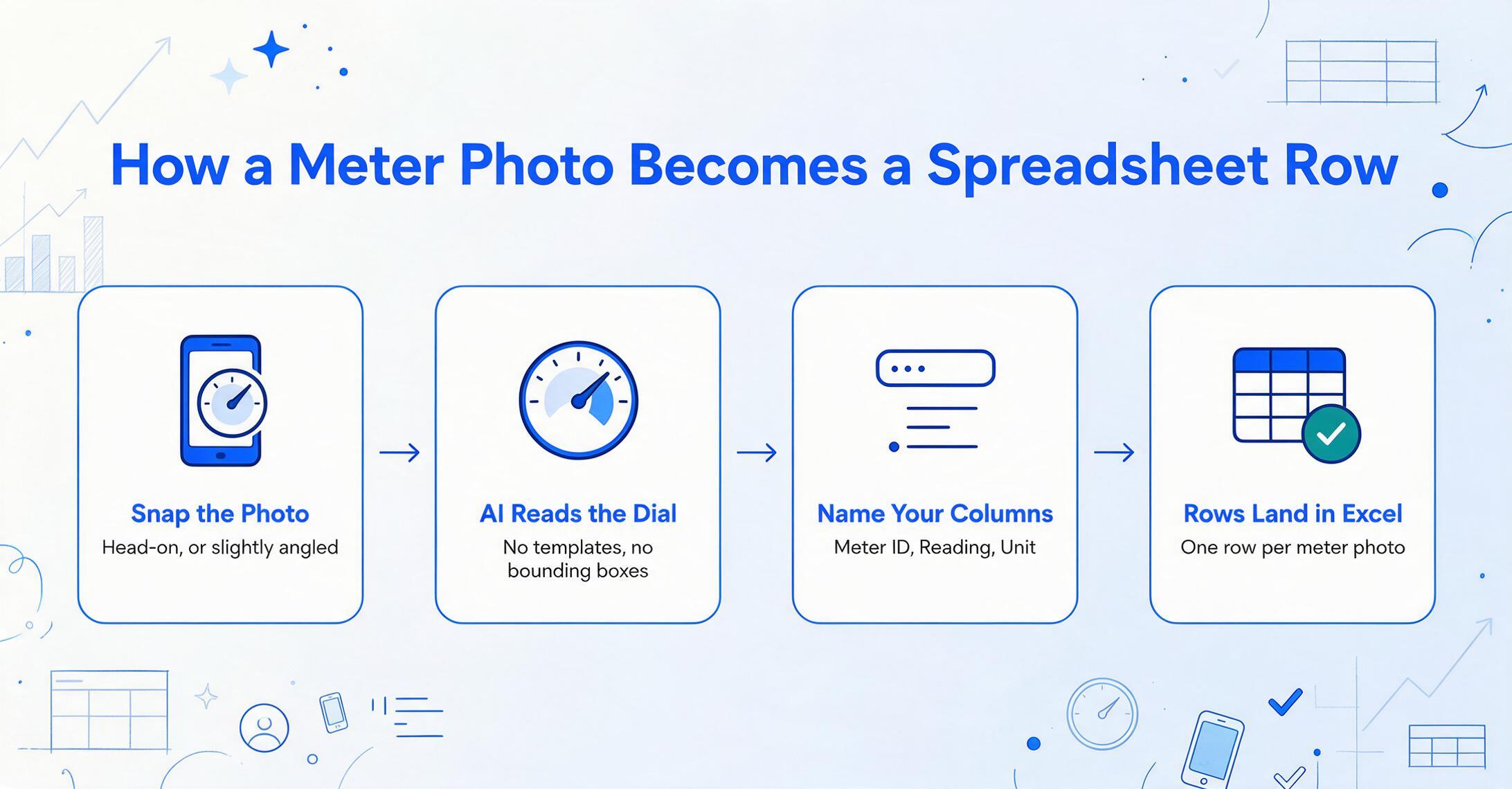
This is the distinction between template-based OCR and visual understanding — and it's why the same system handles a water meter with rolling digits, a gas meter with four analog dials, and a pressure gauge with a single needle, all from the same upload interface. There's no per-meter-type configuration, no training on your specific meter models, and no need to define bounding boxes around each digit.
The output side works through column-name extraction: instead of drawing boxes around fields or setting up template matches, you type the field names you want — "Meter ID," "Reading," "Unit," "Location" — and the AI locates each corresponding value on the meter face by understanding what it means, not where it sits. The column names you type become the headers of a structured Excel table. For example, if you upload photos of 50 different meters with varying dial layouts, the AI finds the reading on each one and populates a single spreadsheet — one row per meter, ready for import into your billing or maintenance system. This is documented in more detail in our step-by-step guide to AI meter reading with camera input.
Files are processed securely and not stored.
The accuracy picture varies by meter type. For printed digits on digital displays and rolling counters, the system achieves up to 99% accuracy — comparable to a careful human reader. For analog dials with needles, accuracy depends on photo quality: a clear, head-on photo under normal lighting produces reliably correct readings. Severely angled photos, heavy shadows, cracked gauge glass, or fogged-up covers reduce accuracy — the same way those conditions would make a human reader squint and guess. For a deeper look at accuracy factors and what degrades results, see our accuracy guide for field meter reading.
Industrial Gauges — The Overlooked Use Case
Walk through any manufacturing plant, water treatment facility, or oil and gas well site and you'll see them: analog pressure gauges, temperature dials, flow meters, and level indicators — often hundreds of them — each being read by a technician with a clipboard on a daily or weekly round. These aren't billing meters. They're operational gauges that tell you whether a pump is running in spec, a filter needs changing, or a compressor is about to overheat. And in most facilities, they're still read by hand.
The industrial gauge market is shifting toward digital instruments that integrate with SCADA and DCS control systems — but analog gauges remain widely used, especially in legacy plants and cost-sensitive environments. They're durable, don't require power, and have decades of service life left. Replacing every analog gauge on a factory floor with a networked digital equivalent is a capital project that competes with production equipment upgrades for budget.
Camera AI reading applies to industrial gauges exactly the same way it applies to utility meters. The vision model doesn't distinguish between a water meter dial and a psi gauge dial — it reads both by understanding the scale, the pointer position, and the context. A maintenance tech photographs a pressure gauge during their round. The AI extracts the reading, the gauge ID, and the timestamp into a structured maintenance log. The gauge stays. The clipboard goes away.
This use case is often missing from "meter reading" content because it doesn't fit neatly into either the utility billing narrative or the Industry 4.0 sensor-deployment narrative. But for a facility manager who just needs accurate gauge readings in a spreadsheet — without months of instrumentation projects — it's the most immediately useful application of the technology.
When Each Approach Makes Sense — A Decision Framework
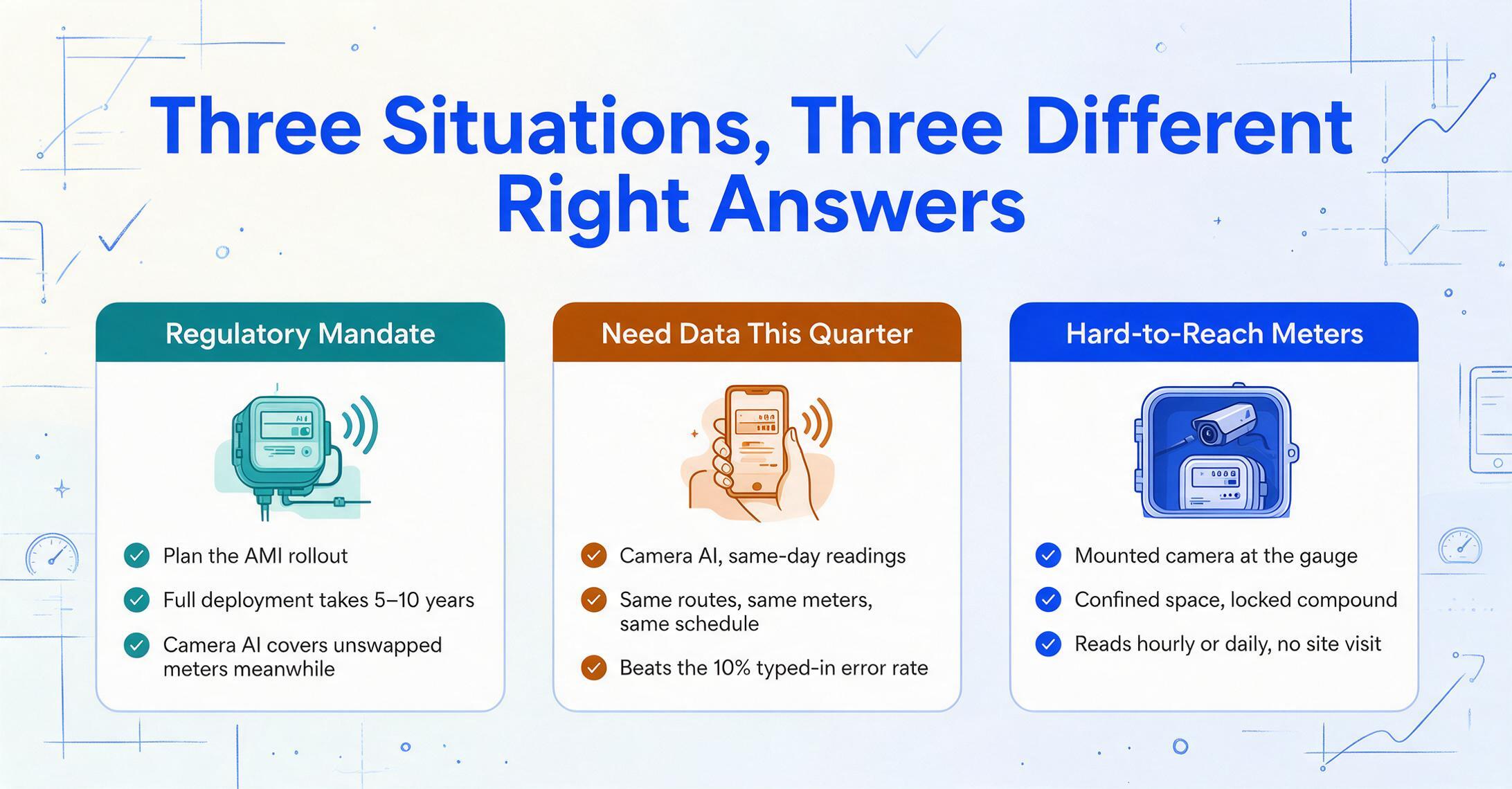
No single meter reading approach is optimal for every situation. The right choice depends on three variables: your timeline, your data needs, and your budget. Here's how to think about it by scenario:
You have a regulatory mandate and a 5–10 year deployment window. Plan the AMI rollout. It's the most capable long-term solution — interval data, leak detection, remote disconnect, outage reporting. But accept that full deployment takes years. In the interim, camera AI can provide billing-grade data for the meters that haven't been swapped yet. At scale, this hybrid approach is discussed in detail in our guide to scaling AI meter reading without IoT infrastructure.
You need accurate billing data this quarter — not in five years. Camera AI reading gives you a same-day operational improvement. Field technicians photograph meters during their existing routes instead of reading and recording manually. The reading is extracted by AI rather than entered by hand, eliminating transcription errors. You keep the same routes, same meters, same schedule — just a different data capture method. This approach also works for customer self-read programs: instead of asking customers to type numbers into a web form, have them snap a photo instead — eliminating the 10% error rate that comes with manually keyed customer submissions.
You have meters in difficult or dangerous locations. This is where the mounted camera approach shines. If a meter is in a confined space, behind a locked compound, or in a hazardous area, a permanently installed low-power camera that captures images on a schedule eliminates the safety risk of repeated human access. Combining this with camera AI for image processing gives you automated data collection without the cost of full meter replacement and communication infrastructure.
You run an industrial facility with mixed gauge types. Camera AI is likely your fastest path to digitization. The same system reads pressure gauges, temperature dials, flow meters, and level indicators — all from smartphone photos. You don't need to instrument each gauge individually. You just need a clear photo. For a practical walkthrough of what can go wrong when photos aren't good enough, see our troubleshooting guide for meter photo extraction.
You're choosing between tools and want a direct comparison. We've written a detailed side-by-side comparison of AMI, AMR, and camera AI approaches that breaks down cost per meter, deployment timeline, and operational fit by utility size.
Getting Started With Camera AI Meter Reading
Camera AI meter reading has a uniquely low barrier to entry compared to any hardware-based approach. You can validate whether it works on your meters in an afternoon — without procurement, without installation, and without committing to anything. Here's the sequence:
1. Photograph your meters. Take clear, head-on photos of a representative sample of your meter types — analog dials, digital displays, rolling counters. Include a mix of lighting conditions you actually encounter: indoor fluorescent, outdoor sunlight, basement dim. These are your test images.
2. Define your output columns. What data do you need from each meter reading? Typical columns include Meter ID, Reading Value, Unit (kWh, gallons, therms, psi), Date, Location, and Technician Name. These become your structured output — what the AI extracts into each column of your spreadsheet.
3. Run a test batch. Upload your sample photos, specify your columns, and run the extraction. Review the results against your known readings. If accuracy is sufficient on your meter types under your lighting conditions, you have a validated path forward. If certain photos produce errors — common causes include extreme angles, heavy shadows, and digit transitions on rolling counters — identify those conditions and adjust your photo-taking procedures accordingly. The meter reading to Excel converter uses the same extraction engine with a meter-specific template, so what you validate here is what you'll get in production.
4. Scale gradually. Start with one route or one facility. Integrate the photo-and-extract step into your existing workflow. Once the process proves reliable, expand to additional routes or gauge rounds. This incremental approach avoids the organizational risk of a big-bang deployment while building operational confidence at each step.
The entire test — from taking photos to reviewing extracted data — can be completed in under an hour for a small sample set. No vendor onboarding, no hardware procurement, no contract negotiation. Just photos and a web browser.
Frequently Asked Questions
Can AI read analog dials with needles — or does it only work on digital displays?
Yes, it reads analog dials. The vision model interprets the dial face, scale markings, and needle position visually — the same way a person would. Accuracy on analog dials depends on photo quality. A clear, straight-on photo under normal lighting yields reliable readings. Extreme angles, heavy shadows, or cracked gauge glass reduce reliability. This is not a limitation of the AI's ability to understand dials — it's a limitation of the image quality, the same constraint a human reader faces.
How accurate is camera AI meter reading compared to a human?
For printed digits on digital displays and rolling counters, up to 99% — comparable to or better than a careful human reader who doesn't transpose digits. For analog dials, accuracy varies with photo conditions. A well-lit, head-on photo produces results matching a trained meter reader. If your current manual process has a 10% error rate (which is consistent with industry data on customer-submitted readings), even AI reading at 95% accuracy on challenging analog dials represents a significant improvement over the status quo.
Does camera AI meter reading replace smart meters?
No. They serve different purposes. Camera AI provides on-demand readings — one data point per photo. Smart meters (AMI) provide continuous 15-minute interval data, remote service connect/disconnect, outage detection, and two-way communication. These are fundamentally different capabilities. Camera AI is best understood as a bridge to AMI — it gives you accurate billing data now, using your existing meters, while you plan and execute the hardware upgrade on a realistic timeline. It doesn't replace the need for AMI in the long run if your utility requires real-time grid management.
Can it handle different meter types in the same batch?
Yes. The AI doesn't need to be told what type of meter it's looking at. You can upload a batch containing water meters with rolling digits, gas meters with four analog dials, and electric meters with digital displays — the same extraction run handles all of them. Each photo is processed independently. The output is a single spreadsheet with one row per meter, regardless of meter type mix.
What about bad lighting — basement meters, outdoor glare, night readings?
Lighting quality directly affects accuracy. For dark locations, using your phone's flash produces usable images in most cases. For outdoor glare, angling the phone to avoid direct reflection on the gauge glass resolves most issues. Severely backlit meters (bright sun directly behind the meter) and fogged-up or condensation-covered glass are the hardest conditions — and they're hard for human readers too. If your meters are consistently in challenging lighting, a mounted camera with integrated illumination (approach 5 in the landscape above) is worth evaluating for those specific locations.
Do I need to train a model on my specific meter types?
No. General-purpose vision large models work on meter types they've never seen before because they understand visual concepts — dials, needles, scales, digits — rather than matching against stored templates of specific meter models. This is a key difference from traditional computer vision approaches, which require training images of each specific gauge or meter model. If we compare the tools in the market, the gap between template-trained and general-purpose AI is the most under-appreciated factor — covered in our tools comparison article.
Can this integrate with my billing system?
The output from camera AI reading is structured data — typically Excel (XLSX), CSV, or JSON. Most billing systems and maintenance management platforms can import these formats directly. The integration point is the import step: you extract the readings to a spreadsheet, then feed that spreadsheet into your billing system's batch import function. This is the same workflow you'd use with AMR data or manually entered readings — the difference is that the data arrives without human keystrokes, eliminating the dominant source of entry errors.