AI Meter Reading Tools Compared:
Smart Meters, AMR, and Camera AI — Which One for Your Operation?
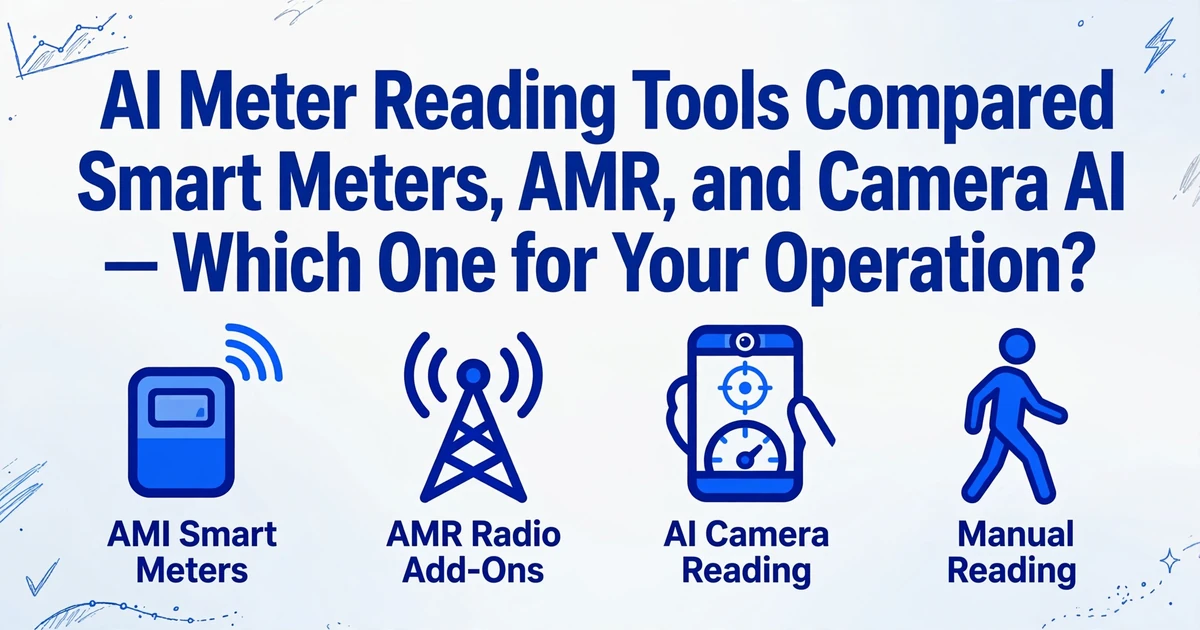
There are four ways to read a utility meter in 2025. Two of them require hardware replacement and a decade-long deployment plan. One eliminates hardware entirely but has accuracy constraints in basements and bad lighting. And the fourth is getting actively more expensive every year. Here's how to choose — by utility size, meter type, and what you can afford to wait for.
Key Takeaways
- $15 to $25 — what one manual meter read costs a utility in 2025. Oregon's EWEB now charges customers a monthly fee just for staying on manual reads.
- 69% of UK smart meters took 14 years to install — and 8.7% of those installed "smart" meters aren't even transmitting data to the utility.
- AI camera reading deploys in days not decades — it reads any meter face from 1995 or 2025 through a smartphone without replacing a single piece of hardware.
There Are Four Ways to Read a Meter in 2025. Most Utilities Only Know About Two.
Ask a utility operations manager how they read meters, and the answer usually falls into one of two buckets: "we're deploying smart meters" or "we still send people." The first answer describes a project that will take 15 years and cost more than the annual operating budget. The second describes a practice that the most forward-looking utilities are now actively charging customers to avoid.
But in 2025, the landscape has four distinct approaches — not two. And the newest one, AI camera-based reading, doesn't require replacing a single meter. Understanding the differences between them isn't an academic exercise. It's the difference between waiting a decade for operational data and getting it next month.
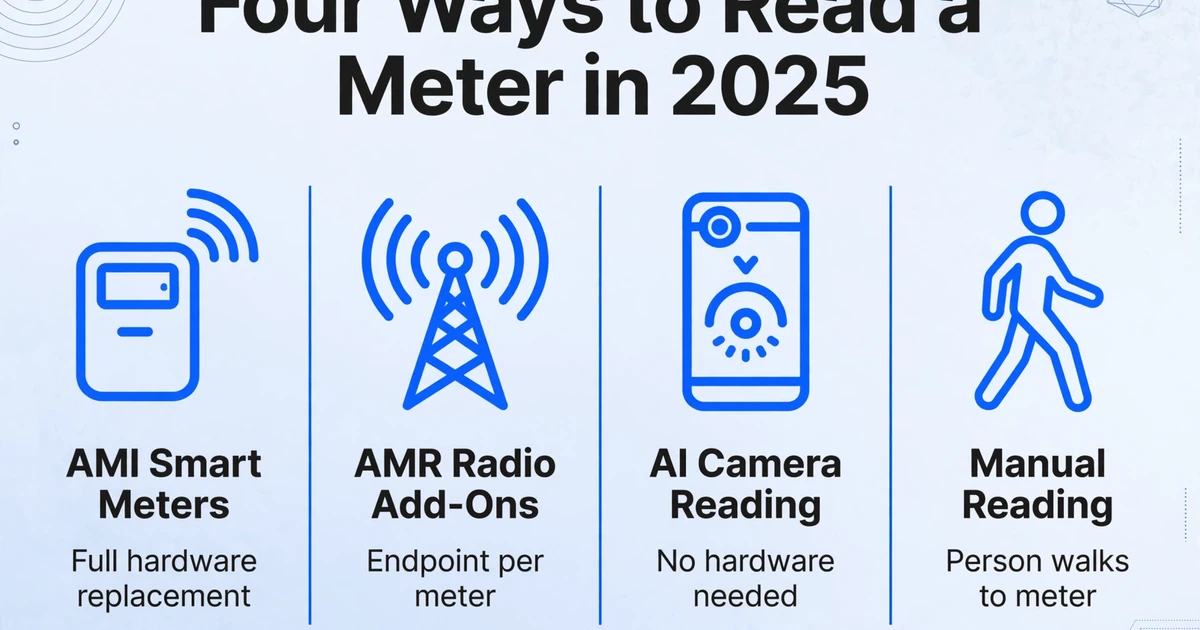
The four approaches, in order of infrastructure investment required:
1. AMI Smart Meters — Full hardware replacement. Two-way communication. Near-real-time data. Requires replacing every meter in the service territory.
2. AMR Radio Add-Ons — Endpoints attached to existing meters. One-way radio transmission. Walk-by or drive-by collection. Still requires hardware installation at every meter point.
3. AI Camera Reading — No hardware. Smartphone camera captures meter face. AI extracts the reading from the image. Works on any existing meter — analog, digital, mechanical.
4. Manual Reading — A person walks to the meter. Reads the dials. Writes down the number. The baseline that everything else is measured against.
The right answer depends on three things no vendor will ask you first: how many meters you have, what kind they are, and whether the person reading them today is standing in a driveway or climbing down a basement ladder.
Option 1: AMI Smart Meters — The Gold Standard, If You Have 15 Years and $100 Million
Advanced Metering Infrastructure is the most capable approach. It's also the most expensive, slowest to deploy, and least flexible once installed.
AMI replaces every meter with a smart meter that transmits consumption data over a fixed communication network — cellular, radio mesh, or power line carrier — directly to the utility's back-office systems. Readings arrive at 15-minute or hourly intervals. Two-way communication allows remote service connects and disconnects. Outage detection is automatic. Theft and tampering are flagged in real time. The data enables time-of-use billing, demand response programs, and predictive grid management.
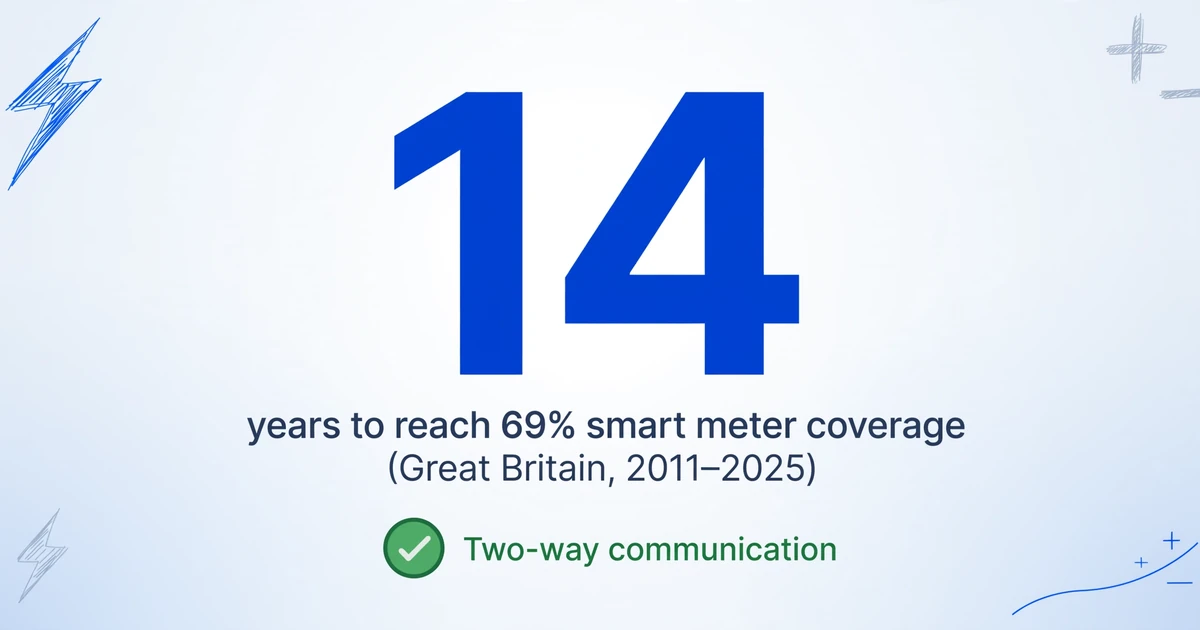
The UK's smart meter rollout illustrates the timeline: as of Q2 2025, 69% of domestic meters in Great Britain were smart, with the rollout having begun in 2011. That's 14 years to reach roughly two-thirds coverage. A further 8.7% of installed smart meters were operating in traditional (non-communicating) mode due to supplier compatibility issues — meaning the meter was smart but the data wasn't flowing.
The cost profile is similarly stark. The global smart electric meter market was valued at $17.6 billion in 2024, projected to reach $40.2 billion by 2034. A single smart meter deployment for a mid-sized utility serving 500,000 customers can run into the hundreds of millions — not just for the meters themselves, but for the communication network, the data management system, the IT integration, and the decade of field installation labor.
Best for: Large investor-owned utilities with capital budgets and regulatory mechanisms to recover costs over 10-15 year rate cases. Electric and gas utilities where outage detection and remote disconnect have direct operational value.
Not ideal for: Small municipal water districts, rural electric co-ops with dispersed meter bases, any utility that needs improved data in less than 5 years, or organizations where the existing meter stock still has 10+ years of useful life remaining.
Option 2: AMR Radio Add-Ons — Cheaper Than AMI, But Still a Hardware Project
Automated Meter Reading sits between manual reading and full AMI. An endpoint — a small battery-powered radio transmitter — is attached to each existing meter. When a utility vehicle drives down the street or a technician walks the route, a receiver collects the readings from every endpoint within range. No one has to step onto the property. No one has to read a dial.
AMR eliminates the per-meter labor cost of manual reading. It doesn't require replacing the meter itself — the endpoint reads the existing register and transmits the value. This makes it significantly cheaper than AMI: no meter replacement, no communication network buildout, no IT integration project.
The tradeoffs are real. AMR is one-way. The endpoint transmits; the utility receives. There's no remote connect/disconnect, no outage detection, no real-time tampering alert. Readings arrive when the collection vehicle drives by — daily, weekly, or monthly, depending on route frequency — not continuously. If an endpoint battery dies, the reading stops coming in, and the utility discovers the gap at the next billing cycle.
Itron's Temetra platform is the dominant player in this space, used by utilities including Las Vegas Valley Water District and Spire Energy. Spire reports collecting daily reads from 100% of customers using drive-by AMR — a significant improvement over monthly manual reads, but still a hardware-dependent system requiring field vehicles and route planning.
Best for: Utilities that have already invested in meter endpoints and want to improve collection efficiency without the capital commitment of full AMI. Water and gas utilities where remote disconnect is less critical. Territories with dense, drivable meter routes.
Not ideal for: Rural territories where drive-by routes are uneconomical. Utilities where real-time data or outage detection is operationally required. Any organization starting from zero — installing AMR endpoints on a full meter base is still a multi-year hardware deployment project.
Option 3: AI Camera Reading — No Hardware, No Truck Roll, Real Accuracy Trade-offs
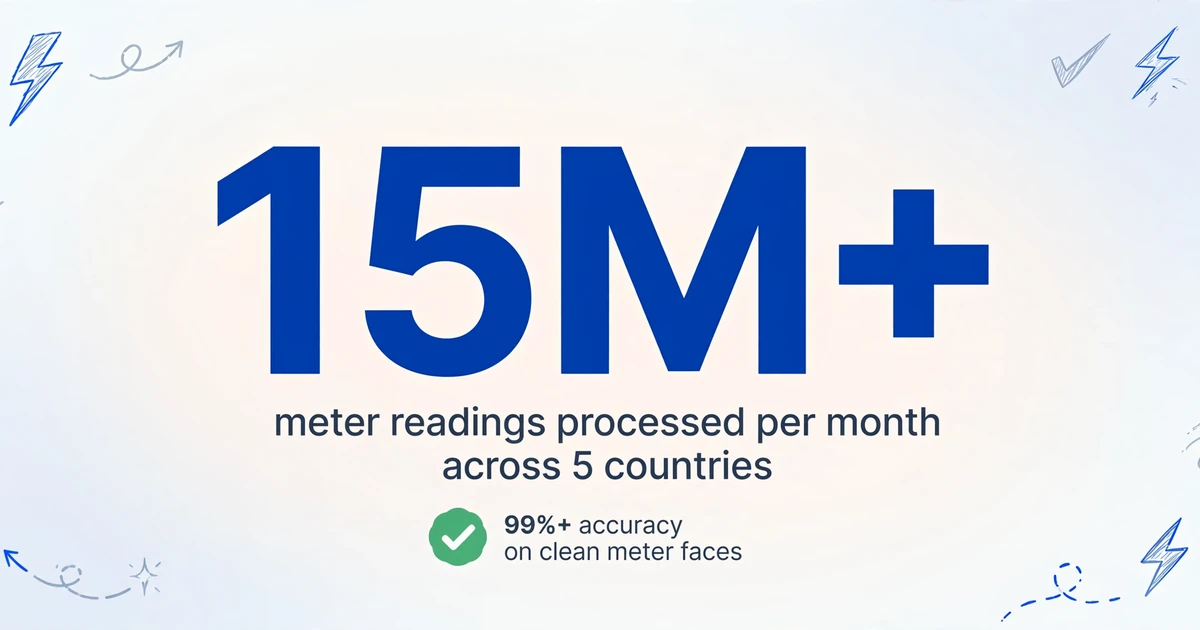
This approach didn't exist in a production-ready form five years ago. In 2025, it's reading over 15 million meters a month across five countries.
AI camera-based meter reading works on a simple principle: a field technician — or a customer — holds up a smartphone, takes a photo of the meter face, and an AI vision model extracts the reading from the image. The meter doesn't change. The communication infrastructure doesn't change. The only new element is the software that reads the dials.
Blicker, the market leader in this category, reports 99%+ accuracy on meter readings across water, gas, and electric meters. The company's AI core has been trained on millions of meter images and claims "superhuman precision, even in challenging field conditions." Blicker is operational in 5 countries, serving 25 utility organizations and 3,000+ field technicians, processing over 15 million readings per month. Brabant Water, a Dutch utility, uses Blicker for "first-time-right meter readings" across their service territory.
Anyline takes a complementary approach, embedding OCR into utility mobile apps so both field workers and customers can scan their own meters. The co.met utility in Germany uses Anyline for customer self-reading — customers scan a QR code on their meter, the app captures the reading, and data flows directly to the utility's billing system.
The accuracy profile deserves honest framing. AI camera reading achieves 99%+ on clean, well-lit analog and digital meter faces. Accuracy degrades when the meter is in a dark basement, behind obstructions, covered in condensation, or angled awkwardly. A field technician with a flashlight and a steady hand solves the lighting problem. A customer self-reading in a dim utility closet introduces more variables.
Best for: Utilities that need reading data now, not in a decade. Organizations with mixed meter stock (analog, digital, mechanical from multiple manufacturers) where hardware standardization is infeasible. Water utilities where the ROI on AMI is harder to justify than on electric. Customer self-reading programs. Field workforce already equipped with smartphones.
Not ideal for: Meters in consistently unlit or inaccessible locations. Operations that require continuous 15-minute interval data for grid management. Utilities that have already committed to and funded a full AMI rollout — in which case AI reading serves as a bridge during the transition, not the final destination.
Option 4: Manual Reading — Still 2% of the Grid, and Getting More Expensive Every Year
Manual meter reading isn't a technology choice. It's the baseline that's becoming a liability.
EWEB, the public utility serving Eugene, Oregon, reached a tipping point in 2025. With 98% of electric customers and 85% of water customers on smart meters, the remaining manual-read customers — about 2% of the meter base — had become disproportionately expensive to serve. The utility proposed implementing monthly manual meter reading fees because "efficient meter reading routes are no longer possible" for a scattered set of non-communicating meters. A single manual read, in a service territory optimized for automated collection, requires a dedicated truck roll that serves no other purpose.
The math is straightforward: a utility worker driving to a single location to read one meter costs $15-$25 per read in fully loaded vehicle and labor cost. For a utility reading 100,000 meters monthly, that's $18-$30 million annually just for meter reading — before accounting for weather delays, safety incidents, and data entry errors from manual transcription.
Vue.ai's analysis of manual meter reading costs found that the hidden expenses extend beyond the obvious: delayed leak detection (bimonthly reads mean leaks run for weeks before detection), billing estimate errors (estimated bills generate customer service calls and dispute resolution costs), and revenue leakage from meters that are skipped, misread, or inaccessible.
Best for: Nothing. Manual reading is not a strategy. It's the default state that every other approach improves upon. The question isn't whether to move away from manual reading — it's which alternative fits your timeline, budget, and meter stock.
How to Choose: A Decision Matrix by Utility Size, Meter Type, and Budget
The right answer isn't one of these four approaches. It's a sequence. For most utilities, the realistic path is a phased transition: start with what works today, build toward what's possible tomorrow.
| Dimension | AMI Smart Meters | AMR Radio | AI Camera | Manual |
|---|---|---|---|---|
| Upfront cost | $$$$$ (hundreds of millions) | $$$ (millions–tens of millions) | $$ (subscription, no hardware) | $$$$ (ongoing labor) |
| Deployment time | 10–15 years | 2–5 years | Days to weeks | Immediate (already in place) |
| Data frequency | 15-min to hourly | Daily to monthly | On-demand (per photo) | Monthly to quarterly |
| Accuracy | 99.5%+ | 99%+ | 99%+ (ideal) / 90%+ (poor conditions) | 95–98% (transcription errors) |
| New hardware required | Every meter replaced | Endpoint per meter | None (smartphone) | None |
| Remote disconnect | Yes | No | No | No |
| Best meter types | Electric, gas | Water, gas | Any visual meter face | Any accessible meter |
| Best utility size | Large (100K+ meters) | Mid-size (10K–100K) | Any size | Shrinking viability |
For a large electric utility with regulatory cost recovery: AMI is the long-term answer. Start the deployment. Use AI camera reading during the 10-15 year transition for the meters that haven't been upgraded yet, and for water meters where the AMI business case is weaker.
For a mid-size water district with a 20-year meter replacement cycle: AMI requires replacing meters before their useful life ends. AMR requires installing endpoints and maintaining drive-by routes. AI camera reading gives you digital data immediately on your existing meter stock — deploy the smartphone app to your field team this month, collect structured data this billing cycle, and make the AMI/AMR decision with actual operational data rather than vendor projections.
For a rural co-op with dispersed meters and challenging drive routes: AMI is cost-prohibitive per meter. AMR drive-by routes are uneconomical at low density. AI camera reading gives each field technician a tool that works at any meter, on any road, without requiring a density threshold. Readings flow into the billing system from the field, not from a route schedule. If your operation is growing past a few thousand meters, our guide to scaling AI meter reading without full IoT rollout walks through the back-office tipping point where manual systems break down.
The realistic path for most utilities: AI camera reading today for immediate operational data. AMI over the next 10-15 years for full smart grid capability. They're not competitors — they're phases in a transition that takes longer than any single technology's deployment window.
Where AI Camera Reading Fits — and Where It Doesn't
AI camera-based meter reading is the fastest-deploying, lowest-capital option on this list. It's also the most constrained by physical conditions. Honest boundaries matter more than inflated promises.
Where it works well: Outdoor meters in accessible locations. Meters with clear, unblocked faces. Daytime readings in normal weather. Any meter type — analog dials, digital displays, mechanical odometer-style counters. The AI doesn't care whether the meter was manufactured in 1995 or 2025. It reads the visual display regardless of the underlying technology. This makes it uniquely suited to utilities with mixed-age meter stock — which is almost every utility that hasn't completed an AMI deployment.
Where it struggles: Meters in dark basements without supplemental lighting. Meters behind furniture, stored items, or outdoor obstructions. Meters with condensation, dirt, or physical damage obscuring the display. In these conditions, accuracy drops from 99%+ to the 85-90% range — still useful for estimation and anomaly detection, but not reliable enough for billing without human verification. The fix is procedural: require field workers to carry a flashlight, clean the meter face before photographing, and retake the photo if the AI flags a low-confidence reading.
Where it doesn't work: Meters that cannot be physically accessed at all. Submerged water meters. Meters installed behind permanently sealed panels. These edge cases exist in every service territory — and for them, the only option remains either hardware replacement (AMI/AMR) or continued manual reading with its escalating cost.
For a practical guide to setting up an AI meter reading workflow — from capturing field photos to exporting structured meter data — see our walkthrough on AI meter reading without smart meters. For the cost comparison in dollar terms, including a manual-vs-AI ROI model, see our analysis of manual vs AI meter inspection costs.