Australian Receipt Tax Deduction Checklist
ABN-Verified, GST-Ready & EOFY-Prepared
The Australian financial year ends June 30. For most small business owners, the final two weeks before EOFY are when a year's worth of receipts — currently sitting in a shoebox, a glove compartment, an email inbox, and a kitchen drawer — suddenly need to become a coherent set of tax records. The pressure isn't just about volume. It's about the fact that not all receipts are equal under Australian tax law. A Bunnings receipt for a $180 drill and a Bunnings receipt for $180 of cleaning supplies look identical at a glance — but one is a depreciable asset subject to the $20,000 instant asset write-off, the other is an immediately deductible expense. Sort them wrong and you've either under-claimed or created an audit exposure. This checklist walks through exactly what to do with your receipts in each phase of the EOFY countdown — so that on July 1, you hand your accountant a spreadsheet, not a shoebox.
Key Takeaways
- A receipt missing its ABN over the $75 threshold isn't just incomplete — it creates a 47% PAYG withholding liability that turns a $1,000 supplier payment into $470 you personally owe the ATO.
- The $20,000 instant asset write-off has a hidden trap: the asset must be installed and ready for use by June 30 — a laptop still in its box on June 29 shifts the entire deduction 12 months forward, because purchase date alone isn't enough.
- Turning a shoebox of 80 receipts into a BAS-ready spreadsheet isn't about typing faster — it's about column-name extraction that reads ABNs, GST amounts, and deduction types by what they mean, not where they sit on the page, so you hand your accountant data instead of data entry.
Why the June 30 Deadline Hits Receipts Harder Than Everything Else
Most EOFY checklists — the ones from Xero, MYOB, and accounting firms — are organised by task type: reconcile bank accounts, finalise payroll, lodge BAS, pay super. That structure makes sense for an accountant looking at a general ledger. It makes far less sense for a sole trader staring at a pile of 80 receipts on June 25.
The reason receipts are the bottleneck is that every other EOFY task works with data that's already structured. Your bank transactions are already in your accounting software. Your payroll is already running through STP. Your BAS labels pull from the GST you've been tracking all year. But receipts — especially in a small business that mixes Bunnings runs, Uber rides, supplier invoices, and hand-written tradie dockets — arrive at EOFY as the last unstructured frontier. They need to be sorted, classified, verified, and converted into structured data before they can feed into any of those other tasks.
Three realities of the Australian system make receipt work at EOFY uniquely high-stakes:
1. Receipts determine what you can deduct this year. An expense receipt dated June 29 is deductible in the current financial year. The same purchase on July 2 goes into next year's return. For a sole trader on the 32.5% marginal rate, a $5,000 equipment purchase claimed in the right year is worth $1,625 in tax saved. Get the date wrong and that saving shifts 12 months forward — or vanishes entirely if the $20,000 instant asset write-off threshold changes next year.
2. Receipts create compliance obligations that survive long after the deduction is claimed. Under ATO record-keeping rules (ITAA 1936 section 262A), you must retain records for 5 years from lodgement. A receipt you digitise and extract today is evidence that protects a deduction claimed in a return audited in 2031. Every receipt you toss because "I'll remember what it was for" becomes a deduction you can't substantiate.
3. Missing ABNs create liabilities, not just missed deductions. If you pay a supplier who hasn't quoted their ABN and the payment exceeds $75 (excluding GST), you as the payer may be required to withhold 47% of the payment under PAYG no-ABN withholding rules (Taxation Administration Act 1953, Schedule 1, Division 12). That obligation sits with you — not the supplier. A receipt without an ABN isn't just incomplete. It's a potential $470 liability on a $1,000 payment.
EOFY receipt work isn't about tidiness. It's about locking in deductions, establishing compliance evidence, and surfacing liabilities — all before a hard deadline that cannot be moved. The following checklist breaks the work into time-boxed phases, each building on the last.
Two Weeks Out (Mid-June): Sort and Classify Every Receipt by Tax Treatment
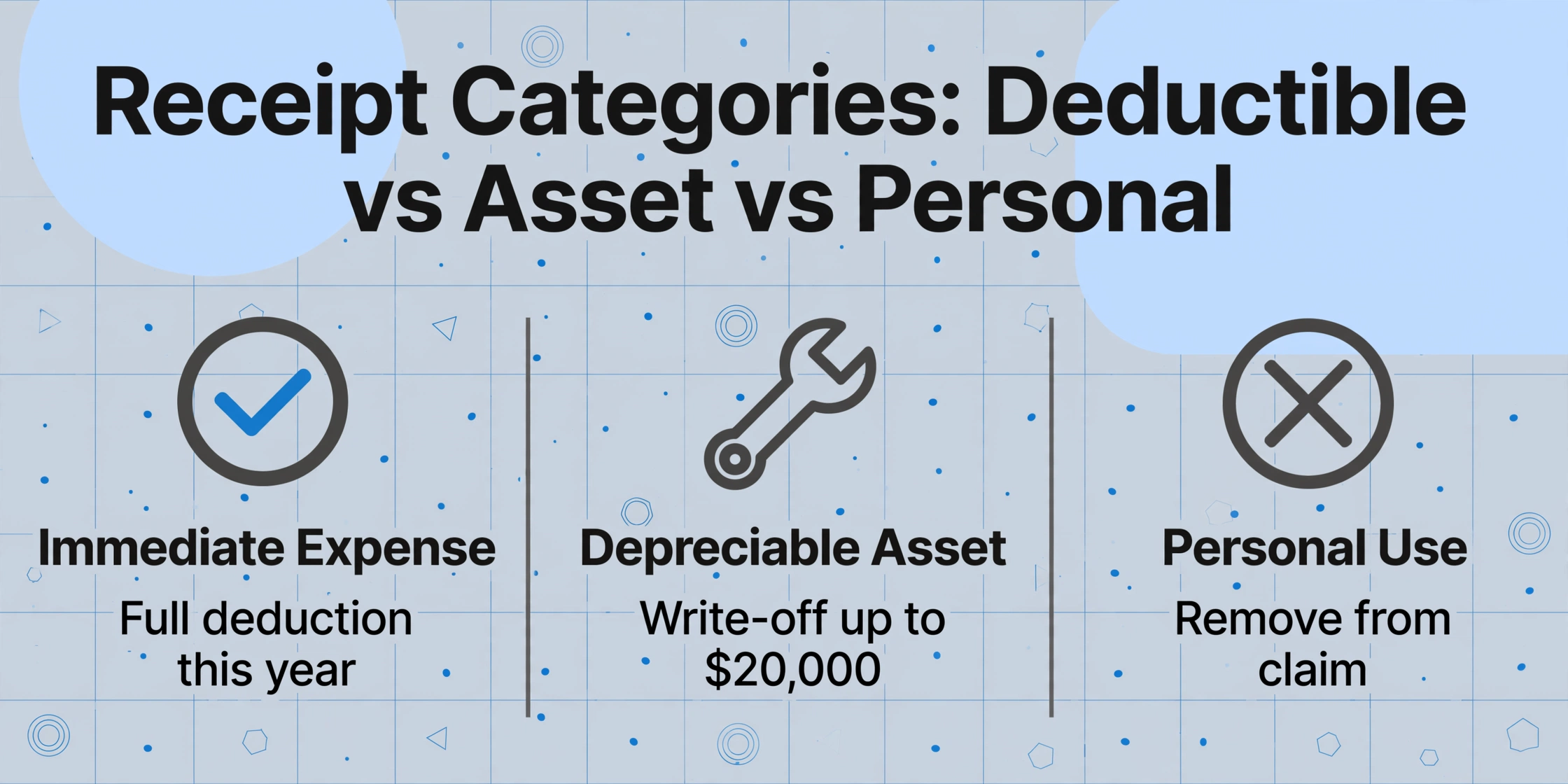
If there's one step that separates an organised EOFY from a chaotic one, it's this: before you scan anything, before you type a single column name, sort your receipts by what they mean for your tax return. The classification determines everything downstream — what columns you need to extract, what records you need to keep, and what happens if you get audited.
Australian tax law treats receipts differently depending on what the purchase was for. A $2,500 laptop, a $180 drill, and a $45 stationery run all produce receipts — but they follow entirely different deduction rules. Sorting them correctly before extraction means your spreadsheet rows can carry the right treatment from day one.
| Receipt Category | Tax Treatment | Examples | EOFY Check |
|---|---|---|---|
| Immediately Deductible Expense | Full deduction in current year | Office supplies, software subscriptions, stationery, cleaning, client meals, Uber for work, postage, phone bills | Dated on or before June 30. ABN present if from a GST-registered supplier over $82.50 |
| Depreciable Asset (costing $20,000 or less) | Instant asset write-off — full deduction in current year | Laptop, tools, office furniture, printer, tradie equipment, camera | Must be installed and ready for use by June 30. Purchased but still in the box = no deduction this year. ABN required regardless of price |
| Depreciable Asset (costing more than $20,000) | Depreciated over effective life — partial deduction each year | Vehicle, major machinery, fit-out, commercial oven | Installed ready for use by June 30 to claim this year's depreciation portion. Talk to your accountant about the depreciation schedule |
| Mixed Business & Personal Use | Apportioned — claim only the business-use percentage | Mobile phone bill (60% business calls), home internet, vehicle logbook, home office utilities | Need a reasonable basis for the split. A 4-week logbook or usage diary is the ATO's accepted method. Keep the working |
| Personal Expense | Not deductible | Personal groceries, family meals, non-work clothing, personal entertainment | Remove from the business receipt pile entirely. If it's in the same transaction as a business item (e.g. one Bunnings receipt with both), flag it for apportionment |
The most common EOFY mistake in this phase is treating everything as "general expenses" and dumping it all into the same column. A $2,200 laptop and a $22 lunch both produce receipts, but one goes to your asset register (and potentially the instant asset write-off), while the other goes to your P&L as a straightforward expense. If you extract them into the same spreadsheet without a category column that captures this distinction, you or your accountant have to re-sort everything later — effectively doing the same work twice.
Create a column called Deduction Type (options: Immediate Expense/Instant Asset Write-off/Depreciable Asset/Personal Use Portion). This is an inferred column — meaning the AI reads the receipt content and assigns the category based on what was purchased, even though no "deduction type" label exists on the receipt itself. The category automatically populates as part of the extraction step, saving you the manual classification pass after the fact. For a deeper walkthrough of how inferred columns work across mixed receipt batches, see the guide to Australian tax receipt extraction with ABN and GST.
Before You Scan: The 30-Second ABN Check That Prevents a 47% Liability
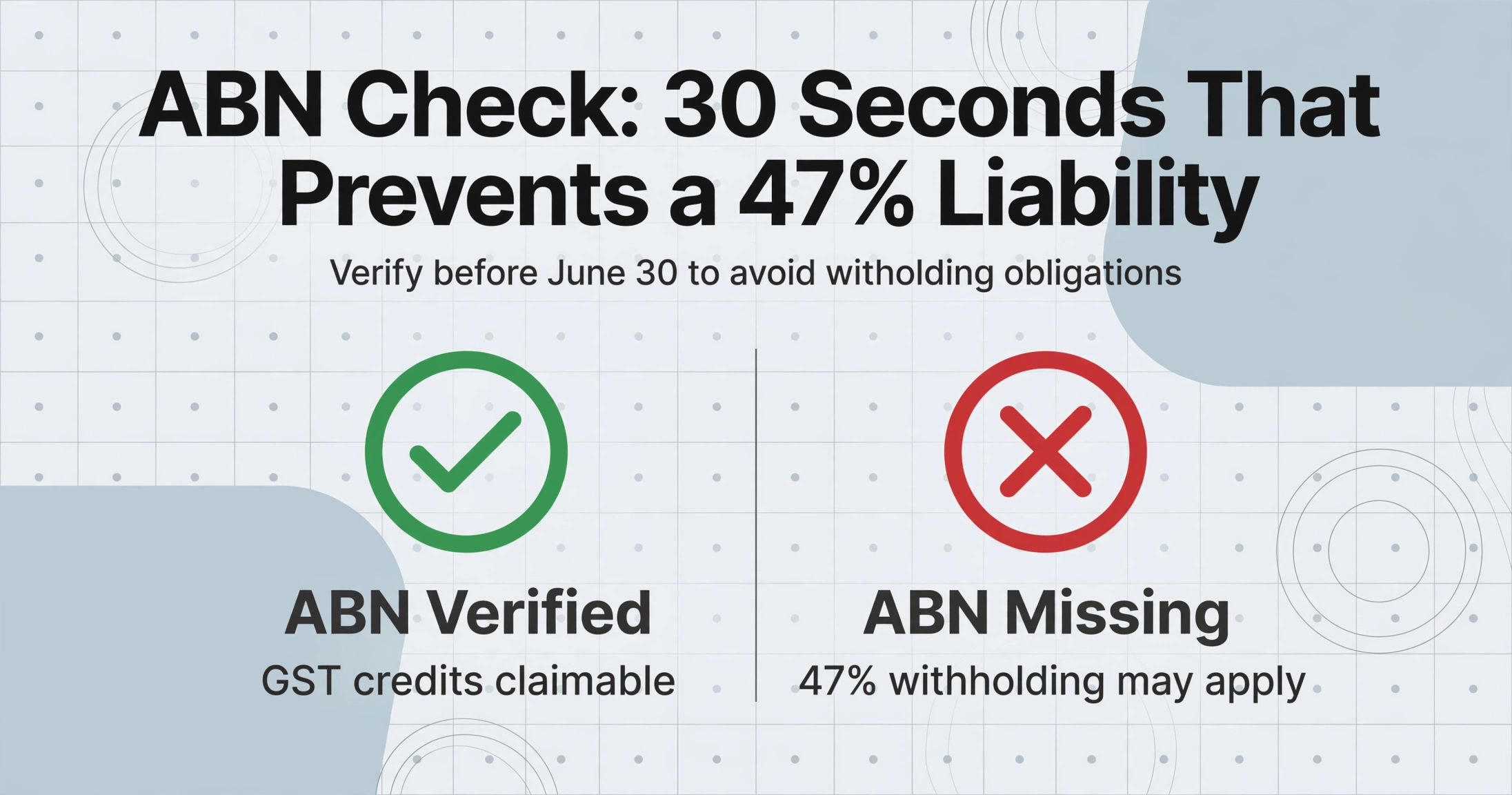
Once receipts are sorted by category, the next 10 minutes are the highest-ROI compliance work you'll do all year. Pick up every receipt in your "immediately deductible" and "asset" piles. Look for the supplier's ABN — an 11-digit number, usually near the business name or at the bottom of the receipt.
If the ABN is present, type it into the free ABN Lookup tool on the Australian Business Register website. This confirms the ABN is active, the business name matches, and the supplier is registered for GST. A valid ABN on the receipt plus a matching ABR record means the receipt is eligible for GST credit claims (assuming it's labelled a tax invoice and meets the other ATO requirements).
If the ABN is missing — and the total exceeds $75 (excluding GST) — you need to make a decision before June 30:
- Contact the supplier immediately. Ask them to provide a tax invoice with their ABN. Most legitimate businesses can email one within hours.
- If they can't or won't provide an ABN: determine whether the supplier is carrying on an enterprise or engaging in a hobby/private transaction. If it's a business, the 47% withholding obligation may apply. Talk to your tax agent about whether you need to withhold and report on your BAS at label W4.
- Flag the receipt. Even if you pay without withholding, knowing which receipts lack ABNs means you can explain the situation if the ATO asks — and gather the correct documentation (such as a NAT 3346 Statement by a Supplier form for hobby exceptions) before the audit, not during it.
This step takes roughly 15 seconds per receipt once you're in rhythm and eliminates the single largest compliance risk hiding in a small business's receipt pile. Skip it, and you're gambling that the ATO won't ask about supplier ABNs on audit — a bet that's gotten worse as the ATO's data-matching capabilities have improved.
Seven Days to Go: Digitise Every Physical Receipt Before It Fades
Thermal-printed receipts — the kind from every EFTPOS terminal in Australia — are chemically unstable. After 6-12 months, the text fades to blank. A Bunnings receipt from March that was perfectly legible then may be a blank white slip by the time you need it for an audit in 2028. The ATO's 5-year retention rule means you need a copy that survives long after the original has degraded.
This is the week to create digital copies of every physical receipt. Three practices make this actually work rather than creating a new mess:
Use a consistent file naming convention.
SupplierName_YYYY-MM-DD.jpg — for example, Bunnings_2026-03-15.jpg or Uber_2026-04-22.pdf. The filename becomes the bridge between a row in your extraction spreadsheet and the original document on disk. If an auditor asks to see the receipt for the $180 drill claimed on row 47, you can find it in seconds rather than opening 200 files named IMG_4287.jpg.
Photograph or scan at enough resolution to read the ABN.
An ABN printed in 8pt font near the bottom of a receipt needs to be legible in the digital copy. Hold your phone steady, ensure good lighting, and check that you can zoom in and read small text before moving on. The ATO's myDeductions app handles the photo capture — but doesn't extract data from it automatically.
For email receipts, save as PDF — not a screenshot.
Uber receipts, Xero subscription invoices, and Amazon business purchase confirmations arrive by email. Save each as a PDF (most email clients support "Print to PDF" or "Save as PDF") rather than taking a screenshot. PDF preserves the metadata and text layers that make extraction more accurate. Screenshots introduce compression artefacts that can confuse an AI reading small numbers — particularly ABNs and GST amounts.
By the end of this step, every receipt should exist as a named digital file in a folder. The shoebox can wait — the structured data you're about to create is what carries the deduction, and the digital copy is what proves it.
The Week of EOFY: Batch Extract Everything into One Spreadsheet
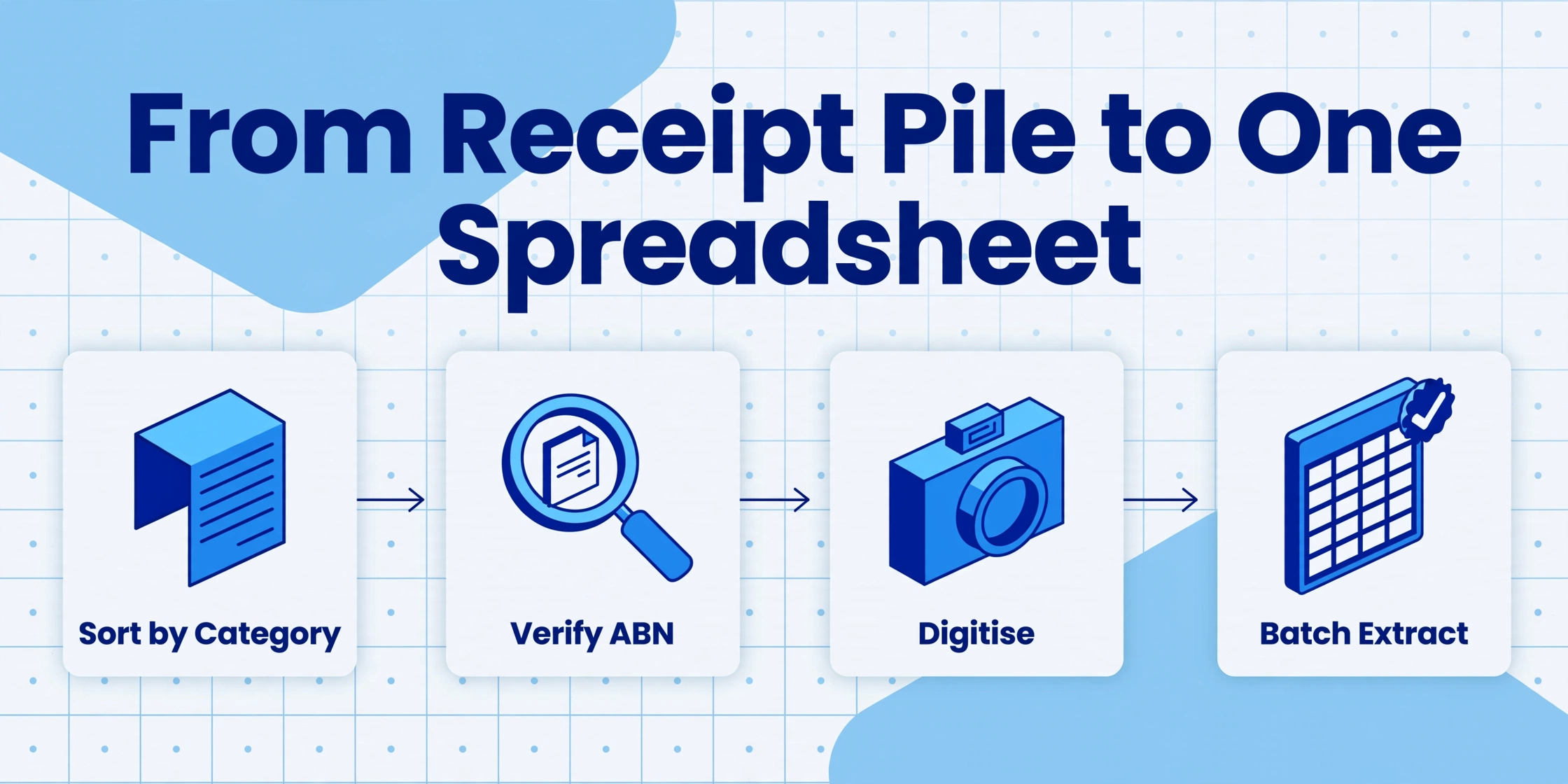
This is where the week-by-week preparation pays off. You have a folder of named, categorised receipt images. Now you need to turn them into a single spreadsheet with ATO-compliant columns — in one pass, not 80 individual manual entries.
Traditional receipt OCR tools work document by document: upload one receipt, review, export, repeat. At 45 seconds per receipt for an experienced user, 80 receipts is a full hour of repetitive clicking. And that's before you deal with the receipts that don't match the tool's expected format — an Uber email receipt and a hand-written tradie docket share no layout in common.
What works at EOFY scale is column-name extraction: you define the output columns you want once — Supplier Name, ABN, Date, GST Amount, Total, Deduction Type — and upload your entire folder. The AI reads each receipt, locates the matching values by understanding what they mean (not where they sit on the page), and assembles one unified spreadsheet where each row is a receipt. A Bunnings receipt, an Uber PDF, and a carbon-copy tradie invoice all feed into the same table because the AI isn't looking at layout — it's looking at meaning.
For an Australian EOFY receipt batch, here are the columns that matter:
| Column Name | What It Captures | Why It Matters at EOFY |
|---|---|---|
Supplier Name | Trading name on the receipt | Identifies the vendor for your P&L and BAS |
Supplier ABN | 11-digit ABN from the receipt | Required for GST credit claims; cross-check with ABR Lookup |
Invoice Date | Date of the transaction (DD/MM/YYYY) | Determines which financial year the deduction falls in. June 29 vs July 2 is the difference between this year's return and next year's |
GST Amount | GST component shown on the receipt | Feeds directly into BAS label 1B (GST on purchases). Was the receipt a valid tax invoice? If GST isn't shown, you may not be able to claim it |
Total (incl GST) | Full amount paid, GST-inclusive | Feeds into BAS labels G10 (capital) or G11 (non-capital) depending on Deduction Type |
Deduction Type (options: Immediate Expense/Instant Asset Write-off/Depreciable Asset/Personal Use Portion) | Tax treatment category | Inferred column — AI determines the category from the receipt content. Drives which BAS label and which depreciation schedule the row feeds into |
GST Claimable (Yes/No) | Whether this receipt qualifies as a tax invoice with claimable GST | Inferred column — AI checks for "Tax Invoice" label, ABN presence, and GST breakdown. Saves the manual per-receipt determination |
Description | What was purchased | The level of detail an auditor would accept as "sufficient to determine the character of the expense" |
Files are processed securely and not stored.
The demo above is pre-loaded with a receipt preset. Try typing Supplier ABN, GST Amount, and Deduction Type (options: Immediate Expense/Instant Asset Write-off/Depreciable Asset/Personal Use Portion) as column names to see how column-name extraction reads each field by meaning rather than position. For more on the extraction mechanics — including how to handle handwritten tradie receipts, mixed GST-free and taxable line items, and the ÷ 11 GST shortcut pitfall — see the step-by-step guide to extracting ABN and GST from Australian receipts. For the complete batch workflow — including file naming conventions, format fragmentation strategies, and the 100-receipt efficiency cliff — see the guide to batch processing business receipts for tax.
The Final 48 Hours (June 29–30): Last-Chance Deductions
There are deductions available to Australian small businesses that have a hard June 30 cutoff — not a lodgement deadline, but a "must occur by this date" requirement. If you miss the cutoff, the deduction shifts a full year forward. These are the items to check in the final two days:
Instant asset write-off: purchase and install by June 30. The FY 2025-26 instant asset write-off allows businesses with aggregated turnover under $10 million to immediately deduct the full cost of eligible assets costing less than $20,000 each. The asset must be first used or installed ready for use by June 30. Ordered but not delivered? Not deductible this year. Delivered but still in the box? Not deductible this year. Installed and operational on June 29? Deductible this year. The receipt date is evidence, but the test is whether the asset was ready to do its job.
Pre-pay deductible expenses for next year — within limits. Under the prepayment rules, you can claim an immediate deduction for prepaid expenses that cover a service period of 12 months or less, ending by June 30 of the following year. Pre-paying your July 2026 rent, insurance premiums, or software subscriptions on June 29 brings the deduction into the current year. This is a standard EOFY planning tactic — but check with your accountant, as prepayment rules interact with your business structure (sole trader vs company) and whether you're a Small Business Entity for tax purposes.
Super contributions — cleared by June 30. Super guarantee contributions for employees must be received by the fund by June 30 to be deductible in the current year. Sending the payment on June 29 isn't enough — it needs to clear and land in the fund's account. Most clearing houses quote 3-5 business days for processing, so the practical last day to initiate a super payment for June 30 deduction is around June 23-25. For sole traders making personal deductible contributions, the same clearing timeline applies. The ATO's concessional contributions cap for FY 2025-26 is $30,000 — and unused cap amounts from previous years may be carried forward if your total super balance is below $500,000.
| Last-Chance Deduction | Deadline | What the Receipt Must Show |
|---|---|---|
| Instant asset write-off ($20,000 per asset) | Installed ready for use by June 30 | Purchase date, supplier ABN, description of asset, total price. Keep the delivery confirmation if purchase and delivery dates differ |
| Prepaid expenses (12-month rule) | Paid by June 30 | Invoice date, payment date, period of service covered. The prepaid period must end by June 30 next year |
| Super contributions | Received by the fund by June 30 | Payment receipt from your clearing house confirming the fund received the contribution. Initiate by ~June 25 to account for clearing time |
| Write off bad debts | Written off in your books by June 30 | Board minute or sole trader declaration documenting the decision. The debt must have been previously included as assessable income |
| Trading stock write-down | Stocktake and valuation by June 30 | Stocktake records showing obsolete or damaged stock valued at the lower of cost or net realisable value |
None of these last-chance deductions require new software or processes. They require knowing the deadlines exist and having the receipts organised enough to identify which purchases qualify. If you've done the sort-and-classify step in mid-June, you already know which receipts fall into the instant asset write-off category — and can check whether those assets were installed and ready for use before the deadline passed.
After June 30: From Spreadsheet to Accountant, BAS, and Archive
EOFY has passed. You have a spreadsheet with every receipt as a row, classified by deduction type, with ABN and GST columns populated. The last phase is connecting that spreadsheet to the systems that need it.
Step 1: Hand to your accountant — as structured data, not a paper folder. Most Australian small business accountants work in Xero, MYOB, or QuickBooks Online. All three accept CSV imports for expense transactions. Export your extraction result as a CSV, map the columns to your accounting platform's import format (Date → Date, Supplier Name → Payee, Total → Amount, GST Amount → Tax), and import. Your accountant gets clean, categorised data instead of a shoebox — and charges for tax return preparation rather than data entry. If you're lodging yourself, the same CSV feeds directly into myTax's deductions section, or forms the basis of your BAS lodgement figures.
Step 2: Map extracted data to your BAS labels. If you're GST-registered and lodging quarterly, your April-June BAS is due July 28. The spreadsheet you just created contains the numbers you need: sum the Total column for rows where Deduction Type is "Instant Asset Write-off" or "Depreciable Asset" → BAS label G10 (capital purchases). Sum Total for rows where Deduction Type is "Immediate Expense" → BAS label G11 (non-capital purchases). Sum GST Amount for rows where GST Claimable = Yes → BAS label 1B (GST on purchases). These three sums, verified against the underlying receipt data, replace the estimate-and-hope approach that many sole traders use for BAS lodgement.
Step 3: Archive for the 5-year retention window. Save the spreadsheet and the receipt image folder to at least two locations — one local, one cloud. Name the archive folder clearly: FY2026_Receipts/[SupplierName]_[Date].[ext]. The ATO requires records to be in English (or easily converted to English) and stored in a way that prevents alteration. A PDF export of the final spreadsheet, timestamped and stored alongside the receipt images, meets the "true and clear copy" standard under ATO record-keeping requirements. If your record-keeping system changes over time, you need to be able to reconstruct the original data — another reason to keep the extraction spreadsheet in a durable, non-proprietary format.
A spreadsheet connected to named receipt files is a substantiation-ready record. An auditor should be able to start at any row — "Bunnings, 2026-03-15, $180, Instant Asset Write-off" — and locate the matching receipt image in seconds. The 5-year retention clock starts from lodgement, not from purchase date, so a deduction claimed in a return lodged in October 2026 needs records kept until at least October 2031.
A Special Case: Handwritten Trades Receipts at EOFY
If your business deals with tradies — plumbers, electricians, builders — a portion of your EOFY receipt pile will be handwritten carbon-copy dockets. These are common in the Australian construction and trades sector, and they present a specific challenge: the handwriting may be rushed, the carbon copy may be faint, and the ABN (which tradies are legally required to display on invoices over $75) is sometimes missing or illegible.
The ATO accepts handwritten receipts as valid evidence provided they contain the same information a printed tax invoice would: supplier name, ABN, date, description, and amount. The issue isn't legal validity — it's legibility. A carbon copy that's readable today may be unreadable in a year.
For handwritten tradie receipts in your EOFY batch: digitise them immediately after receipt — don't wait for the June rush. Photograph them with the best lighting you can manage. Run them through the same extraction workflow as printed receipts: the AI reads handwriting by understanding character shapes in context, not by matching fonts. Accuracy is lower than printed text, so spot-check these rows before handing them to your accountant. For a complete walkthrough of handling handwritten receipts — including legibility expectations, accuracy rates by handwriting style, and the trade-offs of manual review vs AI extraction — see the guide to batch processing handwritten receipts for tax.
The Complete EOFY Receipt Checklist at a Glance
Two weeks before June 30
- Gather every physical receipt, email receipt, and supplier invoice from the financial year
- Sort into five piles by tax treatment: immediate expense, instant asset write-off, depreciable asset, mixed business/personal use, personal (remove)
- Check every receipt for supplier ABN; verify via ABN Lookup
- Contact any supplier whose receipt lacks an ABN over the $75 threshold — get a tax invoice before June 30
- Separate tax invoices from regular receipts; flag receipts under $82.50 for simplified treatment
One week before June 30
- Digitise all physical receipts using consistent naming convention:
SupplierName_YYYY-MM-DD - Save email receipts as PDFs, not screenshots
- Take clear, well-lit photos of handwritten tradie receipts — check ABN legibility
- Store digital copies in a named folder (e.g.
FY2026_Receipts/)
Week of June 30
- Set up extraction columns: Supplier Name, Supplier ABN, Invoice Date, GST Amount, Total (incl GST), Deduction Type, GST Claimable, Description
- Upload entire receipt folder for batch extraction — one unified spreadsheet as output
- Spot-check asset receipts and handwritten receipts for extraction accuracy
- Review the Deduction Type column: does each row's classification match your manual sort?
June 29–30: Last-chance window
- Confirm all instant asset write-off purchases are installed and ready for use
- Consider pre-paying deductible expenses covering the next 12 months (rent, insurance, software)
- Initiate super contributions — needs to clear by June 30, so last practical initiation is ~June 25
- Document any bad debt write-offs and trading stock revaluations
After June 30
- Export extraction result as CSV; import into Xero/MYOB/QuickBooks or hand to accountant
- Calculate BAS figures: sum columns by Deduction Type → G10, G11, 1B
- Archive spreadsheet (PDF) + receipt images in two locations for ATO 5-year retention
- If using a tax agent, ensure you're on their client list before October 31 to qualify for the lodgement extension
FAQ
Is June 30 the deadline to lodge my tax return?
No. June 30 marks the end of the financial year — the last day that income and expenses count toward FY 2025-26. Your tax return lodgement deadline depends on your situation: October 31, 2026 if you self-lodge; as late as May 15, 2027 if you use a registered tax agent (provided you're on their client list by October 31). The June 30 cutoff matters for deductions — a purchase made July 1 goes into next year's return — not for the lodgement itself.
I'm not GST-registered. Does this checklist still apply to me?
Most of it does. If your annual turnover is under $75,000 and you haven't voluntarily registered for GST, you can skip the GST Amount and GST Claimable columns. The ABN check is still worthwhile — it confirms your suppliers are legitimate businesses — and the deduction type classification (expense vs asset vs personal use) still determines when and how you claim each item. The digitisation and record-keeping steps apply to everyone.
Can I just divide the receipt total by 11 to get the GST amount?
Only if every line item on the receipt is subject to GST. In Australia, many common purchases include GST-free items — basic foods, some health services, exports — alongside taxable items. A Bunnings receipt that includes both GST-free plants and taxable hardware means the ÷ 11 shortcut gives a wrong GST figure. Extract the GST amount as its own column from the receipt. If the receipt doesn't show GST separately, it may not qualify as a tax invoice, meaning you can't claim the GST credit regardless of what calculation you do.
Can I just use the ATO's myDeductions app instead of batch extraction?
The myDeductions app is a record-keeping tool — it stores photos of receipts with manually entered amounts and categories. It's designed for employees and individuals with modest deduction claims, not for small businesses processing dozens of receipts per quarter. The app has three limits that make it unsuitable for EOFY batch work: it doesn't produce structured data exports (no spreadsheet with ABN, GST, date as filterable columns), it processes one receipt at a time (no batch upload), and it doesn't extract data from the receipt image (you type everything manually). It's complementary to batch extraction: use myDeductions for the odd receipt on the go, and batch extraction for the EOFY pile.
Do phone photos count as valid ATO records?
Yes. The ATO accepts electronic copies of receipts, including phone photos, as long as they're a "true and clear" reproduction of the original. The key requirement is that the photo must be clear enough to read all the information an auditor would need to verify — supplier name, ABN, date, description, amount, and GST. A blurry, low-light photo of a receipt where the ABN is illegible doesn't meet the standard. The photo also needs to be stored in a way that prevents alteration and preserved for the full 5-year retention period.
My tax agent says I have until May next year to lodge. Why does June 30 still matter?
The lodgement extension your tax agent gets you applies to filing the return, not to what can be claimed in it. June 30 is the cutoff for deductibility — a purchase on July 1 belongs to next year's return regardless of when you lodge. Additionally, your tax agent needs your receipt data well before the extended lodgement date to prepare the return. If 80% of their clients dump receipt folders on them in the last week of April, your return may not get the attention it deserves. Sending organised data in July means your accountant works on your return when they have time, not when they have no choice.
What if a receipt is over $82.50 but doesn't say "Tax Invoice"?
Under ATO rules, a document must contain the words "Tax Invoice" (or be clearly identifiable as one) to support a GST input tax credit claim for purchases over $82.50 (GST-inclusive). If your receipt lacks this label but otherwise contains all seven required elements (supplier name, ABN, date, description, GST amount or statement, total), contact the supplier and ask them to reissue it as a tax invoice. If they won't, you may not be able to claim the GST credit on that purchase. This is one reason the "tax invoice vs receipt" check in the sorting phase isn't optional — discovering it after you've extracted and classified 80 receipts means backtracking.
The Difference Between EOFY Panic and EOFY Readiness Is What You Know on June 1
Every Australian small business owner will reach June 30 with a pile of receipts. The difference between those who hand their accountant a spreadsheet on July 5 and those who hand over a shoebox on April 28 isn't software, accounting knowledge, or how many hours they worked. It's whether they knew, on June 1, that receipts need to be sorted by tax treatment — not by vendor — and that the ABN verification step isn't optional.
The checklist in this article is designed to compress a year's worth of receipt work into a repeatable EOFY-week process. The first year through, it takes an afternoon. The second year, you'll be wondering why you ever did it any other way.
What changes isn't the deadline — June 30 doesn't move. It's that you arrive at it knowing which receipts support which deductions, which ABNs are valid, and which rows in your spreadsheet map to which labels on your BAS. That knowledge transforms EOFY from a compliance gamble into a routine close — same deadline, entirely different experience.