Catching Up 8 Years of Bookkeeping
Without Typing Every Page by Hand
Being eight years behind on bookkeeping means roughly ninety-six monthly reconciliations, each one leaning on the one before it. Whether that project finishes in four months or drags into next year is rarely decided by the accounting. It is decided by how many of those months still exist only as paper, phone photos, or scanned PDFs that nobody has turned into rows yet.
Key Takeaways
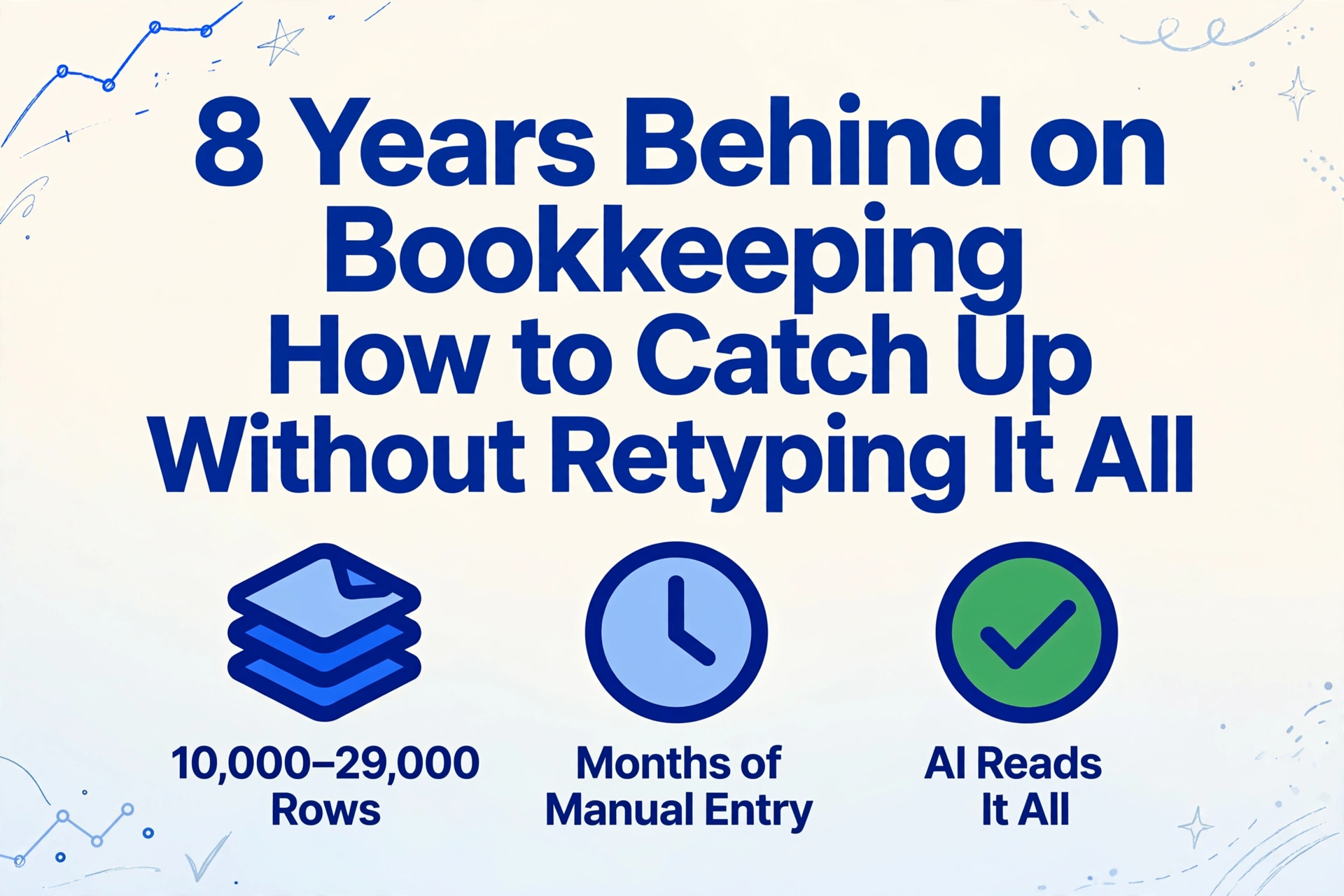
- An eight-year backlog is not a penalty for being slow, it is 10,000 to 29,000 rows that have not been turned into data yet.
- Pricing guides bill by the month of backlog, but the real cost is handling the paper, not posting the journal entries.
- Your attention belongs on treatment decisions, split transactions, and records that never existed, while the reading is the part you can batch and hand off.
Eight Years Behind Is a Document Problem Before It Is an Accounting Problem
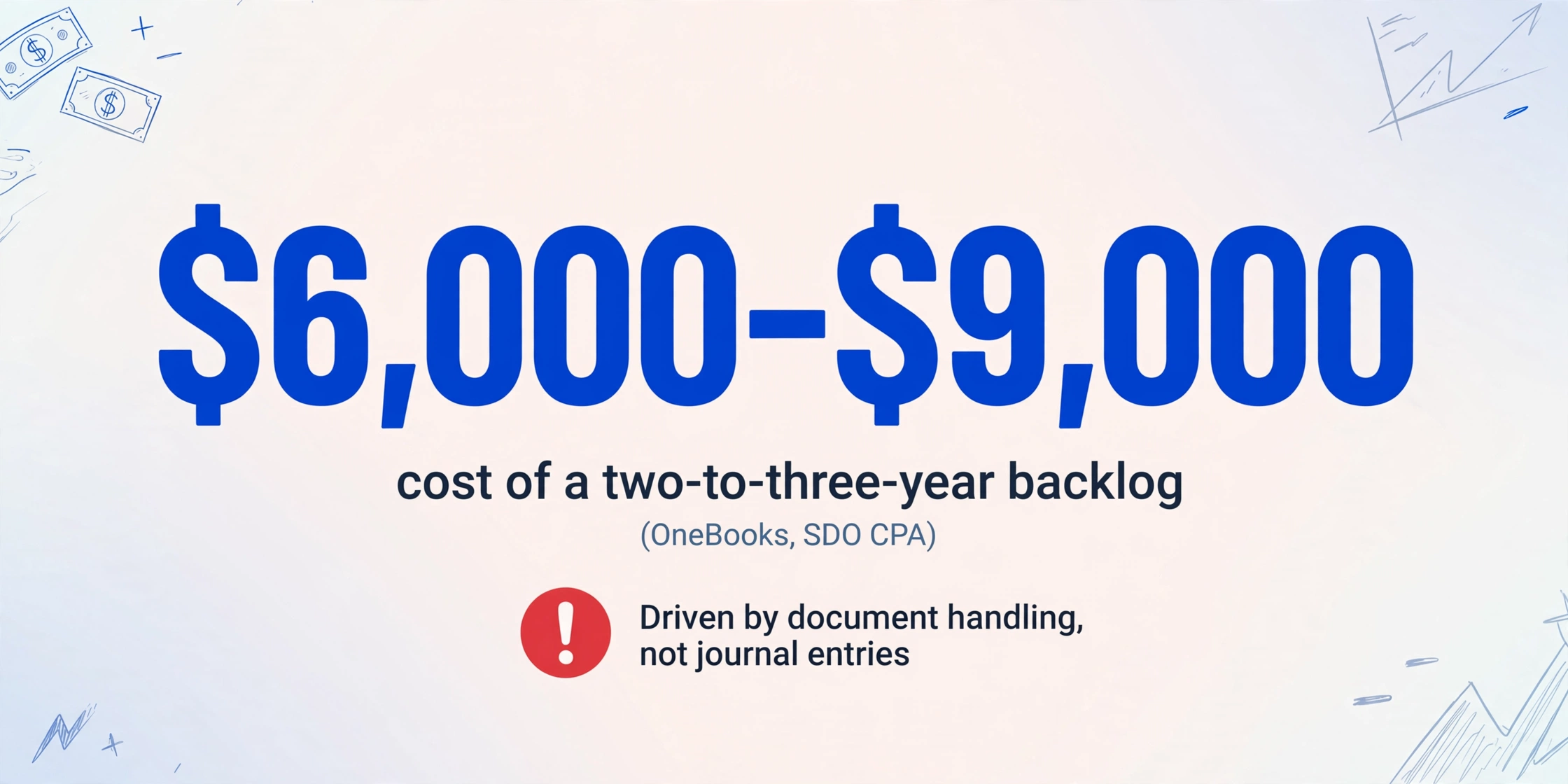
When you need to catch up bookkeeping for a client who is years behind, the work is priced by the month of backlog, because that is how it accumulates. Published 2026 pricing from US bookkeeping firms puts a one-to-three-month backlog at roughly $300 to $750, one to two years at $3,000 to $6,000, and two to three years at $6,000 to $9,000, with four-to-five-year projects quoted individually and commonly scheduled across four to five months (OneBooks, SDO CPA).
Read those numbers again and notice what drives them. The expensive part of a multi-year catch-up is not the journal entries. It is the raw handling of the source documents: retrieving statements the bank no longer serves through an online feed, sorting boxes of paper, and turning every page into a row that can be reconciled.
For a business doing 100 to 300 transactions a month, eight years is roughly 10,000 to 29,000 rows to reconstruct. At three minutes of manual entry per page, that is a full-time job measured in months before the first reconciliation even runs.
This is the gap between what a standard catch-up checklist tells you (gather the documents, reconcile month by month) and what actually stalls the project. The checklist assumes the documents are already data. They are not, and the multi-year version of the problem is where that assumption costs the most.
Start With the Oldest Year, and Know Why
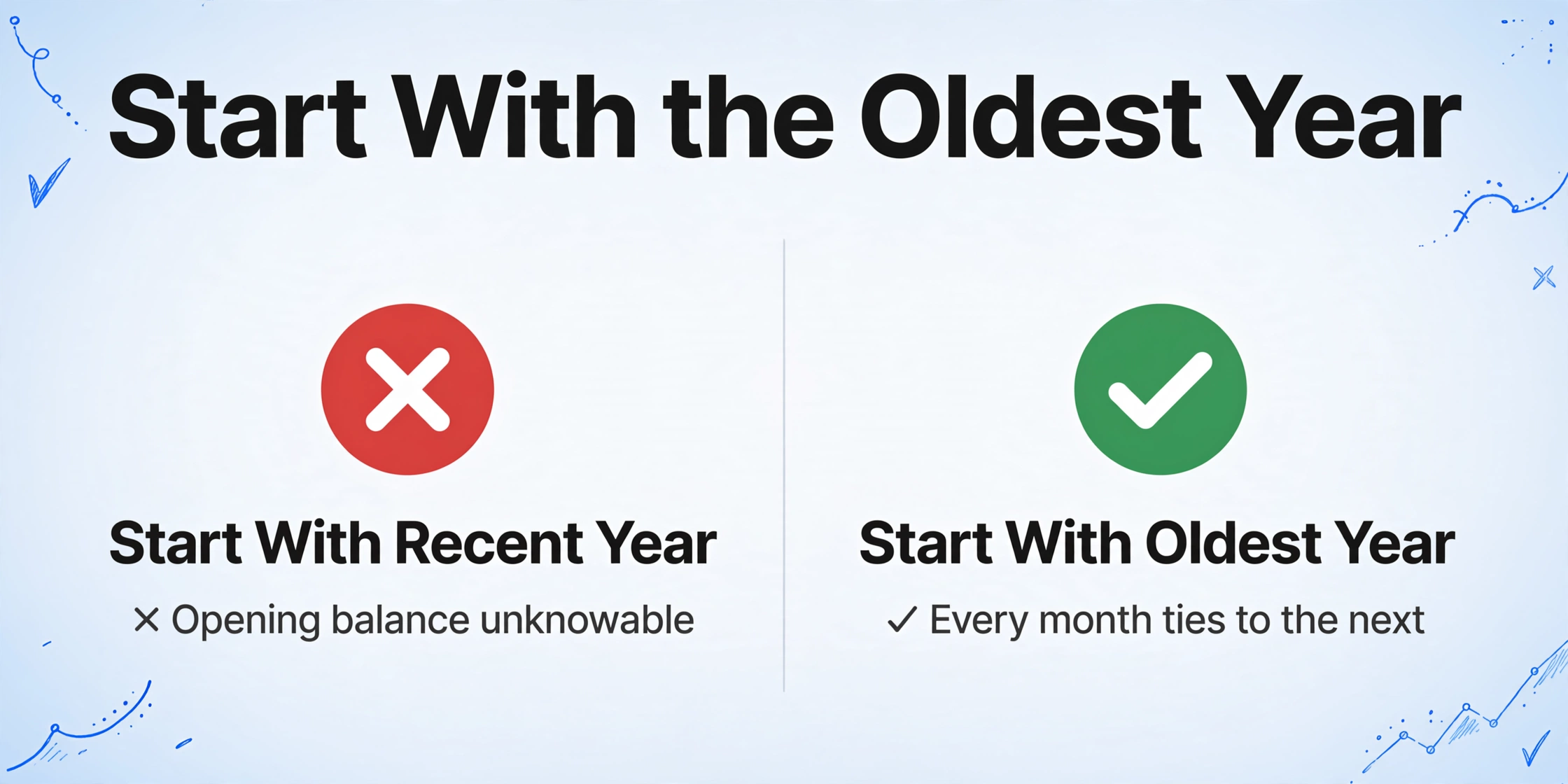
When a client asks where to begin, the correct answer is the earliest period in the backlog. The reason is structural. Every month's ending balance becomes the next month's opening balance, so an error in year one travels forward through all ninety-six months and reappears as an unexplained variance in year eight.
That is why a multi-year catch-up cannot be shuffled the way a pile of invoices can. You can extract all eight years at once, but you have to reconcile them in order. A bookkeeper who skips ahead and fixes only the years with unfiled returns ends up unwinding the same discrepancies twice, because the recent year they care about has an opening balance that depends on every year before it.
Some advice online suggests starting with the most recent year because it is easier to remember and the documents are easier to find. That works for a couple of missing months. It fails for a genuine multi-year gap, where the recent year's opening balance is unknowable until the prior years are corrected, and where the prior-year returns may themselves need amending.
This is the exact question behind the r/Bookkeeping thread that opens with "8 yrs of bookkeeping…where to begin?", and it is the one part of the process the generic checklist answers correctly. The harder question is what to do with the documents themselves.
The Bottleneck No One Prices: Getting Years of Records Into Rows
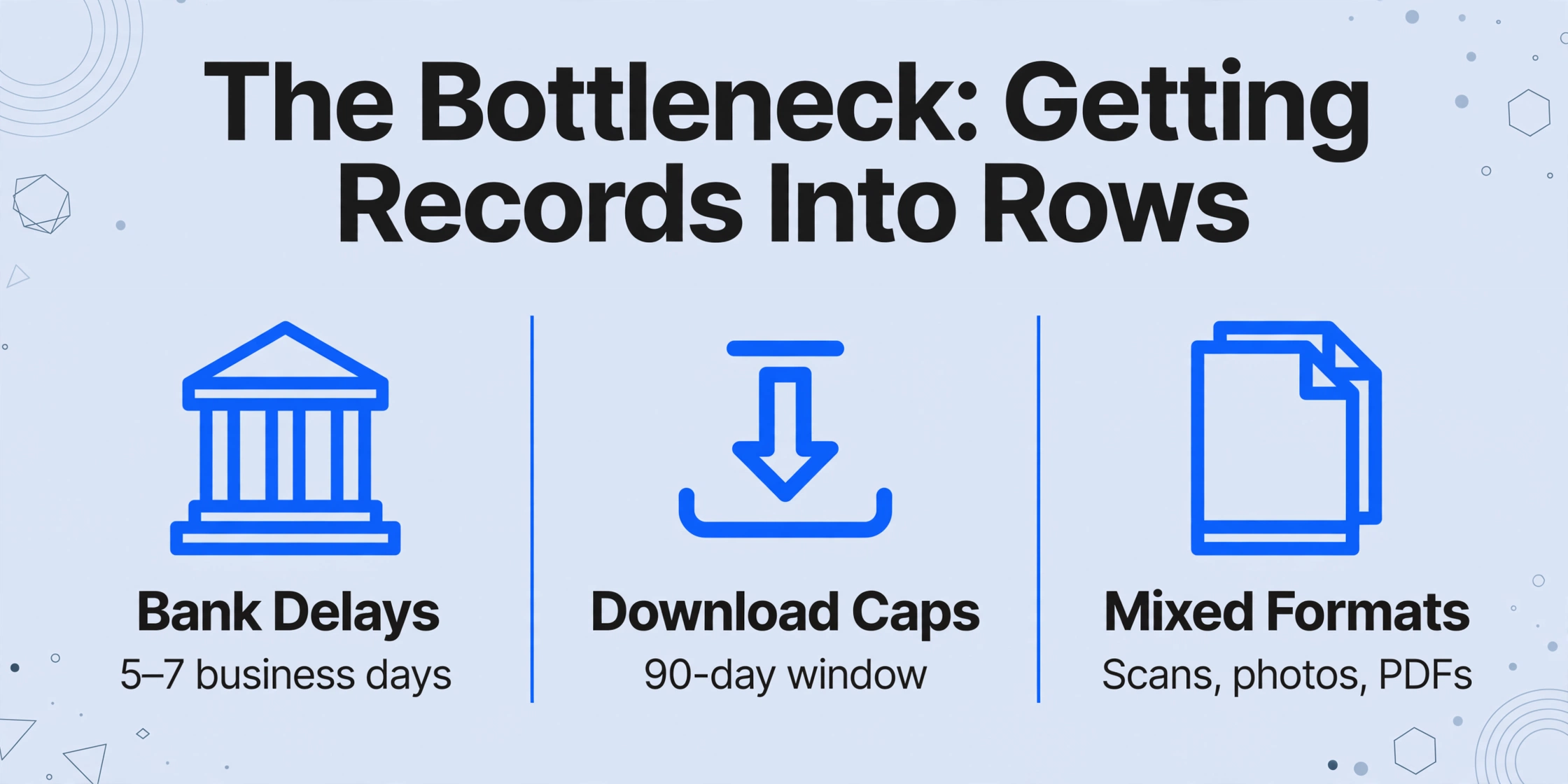
A multi-year reconstruction has two separate bottlenecks, and the pricing guides blend them into a single "how far behind" number.
Acquisition. Institutions do not keep historical statements equally available. Many banks take five to seven business days to produce statements older than 18 months, some charge for them, and download limits are real: Bank of America caps CSV transaction downloads to a rolling 90-day window and 3,000 transactions. Closed accounts and payroll providers from years ago can be harder still. Across a five-to-ten-year project, some of the source data may no longer exist in digital form at all.
Entry. What does exist arrives as a mixture: scanned paper statements, phone photos of receipts, thermal paper faded to near-blank, and PDFs from three or four different banks and card issuers. Typing that mixture by hand is the line item that turns a two-week reconciliation into a six-month project.
Bookkeepers describe this plainly in their own forums. In one r/Bookkeeping discussion of a new client, a commenter warns that "people underestimate how bad their previous bookkeeping is more often than not." Another thread describes a sole proprietor running 100+ transactions a month with more than half of them personal, where a single Amazon order mixes business and personal items.
Extraction speed is not the constraint people expect. The constraint is that no one can reconcile a page that has never been converted into rows, and a multi-year bookkeeping backlog contains thousands of them.
How to Bulk-Process Years of Records Instead of Typing Them
The step that makes a multi-year catch-up tractable is separating two jobs a spreadsheet normally forces together: reading the documents, and reconciling the balances. Reading is mechanical and can be batched across all eight years at once. Reconciliation is sequential and stays with the bookkeeper. Once reading is automated, the sequential part shrinks to the part that genuinely needs judgment.
The mechanism to look for is what ImageToTable.ai calls Custom Column Extraction. Instead of drawing a box around "Transaction Date" on page one of one statement and hoping the layout repeats, you type the column names you want, and the AI reads each page and finds the value that matches the meaning of each name. A Chase statement, a credit union PDF, and a photographed paper statement all map into the same columns, even though they label and position the data differently.
For a catch-up, that column set is the same one you would build by hand:
| Column | What it holds | Why a catch-up needs it |
|---|---|---|
Date | Transaction date | Places each row in the right month for the balance chain |
Description | Merchant or payee text | The raw text for categorization and client questions |
Debit / Credit | Money out and money in in separate columns | Feeds the ledger without the sign errors a single amount column creates |
Balance | Running statement balance | Lets you tie each month to the next opening balance |
Account | Which bank or card | Keeps multiple accounts straight when several were behind at once |
Category | Schedule C line or Personal | Classifies during extraction instead of in a second pass |
The Category column is worth calling out, because it is the difference between a pile of rows and a usable ledger. ImageToTable.ai supports an inferred column: you give it a list of options such as Advertising, Car and Truck, Office Expense, Meals, Insurance, and Personal, and the AI reads each transaction description and assigns the best match while it extracts. Obvious cases like a fuel purchase or a software subscription get coded automatically. Ambiguous vendors get flagged for review instead of guessed.
Two other settings matter specifically for old records. Multi-Page Merge groups the pages of one statement back into a single logical record when it arrives split across several images or files, which is common with photographed paper. And because extraction is independent of reconciliation order, you can upload all eight years in one batch, then sort the output by year and account before the reconciliation phase.
Files are processed securely and not stored.
If the client is sending records over weeks rather than handing over one box, a Collection Link generates a shareable URL that lets them upload directly into your processing queue without creating an account, and Email Inbox lets them forward statements and receipts to a dedicated address. Our guide to collecting documents from clients before extraction covers that handoff, and the single-year mechanics live in extracting bank statement data into Excel. For a pile that is a single year-end crush across document types rather than a years-wide reconstruction, the year-end backlog playbook is the closer match.
What Still Needs a Human
Extraction removes typing. It does not remove accounting judgment, and a catch-up that pretends otherwise produces clean-looking books that fail a CPA handoff.
- Treatment decisions. Whether a payment is loan principal, a fixed asset, deferred revenue, or an expense is a judgment the document cannot make. Extraction delivers the transaction; the classification into a chart of accounts is yours.
- Split transactions. A mixed personal and business deposit, or an order that is part supplies and part personal, still needs a human split and a note. Automated categorization can flag likely personal rows, but it cannot decide 70/30.
- Opening balances and prior returns. If a prior-year return was wrong, correcting the reconstructed books may require amending it. No extraction tool resolves that for you.
- Missing records. Statements you cannot obtain will not appear because you ran a batch. Some balances stay uncertain and should be documented as uncertain in the handoff, not quietly estimated.
- Compliance layers. A multi-year gap often hides missed payroll filings or unremitted sales tax. Those are liabilities with penalties attached, and they are a separate workstream from the bookkeeping.
One obligation also survives the automation. Under IRS Publication 583, the burden of proof for every deduction rests on the business. Records generally must be kept for three years after filing, four years for employment tax records, and six years when income is underreported by more than 25%. Keep the original statements and receipts even after they are extracted. The spreadsheet is the working record; the source documents are what substantiate it. For the wider intake workflow, our guide to AI data entry for accountants covers where extraction sits in a firm's stack.
Keep the Backlog From Rebuilding
The catch-up is a repair job, and the failure mode is that it stays one. The month after the last reconciled period is the one that starts the next backlog, which is how a client ends up eight years behind a second time.
The fix is to keep the path from the client to the ledger short and automated. A standing collection link for receipts, an email inbox that processes statements on arrival against a saved template, and a monthly close calendar replace the year-end scramble. The column set you built for the catch-up is reusable, so ongoing months cost a fraction of the reconstruction work.
The same discipline that made the catch-up possible (one place to put documents, one column set, one reconciliation order) is what keeps it from coming back. Our guide to organizing client receipts with AI covers that ongoing intake, and an automated reconciliation pipeline into Google Sheets is the natural next step once the historical years are clean.
Frequently Asked Questions
How long does it take to catch up eight years of bookkeeping?
Eight years of backlog is a multi-month project, not a weekend. Published timelines put a one-to-two-year backlog at one to two months and a four-to-five-year backlog at four to five months of working time, and the driver is how quickly records are provided. The extraction step itself takes minutes per year of statements once the documents are collected, so calendar time is dominated by acquiring old statements and reviewing flagged categories.
Should I start with the oldest year or the most recent?
Oldest year first. Each month's ending balance becomes the next month's opening balance, so reconciling out of order creates discrepancies that have to be unwound later. Starting with the most recent year only works for a short, recent gap where the opening balance can be taken as given.
Can AI extract transactions from old paper statements and phone photos?
Yes. ImageToTable.ai reads images and scanned PDFs as visual input, so a photographed paper statement, a faded thermal receipt, and a multi-page PDF all go through the same extraction. Accuracy depends on legibility. Clear scans and modern print reach up to 99% on printed table data, while badly faded or low-resolution images need more review. Handwritten annotations should always be verified manually.
What if some years of statements are missing?
Extraction cannot create records that do not exist. Request the missing statements from the bank early, since institutions can take five to seven business days to produce statements older than 18 months, and closed accounts may be harder. For periods with no recoverable statements, document the uncertainty in the handoff rather than estimating silently, and check IRS account transcripts to see what third parties reported.
Do I still need the original documents after extracting them?
Yes. IRS Publication 583 requires you to keep records that support income and deductions for at least three years after filing, four years for employment tax records, and longer in specific situations. The extracted spreadsheet is your working ledger; the original statements and receipts are the supporting evidence behind it.
Can this handle a client whose business and personal spending are mixed?
Partly. An inferred Category column can flag clear personal transactions and route obvious business expenses to the right Schedule C line, which removes most of the sorting. The gray areas, such as a home improvement store purchase that could be supplies, repairs, or personal, still need a person to decide and note the split. Extraction narrows the review to those rows; it does not eliminate them.
The reason an eight-year catch-up feels impossible is not the accounting. It is that thousands of old pages have to become rows before any of the accounting starts. Separate those two jobs, automate the reading, and keep the reconciliation order intact, and the project turns from an open-ended pile into a sequence of months you can actually finish.