What Is Meter Reading Extraction?
How AI Reads Gauges from Photos
Meter reading data extraction is the automated process of reading values from analog gauges, digital displays, and utility meters using a photo or scan — and converting those readings into structured rows in a spreadsheet or database, without manual transcription. It doesn't replace the meter. It replaces the clipboard, the squinting, the misread dial, and the data entry between field and billing.
Key Takeaways
- Every utility is trapped in a false binary: pay for manual reading at up to 10% error, or spend $150–$400 per meter on smart hardware that takes years — and can't read the analog dials still in half your meter boxes.
- The absurdity: both paths treat the meter as the problem. One accepts transcription errors as inevitable cost. The other replaces hardware that works fine — neither path solves the fleet you actually have today.
- A photo of any meter — analog needle, LCD screen, or rolling counter — produces structured data through one column template, this billing cycle. No hardware swap, no per-model setup, no waiting for capital approval.
What Meter Reading Data Extraction Actually Is
The most common misunderstanding about meter reading extraction is that it's another name for smart meters, AMR, or IoT sensor retrofits. It isn't. Smart meters and AMR systems replace or modify the meter hardware — they install radio transmitters, cellular modules, or networked endpoints on every device. Meter reading extraction changes nothing on the meter. It changes what happens after someone looks at it.
Think of it as the layer between a field photo and your billing spreadsheet. A technician — or a customer — takes a smartphone photo of a meter face. The extraction software processes that image using a vision AI model that understands what a meter reading looks like: where the needle rests on an analog dial, what digits appear on an LCD screen, what numbers the rolling counters display. It outputs the reading as a structured value — "04587.3 kWh" or "126.5 PSI" or "3821 m³" — directly into the column you specified, alongside the meter ID, timestamp, and unit of measure.
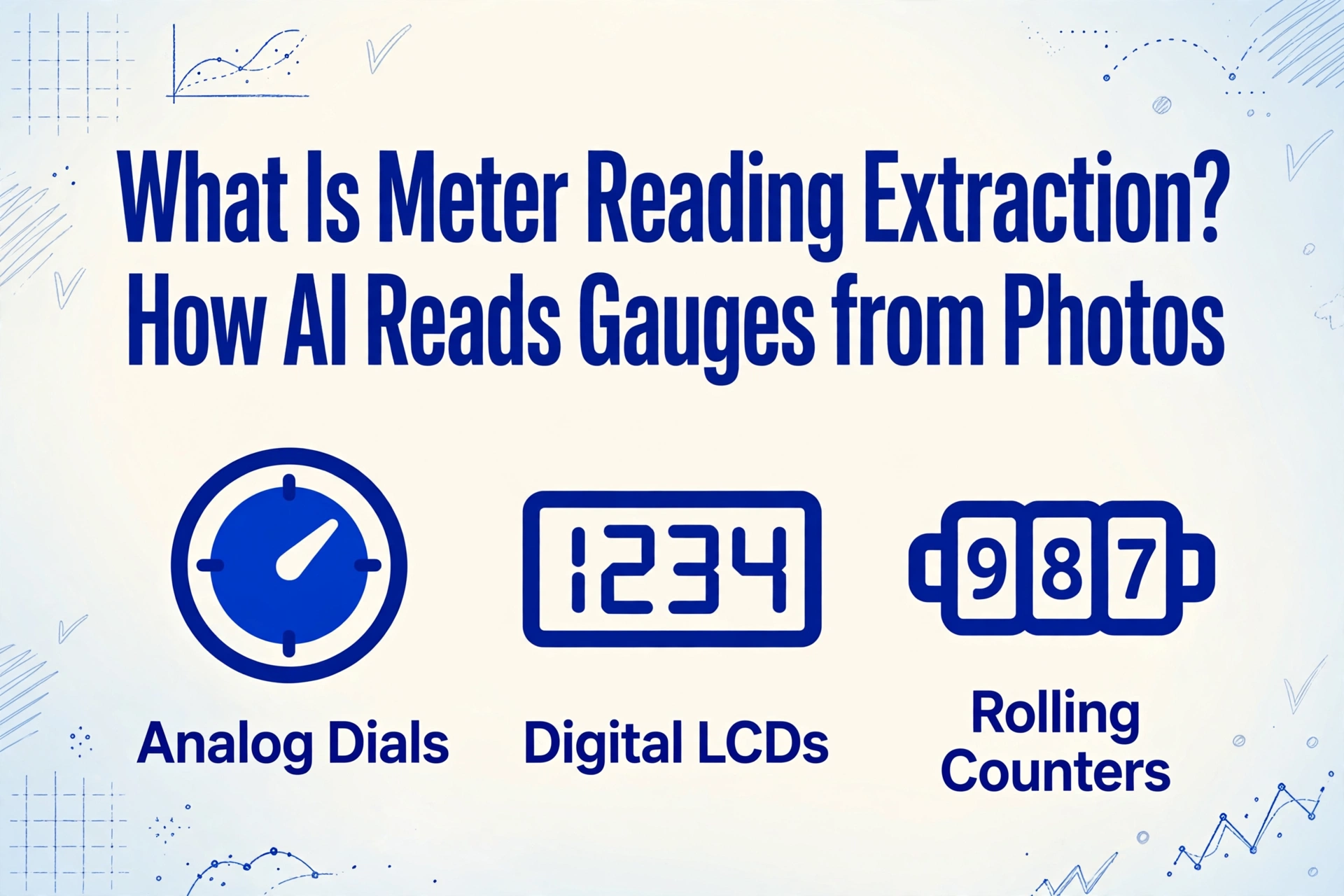
This works across meter types that have nothing in common physically. A 40-year-old analog gas meter with four spinning dials. A modern digital electric meter with an LCD readout. A pressure gauge on a factory boiler with a single needle and arc scale. A water meter with mechanical rolling digits behind fogged plastic. The AI doesn't need to be told what kind of meter it's looking at — it recognizes the gauge face, understands the scale, and reads the value. This is the fundamental difference from template-based OCR, which requires you to define a zone for every meter model in your fleet and redo the work every time a format changes. For the broader technology landscape that includes smart meters, AMR, and other approaches, see our guide to AI meter reading.
Meter Reading Extraction vs Smart Meters vs Manual Reading
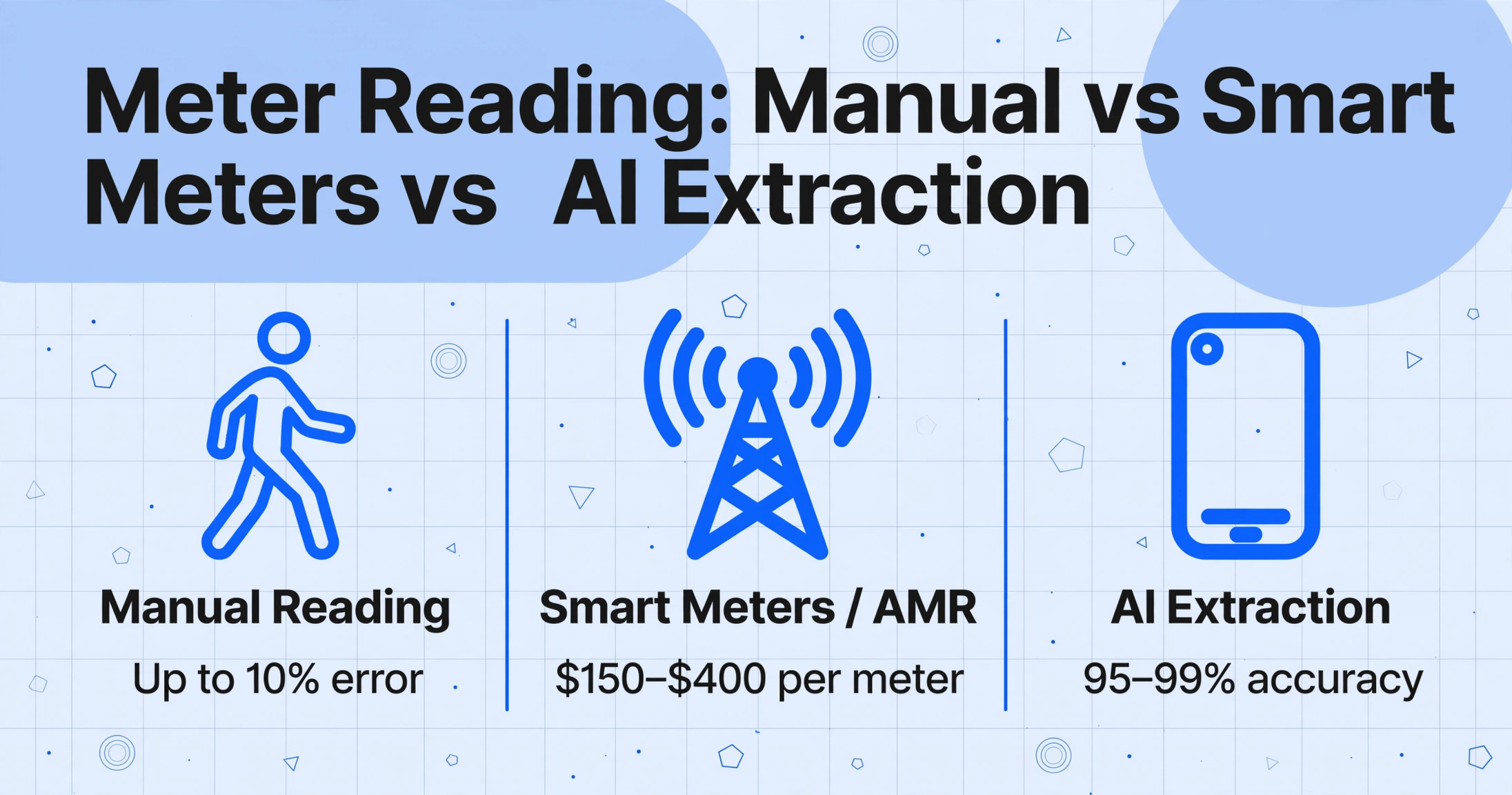
These three approaches solve the same problem — getting a reading from meter to database — but they differ in what they cost, how fast they deploy, and what they actually change in the field. Confusing them leads to spending on the wrong solution.
| Dimension | Manual Reading | Smart Meters / AMR | AI Extraction |
|---|---|---|---|
| What changes | Nothing — person walks route | Meter hardware replaced or radio added | Nothing — photo added to workflow |
| Deployment time | Immediate (existing) | Years to decades | Same day |
| Upfront cost | Labor only | $150–$400 per meter + infrastructure | Per-photo or subscription |
| Error rate | Up to 10% (misreads, transcription) | Near zero (digital transmission) | 95–99% for printed digits; varies for analog |
| Handles analog dials | Yes, but error-prone | No — requires digital meter | Yes — reads needle position |
| Works on mixed fleets | Yes | No — one standard per deployment | Yes — single system for all types |
| Requires field visit | Yes, every meter, every cycle | No | Yes — but faster per visit |
Manual reading is the baseline: 700–900 meters per day per reader, field staff navigating locked gates and aggressive dogs, numbers handwritten or keyed into a handheld device. The Washington State Auditor's office notes that manual meter reading is still the reality for most utilities, and that error rates from misreads and transcription mistakes can reach 10% — one in ten bills wrong.
Smart meters solve the labor problem permanently: no field visits, 15-minute interval data, remote disconnect. But the deployment timeline is measured in years, the cost is $150–$400 per endpoint plus fixed-network infrastructure, and the meters themselves have to be digital — an analog dial can't transmit anything. Eugene Water & Electric Board's 2025 proposal for a $20/month manual-reading surcharge illustrates the direction: manual reading is transitioning from accepted cost to explicit penalty. But for small utilities with mixed fleets installed over 30 years — some Neptune analog dials, some Badger digital odometers, some Sensus mechanical registers — replacing every meter is a capital project, not a quarterly decision.
Extraction occupies the gap between them. The meter reader still visits the meter — but instead of reading, transcribing, and later keying the value, they take a photo and move on. The reading reaches the database through AI, not through a person's eyes and fingers. The workflow change for field staff is one extra second per meter. The workflow change for the back office is transformative: instead of keying 2,000 readings from a route sheet, the billing clerk opens an Excel file that populated itself. For a detailed cost comparison of manual vs automated approaches, see our analysis of manual vs AI meter reading costs.
How Meter Reading Extraction Works
The mechanism that makes extraction possible across such different meter types is semantic visual understanding — the same class of AI that can describe a photograph in natural language, but applied to structured data capture.
A traditional OCR approach would try to locate text zones, recognize characters, and output whatever strings it finds — with no concept of which string is the reading value versus the meter serial number versus a manufacturer label. It works on a digital LCD that displays clean segmented digits, and it breaks on an analog dial with no characters at all.
A vision AI model works differently. When it sees an analog pressure gauge with a needle resting between 4 and 5 on a scale marked 0–10, it doesn't calculate the pointer angle and interpolate. It sees: "the needle is pointing to approximately 4.3 bar." When it sees a digital display showing 0554876 at a slight angle in low light, it reads the digit sequence by understanding what the characters represent contextually — not by matching pixel patterns against a font library. When it sees a gas meter with four separate analog dials, it reads each dial's needle position and assembles the full reading from right to left — the same way a trained human reader does.
This is what makes Custom Column Extraction the enabling mechanism. You define the output columns you want — "Meter ID," "Current Reading," "Unit," "Reading Date" — and the AI locates each value in every photo by understanding what it means, not where it sits on the meter face. One column template works across every meter type in the fleet. No zone-drawing, no per-model template, no retraining when a new meter brand enters the inventory. For a practical walkthrough of this workflow, see our guide to automating meter reading with AI.
Files are processed securely and not stored.
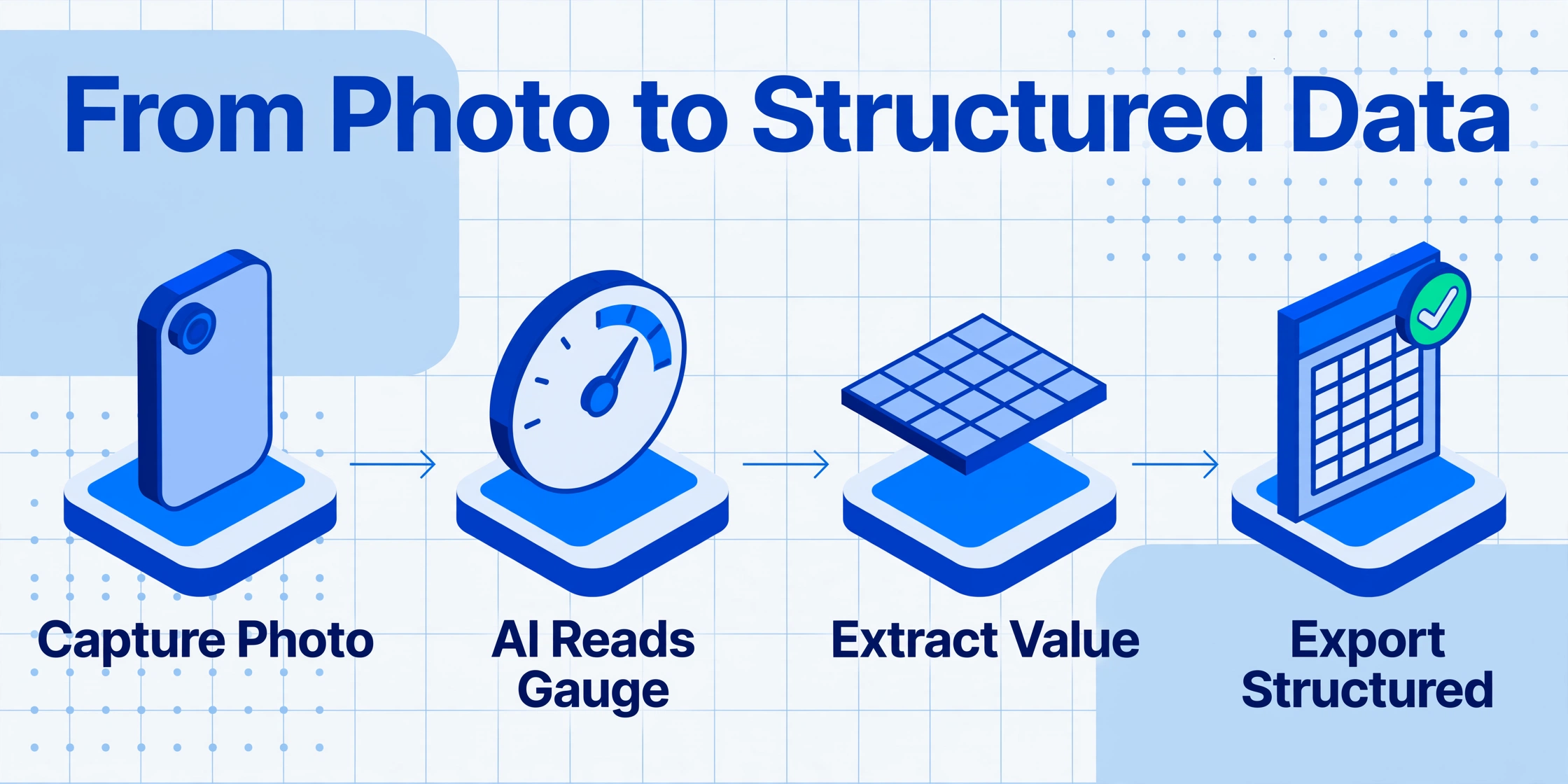
The pipeline end-to-end is straightforward enough that field staff use it without training, and flexible enough that office staff process batches of hundreds of meters in a single session:
Capture the photo
Any smartphone camera works. A clear, head-on shot of the meter face produces the best results, but the AI handles moderate angles, glare, and the real-world conditions of a meter in a dark basement or a gauge behind dusty glass. No special lighting, no tripod, no calibration.
Define the output columns
Type the field names you want extracted — "Meter ID," "Reading," "Unit," "Location," "Date." These become the headers of your output spreadsheet. The same column template works for water meters, gas meters, pressure gauges, and digital displays in the same batch. No template setup per meter type.
AI reads and structures the data
The vision model scans each photo, identifies the gauge face, reads the value — whether it's a needle position, LCD digits, or rolling counter — and maps it to your output columns. One photo, one row. Upload 50 photos, get 50 rows merged into one file.
Export or integrate
Download as Excel (XLSX), CSV, or JSON. Or write results directly into Google Sheets. The data is ready for billing, trend analysis, compliance reporting, or feeding into your CMMS — no manual transcription, no re-keying, no copy-paste.
The model's ability to handle the full diversity of meter types from a single column definition is what separates semantic extraction from template OCR. A template tool needs a zone definition for every meter model. Semantic extraction needs one set of column names — Meter ID, Reading, Unit — and it works across your entire fleet. For guidance on achieving reliable accuracy in field conditions, see our field accuracy guide for AI meter reading.
When You Need Meter Reading Extraction
Not every operation needs extraction. A building with four water submeters that the superintendent checks quarterly can keep using a clipboard. Extraction becomes the right answer when the volume, variety, or velocity of readings crosses a threshold where manual transcription stops being tedious and starts being the bottleneck in a revenue-generating or compliance-critical process.
1. You run a utility with a mixed meter fleet. Small and mid-size water, gas, and electric utilities rarely have the luxury of a single meter standard. Meters get installed over decades as budgets allow — some Neptune analog dials from the 1990s, some Badger digital odometers from 2005, some Sensus mechanical registers from 2015. A smart meter deployment would require replacing every one of them, at $150–$400 per endpoint plus network infrastructure — a multi-year capital project. Extraction lets the field reader photograph whatever meter is in the box and get structured data regardless of type, starting this billing cycle. For the scaling math on a full route, see our analysis of scaling AI meter reading without IoT infrastructure.
2. You manage industrial gauges across a plant floor. Manufacturing facilities, water treatment plants, and chemical processing sites have hundreds of analog pressure gauges, temperature dials, and flow meters mounted throughout the operation. These gauges are functional, calibrated, and cost thousands to replace — but they require physical walk-throughs to log readings, often on hourly rounds. A maintenance tech photographing each gauge during rounds and having the readings extracted into the CMMS eliminates the clipboard step without touching a single piece of hardware.
3. Field inspectors need fast, auditable data capture. Insurance surveyors, energy auditors, and regulatory inspectors photograph meters and gauges as part of site assessments. The photo serves as proof of visit; the extraction turns the photo into actionable data. This is especially relevant for compliance reporting — meter readings that feed into annual energy audits, environmental discharge reports, or equipment condition assessments lose their audit trail when someone types them from memory hours after the inspection.
4. You handle diverse meter types that no single hardware solution covers. A facility management company might deal with electric meters (digital kWh), gas meters (analog dials in cubic feet), water meters (rolling digits in gallons), and HVAC pressure gauges (analog PSI) — all in different buildings, all different brands, all different eras. A single hardware solution that reads all of them doesn't exist. A single extraction tool that reads all of them from a photo does.
What to Look For in a Meter Reading Extraction Tool
Extraction tools range from basic OCR apps that read digits to AI-native platforms that understand gauge faces. Here are the criteria that actually differentiate them:
Genuine analog dial support. This is the hardest capability and the most important filter. Many tools claim "meter reading" but only handle digital LCDs with clean segmented digits. An analog dial with a needle — the kind on most gas meters and industrial pressure gauges — requires the AI to understand the gauge face, recognize the scale markings, and interpret needle position. If a vendor can't show you it working on a gas meter with four analog dials or a pressure gauge with a curved scale, their "meter reading" is digital-only. Ask for a demo on your actual meters, not their curated samples.
Template-free, format-independent operation. A tool that asks you to draw zones around each meter's readout area, or configure parsing rules per meter model, is not extraction — it's template management. The right tool reads any meter type from the same column definition. If your fleet adds a new meter brand next month, the tool should handle it with zero configuration changes.
Batch processing with merged output. Can you upload 200 meter photos at once and get one spreadsheet back with one row per meter? Or do you process them one at a time? For any operation reading more than 20 meters per cycle, batch processing is the difference between "this saves time" and "I traded data entry for upload management."
Resilience to real-world photo conditions. Meters live in basements, behind locked gates, under direct sunlight, behind fogged plastic covers. The AI needs to handle glare on glass, moderate shooting angles, dust and dirt on the gauge face, and the mixed lighting of a utility closet. A tool that only works on studio-lit, head-on photos won't survive its first field route. Test with the worst photos in your library, not the best.
Output that fits your downstream workflow. If billing runs through Excel, XLSX with properly typed numeric columns is non-negotiable. If data feeds into a CMMS, CSV or JSON matters. If the team lives in Google Sheets, a tool that writes results directly into a sheet eliminates the export-import cycle. For the Sheets-native workflow specifically, see our Google Sheets add-on for meter reading.
Frequently Asked Questions
Can AI read analog dials with needles?
Yes. Vision AI models recognize the gauge face, understand the scale markings, and interpret needle position — the same way a human reader does. A clear, head-on photo of an analog pressure gauge or gas meter dial produces reliably correct readings. Accuracy drops with extreme off-angles, heavy shadows across the needle, or cracked gauge glass that distorts the scale. The system handles a wider range of conditions than template-based OCR, but it's not immune to bad input — the same way a human reader can misread a fogged-up meter. For a deeper look at what affects accuracy, see our field accuracy guide.
What types of meters and gauges does extraction support?
The same AI engine handles analog dials (gas meters, pressure gauges, temperature gauges), digital LCD displays (electric meters, flow meters), rolling-digit mechanical counters (water meters), and mixed panels where analog and digital readouts appear side by side. This includes residential utility meters, commercial submeters, industrial process gauges, and field instruments. The key requirement is that the meter face is visible and reasonably legible in the photo — the AI doesn't need to know the meter brand or model.
Does meter reading extraction replace smart meters?
Not entirely. Smart meters provide capabilities that photo-based extraction can't replicate: 15-minute interval data, remote disconnect/reconnect, real-time outage detection, and two-way communication with the grid. If you have the budget and timeline for a full AMI deployment, smart meters are the more complete solution. Extraction fills the gap for operations that can't wait years for that deployment, can't afford the per-meter hardware cost, or have analog gauges that can never be "smart." Many utilities use extraction as an interim layer during a multi-year smart meter rollout — or as the permanent solution for their analog-only meter types. For the scaling perspective, see scaling AI meter reading without IoT.
Can extraction handle different meter types in the same batch?
Yes — this is one of its core strengths. You can upload a batch containing photos of analog gas meters, digital electric meters, rolling-digit water meters, and industrial pressure gauges, define your output columns once (Meter ID, Reading, Unit, Location), and get all readings in a single merged spreadsheet. The AI identifies each meter type from the photo and reads the value accordingly. No pre-sorting, no separate processing runs per meter type.
What photo quality does the AI need for accurate readings?
A clear, reasonably well-lit photo of the meter face produces the best results — the kind any modern smartphone takes without special settings. The AI handles moderate angles (up to about 30 degrees off-axis), typical indoor and outdoor lighting, and some glare on glass covers. What reduces accuracy: extreme backlighting that silhouettes the gauge, heavy shadows directly over needle or digits, motion blur, and meters photographed through heavily fogged or cracked glass. The rule of thumb: if a human can read the meter from the photo, the AI can too. If a human would struggle, the AI might as well. For specific failure modes and how to avoid them, read about common causes of extraction failures.
How does the AI handle glare and reflections on meter glass?
Vision AI models are more resilient to glare than traditional OCR because they interpret the gauge face holistically rather than character-by-character. A reflection that partially obscures a digit on an LCD might still leave enough visible for the AI to infer the value from context — the same way you can read a number through a reflection by looking at the unblocked portions. Severe glare that completely washes out the readout area will cause failures. The simplest fix when photographing meters with glass covers is to angle the phone slightly to move the reflection off the reading area — the AI handles the moderate off-angle better than it handles total washout.
Can extraction read handwritten meter readings from log sheets?
Yes, but with qualifications. Vision AI models can read handwriting — including handwritten numbers on meter log sheets, inspection forms, and field notes — at accuracy rates that depend on handwriting legibility. Clear block-print numbers extract reliably; dense, slanted cursive in low-light photos will be lower. The key advantage over traditional OCR is that the AI uses field context to resolve ambiguity: if it's looking for a "Reading" value and sees both handwritten and printed numbers in the photo, it can reason about which ones represent the meter reading rather than the meter serial number or a date.
Where to Go From Here
Meter reading extraction sits at the intersection of two realities: most meters in the field are still analog or mixed-format devices that will be there for years, and AI has reached the point where it can read them from a photo as reliably as a trained human — faster, and without transcription errors. The hardware replacement path (smart meters, AMI) is the long-term answer for utilities with capital budgets. The extraction path is the answer for this quarter, this billing cycle, this gauge that can't be swapped out.
The best way to evaluate whether it fits your operation is to test it on your actual meters — not curated demo images, but the meter in the basement with the dusty glass and the gauge on the boiler with the faded scale. If it handles your hardest cases, the easy ones are a given. Upload a few photos of the meters in your fleet, define the columns you'd use, and see the output. For the complete workflow from photo to structured data, start with our guide to automating meter reading extraction. Or if you're ready to test it now, upload a sample meter photo and see the results.