What Is Construction Timesheet Tracking?
Paper Job-Site Cards to Payroll & Compliance
Construction timesheet tracking is the process of moving labor hours, craft classifications, and cost codes from job-site time cards into the payroll, job costing, and certified payroll systems that depend on them. In most construction companies today, the tracking pipeline still starts with a paper form — filled out by a foreman on a clipboard, photographed with a phone, or faxed from a subcontractor's office — which means the hours must cross the gap from handwritten paper to structured data before any downstream system can track them at all. Construction timesheet data extraction is the automated mechanism that bridges that gap: it reads the key labor fields from paper or digital timesheets — employee name, craft classification, hours worked (straight, overtime, and double-time), project code, and cost code — and converts them into structured data that feeds directly into payroll processing, certified payroll compliance under the Davis-Bacon Act, and job cost allocation across CSI MasterFormat cost codes.

What Construction Timesheet Tracking Actually Means
If you search for "construction timesheet tracking," most results will show you a time clock app — a mobile tool where workers clock in and out digitally. That is one version of timesheet tracking, but it is not the complete picture, and it is almost certainly not the version you are dealing with if you arrived at this article through paper time cards on your desk.
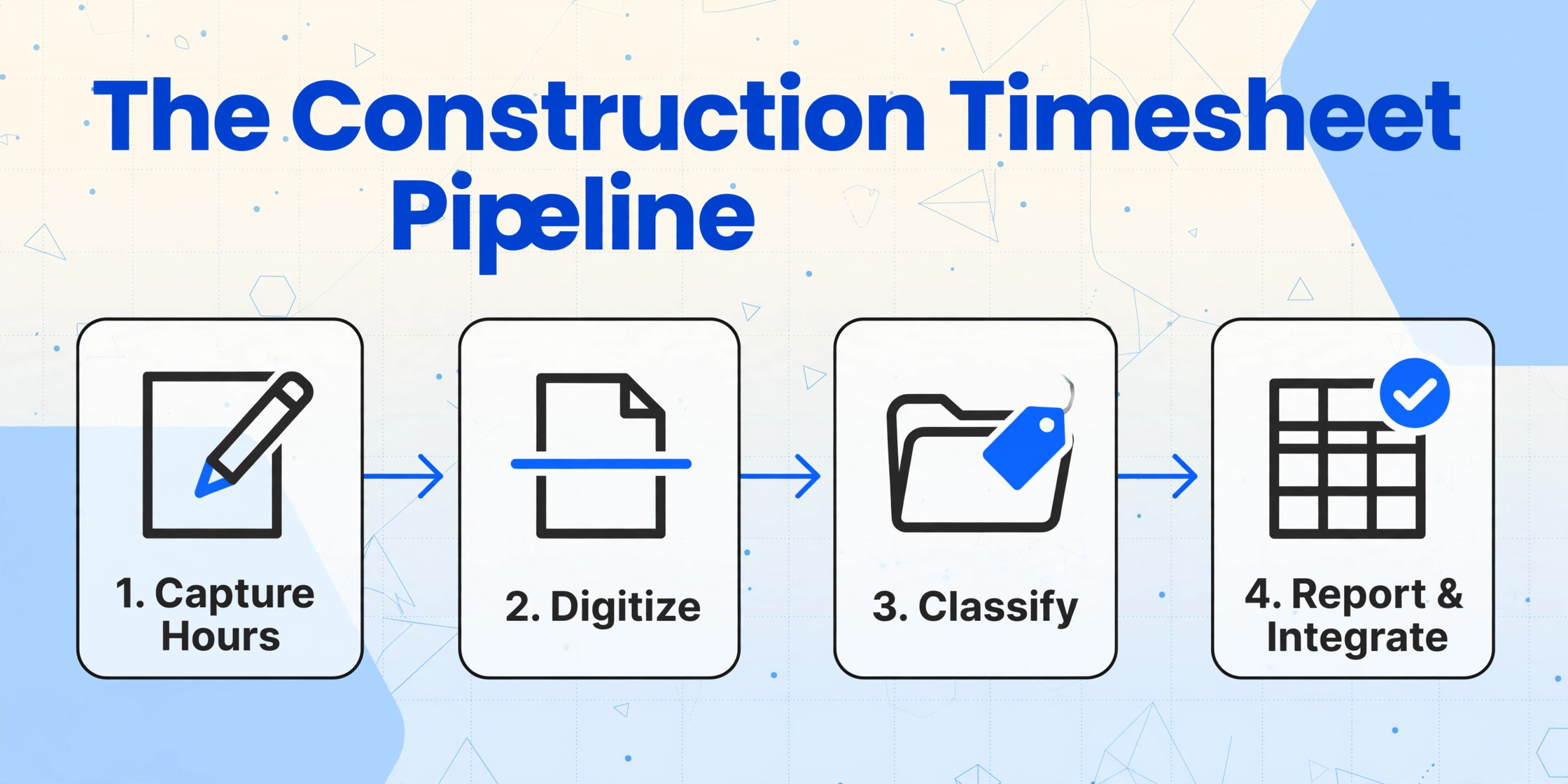
Construction timesheet tracking, properly understood, is the full pipeline from the moment a worker's hours are recorded on a job site to the moment those hours appear as a structured line in payroll, a cost code in job costing, and a classification entry on a certified payroll report. The pipeline has four stages:
Capture
Hours are recorded — on paper, in a digital app, or via a photo of a handwritten card. In construction, the capture medium varies by crew and subcontractor, and paper remains dominant for field crews without reliable cell service.
Digitization
The handwritten or printed data must become machine-readable. For paper-origin timesheets, this is the critical bottleneck — it is where manual data entry, extraction tools, or OCR systems sit.
Classification
Each hour must be assigned to the correct craft classification (Carpenter vs. Laborer vs. Electrician), cost code (CSI MasterFormat), and project. This is where construction tracking diverges most sharply from generic timesheet processing — classification is a first-class dimension, not a tag.
Reporting & Integration
The structured data feeds payroll (Sage 300 CRE, Viewpoint, ADP, Paychex), job costing (Foundation, HCSS), and certified payroll software (LCPtracker, eMars) — each of which requires the data in a different structure but from the same source.
Most time tracking apps address only stage 1 — capture. They prevent future paper by digitizing clock-in at the source. But if your crews, subcontractors, or staffing agencies already produce paper timesheets, the capture stage has already happened on paper. The tracking gap is in stages 2 through 4: getting that paper data digitized, classified, and fed into your downstream systems. For a broader look at how this pipeline works across all document types in construction — not just timesheets but also invoices, receipts, COIs, and daily reports — see our guide to document data extraction for construction project managers.
What makes construction timesheet tracking fundamentally different from generic time tracking is the dimensions of data each timesheet carries. A generic office timesheet has employee name, date, and total hours. A construction timesheet must capture four interlocking layers:
Worker Identity & Craft Classification
- Employee Name / ID
- Craft / Trade Classification (Carpenter, Electrician, Laborer, Operator, Ironworker)
- Union vs Non-Union Status
- Apprentice / Journeyman / Foreman Level
Project & Cost Code Allocation
- Project Code / Job Number
- CSI MasterFormat Cost Code (e.g. 03 30 00 Cast-in-Place Concrete)
- Job Phase / Work Breakdown Element
- Equipment Used (chargeable or non-chargeable)
Daily Hours Grid
- Regular Hours — Mon through Sun
- Overtime Hours (1.5× after 8/day or 40/week)
- Double-Time Hours (prevailing wage thresholds)
- Prevailing Wage Determination Number
Compliance & Fringe Benefits
- Fringe Benefit Rate ($/hour or paid-in-kind)
- WH-347 Classification Mapping
- Supervisor Signature / Date
- State-Specific Prevailing Wage ID
On a Davis-Bacon prevailing wage project, the same worker might spend 3 hours as an Electrician and 5 hours as a Laborer on the same day. The paper timesheet may or may not capture that split — but the certified payroll report must reflect it as two separate line entries with two different wage rates. A tracking system that reads "8 hours" into one row fails at stage 3 (classification) even if it succeeds at stage 1 (capture). A construction-aware tracking solution — whether it is a time clock app or an extraction tool — must treat classification and cost code as first-class dimensions of every hour recorded.
Construction Timesheet Tracking vs Manual Entry vs Digital Apps
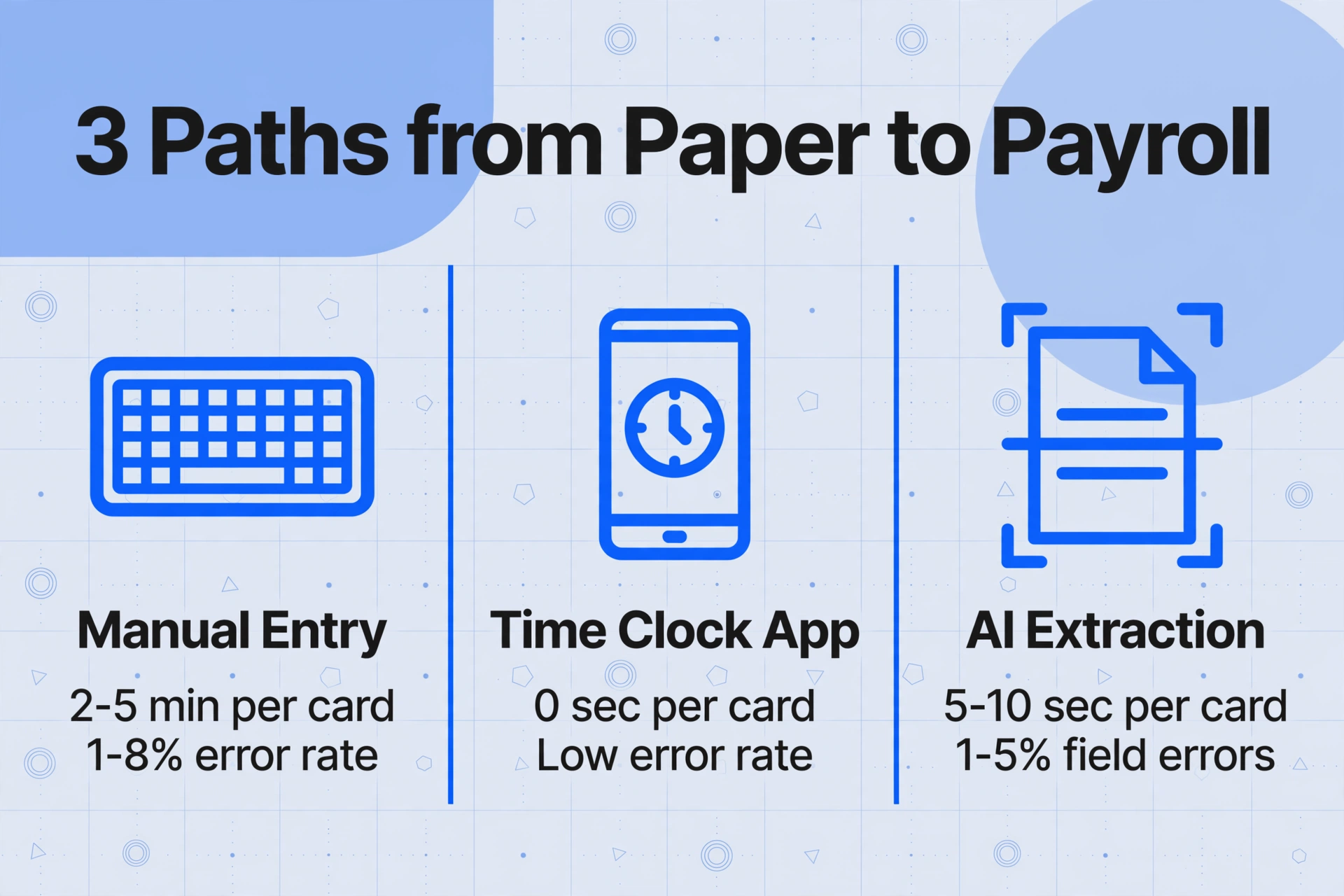
The question most construction offices face is not "should we track time" — you already do, on paper. The question is which digitization path closes the gap between your existing paper timesheets and the systems that need the data. Three paths exist, and they are not mutually exclusive:
| Manual Data Entry (Paper → Keystrokes) | Digital Time Tracking App (App → System) | Paper Timesheet Extraction (Paper → AI → System) | |
|---|---|---|---|
| How the pipeline works | Foreman fills paper card → Payroll clerk types every field into payroll system | Worker clocks in/out on phone → Hours flow to payroll automatically | Foreman fills paper card → Photo/scan fed to AI → Structured data output |
| Handles existing paper? | Yes — you type it | No — paper must be eliminated first | Yes — designed for paper-origin data |
| Craft classification handling | Payroll codes it manually — error-prone | Worker selects from dropdown in app | AI reads handwritten or printed classification from the card |
| Cost code split (one worker, two codes) | Manual split, transcription risk | Worker splits in app at clock-in | Reads split as written on card; preserves per-code rows |
| Per-timesheet processing time | 2-5 minutes per card | 0 seconds (fully digital from capture) | 5-10 seconds (AI reads, human reviews) |
| Error profile | 1-8% of total payroll cost (APA estimate), $291 avg cost per error (E&Y) | Low (app-captured, no transcription) | 1-5% field-level errors; visible for review before payroll runs |
| Best for | Tiny crews, 1-5 cards per week | Direct-hire crews with phone access and app adoption | Subcontractor paper, mixed-format cards, crews without app access, temp agencies, legacy records |
| Certified payroll readiness | Depends entirely on accuracy of keystrokes | Yes — if classification configured correctly | Produces structured data that populates WH-347 fields — classification, hours/day, project |
The key insight: time tracking apps and extraction tools are not competitors. They solve different stages of the same pipeline. A time tracking app prevents future paper by digitizing capture at the source. An extraction tool processes the paper that already exists — from subcontractors who do not use your app, from temporary staffing agencies, from legacy records, from crews on sites without cell signal. If you are a general contractor receiving 30 paper timesheets from 5 different subs every Friday, deploying a time tracking app to your direct-hire crew does not reduce that stack by a single sheet. For a detailed breakdown of what that stack actually costs, see our analysis of manual timesheet processing costs in construction.
How Construction Timesheet Tracking Works with Paper-Origin Data
When a timesheet originates on paper — whether it is a union-issued daily card, a company-specific weekly crew sheet, or a subcontractor's handwritten log — getting it into a digital tracking pipeline requires three steps. The technology powering this determines whether the pipeline works across the format chaos that defines construction timekeeping.
Capture the timesheet as a digital image
Take a photo of the paper time card with a phone, scan it, or upload an existing PDF or image. The tool accepts JPG, PNG, and PDF — including phone photos taken on a job site with uneven lighting, folded corners, or dirt smudges. No flatbed scanner is required. For multi-crew payroll runs, upload all timesheets from the week in a single batch.
Define the output columns that match your job cost and compliance structure
Instead of drawing boxes around fields or building parsing templates for each foreman's timesheet format, you type the output columns you need: "Worker Name," "Classification," "Cost Code," "Mon Reg," "Mon OT," "Project Number," "Wage Determination." This approach — Custom Column Extraction — means the AI searches for each value by understanding what it means in context, not by matching a pre-defined position on the page. A cost code scribbled in the margin of one foreman's card and typed in a dedicated column on another's card both resolve to the same output column. For guidance on setting up columns specifically for construction labor allocation, see our walkthrough on extracting construction timesheet hours by cost code and job phase.
Receive structured, classified payroll data
The tool outputs a structured table — one row per worker per timesheet, or per classification split when a worker divides time across trades — with columns matching the field names you defined. Export to Excel, CSV, or directly into Google Sheets via the Google Sheets add-on for timesheet extraction. From there, the structured data feeds into Sage 300 CRE, Viewpoint Vista, Foundation, HCSS HeavyBid, ADP, Paychex, LCPtracker, eMars, or any payroll and job cost platform that accepts structured data import.
What separates semantic AI extraction from traditional OCR in construction timesheet tracking is how it handles the grid structure and handwriting variability of job-site time cards. Traditional OCR sees a timesheet as a flat grid of characters — it might correctly read "8" in the Monday column and "Carpenter" in the classification column, but it does not understand that the 8 belongs to the Carpenter's Monday regular hours. Semantic extraction reads the document holistically: it recognizes the table structure, understands that column headers define the meaning of cells beneath them, links each data point to its row and column context, and preserves the relationships that make payroll processing and job costing possible.
The template-free dimension matters especially in construction because timesheet formats multiply with every subcontractor added to a project. One electrical sub emails a PDF with hours in a Monday-Sunday grid. Another texts a photo of a handwritten card with hours in a single line: "Mon 8 Tue 7 Wed 8.5." A third faxes a union-issued form with classifications pre-printed in the margin. Template-based tools require a separate configuration for each format — which means the tool's value decreases as the number of subcontractors increases, the exact opposite of what a GC needs. Semantic extraction reads all three formats with the same column definition.
Files are processed securely and not stored.
When Paper-Origin Tracking Becomes a Compliance Problem
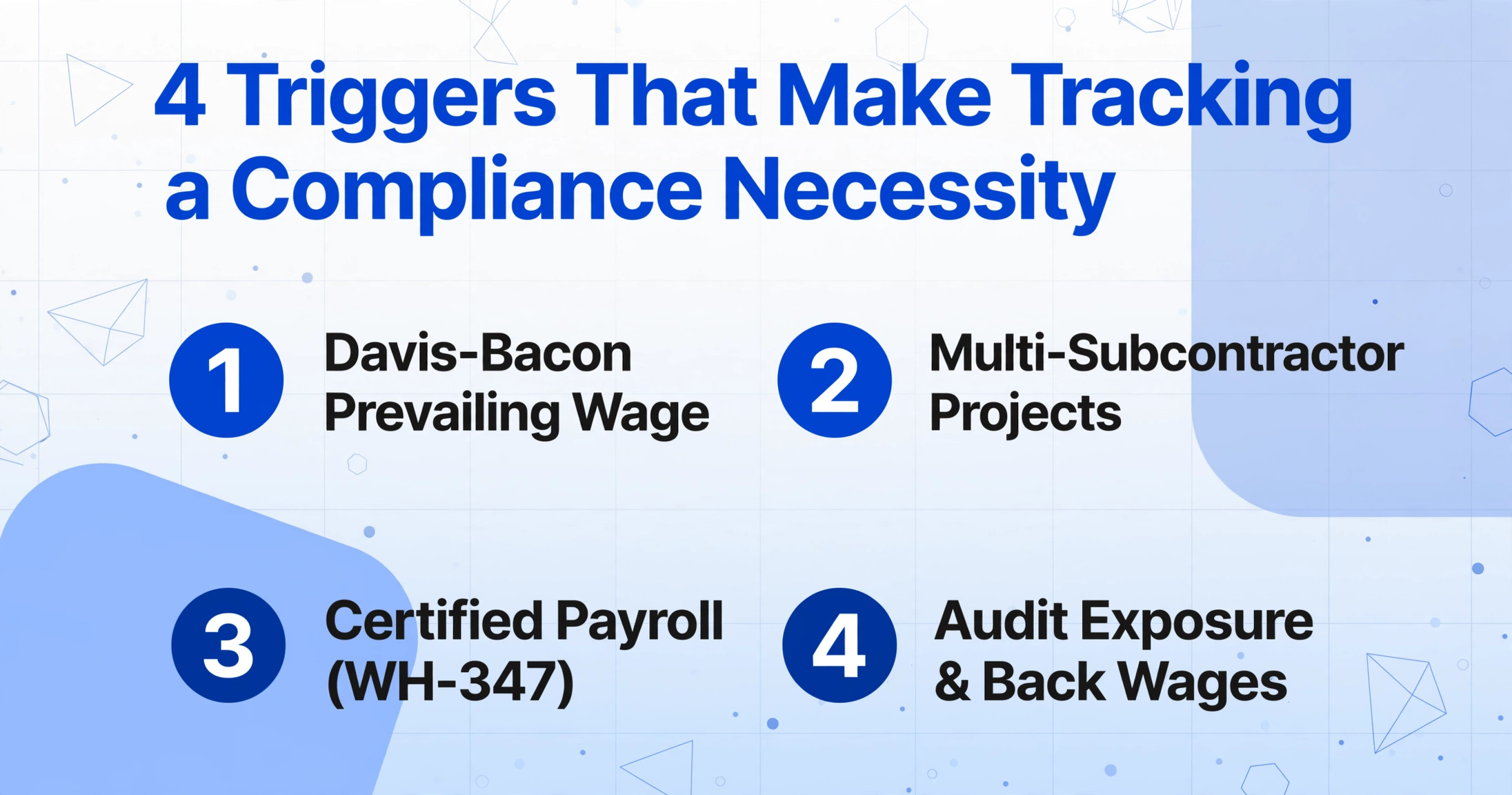
Not every construction company needs automated timesheet tracking right now. Extraction crosses from "nice to have" to "operational necessity" at specific thresholds — and in construction, those thresholds almost always involve compliance exposure, scale, or both. Here are the four most common triggers:
1. Your projects fall under Davis-Bacon prevailing wage requirements. Under the Davis-Bacon Act (40 U.S.C. § 3141 et seq.), any federal construction contract over $2,000 requires workers to be paid locally prevailing wage rates — and you must prove it weekly using DOL Form WH-347. The DOL's instructions are explicit about classification: if a worker performed work in more than one classification, the report must show "an accurate breakdown of hours worked in each labor classification." When the only record of those hours is a handwritten number on a paper card, the path from the card to a compliant WH-347 runs through manual data entry — and every keystroke carries the same odds of becoming a compliance violation. The U.S. Department of Labor's Wage and Hour Division recovered more than $38 million in back wages for construction workers in fiscal year 2022 alone, and classification errors in manual timesheet processing were a primary driver. For the complete compliance picture, our guide to certified payroll for contractors covers the regulatory framework in detail.
2. You process timesheets from multiple subcontractors on the same project. A GC receiving timesheets from electrical, plumbing, HVAC, drywall, and concrete subs on a single project faces five different timesheet formats arriving through five different channels — one PDF in email, two photos texted from the field, one scan from a fax machine, and one Excel export from a sub who "does things digitally." Consolidating these into a single payroll run means someone in the office handles every format individually — decoding handwriting, cross-referencing classification lists against prevailing wage determinations, and ensuring each hour lands under the right cost code. Batch processing — uploading all timesheets at once with a single column definition and receiving one unified spreadsheet — collapses this multi-hour reconciliation into a review step. For a concrete walkthrough, see how to batch construction crew timesheets across job sites.
3. Union reporting requires classification-level tracking across trades. Union craft classifications (Carpenter, Electrician, Laborer, Operating Engineer, Ironworker, Plumber/Pipefitter, Sheet Metal Worker) are contractual obligations, not payroll categories. A worker dispatched from the hall as a Journeyman Carpenter must be paid at the Carpenter rate for all Carpenter hours. If that worker also performs Laborer work during the week, the hours split must be documented separately for union reporting, fringe benefit contributions, and certified payroll. Extraction that captures classification as a first-class field — rather than requiring someone to manually code each row after extraction — eliminates the most common source of union payroll disputes: misclassified hours that surface weeks later when the union reviews contribution reports.
4. The gap between field data and office systems is widening as you grow. The Construction Financial Management Association's 2024 Financial Benchmarker found that cost administration consumes an average of 5.4% of project revenue for U.S. general contractors, and the primary driver is the labor of reconciling data that should have matched from day one. The Associated General Contractors of America identifies manual payroll processing as one of the top drains on profitability for firms managing multiple job sites. When a company grows from 2 job sites to 6, the manual timesheet workflow does not scale linearly — it compounds, because each new site brings new subcontractors, new cost codes, and new formats. The American Payroll Association estimates that manual data entry produces errors in 1% to 8% of total payroll value in paper-based construction systems. On a $2 million annual labor budget, that is $20,000 to $160,000 in recoverable cost — before counting compliance penalties or the corrupted job cost data that produces wrong estimates for the next bid. For a parallel analysis of how the same paper-to-structured pipeline applies to other construction documents, see our guide to construction invoice extraction.
What to Look For in a Construction Timesheet Tracking Solution
Whether you choose a time tracking app, an extraction tool, or a combination of both, a few criteria separate solutions that actually reduce the payroll workload from solutions that just move the typing to a different screen. These criteria are specific to construction — generic timesheet tools miss them.
Template-free, format-independent operation. The single most important differentiator for construction — because your timesheets come from a dozen different sources, each with its own layout. A tool that requires you to define a template per subcontractor format is not tracking — it is template management. Template-free extraction reads by semantic understanding: a timesheet from a subcontractor you have never processed before works on the first upload, because the AI locates values by meaning rather than position. Ask the vendor: "If I receive a timesheet in a format I have never seen, does it work immediately?" If the answer involves "first create a template," you are buying maintenance, not automation.
Classification-aware extraction at the field level. A generic timesheet tool sees "8 hours" and outputs "8 hours." A construction-aware tool understands that classification — Carpenter vs. Laborer vs. Electrician — is a first-class dimension. It reads classification from the timesheet where it is written and preserves it as a separate column in the output, so when a worker splits 3 hours as Electrician and 5 as Laborer, you get two rows with two classifications and two wage rates — not one row requiring manual post-extraction coding. For practical guidance on configuring this, our walkthrough on allocating hours by cost code and job phase covers the setup steps.
Handwriting accuracy under job-site conditions. Construction timesheets are filled out in truck cabs, on tailgates, and under hardhats — in ballpoint pen on paper that has been folded, smudged, or exposed to weather. A tool that only handles clean printed PDFs solves the easy fraction of the problem. A 2025 study on AI-powered timesheet OCR found that multimodal vision AI achieved 87.92% accuracy across document degradation states — original (100%), folded (90%), crumpled (70%), and wet (91.66%) — a significant improvement over baseline OCR. For a deeper analysis, see our article on handwriting accuracy in payroll extraction.
Crew-sheet-aware row extraction. Construction timesheets are often crew sheets — one card listing 6-12 workers with individual hours, classifications, and cost codes per person. The extraction tool must recognize that each name in the left column corresponds to a separate data row, and that each worker may have different classifications and cost codes. A tool that treats a crew sheet as a single form and outputs one row misses the structure entirely. For crew-scale batch processing, our guide on batch processing handwritten timesheets covers the multi-worker extraction workflow.
ERP-ready export with construction software field mapping. The extracted data needs to land where your systems can consume it. Sage 300 CRE, Viewpoint Vista, Foundation, and HCSS all accept structured Excel or CSV imports — but the column structure must match what the software expects. A tool that exports to a generic flat table without preserving cost code, classification, and project fields as separate columns forces you to restructure before import. For an end-to-end pipeline that eliminates the manual import step, see how to extract timesheet data directly with the Google Sheets add-on.
Frequently Asked Questions
What is the difference between construction timesheet tracking and a time clock app?
A time clock app (like QuickBooks Time, Procore Timecard, or Raken) digitizes the capture stage — workers clock in and out on a phone, and hours flow digitally from there. Construction timesheet tracking is the broader pipeline that includes capture, digitization, classification, and reporting. If your workers already clock in via an app, you have solved capture but still need the classification and reporting stages to feed payroll and job costing. If your workers still use paper, you need an extraction step to digitize the paper before any downstream system can use the data. The two approaches are complementary: many GCs use a time clock app for direct-hire crews and extraction for subcontractor and temp-agency paper.
Can AI read handwritten construction timesheets accurately?
Yes, modern vision AI models read handwritten timesheet data — names, numbers, classifications, cost codes — even on paper that has been folded, smudged, or exposed to job-site conditions. The AI does not just decode individual characters; it uses surrounding context — day-of-week column headers, row labels, the grid structure of the timesheet — to disambiguate what a scribbled number means. A 2025 study found multimodal AI achieved 87.92% accuracy across varied document degradation states, from pristine originals to crumpled and wet cards. Clear block print is highly reliable; rushed cursive with ambiguous numerals (1 vs. 7, 4 vs. 9) remains the hardest case. The advantage over traditional OCR is that the AI knows it is reading a construction timesheet — it expects hours in a grid, recognizes overtime notation, and interprets classification abbreviations in context.
Does timesheet extraction handle Davis-Bacon prevailing wage classifications automatically?
The extraction tool reads the classification as written on the timesheet — "Carpenter," "Laborer," "Electrician" — and outputs it as a structured field alongside the worker's hours. It does not assign prevailing wage rates, because the applicable rate depends on the project's specific wage determination number, which varies by county, contract type, and classification. What extraction provides is the structured classification data that certified payroll reporting requires: instead of a payroll clerk reading "Carpenter — 8 hours" from a paper card and typing it into LCPtracker or eMars, the classification and hours arrive pre-structured in the extraction output. The wage rate mapping and certification signature still require human verification. For the full compliance workflow, see our guide to certified payroll in construction.
Can the extracted data feed directly into Sage 300 CRE or Viewpoint?
The extraction output is a standard XLSX or CSV file with consistent column headers — the format that Sage 300 CRE, Viewpoint Vista, Foundation, HCSS HeavyBid, and virtually every construction ERP accept as an import source. The critical factor is that the output column structure is yours to control: if Sage expects a field called "Job" and your extraction column is named "Project Number," you rename the header before import. The value is that the hours, classifications, cost codes, and project assignments are already populated correctly — you are not retyping data, you are mapping column names.
What happens when a worker splits time across two cost codes on the same day?
If the paper timesheet captures the split — for example, "Carpenter: Framing Phase 2 — 4 hours (06 11 00), Door Hardware Phase 3 — 4 hours (08 10 00)" — construction-aware extraction reads both allocations and outputs two separate rows for that worker, each with the correct cost code and hours. If the paper timesheet does not capture the split and only shows "8 hours," the extraction tool outputs what is on the card — it will not fabricate a split. This highlights a structural issue in construction timekeeping: the extraction tool can only be as accurate as the timesheet it reads. The most common cause of missing cost-code splits is the foreman not recording them on the card, not a failure of extraction technology.
Does timesheet extraction produce a completed WH-347 certified payroll form?
No — and no tool should claim to, because the WH-347 requires a signed Statement of Compliance attesting to the accuracy of reported wages, which is the contractor's legal responsibility. What extraction provides is the structured data the form needs: worker name, classification, hours per day (regular and overtime), rate of pay, and project identification — all in a format that can populate WH-347 fields or import directly into certified payroll software like LCPtracker, eMars, Miter, or Payroll4Construction. The certification step remains the contractor's responsibility, but the data entry step that introduces the errors triggering certification failures is eliminated. Under the Davis-Bacon Act, certified payroll records must be retained for at least three years after project completion — extraction creates a digital audit trail, including the original timesheet photo, that paper alone cannot provide.
Can extraction calculate overtime automatically based on daily and weekly thresholds?
Yes, when the tool supports computed columns. Construction overtime rules are jurisdiction-specific: federal projects under Davis-Bacon require 1.5× after 40 hours/week; California requires 1.5× after 8 hours/day and 40 hours/week, with double-time after 12 hours/day; union agreements may have entirely different thresholds. A tool with computed column capability lets you define a column like "OT Hours (hours > 8/day × 1.5; hours > 40/week × 1.5)" and the AI applies the calculation during extraction, producing a column of overtime totals alongside the regular hours. This requires the AI to sum daily entries per worker, determine which hours cross the threshold, and calculate the result — all within the extraction pass, so the output is ready for payroll without a separate spreadsheet calculation.
I already use Procore / HCSS / Sage for time tracking. Do I still need extraction?
It depends entirely on where your timesheet data originates. If every worker on every project clocks in through your digital system — including subcontractor crews, temp staffing, and material-only suppliers — then your tracking pipeline is complete and extraction adds marginal value. In practice, most GCs and mid-size subcontractors discover that a significant fraction of their labor data still arrives on paper: from small subs who cannot justify a software license, from crews on sites without cell coverage, from workers who refuse to use a phone on site, or from legacy records needed for audit. Extraction fills that specific gap — it processes the paper that your existing systems cannot reach. For a complete overview of how document extraction fits into the broader construction technology stack, see our guide to document data extraction for construction project managers.
From the Job-Site Card to the Payroll System
Construction timesheet tracking is not about replacing your payroll software. Sage 300, Viewpoint, ADP, and Paychex do their jobs well. It is about closing the gap between where construction labor data originates — a paper card on a job site, filled out with a ballpoint pen — and where it needs to land: a structured row in your payroll system, a line on a WH-347, a cost allocation in your job cost ledger. That gap is currently bridged by human keystrokes, each carrying a 1-3% chance of error, multiplied across hundreds of fields per payroll run.
The technology to read a construction timesheet — to understand its grid structure, decipher job-site handwriting, extract craft classifications, and output cost-coded structured data — exists today without templates, without training, and across any timesheet format. The best way to evaluate whether it fits your payroll workflow is to test it on your actual timesheets — particularly the difficult ones: the crew card with classifications scrawled in the margin, the subcontractor PDF that prints as an image, the card where a 4 looks like a 9. Upload a sample construction timesheet and see the structured data you get back — or start with our step-by-step guide to timesheet extraction with the Google Sheets add-on.