The Real Cost of
Manual Timesheet Data Entry
Ernst & Young's 2022 payroll error study found that time and attendance errors alone cost organizations $250,000 per 1,000 employees per year. The single most common payroll error category is not tax miscalculation or benefit misconfiguration. It's timekeeping: 1,139 errors per 1,000 employees annually. Every one of those errors starts with a piece of paper — a handwritten timesheet, a scribbled time card, a form where a 9 looks like a 4 and a payroll clerk has two seconds to guess which one it is. This article builds the line-by-line cost of manual timesheet data entry — not as a thought experiment, but as a working calculation you can replicate for your own payroll run.
Key Takeaways
- $469 per employee, per year — that's what moving hours from a paper timesheet into payroll costs, and it's the floor, because 38 percent of U.S. companies still run payroll through ink on dead trees.
- When a payroll clerk misreads a handwritten '42' as '38,' the real cost isn't $2.92 in wasted transcription time — it's a potential $6,240 back-wage claim under the Fair Labor Standards Act, the federal law that puts the burden of proving accurate hours on the employer, not the employee.
- The 93 percent collapse in data entry time that AI handwriting recognition delivers isn't aspirational — ImageToTable.ai processes a stack of 100 handwritten timesheets in one batch, recognizing '7:00 AM' by column context rather than pixel shapes, so your payroll team validates outliers instead of retyping every field.
Every Timesheet Costs $8.42 Before You Even Check It for Errors
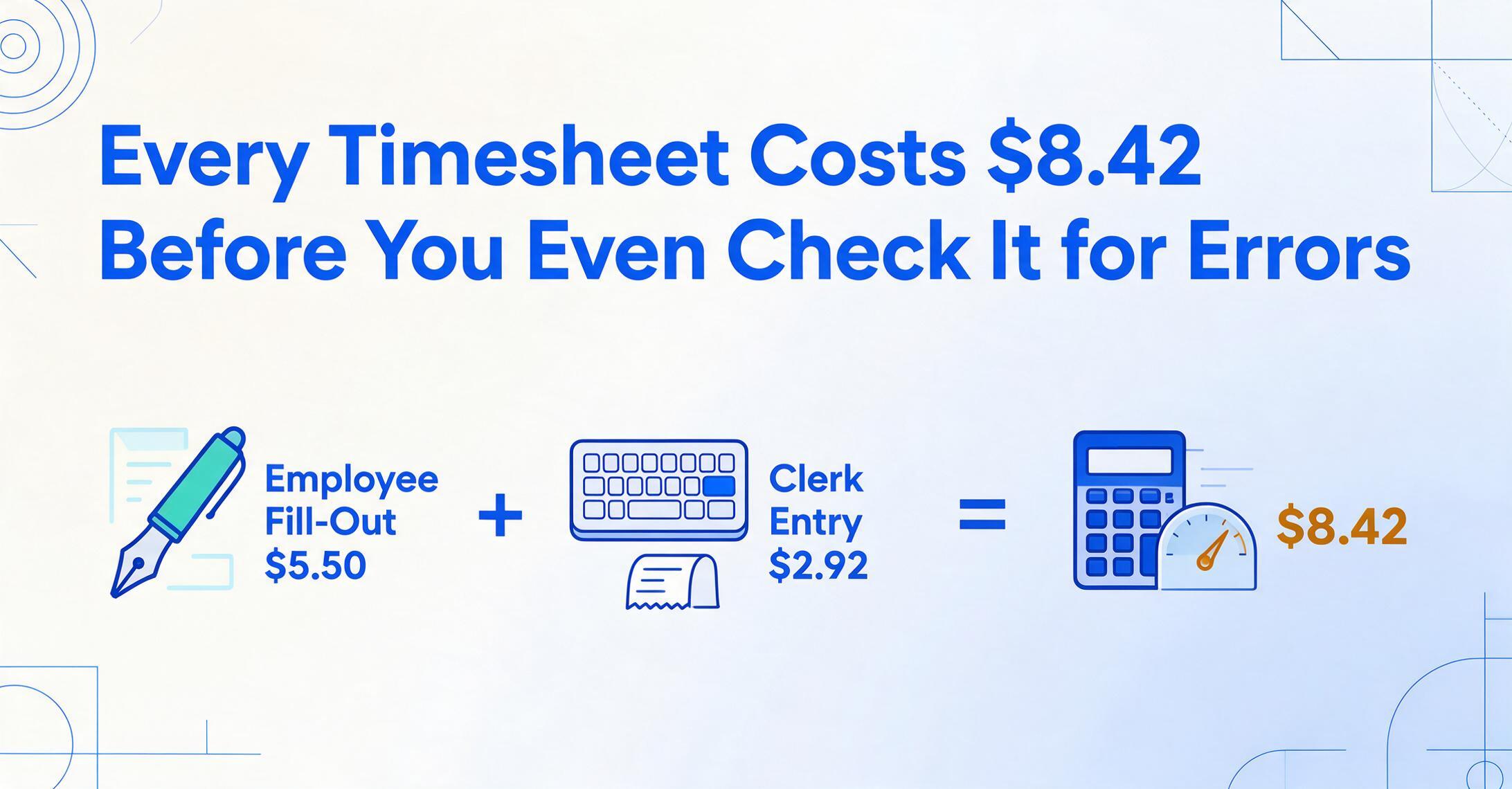
Manual timesheet processing has two labor components that most cost analyses conflate: the employee's time filling out the form, and the payroll clerk's time entering it. Both have a dollar value. Neither shows up as a line item on a departmental P&L — which is precisely why they go unmeasured.
The employee spends roughly 15 minutes per week filling out a paper timesheet: writing their name, date, job codes, start and end times, break durations, and totaling their hours. At a loaded hourly rate of $22 for a field worker or hourly employee, that's $5.50 per timesheet — just in the employee's time spent performing a zero-value administrative task instead of their actual job.
Then the payroll side. Industry benchmarks compiled by 941 Payroll put the average payroll manager's data entry time at approximately seven minutes per timecard — collecting the physical sheet, deciphering handwriting, transcribing each field into the payroll system, verifying totals. At a loaded rate of $25 per hour for a payroll clerk, that's $2.92 per timesheet in direct data entry labor.
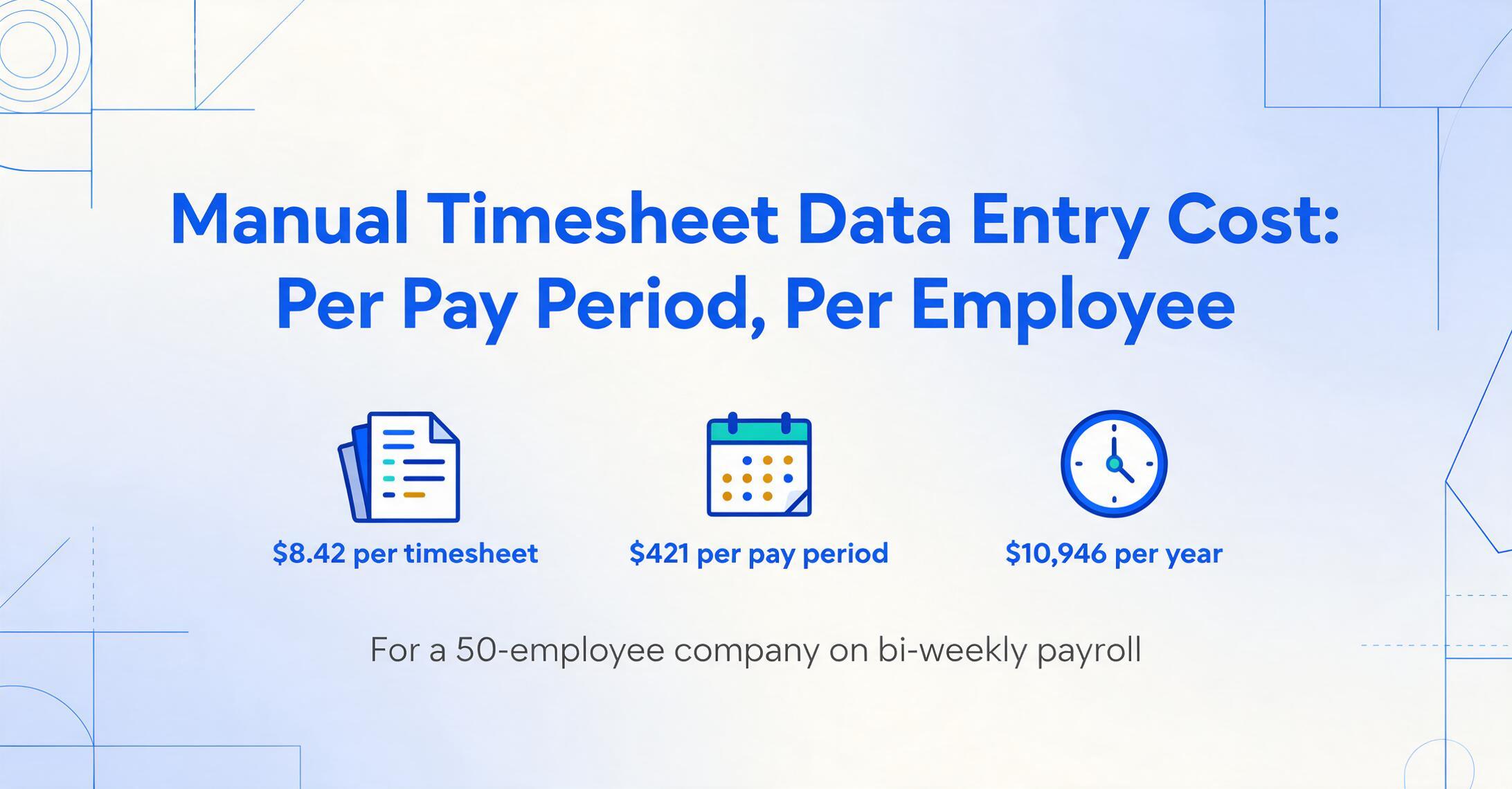
Combined cost per timesheet: $8.42. For a 50-employee company on a bi-weekly payroll schedule, that's $421 per pay period — or roughly $10,946 per year — spent on nothing more than capturing the same data that a digital time clock would collect automatically. This is before a single error is caught, before a single overtime dispute is resolved, before a single correction check is cut.
The number climbs almost linearly with headcount and pay frequency. A weekly payroll for 100 employees: approximately $43,784 per year. A semi-monthly payroll for 200 employees: approximately $40,416. These are conservative estimates using entry-level wage assumptions. In cities where a payroll specialist's loaded rate exceeds $35/hour, the per-timesheet cost crosses $10.40.
| Employee Count | Pay Frequency | Timesheets / Year | Annual Data Entry Cost |
|---|---|---|---|
| 25 | Bi-weekly (26) | 650 | $5,473 |
| 50 | Bi-weekly (26) | 1,300 | $10,946 |
| 100 | Weekly (52) | 5,200 | $43,784 |
| 200 | Semi-monthly (24) | 4,800 | $40,416 |
| 500 | Bi-weekly (26) | 13,000 | $109,460 |
But data entry labor is only the visible cost. The invisible costs begin the moment a payroll clerk misreads a handwritten digit.
The Error Correction Tax: $291 Per Mistake, and Mistake Density Is Higher Than You Think
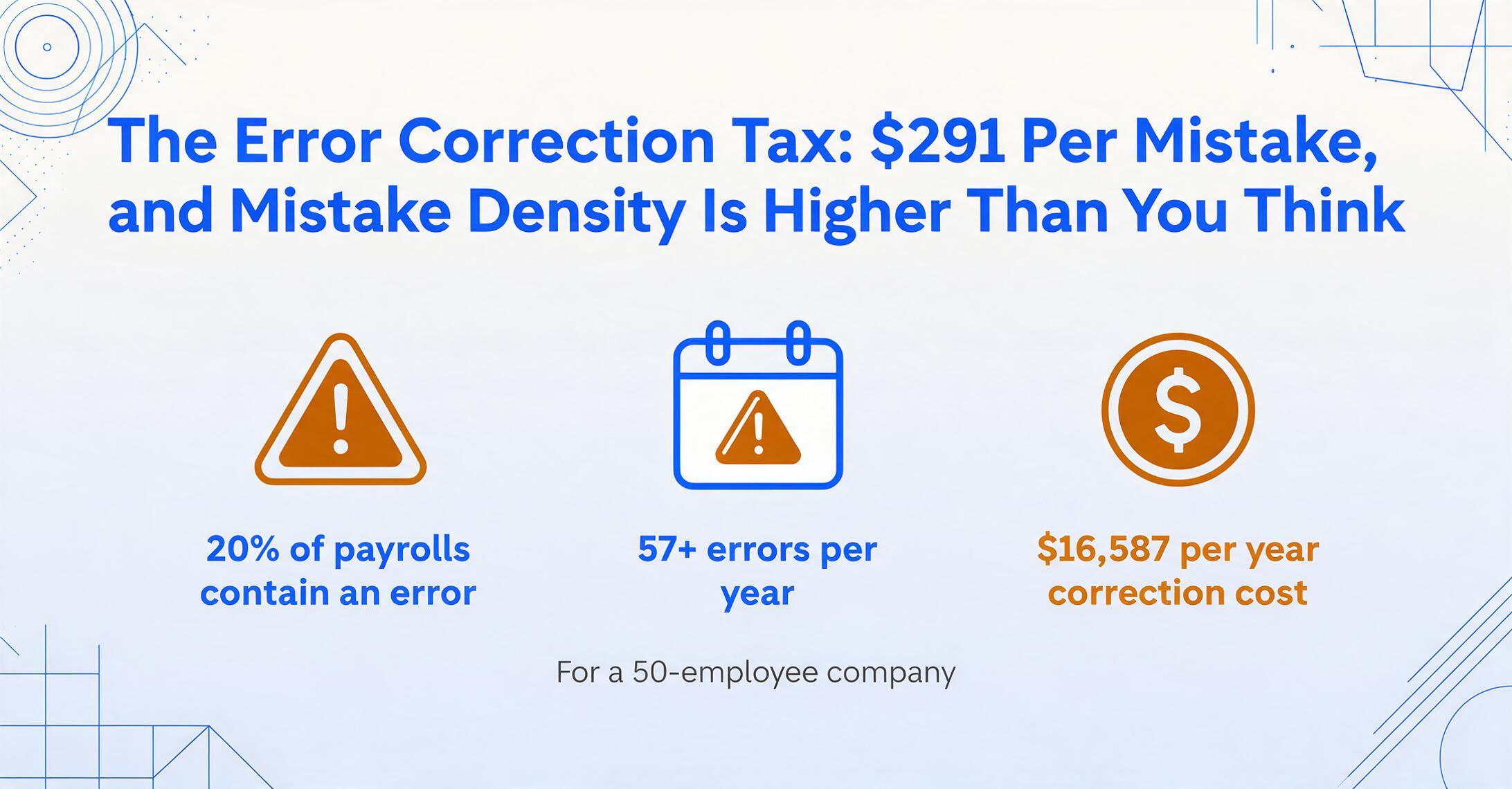
EY's research found that organizations using traditional, non-automated payroll processes experience a payroll error rate approaching 20 percent. That is not 20 percent of data fields — it's 20 percent of payrolls containing at least one error requiring correction. The average cost to fix a single error: $291, combining $281 in direct processing costs (recalculations, voided checks, stop-payment fees, reprocessing) and $10 in internal labor time spent investigating and correcting.
Handwritten timesheets drive a disproportionate share of these errors. When the EY study broke down error frequency by category, time and attendance errors were the most common type — occurring on average more than once per employee per year across the surveyed organizations. A company with 50 employees can expect 57 or more time and attendance errors annually, at a combined correction cost of approximately $16,587 per year.
The most time-consuming error to fix, according to EY, is a missing or incorrect time punch. Organizations spend an average of 26 minutes per employee investigating and correcting time punch errors over the course of a fiscal year. For a 200-employee company, that's nearly 87 hours — more than two full workweeks — spent on nothing but time punch corrections.
Unlike the data entry labor cost — which is predictable and linear — the error correction tax is stochastic. It spikes during periods of high turnover (new employees fill out timesheets incorrectly), after holidays (employees reconstruct time from memory), and in any week where a supervisor approved a batch without cross-checking. A single payroll run can generate zero corrections. The next can generate ten. The annual total is the average, and the average is $250,000 per 1,000 employees.
The industries most exposed to handwritten timesheets — construction, manufacturing, agriculture, field services — carry higher error rates because their workers are filling out paper forms in conditions that amplify illegibility: rain-streaked sheets, carbon-copy duplicates fading by the time they reach the office, a foreman filling out time for 15 crew members at once on a truck tailgate. AI handwriting recognition does not solve the weather, but it does shift the question from "can someone read this?" to "can a model trained on millions of handwriting samples read this?" — and increasingly, the answer to the second question is the more reliable one.
Overtime Miscalculation Turns a $2.92 Entry Error into a Three-Year Liability
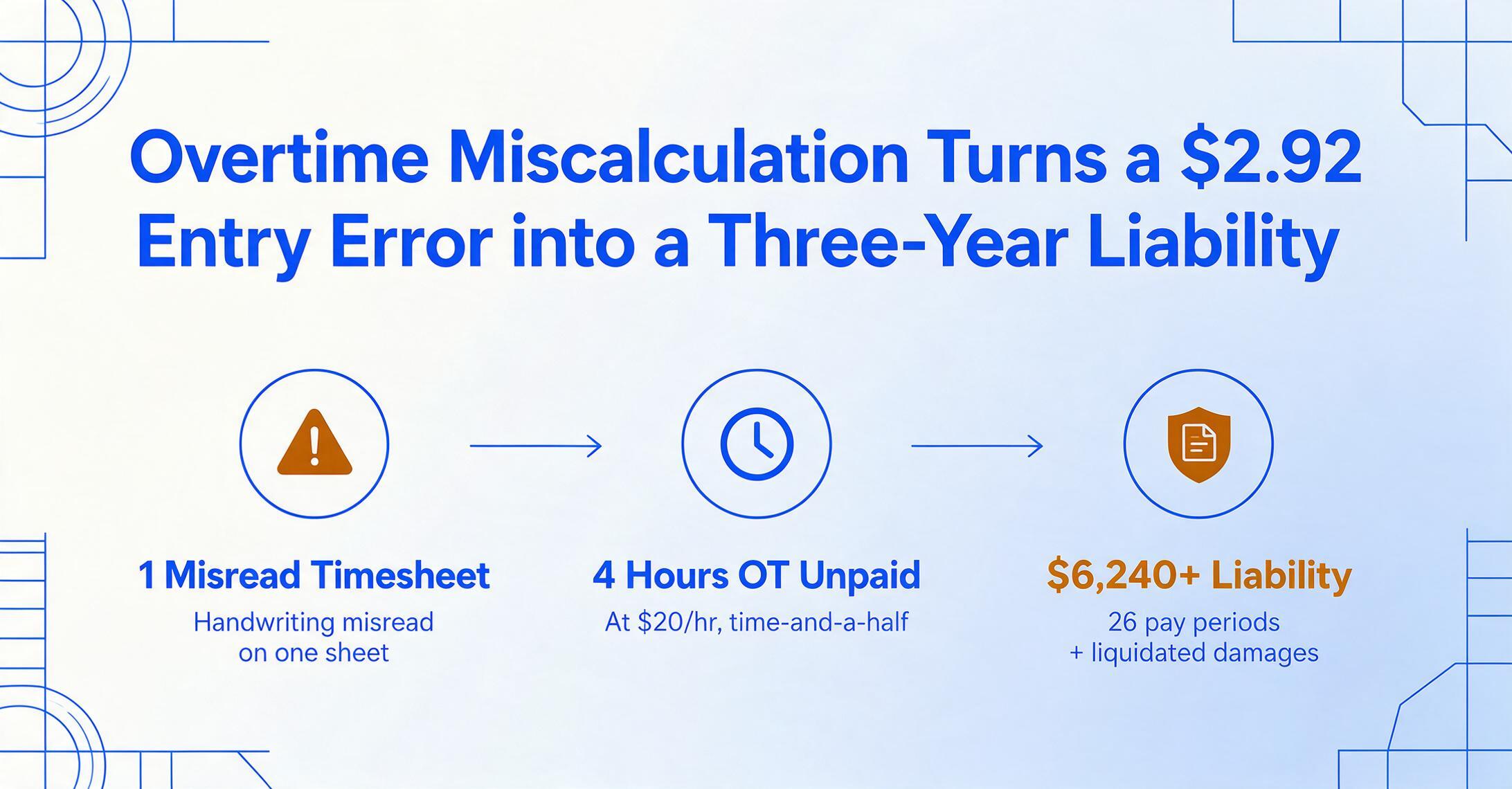
A data entry error of $2.92 per timesheet sounds manageable. But when that error changes an employee's recorded hours from 38 to 35 — or from 41 to 38 — the cost multiplies beyond the wage difference. Overtime miscalculation carries a legal liability tail that stretches three years backward.
Under the Fair Labor Standards Act (FLSA, 29 CFR Part 516), employers are required to maintain accurate records of hours worked for all non-exempt employees. The law places the burden of proof on the employer — not the employee. When an employee claims unpaid overtime and the employer cannot produce accurate timesheet records, the Department of Labor defaults to the employee's account of hours worked. The remedy is not simply the unpaid overtime. FLSA Section 16(b) mandates liquidated damages equal to the amount of unpaid wages — effectively doubling the employer's liability — plus the plaintiff's attorney's fees.
Consider a single handwritten timesheet where the employee worked 42 hours but the payroll clerk entered 38 because the "4" in 42 looked like a "9" in the Friday overtime column, or the writer's "2" was interpreted as a "0." Four hours of unpaid overtime at a $20 hourly rate — that's $120 owed (time-and-a-half on the extra $20 × 1.5 × 4 = $120). If the error is discovered two years later and multiplies across 26 pay periods for that employee: $3,120 in unpaid wages, plus $3,120 in liquidated damages, plus legal costs. Total: more than $6,240 — from one recurring misread on one employee's timesheet.
This is not a hypothetical structure. FLSA collective actions routinely involve dozens to hundreds of employees. The common denominator in deposition testimony is almost always the same: paper time records that someone transcribed incorrectly, or that couldn't be produced because they were lost or discarded.
California employers face an additional layer. State law requires meal and rest break tracking, and inaccurate timesheet records create presumptions of non-compliance. A California DLSE overtime claim filed by a single employee can trigger a wage audit that expands to all employees in the same classification. The audit uses the employer's own timesheets as evidence — and handwritten records with inconsistent formatting, missing signatures, or ambiguous entries become the prosecution's exhibits.
The IRS and DOL Don't Care That the Handwriting Was Bad
Payroll records are the most heavily regulated document category in a small or mid-size business. They must survive audits from three separate federal agencies, each with its own retention requirements and penalty schedules.
The IRS requires employers to retain payroll tax records for four years under 26 CFR §31.6001-1. This includes all records of wage payments, tax deposits, and filed returns. The penalty for failing to file correct information returns: $60 to $310 per form under IRC §§6721 and 6722, depending on how late the correction is made and whether the IRS determines the error was intentional.
The DOL's Wage and Hour Division enforces FLSA recordkeeping under 29 CFR Part 516. Payroll records and employment agreements must be kept for three years. Wage computation records — including timesheets, time cards, and work schedules — must be kept for two years. Crucially, while there is no private right of action for a recordkeeping violation alone, the absence of records shifts the entire burden in a wage claim: if the employer cannot produce a timesheet, the employee's testimony about hours worked becomes the presumptively accurate record.
The Equal Employment Opportunity Commission layers its own requirements on top — any document related to hiring, promotion, demotion, or termination must be preserved for at least one year from the personnel action date.
IRS payroll penalties cost U.S. businesses approximately $4.5 billion annually, according to IRS enforcement data. A significant share of these penalties trace back to incorrect forms driven by inaccurate underlying data — and the most upstream source of inaccurate payroll data is the timesheet entry point. When a payroll clerk transposes digits on a paper time card, the error propagates through W-2s, 941 filings, and state unemployment insurance reports before anyone catches it. By then, multiple amended filings are required, and the IRS penalty clock has started.
Where Paper Timesheets Still Rule — and Where the Costs Hit Hardest
Not every industry is equally exposed. The financial damage of manual timesheet processing concentrates in sectors where field conditions make digital clock-in impractical and where regulatory oversight compounds the cost of errors.
Construction. Between 38 and 60 percent of construction firms still rely on paper time tracking, depending on the survey. A ConstrucTech study put the U.S. figure at approximately 40 percent; UK-based research by Causeway found closer to 60 percent. Construction adds two cost multipliers unique to the industry: Davis-Bacon prevailing wage requirements for federal projects (which mandates certified payroll reports with hours broken down by job classification and wage rate) and multi-employer job sites where subcontractors submit timesheets on their own forms — different layouts, different handwriting, different conventions for recording overtime. SmartBarrel's 2025 analysis estimated that paper-based time tracking costs contractors $4,285 per worker annually through time theft, padded hours, and payroll inaccuracies combined.
Manufacturing and warehousing. Shop-floor time tracking often involves a blend of digital and paper — workers badge in at a central clock but record job codes, work order numbers, and downtime codes on paper sheets. The payroll clerk reconciles the two data sources manually, a cross-referencing task that consumes additional hours and creates its own error category: mismatch between the digital clock time and the hand-entered job allocation.
Agriculture and food processing. Seasonal workers, multiple languages, remote fields with no network infrastructure — paper timesheets are not a choice; they are the only option that works at 6:00 a.m. in a strawberry field 40 miles from the nearest cell tower. The H-2A visa program adds federal reporting requirements that make timesheet accuracy a condition of continued program eligibility.
Hospitality. Restaurants and hotels have the highest employee churn rate of any U.S. sector — roughly 70 to 80 percent annual turnover, according to BLS data. Every new hire means a period of timesheet training, followed by a period of timesheet mistakes. A restaurant group with 150 employees across five locations can easily spend 15 hours per pay period just reconciling paper timesheets before they can run payroll, according to payroll software provider Netchex's benchmarking.
If your industry is in this list, the $10,946 annual data entry cost for 50 employees is the floor, not the ceiling. Each industry layer — certified payroll, job-cost allocations, visa compliance — adds labor hours and error exposure that the baseline calculation does not capture.
Calculate Your Own Number: A Payroll Data Entry Cost Framework
The point of this article is not to give you a generic industry statistic. It's to give you a calculation framework you can run with your own numbers. Here are the variables:
| Variable | How to Find It | Example Assumption |
|---|---|---|
| E = Number of hourly employees submitting paper timesheets | Headcount report | 50 |
| P = Pay periods per year | Payroll calendar (26 bi-weekly, 52 weekly, 24 semi-monthly) | 26 |
| D = Minutes per timesheet for data entry | Time your own payroll clerk across 10 timesheets; average it | 7 |
| R = Loaded hourly rate of payroll clerk | Salary + benefits ÷ 2,080 hours | $25 |
| F = Minutes per timesheet for employee to fill out | Survey your team; most report 10-20 | 15 |
| W = Loaded hourly rate of employee filling out timesheet | Average hourly wage + benefits ÷ 2,080 hours | $22 |
| ER = Annual error correction cost per employee | EY benchmark: ~$250/employee/year or use your own correction log data | $250 |
The formula:
Annual Cost = (E × P × D/60 × R) + (E × P × F/60 × W) + (E × ER)
Worked example — 50 employees, bi-weekly payroll:
Data entry labor: 50 × 26 × (7/60) × $25 = $3,791.67
Employee fill-out time: 50 × 26 × (15/60) × $22 = $7,150.00
Error correction: 50 × $250 = $12,500.00
Total estimated annual cost for 50 employees: $23,441.67. Or approximately $469 per employee per year — spent on nothing more than moving hours worked from a piece of paper into a payroll system. This does not include overtime miscalculation liability, FLSA penalty exposure, or the payroll manager's overtime hours during correction-heavy pay cycles.
To test the sensitivity: increase D from 7 to 10 minutes (common when timesheets have multiple job codes or project allocations) and R from $25 to $35 (a more realistic loaded rate in metro areas). The data entry labor cost jumps from $3,792 to $7,583. The framework is sensitive to these inputs because the real-world processes it models are sensitive to them. A payroll clerk processing 100 multi-job-code timesheets in San Francisco is incurring a materially different cost than one processing 25 simple timesheets in a rural county — and your calculation should reflect that.
When Timesheet Data Enters Payroll Digitally, the Cost Structure Collapses
The cost framework above exists because timesheet data enters payroll through human transcription. Every dollar in it is a function of human time — interpreting handwriting, typing fields, cross-checking totals. Remove the transcription step, and the entire equation changes.
This is where the intersection of AI handwriting recognition and batch document processing changes the economics of payroll data entry. AI-based handwriting recognition replaces character-by-character OCR with semantic understanding: the model reads a handwritten timesheet not by matching shapes to a font library, but by understanding what a written "7:00 AM" means in the context of a "Start Time" column. It does not mistake a cursive 9 for a 4 because it's not matching pixels — it's interpreting the same visual cues a human reader uses, trained across orders of magnitude more handwriting samples than any one payroll clerk will see in a career.
When this recognition capability is paired with batch processing, the workflow shifts from "one timesheet at a time" to "a month's worth of timesheets at once." Batch-converting a full month of handwritten timesheets collapses the data entry time from 7 minutes per sheet to seconds — the AI processes all sheets in a single pass and outputs a structured spreadsheet with consistent column formatting. The payroll clerk's role shifts from data transcriber to data validator: spot-check the AI's output for outliers, which is a far cheaper task than entering every field from scratch.
The cost impact on our framework: D (data entry minutes) drops from 7 to approximately 0.5 (for validation spot-checking). R doesn't change. Everything else scales accordingly. The $3,792 in data entry labor for 50 employees drops to approximately $271 — a 93 percent reduction. Employee fill-out time remains until the paper itself is replaced by digital capture, but the error correction line item — $12,500 per year at the EY benchmark — drops proportionally with the reduction in human transcription errors. An automated output with validated formatting doesn't transpose digits and doesn't misread handwriting.
This is not predictions about an AI future. AI handwriting-to-text conversion with vision language models is production-grade today. The accuracy on structured forms with clear field labels is high enough that the validation task is real — not "check every field," but "review the exceptions." The economic question is not "does the technology work?" — it's "what is the cost of continuing to pay humans to do something that machines can do at 18 times the speed with lower error rates?"
Frequently Asked Questions
Is manual timesheet data entry still common?
Yes. Approximately 38 percent of U.S. companies still use paper timesheets, spreadsheets, or punch cards for time tracking, according to QuickBooks survey data. In construction specifically, 40 to 60 percent of firms report using paper-based time and attendance systems. These are concentrated in industries where workers are field-based — construction, agriculture, field services, manufacturing shop floors — and where the physical conditions of the job site make digital clock-in impractical.
How much time does a payroll clerk actually spend per timesheet?
Industry benchmarks range from 5 to 10 minutes per timecard. The 941 Payroll benchmark puts the average at approximately 7 minutes for a straightforward timesheet with standard hours and a single job code. Timesheets with multiple job codes, project allocations, overtime calculations, or handwritten corrections take longer. A payroll clerk processing 100 multi-job-code timesheets per pay period can easily spend an entire workday on data entry alone.
Can AI really read handwritten timesheets accurately?
Modern vision language models can read handwritten timesheets with high accuracy on structured forms — especially when the handwriting is at a functional legibility level (i.e., a human could read it). The AI does not need every character to be perfectly formed because it uses contextual understanding: if a field is labeled "Start Time" and the writing looks approximately like "7:00," the model interprets it as a time, not a random string. The practical limitation is extreme illegibility — the same scenario where a human payroll clerk would also need to call the employee to confirm. For most real-world handwritten timesheets, AI recognition accuracy is sufficient to shift the human role from data entry to data validation.
What's the most cost-effective first step to reduce manual timesheet costs?
If you cannot immediately replace paper timesheets with digital time clocks (common in construction and field services where the infrastructure isn't there), the highest-ROI intermediate step is to eliminate the manual transcription step. Keep the paper at the job site if conditions require it, but use AI-based extraction to convert the completed timesheets into structured payroll data — rather than paying a human to retype each one. This captures the bulk of the labor savings (the 93 percent reduction in data entry time) without requiring any change to field operations.
How does FLSA recordkeeping apply to digital records vs. paper?
The FLSA does not specify a required format for time records — paper, spreadsheet, and digital timekeeping systems are all permitted. The requirements are about accuracy and retention, not format. Digital records are easier to search, back up, and produce during an audit. Paper records carry the risk of loss, damage, or destruction — and if the DOL requests timesheets from two years ago and they were lost in a flood, the employer still bears the burden of proof on hours worked.