What Manual PO Data Entry Costs
a Manufacturing Operation — Per Quarter, in Real Dollars
Industry benchmarks say a manual purchase order costs $50 to $500 to process. But those numbers were built for office supply orders, not for POs that carry BOM line items, tolerance specs, delivery windows, and three rounds of supplier revision. For a mid-size manufacturer, the real quarterly cost is a number most procurement directors have never seen on a single page.
Key Takeaways
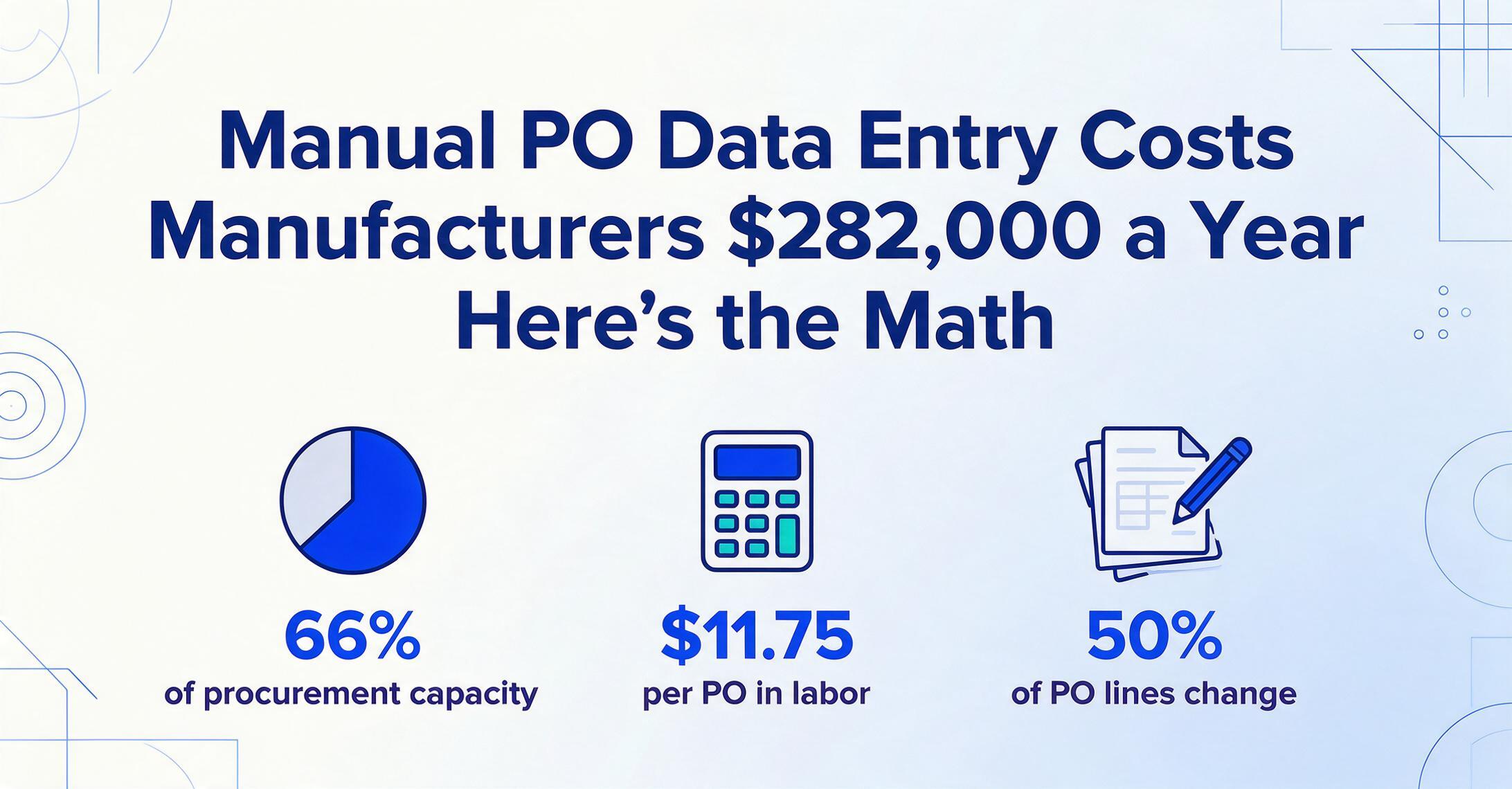
- 66%. That's the share of a manufacturing procurement team's labor budget consumed by manually re-typing supplier data from PDFs into the ERP — not negotiating prices, not qualifying new vendors, but copy-pasting numbers across systems that don't talk to each other.
- One mistyped digit on a raw material PO finger-counts into a scrapped batch, 36 hours of line downtime, and a late-delivery penalty — costs that land in manufacturing variance, not procurement's budget, so the team that typed the wrong number never sees the five-figure consequence.
- When AI reads and compares the supplier's PDF against the original PO, price shifts and quantity changes are flagged at document arrival — not discovered three manual reconciliation rounds later, after the wrong material is on the dock.
The Average PO Costs $100 to Process. For Manufacturers, That Number Is Misleadingly Low.
APQC's procurement benchmarking data — the most widely cited source in the industry — puts the average purchase order processing cost between $35.88 and $506.52, with a median around $100. CAPS Research, using a broader cost allocation model, found an average of $527 per PO in its 2022 cross-industry study. The Hackett Group reports that top-performing procurement teams with automation process POs 76% faster and at 55% lower cost than manual peers.
These are useful reference points. They're also misleading for manufacturers.
The APQC and CAPS numbers average together every industry: a law firm ordering printer paper, a tech company renewing SaaS subscriptions, a retailer restocking shelves. A manufacturing purchase order is a different animal. It carries bill of materials line items with part numbers and revision codes, material specifications with tolerance ranges, delivery windows tied to production schedules, and quality inspection criteria. Each field matters. Each field can be wrong. And when one is wrong, the consequence isn't a delayed office delivery — it's a production line that stops.
The cost of a manufacturing PO isn't just the labor to create it. It's the labor to verify it, correct it, synchronize it across four systems, handle the supplier's revision, and absorb the downstream cost when something breaks. Generic benchmarks miss all of that.
What "Processing a PO" Actually Means on a Manufacturing Floor
Let's walk through a real workflow — not the three-step diagram on a procurement software landing page, but what actually happens when a mid-size manufacturer processes a purchase order from a raw materials supplier.
Step 1: The requisition arrives. A production planner identifies a need — 500 units of a specific aluminum alloy, grade 6061-T6, with a required delivery date three weeks out to align with a production run. They fill out a requisition form. It goes to the procurement team.
Step 2: The PO is created. A buyer opens the ERP — SAP, NetSuite, Epicor, Microsoft Dynamics — and creates the purchase order. They enter the supplier name, the part number, the material spec, the quantity, the unit price, the delivery date, the shipping terms, the payment terms. If the ERP has the supplier's current pricing loaded, great. If not — which is common when raw material prices fluctuate weekly — they check the last email from the supplier for the current quote.
Step 3: The PO goes out. The supplier responds. The supplier receives the PO. But the supplier has their own system. Their part number for the same alloy is different. Their pricing may have changed since the last quote — aluminum spot prices move daily. They send back a PDF confirmation with revisions: different lead time, updated unit price, alternative lot size. The buyer now has to reconcile the confirmation against the original PO, line by line.
Step 4: Revision round. The buyer flags the discrepancies, emails the supplier, waits for a response. The supplier sends a revised PDF — or sometimes a one-line email that says "price updated to $4.32/lb confirmed." The buyer manually updates the PO in the ERP. The approval chain re-triggers.
Step 5: Synchronize across systems. The PO data now needs to reach inventory management (to update expected receipts), production scheduling (to confirm material availability for the planned run), and finance (to reserve budget). In a fully integrated environment, this happens automatically. In most mid-size manufacturers, it happens because someone re-enters the same data into a second, third, or fourth system.
One procurement professional on Reddit's r/procurement described the reality with brutal clarity: "We were literally taking PDFs from suppliers, copying values into spreadsheets, checking every line against the PO, emailing suppliers about mismatches, pasting everything into ERP because none of these systems speak to each other. Half the job is admin disguised as supplier management."
That last sentence is the thesis: half the procurement team's labor budget is spent on data coordination, not supplier strategy. The $100 benchmark only counts Step 2. Steps 3 through 5 are where the real cost lives.
The ERP Integration Gap — Why Half Your PO Process Is Still Manual
Most manufacturers have an ERP. Most manufacturers also believe their PO process is "automated" because the ERP generates purchase orders. This is like saying you have a meal delivery service because you own a refrigerator.
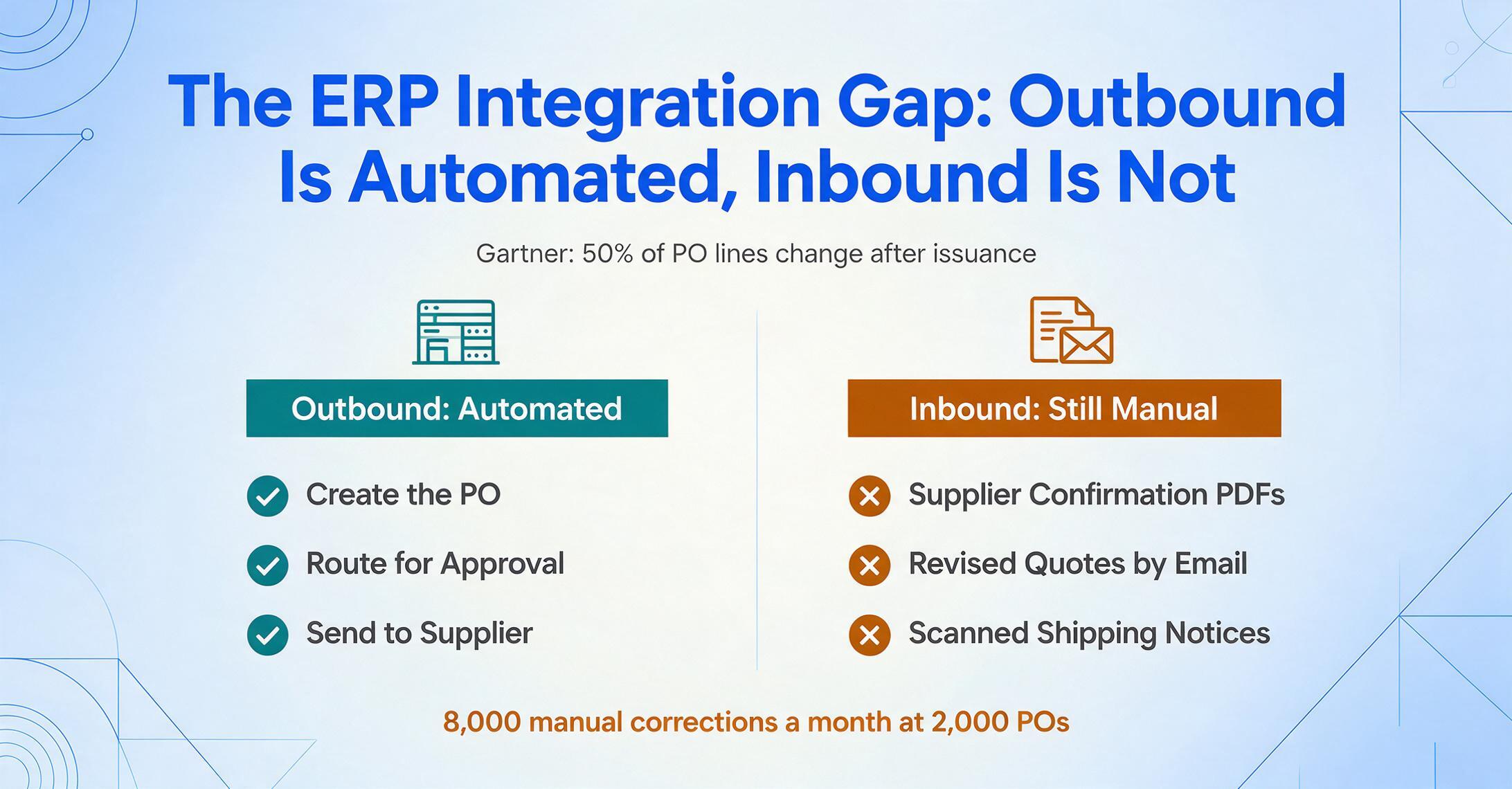
The ERP handles the outbound side well: create PO, route for approval, send to supplier. It's the inbound side where the gap opens. Supplier confirmations arrive as PDFs. Revised quotes arrive as email attachments. Shipping notices arrive as scanned documents. None of this data flows back into the ERP automatically. Someone has to read each document and type the updates into the system.
Gartner's 2024 procurement research found that 50% of purchase order lines undergo changes after issuance. Every one of those changes creates a manual data entry event. For a manufacturer processing 2,000 POs a month with an average of 8 line items each, that's 16,000 line items — and if half of them change, that's 8,000 manual corrections per month flowing through the procurement team's inboxes.
And it's not just the ERP-to-supplier gap. It's the ERP-to-inventory gap. The ERP-to-scheduling gap. The ERP-to-finance gap. Each of these system boundaries is held together by a person copying numbers from one screen to another.
The structural problem: ERPs are designed to manage structured data within their own walls. They weren't built to ingest unstructured data from external PDFs, emails, and scanned documents. The gap between "what the ERP can do" and "what the supplier actually sends" is filled by human labor — and nobody budgets for it.
What This Costs Per Quarter — a Line-by-Line Breakdown
Let's build the actual cost model. Assumptions for a mid-size manufacturer: 2,000 purchase orders per month, average 6 line items each, 300 active suppliers, 3 procurement staff plus 1 manager. All costs are fully loaded (salary + benefits + overhead).
| Cost Category | Monthly Hours | Annual Cost | % of Total |
|---|---|---|---|
| PO creation and data entry | 180 | $108,000 | 38% |
| Supplier confirmation reconciliation | 120 | $72,000 | 26% |
| Approval routing and follow-up | 60 | $36,000 | 13% |
| Cross-system data synchronization | 80 | $48,000 | 17% |
| Error correction and rework | 40 | $18,000 | 6% |
| Total manual PO processing cost | 480 hrs/mo | $282,000 |
Assumes 3 procurement staff at $50/hr fully loaded + 1 manager at $65/hr fully loaded. Total annual labor pool: $429,000. Manual PO processing consumes ~66% of procurement team capacity. Remaining 34% covers strategic sourcing, supplier negotiations, and market analysis.
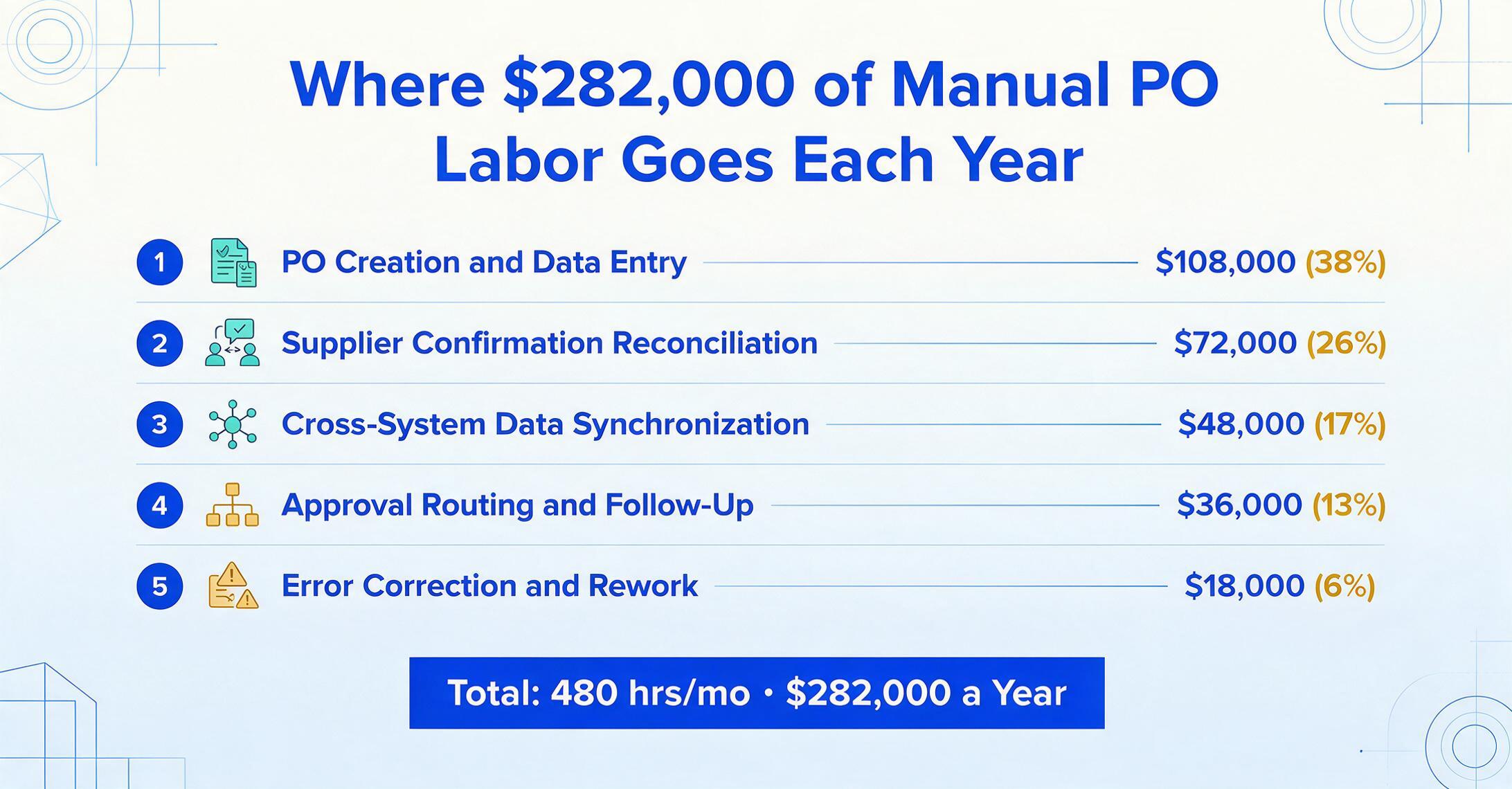
$282,000 per year in labor alone. That's $70,500 per quarter — or roughly $11.75 per PO in fully loaded labor cost for a team processing 24,000 POs annually. And this only counts the visible labor. It doesn't count the cost of errors that escape the rework cycle.
Compare this against automated benchmarks. The Hackett Group's data shows automated procurement teams operate at 55% lower cost per PO. Applied to our model, that's $155,100 in annual savings — enough to fund an additional strategic buyer, upgrade supplier quality programs, or absorb the year's raw material price inflation without cutting margin.
And for context: APQC's 2024 benchmarks show that 39% of manually processed invoices contain errors requiring correction. Each correction cycle costs an estimated $53 in labor (APQC). On 24,000 POs annually at a conservative 15% error rate, that's 3,600 correction events — another $190,800 in hidden cost.
The Error Cost Multiplier — When a Wrong PO Number Hits the Production Floor
Procurement ROI calculators typically stop at labor savings. They shouldn't. The cost of a PO data entry error isn't the $53 to fix it — it's what happens when the error isn't caught in time.
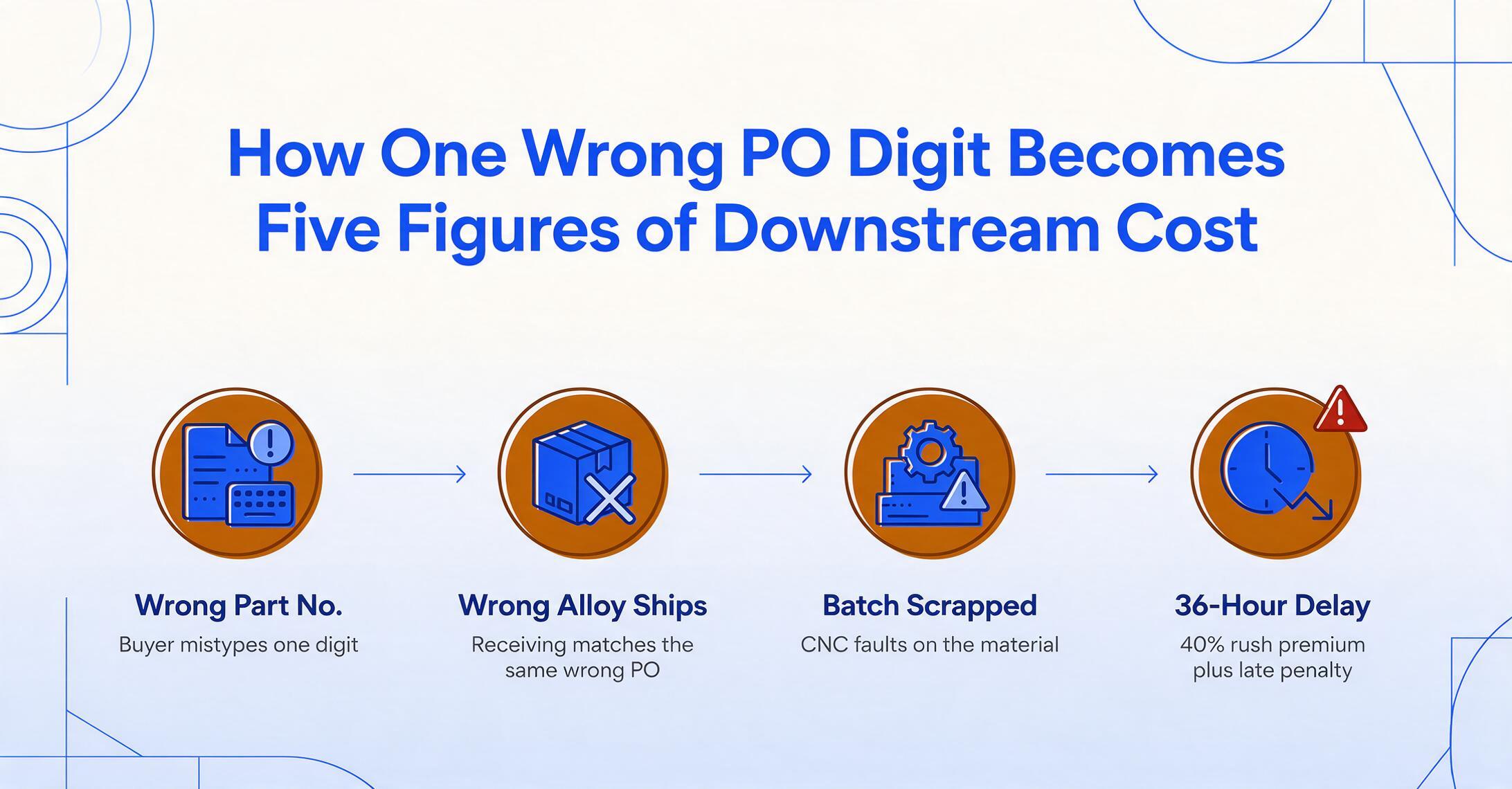
Consider the chain: a buyer mistypes a part number on a raw material PO. The supplier ships the wrong alloy. The material arrives, passes a cursory receiving check because the receiving clerk is matching against the same wrong PO, and goes into inventory. Ten days later, it reaches the production floor. The CNC operator loads it. The machine faults. The batch is scrapped. The production run is delayed by 36 hours while the correct material is expedited — at a 40% premium for rush shipping. The customer's delivery deadline is missed, triggering a late-delivery penalty in the contract.
One mis-typed digit. Five-figure downstream cost. Zero visibility in any procurement dashboard.
APQC research confirms the pattern: manual data entry in procurement carries a 1-4% error rate, and each error that reaches production creates a cost multiplier that procurement software vendors don't model because it falls outside the procurement budget. It lands in manufacturing variance. Or customer penalties. Or expedited freight. It's invisible to the function that caused it.
This is why manufacturing PO costs can't be benchmarked against cross-industry averages. The error cost multiplier — the gap between "incorrect field" and "production line down" — doesn't exist in most industries. In manufacturing, it's the dominant variable.
What Changes When Extraction and ERP Sync Happen in One Motion
The root cause of every cost described above is the same: data that starts in one format (a supplier's PDF, an email, a scanned document) needs to end up in a structured system (ERP, inventory, scheduling), and the conversion step is manual.
An AI-powered extraction layer changes the equation at the point where the cost is highest — the inbound data flow:
1. Supplier PDFs are read automatically. Instead of a buyer opening a supplier confirmation PDF and typing line items into the ERP, the AI extracts every field — part number, quantity, unit price, delivery date, terms — directly from the document. No templates. No per-supplier setup. The system reads each PDF fresh, understanding field semantics rather than relying on fixed positions.
2. Discrepancies are flagged, not hunted. The original PO data and the supplier's confirmation are automatically compared. Price differences, quantity changes, date shifts — flagged immediately, with the specific delta highlighted. The buyer reviews exceptions instead of hunting for them.
3. One export feeds all systems. Extracted PO data exports as structured Excel, CSV, or JSON — formats every ERP, inventory system, and scheduling tool can ingest. Instead of re-entering the same data into four systems, the procurement team exports once and imports everywhere. For Google Sheets users, data appends directly to the active sheet.
4. Computed columns catch errors before they leave procurement. Line item totals can be auto-calculated during extraction and compared against the PO total. If the sum of line items doesn't match the header total, the discrepancy is flagged before the data reaches the ERP — catching the kind of arithmetic error that would otherwise become a production-floor problem.
What this replaces: 480 hours/month of manual data coordination — the PO entry, the supplier confirmation reconciliation, the cross-system synchronization, and most of the error rework. What remains: strategic supplier management, negotiation, and the work procurement professionals were actually hired to do.
For a deeper look at the full PO extraction workflow — from batch processing purchase orders to setting up automatic data validation — see our guide on extracting purchase order fields into structured spreadsheets and the companion article on batch processing POs into a single cost sheet.