German Tax Declaration July Checklist:
What Self-Filers Need Before the 31 July ELSTER Deadline
The filing deadline for a German income tax return (Einkommensteuererklärung) self-filed through ELSTER is 31 July at midnight. Under § 149 Abgabenordnung (AO), the return must reach the Finanzamt within seven months of the tax year's end — and on 1 August, the late-filing penalty clock starts. But the return itself takes an evening to fill in. What burns through June and July is the gathering: locating and transcribing figures from a Lohnsteuerbescheinigung (wage tax certificate) that arrived in February, a stack of Versicherungsbescheinigungen (insurance certificates) that trickled in by mail across January and February, Spendenbescheinigungen (donation receipts) scattered across email folders, twelve months of Kontoauszüge (bank statements) for capital gains (Kapitalerträge), a folder of Handwerkerrechnungen (craftsman invoices) for the §35a deduction, and whatever Werbungskosten (income-related expense) receipts you accumulated all year. None of these documents arrive in the shape the return wants. Each speaks its own format. And the taxpayer is the integration layer between them and the Anlage fields — turning six document types into one coherent set of form entries, one number at a time. This is the checklist that breaks that gathering into finite, completable steps, so the last week of July is about verification and submission — not discovery.

Key Takeaways
- The 31 July filing deadline under § 149 AO carries a Verspätungszuschlag of 0.25% of assessed tax per month — but the penalty is a late-filing fine, not a price for the weeks of document gathering that make you late.
- The ELSTER form entry is a guided evening's work. The gathering — locating six document types that arrive by different channels at different times, and mapping every figure to the correct Anlage line — consumes the weeks between the last Versicherungsbescheinigung arriving in February and the deadline.
- Redefine "ready to file" as the moment all six document types are digitized into one verified spreadsheet — if that spreadsheet exists by mid-July, the form entry in the final ten days is transcription, not discovery.
The Deadline Is Fixed; the Gather Is What Compresses
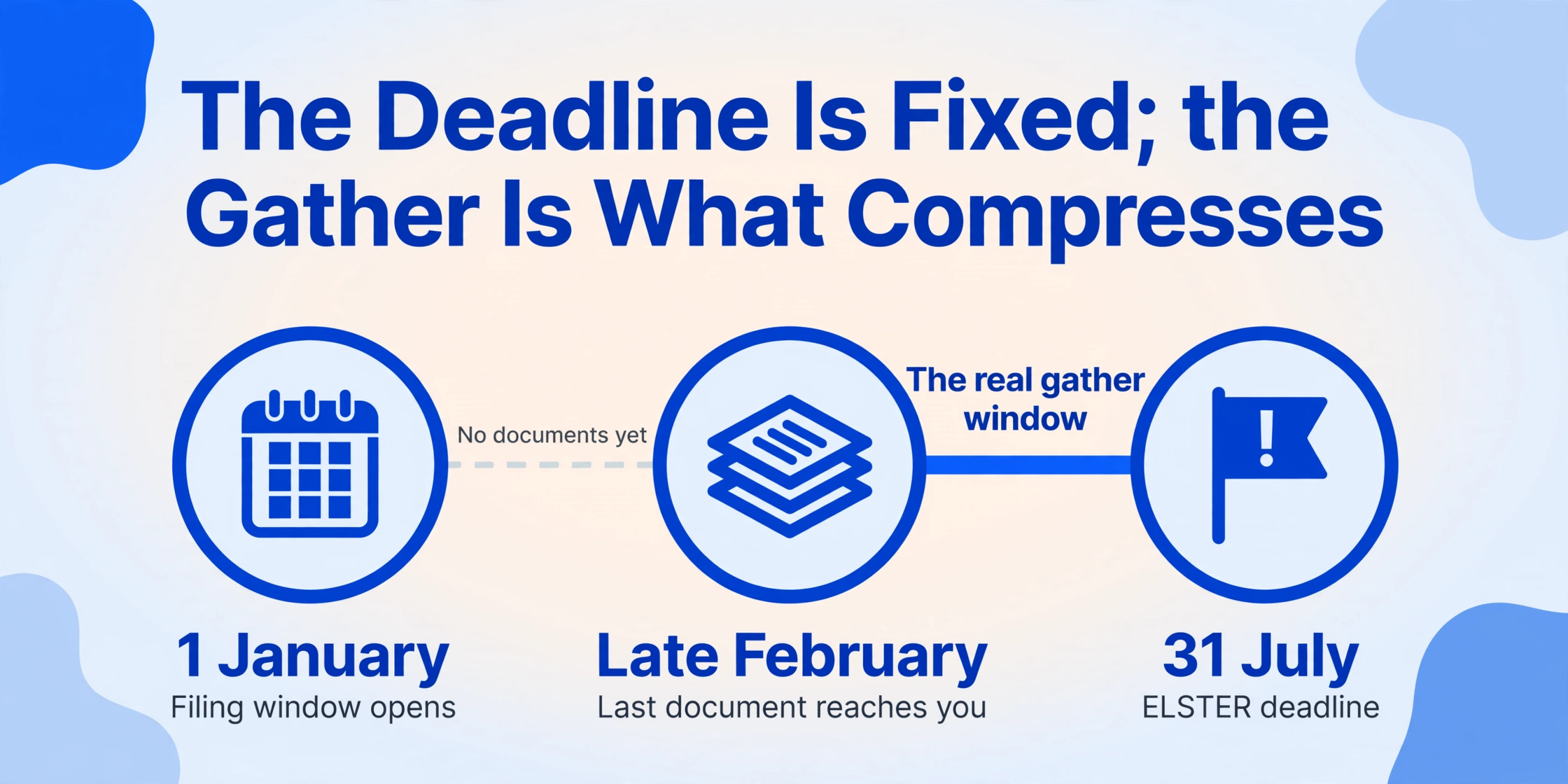
The German tax filing structure creates an asymmetry that is easy to miss until July arrives. The filing window opens on 1 January — you can submit as early as the forms go live on Mein ELSTER, typically in March — and closes on 31 July. That is seven months. But the effective gathering window does not start on 1 January. It starts when the last of the previous year's documents reaches you, which for most filers is late February, when employers are required to have issued the Lohnsteuerbescheinigung and insurers have mailed their annual certificates. So the practical window is roughly five months — January to July — and most self-filers do not touch it until June. By then, the document that was sitting in a February inbox has been buried under five months of other email. The bank statement for March is in a different export format than the one for November. And the Spendenbescheinigung from the charity you donated to in April is somewhere in a folder you last opened when you made the donation.
The deadline structure is spelled out in § 149 Abs. 2 AO: tax returns for a calendar year must be filed within seven months of the year's end. For a self-filer, that means 31 July of the following year. For those who engage a Steuerberater (tax advisor), the deadline extends to 28 February of the second following year — a seven-month extension that reflects the reality of the tax advisory industry's workload, not a concession to taxpayers who would rather file later. The key implication: the extension is not available to you unless a Steuerberater is filing on your behalf. And the Steuerberater's calendar fills up in January. If you are reading this in June without an advisor, your deadline is 31 July and your advisor options are likely closed. The checklist that follows assumes you are filing yourself — through ELSTER or tax software — and that the deadline is fixed.
The filing itself takes an evening. The gathering — locating six document types, reading every field, mapping each figure to the correct Anlage line, computing thresholds, transcribing — consumes the weeks before July 31. The penalty prices the filing step, not the gathering step. And the gathering is where nearly all the time goes.
The Penalty Clock: What Late Actually Costs
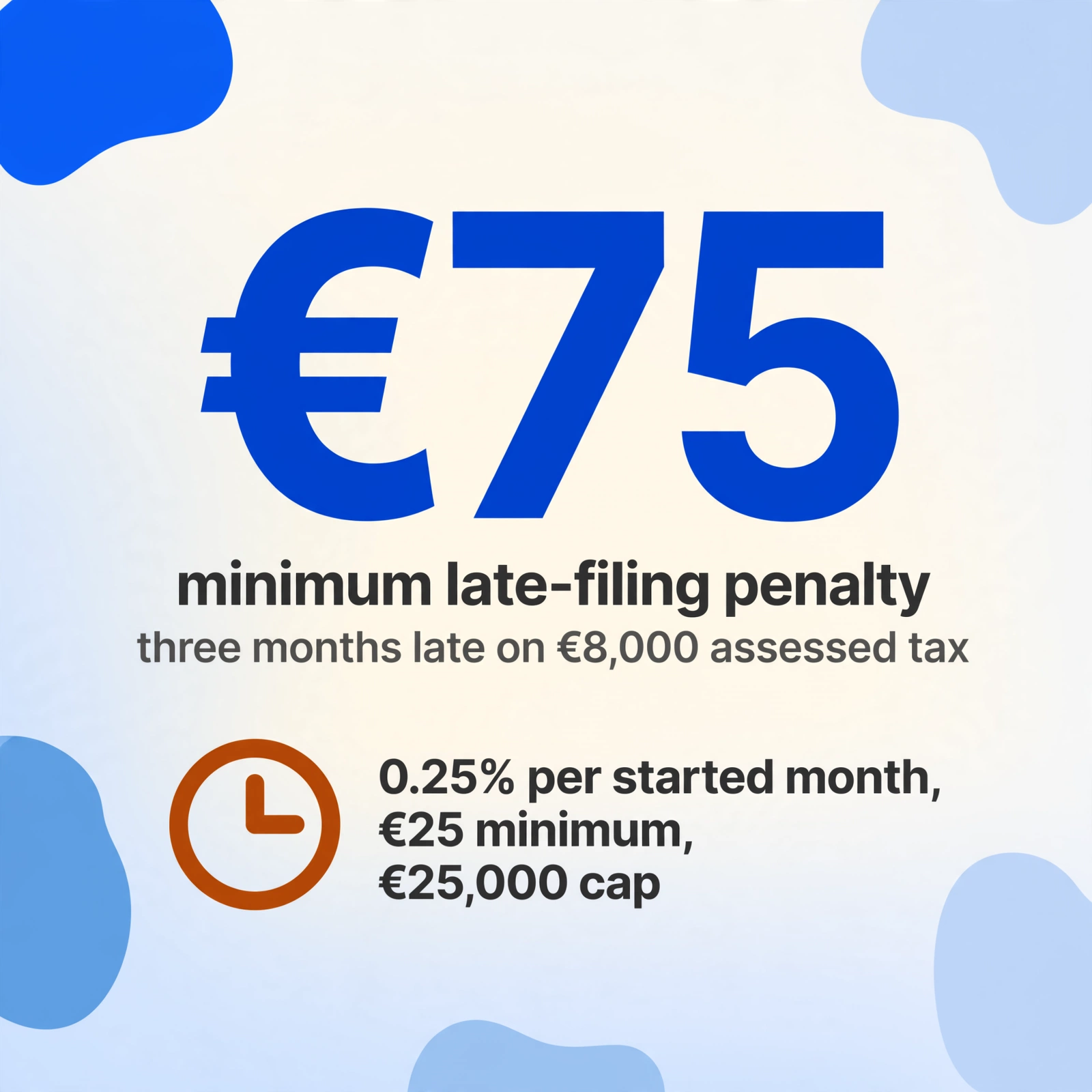
Knowing what you are racing is part of the checklist. Under § 152 AO, a late-filing penalty (Verspätungszuschlag) applies when a mandatory tax return is submitted after the deadline. The calculation is mechanical, not at the Finanzamt's discretion — for returns more than 14 months late, the penalty is mandatory. The rate is 0.25% of the assessed tax per started month of delay, with a minimum of €25 per month and a cap of €25,000. A taxpayer whose assessed income tax is €8,000 and who files three months late faces a Verspätungszuschlag of at least €75. Interest (Zinsen) runs on a separate clock under § 233a AO at 0.15% per month — 1.8% per year — on any underpayment from the day after the deadline. Filing late but paying on time still triggers the Verspätungszuschlag; filing on time but paying late triggers interest. The two obligations run on independent clocks, and 31 July is the deadline for both.
Beyond the penalty itself, a late or entirely missing return triggers a cascade. The Finanzamt may issue a tax estimate (Schätzung) — a figure calculated without any of the deductions you would have claimed, which almost always produces a higher tax bill than a correctly filed return. If you then file late, you owe the difference plus penalty plus interest. And the Bundesfinanzhof ruling IX R 17/22 (18 July 2023) established that data-entry errors made by the taxpayer are not correctable after the one-month objection period (Einspruchsfrist) from the date the tax assessment notice (Steuerbescheid) is issued. A transcription error that produces an incorrect return becomes permanent if you do not catch it within that window — and a return filed at 22:00 on 31 July is far more likely to contain such errors than one filed with a week to verify.
A return three months late on €8,000 of assessed tax costs at least €75 in late-filing penalty plus interest at 1.8% per year on any underpayment. And that math assumes the return is correct — a rush-filed return with a transcription error that understates a deduction by €500 costs the tax on that €500 plus the time and administrative friction of filing a correction (Korrektur) within the Einspruchsfrist.
The Six-Document Checklist: What to Gather and Where It Goes
The checklist is ordered by what arrives first and what takes the longest to process — not by what appears first on the ELSTER form. Front-load the slow physical dependencies and the final weeks become about verification, not scrambling for a bank statement from April.
Wage Tax Certificate (Lohnsteuerbescheinigung) → Anlage N
Issued by your employer and transmitted electronically to the Finanzamt by the end of February following the tax year. Available as a PDF download from your employer's payroll portal or as a printed copy. Contains: Bruttolohn (gross salary), einbehaltene Lohnsteuer (wage tax withheld), Solidaritätszuschlag, Kirchensteuer (church tax), and social insurance contributions split by type — pension (Rentenversicherung), health (Krankenversicherung), unemployment (Arbeitslosenversicherung), and long-term care (Pflegeversicherung). Every numbered field on the certificate maps to a specific line on Anlage N (employment income annex under § 19 EStG). This is the one document ELSTER can pre-fill through the VaSt (vorausgefüllte Steuererklärung) system — but the pre-fill must still be verified against the employer's certificate because employer-submitted errors are common and the Finanzamt states the taxpayer is responsible for verifying every pre-filled field. If you changed jobs during the year, you have one certificate per employer.
Arrives: By end of February | Format: PDF or paper printout | Estimated time to transcribe: 10 minutes if your situation is simple; 20–30 minutes if you had multiple employers or need to verify against the VaSt pre-fill
Bank Statements (Kontoauszüge) and Annual Tax Certificate (Jahressteuerbescheinigung) → Anlage KAP
For investment income (Kapitalerträge) — interest, dividends, fund distributions — that exceed the Sparer-Pauschbetrag (saver's allowance) of €1,000 per person (€2,000 for jointly assessed couples). Your bank issues an annual tax certificate (Jahressteuerbescheinigung) summarizing all capital gains, withholding tax paid (Abgeltungsteuer), and the portion of the Sparer-Pauschbetrag already applied. If you hold accounts or securities at multiple banks, you need one certificate per institution. If you have foreign accounts not subject to German withholding, the manual assembly is heavier — you must locate statements, identify taxable events, and compute the applicable tax. The data feeds Anlage KAP (capital gains annex under § 20 EStG). For freelancers and self-employed individuals, bank statements serve a second function: they are the income ledger for the Anlage EÜR (Einnahmenüberschussrechnung, the profit-and-loss statement under § 4 Abs. 3 EStG), where business deposits (Betriebseinnahmen) must be separated from personal transfers, tax refunds, and private income.
Arrives: Jahressteuerbescheinigung by March–April; online banking statements available year-round | Format: PDF, CSV export, or paper | Estimated time: 15 minutes for a single-bank saver; 60–90 minutes for a freelancer with two accounts and 150+ transactions
Versicherungsbescheinigungen (Insurance Certificates) → Anlage Vorsorgeaufwand
Each insurance provider sends an annual certificate covering the premiums paid. A typical employee receives three to five separate certificates, each formatted differently, arriving by mail between January and February: statutory health insurance (Krankenversicherung) and long-term care insurance (Pflegeversicherung) — these are usually pre-filled by VaSt for compulsory coverage, but supplementary insurance (Zusatzversicherung), private top-ups, and foreign policies are not; statutory pension contributions (Rentenversicherung) — also pre-filled but must be verified; and private policies: life insurance (Lebensversicherung), occupational disability insurance (Berufsunfähigkeitsversicherung), accident insurance (Unfallversicherung), and private liability insurance (Privathaftpflichtversicherung) — none pre-filled. The premium amounts from each certificate feed into specific lines on Anlage Vorsorgeaufwand (pension and insurance contributions annex under § 10 EStG). The deductibility rules differ by insurance type: statutory base contributions (Basisbeiträge) for health and long-term care are fully deductible; supplementary and private premiums are subject to a cap (Höchstbetrag) of €1,900 for employees and €2,800 for self-employed individuals for other pension expenses (sonstige Vorsorgeaufwendungen). Transcribing the wrong premium amount from the wrong certificate into the wrong line — a single-digit error — has a four-digit tax consequence.
Arrives: January–February by mail | Format: Paper letters, each with its own layout | Estimated time: 20–40 minutes for 3–5 certificates, growing with each additional policy
Spendenbescheinigungen (Donation Receipts) → Anlage Sonderausgaben
Charitable donations to registered organizations (gemeinnützige Organisationen) are deductible up to 20% of total income (Gesamtbetrag der Einkünfte) under § 10b EStG. Each donation above €300 requires an individual receipt (Zuwendungsbestätigung) issued by the charity. A taxpayer who donated €200 to one organization, €350 to a second, and €500 to a third has three receipts and three figures to enter into Anlage Sonderausgaben (special expenses annex) — in the correct donation field, not the church tax field, not the education field, not the childcare field, each of which sits adjacent on the same form. Church tax paid (Kirchensteuer) goes into a separate line on the same Anlage. The VaSt system does not pre-fill any donation or church tax data — this section is fully manual. If a receipt is missing, contact the organization immediately for a reissue; charities are legally required to provide one, but reissuing during filing season takes time.
Arrives: January–March, by email or post | Format: PDF email attachments or paper letters | Estimated time: 10–20 minutes to locate and transcribe; longer if receipts are in different email folders or physical files
Handwerkerrechnungen (Craftsman Invoices) → Anlage Haushaltsnahe Aufwendungen / §35a
Under § 35a Abs. 3 EStG, 20% of the labour portion of craftsman services for renovation, maintenance, and modernization work performed in your own home is deducted directly from your tax liability — up to a maximum of €1,200 per year. Material costs are not deductible. This means every Handwerker invoice must separate labour (Arbeitskosten), travel (Fahrtkosten), and machine costs from material costs — a split the tradesperson is legally required to provide upon request. Payment must be made by bank transfer; cash payments are explicitly excluded to curb undeclared work (Schwarzarbeit). If the invoice does not split labour from materials, the Finanzamt estimates the split — almost always to the taxpayer's disadvantage — so always request a properly itemized invoice before paying. The labour portion amount feeds into Anlage Haushaltsnahe Aufwendungen (household-related expenses annex). Separately, household services like cleaning and gardening qualify for 20% of costs up to €4,000 under § 35a Abs. 2. The two §35a buckets — services (€4,000) and craftsman (€1,200) — plus the mini-job allowance (€510) operate in parallel, giving a household up to €5,710 per year in direct tax reduction.
Arrives: Year-round, as work is completed | Format: Paper or PDF invoices | Estimated time: 15–30 minutes to locate, verify the labour/material split on each invoice, and sum the labour portions
Werbungskosten Receipts (Income-Related Expenses) → Anlage N
The Arbeitnehmer-Pauschbetrag (employee lump-sum deduction) of €1,230 under § 9a EStG is automatically applied — but only Werbungskosten above that threshold produce an additional tax benefit. The threshold is easier to cross than it looks: the Entfernungspauschale (commuting allowance) is €0.38 per kilometre of one-way distance for every workday (up from €0.30 in 2025 — a 2026 change). A 25 km one-way commute × 220 workdays = €2,090 of commuting costs alone, well above the €1,230 threshold. The Homeoffice-Pauschale (home office allowance) is €6 per day for up to 210 days, max €1,260 per year — and a day counts as a home-office day if you spent more than 50% of your working time at home and did not visit your primary workplace. Other qualifying expenses: work equipment (laptops, monitors, office furniture — items over €952 net must be depreciated over their useful life), professional training (Fortbildungskosten), job application costs (Bewerbungskosten), work-related literature, and professional association fees. From 2026, Gewerkschaftsbeiträge (union dues) are deductible in addition to the Arbeitnehmer-Pauschbetrag — even if your total Werbungskosten do not exceed €1,230. A commuter with 210 home-office days and a union membership crosses the threshold on commuting and home office alone before adding a single equipment receipt. All Werbungskosten data feeds into specific lines on Anlage N.
Arrives: Year-round, in every format imaginable — email confirmations, bank transfers, paper receipts, employer systems | Estimated time: 20–40 minutes to organize and total across categories; longer if receipts are unsorted
The labour hidden in this checklist is not the transcription — it is the translation. Each document speaks its own format: a Lohnsteuerbescheinigung is a numbered-field PDF issued by an employer, a Versicherungsbescheinigung is a paper letter from an insurance company with its own layout, a Kontoauszug is a CSV export or a scanned passbook page. ELSTER's Anlage fields ask none of those questions — they ask for totals by category. The taxpayer reads a number from one layout, classifies it into a tax category, decides which Anlage line it belongs on, and transcribes it. Six document types, three to five Anlagen, and a cognitive load that compounds across an evening — the fourth insurance certificate of the session takes longer to process correctly than the first one did, not because the certificate is harder, but because classification accuracy degrades with repetition. This is the same mental fatigue that makes UK Self Assessment data assembly draining in the final January week and why Japanese 確定申告 filers describe the February assembly phase — not the March 15 deadline — as the real tax season. The form is uniform. The assembler is not. And the assembler's fatigue is the single largest uncontrolled variable in tax return accuracy.
A Realistic June-to-July Countdown
If you are reading this in late June or early July with the deadline in sight, the useful thing is a plan for the time you actually have. Break the remaining window into three phases, working backwards from 31 July.
Phase 1 — First week of July: Collect everything
Confirm you can access your Mein ELSTER account — if you have not yet registered, do it now, because the identity verification takes several days. Then locate every document from the checklist: download the Lohnsteuerbescheinigung from your employer portal or request it if missing, download your bank's Jahressteuerbescheinigung and the relevant account statements, locate every Spendenbescheinigung from your email folders and physical files, stack every Versicherungsbescheinigung that arrived by mail, and gather every Handwerker invoice from the past year. This is the step most likely to stall — a missing certificate that needs reissuing, an employer that has not yet provided the Lohnsteuerbescheinigung — so front-load it. If you cannot find a document in this phase, you still have time to request a replacement. If you discover the gap on 30 July, you do not.
Phase 2 — Mid-July: Turn documents into figures
This is the real work: reading every number off each document, classifying it into the correct tax category, mapping it to the correct Anlage line, computing thresholds, and totalling — and doing it for six document types across three to five Anlagen. Create one spreadsheet with a tab per Anlage, transcribe every figure into the correct column, and verify each subtotal against the source document. This is the step that extraction can compress from a multi-session grind to one upload-and-verify pass — covered in the next section. The goal of this phase: every figure ready in a single place, reconciled, and verified against its source document. The ELSTER form entry in Phase 3 should be a transcription of a verified spreadsheet, not a discovery process.
Phase 3 — Last week of July: File, then handle payment
With every figure verified in a spreadsheet, work through the ELSTER forms and submit. Note the tax calculated and any advance payments (Vorauszahlungen) the system computes for the following year, and ensure the payment reaches the Finanzamt by 31 July. Filing on time but paying late triggers a separate penalty clock — so the submission and the payment are two independent checklist items, both due on the same day. If possible, file by 25–28 July, leaving a buffer for the Finanzamt's server load on deadline day. The Mein ELSTER portal does not slow to a crawl, but a late discovery — a missing field, a VaSt pre-fill that does not match your certificate — is far easier to handle with three days of margin than with three hours.
The countdown works because it puts the slow, failure-prone step — document collection — first, and the fast, guided step — form entry — last. Phase 1 should be complete by the first week of July, Phase 2 by mid-July, and Phase 3 — filing — in the final ten days. If Phase 1 stalls because a document is missing, you have time to request it. If Phase 2 stalls because the figures do not reconcile, you have time to find the discrepancy. The countdown buys margin — the one thing a deadline eliminates.
Collapsing the Gather: From Six Document Stacks to One Spreadsheet
Phases 1 and 2 in the countdown above — collecting six document types and turning them into figures — are two separate steps only because the documents and the Anlage fields speak different languages. A Lohnsteuerbescheinigung PDF, a scanned Versicherungsbescheinigung, a CSV of bank transactions, and a photographed Spendenbescheinigung all contain the data the return needs — but none of them are in the shape the return wants, and the traditional way of getting from one to the other is to sit at a desk and type each number by hand into a spreadsheet, then re-type the spreadsheet's totals into ELSTER's web forms.
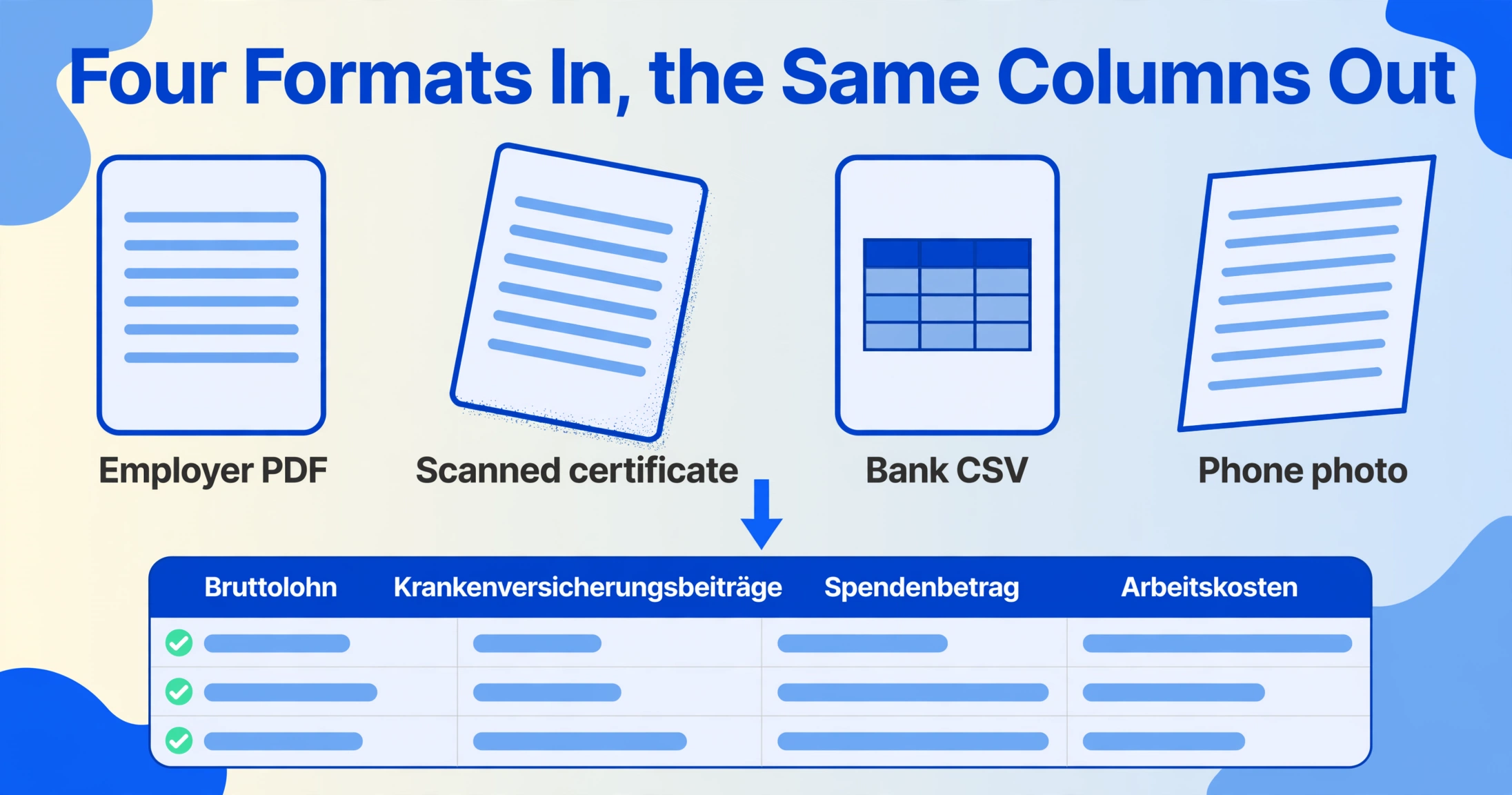
A different approach reads the documents directly. Instead of reading each document by eye and typing each figure manually, you upload the documents and name the columns you want. ImageToTable.ai reads each document by understanding what a field means — Bruttolohn (gross salary), Krankenversicherungsbeiträge (health insurance contributions), Spendenbetrag (donation amount), Arbeitskosten (labour costs from a Handwerker invoice) — and locates the value regardless of where it sits on the page. A structured PDF from an employer, a scanned insurance certificate with a 3-degree skew, a CSV bank export, and a photographed donation receipt from a phone camera all resolve to the same spreadsheet columns because the extraction is semantic, not positional — it reads meaning, not layout.
Three features of the extraction workflow matter specifically for the pre-deadline gather. Because the tool is batch-first — you upload all six document types as a single batch and the results merge into one Excel table — the multi-session grind of working through each document type sequentially becomes a single upload-and-verify pass. A computed column can cross-check the income totals across documents: define a column that compares the Bruttolohn on the Lohnsteuerbescheinigung against the sum of employment income on Anlage N, outputting "OK" or "CHECK" — catching the most common discrepancy before the return reaches the Finanzamt. And an inferred column can assign each Handwerker invoice to the correct §35a bucket (renovation vs. maintenance vs. modernization) by reading the invoice description — eliminating the manual sorting step that eats time in Phase 2.
The full extraction workflow for the entire ELSTER return — which columns to define for each document type, how to map the output to specific Anlage fields, and the verification checklist — is covered in the guide to extracting German ELSTER tax form data to Excel. For the scenario where an employer must also process monthly Lohnsteuer-Anmeldung declarations across an entire payroll, the same batch extraction applies at scale — 50 employees, one column schema, one consolidated dashboard every month. The structural reason this assembly work exists at all — why the digital filing pipeline is a highway but the data assembly is still a staircase — is explored in the companion piece on the problem of manual data entry in Germany's digital ELSTER platform.
Files are processed securely and not stored.
The same seasonal pressure shows up across tax jurisdictions, driven by the same structural bottleneck — digital filing endpoint, manual data assembly — just on different dates. UK freelancers hit their version of this checklist in January with the SA100 January deadline crunch. Japanese freelancers face the same gathering problem every February ahead of the 確定申告 March 15 deadline. The form language, the deduction names, the statute numbers, and the deadline date differ — but the structural bottleneck is the same. The tax authority provides the digital filing endpoint. It does not provide the tools to digitize the document gathering that precedes it. And every year, millions of people fill that gap by hand.
Frequently Asked Questions
What is the exact Verspätungszuschlag if I miss the 31 July deadline?
Under § 152 AO, the late-filing penalty is 0.25% of the assessed income tax per started month of delay, with a minimum of €25 per month and a maximum of €25,000. A taxpayer whose assessed tax is €8,000 and who files three months late owes at least €75. Interest under § 233a AO accrues separately at 0.15% per month (1.8% per year) on any underpayment from 1 August. Filing late but paying on time still triggers the Verspätungszuschlag; paying late but filing on time still triggers interest. If you cannot meet the deadline, you can request an extension (Fristverlängerung) from your Finanzamt before 31 July — extensions are not guaranteed, but reasonable requests with a stated reason (illness, missing documents) are often approved.
What six document types do I need to gather before filing my ELSTER tax return?
The core six for a typical self-filer or an employee with deductions: (1) Lohnsteuerbescheinigung (wage tax certificate) from your employer — feeds Anlage N; (2) Kontoauszüge and Jahressteuerbescheinigung (bank statements and annual tax certificate) — feeds Anlage KAP and optionally Anlage EÜR for self-employed filers; (3) Versicherungsbescheinigungen (insurance certificates) from health, long-term care, pension, and private insurance providers — feeds Anlage Vorsorgeaufwand; (4) Spendenbescheinigungen (donation receipts) from charities — feeds Anlage Sonderausgaben; (5) Handwerkerrechnungen (craftsman invoices) with separate labour and material costs — feeds Anlage Haushaltsnahe Aufwendungen under § 35a EStG; (6) Werbungskosten receipts for commuting, home office, work equipment, training, and other income-related expenses — feeds Anlage N. Each document type arrives at a different time, in a different format, and from a different source. The gathering of all six is the time-intensive part of the tax filing process.
Does VaSt (vorausgefüllte Steuererklärung) eliminate the need to type in tax document data?
VaSt reduces the transcription burden but does not eliminate it. It pre-fills the employer's Lohnsteuerbescheinigung data, compulsory health and long-term care insurance contributions, and pension payment notices — and those must still be verified against the actual certificates, because employer-submitted errors are common and the Finanzamt states the taxpayer is responsible for verifying every pre-filled field. What VaSt does not pre-fill: Werbungskosten (commuting, home office, work equipment, training), Sonderausgaben (donations, church tax, education costs, childcare), außergewöhnliche Belastungen (medical costs, disability expenses), Handwerkerrechnungen for the § 35a deduction, and supplementary or private insurance premiums not captured by the compulsory reporting system. For a self-filer with commuting costs, home-office days, charitable donations, and craftsman invoices, approximately 60–70% of the deduction-relevant fields remain fully manual even with VaSt active.
Can I request an extension if I cannot meet the 31 July deadline?
Yes, but the request must be made in writing — through ELSTER, by letter, or by fax — before the 31 July deadline, and must include a reason (illness, relocation, missing documents). Under § 109 AO, the Finanzamt has discretion and is not obliged to grant the extension. Reasonable requests are often approved, but the earlier you submit, the better. If you engage a Steuerberater, the deadline automatically extends to 28 February of the second following year — but the advisor must be instructed before the original deadline and their calendar fills up in January. If you are reading this in June or July without an advisor, your deadline is 31 July and your best option is to file with the documents you have, request missing certificates simultaneously, and correct the return later if needed.
Can I extract data from all six tax document types at once instead of typing every figure by hand?
Yes. Upload the Lohnsteuerbescheinigung PDF, the scanned Versicherungsbescheinigungen, the bank statements, the Spendenbescheinigungen, the Handwerker invoice PDFs, and any photographed receipts as a single batch. Name your columns — Bruttolohn, einbehaltene Lohnsteuer, Krankenversicherungsbeiträge, Pflegeversicherungsbeiträge, Spendenbetrag, Arbeitskosten — and the AI reads each document by understanding what each field means, not where it sits on the page. The output is one spreadsheet where every figure from every document sits in the same column structure, ready for the classification decisions and Anlage mapping that only a human can make. A computed column can cross-check income totals across documents, and an inferred column can categorize expenses by type. The mechanism is covered step by step in the guide to extracting ELSTER tax form data to Excel.
Do I still need to keep my original documents after extracting the data?
Under German tax law, yes — the statutory retention period (Aufbewahrungsfrist) under § 147 AO is 10 years for accounting records (Buchungsbelege) and 6 years for business correspondence and other tax-relevant documents. For individual income tax returns, the Finanzamt may request original documents during an audit — particularly deduction-related receipts (Spendenbescheinigungen, medical bills, insurance certificates). The extraction replaces the manual data-entry step — the hours spent reading and typing. It does not replace the legal obligation to retain original documents for the applicable Aufbewahrungsfrist. The Festsetzungsfrist (assessment period) for tax returns is four years from the end of the year in which the return is filed, and the Finanzamt can request supporting documents during that entire window. Best practice: extract the data to a spreadsheet for analysis and filing, retain the original documents in a dated folder structure per tax year, and maintain both for the full retention period.
The six document types are finite. The hours you spend locating, reading, classifying, and transcribing them are not. The deadline is fixed — but the gathering is negotiable. Front-load the collection, collapse the transcription, and file not because the penalty clock is ticking — file because the return is ready.
Extract Your Tax Documents Now