Freelancers in China:
Tracking WeChat Pay — The Two Fields That Matter
March arrives, and with it comes the annual comprehensive income reconciliation (年度汇算清缴) deadline. You open the official Individual Income Tax app (个人所得税), scroll past any pre-filled salary data from a day job, and there it is: the section for labor service income (劳务报酬所得). The income you received directly from clients, through WeChat transfers. You open your phone's photo gallery and scroll back through months of screenshots — a ¥500 translation here, a ¥1,200 design fee there, a ¥300 tutoring session. Each one a WeChat Pay confirmation. Each one a number you need to manually enter. This is the moment most freelancers in China realize WeChat Pay comes with a tax documentation gap that only becomes obvious when the filing deadline looms.
Key Takeaways
- WeChat Pay treats client payments like personal transfers — no tax document, no withholding, no year-end summary — yet the tax bureau holds you responsible for reporting every yuan of service income.
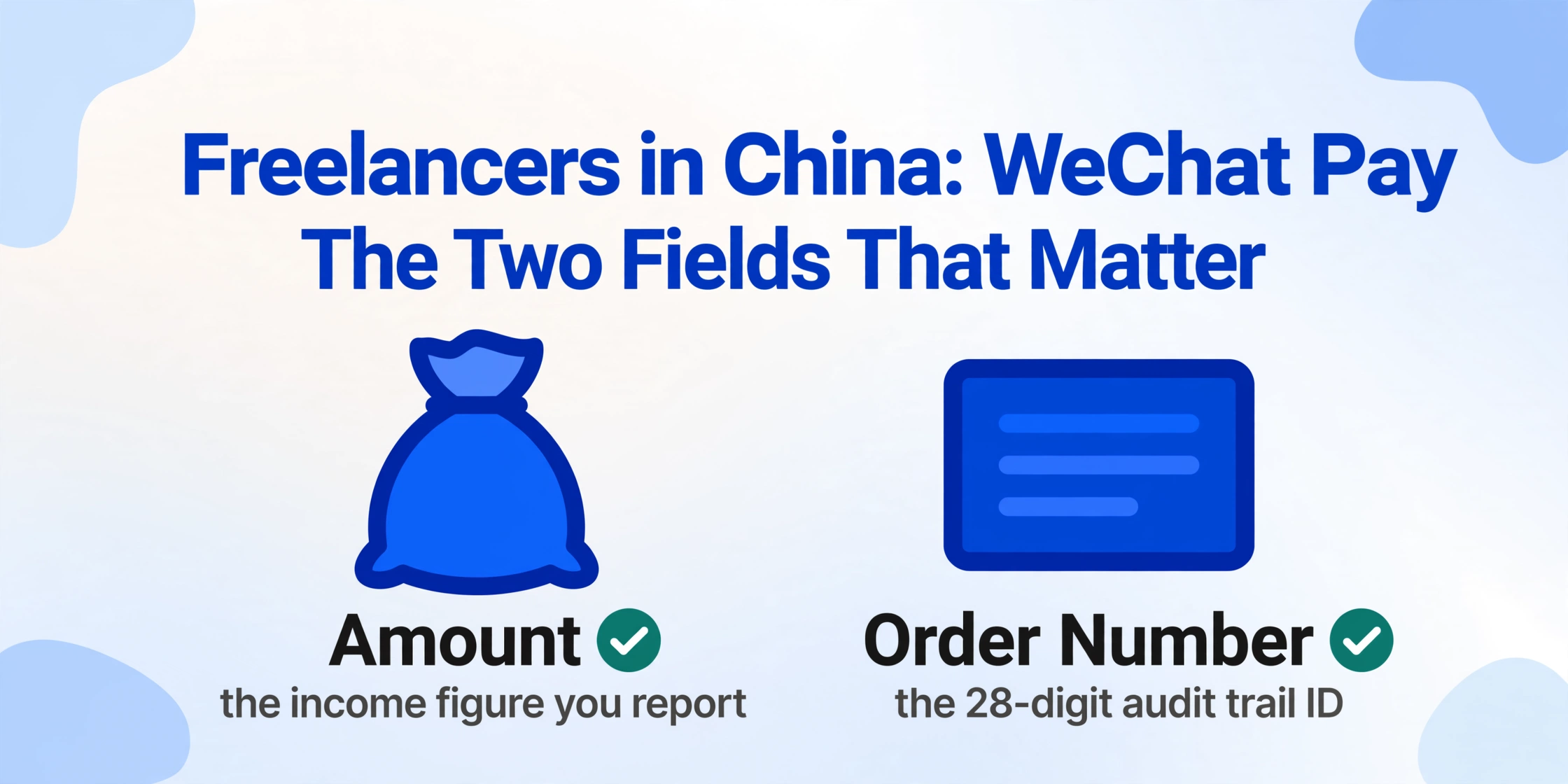
- Of every field on a WeChat transaction screen, only two carry legal weight for tax: the amount and the 28-digit order number — the sender's nickname proves nothing to a tax auditor.
- Define Amount and Order Number as your two columns, batch-upload your screenshots, and export a spreadsheet that feeds directly into the Individual Income Tax app — zero manual typing of 28-digit IDs.
WeChat Pay Doesn't Issue Tax Documents for Personal Transfers
When a client sends you money through WeChat Pay — as a personal transfer (转账) or red packet (红包) — the transaction is recorded as a payment notification, not as a taxable income event. Unlike a merchant payment where the seller issues a formal fapiao (发票), personal transfers carry no tax document, no withholding, and no automatic reporting to the tax bureau (税务局). Your only record is the screenshot you took, or the transaction history inside WeChat Wallet (钱包) that you scroll through month by month.
This matters because China's individual income tax (个人所得税) system draws a sharp line between employment income (工资薪金所得) and personal service income (劳务报酬所得). If you're a freelancer — writer, designer, translator, tutor, photographer, consultant — client payments are classified as 劳务报酬所得, part of your annual comprehensive income that must be declared between March 1 and June 30 each year. The tax bureau expects you to report it. But WeChat Pay does not send you a year-end tax summary for personal transfers. The burden of tracking is entirely yours.
WeChat Pay's in-app annual statement (年度账单) shows total yearly inflows — but it lumps everything together: salary, money from relatives, friend reimbursements, and client payments, all in one undifferentiated sum. For tax purposes, that total is useless. You need to isolate your service income from everyday transfers, and the only way is to record each client payment individually, with enough detail for the tax bureau to accept it.
Why Only Two Fields: Amount and Order Number
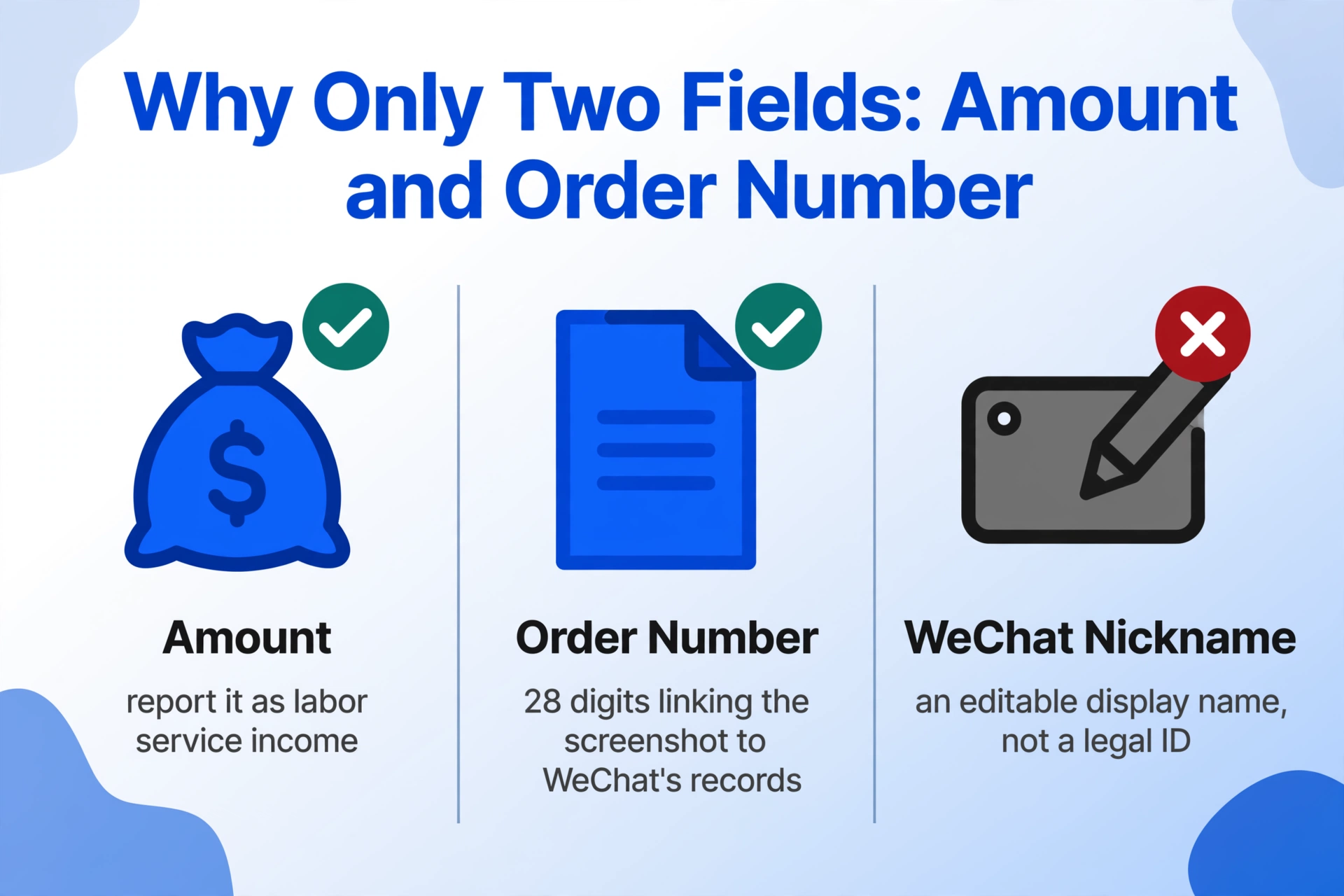
Of all the data visible on a WeChat Pay transaction detail screen — the merchant name (or sender's WeChat nickname), the timestamp, the payment method, the remark — only two fields carry real weight for tax reporting: the amount (收入金额) and the order number (交易单号). Everything else is either redundant or unusable for tax purposes.
The amount is simple — it's the income figure you report in your annual tax filing. Under China's personal service income rules: a single payment below ¥800 triggers no provisional withholding; between ¥800 and ¥4,000, you deduct ¥800 and pay 20% on the remainder; above ¥4,000, you deduct 20% and pay at progressive rates of 20%, 30%, or 40%. Each rate references the same number: the amount on the screenshot.
The order number (交易单号) is the field most freelancers overlook, yet the one that matters most if the tax bureau ever asks for proof. Every WeChat Pay transaction generates a unique 28-digit transaction ID, typically beginning with a date prefix like 4200002193. This number bridges your screenshot to WeChat's internal records. During an audit, the order number is what lets you locate that specific transaction and verify it happened. Without it, all you have is a screenshot — harder to authenticate.
The sender's WeChat nickname (微信昵称), by contrast, is nearly useless for tax purposes. It is an editable display name, not a legal identifier, not linked to a tax ID. Unlike a Venmo @username tied to a verified bank account, a WeChat nickname carries no evidentiary weight. Recording it adds nothing to your tax record.
This is where the extraction approach differs from the general WeChat Pay screenshot guide we've written. Our WeChat Pay transaction details article walks through where each field sits on the screen and how the interface differs between merchant payments, transfers, and red packets. Here, the focus is narrower: you need only two fields, and the reason is tax-specific. The same principle — that a screenshot can yield structured data despite not being a formal document — applies here, as our concept article on non-table extraction explains.
From Screenshot to Spreadsheet: A Tax-Ready Workflow
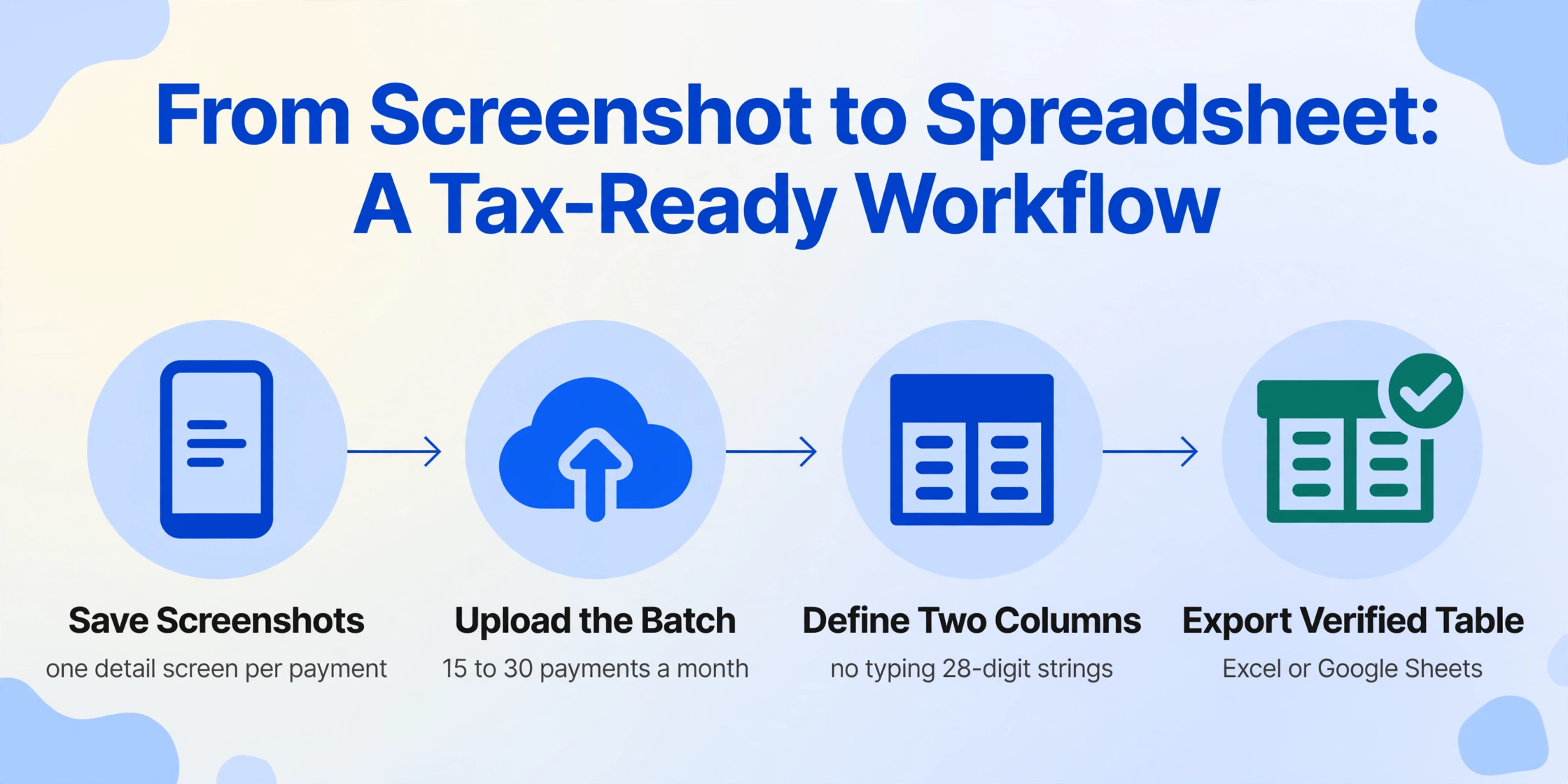
The workflow that makes sense for freelancers is different from one-off extraction. If you receive client payments through WeChat regularly, you're looking at 15 to 30 transactions a month — more if you take on multiple small projects. The value isn't extracting one amount. It's landing twenty or thirty in a batch, with consistent column headers, ready for tax preparation.
Here is the process: save your WeChat Pay transaction screenshots to a folder — one per payment, each showing the detail screen with the amount and order number visible. Upload them. Define two columns: Amount and Order Number. The AI processes the batch and returns a table where each row contains one transaction's amount and its order number. No typing 28-digit strings. No copy-pasting between apps. Export as Excel or keep in Google Sheets.
The order number extraction alone justifies the automated workflow. A 28-digit WeChat Pay transaction ID is the kind of string that is trivial to misread when flipping between a phone screen and a spreadsheet — one wrong digit breaks the audit trail. Automated extraction eliminates that risk because the AI reads the string directly from the image, exactly as it appears.
This approach — defining the columns you want and letting AI locate the values semantically — is Custom Column Extraction. You type the column names; the AI finds the data by understanding what each field means, not by looking for it at a fixed position. The same two columns work on any WeChat Pay screenshot variant. If you also receive payments on Alipay, the same Amount and Order Number columns pull from Alipay screenshots without reconfiguration. Many freelancers use personal accounting apps like 随手记 (Suishouji) or 挖财 (Wacai) to track their income; the extracted spreadsheet feeds directly into these tools or into an Excel file ready for tax season. The same freelancer-income problem applies across payment ecosystems — if you also receive payments via Venmo from international clients, the same extraction approach works for tracking Venmo income with the same column structure.
What the Annual Reconciliation Actually Looks Like
Once your WeChat Pay income is in a spreadsheet, the annual tax filing — which runs from March 1 to June 30 each year — becomes a data-entry exercise, not a hunt through your photo gallery. Open the official Individual Income Tax app (个人所得税 APP) from the State Taxation Administration (国家税务总局). Navigate to the comprehensive income declaration (综合所得年度汇算) section. Add your labor service income (劳务报酬) for the year.
Here is what the tax calculation structure looks like for a Chinese freelancer whose WeChat Pay income is ¥36,000 for the year, with no other comprehensive income:
| Step | Calculation | Amount (CNY) |
|---|---|---|
| Gross labor service income | Sum of all WeChat Pay client payments | 36,000 |
| Deductible expense (20%) | 36,000 × 20% | 7,200 |
| Taxable income from services | 36,000 − 7,200 | 28,800 |
| Standard basic deduction | Annual personal deduction (60,000) | N/A (covered by basic allowance) |
| Annual comprehensive taxable income | 28,800 − 60,000 (limited to 0) | 0 |
| Tax at 3% bracket | On first ¥36,000 of taxable income | 0 |
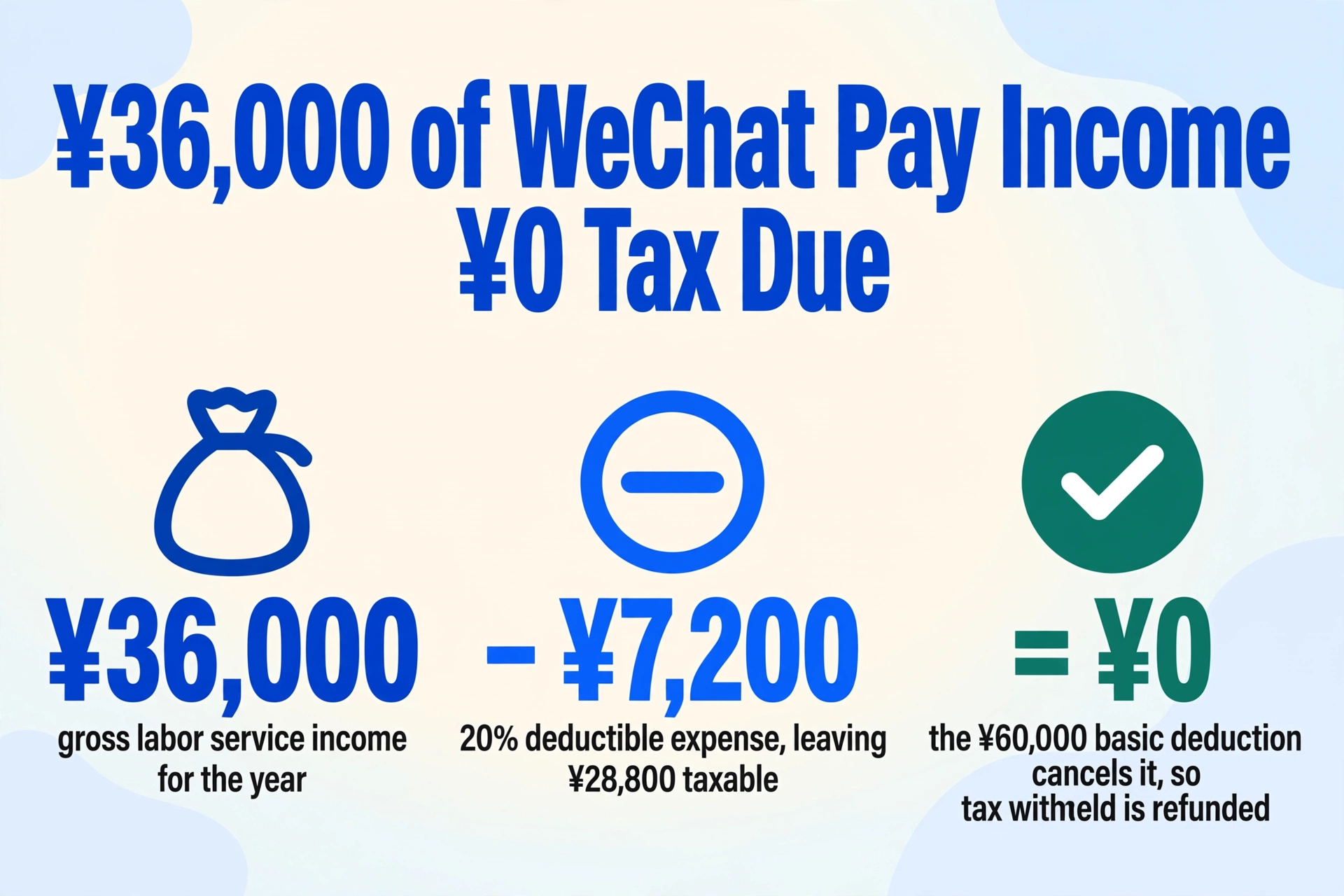
In this scenario, the freelancer would have had provisional tax withheld at source — 20% on taxable amounts over ¥800 per payment. But during annual reconciliation, because total taxable income falls below ¥60,000 (the standard basic deduction), any tax withheld during the year would be refunded. A clean spreadsheet with order numbers lets you quickly verify how much was withheld against each payment and whether the total qualifies you for a refund.
The reconciliation also lets you deduct specific additional deductions (专项附加扣除) — rent, mortgage interest, children's education, elderly care, continuing education, and medical expenses. Each reduces your taxable income, but none matter if the income side is incomplete. Your extracted spreadsheet is the foundation.
What about Golden Tax Phase IV? China's Golden Tax Phase IV (金税四期) system, fully operational since 2025-2026, uses big data to connect tax, banking, industry and commerce, and social security records. For freelancers, this means the tax bureau can see the total volume of digital payment flows through your accounts and flag significant discrepancies between reported income and visible fund flows. What it does not do is classify each WeChat Pay transfer as "taxable service income" versus "personal gift." That classification — and the reporting responsibility — remains yours. But under Golden Tax IV, leaving WeChat Pay income entirely unreported is riskier than it used to be, because the data trail is visible even if the bureau hasn't acted on it yet. The same tax compliance logic applies to small business owners (个体户) and side-hustlers who receive payments through WeChat — the extraction workflow and the two-field framework are platform-neutral.
FAQ
Does WeChat Pay report my personal transfers to the tax bureau?
No, not automatically. WeChat Pay does not send personal transfer data to the State Taxation Administration. However, under anti-money laundering regulations, banks and payment institutions report large or suspicious transactions to the People's Bank of China. Golden Tax Phase IV connects banking data with tax records, which means unusually large or frequent personal transfers can become visible during an audit. For routine client payments in the ¥200 to ¥5,000 range, the tax bureau relies on your self-reported income during annual reconciliation.
Can I just use WeChat Pay's built-in annual statement (年度账单) for tax filing?
Not reliably. The annual statement aggregates salary, friend transfers, red packets, and merchant payments. It does not separate labor service income (劳务报酬所得) from other inflows, provides no client-level breakdown, and does not export order numbers — the key audit trail field. A screenshot-to-spreadsheet workflow with Amount and Order Number columns gives you a tax-specific record that the annual statement cannot.
What if a client sends payment as a WeChat red packet (红包) instead of a transfer?
Red packets present a limitation. A red packet confirmation shows the amount and sender's name but no order number. The transaction has an internal ID in WeChat's system, but it is not shown on the consumer-facing confirmation screen. You can still extract the amount — the primary field for tax reporting — but you lose the audit trail. If you receive significant income via red packets, ask clients to send regular transfers instead, so the order number appears on the screenshot.