FERPA-Compliant
Student Data Extraction: A Guide for Admissions
Automated document extraction tools can convert a stack of enrollment forms into a spreadsheet in minutes — a fact that admissions directors already know. What fewer admissions teams have worked through is what FERPA requires at the exact moment a student document leaves the institution's control and enters a third-party AI processing pipeline. Here is what the Family Educational Rights and Privacy Act (20 U.S.C. § 1232g; 34 CFR Part 99) says about that moment — and the five compliance questions you should ask before processing a single file.
Key Takeaways
- The moment you upload a student enrollment form to any cloud extraction tool, you have made a FERPA disclosure under § 99.30 — before the AI reads a single character — and your institution's annual notification probably does not list external document processors as covered school officials.
- Clicking "I agree" on a vendor's terms of service does not satisfy FERPA's direct control requirement — the U.S. Department of Education's PTAC guidance states this explicitly — yet most admissions offices treat a SaaS privacy policy page as their compliance documentation.
- Compliance becomes verifiable with a signed institutional agreement covering five provisions — data ownership, redisclosure restrictions, deletion at contract end, breach notification, and audit rights — plus a written commitment that student documents are never used to train the provider's AI models.
What Makes a Student Document an "Education Record" Under FERPA
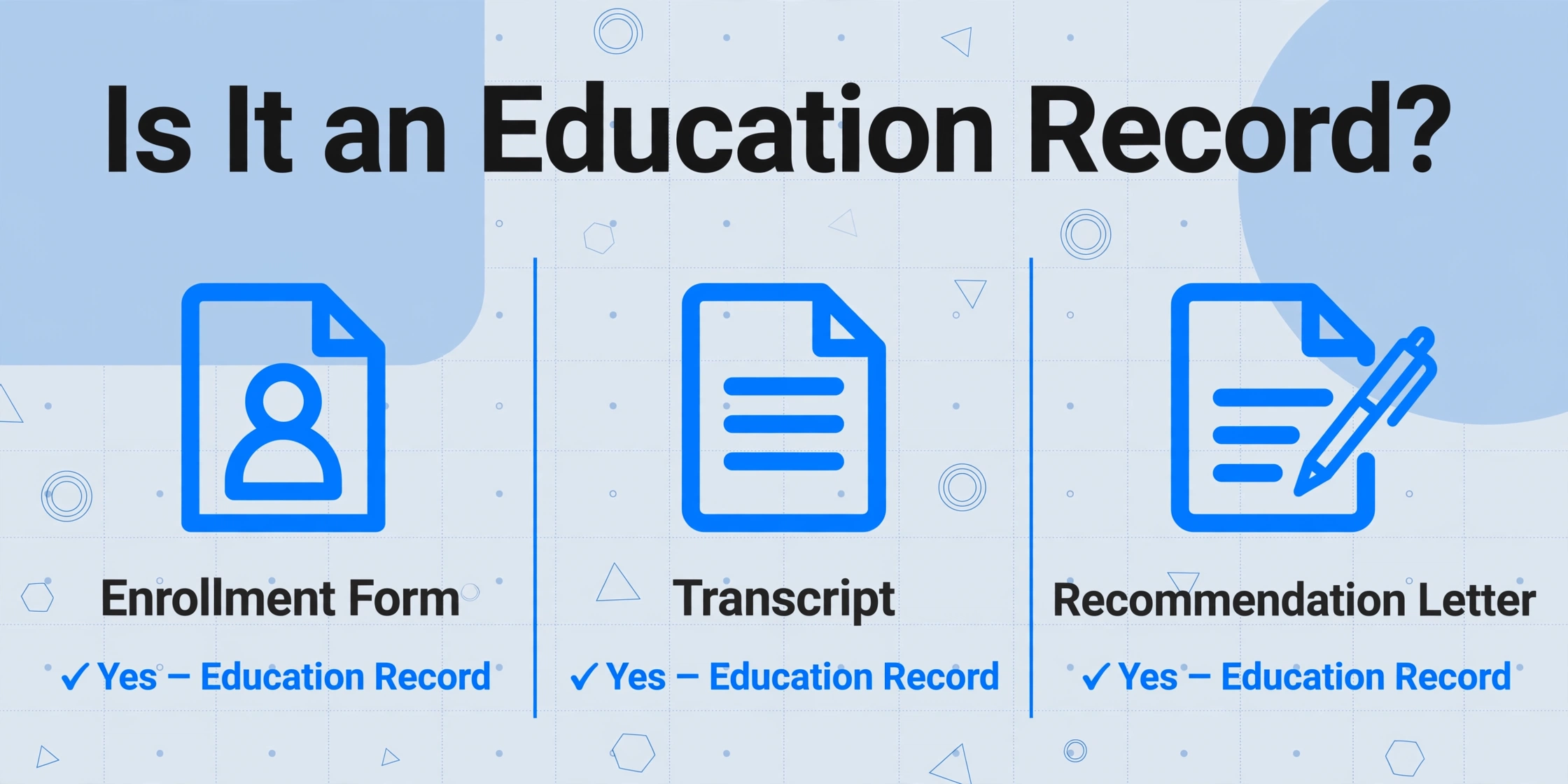
The starting point is not whether you intend to create a student record — it is whether the document you are processing already meets the FERPA definition. Under 34 CFR § 99.3, an education record is one that is (1) directly related to a student, and (2) maintained by an educational agency or institution — or by a party acting for the agency or institution. That final clause is what brings third-party document extraction tools into FERPA's scope.
A document satisfies "directly related" when it expressly identifies a student by name, ID number, or other identifier — or when a student's identity can be deduced from its content in combination with other reasonably available information. An enrollment form with a student's full legal name, date of birth, and address is clearly an education record the moment it becomes part of the institution's maintained records. A transcript is one. A teacher recommendation letter with a student's name on it is one.
What about an application form from a student who ends up not enrolling? FERPA's definition hinges on whether the record is maintained by the institution — not whether the student ultimately attends. If an admissions office scans and stores an applicant's file, those documents are education records under § 99.3 regardless of enrollment outcome. The same applies to deferred applications carried into the next admissions cycle.
If the document names a student and your office stores it — physically, on a server, or in a cloud application — it is almost certainly an education record under § 99.3. The format does not matter. The regulation explicitly covers "handwriting, print, computer media, videotape, audiotape, film, microfilm, and microfiche." A scanned PDF of a handwritten enrollment packet carries the same regulatory weight as the original paper.
Documents that are not education records include sole-possession notes kept by an individual and not shared, law enforcement unit records, employment records for student employees in their capacity as employees, and treatment records from a health professional (34 CFR § 99.3(b)). None of these exemptions apply to enrollment documents, transcripts, recommendation letters, or financial aid forms — the documents admissions offices handle every day.
For a broader view of how FERPA and other regulations shape document workflows across education, see the OCR for education guide, which covers FERPA alongside operational considerations for scanning and digitizing school records.
The Moment You Upload — Why Automated Extraction Is a "Disclosure"
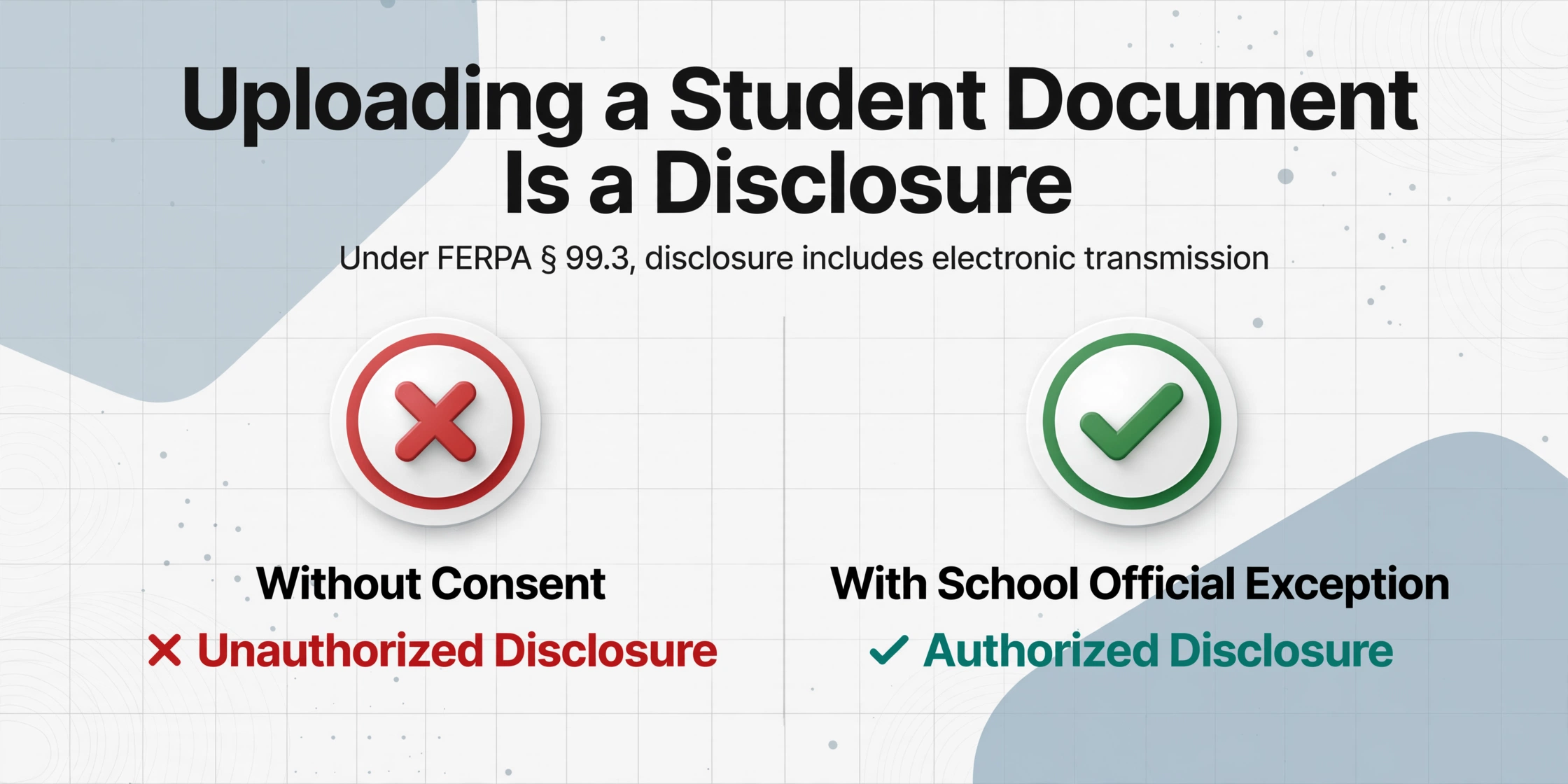
FERPA's core rule under § 99.30 is straightforward: an educational institution may not disclose personally identifiable information (PII) from a student's education record without the prior written consent of the parent or eligible student. The definition of disclosure under § 99.3 means "to permit access to or the release, transfer, or other communication of personally identifiable information contained in education records to any party, by any means, including oral, written, or electronic means."
Uploading a student document to a third-party AI extraction tool meets every element of this definition. The document is transmitted electronically from the institution to a provider. The provider's cloud infrastructure receives the file. The provider's AI model processes the content to extract data. Each of these steps is a disclosure under FERPA — not just the final one. The transmission, the storage, the inference — all are processing operations that require a lawful basis.
This is not a theoretical concern. A June 2021 discussion on r/k12sysadmin captured the practical problem precisely: a district wanted a file-sharing solution that met FERPA requirements for student data sent externally. The thread's central question — "is this provider acting under our control or independently?" — is exactly the question every admissions office must answer before uploading a single student document to any cloud tool.
So the disclosure itself is not illegal — but it is only legal if one of FERPA's exceptions applies. For document extraction, the exception that matters is the school official exception. Without it, that upload is an unauthorized disclosure — and an unauthorized disclosure of an education record is, by definition, a FERPA violation.
The compliance question is not whether automated extraction can be done legally — it is whether the specific provider you choose meets the school official exception criteria. The upload itself creates the disclosure obligation; the exception is what satisfies it.
The School Official Exception — Your Compliance Path Under § 99.31(a)(1)
Under 34 CFR § 99.31(a)(1)(i)(B), an outside contractor — including a cloud-based document extraction provider — may be considered a "school official" permitted to receive education records without prior student consent, provided that three conditions are met. Each condition is a compliance gate. If any one of the three fails, the exception does not apply — and the disclosure is unauthorized.
Performs an institutional service or function
The provider must perform "an institutional service or function for which the agency or institution would otherwise use employees" (§ 99.31(a)(1)(i)(B)(1)). For an admissions office, extracting structured data from enrollment forms — names, addresses, test scores, demographic fields — is a task that staff would otherwise perform manually. Automating that manual data entry meets this condition. A tool processing documents purely for the provider's own purposes (data collection, model training, market research) does not.
Is under the direct control of the institution
The provider must be "under the direct control of the agency or institution with respect to the use and maintenance of education records" (§ 99.31(a)(1)(i)(B)(2)). The U.S. Department of Education's PTAC guidance on Cloud Computing under FERPA (revised July 2015) clarifies that direct control is established through a written contract — and that clicking through a vendor's online terms of service does not meet this requirement. The contract must impose specific restrictions on how the provider uses and maintains the education records disclosed to it.
Is subject to redisclosure restrictions under § 99.33(a)
The provider must be "subject to the requirements of § 99.33(a) governing the use and redisclosure of personally identifiable information from education records" (§ 99.31(a)(1)(i)(B)(3)). Section 99.33(a) states that the receiving party "may not disclose the information to any other party without the prior written consent of the parent or eligible student" — unless the redisclosure is itself permitted under a FERPA exception and the receiving party is acting on behalf of the educational institution. This means: your provider cannot share extracted student data with a sub-processor or analytics partner unless the contract explicitly authorizes it and the sub-processor is bound by the same restrictions.
The PTAC's February 2014 guidance document "Protecting Student Privacy While Using Online Educational Services" adds that schools should use written agreements even when FERPA may not strictly require them — and that the contract should specify data ownership (the school, not the provider), the purpose of processing, and the return or destruction of data at contract end. A model Terms of Service document published by PTAC in March 2016 provides specific contract language for each of these provisions.
One operational note: the institution, not the provider, determines who qualifies as a school official. Under § 99.7(a)(3)(iii), the institution's annual FERPA notification to students must specify the criteria for determining who constitutes a school official and what constitutes a legitimate educational interest. If your institution's notification does not contemplate external document processing providers as school officials, update the notification before you upload.
Directory Information vs. Full Education Records — Why the Exception Does Not Cover Enrollment Forms
Some admissions teams ask: can we treat the data on an enrollment form as directory information, bypassing the school official exception entirely? The answer hinges on what FERPA actually defines as directory information — and what it does not.
Under 34 CFR § 99.3, directory information is "information contained in an education record of a student that would not generally be considered harmful or an invasion of privacy if disclosed." It can include the student's name, address, telephone listing, email address, photograph, date and place of birth, major field of study, grade level, enrollment status, dates of attendance, participation in recognized activities, degrees and awards, and the most recent educational institution attended. Under § 99.31(a)(11) and § 99.37, directory information may be disclosed without consent — provided the institution has notified parents and eligible students of the categories designated and given them the opportunity to opt out.
So a student's name and address, standing alone, could be released as directory information. But an enrollment form containing those fields plus the student's Social Security number, date of birth, medical information, disciplinary history, test scores, language spoken at home, free or reduced lunch eligibility, or immigration status — any of those additional fields fall outside the directory information definition. An enrollment form is not a collection of independent data points that can be separated into "directory" and "non-directory" buckets when uploaded to an extraction tool. The document as a whole contains protected fields, and the disclosure of the document as a whole triggers FERPA — regardless of which fields you intend to extract.
Furthermore, FERPA specifically excludes a student's Social Security number and certain student ID numbers from the directory information definition (§ 99.3, paragraph (c) of the definition). If your enrollment forms collect SSNs — as many do for financial aid verification — the directory information exception cannot apply to the form as a whole. The school official exception remains the correct path even when you are only extracting a subset of fields, as student enrollment form extraction typically does — targeting specific columns like name, address, and emergency contacts while ignoring fields not needed for the SIS import. Those identifiers also appear on student ID cards, so card-scanning workflows fall under the same review.
What the Contract Must Include — Building "Direct Control" on Paper
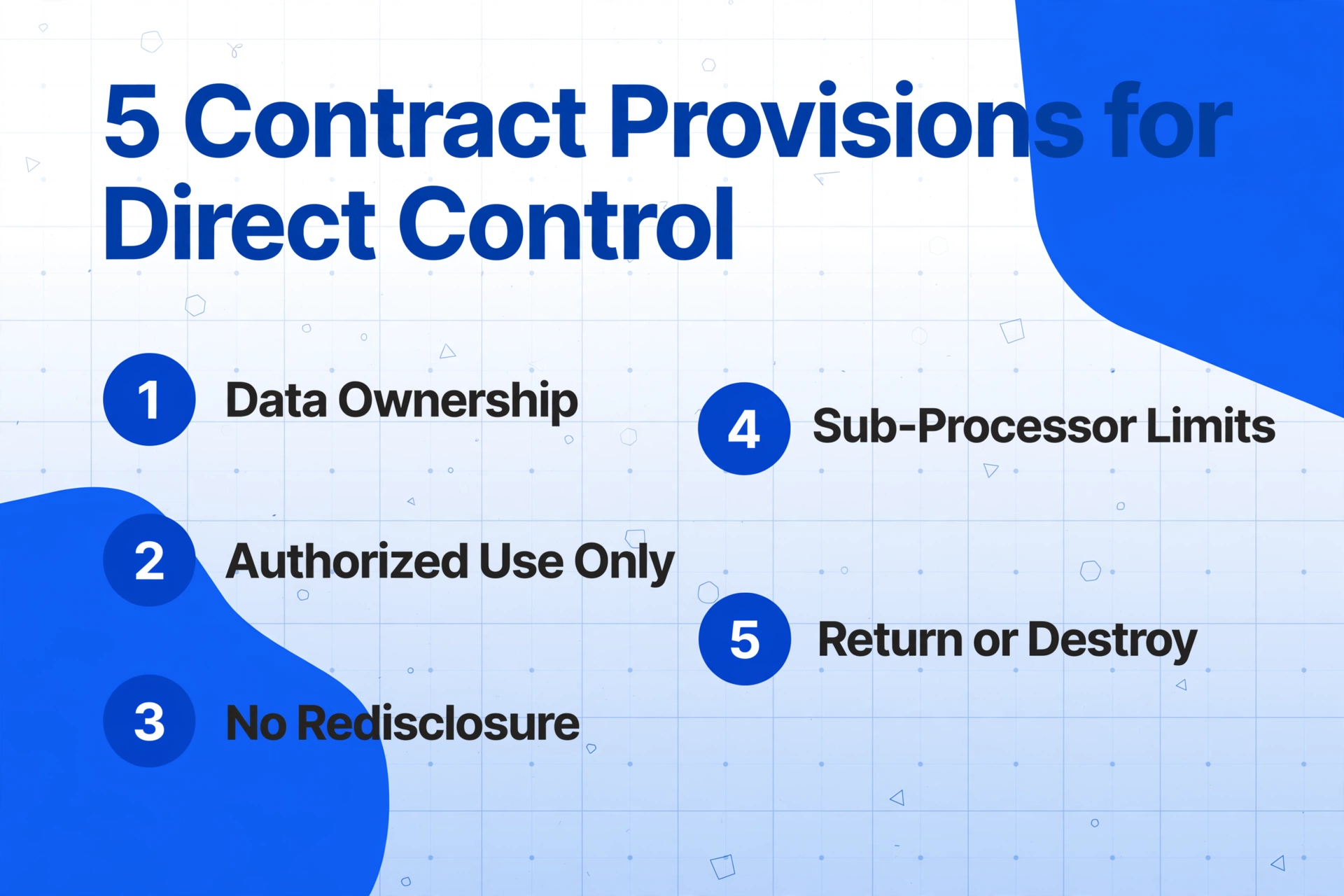
The school official exception requires the provider to be "under the direct control" of the institution. Since an independent company is not under an institution's organizational hierarchy, the only mechanism for establishing direct control is a written contract. Here is what PTAC guidance and institutional best practices say that contract should address.
Data ownership and authorized use
Specify that the institution — not the provider — owns all uploaded documents and extracted data. Limit the provider's use of the data to the specific purpose of performing the extraction service. Prohibit any secondary use, including model training, data aggregation, or product improvement, unless separately authorized in writing.
Redisclosure and sub-processor restrictions
Under § 99.33(a), the provider may not redisclose data to other parties without the institution's authorization. If the provider uses sub-processors (cloud hosting, AI inference APIs, analytics services), the contract must require each sub-processor to be bound by the same FERPA restrictions. Maintain a published list of sub-processors and require notification before any addition.
Data return or destruction at contract end
PTAC's Model Terms of Service recommends a provision requiring the provider to return or destroy all education records at termination. If immediate destruction is not technically feasible due to backup cycles, specify a maximum retention window (30-90 days) and a written certification of destruction upon completion.
Security measures and breach notification
Require encryption in transit (TLS 1.2 minimum) and at rest, access controls, audit logging, and independently verified security certifications (SOC 2 Type II or equivalent). Specify breach notification timelines — PTAC recommends immediate notification upon confirmed breach, not upon completion of investigation — and define each party's responsibilities for notification to affected individuals and regulatory bodies.
Audit rights
Include the right to verify compliance through independent audit reports, security questionnaires, or — for institutional contracts — on-site assessment. Practically, most providers satisfy this through SOC 2 Type II reports and ISO 27001 certificates rather than individual customer audits. Confirm those reports are current and cover the document processing function specifically.
One structural point worth underlining: clicking through a provider's standard terms of service on a website does not satisfy the contract requirement. TOS agreements are typically presented on a take-it-or-leave-it basis and rarely contain the specific data-handling restrictions FERPA requires. A dedicated institutional agreement — whether a standalone contract, a Data Processing Agreement, or a purchase order with FERPA-specific terms appended — is the standard of practice for compliance-conscious institutions. This is the same framework that applies in comparably regulated industries — the legal document extraction guide covers analogous third-party data-handling agreements in the law firm context, where client confidentiality creates parallel control requirements.
Data Retention, Deletion, and the Model Training Question
Three operational questions surface in every admissions office discussion of automated extraction: how long does the provider keep our documents? Can we get them deleted when we are done? And — the question that separates compliant tools from non-compliant ones — will student documents be used to train the provider's AI?
Retention: Minutes, Not Months
FERPA does not specify a maximum retention period for data held by a school official. But the PTAC's Model Terms of Service guidance recommends that providers return or destroy education records at contract end — and, as a best practice, that they retain data only for the duration necessary to perform the contracted service. For document extraction, the contracted service is typically complete within minutes of the file being uploaded and processed. A provider that retains uploaded documents for days, weeks, or indefinitely after extraction is no longer holding data for the authorized purpose — and that gap between processing completion and deletion is where compliance risk accumulates.
Architecture matters here. A tool designed for transient processing — documents uploaded, AI extracts the data, results returned, originals deleted within a defined window — satisfies the retention principle at the system level. A tool that caches documents indefinitely, retains them in inference pipelines for future runs, or stores them for analytics or product improvement creates a corresponding obligation to document and justify that retention. The shorter and more clearly defined the retention window, the less regulatory surface area exists.
Deletion: Get It in Writing
Under the FERPA regulations, an institution does not lose its compliance standing simply because a provider holds data. But when a parent or eligible student exercises the right to request deletion, or when the contract ends, the provider must be able to execute. Request a written confirmation of deletion — not a generic statement, but a specific acknowledgment covering your uploaded files. Record that confirmation in your compliance documentation. If the provider cannot produce it on demand, the direct control requirement under § 99.31(a)(1)(i)(B)(2) is in question.
Model Training: The Hard Line
This is the question where ambiguity is not acceptable. If your extraction provider uses uploaded student documents to train its AI models, that constitutes a use beyond the authorized processing purpose. The PTAC guidance specifically warns against providers using student data for "product improvement" or "data mining" unless explicitly authorized. Using a student's enrollment form to improve an AI model is not the institutional function for which the data was disclosed — it is a secondary use that requires separate authorization.
Ask the provider directly: do you use documents uploaded by my institution to train, fine-tune, or improve your AI models? If the answer is yes — or ambiguous — the school official exception does not cover that use. Get a written commitment. The defensible answer from a FERPA compliance standpoint is a clear no.
Some providers offer dedicated infrastructure or zero-retention processing specifically to avoid this issue. The compliance advantage is structural: if the tool processes transiently and never retains documents past the extraction window, model training on your data is architecturally impossible, not just contractually prohibited. That is a stronger position than a contractual promise alone — and auditors and compliance officers recognize the difference. For a broader treatment of how extraction tools handle documents in highly regulated environments, the OCR for education guide addresses data-handling architectures across different institutional workflows.
What This Means for Admissions Files Already in Your SIS
Many admissions offices process three categories of documents: incoming applications, verified enrollment packets, and records already stored in the student information system. The FERPA analysis differs subtly across these categories — and the distinction matters for the contract you negotiate with an extraction provider.
Incoming applications. Documents that arrive from outside — Common App submissions, mailed transcripts, emailed recommendation letters — become education records the moment the institution "maintains" them. If an admissions office scans a mailed transcript and saves it before processing, that scanning action creates an education record. If the office uploads it directly to an extraction tool without first creating an internal copy, the transmission to the extraction provider is the first act of maintenance — and simultaneously a disclosure requiring the school official exception.
Verified enrollment files. Documents that have already been validated and entered into the SIS (PowerSchool, Infinite Campus, Skyward, Banner) are unquestionably education records. Extracting additional fields from these documents — supplementing the SIS record with new data — is a processing operation that requires the same school official exception. The tool is performing a function the institution would otherwise perform using its own staff.
Records already in the SIS. Exporting student data from the SIS and feeding it into an extraction tool for enrichment, deduplication, or cross-referencing is a disclosure from the SIS to the extraction provider. The SIS export is the source; the extraction tool is the recipient. The chain of custody matters. Document it — which records were exported, to which provider, for what purpose, under which contractual authority.
This data flow — from paper to extraction tool to SIS — is not unique to education. Property management firms face the same chain-of-custody questions when digitizing lease agreements, as covered in the guide to lease agreement extraction at scale. The regulatory framework is different (property law vs. FERPA), but the operational pattern — paper-in, contract control, structured-data-out — mirrors the admissions office workflow.
Practical FERPA Compliance Checklist for Automated Document Processing
Each step below maps to a specific regulatory reference, so you can document compliance before you upload a single file.
Classify the documents in your workflow
Map each document type your admissions office handles against the § 99.3 education record definition. Enrollment forms? Yes. Transcripts? Yes. Recommendation letters? Yes. Test score reports? Yes. Files from applicants who do not enroll? Yes — if you maintain them. The default assumption should be that any document with a student's name that passes through your office is an education record.
Verify the provider qualifies as a school official
Confirm the three § 99.31(a)(1)(i)(B) conditions are met: (1) the provider performs document extraction — a function your staff would otherwise do manually; (2) a written contract establishes direct control over data use and maintenance; (3) the contract binds the provider to § 99.33(a) redisclosure restrictions. Update your annual FERPA notification (§ 99.7) to reflect external document processing as a school official function if it is not already included.
Execute a written agreement covering the five contract provisions
Ensure the contract specifies: data ownership (yours), authorized use (extraction only — no model training), sub-processor restrictions and transparency, data return or destruction at contract end with written confirmation, security measures (TLS 1.2, encryption at rest, access controls, audit certifications), and breach notification timelines.
Confirm no model training on student data
Request written confirmation that uploaded student documents are not used to train, fine-tune, or improve the provider's AI models. If the provider's default terms include model training rights, negotiate a carve-out for your institution's data. The structural alternative — transient processing where documents are never retained — eliminates the question at the architecture level.
Establish a data retention and deletion schedule
Define how long the provider retains uploaded documents (measured in minutes or hours, not days or months) and how long you retain the extracted data. Align both with your institution's records retention policy. Schedule periodic deletion confirmations from the provider and document them in your compliance file.
Document the disclosure record for each batch
Under § 99.32(a), the institution must maintain a record of each disclosure — identifying the parties who received the information and the legitimate interest that justified the disclosure. For document extraction, log each batch: which documents were processed, by which provider, on what date, under which contractual authority. If a parent or eligible student requests their disclosure history, these records satisfy § 99.32(a)(2).
Maintain a compliance file and review annually
Keep a single compliance folder containing: the signed contract or DPA with the extraction provider, the provider's current SOC 2 Type II or equivalent certification, the written confirmation that student data is not used for model training, the most recent deletion confirmation, disclosure logs by batch, and a copy of your updated annual FERPA notification showing external document processing as a covered school official function. Review the full file annually — certifications expire, sub-processor lists change, contracts need renewal.
Frequently Asked Questions
Can I extract only directory information fields and avoid triggering FERPA entirely?
In theory, yes — if the document contains only directory information fields. In practice, most admissions documents — enrollment forms, transcripts, recommendation letters — contain at least one non-directory field (date of birth alongside name and address, SSN on a financial aid form, test scores on a transcript). The document as a whole is disclosed when uploaded, not the individual fields. If any field in the document falls outside the directory information definition, the disclosure triggers FERPA protections. For practical purposes, assume every admissions document requires the school official exception. The directory information exception is rarely sufficient for extraction workflows.
What if my extraction provider offers a click-through terms of service instead of a signed contract?
Click-through terms do not satisfy the direct control requirement under § 99.31(a)(1)(i)(B)(2) for two reasons. First, they are typically non-negotiable — the institution cannot impose the specific restrictions FERPA requires. Second, the PTAC guidance specifically distinguishes between a negotiated contract and a provider's standard terms, recommending the former. If your provider cannot offer a signed institutional agreement with FERPA-specific data-handling provisions, the compliance gap is structural, not contractual.
Are admissions counselor notes on an application an education record?
Not if they qualify as sole-possession records under § 99.3(b)(1) — records kept in the sole possession of the maker, used only as a personal memory aid, and not accessible or revealed to any other person except a temporary substitute. But the moment those notes are shared with an admissions committee, entered into a shared system, or disclosed to an external tool, they lose sole-possession status and become education records. Admissions offices that use extraction tools to digitize counselor notes should treat the digitized versions as education records and apply the school official exception.
What happens to our student data if we switch extraction providers?
The outgoing provider must return or destroy all education records under the termination provision of your contract. Request a documented export of extracted data you need, then a written confirmation of deletion. Keep the confirmation. If the outgoing provider used a sub-processor for AI inference, confirm that the sub-processor's copies are also deleted. This is a contract enforcement exercise, not a FERPA compliance question — but the institution that disclosed the records remains responsible for ensuring proper handling even after the relationship ends.
What are the penalties for using a non-compliant extraction tool?
FERPA does not impose direct monetary fines on institutions. The enforcement mechanism is the loss of federal funding from the U.S. Department of Education — for institutions that receive Title IV funds, this is an existential consequence. The Department's Student Privacy Policy Office (SPPO) investigates complaints and can require corrective action. Beyond the regulatory mechanism, an unauthorized disclosure of student education records carries reputational risk, potential state-law liability (many states have their own student data privacy laws with separate penalties), and the operational burden of mandatory breach notification. For a non-compliant extraction tool, the most likely enforcement path is a complaint from a parent or eligible student triggering an SPPO investigation — and the question the investigator will ask first is whether the school official exception was properly applied.
Do state student data privacy laws add requirements beyond FERPA?
Yes — and the variation is significant. California's AB 1584 requires nine specific contract clauses for every agreement between a school and a technology vendor, including data ownership, advertising restrictions, and deletion requirements. More than 20 states have passed SOPIPA-style laws restricting how educational technology providers may use student data. New York's Education Law § 2-d imposes breach notification timelines and data security requirements beyond FERPA's baseline. If your institution is in California, New York, Illinois, Colorado, Connecticut, or any of the states with comprehensive student data privacy laws, your provider contract must satisfy both FERPA and state law. FERPA compliance is the floor, not the ceiling.
Can a parent access the data our extraction tool produced about their child?
Yes. Under 20 U.S.C. § 1232g(a)(1)(A) and 34 CFR § 99.10, parents and eligible students have the right to inspect and review education records. Extracted data from an enrollment form or transcript is part of the student's education record — the parent has the same access right to the structured spreadsheet data as they do to the original paper form. Your extraction workflow should preserve the ability to produce a complete record upon request. If extracted data is merged into the SIS, the SIS remains the authoritative source for parent access requests.
FERPA compliance for automated document extraction is not about whether the technology can be compliant — it is about whether your provider has established the right contractual, architectural, and operational framework before you process a single student document. Section 99.3 defines what qualifies as an education record. Section 99.31(a)(1) provides the school official exception — the legal pathway that makes automated extraction possible without student-by-student consent. Section 99.33(a) restricts what your provider can do with the data after receiving it. The PTAC guidance fills in the operational details: a written contract, not a click-through; a defined retention schedule, not indefinite storage; a clear prohibition on model training, not an ambiguous privacy policy. Every one of these is verifiable before you upload the first file — and the answer to the compliance question should be documented, not assumed.
This article provides general regulatory guidance and does not constitute legal advice. Consult your institution's compliance officer, general counsel, or a qualified education law attorney for determinations specific to your workflows and jurisdiction.
Evaluate Your Compliance SetupFree to try with no sign-up. Documents processed transiently and not retained. Ask about an institutional agreement.