Document Extraction Cost per Page vs per Month
What You'll Actually Pay
The advertised per-page cost of AI document extraction ranges from $0.015 (AWS Textract basic OCR) to $0.50+ (Nanonets enterprise extraction) — but those numbers compare different things. A "page" on AWS Textract is a physical sheet. A "page" on Docparser is a credit that covers up to 5 physical pages. A "page" on Google Document AI depends on which processor you use and whether you're using a specialized invoice parser or a general-purpose form parser. The number on the pricing page is not the number you will pay.
Key Takeaways
- A three-page invoice costs $0.045 on one extraction tool and $0.39 on another — the advertised per-page rates are nearly identical between them, but each tool defines "page" as a completely different unit of measurement.
- At 1,000 documents per month the real cost difference between tools is nearly 11x — and none of the pricing pages show you the hidden costs that drive it, from stacked API features and expiring allowances to infrastructure overhead that can double your effective rate.
- Model your own monthly volume before comparing tools — a per-image pricing plan charges the same $0.06 whether your file has one page or ten, breaking the assumption that more pages must mean more cost and changing the math for multi-page document workflows entirely.
The "Page" Definition Trap
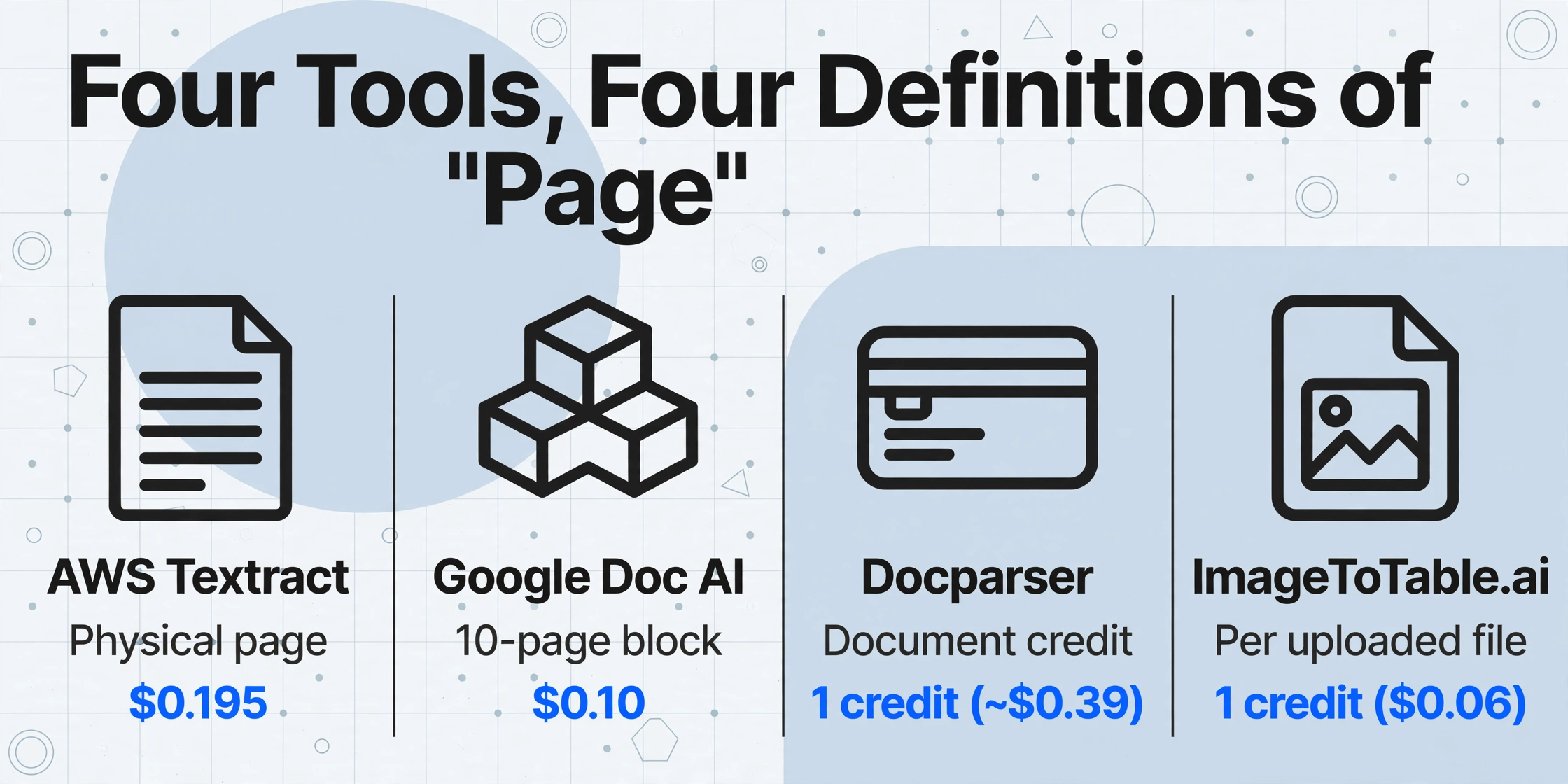
The single most misleading number in document extraction pricing is the per-page rate — not because it's wrong, but because the unit it measures is different in every tool.
A three-page invoice illustrates the problem perfectly. On AWS Textract's AnalyzeDocument API, that invoice costs $0.015 × 3 = $0.045 (for basic forms). On Docparser's Starter plan at $39/month for 100 credits, one credit covers up to five physical pages — so the same three-page invoice costs one credit, or roughly $0.39 at the entry plan rate. On ImageToTable.ai, one credit equals one image regardless of page count within a single uploaded file — a three-page PDF upload costs one credit, or $0.06 on the Basic plan. On Google Document AI's Invoice Parser, you pay $0.10 for every 10 pages — the first 10 pages of any document cost $0.10 whether the document is 1 page or 10.
You are comparing four different definitions of "page" — a physical sheet, a processing credit, a per-document charge, and a tiered processing block — and treating the resulting numbers as equivalent. They are not.
| Tool | What "Page" Means | 3-Page Invoice Cost | 1-Page Receipt Cost | 10-Page Contract Cost |
|---|---|---|---|---|
| AWS Textract (Form + Table) | Physical page | $0.195 | $0.065 | $0.65 |
| Google Document AI (Form Parser) | Physical page | $0.09 | $0.03 | $0.30 |
| Google Document AI (Invoice Parser) | 10-page processing block | $0.10 | $0.10 | $0.10 |
| Docparser (1 credit = up to 5 pages) | Document credit | 1 credit (~$0.39) | 1 credit (~$0.39) | 2 credits (~$0.78) |
| Parseur | Physical page | 3 pages (~$0.39) | 1 page (~$0.39) | 10 pages (~$0.99) |
| ImageToTable.ai (1 credit = 1 image) | Uploaded file | 1 credit ($0.06) | 1 credit ($0.06) | 1 credit ($0.06) |
A single three-page invoice costs between $0.045 (AWS basic OCR) and $0.39 (Docparser entry plan) depending on which definition of "page" the tool uses. The ratio between cheapest and most expensive is nearly 9x — and all the advertised per-page rates are in the same stated range of $0.015 to $0.06. The definition difference, not the rate difference, drives the real cost.
How Per-Page API Pricing Actually Works
Per-page API pricing is the model used by cloud infrastructure providers. You pay for each page processed, with volume tiers that lower the rate as you scale. It is predictable at the unit level and unpredictable at the monthly level because your volume determines your bill with no cap.
AWS Textract charges per physical page with rates that vary by feature combination. Basic text detection runs $1.50 per 1,000 pages ($0.0015/page). Adding form and table extraction brings the rate to $65 per 1,000 pages ($0.065/page) for the first million pages per month. If you combine forms, tables, and custom queries, the rate reaches $80 per 1,000 pages ($0.08/page). The model is additive — calling DetectDocumentText and AnalyzeDocument on the same page means paying for both operations.
Google Document AI uses a similar per-page model but adds processor-specific pricing. The Form Parser costs $30 per 1,000 pages ($0.03/page) for the first million pages. Its specialized processors use different units: the Invoice Parser charges $0.10 for every 10 pages ($0.01/page effective), while the Bank Statement Parser charges $0.75 per classified document regardless of length. Google's model creates a situation where two documents of the same length can cost different amounts depending on which processor handles them.
The appeal of API per-page pricing is straightforward: you pay only for what you use. There is no monthly minimum, no commitment, and no unused credit to expire. The trade-off is that the per-page rate does not decrease meaningfully until you reach very high volumes (one million+ pages per month for AWS tier breaks), and the infrastructure to integrate and maintain an API pipeline adds costs that do not show up on the pricing page — developer time, storage for document staging, and ongoing maintenance as API versions evolve.
For an in-depth comparison of API-based tools versus template-free alternatives, see our guide to zero-training document extraction tools.
How Subscription and Credit-Based Pricing Works
Subscription pricing bundles a fixed number of processing units — pages, documents, or credits — into a monthly fee. The headline number is higher than a per-page rate, but the effective cost per unit drops as you move up tiers.
Docparser uses a credit system where one credit covers up to five physical pages within a single document. The Starter plan costs $39/month for 100 credits. A single-page invoice costs one credit ($0.39). A five-page purchase order also costs one credit ($0.39). A six-page contract costs two credits ($0.78). The credit model benefits documents with more pages because the per-physical-page cost drops as document length increases, but it penalizes very short documents — you pay the same credit for a one-page receipt and a five-page contract.
Parseur uses straightforward per-page pricing within a subscription: $39/month for 100 pages across their entry plan, dropping to $99/month for 1,000 pages on the Pro plan ($0.10/page) and $399/month for 10,000 pages on the Scale plan ($0.04/page). Each page is a physical page with no bundling — a three-page invoice costs three pages of your allowance. The model is simpler but less forgiving for multi-page documents.
ImageToTable.ai uses a per-image (per-uploaded-file) credit model. One credit processes one uploaded image or PDF regardless of the number of pages within it. The Basic plan at $9/month includes 150 credits ($0.06/credit). The Pro plan at $29/month includes 500 credits ($0.058/credit). The Max plan at $59/month includes 1,500 credits ($0.039/credit). A pay-as-you-go option also exists at $0.06/credit with no expiration. For a user processing a mix of single-page and multi-page documents, the per-image model consistently undercuts per-page models because multi-page documents do not cost extra.
The key structural difference between API per-page pricing and subscription pricing is not the listed rate — it is who absorbs the volatility risk. Per-page API pricing passes volume swings directly to your bill. Subscription pricing caps your maximum at the plan allowance and charges overage if you exceed it. Which one wins depends entirely on how steady your volume is from month to month.
Real Cost Comparison: 100, 500, and 1,000 Documents Per Month
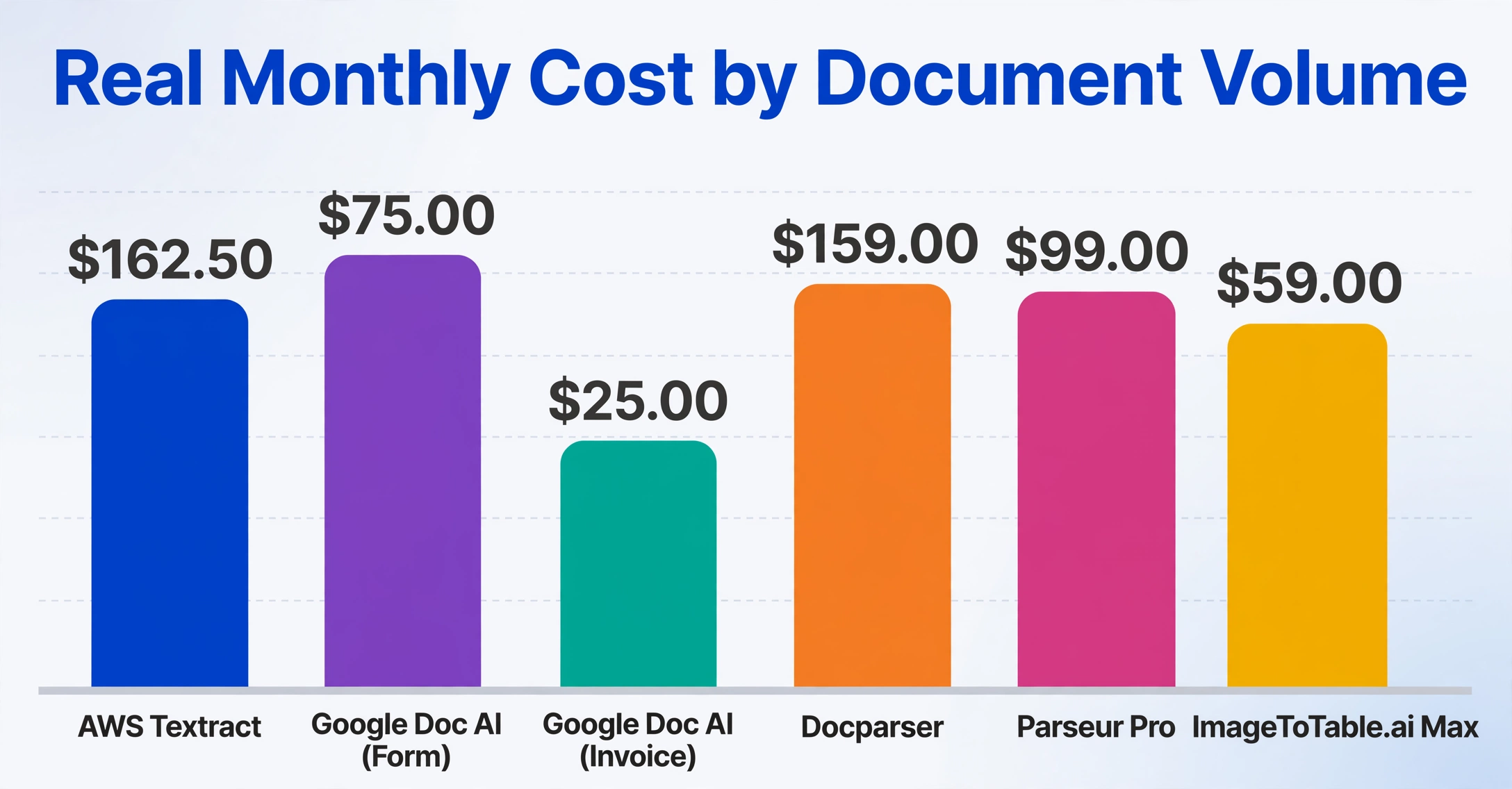
The only way to compare per-page and per-month pricing fairly is to model the same workload across both models. Below is the real monthly cost for three common document volumes — assuming an average of 2.5 physical pages per document (the typical range for invoices, purchase orders, and bank statements).
| Tool | Pricing Model | 100 Docs (250 pages) | 500 Docs (1,250 pages) | 1,000 Docs (2,500 pages) |
|---|---|---|---|---|
| AWS Textract (Forms + Tables) | Per-page API | $16.25 | $81.25 | $162.50 |
| Google Doc AI (Form Parser) | Per-page API | $7.50 | $37.50 | $75.00 |
| Google Doc AI (Invoice Parser) | Per-block API | $2.50 | $12.50 | $25.00 |
| Docparser Business | Subscription (100 credits) | $159.00* | $318.00* | $636.00* |
| Parseur Pro | Subscription (1,000 pages) | $99.00** | $99.00 | $198.00** |
| ImageToTable.ai Max | Subscription (1,500 credits) | $59.00 | $59.00 | $59.00 |
| ImageToTable.ai PAYG | Prepaid credits | $6.00 | $30.00 | $60.00 |
* Docparser: 2.5 pages per doc on average means 100 docs = 100 credits on Starter plan (covers up to 500 physical pages, but only 100 credits included). At 250 physical pages you need to upgrade to a higher plan. ** Parseur: Pro plan includes 1,000 pages — 1,250 pages at 500 docs triggers overage.
The table reveals a pattern that the per-page rate does not show: the model shape matters more than the per-unit price. Google Document AI's Invoice Parser at $0.01/page effective rate looks like the cheapest option on paper, but only if you are processing invoices — switch to bank statement extraction and the rate jumps to $0.75 per document. Docparser's $0.39/credit is not directly comparable to anyone else's per-page rate because one credit buys up to five physical pages. ImageToTable.ai's per-image credit means a batch of 1,000 multi-page documents costs the same $59 as 1,000 single-page receipts, while on a per-page model the same batch would cost 2.5× more.
At 1,000 documents per month, the spread between the cheapest and most expensive option in this table is nearly 11x — and none of the advertised per-page rates would have told you that.
The Breakeven Analysis: When Does Each Model Win?
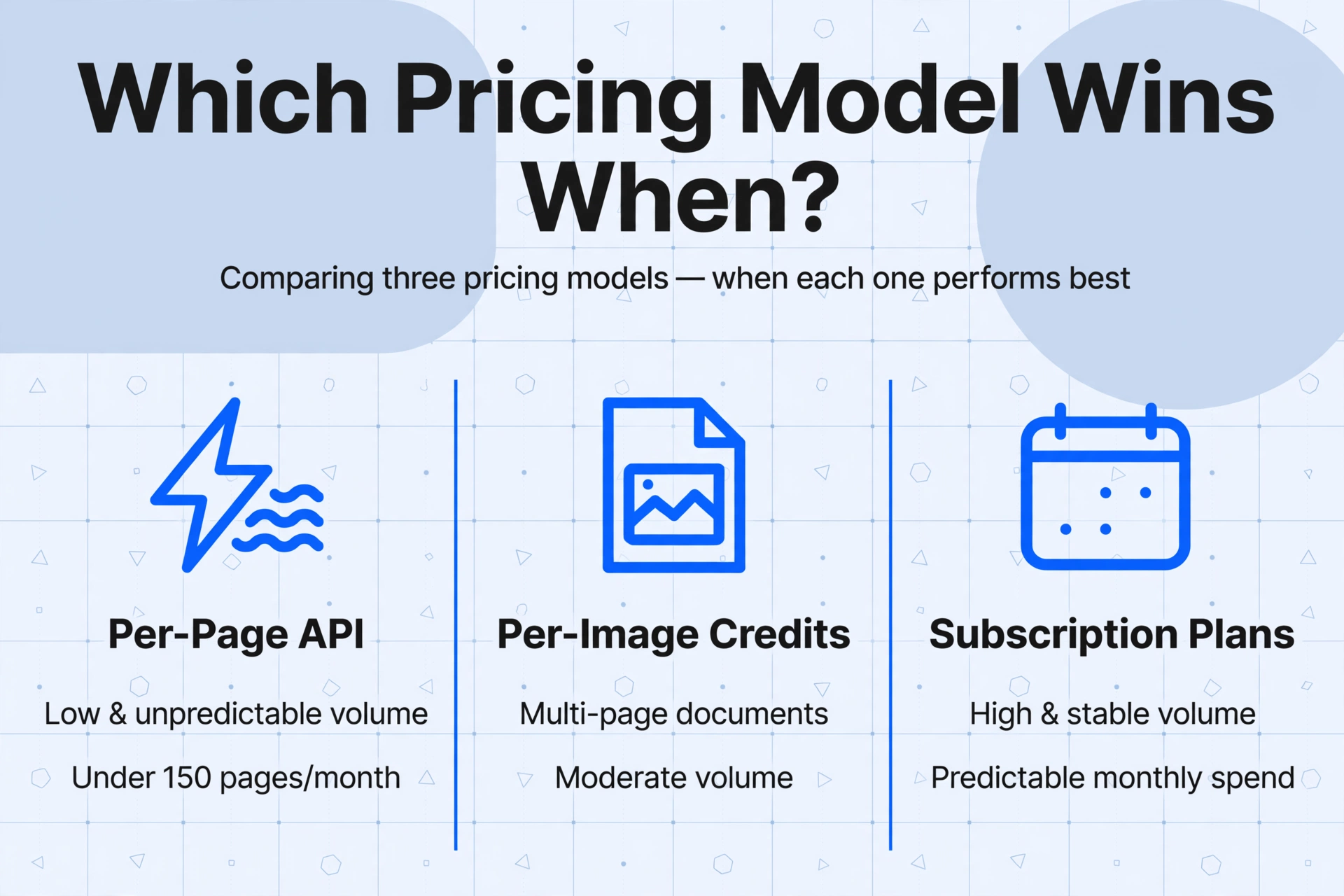
The right pricing model is a function of three variables: document volume, document length, and volume stability. Here is where the breakeven points fall for each model type.
Per-page API wins when: volume is low and unpredictable — under 150 physical pages per month with significant month-to-month swings. At this level, a subscription's unused allowance is a direct loss. AWS Textract or Google Document AI on basic OCR can cost as little as $0.05–$0.22 per document at 100 single-page docs, while the cheapest subscription plan with any meaningful extraction capability starts at $9/month. The breakeven with a subscription happens around 150–200 physical pages per month, where the monthly fee and the per-page cost converge. Below that, you are paying for capacity you do not fill.
Per-image credit plans (like ImageToTable.ai) win when: documents are multi-page and volume is moderate. A per-page model penalizes every additional page. A per-image model treats a 10-page contract the same as a single-page invoice. For organizations processing a mix of short and long documents — invoices, contracts, purchase orders, bank statements — a per-image credit plan consistently produces a lower effective rate than any per-page model. The breakeven against per-page API pricing on multi-page documents happens at the very first multi-page upload: a three-page invoice costs $0.06 on ImageToTable and $0.195 on AWS Textract's forms model.
Subscription pricing wins when: volume is high and stable — 500+ pages every month without fail. At this level, the per-unit rate drops to its lowest point and the unused-allowance risk is negligible because you use most of what you pay for. The key condition is stability: if your volume fluctuates by more than 30% month over month, a subscription for the peak volume means overpaying in the trough months. Subscription plans with high per-page allowances (1,000+ pages) also offer better per-unit economics for users who need concurrent processing or priority queue access — features that per-page API models typically do not include at the base rate.
Pay-as-you-go credits (no expiry) win when: volume is moderate but unpredictable, or when volume is concentrated in bursts. A bookkeeper who processes 400 documents in the first week of the month and nearly nothing for the remaining three weeks would waste most of a subscription allowance. Prepaid credits that never expire absorb this pattern naturally — you buy credits at the flat rate and draw them down when documents come in. The per-unit price is slightly higher than the best subscription tier ($0.06 vs $0.039 on ImageToTable), but the total annual cost is lower if you miss even a single month of processing.
The breakeven summary: Under ~150 physical pages per month, pay-as-you-go or per-page API is cheaper. Between 150 and 500 pages, the gap narrows and the right choice depends on document length and volume stability. Above 500 pages with steady volume, subscription pricing delivers the lowest per-unit cost. The per-unit rate is the headline. The shape of your volume is the deciding factor.
The broader document extraction pricing landscape — including detailed per-document cost tables at additional volume tiers — is covered in our complete 2026 pricing breakdown.
Hidden Traps in Each Pricing Model
Beyond the per-page versus per-month choice, each model carries costs that do not appear on the pricing page. Understanding them is essential to avoid surprises three months in.
Per-page API traps:
- Stacked feature costs. AWS Textract charges separately for each feature combination. Calling forms extraction on a page costs $0.05/page. Adding table extraction brings the total to $0.065/page. Adding queries brings it to $0.08/page. The advertised base rate is never the rate you pay for real extraction workloads.
- Infrastructure overhead. API pricing covers the inference cost only. You pay separately for document storage (S3, Cloud Storage), compute for orchestration (Lambda, Cloud Functions), and developer time to build and maintain the integration pipeline. These costs can double your effective per-page rate at moderate volumes.
- Minimum commitments. Google Document AI charges $0.10 per 10-page block on its specialized parsers — but if you process one page, you still pay $0.10. The unutilized nine pages do not carry over.
Subscription traps:
- Expiring allowances. If your subscription includes 500 pages per month and you process 300, the 200 unused pages vanish at the end of the billing cycle. Over a year, a 60% utilization rate means you paid for 840 pages you never processed.
- Overage pricing. Exceeding the plan allowance often triggers overage rates that are 2–5× the effective per-unit rate of the plan itself. A $39/month plan for 100 credits at $0.39/credit might charge $0.50+ per overage credit — a level that turns a busy month into a disproportionately expensive one.
- Tier lock-in. Moving up a subscription tier typically doubles or triples the monthly fee. If you occasionally need a higher allowance but otherwise operate at a lower tier, you are forced to overpay during the in-between months or risk overage fees during peak months.
Credit and per-image traps:
- Bundled credit expiration. Some tools sell credit packs that expire after 30, 60, or 90 days — functionally equivalent to a monthly subscription but without the predictable allowance.
- Per-document vs per-page ambiguity. If a credit covers "one document" but the tool defines a document differently than you do (e.g., a 50-page PDF that some tools split into multiple charges), the credit system can yield unexpected costs. Always test with your actual longest document before committing.
For a deeper comparison of template-based and no-training approaches to document extraction — which affects both setup cost and ongoing extraction accuracy — see our guide to free and low-cost document extraction tools.
Frequently Asked Questions
How do I calculate the real per-page cost of document extraction?
Take the total monthly cost (subscription fee or API charges plus any infrastructure costs) and divide by the number of physical pages processed. For subscription tools, also divide the plan allowance by the actual pages used — if you pay $39 for 100 credits but only process 60 pages, your real per-page cost is $0.65, not $0.39. For per-page API tools, add estimated developer and infrastructure costs amortized across your monthly volume.
Is per-page or per-document pricing cheaper for multi-page documents?
Per-document pricing (or per-image pricing) is almost always cheaper for multi-page documents. A 10-page contract costs $0.06 on a per-image model and $0.30–$0.65 on a per-page model, depending on the API tool. The advantage grows as document length increases. For single-page documents, the difference between per-page and per-document pricing is typically negligible.
Do per-page API tools cost more than subscription tools for invoice extraction?
It depends entirely on your volume and how your documents are structured. For a bookkeeper processing 50 invoices per month (around 125 physical pages), a per-page API tool like Google Document AI's Invoice Parser would cost roughly $1.25/month — much cheaper than any subscription. For an accounting firm processing 1,000 invoices per month (2,500+ pages), a subscription plan like ImageToTable.ai Max at $59/month or Parseur Pro at $99/month delivers a lower cost than per-page rates. The crossover point varies by tool but typically falls between 200 and 500 physical pages per month.
What hidden costs should I look for in document extraction pricing?
Four costs are commonly hidden: (1) infrastructure and engineering overhead for API-based tools — storage, compute, and integration maintenance; (2) overage rates that are 2–5× the base plan's per-unit rate; (3) feature stacking — API tools that charge separately for each extraction feature applied to the same page; and (4) expiring credits that effectively raise your per-page cost if you do not process the full allowance each billing cycle.
Can I use document extraction tools without committing to a monthly subscription?
Yes. Several tools offer pay-as-you-go or prepaid credit options with no monthly commitment. ImageToTable.ai offers credits at $0.06 each with no expiration date and a free guest mode that requires no account or credit card. AWS Textract and Google Document AI charge per page with no minimum monthly fee. Parseur offers a free tier with 20 pages per month. These options are ideal for low-volume or irregular document processing needs.
Does document extraction pricing include artificial intelligence or is it just OCR?
It depends on the tier and tool. Basic per-page rates on AWS Textract ($0.0015/page) cover raw OCR — text detection only, with no field extraction or semantic understanding. Structured extraction — identifying invoice numbers, due dates, line items — costs significantly more and uses AI models. Similarly, subscription tools like ImageToTable.ai use vision language models for semantic extraction as part of the standard per-credit rate; there is no separate AI surcharge. When comparing pricing, always verify whether the rate covers OCR-only output or full AI-powered field extraction — the difference in capability is substantial and the price difference reflects it.
Your document mix does not match the sample the pricing page used. Run the math on your actual documents — the answer changes with every variable.