The Real Cost of Manual ELSTER Tax Data Assembly
Is Not the Steuerberater's Fee
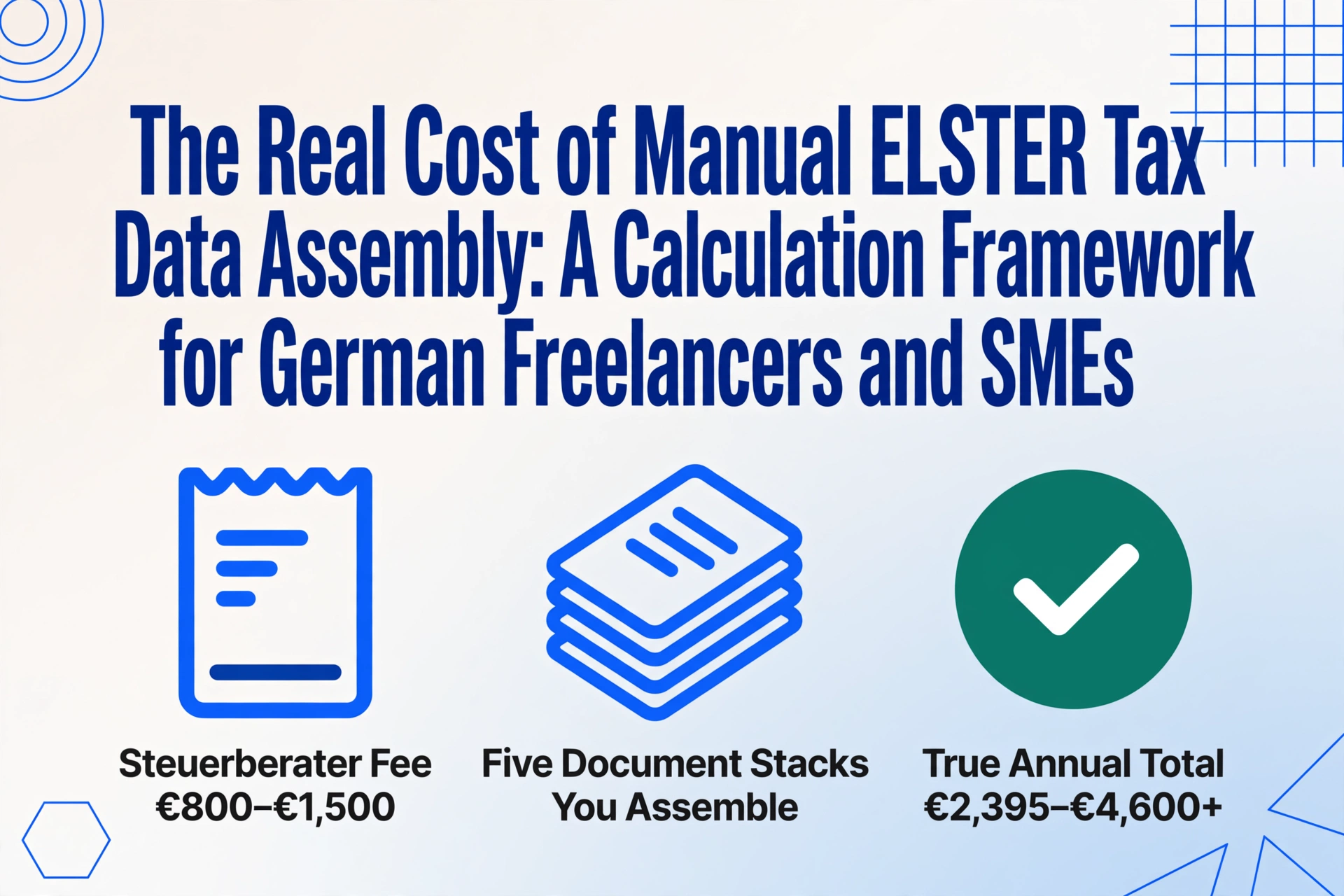
A German freelancer or small business owner looking at the cost of filing a tax return sees one number: the Steuerberater (tax advisor) invoice for €800 to €1,500 for preparing an Einkommensteuererklärung with an Einnahmenüberschussrechnung (EÜR, the income-surplus statement self-employed filers must submit). That number is real — but it is also the cheapest and most visible part of the process. The expensive part never appears on any invoice: it is the hours you spend before the Steuerberater sees a single document — pulling twelve months of Kontoauszüge (bank statements), Versicherungsbescheinigungen (insurance certificates), Spendenbescheinigungen (donation receipts), the Lohnsteuerbescheinigung (wage tax certificate), and last year's Steuerbescheid (tax assessment notice) — and reconciling them into figures an ELSTER form can accept. Hiring a Steuerberater does not remove that work. It moves the deadline forward by seven months and hands the assembly to someone whose hourly rate is €120 to €350. This is a framework for pricing the part of your ELSTER filing that nobody bills you for, so you can produce your own number instead of assuming it is free.
Key Takeaways
- The ten to fifteen hours you spend assembling bank statements, insurance certificates, and donation receipts cost between €950 and €1,425 at a freelancer's billing rate — before the Steuerberater touches a single figure on your return.
- A data-entry error on your tax return becomes legally permanent one month after the Steuerbescheid is issued — the Bundesfinanzhof confirmed in 2023 that even a misclicked data import from a prior year cannot be corrected after the Einspruchsfrist closes.
- Batch-extracting figures from five document stacks into one spreadsheet collapses the assembly from ten hours to a verification pass — the classification decisions that require a human mind, like which deductions qualify and which thresholds apply, remain yours.
The Steuerberater's Fee Is the Visible Cost — Not the Whole One
Begin with the numbers everyone quotes, because they anchor the entire calculation. Steuerberater fees in Germany are regulated by the Steuerberatervergütungsverordnung (StBVV), which sets charges based on the Gegenstandswert — the value of the income or assets being declared. For the 2025 tax year, an employee with a simple return (one employment, no foreign income, no rental property) typically pays €150 to €400. A freelancer or sole trader (Freiberufler or Gewerbetreibender) filing an Einkommensteuererklärung with an EÜR and annual close — the most common scenario — pays roughly €800 to €1,500 at a local Steuerberater, rising toward €2,500 or more when revenue exceeds €150,000 or the return involves foreign income, multiple property assets, or capital gains. For a GmbH (limited liability company), the annual closing alone runs €2,000 to €5,000.
Those are real numbers, and they are not the subject of this article. The trap is treating any of them as the total cost. A Steuerberater prices the filing — checking the figures, applying the deductions, submitting the return through the ELSTER interface under your Steuernummer. They do not price the assembly, because they never do the assembly. You do. A good Steuerberater will hand you a checklist and wait: Kontoauszüge for every bank account, Versicherungsbescheinigungen sorted by type, Spendenbescheinigungen for every donation over €300, the Lohnsteuerbescheinigung from your employer, last year's Steuerbescheid for the carried-forward figures, Krankheitskostenbelege (medical expense receipts) with insurance reimbursement statements — five to seven separate document stacks that land on your desk before they land on the Steuerberater's. Assembling all of it into a clean set of category totals is the labour the ELSTER filing actually demands, and it falls on you whether you file yourself or pay someone to submit what you assembled.
Every time you open a Kontoauszug to separate business income from personal transfers, or sort a folder of Versicherungsbescheinigungen by insurance type to figure out which Anlage each premium belongs on, you are paying a cost the Steuerberater's fee was priced not to cover — and that cost recurs every year, regardless of whether you pay €400 or €2,500 for the filing.
Three Costs Hiding in One Annual Filing Ritual
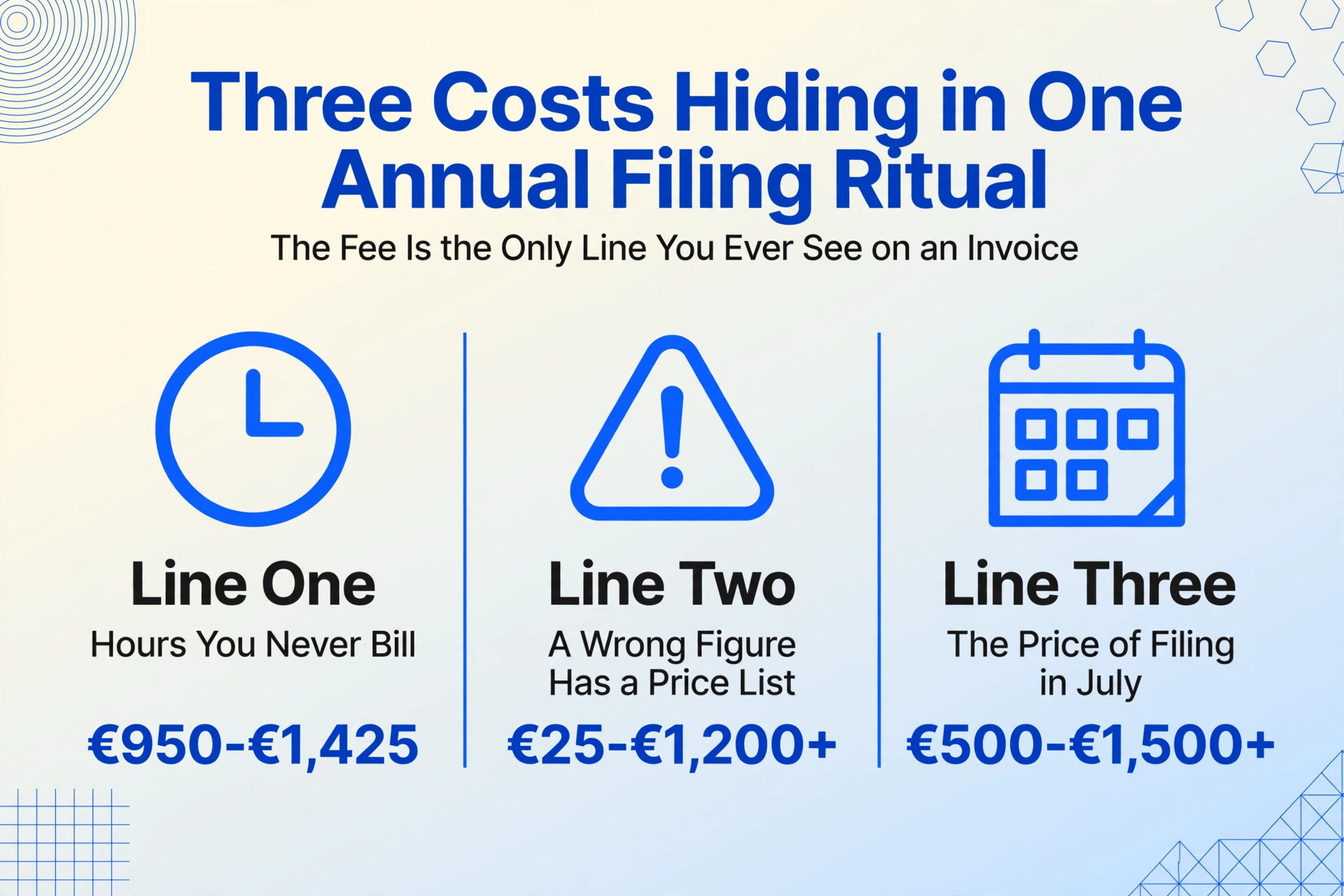
Whether you file the full return yourself through Mein ELSTER or hand assembled figures to a Steuerberater, the cost of a manual ELSTER filing splits into three lines that behave differently and must be added separately. Treating them as one blur of "Steuersaison ist anstrengend (tax season is exhausting)" is exactly why the real number never gets calculated.
- Line One — the hours you never bill. The time spent locating documents across five separate stacks, reading and classifying every figure into the correct Anlage (tax schedule), computing deduction thresholds, and reconciling totals — priced at what an hour of your working time is actually worth, whether a freelance billing rate or an employee's effective hourly cost.
- Line Two — the cost of a wrong figure. The Verspätungszuschlag (late-filing penalty: 0.25% of assessed tax per month, minimum €25, maximum €25,000 under § 152 Abgabenordnung), the interest on underpaid tax (0.15% per month under § 233a AO), and the cost of a Steuerberater spending billable hours to resolve a Finanzamt Rückfrage (tax office inquiry) triggered by a mistyped deduction or a figure assigned to the wrong Anlage line.
- Line Three — the July opportunity cost and the Steuerberater extension trade-off. The billable work displaced when tax assembly collides with summer deadlines, plus the structural price of the Steuerberater filing extension — handing over documents in February instead of July delays the Finanzamt's assessment and any resulting refund by seven months.
To keep the arithmetic concrete, this article follows a single example throughout: a freelance IT consultant in Berlin earning €75,000 in annual revenue from two to three regular clients, with roughly 120 bank transactions per year across one business and one personal account, about 80 receipts, four insurance deduction certificates arriving by mail between December and February, and last year's Steuerbescheid for the quarterly prepayment figures (Einkommensteuervorauszahlungen). Substitute your own figures at each step; the formulas at the end let you rebuild the entire framework for your situation.
Line One — The Hours You Never Put on an Invoice
The reason freelancers and small business owners treat their own tax-prep time as free is that no invoice ever arrives for it. But an hour spent reconciling bank statements against the EÜR is an hour not spent on billable work, and that hour has a market price. For freelancers, the Freelancer-Kompass 2025 survey of 3,210 respondents put the average hourly rate in the DACH region at €104 per hour, with IT freelancers averaging €95 per hour specifically. For an SME employing administrative staff, the effective hourly cost of an employee — including social insurance contributions (Arbeitgeberanteil, roughly 21% of gross), paid leave, sick days, and workplace overhead — runs roughly €35 to €60 per hour, even when the employee's nominal wage is lower. Whichever rate applies to your situation, that is the correct rate to value tax-prep hours against, because those are the hours you are giving up.
The time itself is not the twenty minutes it takes to type figures into ELSTER's web forms once everything is clean. It is the process beforehand, and for a freelancer with moderate complexity it breaks into four phases that repeat every tax year:
- Kontoauszüge (bank statement) reconciliation. Downloading statements from the online banking portal (or retrieving paper statements), identifying which deposits are business revenue (Betriebseinnahmen) versus personal transfers, tax refunds, or private income, cross-referencing deposits against issued invoices (Rechnungen), tallying twelve months of income by hand, and separating business expenses from personal spending. For the example freelancer with 120 transactions across two accounts, this alone consumes two to four hours of concentrated work — more if records have gone untouched since the previous January.
- Versicherungsbescheinigungen (insurance certificate) transcription. Four to five certificates arrive by postal mail between December and February: Krankenversicherung (health insurance), Pflegeversicherung (long-term care insurance), Rentenversicherung (pension contributions), and supplementary policies. Each certificate shows a different layout from a different issuer, and the correct premium amount — the Beitrag, not the reimbursement — must be transcribed into the right line of Anlage Vorsorgeaufwand under § 10 EStG, where each insurance type faces a different Höchstbetrag (maximum deductible limit). At two to three minutes per certificate with verification, this is roughly one hour.
- Receipt sorting and deduction assembly. A year of Spendenbescheinigungen — one at €200, another at €350, a third at €500 — must be entered into the correct fields of Anlage Sonderausgaben under § 10b EStG, not confused with the adjacent church tax, education, or childcare fields on the same form page. Werbungskosten (income-related expenses) — commuting distance at the Entfernungspauschale of €0.30 per kilometre one-way, home office days at the Tagespauschale of €6 per day capped at €1,260 per year, professional training, work equipment, trade union fees — each require their own line entry on Anlage N under § 9 EStG. A freelancer who also claims außergewöhnliche Belastungen (extraordinary burdens) for medical costs under § 33 EStG must compute the zumutbare Belastung (reasonable burden threshold: 1% to 7% of income depending on income level and family status) themselves — ELSTER does not calculate it for manual entries. Two to four hours across all deduction categories.
- Entry and reconciliation. Typing all gathered figures into Mein ELSTER's web forms — or into the Steuerberater's questionnaire — verifying that the deduction totals on the Hauptvordruck (main form) match the individual Anlage sums, checking that the income total on the EÜR reconciles with the bank statement tally, and ensuring last year's prepayment figures (Einkommensteuervorauszahlungen) are correctly carried forward. Two to three hours for a careful self-filer, and more if a discrepancy is discovered that requires re-extracting figures from the original documents.
At ten to fifteen hours of assembly — the midpoint for a freelancer with moderate complexity and 120 annual transactions — and a €95 hourly rate for an IT freelancer, the data assembly step alone costs roughly €950 to €1,425 each tax year. For an SME employee at €45 per hour effective cost, the same hours produce an assembly cost of €450 to €675 — still invisible because it appears as salary, not a separate invoice. This is Line One, and for most freelancers it already matches or exceeds the Steuerberater's fee.
The Steuerberater industry understands this cost allocation. A Steuerfachangestellter (tax clerk) in a Steuerberater-kanzlei who receives a stack of your unassembled documents spends roughly 60 to 90 minutes retyping every figure into DATEV or Addison before the Steuerberater can begin the tax analysis — and at typical Steuerberater hourly rates of €120 to €350, that retyping costs the client €120 to €525 before any tax strategy work has started. If you provide the Steuerberater with an extracted spreadsheet where every field is already in columns, the clerk's time shifts from retyping to verifying — and the Steuerberater's time shifts from data correction to tax strategy. The structural problem of ELSTER's manual data assembly is that the system digitized the filing endpoint but left the assembly pipeline fully manual — and the cost of that gap is exactly what Line One measures.
Line Two — What a Wrong Figure Costs in Germany's Penalty System
Manual transcription has a measurable error rate, and on a tax return an error is not a cosmetic problem — it is a compliance exposure with a published price list defined by the Abgabenordnung (AO, the German Fiscal Code). The exposure has three layers, and most people only picture the first.
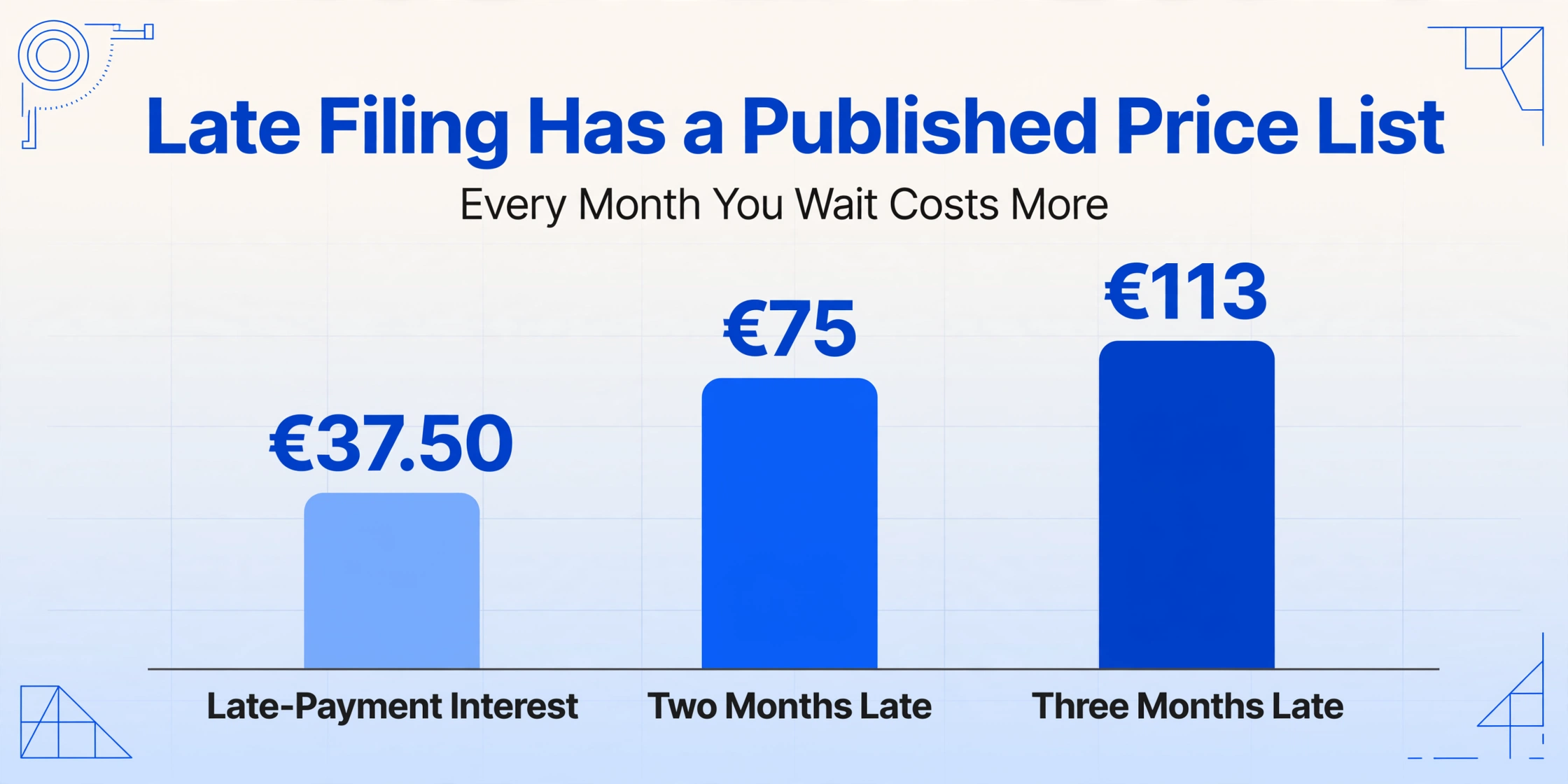
Verspätungszuschlag (late-filing penalty). The standard filing deadline for self-prepared returns is 31 July of the year following the tax year, per § 149 AO. For the 2025 tax year, that deadline is 31 July 2026. Miss it and the Finanzamt imposes a Verspätungszuschlag of 0.25% of the assessed tax per month (or part of a month), with a minimum of €25 per month and a maximum of €25,000, under § 152 AO. On an assessed tax of €15,000 — a realistic figure for a freelancer earning €75,000 — a return filed two months late incurs a Verspätungszuschlag of €75 (€37.50 per month, rounded to the minimum). That is a small number — until you realize that the penalty is calculated on the assessed tax, and a late return means the Finanzamt may estimate the assessment (Schätzung) in the taxpayer's absence, producing a higher assessed tax and a higher penalty base. Separate from the penalty, interest under § 233a AO accrues at 0.15% per month (1.8% per annum) on any underpaid or overpaid tax, running 15 months after the tax year ends. A €5,000 underpayment on a return filed in October instead of July carries roughly €37.50 in interest — small enough to ignore individually, but the interest compounds across multiple tax years.
Finanzamt Rückfrage — the cost of a wrong Anlage assignment. The most common class of ELSTER error is not a mistyped digit. It is a figure assigned to the wrong Anlage line: entering a donation (Spende) into the church tax field on Anlage Sonderausgaben, putting a health insurance premium into the wrong line of Anlage Vorsorgeaufwand where the Höchstbetrag differs, or carrying an EÜR income figure onto the wrong form altogether. The Finanzamt's internal plausibility checks (Plausibilitätsprüfung) catch these automatically, and the response is a Rückfrage — a formal inquiry requiring the taxpayer or their Steuerberater to locate the original document, re-extract the correct figure, and explain the correction in writing. For a self-filer, a Rückfrage costs the time to re-read the inquiry letter, locate the document, recalculate, and respond — rarely less than an hour, often two. For a Steuerberater client, the Rückfrage arrives on the Steuerberater's desk and triggers billable correction hours at €120 to €350 per hour. Two Rückfragen triggered by two misassigned figures can add €240 to €700 to the Steuerberater's invoice — a cost that never appeared in the original fee estimate because no one budgets for errors.
The BFH ruling that made transcription errors permanent. Under German tax procedure law, the Einspruchsfrist (objection period) is one month from the date the Steuerbescheid is issued. After that window closes, the assessment becomes bestandskräftig (legally final). The Bundesfinanzhof ruling IX R 17/22 (18 July 2023) established that data-entry errors made by the taxpayer during filing are not correctable after the Einspruchsfrist expires — even if the error was a simple import mistake, even if the tax overpayment is objectively wrong. The case involved taxpayers who inadvertently imported data from the wrong tax year into their ELSTER return, resulting in a higher assessment. The BFH denied the correction, ruling that the error was the taxpayer's own, not the Finanzamt's, and the assessment stood. A misclicked data import from a prior year produced a permanent tax liability. The number of taxpayers in this position is unknown, but the legal principle is unequivocal: a transcription error that survives the one-month Einspruchsfrist is a permanent cost.
The BFH ruling crystallizes the structural risk of manual tax assembly: the taxpayer bears the liability for every mistyped figure, the Finanzamt does not verify the accuracy of the submitted data against the underlying source documents, and the correction window is one month from assessment issuance. Transcription is not a cost-free step whose errors can be rectified later. It is a step whose errors can become permanent — legally, not administratively.
Line Three — The July Opportunity Cost and the Extension Trade-Off
Line One prices the hours the filing consumes. Line Three prices when it consumes them. The 31 July deadline for self-filers means the assembly work is compressed into the weeks between late January — when the last of the previous year's Versicherungsbescheinigungen arrive by mail — and early July. For a freelancer, July is rarely a quiet month. Summer client projects are underway, invoices from June need chasing, and the tax assembly sits on top of a full workload. Every hour spent reconciling bank statements in July is an hour not spent on billable work — and those are the hours when billable work is fully available.
A Steuerberater extends the filing deadline from 31 July to 28 February of the second following year — for the 2025 tax year, the extended deadline is 1 March 2027 (since 28 February falls on a Sunday), per PwC's Germany tax summary. That seven-month extension is real value — it removes the July crunch. But it comes with a trade-off: handing over documents in February 2027 means the Finanzamt's assessment arrives in mid-2027 at the earliest, and any refund (Steuererstattung) is delayed by roughly seven months compared to a July 2026 self-filing. For a freelancer expecting a €3,000 refund — the average refund for voluntary filers in Germany is roughly €1,095, but self-employed filers with high deductions often exceed €3,000 — that is €3,000 of working capital tied up for seven extra months. At a conservative 4% opportunity cost (what that capital could earn or save if deployed sooner), the seven-month delay carries an implicit cost of roughly €70.
There is a second structural cost here that resists a spreadsheet but is real enough that every freelance forum names it: the kognitive Belastung (cognitive load) of carrying an unfinished Steuererklärung for weeks. The low-grade dread of knowing the documents are piling up, the weekend lost to receipt sorting in June, the background arithmetic of the zumutbare Belastung threshold running while trying to focus on client work. It does not belong in the numeric total, but leaving it out understates what the manual process actually takes from you. And the same opportunity-cost logic applies regardless of jurisdiction — UK freelancers collating SA100 returns in January and Japanese freelancers assembling 確定申告 every February face the identical compression of tax assembly into the busiest work weeks, differing only in the month on the calendar.
Your Own ELSTER Assembly Cost, in Four Expressions
With the three lines separated, the total cost of manual ELSTER data assembly becomes a function of your own situation rather than an industry average. Here is the tally for the running example — the IT freelancer with €75,000 revenue, 120 transactions, 80 receipts, four insurance certificates, filing with a Steuerberater:
| Cost Line | Annual Total (example) | Calculation Basis |
|---|---|---|
| Steuerberater fee | €800–€1,500 | Freelancer EÜR + annual close, €75k revenue, per StBVV |
| Line One — assembly hours (self) | €950–€1,425 | 10–15 hrs gathering & reconciling × €95/hr freelance rate |
| Line One — assembly hours (Steuerberater clerk) | €120–€525 | 60–90 min retyping unassembled documents into DATEV × €120–350/hr clerk rate |
| Line Two — error exposure | €25–€1,200+ | Verspätungszuschlag (min €25/mo, 0.25% of assessed tax) + Rückfrage correction hours (€120–700) + interest under §233a AO + BFH-permanent error risk, probability-weighted |
| Line Three — opportunity cost | €500–€1,500+ | Peak-season hours displaced from billable work, valued at or above the normal hourly rate + refund delay cost (€70–200) |
| Total per tax year | €2,395–€4,600+ | Probability-weighted true cost of manual ELSTER data assembly |
The striking result is that the Steuerberater's fee — the only line most people ever count — is rarely the largest one. To build your own figure, substitute into four expressions:
- Line One = hours spent gathering bank statements, sorting receipts, transcribing insurance certificates, computing deduction thresholds, and reconciling totals × your hourly rate (freelance billing rate, or SME employee effective hourly cost of €35–60)
- Line Two = (Verspätungszuschlag: 0.25% of assessed tax × months late, min €25/month) + (expected number of Finanzamt Rückfragen × Steuerberater correction hours × €120–350/hr) + (§233a interest: 0.15%/month on underpaid tax) + (BFH-permanent error exposure: probability-weighted overpayment on a wrong figure × your marginal tax rate of 14–42%)
- Line Three = peak-month billable hours displaced × your hourly rate premium during the busiest weeks + (expected refund amount × 4% annual opportunity cost × 7/12 months of Steuerberater extension delay)
- Steuerberater fee = the quoted price from the StBVV schedule, which removes the filing labour and a portion of Line Two's error risk — but not Line One and not Line Three
Run those four expressions and the self-file-versus-Steuerberater debate reframes itself. The question is not "is €800 to €1,500 worth it for someone else to file my return?" It is "which of these lines does each option actually reduce?" A Steuerberater reduces the filing labour and, through professional review, a significant portion of Line Two. Neither a Steuerberater nor a tax software subscription touches Line One — until you change the mechanism by which the assembly happens.
Where Extraction Changes the Arithmetic
Every one of the three cost lines traces back to the same root operation: a person reading a figure off a document and typing it somewhere else. Line One is that operation repeated across five document stacks — the Kontoauszüge, the insurance certificates, the donation receipts, the Lohnsteuerbescheinigung, the prior-year Steuerbescheid — compressed into a filing window. Line Two is what happens when a typed figure lands in the wrong Anlage line or the wrong field. Line Three is the same operation done under time pressure, displacing the client work that pays your bills. Remove the manual reading-and-typing and all three lines move at once. That is what document data extraction does, and the value is on the assembly side — not in filing your Einkommensteuererklärung, which no extraction tool does, but in turning five document stacks into structured data your Steuerberater or tax software can work with immediately.
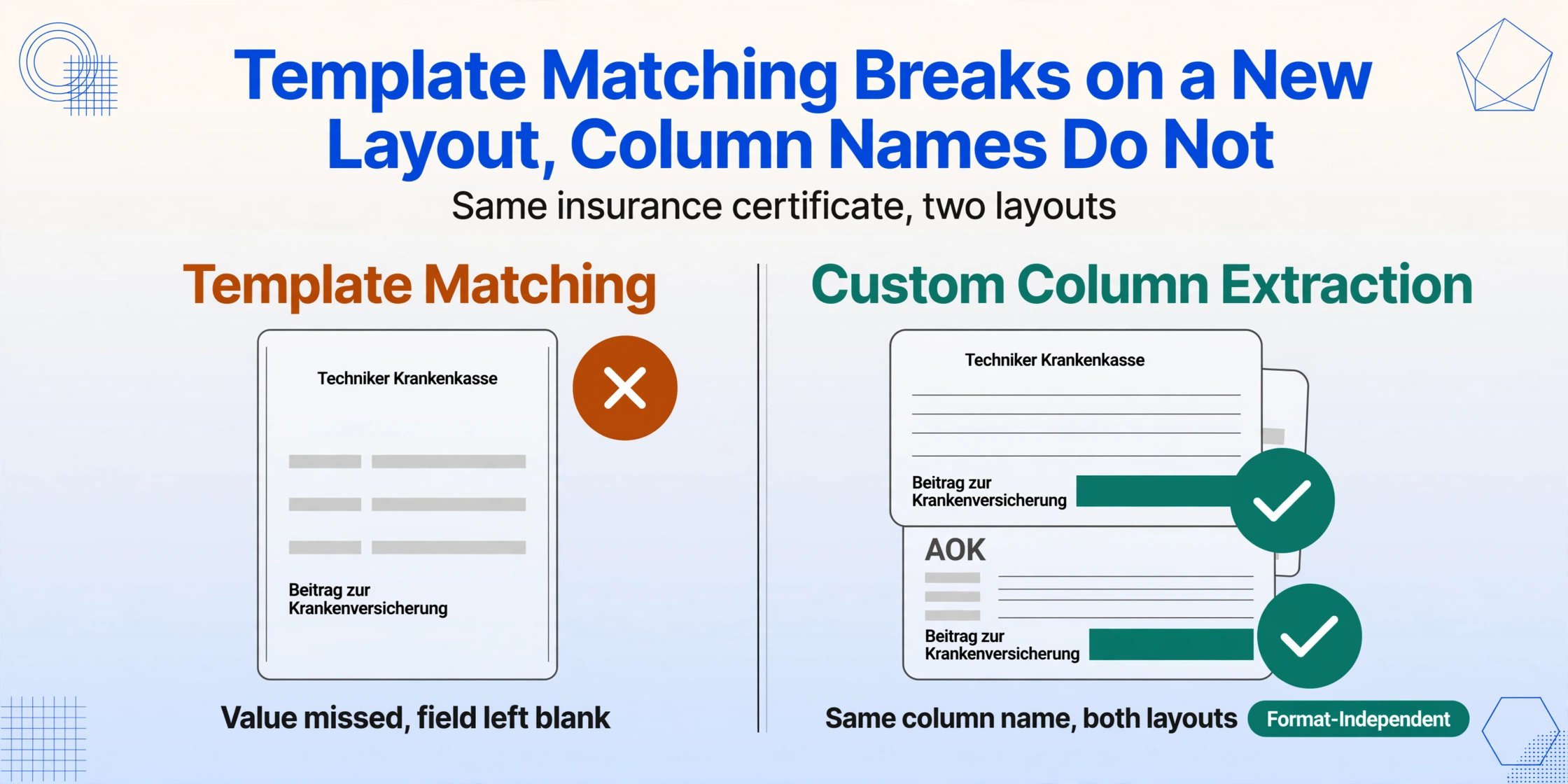
The mechanism is Custom Column Extraction: instead of matching fixed positions on a page — the approach template tools take, which breaks the moment a Versicherungsbescheinigung from Techniker Krankenkasse uses a different layout than one from AOK — you type the column names you want once, and the AI locates each value on every document by understanding what the label means. "Beitrag zur Krankenversicherung" (health insurance contribution), "Spendenbetrag" (donation amount), "einbehaltene Lohnsteuer" (wage tax withheld) — each is read semantically, not by pixel coordinates. Upload all five document stacks in one batch, name your columns to match the Anlage lines they feed, and the output is one spreadsheet with every figure in its own column — ready for the classification decisions a human must still make: which insurance premiums are deductible at which rate, whether medical costs exceed the zumutbare Belastung threshold, which donations qualify under § 10b EStG. The full extraction workflow for a single return is covered in the ELSTER tax form data extraction guide, and the same batch principle applied at scale — 50 employees, one column schema, one consolidated dashboard every month — is covered in the monthly Lohnsteuer-Anmeldung batch processing guide.
Two features attack Line One and Line Two directly. An inferred column is one whose value the AI works out rather than reads: add a column named Category (options: Betriebseinnahmen/Betriebsausgaben/Private Überweisung/Steuererstattung) and the tool classifies each bank transaction even though the word "Category" appears nowhere on the Kontoauszug — turning the manual sort-by-hand step into a verification glance. A computed column then does the arithmetic: define a column that sums total Sonderausgaben and compares against the printed sum on the Hauptvordruck, outputting "OK" or "CHECK" — catching the most common error class, deduction arithmetic mismatches, before the return reaches the Finanzamt or the Steuerberater.
Files are processed securely and not stored.
At roughly ten seconds of processing per document versus the minutes of reading, classifying, and typing by hand, extraction collapses Line One toward a verification glance. And because the AI reads field labels by their semantic meaning — "Beitrag zur Krankenversicherung" is the same field whether it appears on a TK certificate, an AOK certificate, or a Barmer printout — the transcription error rate that drives Line Two falls with it. The Steuerberater who used to spend 90 minutes retyping your unassembled documents into DATEV at €120 to €350 per hour now spends 20 minutes verifying an extracted spreadsheet and 70 minutes on tax strategy — the work you originally hired them to do.
FAQ — The Cost of Manual ELSTER Tax Data Assembly in Germany
How much does a Steuerberater charge to file an Einkommensteuererklärung in Germany?
For 2025/2026, fees are regulated by the StBVV and scaled to the Gegenstandswert (value of income declared). A simple employee return typically costs €150 to €400. A freelancer return with EÜR and annual close costs €800 to €1,500 at a local Steuerberater, rising to €2,500 or more when revenue exceeds €150,000 or the return involves foreign income or multiple properties. A GmbH annual close runs €2,000 to €5,000. The fee covers checking figures, applying deductions, and submitting through ELSTER — not gathering and reconciling your source documents, which you still do. Filing through a Steuerberater extends the deadline from 31 July to 28 February of the second following year.
What is the penalty for filing my German tax return late?
Under § 152 AO, a Verspätungszuschlag of 0.25% of the assessed tax applies per month (or part of a month) past the deadline, with a minimum of €25 per month and a maximum of €25,000. The penalty is calculated on the assessed tax, not the amount you prepaid through quarterly Vorauszahlungen. Separately, interest under § 233a AO accrues at 0.15% per month (1.8% per year) on any underpaid or overpaid tax. For a freelancer whose 2025 return is filed three months late with €15,000 assessed tax, the Verspätungszuschlag alone reaches roughly €113 — and the Finanzamt's penalty discretion ends 14 months after the tax year closes, after which the surcharge becomes mandatory.
Doesn't using a Steuerberater eliminate the data assembly cost?
No — it moves the assembly from your desk to the Steuerberater's desk, and you pay for the move. A Steuerfachangestellter receiving a stack of your unassembled bank statements, insurance certificates, and donation receipts spends roughly 60 to 90 minutes retyping every figure into DATEV before the Steuerberater can begin the tax analysis. At Steuerberater hourly rates of €120 to €350, that retyping costs the client €120 to €525. The assembly problem does not disappear when you hire a Steuerberater. It moves, and you pay the moving cost at professional-service rates. If you instead provide the Steuerberater with an extracted spreadsheet where every field is already in columns, the clerk's time shifts from retyping to verifying — and the Steuerberater's time shifts from error correction to tax strategy.
Doesn't ELSTER's VaSt pre-filling eliminate manual data entry?
Partially — for the Lohnsteuerbescheinigung. The vorausgefüllte Steuererklärung (VaSt) automatically populates wage tax data, health and long-term care insurance contributions, and pension notices that the Finanzamt already holds. But for a freelancer, the pre-filled data is a fraction of the return. Werbungskosten (income-related expenses), Sonderausgaben (special expenses including donations), außergewöhnliche Belastungen (extraordinary burdens like medical costs), and self-employment income on the EÜR are not pre-filled — and for a freelancer, those non-pre-filled categories constitute the majority of the return's data. VaSt automates the easiest data. The harder data — the deduction figures scattered across multiple documents — remains fully manual. For a freelancer with home office, commuting, donations, and medical costs, approximately 60–70% of the deduction-relevant fields still require manual entry even with VaSt fully active.
What happens if I assign a figure to the wrong Anlage line in ELSTER?
The Finanzamt's internal Plausibilitätsprüfung (plausibility check) flags the discrepancy automatically, and the response is a Rückfrage — a formal inquiry requiring you or your Steuerberater to locate the original document, re-extract the correct figure, and explain the correction in writing. For a self-filer, a Rückfrage costs one to two hours of document retrieval and recalculation. For a Steuerberater client, the Rückfrage arrives on the Steuerberater's desk and triggers billable correction hours at €120 to €350 per hour. Two Rückfragen from two misassigned figures can add €240 to €700 to the Steuerberater's invoice — a cost that was never in the original fee estimate. And under the BFH ruling IX R 17/22, if the error is discovered after the one-month Einspruchsfrist expires, the assessment stands — the overpayment is permanent.
Can AI extract data from my bank statements, insurance certificates, and donation receipts for ELSTER?
Yes — that is where the tool saves the most time. You upload all five document stacks — Kontoauszüge, Versicherungsbescheinigungen, Spendenbescheinigungen, Lohnsteuerbescheinigung, and last year's Steuerbescheid — in one batch, name your columns to match the Anlage lines they feed (Bruttolohn, Einbehaltene Lohnsteuer, Krankenversicherungsbeiträge, Spenden, Krankheitskosten, Erstattungen, etc.), and the AI reads each document and fills the rows by understanding what each field means — not where it sits on the page. The extracted spreadsheet has one column per field, ready for the classification decisions that still require human judgment — which insurance premiums are deductible at which rate, whether medical costs exceed the zumutbare Belastung threshold. The honest limit: the tool produces the structured figures that feed your return or your Steuerberater's review — it does not file the Einkommensteuererklärung with the Finanzamt for you. Heavily degraded documents — a faxed copy of a Versicherungsbescheinigung — may reduce accuracy on individual fields, and a verification pass still matters.
The real cost of your ELSTER tax filing was never the Steuerberater's fee. It is the hours of assembling five document stacks into one return, the Rückfrage correction hours at €120–350 per hour when a wrong Anlage assignment triggers a Finanzamt inquiry, and the July billable work displaced every year — all three tracing back to reading documents by hand. Turn bank statements, certificates, and receipts into sorted totals, then run the numbers again.
Extract Your Tax Documents