The Real Cost of Manual Tax Invoice Entry
for Korean Finance Teams
Korea built one of the most advanced digital tax invoice systems in the world. Since 2011, the National Tax Service (NTS) has required electronic issuance, and by 2014, 99% of all B2B invoices in the country were transmitted electronically. Yet for the finance teams that receive those invoices, the work remains stubbornly manual: downloading a PDF, reading the supply value (공급가액), typing the business registration number (사업자등록번호), cross-checking the 24-digit NTS approval number (승인번호). The issuance side was automated. The extraction side was not.
This article quantifies what that extraction gap costs, in Korean won, using Korean salary data and NTS penalty structures. The goal is not to argue that the cost is high — it's to give you the variables and formula to calculate it yourself.
Key Takeaways
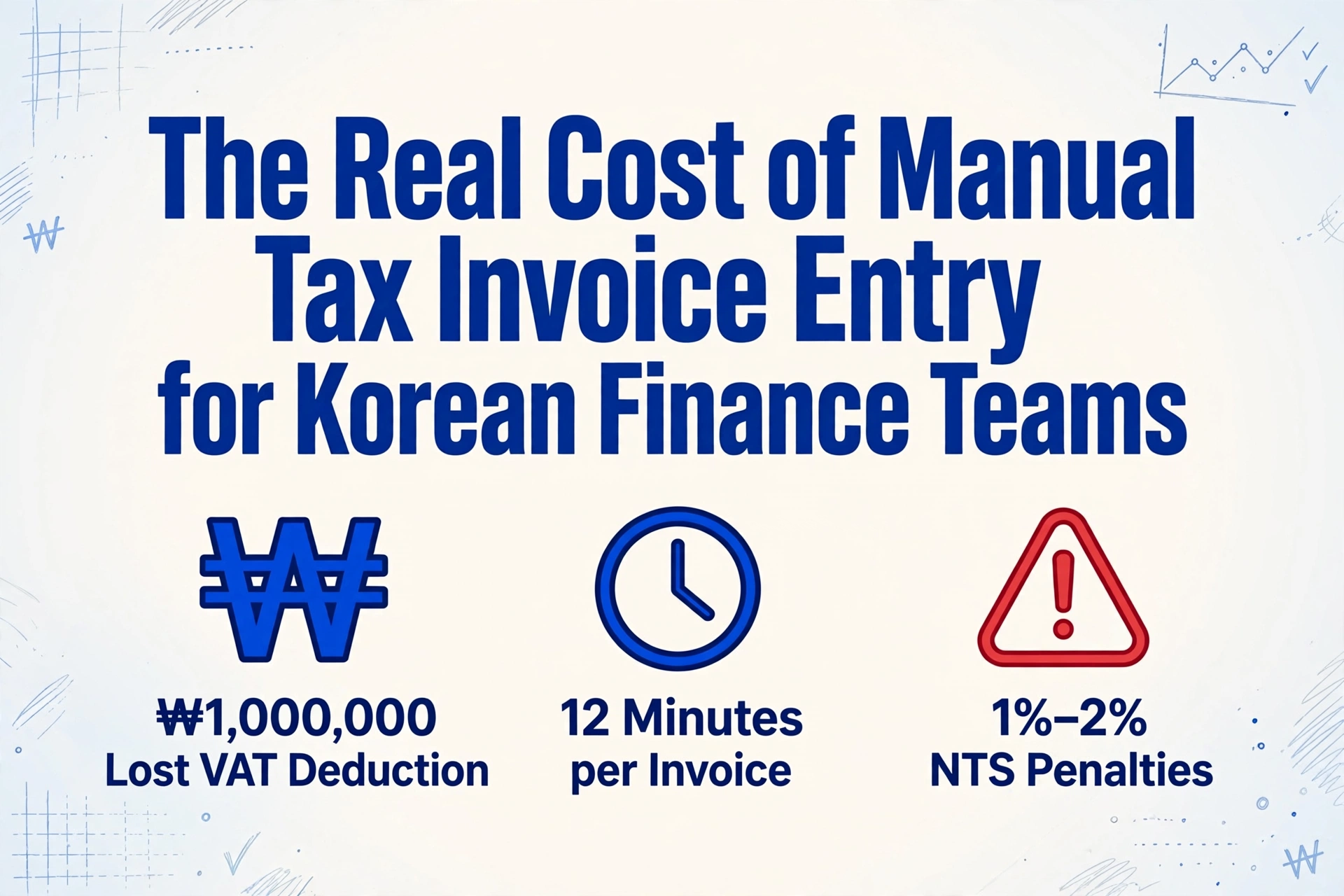
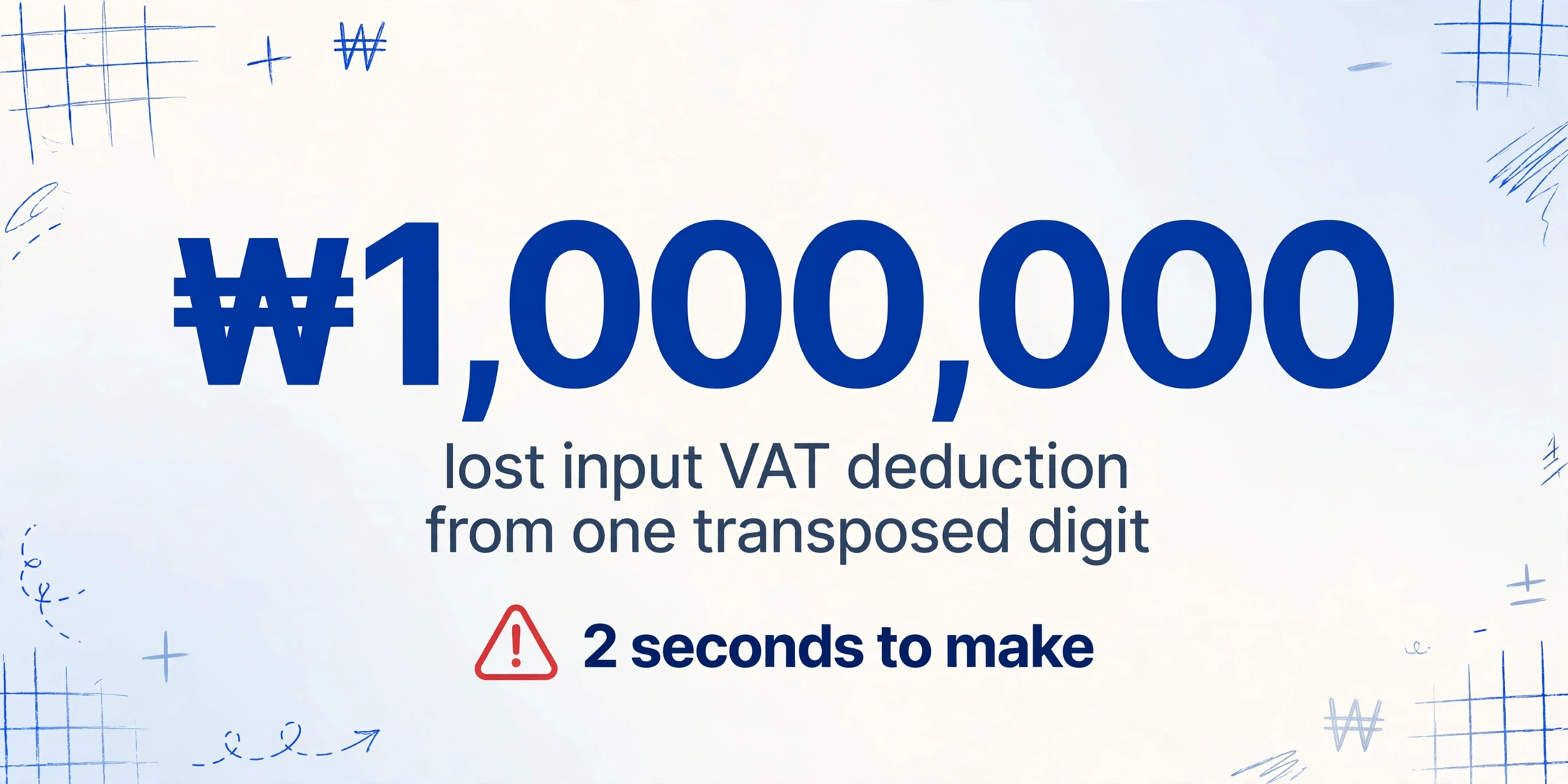
- ₩4,335 per invoice sounds manageable — until one transposed digit in a 10-digit business registration number cascades into ₩1,000,000 of lost VAT deduction.
- 28% of your manual processing cost hides in rework, NTS penalties, and denied deductions that never appear on the same line item as the labor hours that created them.
- 10 seconds replaces 12 minutes of retyping when ImageToTable.ai reads fields by meaning instead of pixel position — this article includes a fill-in formula to calculate your own annual gap.
What One Miskeyed Tax Invoice Actually Costs
Start with the smallest possible unit: a single data entry error on a single Korean tax invoice (세금계산서). A clerk transposes one digit in a 10-digit business registration number. Here is the cascade that follows:
| Step | Action Required | Time |
|---|---|---|
| 1 | Discover the mismatch during VAT return cross-verification | 5–10 min |
| 2 | Pull original tax invoice PDF, compare against entered data | 3–5 min |
| 3 | Contact supplier to confirm correct BRN or request a corrected invoice | 10–30 min |
| 4 | Re-enter corrected data in ERP or spreadsheet | 3–5 min |
| 5 | If correction triggers a revised e-tax invoice submission — verify 24-digit NTS approval number | 5–10 min |
Total rework time for one error: 26 to 60 minutes. At a loaded labor rate of ₩25,800/hour (derived below), that single typo costs ₩11,100 to ₩25,800 in direct labor.
But the labor cost is the small part. Under Korea's VAT Act, if a corrected tax invoice doesn't reach the NTS by the deadline, the supplier faces a penalty of 1% of the supply value for late transmission, or 2% for non-issuance. On a ₩10,000,000 invoice, that's ₩100,000 to ₩200,000. And if the buyer's recorded data doesn't match the NTS record at VAT filing time, the buyer may lose the 10% input VAT deduction entirely — turning a keying error into ₩1,000,000 of additional tax on that same invoice.
A single transposed digit in a business registration number can cascade from 30 minutes of rework to ₩1,000,000 in lost VAT deduction. The error itself takes two seconds to make.
That asymmetry — seconds to create, hours and hundreds of thousands of won to fix — is why manual tax invoice processing costs more than the obvious labor line suggests. The sections below quantify each layer.
The Per-Invoice Time Cost: 12 Minutes Korean Finance Teams Don't Track
Accounts payable benchmarks consistently place manual invoice processing time at 12 to 15 minutes per invoice. For Korean tax invoices specifically, the steps break down into a sequence that includes compliance checks unique to Korea's real-time NTS validation system:
Download the PDF from email, HomeTax (홈택스), or a supplier portal. Identify whether it's a standard tax invoice, an amended tax invoice (수정세금계산서), or a tax-exempt invoice. ~1 min
Type the supplier business registration number (사업자등록번호), buyer registration number, date of issuance (작성일자), supply value (공급가액), VAT amount (세액), and total amount (합계금액). Field layouts differ across supplier platforms — Popbill, Barobill, and Douzone's e-Tax service each use a different format. ~4 min
Cross-check the 24-digit NTS approval number. Confirm the business registration number is valid and active on HomeTax. This step catches supplier errors before they become your compliance problem at VAT filing. ~3 min
Assign a GL account code, match to a purchase order if applicable, route for approval. Korean SMEs using ECOUNT or Douzone WEHAGO still perform this step manually for received invoices. ~3 min
Save the PDF in the correct folder by date or supplier. Korean tax law requires 5-year document retention. ~1 min
Total: approximately 12 minutes per invoice. The Korea-specific overhead is in steps 2 and 3: the BRN verification and NTS approval number cross-check add roughly 3 minutes that don't exist for invoices in countries without real-time tax authority validation.
If you're not familiar with the mandatory fields on a Korean tax invoice, our guide to extracting tax invoice data into Excel covers all seven fields and why each matters for VAT compliance.
Monthly Cost Model: Volume × Unit Cost in ₩
According to the Korea Ministry of Employment and Labor (MOEL) wage survey, the average annual salary for accounting and bookkeeping clerks (회계 및 경리 사무원) in South Korea is ₩41,828,000, or approximately ₩3,486,000 per month. Adding the employer's share of the four mandatory social insurance programs — national pension, health insurance, employment insurance, and long-term care insurance — brings the loaded cost to approximately ₩4,530,000/month (roughly 130% of gross).
Converting to an hourly rate based on 209 standard monthly working hours:
₩4,530,000 ÷ 209 hours = ₩21,675/hour (loaded)
At 12 minutes per invoice, the direct labor cost per invoice is:
₩21,675 × 0.2 hours = ₩4,335 per invoice
This aligns broadly with the SmartBill (BusinessOn) benchmark of ₩3,750 per outgoing invoice and ₩1,000 per incoming invoice in direct processing cost — noting that SmartBill's figure captures issuance labor only, while the 12-minute benchmark above includes verification and filing time that the issuance side doesn't require.
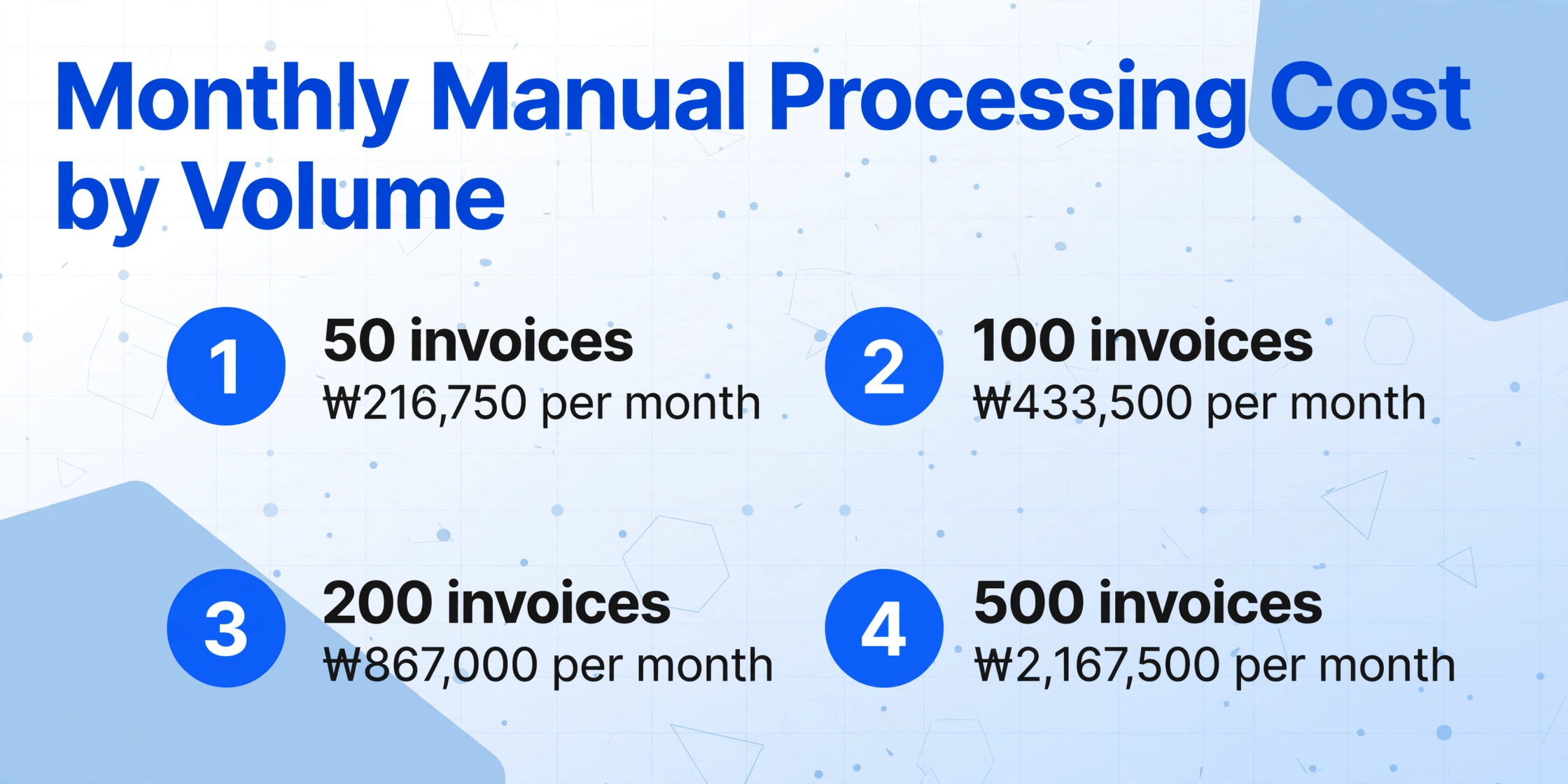
| Monthly Invoice Volume | Hours of Manual Processing | Monthly Labor Cost (₩) | Annual Labor Cost (₩) |
|---|---|---|---|
| 50 | 10 | ₩216,750 | ₩2,601,000 |
| 100 | 20 | ₩433,500 | ₩5,202,000 |
| 200 | 40 | ₩867,000 | ₩10,404,000 |
| 500 | 100 | ₩2,167,500 | ₩26,010,000 |
At 200 invoices per month, that's a half-time employee dedicated entirely to keying data from PDFs into spreadsheets. At 500, it exceeds half of a full-time headcount — and this is only the data entry portion, not the review, correction, or VAT return preparation that follows.
For context on how this compares across markets: German SMEs face per-invoice costs of €8–12 due to higher labor rates, while manufacturing operations with multi-line-item invoices run higher regardless of geography. The Korean figure is lower in absolute terms but represents a larger share of the accounting clerk's total compensation.
Error and Penalty Costs: The NTS Dimension Generic Benchmarks Miss
AP automation research typically cites manual data entry error rates of 1.6% to 4% per invoice. Apply even the conservative 1.6% to 200 invoices per month, and you get roughly 3 invoices with at least one incorrect field.
In most countries, an invoice error means rework. In Korea, the National Tax Service adds a regulatory penalty layer that doesn't exist in most other jurisdictions:
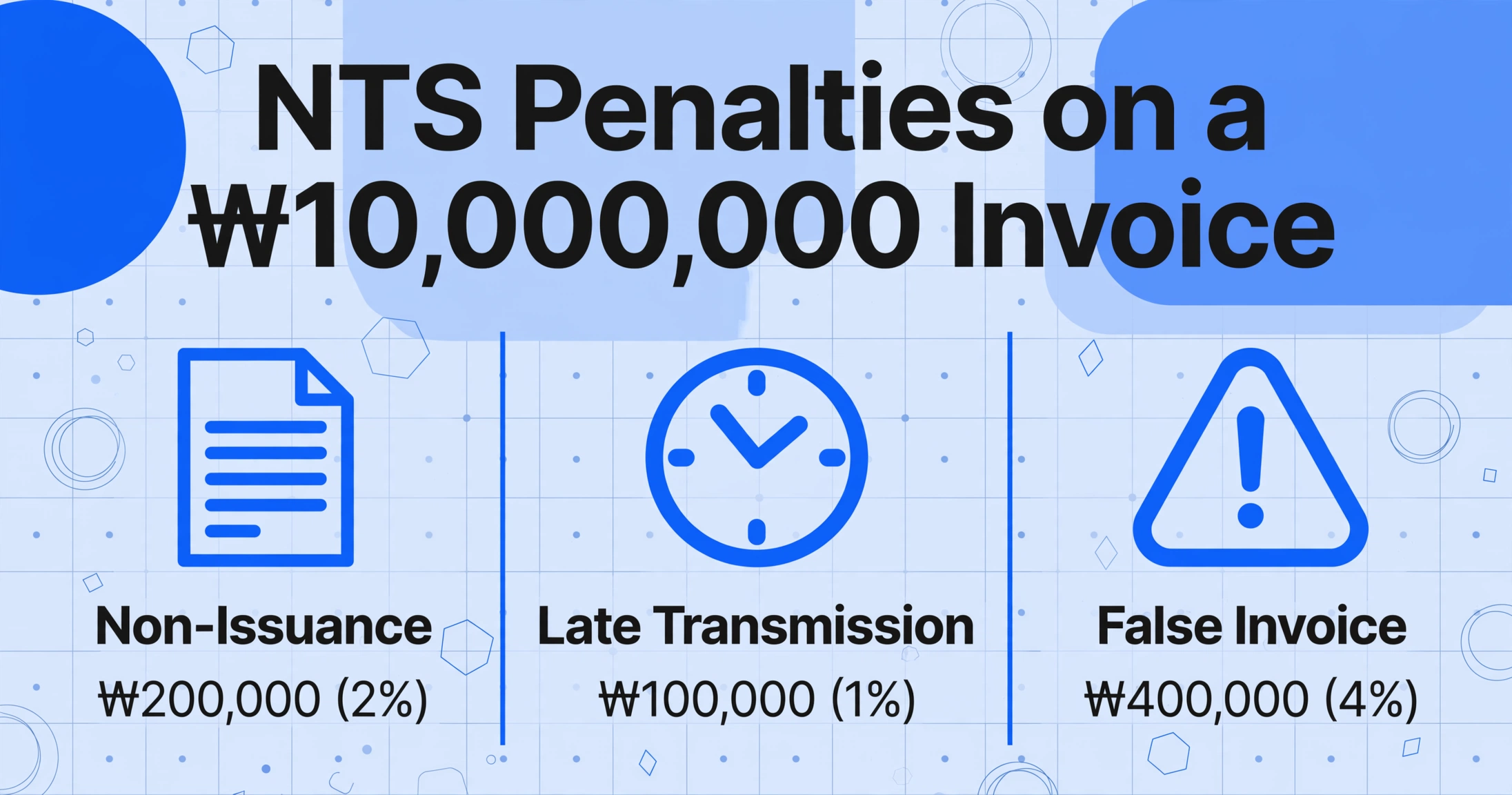
| Violation | Penalty | Example (₩10M Invoice) |
|---|---|---|
| Non-issuance of tax invoice | 2% of supply value | ₩200,000 |
| Late transmission to NTS (after the 10th of the following month) | 1% of supply value | ₩100,000 |
| Issuance of false tax invoice (2026 revision) | 4% of supply value (increased from 3%) | ₩400,000 |
| Buyer receives invalid invoice | Loss of 10% input VAT deduction | ₩1,000,000 |
The last row is the one that catches finance teams off guard. If a buyer's copy contains incorrect mandatory fields — a wrong business registration number, a mismatch between supply value and VAT amount — the NTS may deny the buyer's input tax deduction for that invoice. On a ₩10,000,000 invoice at 10% VAT, that's ₩1,000,000 in tax savings lost. Not because the transaction was improper, but because the recorded data didn't match.
Mapping error costs to a 200-invoice monthly operation at 1.6% error rate:
- 3.2 invoices with errors per month
- Rework labor: 3.2 × 30 min × ₩21,675/hr = ₩34,680/month
- Penalty risk (assuming 1 in 3 errors triggers late correction): 1.07 × ₩100,000 = ₩107,000/month
- VAT deduction risk (assuming 1 in 10 errors results in denied deduction on a ₩10M average invoice): ₩100,000/month expected value
Total error-related cost: approximately ₩242,000/month — on top of the ₩867,000 direct labor cost. That's a 28% surcharge on manual processing that doesn't appear in time-tracking reports because it's distributed across correction cycles, supplier phone calls, and quarterly VAT reconciliation.
For a deeper look at how NTS deadlines interact with batch processing at quarter-end, see our article on batch processing 150+ tax invoices for VAT reporting.
The ₩6.7 Trillion Problem Korea Already Solved — On the Issuance Side
Before Korea introduced its e-Tax Invoice system in 2010, the Korea Institute of Public Finance (KIPF / 한국조세재정연구원) estimated the annual compliance cost of paper-based VAT invoicing at approximately ₩6.7 trillion — covering issuance, submission, storage, and preparation of VAT returns. By 2011, KIPF estimated that electronic invoicing had reduced compliance costs by ₩970 billion annually.
A World Bank study contextualized those savings: tax invoice costs accounted for 50.6% of total VAT compliance costs for Korean corporations and 67.6% for individual businesses. The reduction was real but concentrated almost entirely on the issuance side. Suppliers no longer print, mail, or store paper invoices. The NTS receives transaction data in real-time XML.
What didn't change: the buyer's extraction workflow. A finance clerk at a Korean SME in 2026 still downloads a tax invoice PDF from HomeTax or a supplier portal, opens a spreadsheet, and types supply value and VAT amount one field at a time. The document became digital. The data entry remained manual.
Korea's e-Tax Invoice system automated invoice issuance. It did not automate invoice extraction on the buyer side. The remaining manual cost sits with the 8 million+ businesses that receive those invoices.
This gap matters because the Korean ERP ecosystem — dominated by Douzone (WEHAGO, iCUBE, Amaranth 10) and ECOUNT ($55/month, 80,000+ corporate clients) — automated outgoing invoice issuance through NTS integration years ago. Incoming invoice data entry? That's still the clerk's job. Tools like Popbill and Barobill help with sending invoices. For the invoices your team receives from 40 different suppliers in 40 different PDF layouts, the extraction remains a manual matching problem.
Japan faces a structurally similar situation with its qualified invoice compliance costs — a digitized issuance mandate paired with manual buyer-side extraction.
Building Your Own Cost Framework
The numbers above use national averages. Your actual cost depends on four variables:
| Variable | How to Find Your Number | National Average |
|---|---|---|
| Loaded monthly labor cost | Gross salary × 1.3 (social insurance) ÷ 209 hrs | ₩21,675/hr |
| Monthly invoice volume | Count received tax invoices in one quarter, divide by 3 | Varies (50–500 for SMEs) |
| Minutes per invoice | Time 10 invoices end-to-end, take the average | 12 min |
| Average invoice supply value | Sum last quarter's supply values, divide by invoice count | Varies |
Formula:
Monthly Manual Cost =
(Volume × Minutes/Invoice × Hourly Rate ÷ 60)
+ (Volume × Error Rate × Avg Rework Minutes × Hourly Rate ÷ 60)
+ (Volume × Error Rate × Penalty Probability × Avg Invoice Value × 1%)
Plug in your own numbers. For a team processing 200 invoices at the national average labor rate:
- Direct labor: 200 × 12 × ₩21,675 ÷ 60 = ₩867,000
- Error rework: 200 × 0.016 × 30 × ₩21,675 ÷ 60 = ₩34,680
- Penalty risk: 200 × 0.016 × 0.33 × ₩10,000,000 × 0.01 = ₩105,600
- Total: ₩1,007,280/month (₩12,087,360/year)
That's roughly 22% of a full-time accounting clerk's loaded annual compensation — spent on a task that produces no analysis, no insight, and no strategic value. A Paros ERP survey found that Korean accounting clerks spend nearly half their working hours on data collection and entry tasks. Tax invoice extraction is the single largest block within that half.
What Changes at 10 Seconds Per Invoice
The cost model above has one variable that technology changes dramatically: minutes per invoice.
ImageToTable.ai processes a single-page document in 5 to 10 seconds. Unlike template-based OCR tools — such as Naver Clova OCR or NHN Cloud OCR — which require API integration and format-specific training, ImageToTable.ai uses a vision-based AI model that reads document content by understanding the semantic meaning of each field, not its pixel location. This approach is called Custom Column Extraction: you type the field names you want — such as "Supply Value (공급가액)", "VAT Amount (세액)", "Business Registration Number (사업자등록번호)" — and the AI locates those values on any supplier's invoice layout without per-supplier configuration.
In practical terms, you don't build a separate template for invoices from Popbill versus Barobill versus a supplier's custom format. One set of column definitions works across all of them. The extracted data exports to Excel, CSV, or JSON — ready for import into Douzone WEHAGO, ECOUNT, or any custom system. For a walkthrough of how this invoice data extraction workflow handles different layouts, see the tool page.
Files are processed securely and not stored.
Rerun the cost model with automated extraction:
| Cost Component | Manual (200 invoices) | With AI Extraction |
|---|---|---|
| Data entry time per invoice | 12 minutes | ~10 seconds + 1 min review |
| Monthly processing hours | 40 hours | ~3.7 hours |
| Direct labor cost | ₩867,000 | ₩80,200 |
| Error rework cost | ₩34,680 | Minimal (review catches errors pre-export) |
| Penalty risk | ₩105,600 | Near zero (fewer keying errors to trigger corrections) |
| Total monthly cost | ₩1,007,280 | ~₩80,200 |
The difference — roughly ₩927,000 per month, or ₩11.1 million per year — represents the cost of transcribing data that already exists in digital form. For operations handling 500+ invoices, that gap exceeds ₩25 million annually. You can also batch-process invoices into a single Excel file rather than extracting one at a time, which compresses the review step further.
Extraction automation doesn't replace your finance team. It replaces 36 of the 40 hours they currently spend retyping data — and redirects that time toward the verification, analysis, and VAT return preparation work that actually requires human judgment.
Frequently Asked Questions
Does this cost model apply to both electronic and paper tax invoices?
Yes. The 12-minute benchmark covers received documents regardless of how they were originally issued. Since July 2023, businesses with annual revenue above ₩100 million must issue e-tax invoices (per the VAT Act threshold expansion), so the vast majority of invoices you receive are electronic PDFs. Paper invoices from below-threshold suppliers take slightly longer due to scanning, but the data entry workflow is identical.
We already use Douzone WEHAGO or ECOUNT. Doesn't our ERP handle this?
Korean ERP platforms like Douzone WEHAGO, ECOUNT ($55/month), and Younglimwon automate outgoing invoice issuance and NTS transmission. For incoming supplier invoices, these systems provide data entry forms — but someone still reads the PDF and types the values into those forms. The extraction step is the gap these ERPs leave open. Tools like Popbill and Barobill help with sending invoices, not with extracting data from invoices you receive.
What's the realistic error rate for manual tax invoice data entry?
Industry research puts manual invoice data entry error rates between 1.6% and 4% per invoice. Korean tax invoices are arguably more error-prone because of the 10-digit business registration number, the 24-digit NTS approval number, and the arithmetic requirement that supply value plus VAT must equal the total amount. One mistyped digit in any of these fields can trigger downstream compliance issues that generic invoice formats don't have.
How does the ₩21,675/hour rate compare to actual Korean accounting salaries?
The ₩21,675 figure derives from the MOEL-reported average annual salary of ₩41,828,000 for accounting clerks, plus 30% employer social insurance loading, divided by 209 standard monthly working hours. For senior accountants or Seoul-based staff, the loaded rate may be ₩28,000–₩35,000/hour. For junior staff or regional offices, it may be ₩16,000–₩20,000. Adjust the formula accordingly — the structure stays the same regardless of the rate you plug in.
Can AI extraction read tax invoices with mixed Korean and English text?
ImageToTable.ai's vision model reads both Korean and English text natively. A tax invoice from a multinational supplier with English product descriptions and Korean mandatory fields extracts correctly because the model understands the document's semantic structure, not just the characters. You can define column names in Korean, English, or both — the AI matches by meaning, not by exact string.
What about amended tax invoices?
Amended tax invoices (수정세금계산서) are more complex because they reference the original invoice's NTS approval number and require specific amendment reason codes. Manual processing time for these is typically 15 to 20 minutes because the clerk must verify the amendment against the original. AI extraction handles the field extraction in the same 5–10 seconds, though verifying the amendment against the original invoice still requires human review. For the full family of Korean tax documents — standard invoices, amended invoices, cash receipts, and delivery notes — our Korean tax invoice batch extraction shows the column set each format needs.
Run the Math on Your Own Invoices
Every cost model is only as useful as the inputs you feed it. The framework above gives you the structure — but the numbers that matter are yours: your team's hourly rate, your monthly invoice volume, your typical supply value. If the calculation says you're spending ₩12 million a year on data transcription, the next step is to test whether extraction automation actually delivers 5-to-10-second processing on your suppliers' specific invoice formats.