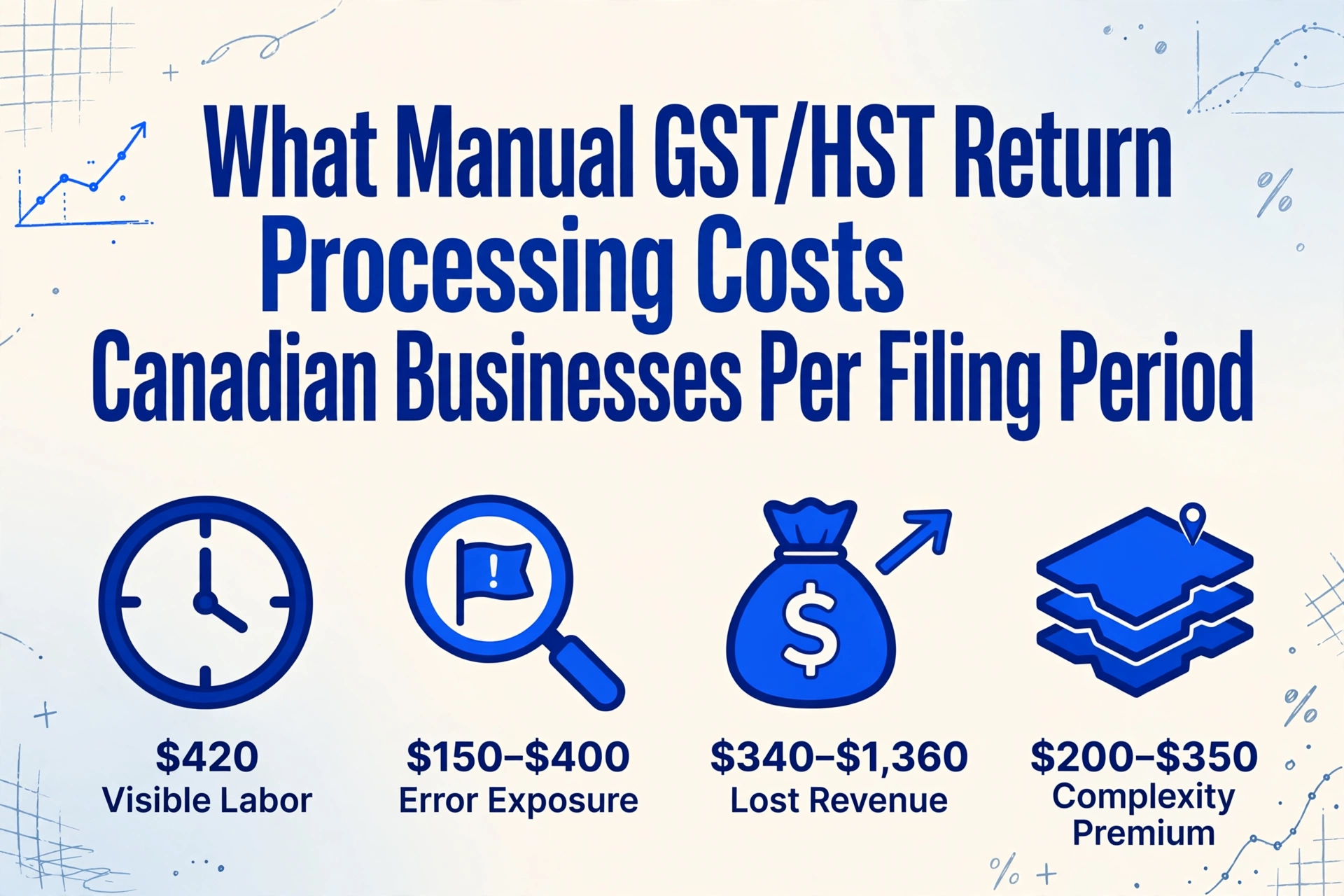
What Manual GST/HST Return Processing Costs
Canadian Businesses Per Filing Period — Four Lines, One Number
A sole proprietor in Mississauga running a small landscaping business can tell you exactly what she pays her bookkeeper per hour: $35. What she cannot tell you — and what almost no Canadian small business owner can tell you — is what manual GST/HST return processing actually costs from end to end. The most visible layer, the bookkeeping invoice, looks too small to measure: $105 per quarter, three hours at $35. It is the other three layers — the ITC that was underclaimed because a Quebec supplier's TPS line was misread in Q2, the CRA interest charged backward to the filing date, the Saturday in April the owner spent retyping invoice data instead of quoting a new job worth $800 — that turn a $105 quarterly line item into a structural drain the income statement never connects. This is a calculation framework for all four cost layers. Substitute your own supplier count, hourly rate, and provincial mix, and you will have a number — not an industry average, not a guess, a defensible cost figure for your own business.
Key Takeaways
- $420 per year — the annual bookkeeping invoice for quarterly GST/HST data entry — is the only cost most businesses measure, and small enough to conclude manual processing costs almost nothing.
- ITC error interest, forfeited Quebec ITC, displaced billable hours, and the provincial rate complexity premium are booked against four different budget lines — wages, compliance, revenue, overhead — and were never added together on a single cost statement.
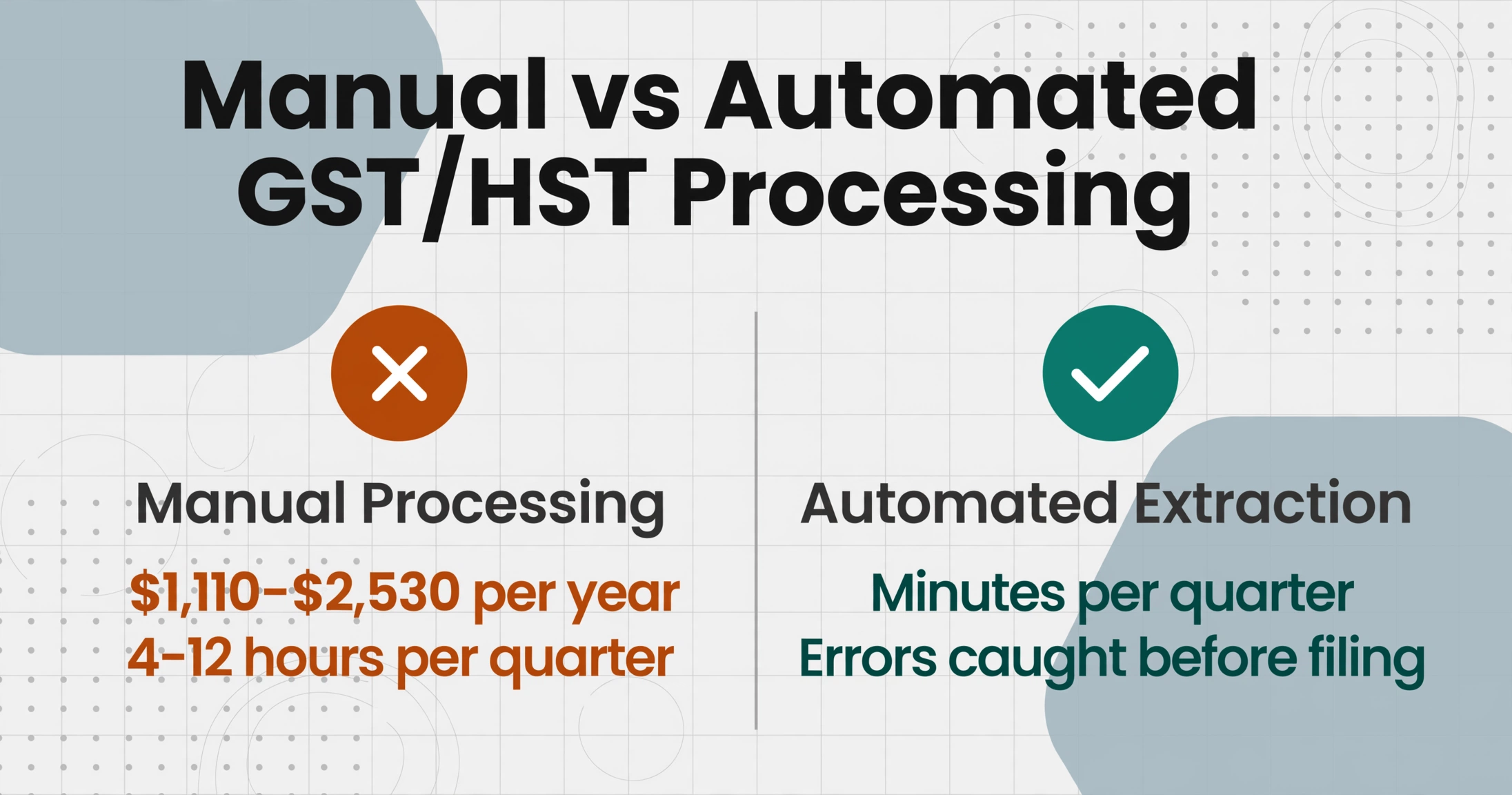
- The fully loaded cost of manual GST/HST processing is $1,110 to $2,530 per year — two and a half to six times the visible bookkeeping line item. Eliminate the transcription step and three of the four cost layers disappear.
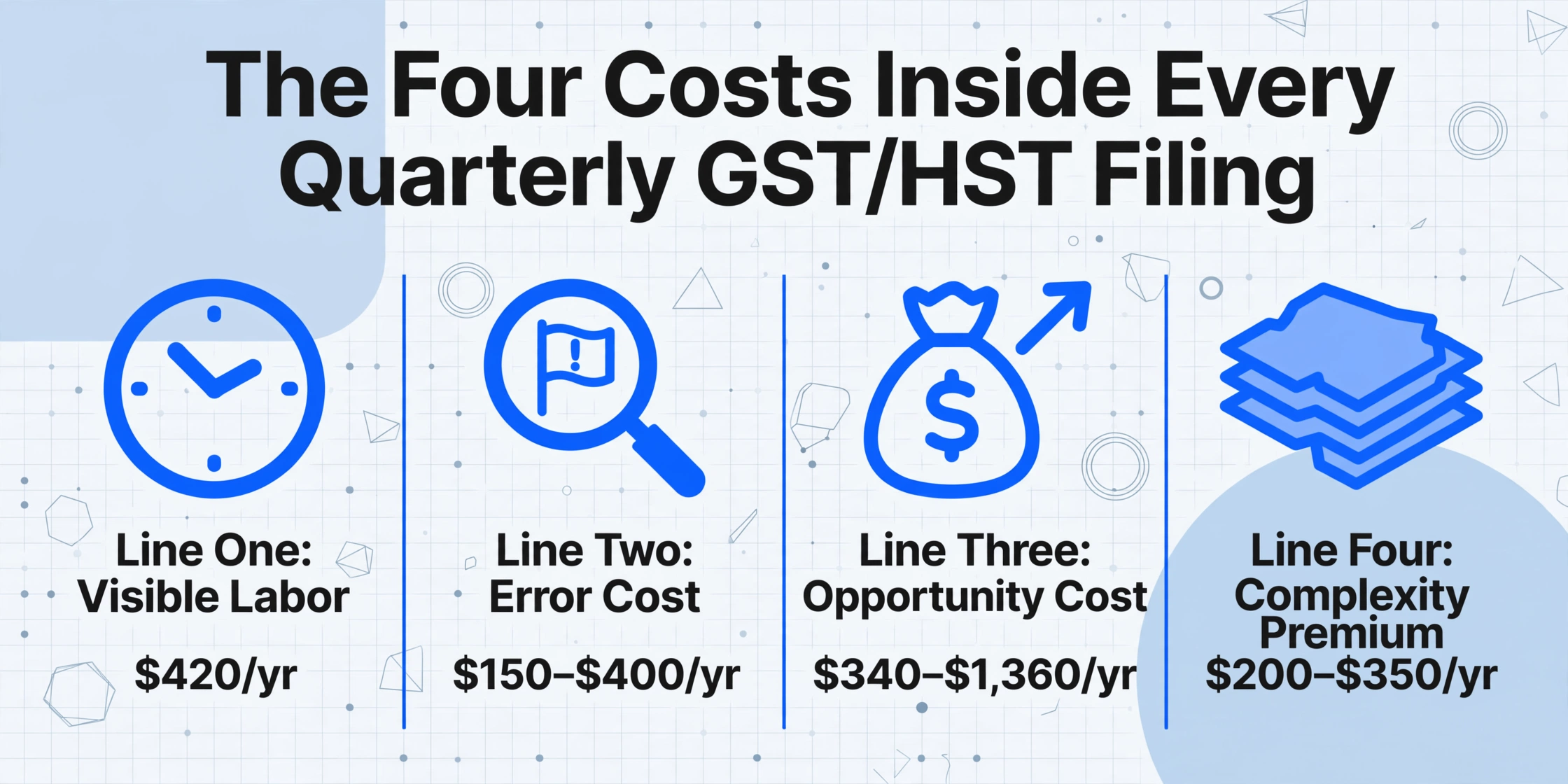
The Four Costs Hiding Inside Every Quarterly GST/HST Filing
Every business registered for GST/HST in Canada must file a return for each reporting period — monthly, quarterly, or annually depending on revenue — using Form GST34-2. That regulatory obligation is not the cost. The cost begins when the bookkeeper or business owner opens the folder of supplier PDFs and starts reading tax lines one invoice at a time.
That person is locating the GST/HST figure on each supplier document — a Home Depot invoice that prints "HST (ON) 13%: $47.32" in the footer, a BC plumbing supplier's receipt with "GST $12.80" handwritten near the total, a Nova Scotia hardware wholesaler's PDF that buries "HST @ 15%" in a multi-line tax summary — and typing each figure into a spreadsheet column. For a small business with 40 supplier invoices per quarter, that is roughly 120 minutes of document reading, rate verification, and data entry. At $35 per hour — the median rate for a bookkeeper in Ontario, with interprovincial variation from roughly $25 in Atlantic Canada to $40 in Vancouver and Toronto — the visible quarterly labor cost is approximately $70. That is the only number most businesses measure. It is also the smallest of the four costs, by a wide margin.
There are four cost lines that behave independently and must be calculated separately. A business that measures only Line One — the bookkeeping hours — will conclude manual GST/HST processing costs $280 per year and make the wrong decision. A business that measures all four will understand why the data entry is the cheapest part of the problem.
Running scenario: A small landscaping business in Mississauga, Ontario. 40 supplier purchase invoices per quarter. Suppliers across Ontario (13% HST), British Columbia (5% GST), Quebec (5% GST + 9.975% QST), and Nova Scotia (15% HST). Bookkeeper at $35 per hour. Quarterly filer. The owner's billable rate is $85 per hour — every hour spent on GST/HST data entry is an hour not spent quoting jobs or managing crews.
Line One — The Visible Cost: Bookkeeping Hours Multiplied by an Hourly Rate
Line One is the only cost most businesses measure, and its size guarantees they never look for the other three. Start with the rate. Bookkeeping rates in Canada vary by province, by certification level, and by whether the work is done in-house or outsourced:
| Who Does the GST/HST Prep | Hourly Rate Range | Typical Quarterly Hours (40 supplier invoices) | Annual Visible Cost (4 quarters) |
|---|---|---|---|
| Business owner (self-prepared) | $40–$120 (opportunity cost) | 2.5–3.5 | $400–$1,680 |
| In-house bookkeeper | $25–$40 | 2–3 | $200–$480 |
| Outsourced bookkeeping firm | $45–$75 | 2–3 | $360–$900 |
| CPA firm (review + filing) | $100–$250 | 1–2 (review only; client provides prepared data) | $400–$2,000 |
The time per quarter varies with three variables: the number of supplier invoices, the number of provinces those suppliers operate in, and the format consistency of the supplier documents. A business whose 40 suppliers are all in Ontario and all send clean PDF invoices with the HST line in a predictable position can process a quarter in roughly two hours. A business whose 40 suppliers span four provinces and send a mix of PDFs, handwritten receipts, and email screenshots — the realistic scenario for a service business that buys materials, equipment, and software — will spend closer to three hours per quarter. Add a Quebec supplier whose invoice splits TPS and TVQ onto separate lines, and the verification step alone consumes an extra two minutes per Quebec invoice compared to an Ontario supplier whose single HST line is unambiguous.
That is the trap: Line One for the landscaping business is $280 per year ($35 × 2 hours × 4 quarters, conservatively). That number is so small it convinces the owner that manual GST/HST processing is essentially free. It is not free. It is front-loaded — the larger costs arrive later, in a different column of the spreadsheet, with compound interest.
Line Two — The Error Cost: What a Single Mistyped ITC Figure Triggers
Manual data entry in a tax context carries a documented per-field error rate between 0.3% and 1%, with the higher end occurring under the deadline pressure and format-switching that define the days before a quarterly filing deadline. At 0.5% per field across 40 invoices with six extracted fields each (240 field entries per quarter), the landscaping business produces roughly one to two transcription errors per quarter. At 1% — realistic when the bookkeeper is processing four clients' returns in a single sitting — that is two to three errors per quarter.
Not every transcription error matters. Typing a supplier name as "Acklands-Grainger" instead of "Acklands-Granger" on the internal spreadsheet has no tax consequence — it is an annoyance. But three types of errors have direct financial consequences:
Type 1: ITC overstatement (wrong rate applied to correct amount)
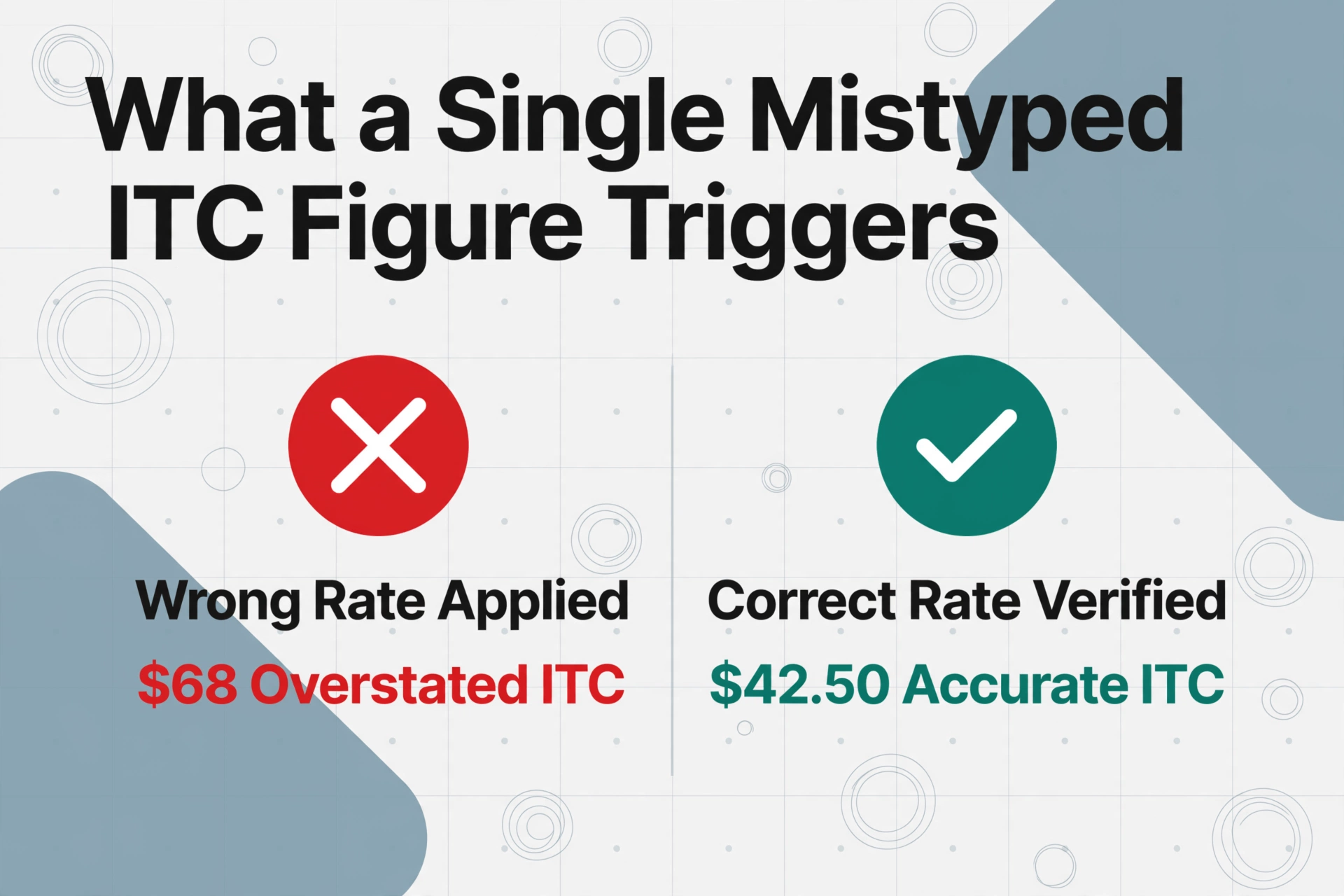
A BC supplier charges 5% GST ($42.50 on an $850 purchase). The bookkeeper, processing 40 invoices, reads the amount correctly but enters the tax rate as 13% — the default mental model for "most of my suppliers." The spreadsheet calculates a $110.50 ITC instead of $42.50. The overstatement is $68.00 on this single invoice. The CRA's GST/HST audit program may not catch this in the current year — but when a future audit does, the excess ITC is reversed with interest calculated under the Excise Tax Act from the original filing date. At the CRA's prescribed interest rate — which compounds daily and is set quarterly — a $68 overstatement discovered two years later accumulates roughly $12 to $18 in interest, plus the principal repayment. Across multiple quarters and multiple supplier invoices, the aggregate ITC overstatement and accumulated interest on a single error pattern repeated four times per year can reach several hundred dollars of unbudgeted liability.
Type 2: ITC understatement (correct amount, wrong line, or Quebec QST inclusion skipped incorrectly)
A Quebec supplier invoice shows TPS ($23.50) and TVQ ($46.88) on separate lines. The bookkeeper, unsure whether to include both, omits the entire line rather than extracting only the TPS portion. The $23.50 federal ITC is lost — and while the CRA allows amended GST/HST returns to correct understatements, the amendment itself requires time to prepare and file. At the bookkeeper's $35 hourly rate and roughly 30 minutes to prepare and submit a single line amendment, the cost to recover $23.50 is $17.50 — a 74% recovery cost. Most small businesses do not bother amending for amounts this small. The ITC is simply lost. Over four quarters, a pattern of Quebec supplier ITC understatement can accumulate to $100 to $300 of permanently forfeited credits — money the business was legally entitled to claim but did not, because the manual entry step between the Quebec PDF and the spreadsheet consumed the margin.
Type 3: Net tax miscalculation from accumulated rounding errors across five rate categories
When the bookkeeper manually sums 40 ITC figures, each rounded to the nearest cent, the accumulated rounding error across four different tax rates (5%, 13%, 15%, plus Quebec's split) can produce a Line 109 net tax figure that differs from the CRA's automated reconciliation by $2 to $5. The CRA's processing system flags discrepancies — any net tax difference — automatically. The letter that arrives requests an explanation. The bookkeeper spends 30 minutes locating the discrepancy, which turns out to be rounding. The CRA closes the file. The 30 minutes cost $17.50. The letter itself cost nothing — but arriving during a different quarter's filing period, it consumed capacity that was needed for the current return. This is the cost that never appears in a budget line: compliance friction that is too small to trigger a process change but large enough to burn an hour every year.
A full accounting of Line Two for the landscaping business, covering ITC overstatement interest exposure, forfeited ITC from Quebec supplier understatement, and compliance friction overhead, conservatively lands between $150 and $400 per year — roughly 50% to 140% of the visible labor cost in Line One. And this estimate assumes only one or two material errors per year. A business with a higher supplier count, more provinces, or a less experienced bookkeeper will see Line Two exceed Line One.
Line Three — The Opportunity Cost: What You Give Up to Do Your Own GST/HST Data Entry
Line One prices the hours spent on data entry. Line Three prices what those hours displace — the revenue-generating or business-building work the owner cannot do because the quarterly filing window consumed the available time.
For a business owner who self-prepares the GST/HST return, the opportunity cost is straightforward: every hour spent locating tax lines on supplier PDFs is an hour not spent quoting new business, managing operations, or generating billable work. The landscaping business owner at $85 per hour opportunity cost pays herself $340 in lost revenue per quarter ($85 × 4 hours including the extra verification and reconciliation time that self-preparers typically incur). Annualized: $1,360.
For a business that uses an in-house bookkeeper, the opportunity cost is subtler but arguably larger. The bookkeeper who spends three hours per quarter on GST/HST data entry — opening PDFs, typing tax amounts, cross-referencing provincial rates — is consuming capacity that could be applied to higher-value work: reconciling the general ledger, analyzing expense trends, preparing management reports, flagging unusual supplier charges. These are tasks that require judgment rather than transcription, and they are the tasks that get deferred to "after the GST/HST is filed" — which, in a quarterly cycle, means they are perpetually three months behind.
The bookkeeper's time has a hard ceiling. Three hours of manual GST/HST data entry per quarter is 12 hours per year that cannot be spent on anything else. At $35 per hour, the direct cost is $420. The displaced value — the management reports not prepared, the expense anomalies not investigated, the supplier overcharges not caught — is harder to price but larger. A single undetected supplier overcharge of $200 — a common occurrence when invoices are processed for tax extraction only and not reviewed line by line for accuracy — wipes out the entire annual savings of doing the data entry in-house.
What the landscaping business misses: the bookkeeper's three hours per quarter is not a fixed cost that disappears by doing it herself. When the owner does the data entry, the bookkeeper does other work instead — and the owner absorbs the opportunity cost directly. When the bookkeeper does the data entry, the owner avoids the opportunity cost but pays the labor cost and loses the bookkeeper's higher-value capacity. Either way, the data entry hours are a deadweight loss on the business — they produce no revenue, no insight, and no strategic value regardless of who performs them.
Line Four — The Provincial Rate Complexity Premium: Why Canada's Multi-Rate GST/HST System Inflates Every Line Above
Most countries with a value-added tax have a single national rate. Canada's GST/HST system — with federal GST at 5% in the non-HST provinces, HST at 13% in Ontario, and HST at 15% in the Atlantic provinces, plus Quebec's separate GST/QST administration — introduces a complexity multiplier that inflates all three preceding cost lines.
In a single-rate jurisdiction like Australia (10% GST nationwide), the bookkeeper's only verification task is "is this purchase GST-bearing?" In Canada, the bookkeeper must verify the supplier's province, confirm the tax rate, determine whether the rate is federal (GST or HST) or provincial (QST, PST), and extract only the federal component for the GST/HST return. This verification step — which has no equivalent in a single-rate system — adds roughly 30 to 60 seconds per supplier invoice compared to a single-rate counterpart. Across 40 invoices per quarter, that is 20 to 40 minutes of additional labor per quarter, or $47 to $93 per year at $35 per hour — the "provincial complexity premium" embedded in Line One.
The same complexity inflates Line Two: the probability of a transcription error increases with the number of decisions the bookkeeper must make per invoice. A single-rate system requires one decision per invoice ("is this GST-bearing?"). The Canadian system requires three decisions per invoice: what province is the supplier in, what rate applies, and is any portion provincial rather than federal. At 40 invoices per quarter and three decisions per invoice, that is 120 decision points per quarter — and a 0.5% error rate across 120 decisions produces roughly 0.6 errors per quarter, compared to 0.2 errors in the single-rate equivalent. The error differential is entirely structural — it is not about the bookkeeper's competence, but about the regulatory complexity of the environment they are transcribing data in.
Line Three is inflated too: the time the owner or bookkeeper spends on provincial rate verification is the time most vulnerable to interruption and the least automatable within the manual workflow. You cannot speed-read a Quebec supplier invoice and reliably distinguish the TPS line from the TVQ line — both say "tax" in French, both sit near the total, and both look identical at a glance. That distinction requires focused attention. Focused attention on a tax-rate verification step, repeated 160 times per year, is the most expensive type of labor a small business can buy — because it consumes the same cognitive resource needed for quoting, planning, and decision-making, and it produces nothing but a number that was already printed on the page.
The provincial complexity premium, annualized for the landscaping business: $70 in extra verification labor (Line One), $80 in additional error exposure from multi-decision fatigue (Line Two), and roughly $200 in displaced higher-value capacity (Line Three). Total provincial complexity premium: approximately $350 per year — a cost that does not exist for the same business in a single-rate jurisdiction, and a cost that is entirely a function of reading tax rates off supplier PDFs instead of having them read automatically.
What the Alternative Costs — and Why the Comparison Changes the Decision
The four cost lines for the landscaping business, conservatively estimated:
| Cost Line | Description | Annual Estimate |
|---|---|---|
| Line One | Bookkeeping labor: 3 hours/quarter × $35/hour × 4 quarters | $420 |
| Line Two | Error cost: ITC overstatement interest exposure + forfeited Quebec ITC + compliance friction | $150–$400 |
| Line Three | Opportunity cost: displaced billable hours (owner self-prepares) or displaced bookkeeper capacity (delegated) | $340–$1,360 |
| Line Four | Provincial complexity premium: extra verification labor + multi-decision error exposure + cognitive load on high-value tasks | $200–$350 |
| Total Annual Cost of Manual GST/HST Processing | $1,110–$2,530 | |
The visible cost — the bookkeeping invoice — is $420 per year. The actual cost is two and a half to six times that figure. The gap between the two numbers is not waste or inefficiency. It is the structural consequence of moving tax data from PDFs to spreadsheets by hand, in a jurisdiction with five federal tax rates, across suppliers who change their invoice formats annually.
The alternative is not a different bookkeeper or a faster typing process. It is removing the transcription step at the point where it happens — the gap between the supplier PDF and the spreadsheet column. The GST/HST extraction workflow replaces the three hours of manual data assembly with a few minutes of document upload and a verification pass. Instead of opening 40 PDFs one at a time, locating the tax line, verifying the province, and typing — the bookkeeper uploads the quarter's folder of supplier documents, defines six columns (Supplier Name, Invoice Date, Invoice Total, GST/HST Paid, Tax Rate Applied, Province of Supplier), and receives a spreadsheet with every tax figure already in its column. The quarterly batch workflow extends this into a year-round system: the same column schema run against each quarter's documents, producing four spreadsheets that stack into one annual tax summary without manual reconciliation.
The economics shift accordingly. The three hours of data assembly per quarter become roughly 15 minutes of upload and review. The bookkeeper's time drops from 12 hours per year to 1 hour. The error rate — previously driven by 40 manual reads and 120 provincial-rate decisions per quarter — drops to near zero for the types of errors that manual transcription produces, because the transcription step no longer exists. The provincial complexity premium disappears entirely — the AI reads "TPS 5%" on a Quebec supplier invoice and extracts only the federal component because the column name tells it to, and it makes the same decision on the 40th invoice as it did on the first.
This pattern is not unique to Canadian GST/HST. The Australian BAS cost analysis traces the same four cost layers through a single-rate GST system — the provincial complexity premium disappears, but the data-assembly labor, error exposure, and opportunity cost remain structurally identical. The Canadian T4 processing cost framework applies the same four-line methodology to payroll year-end — where a single mistyped CPP contribution triggers a CRA PIER review that costs days of correction labor. In every case, the most expensive line is never the typing itself. It is what the typing triggers, months later, in a different cost centre, with compound interest the original budget line never accounted for.
The manual GST/HST data entry problem is not that it takes too long. It takes exactly as long as the task requires — two to three hours per quarter. The problem is that the task itself is pure format translation: the PDF says a number, the spreadsheet needs that number, and a person stands between them reading one and typing the other. A task that adds no judgment, no interpretation, and no value beyond the transfer — and costs $1,110 to $2,530 per year in labor, errors, and displaced capacity to perform — is a task worth eliminating, not optimizing.
FAQ: The Cost of Manual GST/HST Processing
How does the cost compare between filing monthly versus quarterly?
Monthly filers — generally businesses with annual taxable supplies above $6 million or those who have elected monthly filing — process one return per month instead of four per year. The per-return data assembly time is similar (the supplier invoice count per month is roughly one-third of the quarterly count), but the annual total is higher because the setup overhead — opening the spreadsheet, loading the column template, orienting to the supplier folder — repeats 12 times instead of 4. A quarterly filer with 40 invoices per period and 2 hours of assembly per quarter spends roughly 8 hours per year on data entry. A monthly filer with 13 invoices per period and 45 minutes of assembly per month spends roughly 9 hours per year — roughly similar in total, but with higher overhead from the increased filing frequency. The error cost (Line Two) is proportionally higher for monthly filers because the compressed turnaround between periods reduces the time available for verification.
How much does it cost to have a CPA firm handle my GST/HST filing instead of doing it myself?
A CPA firm typically charges $150 to $400 per quarterly GST/HST return preparation and filing, depending on the complexity of the business and the volume of supplier documents. At four quarters per year, the annual cost is $600 to $1,600. This covers the preparation, review, and NETFILE lodgement — but it assumes the business owner or bookkeeper has already organized the supplier documents and provided a reconciled summary of purchases. If the CPA must also extract the GST/HST data from individual supplier invoices, the cost rises. The cost framework in this article applies whether the data entry is done by an owner, a bookkeeper, or a CPA — only the hourly rate changes. At CPA rates of $100 to $250 per hour, the three hours of data assembly per quarter becomes $300 to $750 per quarter, or $1,200 to $3,000 per year, before any review or filing work. This is the ceiling of what manual GST/HST processing can cost — and the number that makes the alternative of automated extraction, at a fraction of a single quarter's CPA data-entry cost, worth comparing.
What if my supplier invoices are mostly from one province — does the provincial complexity premium still apply?
Partially. A business whose suppliers are concentrated in a single province — a Toronto-based retailer buying almost exclusively from Ontario wholesalers — faces a lower provincial complexity premium because the verification step is a single check (13% HST for all invoices) rather than a multi-rate check. But the premium does not disappear entirely: the business still occasionally buys from outside Ontario — a software subscription from a BC-based SaaS company charging 5% GST, equipment from a Quebec manufacturer, supplies from an Atlantic Canada distributor — and those outlier invoices are the ones most likely to produce errors because they do not match the bookkeeper's default mental model of "my suppliers all charge 13%." A single BC supplier charging 5% GST, processed alongside 39 Ontario suppliers charging 13% HST, is the invoice most likely to have its GST amount entered as an HST figure — and the overstatement, while small per invoice, is the error pattern the CRA's automated reconciliation is designed to detect.
Does the cost framework change if I use the Quick Method instead of the Regular Method?
Yes — the data assembly workload shifts but does not disappear. Under the Quick Method, you do not claim ITCs on individual purchases, so the purchase-side data entry (reading GST/HST lines off supplier invoices) is eliminated from the quarterly workflow. Instead, the data assembly work moves to the sales side: you must total your GST/HST-included sales for the period, which still requires extracting revenue figures from invoices, receipts, and payment records. The Quick Method reduces the overall data entry burden — fewer fields to extract per transaction — but the format translation problem is the same: the sales data lives in documents the spreadsheet cannot read, and a person stands between them. The cost framework adjusts by lowering Line One (fewer hours of data assembly) and Line Two (fewer ITC-specific errors) but Line Three (opportunity cost) and Line Four (remaining complexity) stay proportionally similar.
How do I calculate my own number using this framework?
Start with four inputs: your supplier invoice count per quarter, your bookkeeper's or your own hourly rate, the number of provinces your suppliers operate in, and your quarterly filing hours as you currently experience them. Multiply hours by rate for Line One. For Line Two, assume one to two transcription errors per year at your rate × 30 minutes of correction time each, plus a conservative estimate for forfeited ITC from complex invoices (Quebec suppliers with split TPS/TVQ lines, handwritten receipts where the tax line is ambiguous). For Line Three, if you self-prepare, use your billable or revenue-generating hourly rate; if you delegate, estimate the higher-value bookkeeping tasks that are being deferred. For Line Four, if you have suppliers in two or more provinces, add 10-15% to the sum of Lines One through Three as the complexity premium. The total is your number. Compare it against the cost of eliminating the transcription step — a few minutes of upload and verification per quarter — and the decision framework is complete.
The cost of manual GST/HST processing is not the bookkeeping invoice. It is the sum of four independent costs, of which the invoice is the smallest. The other three — errors, displaced capacity, and the provincial complexity premium — cost more, arrive later, and are never booked against the budget line that authorized manual entry. Put them on one line, once a year, and the decision to eliminate the transcription step stops being a cost question and becomes an arithmetic one.