What Manual T4 Processing
Costs Canadian Employers — Four Lines, One Number
Most Canadian employers can quote the penalty for filing T4 slips late: $100 a day, capped at $7,500. But almost no employer can tell you what manual T4 processing actually costs them from end to end — because the most visible layer, the five hours of typing in February, looks too cheap to measure. The four costs that determine whether manual entry is an acceptable expense or a structural drain on the payroll department are the ones underneath that layer: the PIER correspondence that consumes days in July, the February strategic work that never happens, and the CRA reassessment interest that compounds backwards to the first pay period where a mistyped Box 16 diverged from the correct contribution. This is a calculation framework for all four lines. Substitute your own employee count and hourly rate, and you will have a number — not an estimate, not a guess, a defensible line item for next year's budget.
Key Takeaways
- $278 is what you think manual T4 entry costs — the real number is $3,100 to $4,700, spread across payroll rework, compliance overhead, and the strategic reviews that never happen because February's capacity was consumed by data entry.
- Each transcription error during the February crunch becomes a CRA PIER assessment letter between May and October, costing four hours of correction labor per flagged employee — and those four hours are never booked against the budget line that authorized manual entry back in February.
- The only variable that eliminates all four cost lines at once is removing the transcription step — which does not require changing your payroll system, your T4 Summary process, or your filing workflow, only how the data moves from the slip into the spreadsheet.
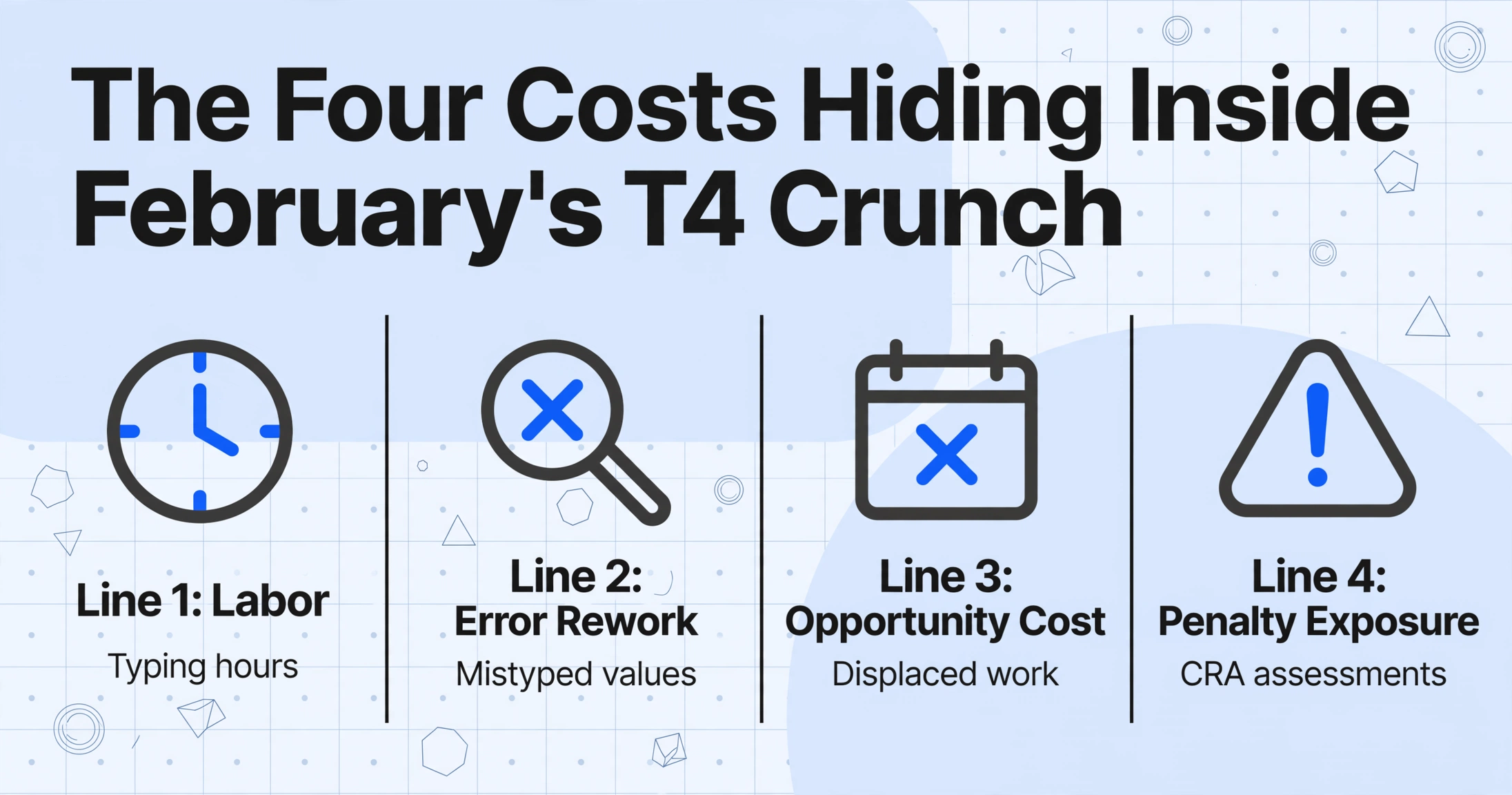
The Four Costs Hiding Inside February's T4 Crunch
Every employer in Canada who paid employment income during the calendar year must issue a T4 (Statement of Remuneration Paid) to each employee and file the slips with the CRA by the last day of February. That regulatory obligation is not the cost. The cost begins when the payroll software — Ceridian Dayforce, ADP Workforce Now, QuickBooks Canada Payroll, Wagepoint — finishes generating the PDFs and a person opens Excel to start typing.
That person is moving roughly twelve Box values per T4 — Box 14 (Employment Income), Box 16 (Employee CPP contributions), Box 16A (CPP2 contributions), Box 18 (EI premiums), Box 22 (Income Tax Deducted), Box 24 (EI Insurable Earnings), Box 26 (CPP Pensionable Earnings), and five to six more depending on the employee's benefit profile — from a PDF into a spreadsheet, into the T4 Summary, into a general ledger reconciliation, and sometimes into an auditor's workpaper. For a company with 150 employees, that is roughly 1,800 individual values transcribed by hand in a compressed two-to-three-week window. The typing itself costs almost nothing. What it triggers, beginning the moment a single digit is wrong, costs considerably more.
There are four cost lines that behave independently and must be calculated separately. A company that measures only Line One — the hourly cost of the typing — will conclude manual T4 processing is trivially inexpensive and make the wrong decision. A company that measures all four will understand why the PwC report commissioned by the Canadian Payroll Association — now the National Payroll Institute — found that payroll compliance costs Canadian employers $12.5 billion annually, with compliance activities consuming 56.1% of payroll professionals' work hours. Here are the four lines, built on a single running scenario — a midsize employer with 150 employees operating across three payroll platforms inherited through acquisitions — with the formula to substitute your own numbers.
Running scenario: 150 employees. Three payroll platforms — Ceridian Dayforce (head office), ADP Workforce Now (acquired subsidiary), and QuickBooks Canada Payroll (project-based division). Each platform generates T4 slips with the same CRA-mandated Box numbers in different visual layouts. One payroll administrator earning $30 per hour median, loaded cost approximately $37 per hour after employer CPP, EI, workers' compensation, and benefits. The company files T4s electronically through Internet file transfer in XML format.
Line One — The Labor Cost That Looks Too Small to Matter
Line One is the only cost most employers measure, and its size guarantees they never look for the other three. Start with the rate. A payroll administrator in Canada earns a median of roughly $30 per hour, according to Statistics Canada's Labour Force Survey, with the interquartile range running from $20 to $43. At $30 gross, the fully loaded employer cost — employer CPP at 5.95% on pensionable earnings, employer EI at 1.4 times the employee rate (1.83% in 2025, employer rate of 2.564%), provincial workers' compensation premiums, and benefits — lands near $37 per hour. A senior payroll professional or controller reviewing the output earns closer to $45-$50 loaded.
Now the time. Transcribing the twelve core Box values from a single-platform T4 into a spreadsheet — locating the PDF, reading each Box, typing it, glancing back to verify — takes approximately two minutes per slip when the layout is consistent and the administrator is working uninterrupted. But most Canadian employers who have grown through acquisition do not operate a single payroll platform, and each platform switch adds a re-orientation cost: the Box 14 value sits in a different visual position on a Ceridian-rendered T4 than on an ADP-rendered T4, and the administrator must pause to locate the grid on each new layout before typing. Across a batch split three ways — 70 employees on Ceridian, 50 on ADP, 30 on QuickBooks — that platform-switching friction adds roughly a minute per slip averaged over the batch, bringing the realistic time to three minutes per T4.
At three minutes per T4 and $37 per hour loaded, the 150-employee company spends 7.5 hours — approximately $278 — on pure transcription each February. If cross-referencing is required — verifying Box 16 against a separate CPP remittance report, or checking taxable benefits calculations that affect Box 40 and cascade into Box 14 — the time rises to four or five minutes per slip, and the cost approaches $463. That is a single working day of labor. In the context of a department's annual budget, a day is invisible.
That is the problem: Line One is so small it convinces organizations that manual T4 processing is free. It is not free. It is front-loaded — the bill arrives later, in a different department, with compound interest.
Line Two — What Every Mistyped T4 Box Value Actually Costs
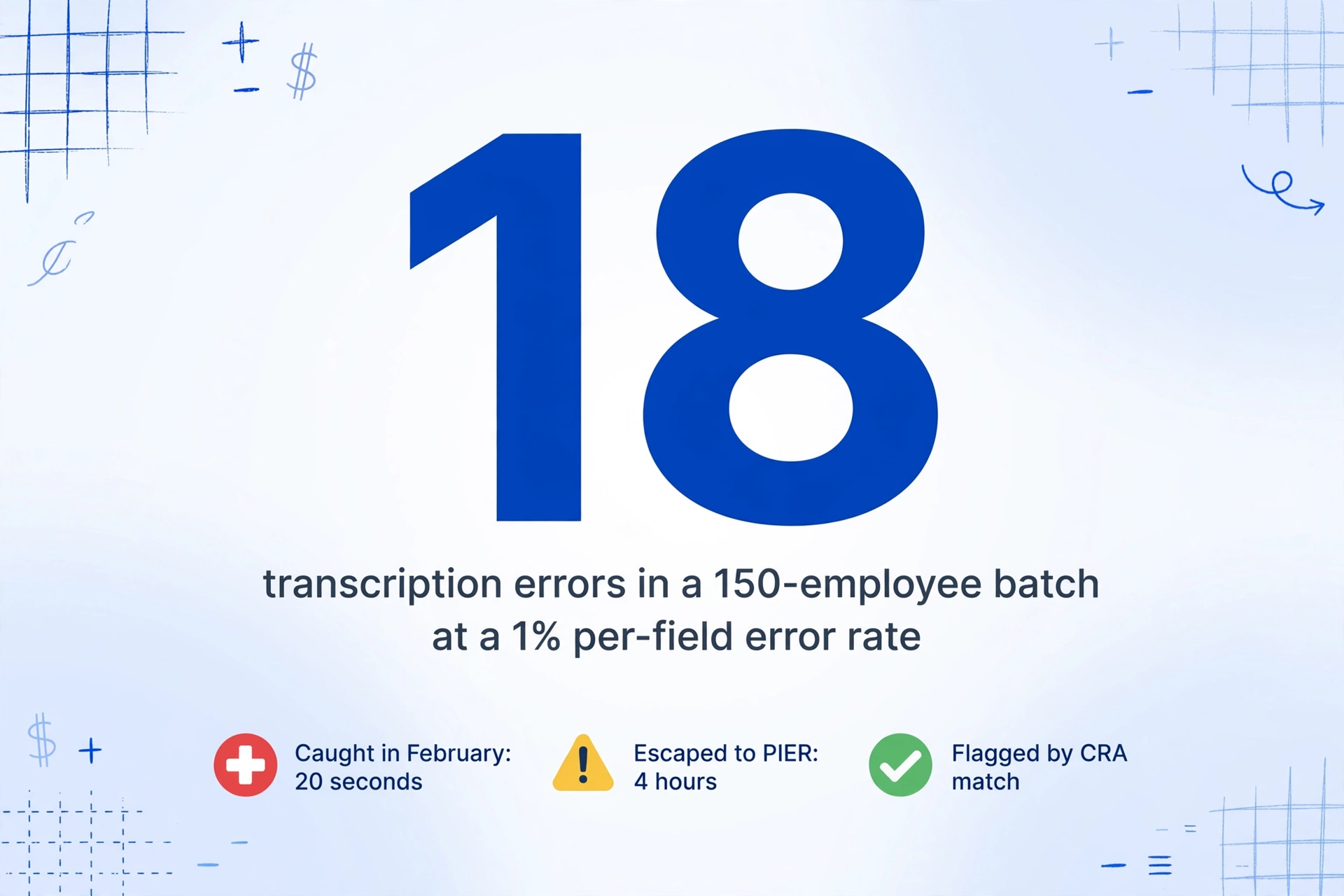
Manual data entry in payroll contexts carries a documented per-field error rate between 0.3% and 1%, with the higher end occurring under the deadline pressure, platform-switching, and interruption patterns that define February in a Canadian payroll department. At a conservative 0.5% per field across 1,800 values, a 150-employee batch contains nine transcription errors the moment the spreadsheet is saved. At 1% — realistic for a multi-platform environment with last-minute corrections and a compressed deadline — that is eighteen errors.
Each error has two costs: the cost of catching it, and the cost of the ones that escape. The catch cost is the smaller one. If the payroll administrator spots that Box 16 ($4,086) was typed as $4,068 during a verification pass, the fix is a keystroke — twenty seconds. But most manual entry errors are not caught during February, because the verification pass is a visual scan across 1,800 numbers at the end of a long day, and the human brain normalizes the difference between $4,086 and $4,068 when it sees both dozens of times. The errors that escape February surface months later, and their correction cost is what makes Line Two the largest line in the framework for most employers.
The CRA's Pensionable and Insurable Earnings Review (PIER) program runs an automated cross-match after all T4 slips are filed. It divides every employee's reported Box 16 (CPP contributions) by their Box 26 (pensionable earnings, minus the $3,500 basic exemption) and compares the result to the statutory rate — 5.95% for the 2025 tax year. If the effective rate deviates beyond tolerance, the employee is flagged. A single miskeyed Box 16 changes that rate enough to trigger the flag, even though the payroll system calculated the correct contribution all along. The companion article on why manual T4 entry keeps getting worse every February traces the full mechanism of how one mistyped digit becomes a six-month problem.
When the PIER assessment letter arrives — typically between May and October — the payroll department must locate the original T4 PDF for every flagged employee, compare the slip's actual Box values against the spreadsheet entries, determine whether the error was transcription or a genuine payroll discrepancy, file amended T4 slips marked "AMENDED," reconcile the T4 Summary against the corrected data, and if the discrepancy was a genuine under-remittance, remit the difference plus interest calculated from the first pay period where the remittance should have been made. For a single flagged employee whose error is pure transcription, this cycle consumes two to six hours of payroll staff time. At $37 per hour loaded, that is $74 to $222 per flagged employee.
The nine transcription errors in the 150-employee scenario produce approximately six to eight PIER flags — not every transcription error triggers a CPP/EI rate mismatch, but roughly two-thirds do because Box 16 and Box 26 are among the most commonly mistyped values. At four hours per response, the direct PIER correction cost is approximately $888 to $1,184. But the direct PIER cost is not the end of Line Two.
Each amended T4 slip triggers downstream consequences the payroll budget does not capture. The employee whose Box 22 (Income Tax Deducted) was wrong must file an amended T1 personal tax return if the correction affects their refund or balance owing. The payroll administrator is now managing employee communications alongside CRA correspondence — explaining why a corrected T4 arrived months after the original, what changed, and whether the employee needs to act. That administrative time sits in the HR budget, not the payroll budget. The T4 Summary revision that follows every amended slip sits in the compliance budget. The auditor's sample trace for a single flagged employee — the step that confirms the corrected Box values match the payroll register — sits in the audit budget. None of these transactions are recorded under a cost centre called "manual T4 entry corrections." The fragmentation keeps the cost invisible.
A full accounting of Line Two for the 150-employee scenario, covering direct PIER response labor, amended filing overhead, employee communication, and T4SUM reconciliation, conservatively lands between $1,500 and $2,500 — roughly five to nine times the direct transcription labor in Line One.
Line Three — The February Work That Does Not Get Done
Line One prices the hours spent typing. Line Three prices what those hours displace — the higher-value work the payroll team cannot do because February's 7.5 hours of data entry are consumed by transcription instead of judgment.
February in a Canadian payroll department is already compressed. The calendar flips from January year-end processing — final pay periods, T4 preparation, last-chance corrections — directly into the T4 filing window, which for the 2025 tax year closes on March 2, 2026 (February 28 falls on a Saturday). During this window, the payroll administrator who is typing 1,800 Box values is not doing any of the following: reviewing year-end CPP and EI remittance reconciliations for anomalies that signal a payroll setup error, preparing the T2200 declaration of conditions of employment for remote employees, updating taxable benefit tracking for the new calendar year, testing the CPP2 calculation in the payroll system against the new YAMPE thresholds, or reviewing the province-of-employment codes on employee records — the coding error that, if left uncorrected, generates a year of wrong provincial tax withholdings.
Each of these displaced tasks has a cost whose denominator is not the hour, but the consequence. A missed CPP remittance reconciliation that surfaces at the October PIER window costs the same as a transcription error — except the error was not a typo, it was a systemic configuration issue that sat unexamined for eight months because February's capacity went to manual data entry. A wrong province-of-employment code for a single employee earning $85,000 is a year of incorrect provincial tax withholdings on $85,000, which the employee discovers in April of the following year when their T1 return triggers a notice of reassessment.
Quantifying opportunity cost is inherently imprecise, but a reasonable approach prices the displaced hours at the rate the organization would pay for them if they were done separately — typically at the controller or external accountant rate of $55 to $90 per hour — rather than at the payroll administrator's loaded rate. Seven-and-a-half hours of displaced strategic review, conservatively priced at $65 per hour, adds approximately $488 to the annual manual T4 processing cost. For an organization that outsources its year-end reconciliation to a CPA firm at $175 per hour, seven-and-a-half hours of avoided in-house review time that the external accountant must now perform represents $1,313 in billable fees that would not exist if the internal team had February capacity.
Line Four — What the CRA Charges When the Numbers Are Wrong
Line Four is the hard penalty exposure — the amounts the CRA assesses when a T4 filing is late, incomplete, or contains errors that produce a remittance shortfall. Unlike Lines Two and Three, which are probabilistic, Line Four is triggered with certainty when specific conditions are met.
Start with late filing. Under the CRA's penalty structure for information returns, the penalty for filing the T4 Summary after the deadline is $100 per day, to a maximum of $7,500. The minimum penalty is $100 even if you are one day late. If you file more than five slips on paper instead of electronically, a separate $250 penalty applies. These amounts are small relative to the correction cost of errors, but they are the penalty most payroll managers know by heart — which is why they incorrectly assume manual entry's cost is bounded by a few hundred dollars.
The penalty that actually matters for manual T4 processing is the PIER reassessment, and it is not a flat fee. When the CRA's automated matching detects a discrepancy between the employer's reported CPP and EI contributions and the amounts that should have been remitted based on reported pensionable and insurable earnings, the CRA reassesses the employer for the shortfall plus compound daily interest. The interest is calculated from the first pay period where the under-remittance occurred — not from the assessment date, not from the T4 filing date, but from the pay period, which for a January error means interest running for the entire calendar year before the PIER letter even arrives. For a $500 CPP under-remittance attributable to a single mistyped Box 16, the direct amount owed is $500. With compound interest at the CRA's prescribed rate — 9% for the first quarter of 2026, adjusted quarterly — and a twelve-month lookback window applying to a January pay period error, the interest adds roughly $45. If the same employer has the same configuration error or transcription pattern in consecutive years, the CRA can assess a $2,500 penalty per instance under the repeated-failure provision. That penalty applies even if the amounts involved are small.
The probabilistic cost of Line Four for the 150-employee scenario can be estimated by multiplying each penalty tier by its probability of occurrence in a given year. Late filing of the T4 Summary — unlikely if the organization files on time — carries a near-zero probability cost. A PIER reassessment triggered by transcription errors — likely given a 0.5% per-field error rate producing nine wrong values — carries a 60-80% probability of generating at least one PIER flag requiring a monetary correction. Prudent budgeting assigns a value of $800 to $1,200 to annual penalty exposure for a manual-entry employer of this size. The number is not large, but the pattern is: you are paying roughly $1,000 a year for the right to keep typing.
The four-line total for a 150-employee, multi-platform Canadian employer: approximately $3,100 to $4,700 per tax season — roughly $21 to $31 per employee per year — to move data from T4 slips into spreadsheets by hand. The $278 of Line One labor is less than 10% of the total cost. The remaining 90% is the downstream correction, displacement, and penalty exposure that manual transcription sets in motion.
The Multi-Platform Multiplier: Why More Payroll Systems Create More Than More Typing
If your organization has acquired another company, inherited a different payroll platform, and now issues T4s from two or more systems, the costs in the framework above do not add — they multiply. A single-platform employer transcribing 150 consistently formatted T4s enjoys a motor routine: the eye goes to the same position on every slip, the Box grid is a familiar landscape, and the error rate settles near the low end of the range. A multi-platform employer — the more common case in Canada, where the mid-market is consolidating — must re-orient between layouts, increasing both the time per slip and the cognitive load that drives the per-field error rate higher.
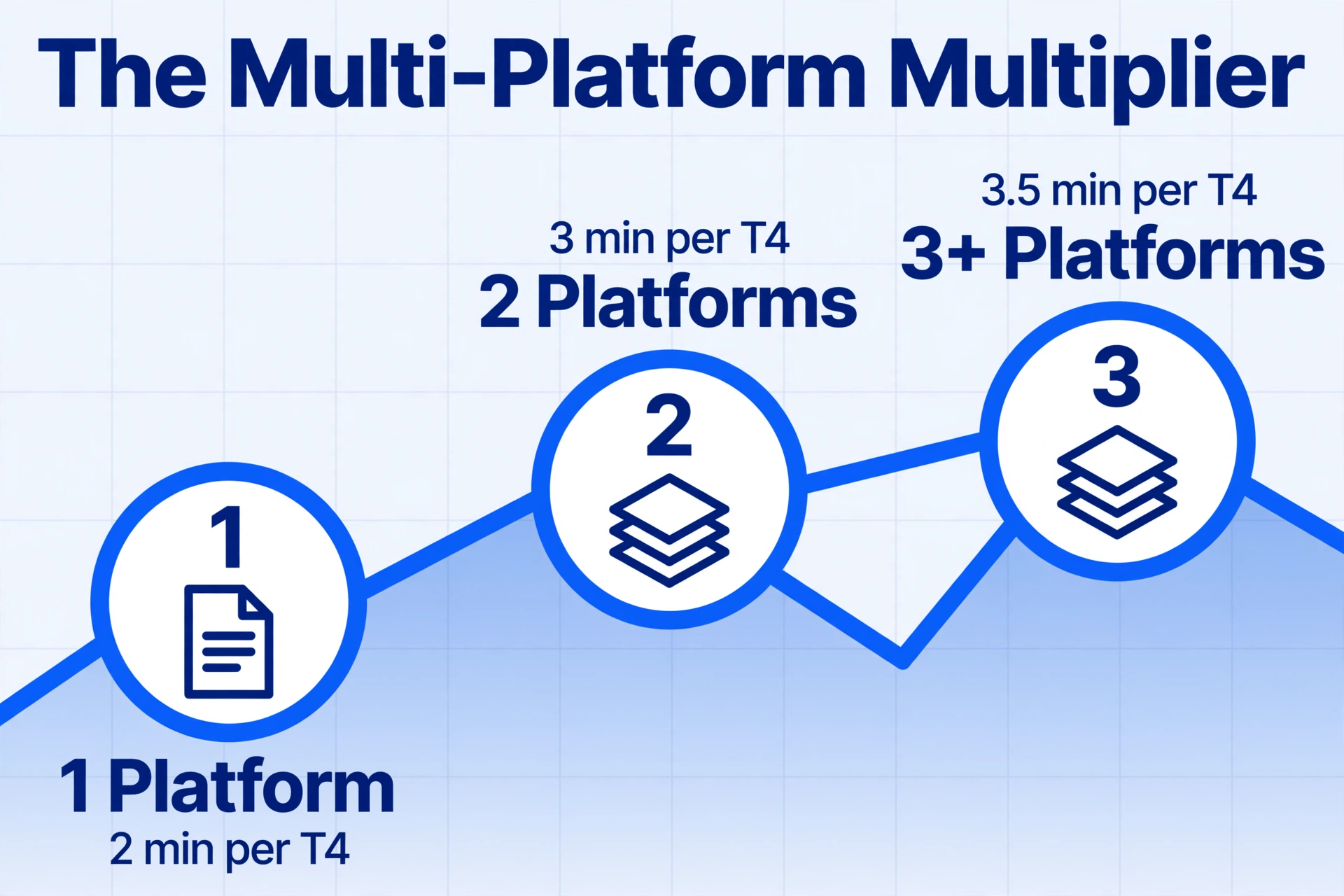
The mechanism is not a mystery. Each platform switch requires the brain to locate a new visual grid for the same Box numbers, and during that re-orientation the fingers are still typing — either from the previous slip's layout or from muscle memory of the primary platform. Under these dual-task conditions, per-field error rates rise measurably. Two platforms push the time per T4 from two minutes to roughly three. Three platforms push it past three-and-a-half. The 150-employee scenario with three platforms generates roughly eighteen transcription errors at a 1% rate — double the single-platform count — and a proportional increase in PIER flag probability, amended filing frequency, and displaced strategic review time.
This is also the cost that an acquisition due-diligence checklist never captures. The acquiring company calculates the acquired entity's payroll cost as the combined salary of their payroll staff, plus the per-employee-per-month fee of the acquired payroll platform. It never calculates the year-end reconciliation cost of operating two or three visually distinct T4 layouts under a single T4 Summary deadline — because nobody has ever measured that cost as a separate line.
Your Numbers: Substitute and Calculate
The intention of this framework is not to give you a number, but to let you produce your own. Here is the formula with the variables isolated:
The Four-Line T4 Manual Processing Cost Formula
Where T = 2 min (single platform), 3 min (two platforms), or 3.5 min (three+ platforms). Use R = $37 as a default loaded rate for a payroll administrator.
Use E = 0.5% (single platform) or 1% (multi-platform). Use P = 0.67 (two-thirds of errors trigger CPP/EI rate mismatches). Use H = 4 hours per PIER response. Add 15% overhead for amended filing and employee communication.
Where R₂ is the rate at which displaced strategic work would be performed — $65/hr for internal controller review, $175/hr for external CPA firm work.
Where M is a multiplier for platform count: 1.0 for single platform, 1.5 for two, 2.0 for three+. This is a probabilistic reserve, not a guaranteed expense. Most employers in the 100-500 employee range should budget between $800 and $1,500.
For a single-platform employer with 50 employees, the formula produces a total manual processing cost of approximately $800 to $1,200. For the 150-employee, three-platform employer, $3,100 to $4,700. For a payroll bureau or multi-entity employer processing 500 T4s across four platforms, the cost approaches $9,000 to $14,000 — at which point the annual cost of manual entry is comparable to the annual cost of tooling that eliminates it entirely.
The per-employee number matters because it isolates the decision. $21 to $31 per employee per year is the cost of doing nothing. The alternative — extracting T4 data directly from the slip into a spreadsheet without typing — costs a fraction of that amount and eliminates the transcription step that generates all four cost lines. For the batch workflow across multiple payroll platforms, the batch T4 processing approach applies the same column schema to every slip regardless of which payroll system generated it, turning the multi-platform multiplier from a cost driver into an irrelevance.
The Same Math, Different Tax Jurisdictions
This four-line cost framework is not specific to Canada. The structural problem — a payroll system generates a year-end certificate, and the data must be manually transferred from that certificate into downstream spreadsheets, reconciliations, and tax filings — exists in every country that requires annual employee income reporting.
In the United Kingdom, the equivalent is the P60 end-of-year certificate, and the calculation framework for UK P60 processing costs reveals the same four-line structure: direct labor at £21 per loaded hour, error rework under May deadline pressure, opportunity cost during an already compressed reporting window, and HMRC penalty exposure that compounds with every mistyped figure on a Self Assessment return. In Australia, manual PAYG payment summary processing generates the same cost pattern during the July STP finalisation window, with ATO data-matching flags serving the same function as the CRA's PIER program. The tax rates are different, the penalty structures are different, the deadlines are different — but the four cost lines are identical, because the gap between what a payroll system outputs and what downstream reporting requires is the same gap in every jurisdiction.
FAQ: Manual T4 Processing Costs and Canadian Payroll
What is the single largest cost of manual T4 processing that Canadian employers overlook?
The largest overlooked cost is the PIER correspondence and amended filing cascade generated by transcription errors — not the errors themselves, but the months-later correction process they trigger. A single mistyped Box 16 costs two seconds in February and four hours in July. For a 150-employee employer with a 0.5% per-field error rate, the nine expected transcription errors produce roughly $1,500 to $2,500 in correction costs annually — five to nine times the direct transcription labor. The CRA's Pensionable and Insurable Earnings Review (PIER) program cross-matches every Box 16/18 value against the corresponding pensionable and insurable earnings figures, and a transcription error that changes the effective CPP or EI rate triggers a flag regardless of whether the payroll system calculated the correct contribution. Responding to that flag involves document retrieval, amended T4 filing, T4 Summary reconciliation, and employee communication — all absorbed into different cost centres where nobody adds them up.
How do I calculate my own organization's manual T4 processing cost?
Start with four independent lines and substitute your own numbers. Line One (labor): number of employees × minutes per T4 ÷ 60 × loaded hourly rate for your payroll administrator. Use 2 minutes per T4 for a single payroll platform, 3 minutes for two platforms, 3.5 minutes for three or more. Line Two (error rework): employees × 12 fields × error rate (0.5% single platform, 1% multi-platform) × 0.67 PIER flag probability × 4 correction hours per flag × loaded rate, plus 15% overhead for amended filing and communication. Line Three (opportunity cost): the Line One hours priced at the rate of the strategic work they displaced — typically $65/hr for internal controller review or $175/hr for external CPA work. Line Four (penalty exposure): budget $800-$1,500 as a probabilistic reserve for a 100-500 employee employer. Summing all four lines gives you a per-year estimate you can compare against the cost of tooling that eliminates the manual entry step.
Does the cost increase with multiple payroll platforms?
Yes — and the increase is multiplicative, not additive. Each additional payroll platform (Ceridian Dayforce, ADP Workforce Now, QuickBooks Canada Payroll, Wagepoint, etc.) introduces a visually distinct T4 slip layout. The payroll administrator must re-orient between layouts when switching between platforms, which increases the per-slip transcription time and raises the cognitive load that drives per-field error rates. Two platforms push the time from 2 minutes to roughly 3 minutes per slip and the error rate from 0.5% to nearly 1%. Three platforms push it further. The multi-platform cost is most common in organizations that have grown through acquisition — the acquiring company inherits the acquired entity's payroll platform alongside its employees, and the combined T4 filing obligation forces manual consolidation of data from different systems into a single T4 Summary.
What happens if a transcription error triggers a PIER assessment?
The CRA issues a PIER assessment letter listing every flagged employee and the discrepancy between reported and expected CPP and EI contributions. The employer has 30 days to respond. If the error is pure transcription — the original T4 slip shows the correct Box 16 value, the spreadsheet shows a different one — the response involves locating the original PDF, confirming the slip's value, filing an amended T4 marked "AMENDED," and revising the T4 Summary totals. The direct labor for this process is 2 to 6 hours per flagged employee. If the error is a genuine under-remittance — the payroll system itself calculated the CPP contribution incorrectly — the employer owes the difference plus compound daily interest calculated from the first pay period where the under-remittance occurred. The companion T4 manual entry problem analysis walks through the full PIER response process step by step.
Is the cost of manual T4 processing high enough to justify switching to automated extraction?
For most employers with more than 25 employees, the math supports the switch. At $21 to $31 per employee per year in manual processing cost, a 50-employee employer is spending roughly $1,050 to $1,550 annually on manual T4 processing. A 150-employee employer is spending $3,100 to $4,700. These figures include the downstream PIER rework costs that most employers do not currently attribute to manual entry, but which tracing the full cost chain reveals as direct consequences of the transcription step. The relevant comparison is not "is $3,100 a lot of money" — it is "does the cost of extracting T4 data directly from the slip into a spreadsheet, without typing, exceed or fall below $3,100." In most cases, the extraction cost is lower, and it eliminates the error rework and penalty exposure lines entirely, because the transcription step that generated them no longer exists.
Manual T4 processing is not expensive because the typing costs a lot. It is expensive because the typing creates four cost lines, and three of them are invisible until someone adds them up. The PwC finding that Canadian employers spend $12.5 billion annually on payroll compliance is not a statement about the cost of running payroll. It is a statement about the cost of the manual tasks — transcription, verification, correction, correspondence — that sit between what a payroll system generates and what compliance requires. Eliminate those tasks, and the four lines collapse to one: the cost of reading the data straight from the slip into the spreadsheet, once, without touching a keyboard.