What Is COI Tracking for
Property Management?
COI tracking for property management is the systematic process of collecting, verifying, and monitoring Certificates of Insurance from tenants, vendors, and contractors across a property portfolio to ensure continuous, compliant coverage — and it depends on extracting the right fields from each certificate into a structured, trackable dataset. Without that extraction step, every expiration date, every coverage limit, every additional insured endorsement stays buried inside a PDF that someone has to open and read one at a time.
What COI Tracking for Property Management Actually Is
Certificate of Insurance (COI) tracking in property management means making sure every tenant, every vendor, every contractor working on or occupying your properties carries active, adequate insurance coverage — and keeping that verification current across every lease term and every service contract. The standard proof-of-insurance document in the U.S. market is the ACORD 25 Certificate of Liability Insurance, a one-page form that condenses a multi-page policy into a summary of coverage types, limits, effective dates, and endorsements.
But a COI is not a static document. Policies renew, lapse, get cancelled, or change mid-term. A vendor who was insured when they started a job in January could have a lapsed policy by March. A tenant who submitted proof of general liability when signing a lease might not have renewed it. Tracking is what turns a collection of one-time PDF submissions into an ongoing compliance system — one that can answer, at any moment, whether every active relationship in the portfolio has current, valid insurance.
The distinction from "COI tracking" in other industries matters. In property management, tracking is not per-project. It is continuous. A contractor works across multiple properties over years. A tenant occupies the same unit on a rolling lease. The coverage relationship does not end when a project delivers — it persists as long as the business relationship does.
Core insight: COI tracking is not a document collection exercise. It is a data extraction and monitoring process. Every COI PDF contains 15-25 trackable data points — policy numbers, coverage limits, effective dates, endorsements — and tracking only works when those values live in a structured format where you can sort, filter, and alert on them.
What Insurance Data Property Managers Actually Track
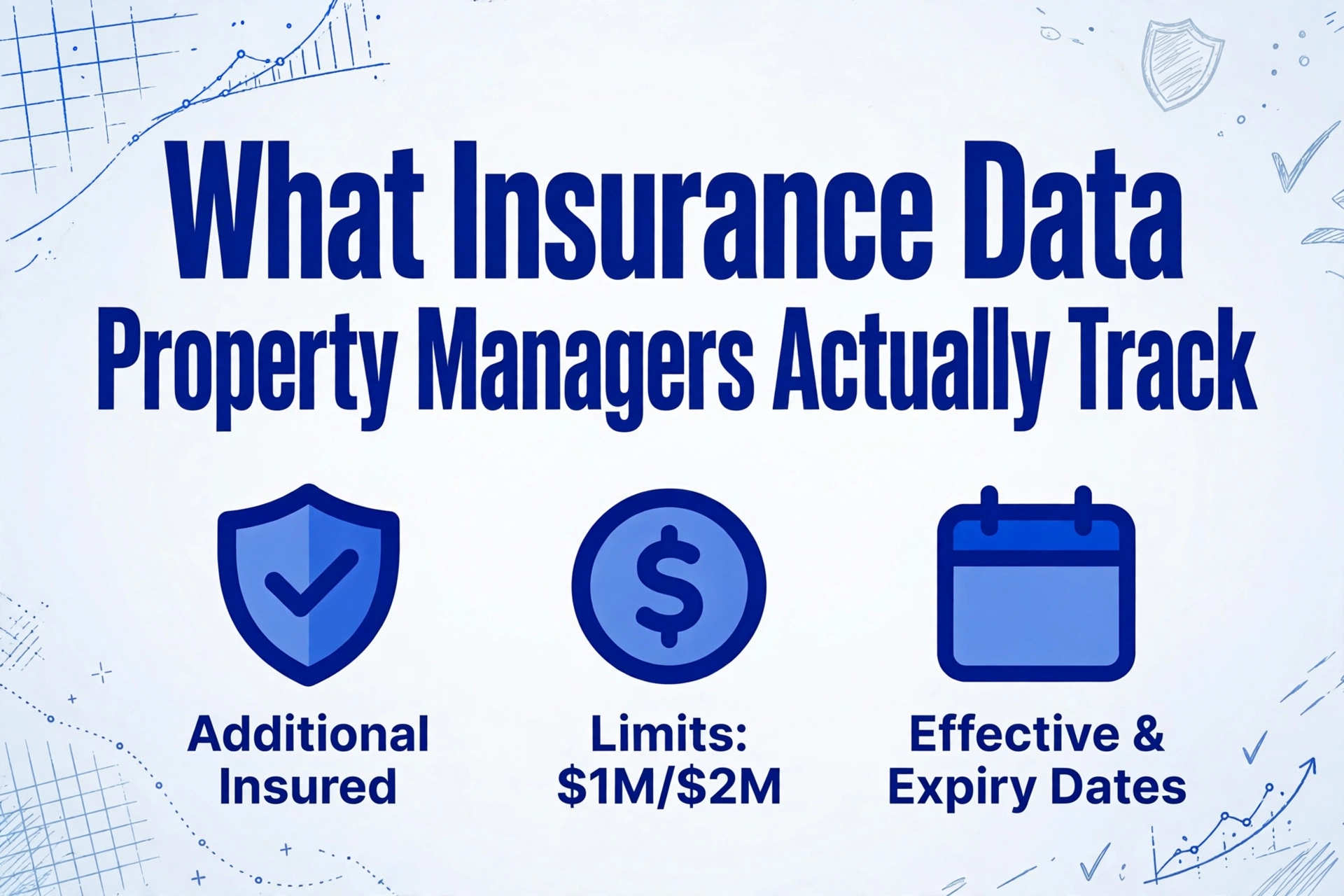
A Certificate of Insurance contains far more information than "is there insurance or not." For property managers, specific fields determine whether a certificate actually protects the property — and each one requires a different extraction check.
Additional Insured Status
The single most important field for property managers. An additional insured endorsement extends the property owner's or manager's protection under the vendor's or tenant's liability policy. Without it, the property manager has no direct coverage if the vendor's work causes a claim. The ACORD 25 form has a checkbox section for "Additional Insured" — but the absence of a checkmark is easy to miss when scanning the PDF manually. Extraction surfaces this field explicitly so you know, at a glance, which relationships have the endorsement and which do not.
Liability Limits (Per Occurrence & Aggregate)
Your property's vendor agreement likely requires specific minimum limits — $1M per occurrence, $2M general aggregate, for example. But the certificate may show limits below those thresholds, or it may show the correct aggregate but an insufficient per-occurrence cap. Extraction reads both numbers so you can validate coverage meets contract requirements, not just confirm that "some insurance exists."
Effective and Expiration Dates
The most common COI failure mode: the policy expired three months ago and nobody noticed. At portfolio scale, with dozens or hundreds of vendors each on their own renewal cycle, tracking expiration dates is the core operational challenge. Extracted dates enable automated alerts — 60 days before expiry, then 30, then 7 — rather than waiting for a lapse to surface during a claim.
Policy Number and Insurance Carrier
The policy number and carrier name are the identity fields that tie a COI to an underlying policy. Without them, verifying coverage with the insurance agency is impossible. Extraction reads these identifiers into a structured column so you can cross-reference certificates against broker records or carrier databases.
Certificate Holder
The certificate holder is the entity named on the COI as the party receiving proof of insurance. This should match the property management company or property owner. Certificates issued with the wrong certificate holder — or with "as interests may appear" rather than a specific named entity — can be challenged during a claim. Extraction reads the certificate holder field so you can verify it matches your entity name.
Waiver of Subrogation
This endorsement prevents the vendor's insurance company from suing the property manager to recover claim payments. Many property management agreements require it. Like additional insured status, it appears as a checkbox or notation on the ACORD form — easy to overlook during manual review, but a field that extraction can surface reliably.
These six fields form the core dataset that property managers need to track. Every COI in the portfolio should have structured values for each one. When they do, the tracking problem shifts from "dig through every PDF" to "query a spreadsheet."
How COI Tracking Works: From Certificate to Compliance Data
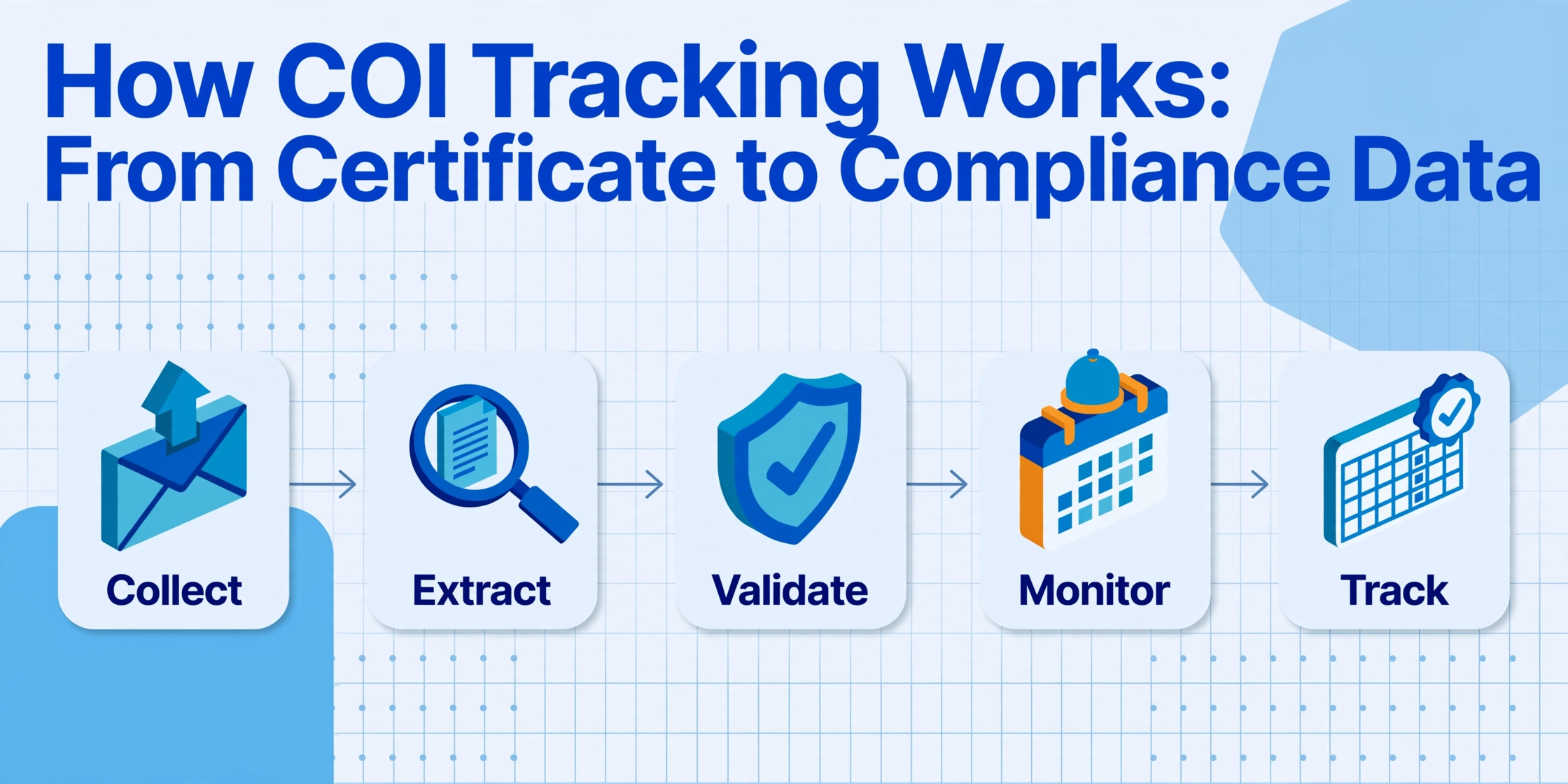
The tracking process follows five stages, and each one depends on data that starts inside a PDF or scanned certificate.
Certificate Collection
Vendors and tenants submit their COI documents — typically as PDF attachments via email, through a vendor portal, or uploaded to a shared system. At small scale, this can be manual. At portfolio scale, collection requires an intake mechanism that automatically routes each certificate to the verification workflow.
Data Extraction
This is where structured tracking begins. Each COI PDF or scan is read to extract the fields described above: policy number, carrier, coverage types and limits, effective and expiration dates, additional insured and waiver of subrogation endorsements, named insured, and certificate holder. Extraction can be done manually (opening each certificate and typing values into a spreadsheet row) or automatically with AI vision models that read the certificate by understanding field semantics, not by matching fixed positions.
Coverage Validation
The extracted fields are checked against your property's insurance requirements. Does the general liability limit meet your minimum? Is the property named as additional insured? Is the certificate holder correct? This step surfaces gaps — but only if the extraction was complete and accurate enough to supply the right comparison values.
Expiration Monitoring
Every extracted expiration date feeds a monitoring schedule. Policies that expire in the next 60 days trigger renewal requests. Policies that have already lapsed trigger compliance escalation. Without structured date data, this step requires manually checking each certificate on its own calendar — which is what fails at portfolio scale.
Enforcement and Renewal
The final stage is acting on what tracking reveals. Non-compliant vendors are flagged, renewal requests are sent, and updated certificates are collected — feeding back into step 1. This loop is only as reliable as the data it operates on. Errors or omissions in extraction cascade through every subsequent stage.
Why Property Management COI Tracking Is Different from Construction
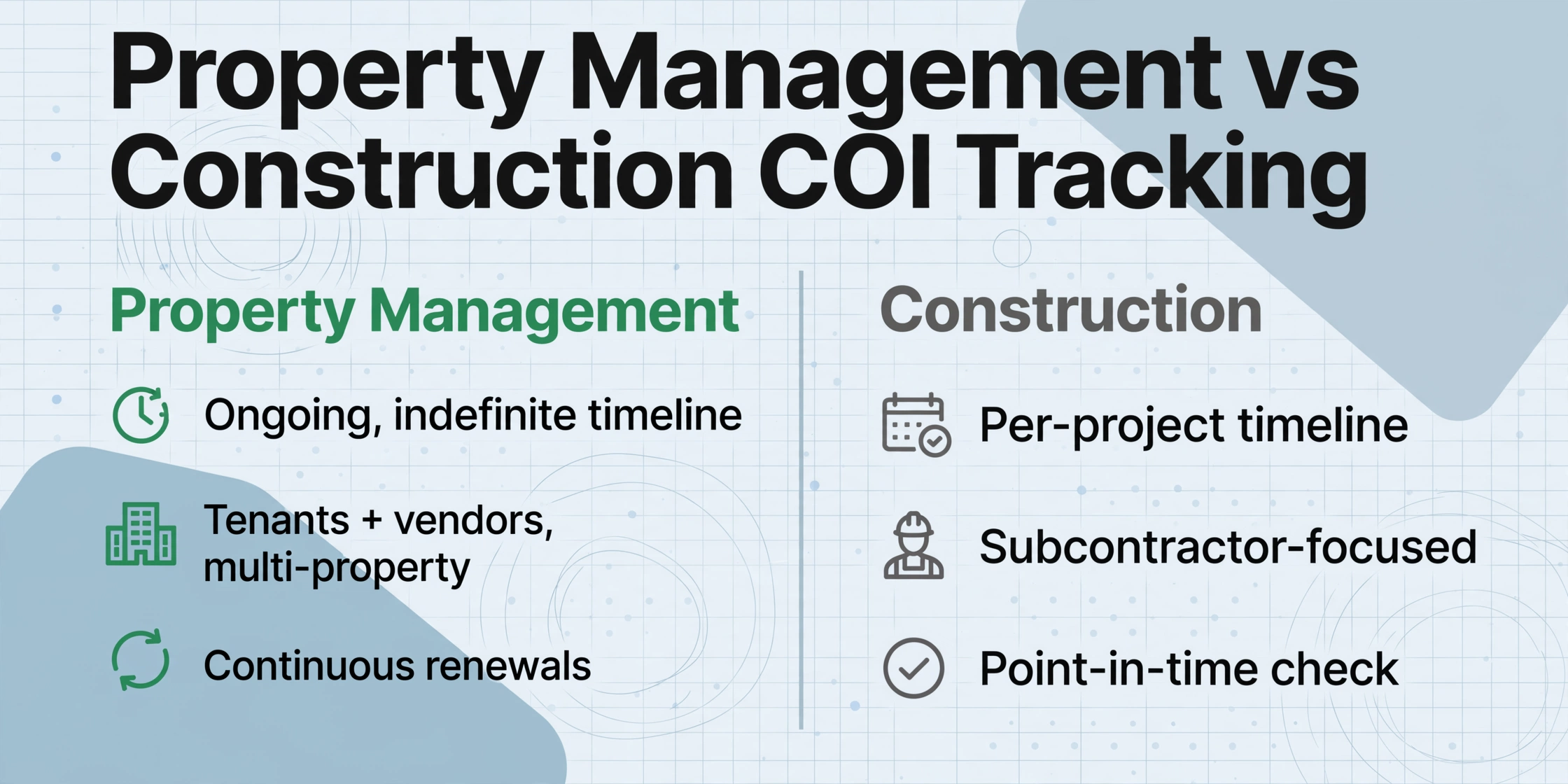
Most COI tracking content defaults to construction scenarios: a general contractor managing subcontractor certificates for a single project site. Property management COI is structurally different in ways that matter for how you approach extraction and tracking.
Construction COI
- Per-project timeline: certificates tied to project duration
- Subcontractor-focused: trade contractors and their policies
- Single-site or limited-site scope
- Verification at project start + mid-project check-ins
- Additional insured typically project-specific
Property Management COI
- Ongoing, indefinite timeline: coverage must persist for the entire business relationship
- Two distinct populations: tenants (residential/commercial) and vendors (maintenance, service, repair)
- Multi-property portfolio: 10, 50, 200+ locations, each with its own set of relationships
- Continuous renewals: coverage cycles never end — they just repeat
- Additional insured per property entity, not per project
This distinction has a practical implication for extraction. In construction, a certificate arrives, you verify it once against project requirements, and the extraction is a point-in-time check. In property management, the same vendor's certificate needs to be re-extracted and re-validated every renewal cycle — sometimes twice a year, sometimes annually, across every property that vendor serves. The volume of extraction work is not one-time. It is continuous and compounding.
A vendor handling maintenance for 12 properties in your portfolio may have a single COI covering all locations — or 12 separate certificates, each with different effective dates and limits. Without extraction that can read each certificate into a structured record tied to a specific property, tracking whether coverage is current for every location becomes a manual cross-referencing exercise that scales poorly.
What Happens When Coverage Lapses at Portfolio Scale
The consequences of untracked or expired COIs are not theoretical — they are measured in denied claims, legal liability, and audit failures. The scale of the problem is larger than most property managers assume.
A 2021 Evident study published via Business Wire found that 75% of third-party vendors across multiple industries did not meet the insurance requirements of the companies that hired them, with 23% not responding to proof of insurance requests at all and at least 1 in 10 falling out of compliance without notifying the verifier. While this study spanned industries, the pattern holds for property management — where the vendor and tenant base is large, the relationship duration is long, and the renewal cycle is continuous.
The practical consequences for property managers include:
- Direct liability for uninsured losses. If a vendor's policy lapsed and the vendor causes property damage or a visitor injury, the claim lands on the property owner's or manager's general liability policy — increasing premiums or triggering coverage disputes.
- Denied insurance claims. Insurers routinely investigate whether the responsible party carried valid coverage at the time of loss. An expired COI on file can result in a denied claim or a protracted coverage battle.
- Lease and contract violations. Most commercial leases and vendor service agreements require the tenant or vendor to maintain specific insurance and name the property owner as additional insured. Failure to enforce these requirements can constitute a contract breach.
- Audit exposure. Institutional investors, lenders, and REIT compliance reviews increasingly include insurance verification in their due diligence. A portfolio-wide coverage gap discovered during an audit undermines trust and can delay financing or acquisitions.
The multiplier effect: A single vendor whose insurance lapses while working across five properties creates five simultaneous compliance gaps. The tracking burden is not additive by certificate count — it is multiplicative by the number of relationships each certificate covers.
Getting Started: From COI PDFs to a Trackable Spreadsheet
The gap between "having COI PDFs in email" and "having a structured compliance tracker" is extraction. And extraction does not require enterprise software — it requires a tool that reads the certificate fields by understanding what they mean, not by matching a fixed template.
Here is the practical starting point for any property manager who wants to move from manual COI review to structured tracking:
- Define your required fields. Based on your lease and vendor agreement requirements, list the columns your tracker needs: named insured, policy number, carrier, general liability limit, auto liability limit, workers comp limit, effective date, expiration date, additional insured (yes/no), waiver of subrogation (yes/no), certificate holder. Each column corresponds to a field on a standard ACORD 25 COI form.
- Collect your COI PDFs. Gather the current certificates from your vendors and tenants. Batch them — a single property's vendors, a single vendor type, or a single portfolio sweep.
- Extract the field data. Use a tool like Certificate of Insurance to Excel extraction that reads the COI images or PDFs and outputs the structured data into spreadsheet columns — without requiring you to set up templates or train models for each carrier's format.
- Validate and monitor. With the extracted dataset in hand, run your first compliance check: identify which certificates fall below your coverage minimums, which lack the additional insured endorsement, and which expire in the next 60 days. The spreadsheet becomes your tracker from this point forward.
This extraction-first approach is not a replacement for dedicated COI tracking software at enterprise scale — platforms that handle automated renewal requests, direct insurance agent communication, and integration with property management systems serve a real need at large portfolios. But it is the fastest way to go from scattered PDFs to a structured compliance picture without committing to a platform purchase or onboarding process.
For a deeper look at how ACORD 25 certificates are structured and what extraction means field by field, see What Is COI Data Extraction. For a step-by-step guide on extracting ACORD 25 data into a compliance spreadsheet, see How to Extract ACORD 25 COI Data to Excel.
Frequently Asked Questions
What is the difference between COI tracking and COI extraction?
COI extraction is the process of reading fields — policy number, limits, dates, endorsements — from a certificate document and outputting them as structured data in a spreadsheet. COI tracking is the broader process of collecting, validating, monitoring, and acting on that data over time. Extraction is the foundation that makes tracking possible; you cannot track what you have not read.
Do I need dedicated COI tracking software, or can I use a spreadsheet?
It depends on your portfolio size and complexity. For portfolios under 50 vendors with simple requirements, a well-structured spreadsheet updated with extracted data can work effectively. The key is having reliable extraction to populate it. Above 100-200 relationships, automated renewal requests and continuous monitoring features in dedicated platforms start to justify their cost. Many property managers start with extraction-to-spreadsheet and migrate to a platform as their portfolio grows.
Can AI extract data from any insurance carrier's COI format?
Modern vision AI can read COI data from any carrier's format because it identifies fields by semantic meaning rather than position on the page. This is important because while the ACORD 25 is the standard, many insurance agencies modify the layout — adding headers, rearranging coverage sections, or using electronic fill-in that shifts field positions. Template-free extraction handles all these variations without setup.
What is an ACORD 25 form?
The ACORD 25 — "Certificate of Liability Insurance" — is the standard form used in the U.S. commercial insurance market to summarize a policy's key coverage details on one page. It is developed by the Association for Cooperative Operations Research and Development (ACORD). Most Certificates of Insurance submitted to property managers use this form or a carrier-specific variant based on it.
How often should property managers refresh their COI data?
Continuous monitoring is the ideal — every certificate has an expiration date, and new ones arrive throughout the year. At minimum, a quarterly portfolio-wide compliance review catches lapses before they compound into audit findings or claim denials. Properties with high vendor turnover or short-term tenant leases may need monthly checks.
What does "additional insured" mean in property management?
"Additional insured" is an endorsement on a vendor's or tenant's insurance policy that extends coverage to the property manager or property owner for liabilities arising from that party's operations. Without this endorsement, the property manager is not covered by the vendor's policy — even if the vendor's insurance is otherwise valid. Verifying this field on every COI is a critical step in property management risk transfer.