UAE Payslip Explained Through
Three Records That Must Agree
A UAE payslip is read by three people who need different things from it. The employee checks the net against the bank. The payroll officer checks the split against the contract. The auditor, sometimes two years later, checks the basic salary against a gratuity calculation that was never printed on the slip.
The document is short. The records those three readers keep differ. Federal law fixes what basic wage means and how it is used; it does not fix a payslip layout. That gap is where a stack of slips can turn into a table that looks complete and still cannot answer the question that outlives the month: what was this person's basic salary, period by period.
Key Takeaways
- Two people on the same AED 18,000 package can leave with gratuity totals AED 16,200 apart, and the only difference is where the contract put the basic salary.
- Basic salary sets gratuity, overtime and unemployment cover, and a wrong basic can sit on a payslip for years because the net still matches the bank.
- Keep one row per employee per pay period with the basic that applied to that month, because a single current basic column quietly rewrites the earlier months.
What a UAE Payslip Shows, and What It Leaves Out
A payslip is the employer's statement of what was earned, deducted and paid for one pay period. A UAE salary slip is the same document under a different name, and it normally carries five blocks. The layout changes from one payroll provider to the next, but the blocks are stable enough that a reader can find the same information on almost any slip issued in the country.
| Block | What usually appears | What it proves |
|---|---|---|
| Who and when | Employer name, MOHRE (Ministry of Human Resources and Emiratisation) establishment number, employee name, employee or labour card number, job title, pay period, pay date | That the slip belongs to this person and this month |
| Earnings | Basic salary, housing, transport, communication, meal or education allowances, overtime, commission, bonus | What the employer says it owed for the period |
| Deductions | Loan or advance repayment, unpaid absence, pension for UAE nationals, disciplinary or court-ordered amounts, ILOE (unemployment insurance) where deducted | What was taken out, and on what ground |
| Net pay | Gross earnings minus total deductions | What should have reached the bank |
| Payment | IBAN (bank account number), bank, payment date, sometimes a WPS (Wage Protection System) or SIF (Salary Information File) reference | Where the money was sent and through which channel |
Gross pay is basic salary plus allowances plus any variable pay, before deductions. Net pay is what remains after the deductions block. There is no income tax line. The UAE does not tax salaries at source, so nothing is withheld before the money reaches the employee, and an expatriate with no loan or advance will often see net pay equal to gross pay. That short distance between gross and net is useful for spotting a payment error. It also hides a different error: a slip can show the right net while the basic salary behind it is wrong, and nothing on the page will look out of place.
A wrong net is visible in the bank account. A wrong basic salary is invisible until the employee leaves.
Federal Decree-Law No. 33 of 2021 sets the wage definitions, the permitted deductions and the end-of-service rules. It does not prescribe a single payslip template. The Dubai International Financial Centre (DIFC) and Abu Dhabi Global Market (ADGM) operate their own employment frameworks, and DIFC's employment law does require an itemised pay statement for each pay period. On the mainland, the slip's layout is a choice made by the employer and its payroll provider. What the slip contains is driven by the contract, the data sent through WPS, and the fact that the slip becomes evidence in a wage or gratuity dispute.
This is why two employees on the same total package can hold slips that look unrelated, and why a payroll team that receives slips from two providers after an acquisition cannot simply stack the PDFs and expect the columns to line up.
Basic Salary Is the Only Line That Keeps Working After Payday
Basic salary is the figure that continues to set obligations after the pay period closes, because UAE law uses it as the base for several entitlements that are not paid monthly. Article 1 of the labour law defines the basic wage (الراتب الأساسي) as the wage stated in the employment contract, excluding allowances and benefits in kind. The wider term, wage, adds the cash allowances and in-kind benefits. Payroll systems usually print "basic salary" rather than "basic wage". They mean the same line.
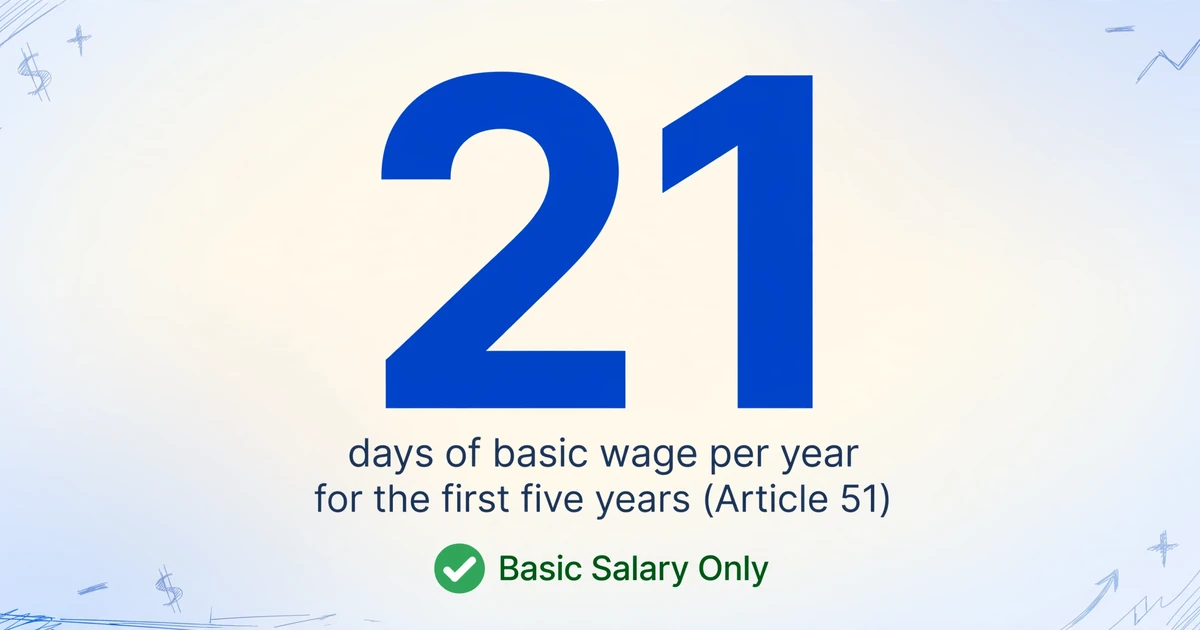
End-of-service gratuity (مكافأة نهاية الخدمة) is the largest of those obligations. Under Article 51, a foreign full-time employee with at least one year of continuous service receives 21 days of basic wage for each of the first five years, and 30 days for each year after that. The daily rate is the monthly basic divided by 30, and the calculation uses the last basic wage the employee was entitled to. The total is capped at two years' wage. Partial years are prorated, unpaid absence is excluded from the service period, and the settlement is due within 14 days of the contract ending under Article 53. UAE nationals do not receive this gratuity; their end-of-service benefit runs through the pension scheme that covers them.
Overtime uses the same base. Article 19 sets overtime at the normal hourly wage calculated on the basic wage plus at least 25 percent. Night work between 10pm and 4am carries at least 50 percent on top, and work on the contractual rest day earns a substitute rest day or the normal day's wage plus at least 50 percent of the basic wage. A payroll sheet that checks overtime against gross pay will pass a calculation that the law does not support.
Unemployment insurance reaches the basic line too. ILOE pays 60 percent of the average basic salary over the six months before a job loss, not 60 percent of the package. A low basic salary reduces the cover as well as the gratuity.
The arithmetic is easiest to see with two people on the same package. Both earn AED 18,000 a month. One has AED 10,800 basic and AED 7,200 in allowances; the other has AED 7,200 basic and AED 10,800 in allowances. Their bank credits are identical every month. Their daily basic is AED 360 and AED 240. In the first five years, gratuity accrues at 21 days a year: AED 7,560 against AED 5,040. After six years, the totals are AED 48,600 against AED 32,400. The difference is AED 16,200, produced entirely by where the contract put the split.
The split also explains a question candidates ask often. One r/UAE thread reads: "I received an offer in Dubai, but the salary is split between basic salary and allowance. What does it mean?" The split is not governed by a percentage in the law. There is no statutory 60/40 rule, and a basic salary set at 30 percent of the package is not automatically unlawful. Most UAE packages land somewhere between 40 and 60 percent basic, which is market practice rather than a legal threshold. A low basic shrinks gratuity, overtime and ILOE cover, and a contract that does not reflect the role is easier to challenge. The practical point for anyone reading a slip is simpler: the basic line is a contractual number, and any reallocation between basic and allowances is a contract change worth questioning.
A basic salary is also a time series, not a single field. If an employee's basic rises from AED 9,000 to AED 10,000 in July, a master sheet with one row per employee and one "current basic" column overwrites the first half of the year. Final gratuity uses the last basic, but monthly provisions and earlier overtime checks use the basic in force in the period they cover. Keep one row per employee per pay period, with the basic that applied to that period.
The Deductions Block Is Short, and That Makes the Odd Line Easier to Catch
The deductions block is short by design, and the shortest version belongs to an expatriate with no loan. There is no income tax withholding, no mandatory social security line for a foreign employee, and no pension contribution. If an expatriate's deductions block contains anything, it should trace to something agreed in writing or to a specific lawful ground.
Article 25 limits deductions to the grounds it lists. They include loan and advance repayment, recovery of an overpayment, pension and insurance contributions required by law, amounts the employee authorised in writing, disciplinary fines, court-ordered debts, and repair of damage caused by the employee's fault. The same article caps the total of all deductions at 50 percent of the wage in any month. That cap is calculated on the wage, which includes allowances, not on basic salary alone.
A UAE national's slip looks different because of the pension line. The General Pension and Social Security Authority (GPSSA) covers nationals in the federal scheme, and Abu Dhabi runs its own pension fund. The employee share and the contribution salary are set by the pension rules, not by the payslip, and they differ between the older scheme and the scheme for nationals first registered from 31 October 2023. None of these contributions apply to expatriates.
ILOE is a separate case. It is the employee's own subscription, often paid directly through the ILOE portal, so it may not appear on the payslip at all. Where an employer deducts and remits it, it shows as a small line. An empty deductions block is not evidence that the employee is covered, and a missing ILOE line is not an error by itself.
For a payroll team, the useful discipline is to keep a reason beside every deduction, not just an amount. "Other deductions: AED 500" cannot be checked by the employee, reconciled by finance, or defended in a dispute. "Salary advance, instalment 3 of 6, agreed 12 March" can.
WPS Is Payment Infrastructure, Not a Payslip Format
WPS is the channel the salary travels through, and it can leave a reference on the slip. A WPS payslip is a payslip whose salary was paid through that channel; the label describes the payment route, not a different document. The Wage Protection System (نظام حماية الأجور) is run by MOHRE with the Central Bank of the UAE. Private-sector employers registered with MOHRE pay wages through approved banks, exchange houses and financial institutions, and the system monitors whether those wages are paid in full and on time.
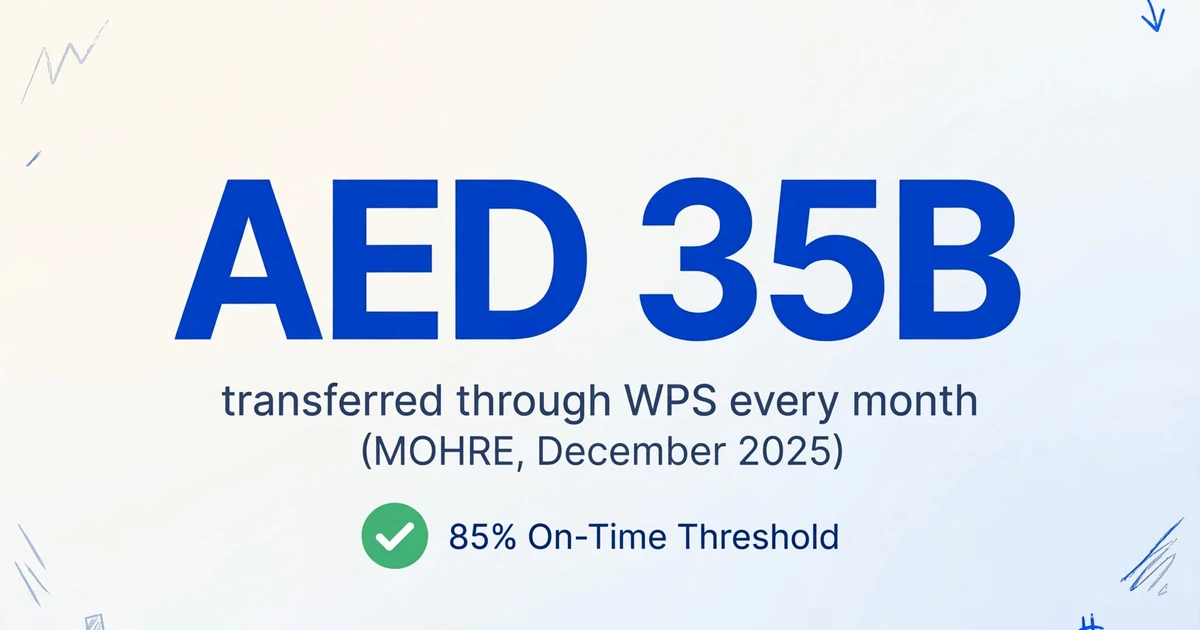
The volume is national infrastructure: MOHRE reported in December 2025 that establishments transfer about AED 35 billion a month through the system to pay private-sector workers.
The timing rule changed in 2026. Under Ministerial Resolution No. 340 of 2026, effective 1 June 2026, wages for the previous month are due on the first day of each Gregorian month. There is no grace period. An employer is treated as compliant when at least 85 percent of total wages due are paid on time, with any shortfall justified by lawful deductions. Enforcement escalates from alerts on day two to work-permit suspension on day five, administrative fines on day eleven, an automatic labour dispute on day sixteen, and legal measures from day twenty-one. A payroll calendar that still assumes the old 15-day window is out of date.
The machine record behind the payment is the Salary Information File, or SIF. It is a structured text file with a salary control record summarising the batch, followed by one employee detail record per worker. Each detail record carries the MOHRE establishment number, the employee's labour card or ID number, the IBAN, the pay period, fixed pay (basic plus fixed allowances), variable pay, deductions and net pay, in fixed formats that the bank validates. Amounts and dates that do not match the specification cause the file to be rejected before any money moves.
The payslip is the human record of the same event. It may show the IBAN and payment date, and sometimes a SIF or WPS reference or the SIF filename. When no reference appears on the slip, the bank statement narrative is the remaining link. A missing reference is a traceability gap in the payroll sheet, because the row can no longer be tied to the transfer that paid it. It is not a compliance failure on its own.
WPS regulates how the money moves. It does not standardise what a payslip looks like, and it takes nothing out of the salary.
Two boundaries are worth keeping straight. The DIFC and ADGM sit outside the MOHRE WPS framework and have their own employment law, including DIFC's Article 15 right to an itemised pay statement. And the UAE's e-invoicing mandate is a separate document regime: a payslip is not a tax invoice, it carries no VAT, and it does not belong in the same filing stream as a supplier invoice. The UAE e-invoicing mandate guide covers that separate track.
The Three Records That Have to Agree, and Who Owns Each
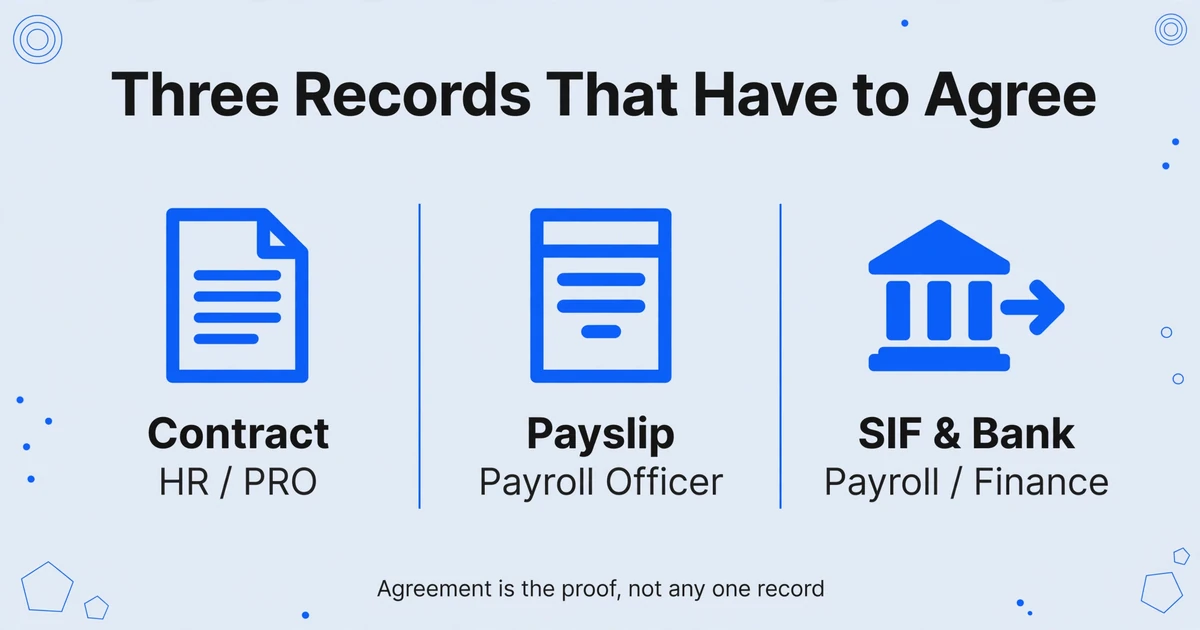
A payslip is one of three records, and the failures that survive month-end are the ones where two of them disagree. Each record is produced by a different person, proves a different thing, and stops proving anything at a different point.
| Record | Owner | What it proves | What it cannot prove |
|---|---|---|---|
| Employment contract or offer letter | HR or PRO, with payroll confirming the split | The basic salary, allowances and start date the employer committed to | That anyone was paid, or that the registered contract matches the offer |
| Payslip | Payroll officer | What the employer calculated for the period, and how it split the package | That the money moved, or that the split matches the registered contract |
| SIF and bank credit | Payroll prepares the SIF; finance approves and reconciles the debit | What was sent, to which IBAN, for which period, and what left the company account | That the slip or the contract agrees, unless the identifiers line up |
Each role owns a different part of the record. The payroll officer builds the run, generates the SIF and issues the slips. The PRO (the government-relations officer who handles visas and MOHRE filings) or HR administrator owns the MOHRE establishment number, the labour card record and the registered contract. The finance manager approves the run and reconciles the total debit against the bank. The employee is the one who checks the bank credit against the slip. The auditor sees neither in real time; the auditor sees the row and, if the file is well built, the page it came from.
Five failures recur when those records are compressed into a spreadsheet.
- Gross used as the gratuity base. The sheet keeps net and gross because those are the two numbers people recognise. Neither one can reconstruct the basic salary, so the gratuity liability is either estimated from the package or left out. A sheet built for payment tracking is not a payroll record until the basic column is present.
- Allowance labels drift between providers. One payroll system prints Housing Allowance, another HRA, another Accommodation Allowance or House Rent Allowance. Transport appears as Transport, Conveyance or Travel. One provider itemises five allowances, another writes Other Allowances and a single figure. A mapping built on header text leaves half the cells empty, and because the gross total still balances, nobody notices until someone tries to compare allowances across entities.
- Names are used as keys. Mohammed, Muhammad and Mohamed are the same person in three systems. Al Maktoum and Almaktoum sort differently. Common names repeat across a large workforce. Use the employee ID, labour card number or IBAN for matching, and keep the printed name as a label rather than a key.
- A mid-year basic change is overwritten. A single row per employee with one basic column records the latest figure and silently rewrites the earlier months. The final gratuity may still be right, but the monthly provision and overtime history are no longer auditable.
- The payment reference is missing. The net on the slip and the bank credit should match dirham for dirham. When they do not, the first question is which period and which transfer. Without a SIF reference or IBAN, the search falls back to names, which is the least reliable key in the file.
A row that cannot be tied to an identifier, a period and a source page is an assertion, not a record.
The Columns to Keep in a Payroll Sheet
The column list is a design decision: one row per employee per pay period, with basic salary and every allowance in its own column. The test is not how many columns the sheet has. The test is whether a reviewer can answer "what was the basic salary in March, and which transfer paid it?" without opening a PDF.
| Group | Columns | Why it stays separate |
|---|---|---|
| Identity | Employee name as printed, employee ID or labour card number, Emirates ID where shown, nationality category, employer or entity, MOHRE establishment number | Matching across slips, SIF and bank; the national or expatriate split changes which deductions and end-of-service rules apply |
| Period | Period start and end, pay date, days paid | Gratuity, leave and unpaid absence prorate by period; a pay date alone does not say which month the work belongs to |
| Earnings | Basic salary, housing allowance, transport allowance, communication allowance, other allowances itemised, overtime, commission or bonus, gross pay | Basic drives gratuity, overtime and ILOE; gross is a control total, not a substitute for the base |
| Deductions | Pension, ILOE, loan or advance, unpaid absence, disciplinary or court-ordered amount, other deduction, deduction reason, total deductions | A total without a reason cannot be checked by the employee or defended by payroll |
| Payment | Net pay, IBAN, WPS or SIF reference, bank, payment date | Ties the row to the transfer rather than to a name |
| Audit | Source file, page, extraction date, reviewer | Lets a disputed cell go back to the page it came from |
Three columns are routinely left out and are worth adding. The first is a nationality category. UAE nationals do not accrue gratuity under Article 51; their end-of-service benefit runs through the pension scheme. Without the flag, a gratuity column attributes a liability to people who never earn it, and the deduction profile of the two groups gets averaged into one meaningless line. The second is the source page. A row that cannot be traced back to a page is only as good as the person who typed it. The third, when the contract is available, is the contracted basic beside the paid basic. A gap between the two is the split change that needs an explanation.
A month-end routine that uses the table looks like this:
- Extract the period's slips into the standard columns, one row per slip.
- Check gross against basic plus allowances, and treat a blank as an error rather than a zero.
- Tie net pay to the bank credit or SIF line, and list every difference with its period.
- Sample the flagged rows against the source page, then lock the file and keep the source reference.
That routine is also the audit trail. The same population, built once and proved, is what an auditor samples when a gratuity or wage claim arrives. The pattern is the same one described in batch payslip extraction for HR audits.
Building the Sheet From a Stack of Payslips
The extraction step is where the column list stops being a wish and becomes a table. A payroll officer running 80 employees receives 80 PDFs, sometimes from two providers after an acquisition, each with its own layout and its own names for the same allowance. Typing 20 fields across 80 slips is 1,600 cells, and one transposed digit breaks the net tie-out.
Custom Column Extraction changes the order of the work. You type the column names you want, such as Basic Salary, Housing Allowance, Total Deductions, Net Pay, IBAN and WPS Reference. The AI reads each payslip and finds the value that means that field, wherever it sits on the page and whatever label the provider used. The column names you enter become the headers of the output table.
That meaning-based match is what handles the label drift. A column called Housing Allowance can pick up HRA, Accommodation Allowance and House Rent Allowance because the AI is reading what the field means, not matching a header string or a coordinate. A provider that itemises five allowances and one that writes Other Allowances can still land in the same standard columns, with the lumped amount visible as a value that needs splitting or a note.
Batch processing is the second half of the answer. Upload the month's slips together and the output is one table with one row per slip, merged into a single Excel file. You are not opening 80 documents, and you are not pasting 80 rows into a master workbook by hand.
A computed column adds the checks without a second pass. A computed column is calculated from values already extracted in the same run. Three that earn their place in a UAE payroll sheet are Gross Check (Basic + Allowances), Deduction Check (Gross - Net) and Basic Share (Basic / Gross). The first exposes a missing allowance, the second exposes a deduction block that does not add up, and the third makes a low basic visible.
Review Mode with Bbox (bounding box) is the last step for the rows that matter. Click an extracted cell and the original page highlights the place the value came from; click a region on the page and it jumps back to the matching cell. For a disputed deduction or a basic salary that changed mid-year, that is the difference between a correction and an argument. Edited fields can be compared with the AI's original value and reverted.
Files are processed securely and not stored.
The output is a clean table in Excel or CSV. Paste values into your payroll workbook rather than the whole file if the workbook has its own formulas and validation, and keep the source reference column intact. For a smaller payroll, the same flow works without a finance team; the small-payroll payslip extraction guide covers that setup. The broader field logic, including the difference between period and year-to-date values, is in the complete guide to payslip extraction.
What This Does Not Do
The tool reads the payslip and structures the values; it does not make the payroll judgment. That boundary matters more in the UAE than in a country where the payslip is a tax document with a fixed set of boxes.
- It does not calculate end-of-service gratuity. It can carry the basic salary and any joining or service dates printed on the slip, but the 21/30-day formula, the cap and the eligibility decision stay with payroll.
- It does not run WPS, generate or submit a SIF, or confirm that a payment met the 85 percent threshold or the first-of-month deadline.
- It does not decide whether a deduction is lawful, whether a basic and allowance split is defensible, or whether a contract clause is valid.
- It does not know the employment contract unless you give it the contract. A slip can be internally consistent and still disagree with the registered contract.
- It cannot recover a value that is not printed, and it cannot correct a wrong figure at source. A transposed amount on the payslip comes through as a transposed amount.
- It does not replace the payroll system, the reviewer or the signature on the file.
A clean table is evidence that the document was read. It is not evidence that the payroll was compliant.
The useful place for human review is the exceptions: the row whose net does not tie, the allowance that arrived under a new label, the basic salary that changed in July, the deduction with no reason. Those are the rows where a reviewer's judgment changes the answer.
FAQ
Is a UAE payslip legally required?
Federal law does not prescribe a single mandatory payslip template. Mainland employers must keep wage records, pay through WPS and be able to show what was paid and why. In the DIFC, Article 15 of the DIFC Employment Law gives an employee the right to a written itemised pay statement for each pay period, including each deduction and its purpose; ADGM has its own framework. In practice, the payslip is the document an employee, an auditor or MOHRE will ask for, so not issuing one leaves the employer without its own evidence.
Is gratuity calculated on basic salary or total salary?
For a foreign full-time employee, gratuity is calculated on the basic wage only. Article 51 gives 21 days of basic wage for each of the first five years and 30 days for each year after that, using the last basic wage, with the total capped at two years' wage. Allowances are outside the calculation. UAE nationals are covered by the pension scheme instead. A sheet that stores only gross or net pay cannot support this calculation later.
What does WPS mean on a payslip?
It means the salary was paid through the Wage Protection System, the MOHRE and Central Bank channel for private-sector wages. WPS is not a deduction and not a payslip format. A SIF or WPS reference on the slip, or in the bank narrative, is the link between the slip and the transfer. Since 1 June 2026, wages for the previous month are due on the first day of the following month, with an 85 percent on-time payment threshold.
Why is there no gratuity line on my payslip?
Gratuity is a liability that is settled when the employee leaves, not a monthly payment. Most UAE payslips do not show it. Some employers include an accrual or provision line so the liability stays visible, but its absence is normal. The basic salary line is the number that sets the eventual amount.
How do I combine payslips from different payroll providers?
Define one standard column list first, with basic salary and each allowance separate, then map every provider's labels into it. Keep the employee ID, labour card number or IBAN for matching, and keep one row per employee per pay period. A meaning-based extraction step handles the label differences; a header-based mapping does not, because the same allowance can carry four different names.
Should UAE national and expatriate employees use the same sheet?
They can share the sheet if the nationality column stays separate. Keep a nationality category column. A UAE national has a pension line and does not accrue gratuity under Article 51; an expatriate usually has a near-empty deductions block and does accrue gratuity. Without the flag, a gratuity total will include people who never earn it, and a pension column will sit blank on expatriate rows, easy to misread as missing data.
The Basic Line Is the One That Outlives the Month
The net tells you what happened this month. The basic tells you what the company owes when the employee leaves, what an hour of overtime is worth, and what the unemployment cover was built on. A sheet that keeps only the first is a record of payments, not a payroll record.
Put this month's slips in one batch and check the basic column first. If it comes back clean, with every allowance still in its own column and every row tied to an identifier, the rest of the month-end check gets shorter. Try it on your own payslips.