Canada's Seasonal ROE Rush
5-Day Deadlines, 40 Layoffs, One November
The construction season in Canada does not end on a single date. It ends site by site, trade by trade, as the ground freezes from north to south. A road-paving crew outside Edmonton stops when the asphalt plant shuts down for winter, usually the second week of November. A high-rise concrete crew in Toronto pushes into late November because the building envelope is closed and the pours can continue. A roofing crew in Vancouver stops when the rain makes the pitch too dangerous — which could be October, or it could be never. Each shutdown triggers a separation. Each separation triggers a Section 19(3) obligation under the Employment Insurance Regulations (SOR/96-332): the employer must issue a Record of Employment (ROE, form INS5153) within five calendar days of the first day of an interruption of earnings. Five calendar days — not five business days, not five payroll processing days. The Saturday and Sunday between the layoff and the deadline are days two and three. And the clock starts not from the day the payroll administrator receives the separation notice, but from the day the employee's earnings actually stopped — the last day paid. For a construction company with six active sites that freeze at six different points across a four-week window, that means six separate five-day countdowns, each one triggered by a foreman's phone call from a job site, each one consuming payroll hours that were already committed to processing the previous site's ROEs. This is not a workload problem. It is a clock architecture problem — and it arrives every November.
Key Takeaways
- Canada's Employment Insurance Regulations require a Record of Employment within five calendar days of an interruption of earnings — not five business days, and the clock starts from the last day paid, not from when payroll learns about the layoff.
- That five-day window was designed for isolated separations, not for a construction company with six sites freezing in sequence across four weeks — generating 66 ROEs with overlapping countdowns that a single payroll administrator cannot physically honor.
- A pre-rush audit that pre-confirms every reason code, SIN, and earnings code, combined with a single column schema that extracts all 53 ROE blocks in one pass, turns 33 hours of manual verification into 2.2 hours of spreadsheet review — and the November rush becomes output you review, not a clock you race.
The November Freeze-Up: When Six Sites Generate 40 ROEs in One Week
To understand what a seasonal ROE rush actually looks like, start with a real construction company. Eighty employees across six sites. Edmonton roadworks (14 crew), Toronto high-rise (22 crew, multiple trades), Vancouver roofing (8 crew), Calgary commercial interiors (12 crew), Winnipeg residential foundation (10 crew), and a head office yard crew (14 equipment operators and laborers). Each site has a foreman. Each foreman reports to the office manager. Each office manager processes payroll in Ceridian Dayforce, which generates the ROE automatically — and each ROE must be verified against the payroll register before any of its fifty-three blocks can be trusted. None of those blocks are verified by the payroll system itself. The system generates. The human verifies. And the human has five calendar days to do it, counted from the last day the employee was paid — not from the day the foreman called, not from the day the office manager opened the payroll module.
Here is how the timeline lands in a typical November:
| Date | Site | Workers Laid Off | Last Day Paid | ROE Deadline | Calendar Days Remaining After Layoff |
|---|---|---|---|---|---|
| Nov 8 (Fri) | Edmonton roadworks | 14 | Nov 8 | Nov 13 (Wed) | 5 |
| Nov 12 (Tue) | Calgary commercial interiors | 12 | Nov 12 | Nov 17 (Sun) | 5 |
| Nov 15 (Fri) | Toronto high-rise — concrete crew | 8 | Nov 15 | Nov 20 (Wed) | 5 |
| Nov 18 (Mon) | Winnipeg foundations | 10 | Nov 18 | Nov 23 (Sat) | 5 |
| Nov 20 (Wed) | Vancouver roofing | 8 | Nov 20 | Nov 25 (Mon) | 5 |
| Nov 22 (Fri) | Head office yard crew | 14 | Nov 22 | Nov 27 (Wed) | 5 |
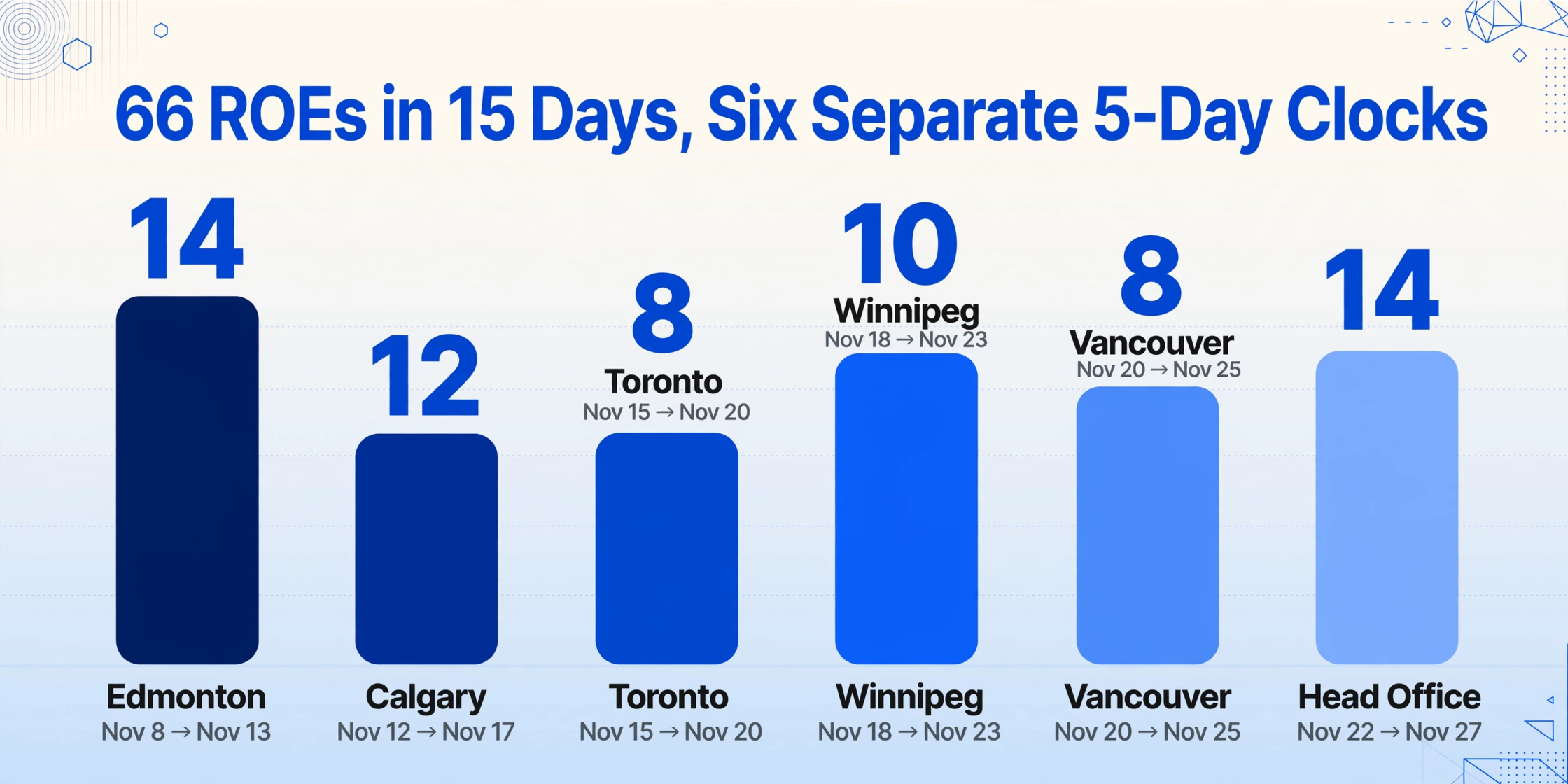
That is 66 ROEs in 15 calendar days. The Edmonton crew's 5-day deadline expires on November 13 — which is a Wednesday, two days after the Remembrance Day statutory holiday that closed the office on November 11. The office manager gets the foreman's call on Friday afternoon, November 8, and has roughly the equivalent of three working days — Monday the 11th is a statutory holiday — to verify and file fourteen ROEs with fourteen different insurable hours totals, fourteen different last-day-paid dates (the crew doesn't all finish the same day), and fourteen different accumulated earnings across the season. While that verification is happening on Monday and Tuesday, the Calgary foreman calls on Tuesday the 12th: his site finished, twelve more ROEs, deadline Sunday the 17th. The deadline falls on a weekend but the ROE Web electronic filing system accepts submissions 24/7 — so the effective deadline is midnight Sunday. The office manager, still processing Edmonton, now has two parallel deadlines running. By the time the Toronto crew completes on the 15th, three sets of ROE clocks are ticking simultaneously, with 34 of the 66 total already in progress and the office manager nowhere near finishing the first batch.
Why the Five-Day ROE Deadline Was Not Designed for Seasonal Volume
The structural problem with the five-day ROE deadline is not the deadline itself. It is what the deadline assumes. Section 19(3) of the Employment Insurance Regulations was written to serve a specific administrative purpose: the faster Service Canada receives a completed ROE, the faster it can calculate an Employment Insurance (EI, Canada's federal unemployment benefit) benefit rate for a displaced worker and begin issuing payments. That purpose is sound. The problem is that the regulation's five-calendar-day window — which starts at the interruption of earnings, not at the moment the payroll department receives notice — was designed for a world of isolated separation events. One employee resigns. One ROE is generated. One verification sequence runs to completion. The next separation might not occur for weeks. The deadline structure assumes steady state processing where each ROE receives the payroll administrator's undivided attention for its full five-day window.
Seasonal construction inverts that assumption entirely. Instead of one separation triggering one five-day window, a single weather event — the first hard frost — triggers a cascade of separations across multiple sites, each with its own last day paid, each starting its own five-day countdown. The regulation does not contain a provision for volume. Nothing in SOR/96-332 says "except when the employer issues more than X ROEs in a single week, in which case the deadline extends." The deadline is absolute and per-ROE: five calendar days from the first day of the interruption of earnings, for every interruption of earnings, regardless of how many interruptions occur simultaneously. A construction company that separates 66 employees in 15 days is required by law to fulfill 66 independent five-day verification and filing obligations — roughly 33 hours of verification labor based on the 30-minute per-ROE verification sequence — inside a window that contains payroll processing for the employees who are still on payroll, responding to the CRA remittance deadline, and handling the seventeen other tasks of a normal payroll month. The regulation does not acknowledge any of this. It simply counts days.
The Cascading Deadline Problem: Multi-Site Layoffs and the 48-Hour Trap
The most dangerous feature of a multi-site seasonal layoff is not the total volume — 66 ROEs in 15 days is roughly 4.4 per day on average. The danger is the uneven distribution. Edmonton's 14 ROEs land on November 8 with a November 13 deadline — five calendar days. But the verification work cannot begin until the office manager receives the separation data from the foreman, which means the clock on the Edmonton ROEs may have already burned a day before verification begins. Meanwhile, Calgary's 12 ROEs arrive on November 12 with a November 17 deadline — and the office manager is still verifying Edmonton's ROEs on November 12, which means Calgary's clock has started and is burning time while the administrator is occupied with a different site's batch.
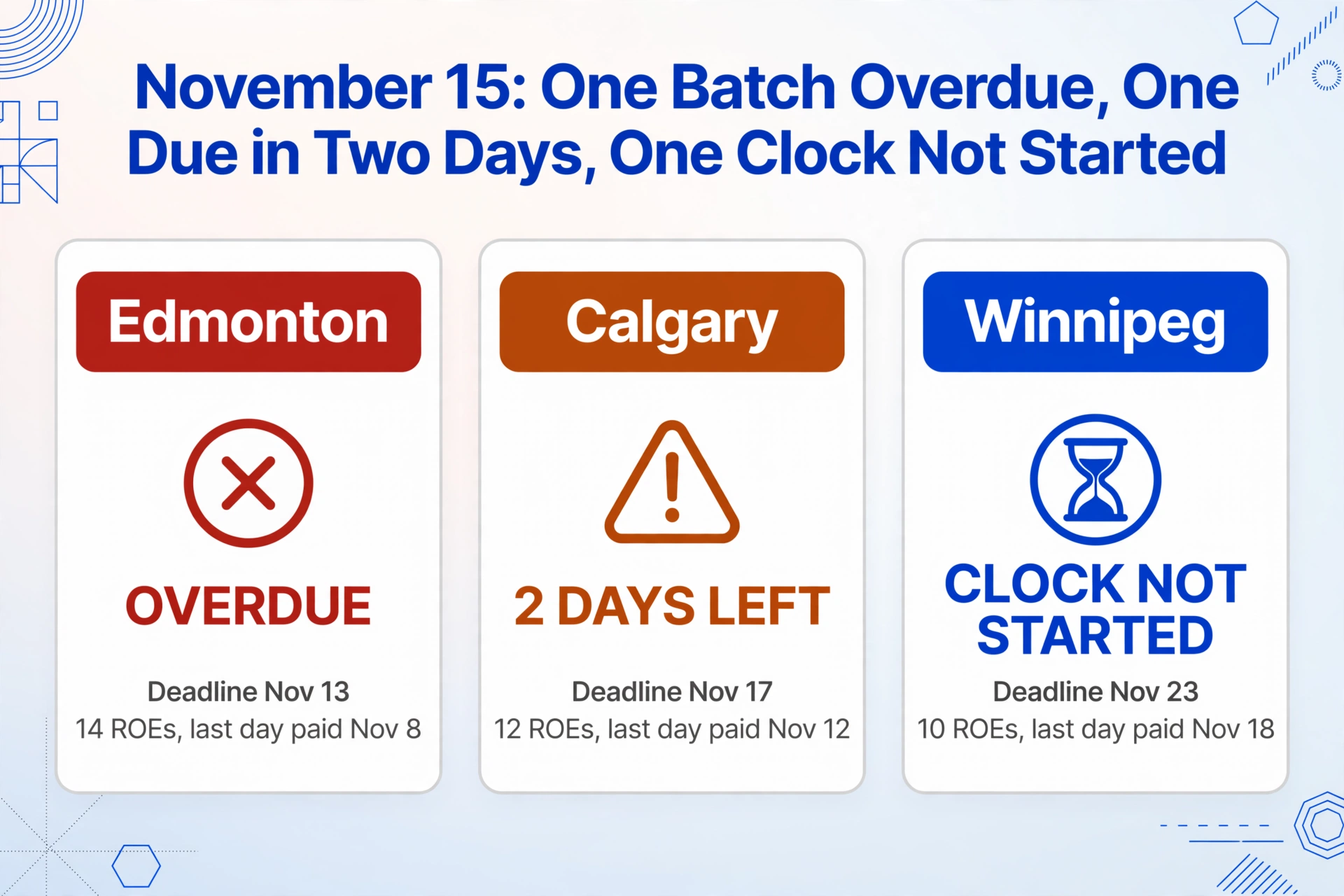
This is the cascading deadline problem. Each site's five-day window overlaps the previous site's window by only a few days, creating a relay race where the baton is a stack of unverified ROEs. By November 15, when the Toronto concrete crew finishes, the Edmonton deadline has already passed (November 13), the Calgary deadline is two days away (November 17), and the Winnipeg deadline is eight days out (November 23) — but Winnipeg's clock has not started yet because the site hasn't finished. The office manager is simultaneously past deadline on one batch, two days from deadline on a second, and watching a third approaching. The regulation treats each ROE as an independent obligation with an independent timeline. The reality on the ground is that three independent obligations are running simultaneously and the same human is responsible for all three. The math of simultaneous obligations under a serial processing constraint guarantees that at least one batch will be late — or at least one batch will be filed without full verification, trading accuracy for deadline compliance.
The trigger event is always the same: Code A (Shortage of Work) in the ROE's Block 15C (reason for issuing the ROE). Code A is the most common seasonal reason code and the one that creates the fewest eligibility complications for the departing employee — it means the employer has temporarily or permanently stopped offering work, and the employee is eligible for EI benefits after a one-week waiting period. But Code A on 66 ROEs requires 66 separate verifications that the code is correct — that each of the 66 separations is genuinely a shortage of work and not, for example, a dismissal disguised as a layoff, a quit that the foreman recorded as a layoff to avoid confrontation, or a worker who was never actually on the crew list and whose ROE should never have been generated. A payroll administrator processing the Edmonton batch under a November 13 deadline is unlikely to call the Edmonton foreman to confirm each of the 14 reason codes — the time pressure prohibits it. The risk accumulates silently, ROE by ROE, until March when a former employee's EI claim is flagged because Service Canada's system detects a pattern mismatch between the reason code and the employer's claims history. By then, the ROE rush is four months in the past and the payroll administrator who filed it cannot remember which ROE was verified and which was submitted on faith.
Tourism's November-December Close: An Entire Resort Workforce Hits the Door at Once
The construction seasonal rush is a cascade — deadlines that start at different times, overlap, and drown the payroll desk. The tourism seasonal rush is a single tidal wave. A mountain resort in the Alberta Rockies closes for the shoulder season between summer operations (June to October) and winter operations (December to April). On the last day of autumn operations, every seasonal employee who is not staying for the winter — housekeeping staff, summer dining room servers, grounds crew, hiking guides — receives their last paycheque and becomes a separation event. A resort that operates with 120 seasonal summer staff and keeps 40 for the winter issues 80 ROEs, all with the same last day paid, all with the same five-day deadline. That is 80 ROEs × 30 minutes of verification per ROE = 40 hours of verification labor compressed into five calendar days. One person working eight-hour days can complete 40 hours of work in five days — if they do nothing else. But the same payroll administrator is also processing the final payroll for the departing staff, closing out the seasonal payroll register, and preparing for the winter hires whose first pay period starts in three weeks. The 40-hour verification obligation is competing with 15 to 20 hours of non-deferrable payroll work inside the same five-day window, and the arithmetic does not close.
The January P45 rush in the UK — where payroll teams return from Christmas to find resignations accumulated through the shutdown and new hires arriving simultaneously — is a parallel seasonal payroll crisis with a different trigger mechanism. But the P45 rush is primarily a data-entry crisis: issuing the P45 forms, receiving new-hire P45s from incoming employees, and re-entering starter data into the payroll system. The ROE rush is a deadline crisis: the clock is running, the penalty exposure is accumulating, and the compliance obligation is armed with a legal enforcement mechanism that the P45 deadline — which HMRC rarely enforces with penalties — does not carry. A late P45 is administratively inconvenient. A late ROE can trigger an Administrative Monetary Penalty (AMP) under the Employment Insurance Act — up to $2,500 per violation for a corporation in cases of negligence, with higher amounts for knowing or reckless non-compliance. The seasonal employer who files 80 ROEs in five days is one system crash, one power outage, or one payroll administrator illness away from 80 potential penalty events.
What a Pre-Rush Payroll Audit Looks Like: The November 1 Checklist
The most effective thing a seasonal employer can do is not process ROEs faster. It is eliminate the decisions that slow down processing, before the rush starts. A pre-rush payroll audit — performed the first week of November, before the freeze-up layoffs begin — answers every question the payroll administrator will face when each ROE lands, except one: the last day paid. That date is determined by the weather and the foreman, not by the payroll department. Everything else can be pre-verified.
The audit has four components:
Verify the reason code roster.
For every seasonal employee who will be laid off, confirm that Block 15C is Code A (Shortage of Work). Do not trust the payroll system's default. Walk the roster with each foreman: "Is anyone on this crew being laid off for a reason other than shortage of work — performance, attendance, conflict?" Flag any non-Code-A separations and pre-determine the correct code (Code M for dismissal, Code E for quit). Write the confirmed code next to each name on the master roster. When the layoff happens and the ROE is generated, the payroll administrator is not deciding the code under deadline pressure — they are confirming a code that was already decided a week earlier.
Audit insurable earnings codes across the full season.
Block 15B (total insurable earnings) sums every insurable dollar paid to the employee during their tenure — regular wages, overtime, vacation pay, statutory holiday pay, pay in lieu of notice — and excludes non-insurable items like severance, retiring allowances, and expense reimbursements. A single pay period where overtime was misclassified under a non-insurable earnings code will silently reduce Block 15B for that employee, potentially dropping their insurable earnings below the threshold for the highest EI benefit rate. Run an earnings code audit in October: pull every earnings code assigned to every seasonal employee across the season, confirm that insurable earnings are coded to insurable categories and non-insurable earnings to non-insurable categories. Correct any misclassified codes now — once the ROE is generated in November, correcting an earnings code means issuing an amended ROE and explaining the amendment to Service Canada.
Pre-verify Social Insurance Numbers and personal information.
A ROE filed with an incorrect SIN triggers a rejection from Service Canada's intake system — and the five-day clock does not pause while the employer corrects it. The correction + re-filing process consumes one to two hours and the ROE is now late regardless of when it was originally submitted. In the first week of November, cross-reference the SIN on every seasonal employee's payroll profile against their physical SIN card or CRA correspondence. A single mismatched digit across 66 employees costs more in correction labor during the rush than the entire audit takes to perform. If an employee cannot produce their SIN, flag the ROE as pending-SIN-verification and file it last — the deadline is still five days, but the file order prioritizes verified over unverified, reducing the probability that a SIN rejection cascades into a late penalty.
Pre-confirm the last-day-paid communication protocol with every foreman.
The single largest source of delay in the seasonal ROE rush is not processing speed — it is the gap between the actual last day paid and the day the payroll administrator learns about it. A foreman who finishes his site on Friday, drives home, and calls the office on Monday has already burned two days of the five-day deadline before the payroll administrator even knows an ROE is required. Establish a protocol: every foreman notifies the office within two hours of the crew's last departure, by phone or text, with the confirmed list of employees and their last day paid. The foreman does not need to provide any other data — just the names and the date. The protocol costs nothing and recovers the two to three days of the five-day window that seasonal employers routinely lose to communication lag.
Extracting ROE Data During the Rush: From 30 Minutes Per ROE to a Single Spreadsheet Pass
The pre-rush audit eliminates the decisions that slow down processing. What it cannot eliminate is the verification itself — the manual cross-reference between the ROE's 53 blocks and the payroll register that is the single largest time sink in the seasonal rush. The comprehensive ROE data extraction guide walks through the full workflow for extracting Block 10, Block 11, Block 15A, 15B, 15C, and Blocks 17A through 17D from any payroll layout. What matters for the seasonal rush specifically is the batch dimension: processing ROEs not one at a time, but as a group, with a single column schema applied across the entire November workforce.
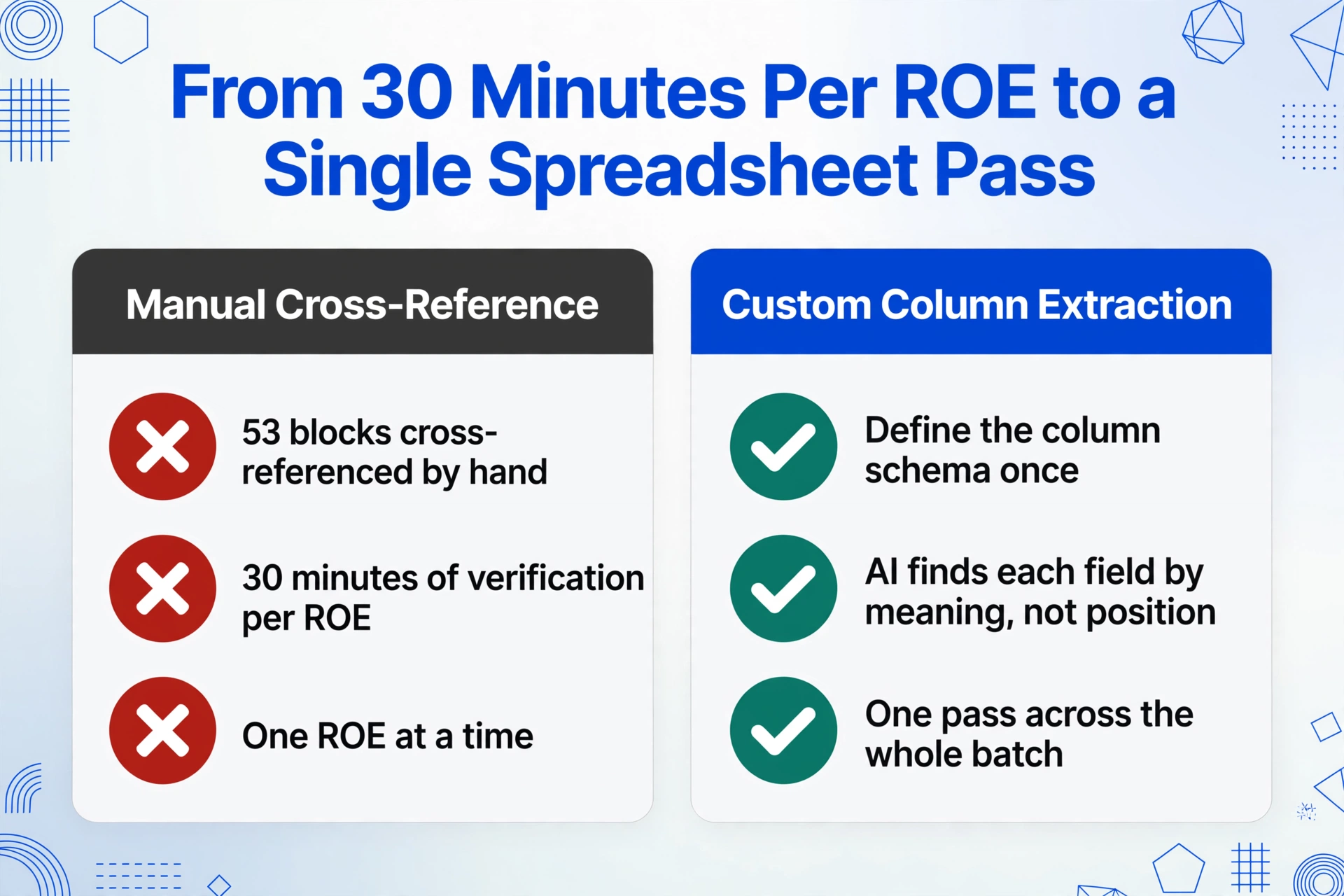
Custom Column Extraction — the core extraction mechanism in ImageToTable.ai — works by semantic understanding rather than template matching. You define the columns you want extracted (for example, "Employee Name," "Last Day Paid," "Total Insurable Hours," "Total Insurable Earnings," "Reason Code"), and the AI locates each value anywhere on the ROE by understanding what the field means, not where it sits on the form. This is the critical capability for a multi-site construction firm whose ROEs may come from different payroll platforms — Ceridian Dayforce for the head office crew, ADP Workforce Now for the Edmonton and Calgary sites if the company acquired a competitor mid-season — or from paper ROEs filled out by a foreman at a remote site without electronic access. The layout varies; the column schema does not. A forty-ROE rush processed through a single column definition extracts all 53 blocks per ROE into one spreadsheet in a single pass, reducing the per-ROE verification time from 30 minutes of manual cross-reference to roughly two minutes of scanning the extracted spreadsheet for discrepancies. The batch ROE processing guide covers the full end-to-end workflow, including the monthly EI summary report output that Service Canada expects as supporting documentation for multi-ROE filings.
Files are processed securely and not stored.
For the 66-ROE November rush scenario, the math shifts dramatically. Manual verification at 30 minutes per ROE = 33 hours of labor across a 15-day window, during which payroll operations continue for the employees still working. With extraction, the per-ROE time falls to roughly two minutes of spreadsheet review — verifying that the extracted values in the Block 15A, 15B, and 15C columns match the pre-audit roster confirmed two weeks earlier, flagging outliers, and filing. That is approximately 2.2 hours of review for the entire 66-ROE batch. The difference — 33 hours versus 2.2 hours — is the difference between a payroll administrator who cancels all other work for two solid weeks and one who processes the November ROE rush alongside the regular payroll run, without overtime, without skipped verification steps, and without a single late filing.
The bottleneck that creates the seasonal rush is not the speed of the payroll system that generates the ROE. It is the speed of the human who verifies what the system generated — and the calendar that allows only five days per ROE regardless of how many ROEs are in progress simultaneously. Extraction does not change the deadline. It changes who does the cross-reference — from the payroll administrator scanning three data sources per ROE to a spreadsheet that flags discrepancies in one view — and it changes when the cross-reference happens: during extraction itself, not as a separate step after generation. The seasonal rush still arrives every November. But the response changes from "clear the calendar and hope" to "define the columns once and review the output."
FAQ: Seasonal ROE Processing and Canadian Payroll
How many ROEs does a typical Canadian construction company issue during the seasonal layoff period?
A mid-sized construction company with 60 to 100 employees operating across four to six sites typically issues 40 to 80 ROEs during the four-week seasonal layoff window from mid-November to mid-December. The volume depends on how many sites freeze simultaneously — a single hard frost can trigger 20 to 30 layoffs in one day — and how many employees are retained for winter maintenance or interior work. Companies that operate year-round in climate-controlled environments (commercial interiors, industrial maintenance) may have no seasonal layoffs at all. Companies that are entirely outdoor — road paving, roofing, concrete, excavation — may lay off their entire workforce within two weeks. The critical variable is not the total ROE count but the number of different last-day-paid dates, which determines how many overlapping five-day deadlines are running simultaneously.
What is the penalty for filing a ROE late during the seasonal rush?
Under the Employment Insurance Act, Service Canada may impose Administrative Monetary Penalties (AMPs) for late ROE filing. The penalty structure is progressive: a first violation may result in a warning, but repeated violations escalate. For a corporation, penalties can reach $2,500 per violation in cases of negligence, with higher amounts for knowing or reckless non-compliance. A seasonal employer with a multi-year pattern of late November ROEs — not due to negligence but to the structural volume collision described above — may accumulate enough late filings to cross Service Canada's enforcement threshold. Once triggered, the penalty per late ROE rises from a warning to a monetary amount. A seasonal employer filing 66 ROEs with a 10% late rate (6 to 7 ROEs past the five-day deadline) and a prior warning letter faces approximately $600 to $1,050 in penalty exposure for the November season alone. The pre-rush audit described above eliminates the most common causes of delay — reason code uncertainty, earnings code errors, and foreman communication lag — and reduces the late-filing probability from an estimated 10-15% to below 2%.
Does ROE Web help with the seasonal rush or just move the bottleneck?
ROE Web — Service Canada's electronic filing system — eliminates the Canada Post delivery window that added two to five business days to the deadline for paper ROE users. Filing electronically means the ROE is received by Service Canada the moment it is submitted, regardless of the time of day, and the employer receives immediate confirmation of receipt. ROE Web speeds up filing. It does not speed up verification. The bottleneck in the seasonal rush is not the transmission of data from the employer to Service Canada — it is the thirty-minute manual cross-reference between each ROE's 53 blocks and the payroll register that must happen before the data is accurate enough to file. ROE Web accepts whatever data the employer submits; it does not check whether Block 15A matches the payroll register or whether Block 15C was the correct code for the separation. A payroll administrator who submits 66 ROEs through ROE Web without full verification is simply submitting 66 potentially incorrect ROEs faster. The bottleneck moves from the filing step to the amendment step — amended ROEs that must be re-filed months later when errors surface.
How does the seasonal ROE rush compare to year-end T4 processing in Canada?
The two compliance events operate on different cycles and create different types of pressure. T4 processing — covered in the four-line cost framework for manual T4 processing — is annual and concentrated in February, with a fixed deadline (last day of February) that applies to all T4s equally. The pressure is volume: every employee triggers a T4, and a 100-employee company must verify 100 T4s by a single deadline. The seasonal ROE rush is different: the volume is lower (66 ROEs versus 100 T4s in the example above), but the deadlines are asynchronous — each ROE has its own five-day clock starting from a different last day paid. T4 processing is a deadline wall (one date, everything due). ROE seasonal processing is a deadline cascade (multiple start dates, overlapping countdowns). The T4 rush is solved by starting early and front-loading the work. The ROE rush cannot be front-loaded because the clock starts when the weather stops — and the weather does not operate on the payroll calendar.
What is the one thing a seasonal employer should do before the November rush to avoid deadline breaches?
Pre-confirm the reason code roster with every foreman. A wrong reason code — particularly a Code A (shortage of work) that should have been Code M (dismissal) or Code E (quit) — is the most expensive single error in the seasonal rush. Correcting it requires an amended ROE, communication with the former employee, and potentially Service Canada adjudication — two to three hours of blended payroll/HR labor. A pre-rush walkthrough with each foreman, matching every seasonal employee's name to a confirmed reason code, costs roughly 15 minutes per foreman and eliminates the single most common verification bottleneck. Everything else — earnings codes, SIN verification, communication protocol — builds on this foundation. The reason code decision is the one that cannot be automated or extracted; it must be made by someone who knows why the employee stopped working. Make that decision before the deadline pressure arrives, not during it.
Seasonal layoffs are not a surprise. The ground freezes every November. The construction season ends every year. The resort empties every autumn. What is surprising — and costly — is that the regulatory framework governing the documents triggered by these predictable events was designed for unpredictable, isolated separations, not for the six-site, forty-ROE, five-day-deadline cascade that arrives when the weather turns. The response is not to get faster at manual verification. It is to pre-audit the decisions, define the extraction schema once, and let the spreadsheet catch the discrepancies — so that when 40 ROEs land in one week, the payroll administrator is reviewing output, not racing a clock that started before they knew it was running.