The Real Cost of Manual Seikyusho Processing
for Japanese SMEs
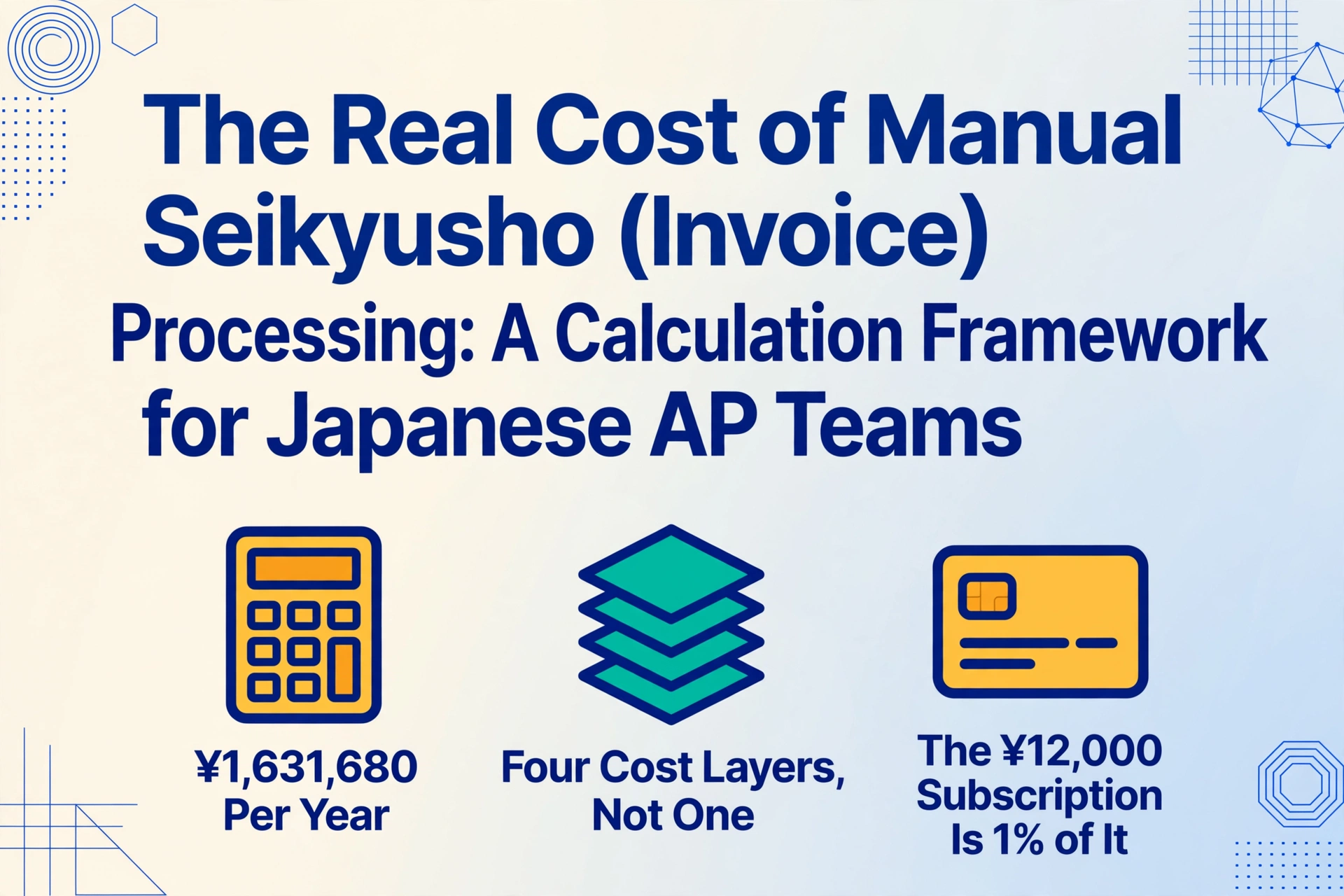
A Japanese SME processing 300 supplier invoices per month pays roughly ¥12,000 a year for an accounting app and treats that as the full cost of accounts payable. What never appears on any statement: the thirty-eight hours a month spent opening each seikyusho (請求書), reading the furikomi bank details (振込先), typing the amounts and the shohizei (消費税) component and the shimebi (締め日) into a screen, cross-checking whether the invoice registration number (インボイス登録番号) is still valid, deciding whether a line item is subject to gensen choshu (源泉徴収) withholding, and untangling the mis-typed bank branch code that sent ¥320,000 to the wrong account — a ¥880 kumimodoshi (組戻し) fee to reverse, plus the supplier's call asking why the payment never arrived. This article separates the visible cost from the invisible ones and gives you a framework to calculate your own number instead of believing the subscription fee is the whole picture.
Key Takeaways
- Your accounting app subscription costs ¥12,000 a year, and that single line on the card statement is treated as the full cost of accounts payable.
- Beneath it — in labour hours, bank transfer errors, tax penalties, and compliance checks that never appear on any budget line — the real cost of manual seikyusho processing adds up to roughly ¥1.6 million per year for a 300-invoice SME.
- Remove the manual reading-and-typing step — extraction reads furikomi digits, flags gensen withholding, and captures the T+13 number from the document — and all four cost layers compress, because the step being replaced is the one every downstream error traces back to.
The Subscription That Hides Thirty-Eight Hours of Labour
Every cost analysis of manual invoice processing begins with the same mistake: measuring the visible subscription fee and declaring that the problem costs ¥12,000 a year. A Japanese accounting app — freee (¥12,936 per year, tax-inclusive), Yayoi (弥生, ¥11,800), or MoneyForward Cloud (マネーフォワード クラウド, ¥11,880, as listed on each provider's pricing page) — appears on the credit card statement as a single line item. The statement does not itemise the thirty-eight hours a month the app's automatic journal entry (自動仕訳) feature cannot handle, because the bank feed never sees the paper seikyusho that arrived by mail, or the PDF attachment with the scanned bank stamp (銀行印), or the supplier whose invoice layout changed this month and the OCR engine the app bundles has never seen before.
The accounting app automates the journal entry for transactions it can match to a bank feed. It does not read a paper seikyusho, does not know which line items require gensen choshu withholding, and cannot verify whether a T+13-digit invoice registration number is still valid on the NTA's Qualified Invoice Issuer public database. Every one of those steps lands on a person — and that person's time is the cost the ¥1,000 monthly subscription was priced not to cover.
The problem is structural. A Japanese seikyusho contains fields that no Western invoice format includes: the payment terms expressed as a shimebi (締め日, the monthly cut-off date) plus a payment window (翌月末払い meaning payment by the end of the following month), the furikomi bank details (振込先 — bank name, branch name, account type, account number, account holder name) that must be transcribed character-for-character to avoid a failed transfer, the shohizei (消費税) broken out by tax rate (10% standard vs. 8% reduced), and since October 2023, a T+13-digit invoice registration number (インボイス制度登録番号) that the buyer must verify to claim the input tax credit. An accounting app automates none of these checks. The monthly subscription reduces the writing of a journal entry to a click, not the reading of a seikyusho to a glance — and the reading is where the thirty-eight hours go.
Four Cost Layers That No Global Benchmark Captures
Industry studies put manual invoice processing at $15 to $26 per document globally — a figure cited in Ardent Partners and IOFM research. That number folds labour, error correction, and overhead into one average, and its frame of reference is the US and European AP department. Drop it into a Japanese SME — where the invoice is a seikyusho with furikomi details that can trigger a failed bank transfer, where certain line items trigger a 10.21% withholding obligation that, if missed, becomes the company's tax liability plus penalties, and where every invoice since October 2023 carries a registration number the buyer must verify or lose the input tax credit — and the cost structure looks different. Four cost layers that no global benchmark captures:
Layer One — Direct labour. The time spent opening the seikyusho, reading each field — invoice date (請求日), payment due date (支払期限), line items (品名/数量/単価/金額), subtotal (小計), consumption tax (消費税), total (合計), furikomi bank details (振込先), and invoice registration number — and typing them into a screen. Priced at what an hour of bookkeeping labour costs in Japan: ¥2,500 to ¥3,500 per hour for experienced AP staff. At five minutes per invoice for a moderately complex seikyusho, 300 invoices a month consumes twenty-five hours of labour — ¥62,500 at the lower rate, ¥87,500 at the upper. Per year, ¥750,000 to ¥1,050,000. That is the visible labour, and it is not the largest cost layer.
Layer Two — Furikomi error costs. The seikyusho contains a furikomi block: bank name (銀行名), branch name (支店名), account type (普通/当座), account number (口座番号), and account holder name (口座名義). One mistyped digit in the branch code or account number — and the bank processes a transfer to the wrong destination. Reversing a completed domestic transfer (furikomi) requires a kumimodoshi (組戻し) procedure: the sending bank contacts the receiving bank, which contacts the unintended recipient, who must consent to return the funds. Mizuho Bank charges ¥880 (tax-inclusive) for a kumimodoshi request, and the fee is non-refundable even if the recipient refuses. The process takes two weeks to several months according to SBI Shinsei Bank's published timeline. Beyond the fee, the supplier whose payment never arrived calls — and someone spends thirty to sixty minutes tracing the payment, explaining the error, and arranging a corrective transfer. Total cost per furikomi error: ¥880 direct fee plus roughly ¥2,000 in staff time, plus the supplier relationship damage that has no line item on any spreadsheet but shows up in tighter payment terms next quarter.
Layer Three — Gensen choshu penalty exposure. Certain payments to individuals and sole proprietors carry a withholding tax obligation (源泉徴収). Professional fees — legal, accounting, design — require a 10.21% withholding at source. A ¥500,000 payment to a designer means ¥51,050 must be withheld and remitted to the tax office by the 10th of the following month. An AP clerk manually entering a seikyusho who categorises the payment as a standard purchase rather than a withholding-eligible service fee has not collected the ¥51,050. Under Article 42 of the National Tax Collection Act (国税通則法), the company — not the supplier — is liable for the unremitted amount plus a non-payment penalty (不納付加算税) of 10% (or 5% if self-corrected before a tax audit). On that single ¥500,000 invoice, the missed withholding costs ¥56,155 in tax and penalties — and that is before late payment interest (延滞税), which accrues daily from the original due date. A mid-sized SME processing 300 seikyusho per month with even a 2% misclassification rate across withholding-eligible items faces an annual exposure that can reach several hundred thousand yen — entirely invisible in the accounting app subscription cost.
Layer Four — Invoice compliance verification. Since October 2023, the Qualified Invoice System (インボイス制度, 適格請求書等保存方式) requires that a buyer claiming an input tax credit must preserve a qualified invoice (適格請求書) bearing a T+13-digit registration number. The buyer must verify that the number is valid — a supplier's registration can be cancelled, expired, or never issued — by checking it against the NTA's Qualified Invoice Issuer public database (適格請求書発行事業者公表サイト). The site accepts up to ten registration numbers per query. For a company with thirty new suppliers in a quarter, that is three queries. For a company with 200 active suppliers where registration status can change and must be verified at each transaction, the compliance check is a recurring manual cost: ten to twenty minutes per batch, or roughly sixty to eighty minutes per month for a 300-invoice AP queue. At ¥3,000 per hour, that compliance verification costs ¥36,000 to ¥48,000 per year — a cost that did not exist before October 2023 and that no benchmark study includes, because no other jurisdiction requires per-invoice registration number verification as a condition of input tax credit eligibility.
To keep the arithmetic grounded, the calculations that follow use a single example: a Japanese SME (中小企業) with ¥500 million annual revenue, an AP team of two people, and 300 supplier seikyusho per month arriving as paper by mail and as PDF attachments by email. Substitute your own volume, labour rate, and error experience at each step.
Layer One — What an Hour of Manual Seikyusho Entry Costs in Japan
The reason manual data entry labour is consistently underestimated in AP cost analyses is that no invoice arrives for your own staff's time. But an hour spent opening a seikyusho, reading each field, typing it into the accounting system, and cross-checking the furikomi details against the supplier master data is an hour not spent on higher-value work — and that hour has a market price in Japan that is well-documented.
Japanese bookkeeping and AP staff earn ¥1,800 to ¥2,800 per hour as dispatch workers (派遣社員). Experienced AP staff in Tokyo and Osaka command ¥2,500 to ¥3,500 per hour with full burden. A bookkeeping outsourcing service (記帳代行) charges ¥30 to ¥80 per journal entry on a volume basis — which, for a seikyusho with five line items each requiring separate journal entries for the purchase amount, consumption tax, and withholding, translates to ¥150 to ¥400 per invoice in outsourced data entry alone. A tax accountant (税理士) on a monthly advisory contract (顧問契約) costs ¥30,000 to ¥40,000 per month for a small business — and that typically includes reviewing the books, not entering the invoices from scratch. If the accountant has to re-enter or correct manually entered seikyusho data before closing the month, the fee reflects it.
The time-per-invoice number varies by complexity, but a usable range exists. A simple seikyusho — single line item, standard 10% consumption tax, no withholding, furikomi details that match the supplier master — takes three to four minutes to enter and verify. A complex seikyusho — multiple line items with mixed tax rates (10% and 8%), a withholding-eligible service component, furikomi details that differ from the previous month's, and an invoice registration number that needs verification — takes eight to twelve minutes. At 300 invoices per month split 70% simple and 30% complex: 210 simple invoices at four minutes each (fourteen hours) plus 90 complex invoices at ten minutes each (fifteen hours) equals twenty-nine hours. Add the month-end reconciliation — checking that the total entered matches the supplier statement (請求書一覧表), chasing missing invoices, correcting mis-entered shimebi dates — and the monthly total lands at thirty-two to thirty-eight hours.
At thirty-five hours a month and a ¥3,000 hourly rate — the mid-range for an experienced AP clerk in a Japanese city — the direct labour cost of manual seikyusho entry is ¥105,000 per month, or ¥1,260,000 per year. This is the cost the ¥1,000 monthly accounting app subscription was supposed to eliminate but did not, because the app automates journal-posting once the data is digital, and the bottleneck is the step before that: turning a paper or PDF seikyusho into the digital data the app can post.
Layer Two — The Cost of One Wrong Digit in a Furikomi Block
A Japanese seikyusho carries a payment instruction block that has no equivalent in Western invoice formats. The furikomi block (振込先) specifies a bank name (銀行名), branch name (支店名), account type (普通/当座), a seven-digit account number (口座番号), and an account holder name (口座名義) that may use katakana (カタカナ) or kanji. A manual AP process means a person reads these fields off the seikyusho and types them into the internet banking interface — character by character, with no cross-validation against the supplier master data unless the company has built one. A mistyped branch code — 銀座支店 (Ginza branch) entered as branch code 001 instead of 002 — does not prevent the transfer from executing. It sends the payment to a different account.
When the supplier calls ten days later asking why the payment has not arrived, the AP team enters the furikomi error chain: locate the original transfer confirmation in the internet banking history, identify which digit was wrong, determine whether the funds landed in a closed or active account, and if the latter, initiate a kumimodoshi (組戻し).
The kumimodoshi procedure varies by bank but follows a consistent structure. Mizuho Bank's published FAQ lists the fee at ¥880 (tax-inclusive) and requires the caller to provide the transfer date, receiving bank and branch, recipient name, and amount. SBI Shinsei Bank warns that the procedure may take two weeks to several months and that the receiving account holder must consent — if the recipient refuses, the funds are not returned, and the ¥880 fee is still charged. The Rakuten Bank FAQ adds that kumimodoshi is not guaranteed even after the request is filed. These are not edge cases. A Japanese AP team processing 300 seikyusho per month with a conservative 1% furikomi entry error rate — three incorrect transfers per month — faces ¥2,640 in direct kumimodoshi fees per month, plus the staff time spent on each recovery: telephoning the bank, documenting the error, following up with the supplier, and processing a corrective payment. At one hour of staff time per incident and ¥3,000 per hour, the labour component adds ¥9,000. The total monthly furikomi error cost for a 1% error rate: approximately ¥11,640, or ¥139,680 per year.
The supplier relationship cost — a vendor who now asks for payment upfront or shortens the shimebi window — has no line item and matters more than the ¥880 fee. It is also the cost most visible to the procurement team and least visible to the accounting app vendor who priced their product at ¥980 a month.
Layer Three — Gensen Choshu: When a Misclassified Line Item Becomes a Tax Liability
Japan's withholding tax system (源泉徴収制度) requires that payers of certain categories of service income — professional fees to lawyers, certified public tax accountants (税理士), judicial scriveners (司法書士), social insurance labour consultants (社会保険労務士), designers, writers, and speakers — withhold income tax at source. The withholding rate is 10.21% of the payment amount (20.42% on the portion exceeding ¥1 million for a single payment to the same recipient). The withheld amount must be remitted to the tax office by the 10th of the month following the payment.
In a manual AP process, the decision of whether a seikyusho line item triggers withholding rests on a person reading the payment description and knowing the rules. The seikyusho from a web design firm for ¥480,000 — does it include a design service component that is withholding-eligible? The seikyusho from a consulting sole proprietor (個人事業主) — is the entire amount subject to withholding, or only the portion above expenses? An AP clerk who has processed 200 invoices this week, half of them paper seikyusho from suppliers who do not digitally label withholding status, makes a call — and when the call is wrong, the mistake is invisible until the tax office's reconciliation or audit uncovers it.
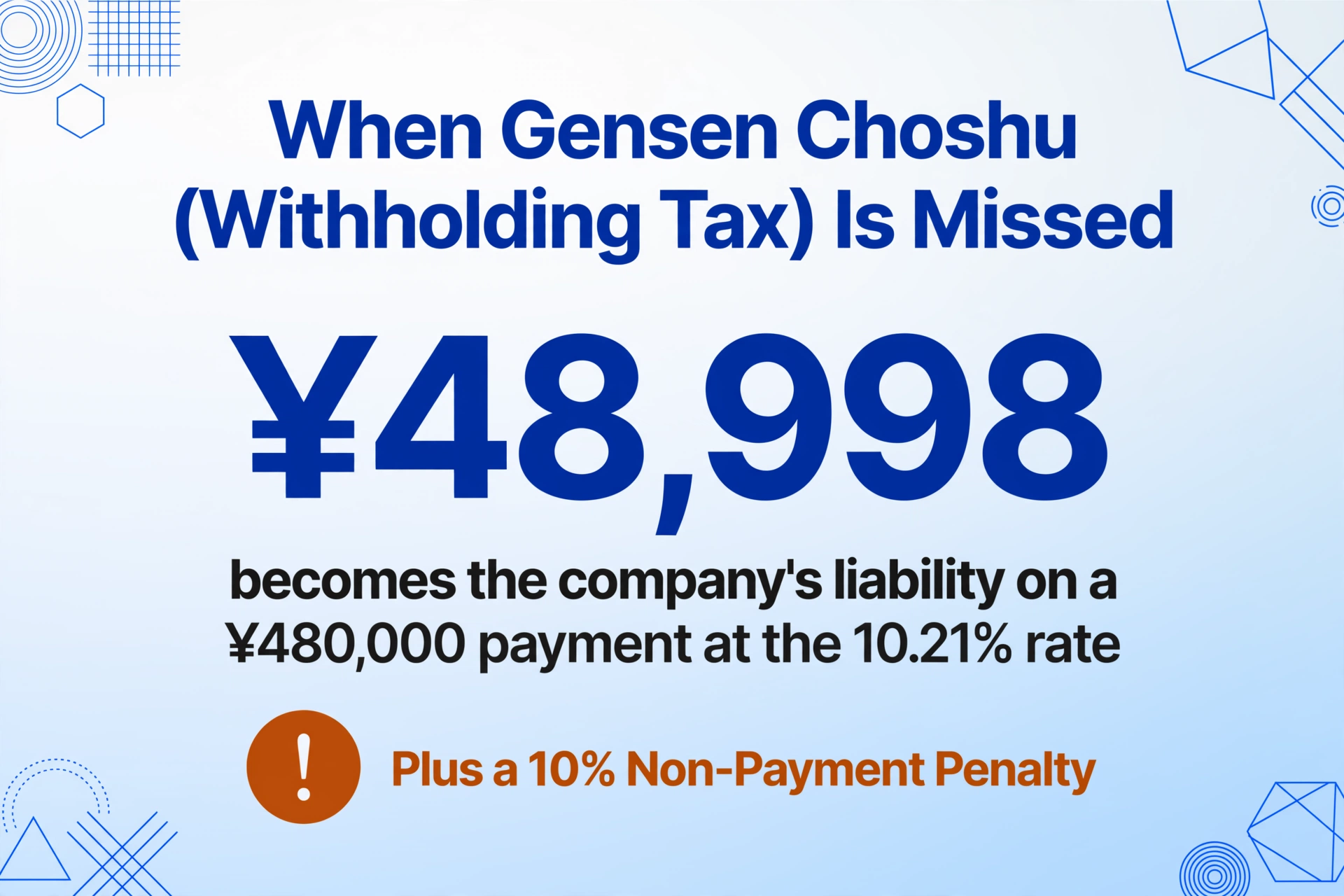
The consequence of missed withholding flows through a defined penalty structure. The unremitted withholding tax itself becomes the company's liability — ¥48,998 on a ¥480,000 payment at 10.21%. The non-payment penalty (不納付加算税) is 10% of the unremitted amount (5% if the company discovers and corrects the error before the tax office issues a notice). Late payment interest (延滞税) accrues daily from the original statutory due date at the rate set under the General Law of National Taxes (国税通則法), currently 3% per annum (the statutory rate under Article 404 of the Civil Code, effective April 2026 under Ministry of Justice Notification No. 73 of 2025) for the first two months and potentially higher thereafter. On a single missed withholding of ¥48,998 discovered six months late, the company owes: ¥48,998 (principal) + ¥4,900 (10% penalty) + roughly ¥735 (six months at 3% annualised) = ¥54,633. That is 11.4% of the original payment — and the penalty multiplies across every withheld-eligible invoice the AP clerk misclassified over a year.
A separate exposure concerns the contractual delay penalty rate. Many Japanese commercial contracts specify a delay damage rate (遅延損害金) of 14.6% — commonly derived from the rate in the National Tax Collection Act — and while the Civil Code's default statutory rate was lowered from 5% (and the former Commercial Code's 6% 商事法定利率 was abolished in April 2020), a contractually specified rate overrides the statutory default. An SME that consistently misses its own payment deadlines because manual furikomi entry delays the batch — and whose contracts specify a 14.6% delay rate — faces a compounding exposure on top of the direct penalties from the tax office. The legal framework for 2026 delay damages under Japanese law explains the interaction in full.
Layer Four — The Compliance Tax: Verifying Registration Numbers That Were Valid Last Month
The Qualified Invoice System introduced a cost that did not exist in Japanese AP before October 2023: the per-invoice compliance check. To claim an input tax credit on a purchase, the buyer must hold a qualified invoice (適格請求書) bearing a T+13-digit registration number (登録番号) — and that number must belong to a currently registered qualified invoice issuer, not one that was cancelled or expired. The NTA's Qualified Invoice Issuer Public Database (適格請求書発行事業者公表サイト) is the authoritative source, and it requires per-query lookup: enter the registration number, see if the issuer is still active. The database accepts up to ten numbers per batch query.
For a Japanese SME with 200 active suppliers, the compliance check is not a one-time setup. A supplier's registration can be cancelled at any time — voluntarily, or automatically when the business closes or its tax status changes. The Tokyo Chamber of Commerce and Industry (東京商工会議所) advises buyers to verify registration status at each transaction. That means every seikyusho from a supplier whose registration was verified three months ago needs re-verification. A quarterly batch verification for 200 suppliers, at ten suppliers per query and roughly two minutes per query to enter numbers and record results, takes forty minutes. Per year: 160 minutes. If the AP team does it monthly — as recommended — that is 480 minutes or eight hours. At ¥3,000 per hour, ¥24,000 annually.
The cost is small per invoice but large in consequence when missed. Receiving a seikyusho without a valid registration number and claiming the input tax credit anyway means the credit is disallowed on audit — and the disallowed amount becomes the company's additional consumption tax liability plus penalties. On a single ¥1,500,000 seikyusho with ¥150,000 in consumption tax that was claimed but the supplier's registration had expired, the company owes ¥150,000 in back tax plus a potential understatement penalty (過少申告加算税) of 10% to 15% under the General Law of National Taxes. The per-transaction cost of verification is ¥40 to ¥80. The per-transaction cost of not verifying is, at minimum, the input tax credit itself.
Your Total: A Four-Layer Calculation Framework Per Monthly Settlement Cycle
With the four layers separated, the annual cost of manual seikyusho processing becomes a function of your own invoice volume, labour rate, error frequency, and compliance requirements rather than a global benchmark that averages out every market's differences. The table below runs the calculation for the example SME — 300 seikyusho per month, a two-person AP team, ¥3,000 hourly labour rate, 1% furikomi error rate, 2% gensen choshu misclassification rate, and monthly invoice compliance verification:
| Cost Layer | Monthly Total | Annual Total | Calculation Basis |
|---|---|---|---|
| Accounting app subscription | ¥1,000–¥1,500 | ¥12,000–¥17,000 | freee/Yayoi/MoneyForward Cloud business tier |
| Layer One — Direct labour | ¥105,000 | ¥1,260,000 | 35 hrs/mo × ¥3,000/hr: reading seikyusho fields, typing into accounting system, reconciling totals |
| Layer Two — Furikomi errors | ¥11,640 | ¥139,680 | 3 errors/mo × (¥880 kumimodoshi fee + 1 hr labour @ ¥3,000) |
| Layer Three — Gensen choshu exposure | ¥16,333 | ¥196,000 | 6 misclassified invoices/mo × avg ¥48,998 withheld × (10% penalty ÷ 12, weighted by audit probability); excludes the principal tax liability itself |
| Layer Four — Invoice compliance | ¥2,000 | ¥24,000 | 8 hrs/yr × ¥3,000/hr: verifying T+13 registration numbers on NTA database |
| Total per year | ¥1,631,680–¥1,636,680 | True cost of manual seikyusho processing for a 300-invoice/month SME |
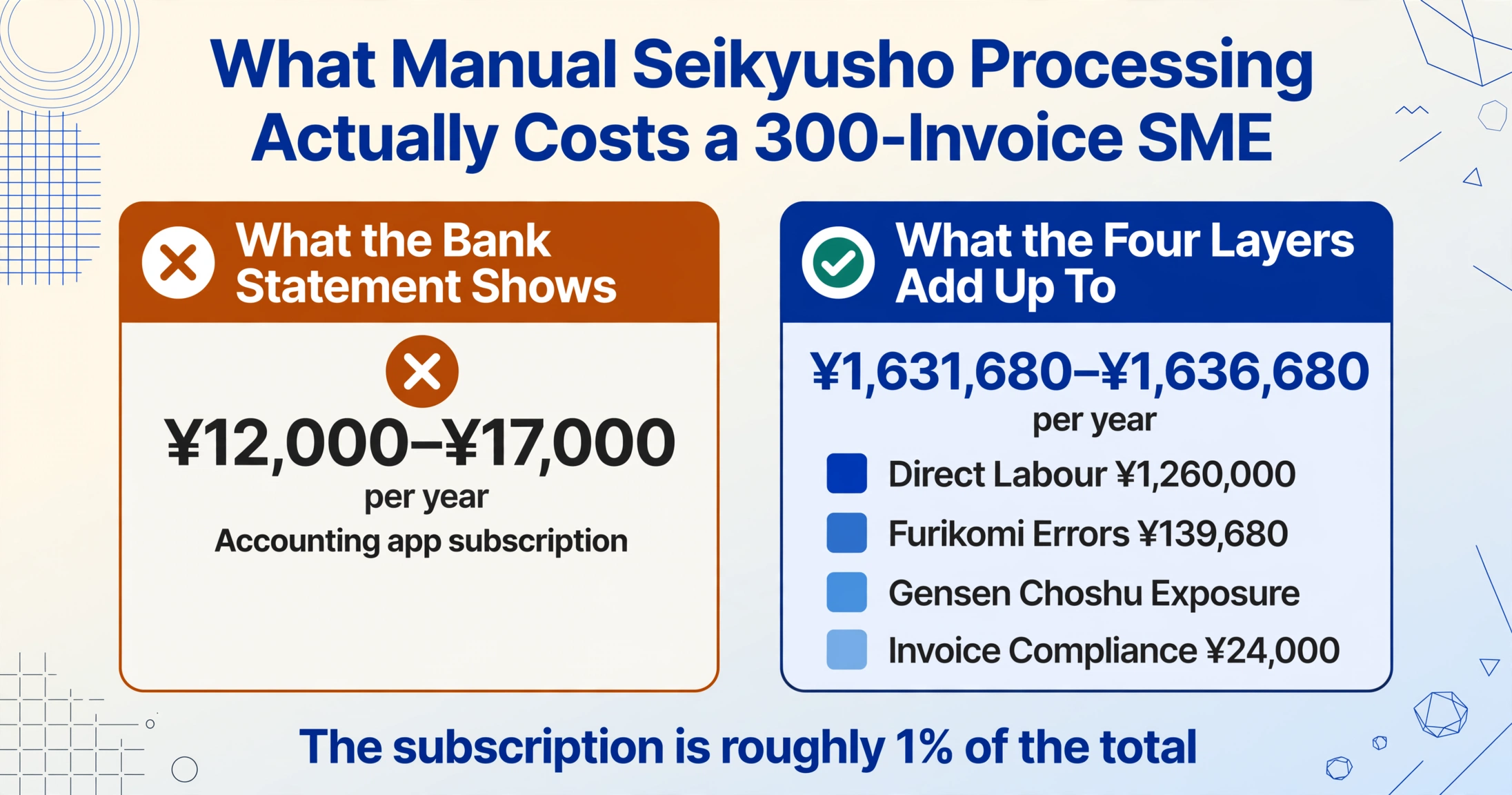
The accounting app subscription — the only cost most SMEs count — is roughly 1% of the total. To adapt the framework to your own operation, substitute into five expressions:
- Layer One = (monthly invoice count × average entry time per invoice in hours) × your AP staff hourly rate × 12 months
- Layer Two = monthly invoice count × your furikomi error rate × (kumimodoshi fee at your bank + staff recovery time × hourly rate) × 12 months
- Layer Three = monthly invoice count × your gensen-eligible proportion × estimated misclassification rate × average withheld amount × penalty rate (5%–10%), annualised with audit probability
- Layer Four = (number of active suppliers ÷ 10 suppliers per batch query) × minutes per batch ÷ 60 × hourly rate × queries per year
- App subscription = your current accounting software annual fee (¥12,000–¥17,000 for SME tier)
The same cost structure — invisible downstream costs dwarfing visible subscription fees — appears across markets that depend on manual document data entry. The companion article on what manual BAS entry costs Australian small business owners found the same pattern: the labour you see is less than half the total cost. The analysis of manual passbook transcription costs for Japanese sole proprietors identified three cost lines hiding behind a ¥1,000 monthly subscription. The jurisdiction and the document type change, but the cost architecture — visible labour plus error correction plus compliance friction plus penalty exposure — is remarkably consistent.
What Happens When the Typing Step Disappears
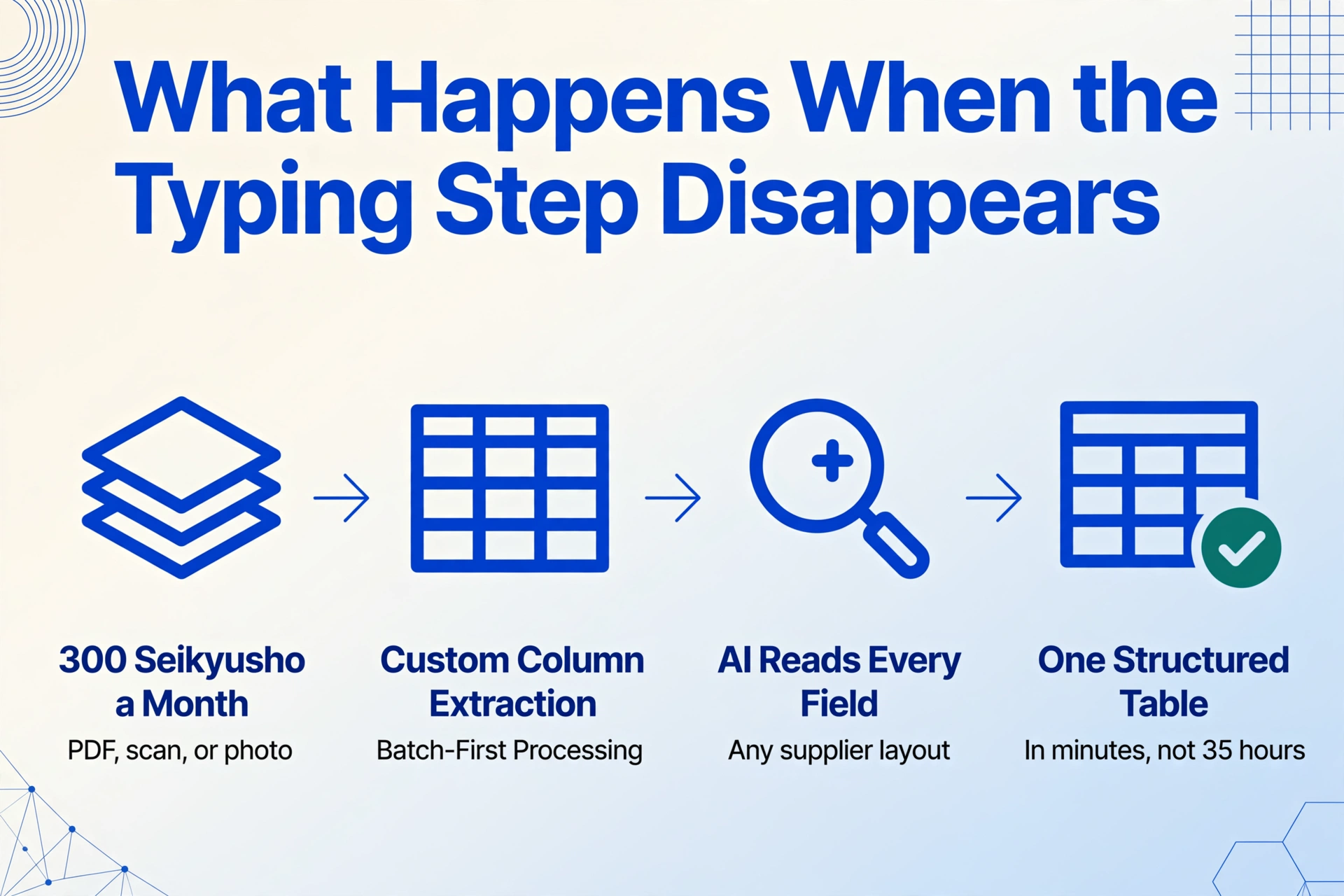
Every one of the four cost layers traces back to the same operation: a person reading a seikyusho and typing its fields into a screen. Layer One is that operation multiplied by 300 invoices every month. Layer Two is what happens when the furikomi block is mistyped. Layer Three is what happens when the withholding decision is made by a person under time pressure rather than by a consistent rule applied to every invoice. Layer Four is what happens when compliance verification is a manual batch query rather than an automatic lookup. Remove the manual reading-and-typing, and all four layers compress.
The mechanism is Custom Column Extraction: you define the columns you want — "Invoice Date (請求日)," "Supplier Name (請求元)," "Line Item Description (品名)," "Quantity (数量)," "Unit Price (単価)," "Line Amount (金額)," "Subtotal (小計)," "Consumption Tax (消費税)," "Total Amount (合計)," "Bank Name (振込先銀行名)," "Branch Name (支店名)," "Account Number (口座番号)," "Account Holder (口座名義)," "Invoice Registration Number (インボイス登録番号)," and "Shimebi (締め日)" — and the AI reads every seikyusho and populates each column by understanding what the labels mean, regardless of each supplier's layout or whether the invoice arrived as a PDF, a scan, or a photograph. Because it is batch-first, 300 seikyusho become one structured table in minutes rather than the thirty-five hours of manual entry that Layer One measures. The step-by-step version of that workflow for a single seikyusho is covered in the guide to extracting Japanese invoice data to Excel with payment fields and consumption tax. The guide to batch-processing Japanese supplier invoices into an AP spreadsheet with furikomi bank details covers how the same approach scales to a full monthly settlement cycle.
Two capabilities directly attack Layers Two and Three. An inferred column can flag whether a supplier is a withholding-eligible entity: add a column named Withholding Required (options: Yes/No/Check) and the tool makes an initial categorisation you verify rather than build from zero — collapsing the decision that currently rests on an AP clerk's memory of which suppliers are gensen-eligible. A computed column can verify the arithmetic: define a column that sums all line item amounts plus consumption tax and compares the result to the stated total (合計), and every seikyusho with a calculation error is flagged before it enters the payment queue. What was a manual cross-check becomes an automated validation.
The cost comparison for the example SME:
| Cost Layer | Manual Processing (Annual) | Automated Extraction | Saving |
|---|---|---|---|
| Layer One — Direct labour | ¥1,260,000 | ¥0 (machine time, minutes) | ¥1,260,000 |
| Layer Two — Furikomi errors | ¥139,680 | ¥0 (extracted values, no typing errors) | ¥139,680 |
| Layer Three — Gensen exposure | ¥196,000 | ¥30,000 (review of inferred categorisation) | ¥166,000 |
| Layer Four — Invoice compliance | ¥24,000 | ¥0 (registration number extracted, no manual lookup) | ¥24,000 |
| Total | ¥1,619,680 | ¥30,000 | ¥1,589,680 |
Files are processed securely and not stored.
At roughly ten seconds of AI processing per seikyusho versus five to ten minutes of manual reading, typing, categorising, and verifying by hand, extraction does not reduce Layer One — it eliminates the reading-and-typing step and replaces it with a verification glance. The furikomi error risk on Layer Two collapses because the bank details are extracted from the document text, not typed from memory. The gensen choshu exposure on Layer Three shrinks because the withholding decision is flagged consistently rather than made under time pressure. The compliance cost on Layer Four disappears because the invoice registration number is captured alongside every other field and can be batch-verified. The arithmetic is not gradual improvement. It is a structural change in the cost base.
FAQ — Manual Seikyusho Processing Costs for Japanese SMEs
How much does it actually cost a Japanese SME to process one seikyusho manually?
Using the four-layer framework: Layer One direct labour at ¥3,000/hr and five minutes per simple seikyusho is ¥250. Add a pro-rated share of Layer Two furikomi error costs (¥39 per invoice at a 1% error rate), Layer Three gensen choshu penalty exposure (¥54 per invoice at a 2% misclassification rate), and Layer Four invoice compliance (¥7 per invoice for monthly verification). The total is approximately ¥350 per seikyusho — and that is the lower bound for a simple, single-line-item invoice. A complex seikyusho with multiple line items, mixed tax rates, and a withholding-eligible component pushes past ¥600. Compare that to the roughly ¥10 per document in AI extraction time, and the cost structure flips from labour-dominated to verification-dominated.
Why does the accounting app subscription not eliminate these costs?
Accounting apps — freee, Yayoi, MoneyForward Cloud — automate the accounting ledger: journal entries, tax calculations, financial statement generation. They do not read the paper seikyusho that arrives by mail, the PDF attachment with a scanned bank stamp, or the supplier invoice whose layout changed this month. The app's automatic journal entry (自動仕訳) feature matches bank feed transactions to existing supplier data, but the step that feeds the data into the system in the first place — the manual typing of the seikyusho — remains a human task. The ¥1,000 monthly subscription reduces the writing of a journal entry but not the reading of an invoice, and for seikyusho-dependent AP workflows, the reading is where the thirty-eight hours a month go.
What is the penalty for missing a gensen choshu withholding on a seikyusho?
The unremitted withholding tax amount becomes the company's liability. The non-payment penalty (不納付加算税) is 10% of the unremitted amount under Article 42 of the National Tax Collection Act, reduced to 5% if the company discovers and corrects the error before the tax office issues a notice. Late payment interest (延滞税) accrues daily at the statutory rate — currently 3% per annum under Article 404 of the Civil Code, confirmed at 3% for the April 2026 to March 2029 period by Ministry of Justice Notification No. 73 of 2025 — on top of the penalty. On a single ¥500,000 payment where 10.21% (¥51,050) should have been withheld, the total exposure six months late is roughly ¥56,815. The penalty compounds across every misclassified seikyusho over a tax year.
How does the invoice system (インボイス制度) add cost to manual seikyusho processing?
Since October 2023, a buyer claiming an input tax credit must hold a qualified invoice (適格請求書) bearing a valid T+13-digit registration number. The buyer must verify the number against the NTA's Qualified Invoice Issuer Public Database (適格請求書発行事業者公表サイト) — the Tokyo Chamber of Commerce guidance recommends verification at each transaction. The database accepts ten numbers per query. For a company with 200 active suppliers, quarterly verification takes roughly 160 minutes per year; monthly verification, roughly eight hours annually. The per-query cost is small (¥40–¥80 at ¥3,000/hr), but the consequence of missing an expired registration is the disallowance of the entire input tax credit for that transaction — plus understatement penalties of 10% to 15% under the General Law of National Taxes.
What is the kumimodoshi procedure and why does it cost more than the fee?
Kumimodoshi (組戻し) is the procedure for recalling a domestic bank transfer (furikomi) that was sent to the wrong account. The sending bank contacts the receiving bank, which contacts the unintended recipient, who must consent to return the funds. Mizuho Bank charges ¥880 (tax-inclusive) per request, and the fee is non-refundable even if the recipient refuses. SBI Shinsei Bank's published timeline warns the procedure may take two weeks to several months. The visible cost is the ¥880 fee. The invisible cost is the staff time spent: locating the original transfer, identifying the error, contacting the bank (phone or branch visit), documenting the request, following up with the supplier whose payment is delayed, and processing a corrective transfer — roughly one hour per incident. At ¥3,000/hr, the total cost per furikomi error is approximately ¥3,880, of which only 23% is the bank fee.
Can document extraction tools read the furikomi block and invoice registration number from a Japanese seikyusho?
Yes. A seikyusho has a highly structured format: the furikomi block typically appears in a dedicated section near the bottom of the page with labelled fields (銀行名, 支店名, 口座番号, 口座名義), and the invoice registration number (T+13 digits) is a labelled field required by law. Extraction reads these values from the document image rather than relying on a person to type them — which means a furikomi error caused by a mistyped digit cannot occur, because the digits come from the document, not from the keyboard. The limitation to be honest about: heavily handwritten seikyusho where the bank details are written by hand in small characters may reduce accuracy, and a verification glance at the extracted bank name against the supplier master remains a sensible check — but that glance replaces the entire typing step, not adds to it.
The four layers of manual seikyusho processing cost — labour, furikomi errors, gensen choshu exposure, and invoice compliance — add up to something the ¥1,000 monthly app subscription was never priced to cover. Take one settlement cycle's seikyusho, name your columns once, and see them become a structured AP ledger instead of thirty-five hours of typing.
Process Your Seikyusho Automatically