Why Billable Hours Leakage
Costs More Than Most Partners Realize
The real problem with billable hours isn't getting people to work more. It's getting the hours they already worked onto an invoice. Every consulting firm has a utilization target — 75%, 80%, whatever the partnership agreed on last planning cycle — and every partner can tell you their firm's number to the decimal. What almost none of them can tell you is what happens to the gap between hours tracked and hours billed. Not the hours that get written off after client negotiation. The hours that never make it far enough to be negotiated over. They dissolve somewhere between the consultant who did the work and the accounting team that turns time into revenue — and the dissolution isn't random. It follows a pattern that's been hiding in plain sight for as long as professional services firms have billed by the hour.
Key Takeaways
- €44,000 per consultant disappears each year between work done and invoice sent — not client negotiation, just hours that never get described in the language a billing system can read.
- The spreadsheet you trust to manage hours hides losses better than paper ever did: a blank cell in row 847 stays invisible forever, and manual re-entry silently doubles every transcription error.
- Fixing this doesn't need new policies or more management pressure — it needs two fewer translation steps between a filled timesheet and billing-ready structured data.
The Work-Doer and the Biller: Two People, Two Views of the Same Hour
Every hour of billable work in a consulting firm passes through at least two people before it becomes revenue. The first is the consultant who did the work — let's call them the work-doer. The second is whoever turns that consultant's time entry into a line on an invoice — the biller, typically someone in finance or a practice manager. These two people describe the same hour of work in fundamentally different languages, and the gap between those languages is where billable hours go to die.
The work-doer thinks in terms of what happened. "Reviewed draft contract for Acme." "Call with CFO about Q3 projections." "Revised Section 4 per client feedback." Their mental model is narrative — a story of their day, reconstructed from memory, often at 4:55 PM on a Friday after the real work is done.
The biller needs something entirely different. A client code (is this Acme Corp or Acme Holdings — the subsidiary matters for the SOW). A matter or project code (which engagement? there are three active). A task category (was that call "strategy" or "project management"? the rate is different). A billable rate. And the hours — entered not as a story but as a number, preferably in decimal, preferably in a system that talks to the invoicing module.
The distance between "reviewed draft contract for Acme" and "Client 4472 / Matter ENG-2026-03 / Task 3.1 / 1.5 hours / $275" is where the first leak happens. The consultant has the information but not in the format the biller needs. The biller can format it but doesn't have the information. Somewhere in between, someone has to translate — and translation always loses something.
A large-scale study of professional services firms quantified this precisely. Across consulting, legal, and accounting sectors surveyed, 22% of professionals record less than 70% of the time they spend on client work. That's not 22% who occasionally forget a 10-minute call. That's 22% for whom more than 30% of their billable time goes entirely unrecorded. Another 38% capture between 70% and 90%. Only 40% capture more than 90%.
This is not a discipline problem. A consultant who can manage a $2M engagement, navigate a hostile client steering committee, and deliver a 120-slide board presentation on deadline is not incapable of filling out a timesheet. The problem is structural. The work-doer and the biller operate in different information systems that were never designed to talk to each other — and the manual spreadsheet that bridges them is, as we'll see, a bridge with holes in it.
Where the Hours Actually Go: Three Tasks Nobody Thinks to Log
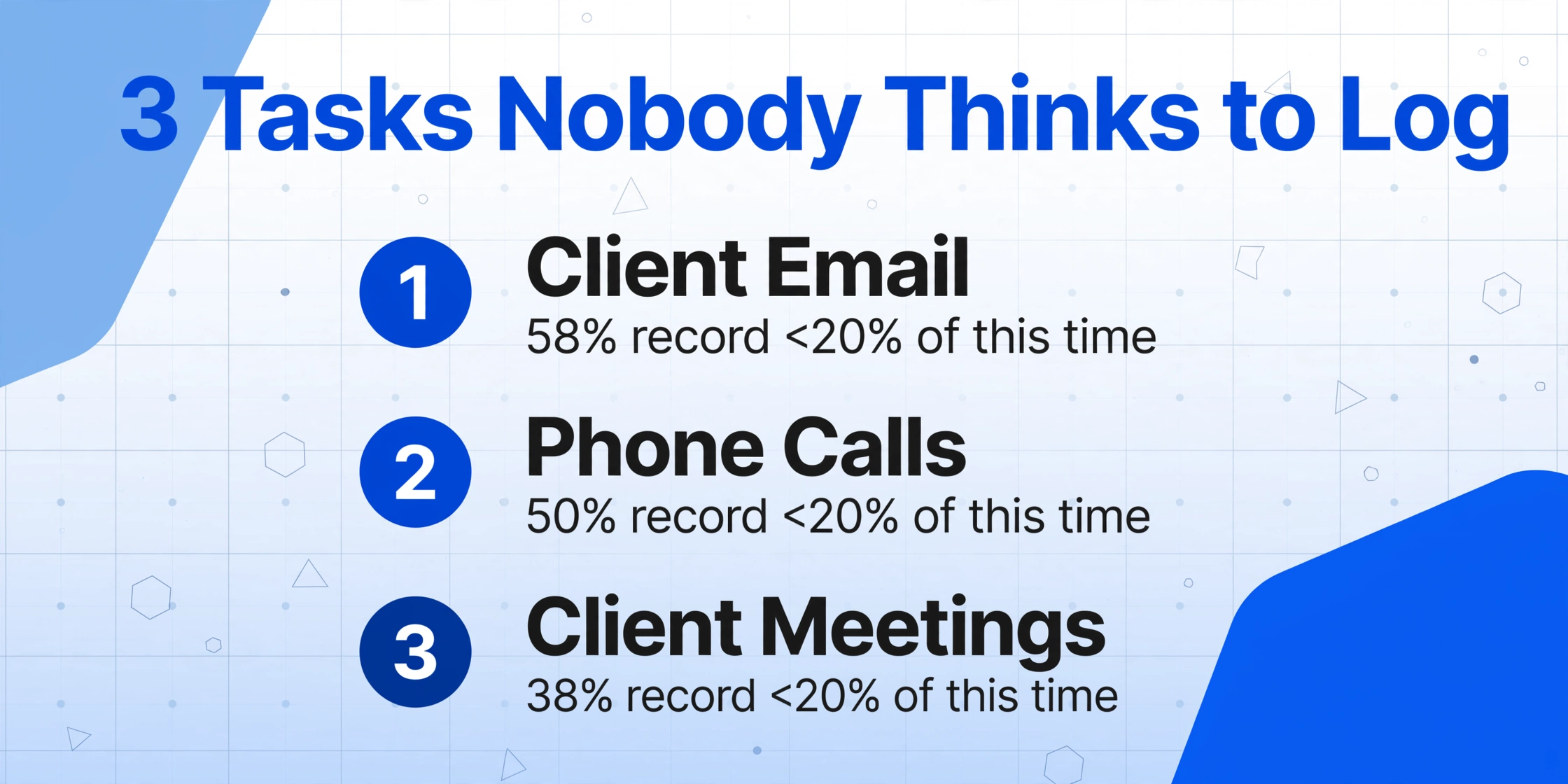
Not all billable activities leak at the same rate. The same study broke down time-recording behavior by task type, and the pattern is revealing. The three activities with the highest leakage are the ones that feel least like "work":
- Reading and answering client email: 58% of advisors record less than 20% of this time. Over half of consultants capture essentially none of their email time — despite it being core billable communication.
- Phone calls with clients: 50% record less than 20%. A 12-minute call about a deliverable revision is billable work. It almost never appears on a timesheet.
- Client meetings: 38% record less than 20%. Even scheduled, blocked-out time in a conference room — the most structured kind of billable work there is — goes unrecorded by more than a third of professionals.
Why these three? Because they don't feel like deliverables. Writing a report feels like work — you have a document at the end to prove it. Reading 47 client emails and crafting 12 responses feels like overhead, even when the content is substantive client guidance. The work-doer's brain categorizes it as "communication" rather than "work product," and the timesheet stays blank. The biller never sees it. The invoice never reflects it. The revenue simply never materializes.
This pattern matters because it means the leakage isn't random. It's concentrated in the highest-frequency, shortest-duration interactions — the ones that add up to real money precisely because there are so many of them.
The Psychology of Logging What You Earn By the Hour
There's a deeper layer to this problem, and it lives in the way billable hours reshape how people think about time itself.
In 2007, organizational psychologists Sanford DeVoe and Jeffrey Pfeffer published a study with a finding that should be required reading for every partner at a billable-hours firm. They demonstrated that being paid by the hour — or even just calculating your implicit hourly wage — causes people to apply an economic frame to their time. Time becomes money, literally, in the cognitive architecture. And when time is money, people become more reluctant to spend it on anything that doesn't generate income.
The irony lands here: the very billing model that makes consulting profitable creates the psychological conditions that make consultants avoid recording their time. Filling out a timesheet is uncompensated labor. It doesn't generate a deliverable. It doesn't advance the client engagement. It exists purely to translate work into revenue — and to someone whose brain has been trained by hourly billing to evaluate every activity through a "does this earn?" filter, it registers as a cost, not a benefit.
DeVoe and Pfeffer followed this thread across multiple studies. Their research on volunteering behavior found that hourly-paid workers spent significantly less time volunteering — the economic frame suppressed uncompensated activity. They found the same pattern in environmental behavior: thinking about time in terms of money made people less willing to engage in pro-environmental actions that cost time but not money. The effect isn't conscious. Nobody sits at their desk thinking "I refuse to fill out this timesheet on principle." The resistance operates below conscious reasoning, as a subtle avoidance of anything that feels like giving away time for free.
This helps explain a phenomenon that Reddit's r/consulting is full of: the timesheet submitted at 5:00 PM on Friday with 40 hours exactly, every week, regardless of what actually happened. "Bill 8, work 10" is a meme for a reason. When timesheet submission is the last thing between a consultant and their weekend, and the system requires reconstructing fragmented work from memory with no immediate payoff, the human brain takes the path of least resistance: round to a clean number and close the laptop. The hours between 40 and 55 — the ones that actually got worked — simply cease to exist in the firm's financial records.
A meta-analysis of time management research published in PLOS ONE confirmed a related finding: time management behaviors correlate most strongly with conscientiousness as a personality trait (r = 0.451), not with intelligence, experience, or motivation. In other words, detailed time tracking is something only a subset of people are dispositionally inclined to do well — yet the billable-hours model demands it uniformly from every consultant, including the brilliant strategist who can't remember what they had for lunch. The system is designed as if everyone is high-conscientiousness, and the people who aren't leak revenue every day without anyone noticing.
Fifteen Minutes Here, Thirty There: The Arithmetic of Small Gaps
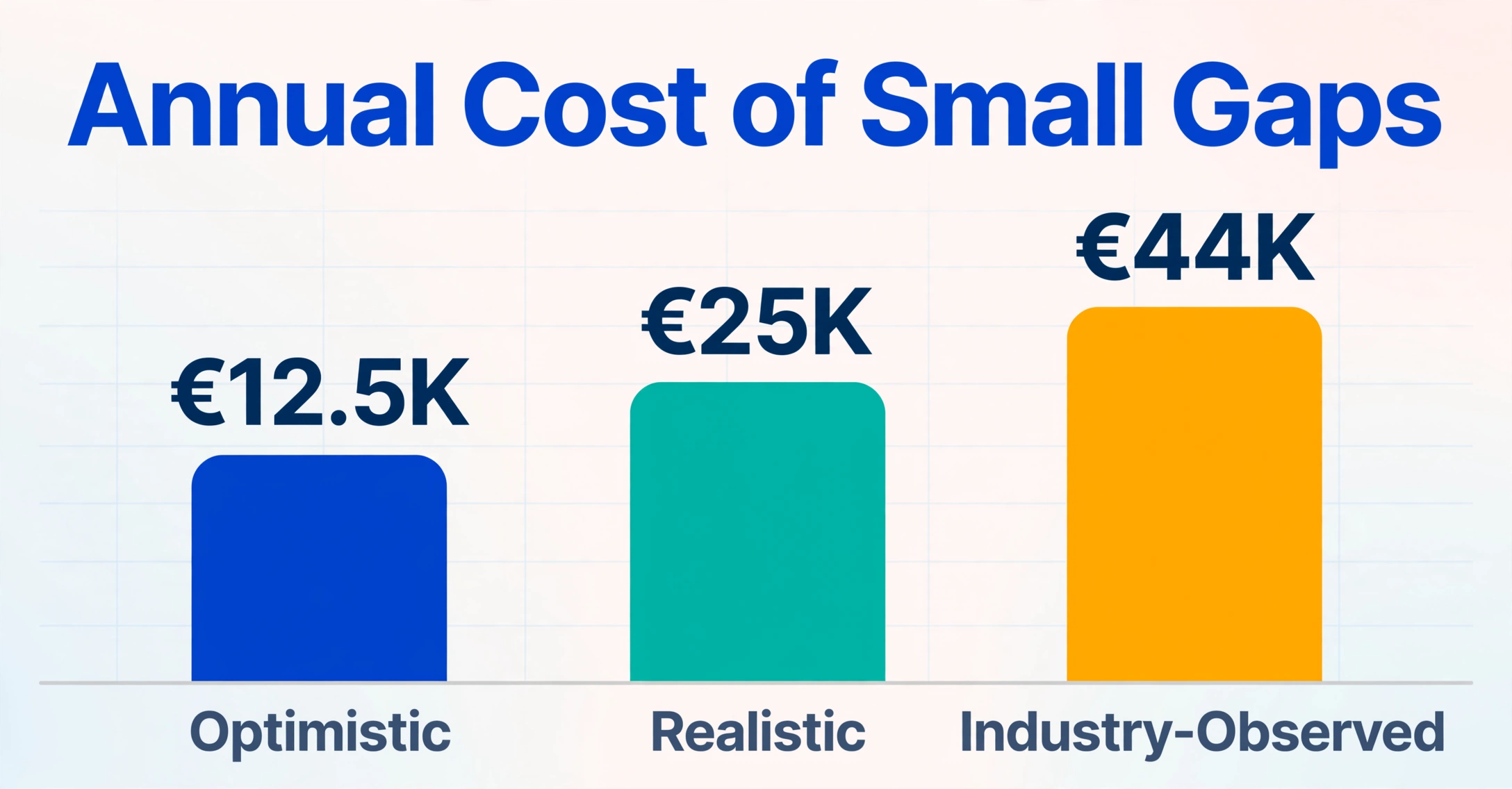
Individually, the numbers look trivial. Fifteen minutes unlogged. A half-hour call forgotten. A batch of client emails answered at 9 PM that never made it into Thursday's timesheet. Nobody loses sleep over fifteen minutes. But the arithmetic of small gaps is brutal once you aggregate it across a year.
The Compounding Effect: What 15 Minutes Per Day Actually Costs
| Scenario | Daily Gap | Annual Loss (1 Consultant) | Annual Loss (20-Person Firm) |
|---|---|---|---|
| Optimistic | 15 min @ $200/hr | $12,500 | $250,000 |
| Realistic | 30 min @ $200/hr | $25,000 | $500,000 |
| Industry-Observed | ~4.3 hrs/week @ €212/hr | €44,000 | €880,000 |
Sources: Optimistic/Realistic calculated at $200/hr, 250 working days. Industry-Observed from consultancy.uk survey data using €212/hr average billable rate, 48-week year.
At the industry-observed level — the documented 15% leakage rate found in professional services surveys — we're looking at roughly €44,000 per consultant per year in work that was performed but never invoiced. For a 20-person firm, that's nearly €900,000 annually. The number isn't hypothetical. It's what happens when 4.3 billable hours per week, spread across dozens of unlogged micro-tasks, never make the transition from "work done" to "revenue recognized."
Ruddr, a PSA platform that works with services firms, reports that billing leakage typically runs 3–7% of billable revenue — and for a $20M firm, that's $600,000 to $1.4 million per year that never gets invoiced. "No client short-pays. No invoice gets disputed," they note. "The revenue simply never appears."
And it's getting worse. SPI Research's 2025 Professional Services Maturity Benchmark, surveying 403 firms globally, recorded billable utilization at 68.9% in 2024 — the lowest in five years and a full 6.1 points below the 75% threshold considered necessary for healthy margins. The 2026 benchmark showed further deterioration to 66.4%, an all-time low in SPI's 19-year survey history. Utilization isn't just soft — it's in structural decline, and the trend predates any single economic cycle.
The trend that should concern every partner:
SPI Research utilization data: 73.2% (2021) → ~71% (2023) → 68.9% (2024) → 66.4% (2025). That's a 6.8-percentage-point drop over four years, during which revenue per billable consultant also declined from $207K to roughly $199K. These are not rounding errors. They represent billions in aggregate across the professional services sector.
When the Spreadsheet Makes the Problem Invisible
There's a quiet paradox in how professional services firms handle timesheets, and it's visible in the technology they use to bridge the work-doer/biller gap. The bridge is usually a spreadsheet — sometimes a shared Excel file, sometimes a Google Sheet, sometimes a CSV export from whatever time-tracking tool the firm half-adopted three years ago. And spreadsheets, counterintuitively, make the leakage problem harder to see, not easier.
To understand why, consider what paper timesheets did that spreadsheets don't. A paper timesheet has a fixed physical space. It has a finite number of rows. If you're totaling hours for the week and the sum doesn't match expectations, the discrepancy is visible on the same surface as the data. A manager flipping through a stack of 20 paper timesheets can spot a blank Friday column from across the desk. An eraser leaves a mark. A cross-out tells a story. Paper's physical constraints are, in this specific context, a feature — they make anomalies visible.
A spreadsheet has none of these constraints. It can hold infinite rows. A formula error on row 847 of a 1,200-row workbook produces no visual signal — the number just sits there, wrong, indistinguishable from all the numbers around it. A missing entry leaves no evidence because a blank cell in a sea of populated cells is effectively invisible during a 4:30 PM Friday review. The spreadsheet's infinite capacity is also its infinite capacity to hide.
Academic research on spreadsheet auditing backs this up. Chen and Chan at the National University of Singapore documented what they call the "surface vs. deep structure" problem: what you see in a spreadsheet (the surface — numbers, formatting, labels) and how it actually works (the deep structure — formulas, cell dependencies, data flows) are only loosely connected. Errors hide in the gap between surface and structure. A cell that looks like it contains a consultant's total weekly hours might actually contain a formula that's referencing the wrong range, quietly excluding Thursday's entries. The surface gives no clue. The deep structure is wrong. And nobody notices until the invoice goes out with 8 hours instead of 12.
Now add the transcription step. In most firms, a consultant's timesheet — whether it started as a paper form, a PDF, or an entry in a time-tracking app — gets manually re-entered into the billing spreadsheet by someone in accounting. That's a second translation layer. The consultant wrote "Acme — strategy review." The biller needs to map that to client code ACM-004, project STRAT-Q3, task 3.2.1. Every mapping decision is an opportunity for error. And because spreadsheets don't validate semantic consistency (they'll happily accept client code ACM-004 in a column meant for hours), the errors land silently and stay there.
Industry data on manual timesheet processing suggests that human review capacity maxes out well before the spreadsheet does. After reviewing roughly ten timesheets, error detection rates drop sharply — a phenomenon similar to alarm fatigue in industrial settings. The tenth timesheet gets the same scrutiny as the first in theory. In practice, it doesn't. And the twentieth gets even less. The spreadsheet, designed for infinite capacity, encourages firms to process volumes that human attention was never designed to handle.
Closing the Gaps: What a Fix Actually Looks Like
If the problem has three layers — a structural gap between work-doer and biller, a psychological disincentive to log time, and a spreadsheet layer that amplifies both by hiding errors — then the fix has to address at least two of them to matter. A new time-tracking app that makes logging "easier" only addresses the psychological layer, and only partially. A stricter timesheet compliance policy addresses none of them — it just makes people angry.
What actually closes the gap is shortening the translation chain. Instead of work-doer → memory → timesheet entry → biller interpretation → spreadsheet transcription → invoice, the chain becomes: timesheet image (paper/PDF/photo) → structured data → invoice. The two middle translation steps — the ones where information loss happens — get removed.
This is where AI-based document extraction enters the picture. Rather than requiring a consultant to manually enter hours into a system and an accountant to re-enter them into a billing spreadsheet, extraction tools read the timesheet directly — whether it's a scanned paper form, a PDF export, or a photo of a handwritten log — and produce structured data (client, project, hours, rate, task category) that can flow straight into billing. The concept is called Custom Column Extraction: you define the columns you want in your output (Client Name, Project Code, Billable Hours, Rate, Task Category), and the AI locates each value on the document by understanding what it means, not where it sits. If one consultant writes "Acme Corp" and another writes "Acme" and a third uses the client code "ACM-004," the AI recognizes all three as the same entity because it reads semantically — the way a human would — not by template-matching font positions.
This also addresses the spreadsheet-visibility problem from the other direction. When timesheet data flows directly from the source document into a structured table — without passing through manual re-entry — there's no translation step to introduce errors. The data either extracts correctly or it doesn't, and a quick scan catches extraction failures. There's no "wrong but plausible" category of error that hides for three billing cycles before surfacing.
Files are processed securely and not stored.
For firms managing multiple consultants — which is every firm — the value compounds further. Batch processing means submitting a stack of timesheets at once and getting back a single structured table with every consultant's hours, sorted by client and project, ready for billing reconciliation. The batch dimension is where the structural work-doer/biller gap closes most dramatically: instead of one accountant spending hours mapping 20 consultants' free-text entries to billing codes, the extraction output arrives pre-structured in the columns the billing system expects. The accountant shifts from translator to validator — a faster, higher-accuracy role.
This isn't theoretical. The mechanics are straightforward: a consultant fills out a timesheet — on paper, in a PDF, or in whatever form their firm uses. That timesheet gets uploaded. The AI reads it, extracts the structured data, and outputs a table with the columns you defined. The output goes straight into your billing run. Two translation steps eliminated. €44,000 per consultant per year is suddenly recoverable — not because anyone is working harder, but because the information that was always there is finally making it to the invoice.
For a deeper walkthrough of the extraction workflow, read our step-by-step guide to extracting timesheet data for billing reconciliation. For firms processing dozens of timesheets across multiple consultants, the batch processing approach covers how to turn 30 individual timesheets into one client-by-client revenue view.
Frequently Asked Questions
How much billable time do consulting firms actually lose?
Multiple independent sources converge on 10–25%. A professional services study found roughly 15% of chargeable work goes unbilled. Other industry estimates range from 10% (optimistic, daily tracking) to 25% (manual, end-of-week reconstruction). At a typical consulting billable rate, 15% leakage costs approximately €44,000 per consultant per year. Ruddr reports billing leakage typically runs 3–7% of total billable revenue across the firms it works with — but that figure reflects firms that already use some form of digital time tracking; firms still relying on spreadsheets and manual processes are likely at the higher end of the range.
Why don't consultants just log their time more carefully?
The research on this is clearer than most partners assume. DeVoe and Pfeffer's work on the psychology of hourly billing found that being paid by the hour causes people to apply an economic evaluation to their time — making them more reluctant to spend time on uncompensated activities. Timesheet logging, by definition, is uncompensated. It's not laziness; it's a predictable psychological response to the billing model itself. Add to this the personality research showing that conscientiousness — the trait most correlated with detailed time tracking — varies naturally across any team, and you have a system that's designed as if everyone is equally wired for meticulous logging, when they demonstrably aren't.
Is the problem the consultants, the process, or the tools?
All three, but the tools amplify the other two. The structural gap between how consultants describe work and how billers code it would exist in any system. The psychological resistance to time logging is baked into hourly billing. But spreadsheets make both problems worse by hiding the resulting errors — a missing entry in row 847 doesn't announce itself, and a formula referencing the wrong range looks identical to a correct formula. Fixing the tool layer (automating the transcription step) addresses the part of the problem that's most tractable, which creates space to work on the cultural and process layers.
Does AI extraction work with handwritten timesheets?
Yes. Modern vision-language AI models read handwriting — including cursive, printed forms filled in by hand, and mixed handwritten/printed documents — with high accuracy. The technology is fundamentally different from traditional OCR (optical character recognition), which matches character shapes to known fonts. AI extraction reads handwriting the way a human does: by understanding the shape, context, and meaning together. That said, extremely illegible handwriting will reduce accuracy, just as it would for a human reader. The advantage over manual entry is speed — extracting a full timesheet takes seconds rather than minutes — and consistency, since the extraction doesn't degrade across the 20th timesheet the way human attention does.
How does this compare to just using a digital time-tracking app?
A digital time-tracking app (Harvest, Toggl, Clockify) solves part of the problem — it makes time logging easier and reduces memory-based reconstruction. But it doesn't solve the structural gap. A consultant still has to log time in the app's categories, and an accountant still has to map those entries to billing codes. The app introduces its own classification friction (is this Task A or Task B? which project code?) without removing the downstream translation step. The most effective approach may combine both: digital timers for real-time capture during the day, and AI extraction for timesheets that arrive in paper, PDF, or image form — ensuring that all billable time, regardless of format, reaches the billing system without a manual transcription bottleneck.
The gap between hours worked and hours billed isn't a billing problem. It's an information problem that compounds at every handoff — from consultant memory to timesheet entry to billing spreadsheet to invoice. The question isn't whether the technology exists to close it. The question is whether your current process can afford to leave it open.