Why the UNI-PASS Export Gap
Costs More Than Trade Teams Realize
Korea's UNI-PASS system is one of the most advanced customs platforms in the world. It processes 430 million declarations annually, clears exports in an average of 1.5 minutes, and has been adopted or exported to over 20 countries as a global reference implementation for electronic customs modernization.
Yet when a Korean trade team needs declaration data for their internal systems — to update the HS code compliance registry, to prepare a trade finance application, or to match declaration values against a commercial invoice and packing list — they do exactly what trade teams did before UNI-PASS existed. They print a paper copy of the declaration, open an Excel spreadsheet, and type the numbers in by hand. The most advanced customs clearance platform on earth produces data that still reaches internal spreadsheets via human keystrokes. This article examines why — and what that gap actually costs.
Key Takeaways
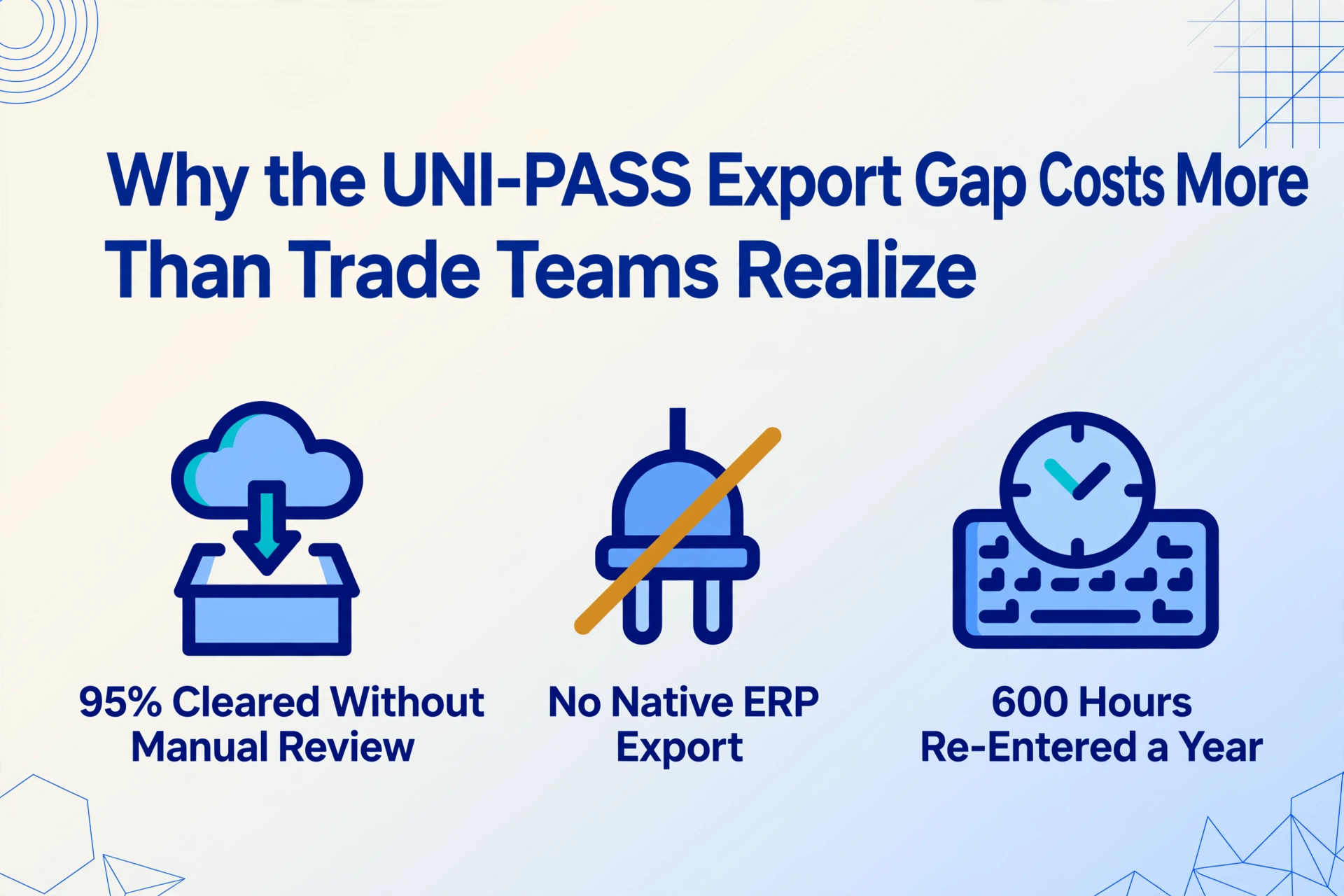
- A mid-sized Korean exporter spends 600 hours per year re-entering declaration data that already exists in UNI-PASS — the equivalent of 15 full-time work weeks for one trade specialist.
- A single transposed digit in a 10-digit HSK code triggers a penalty of up to 40% of cargo value under Korea's Customs Act — and manual transcription produces those errors predictably at scale.
- Semantic extraction reads a printed declaration the same way a trade specialist reads it: by understanding what each field means, not where it sits on the page — no template training or zone drawing required.
The Digital Declaration That Still Creates Paper Work
Consider a typical export transaction from a Korean trading company. A shipment of automotive parts leaves a factory in Ulsan, destined for a buyer in the United States. The company's customs broker submits the export declaration through UNI-PASS at 10:00 AM — a process that takes minutes for a routine filing. By 11:30 AM, the declaration has passed KCS's automated risk assessment and been approved. The cargo is authorized for loading. Korea Customs Service statistics show this scenario covers roughly 95% of all export declarations: filed, reviewed, and cleared without manual intervention.
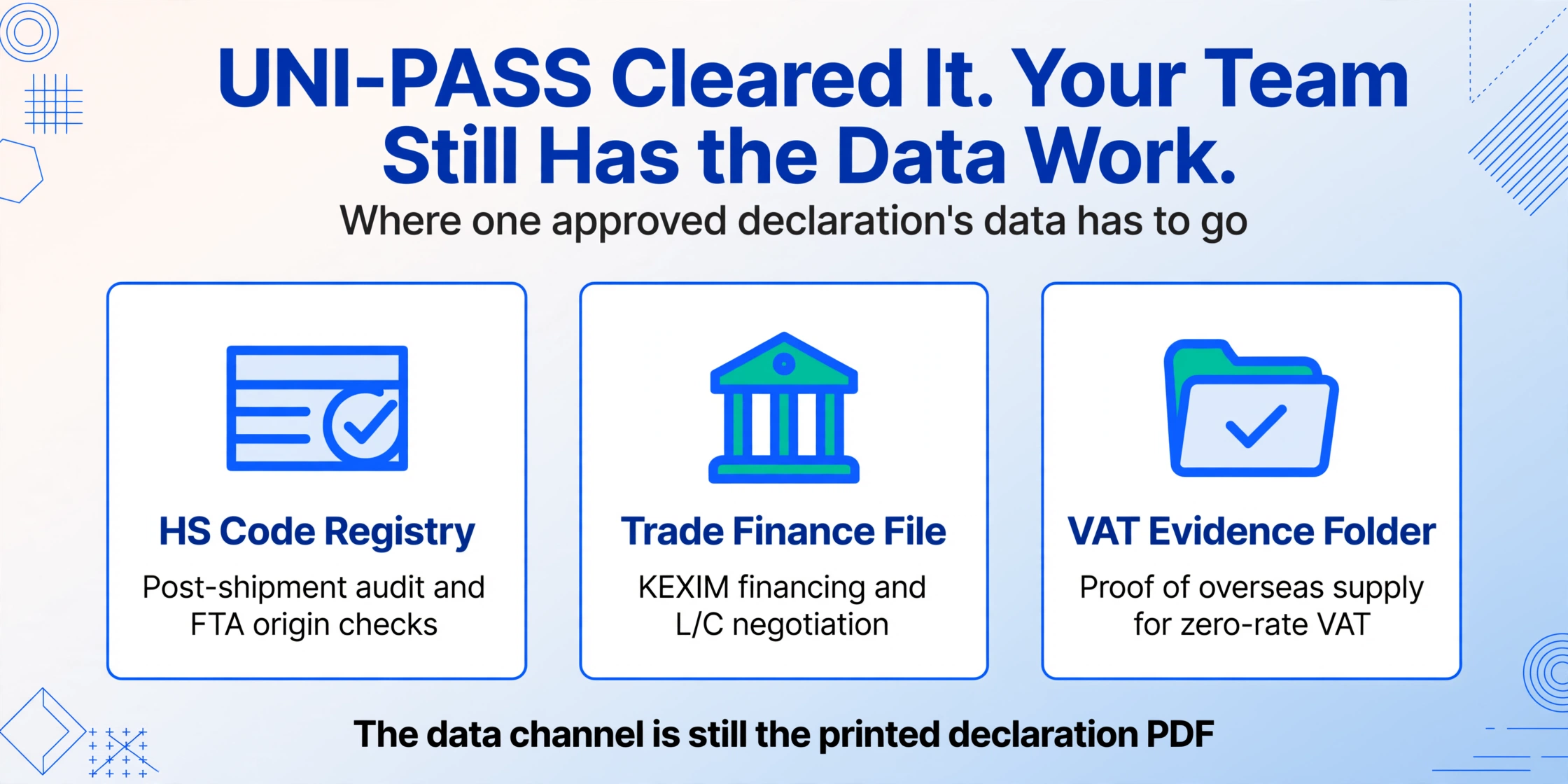
At this point, from the customs perspective, the transaction is complete. But for the trade team inside the exporting company, the work has just shifted from customs compliance to internal data processing. The team needs that declaration's data in at least four downstream systems:
- The HS code compliance registry — to record which 10-digit HSK codes were declared for which shipments, used for post-shipment audits and FTA origin verification.
- The trade finance file — to document the FOB value and shipment details for KEXIM export financing or L/C negotiation.
- The VAT zero-rating evidence folder — Korea's National Tax Service requires exporters to retain export declaration records as proof of overseas supply (수출실적증명서) for 부가가치세 영세율 declarations. (The same paradox — a fully digital tax system that still generates paper-based manual processing — underlies the manual data entry problem in Korean tax invoices as well.)
- The three-way matching worksheet — where the declaration's quantities and values are cross-checked against the commercial invoice and packing list to identify discrepancies before the buyer raises a claim.
None of these downstream systems are connected to UNI-PASS. The declaration data exists in Korea Customs Service's database — but the trade team's internal processes require it in a spreadsheet, in their ERP, or attached to a PDF application form. The printed UNI-PASS declaration receipt (수출신고필증) becomes the bridge between the world's best customs system and the company's own data infrastructure. That bridge is made of manual typing.
What Every UNI-PASS Declaration Contains — and Where It Needs to Go
A standard Korean export declaration (수출신고서) carries roughly 20 to 30 data fields depending on the shipment type. The ones that downstream systems actually need are fewer — but every one of them has a specific purpose beyond customs clearance:
| Field | Korean (한글) | Downstream Use | If It's Wrong |
|---|---|---|---|
| Declaration Number | 신고번호 | Cross-reference with B/L, invoice, insurance certificate | Audit trail broken; bank rejects trade finance application |
| Exporter BRN | 수출자 사업자등록번호 | VAT zero-rating claim, export performance reporting | NTS rejects VAT refund; export statistics misattributed |
| HS Code (10-digit HSK) | HS 부호 (10자리) | Compliance registry, FTA tariff verification, duty calculation | Misclassification penalty up to 40% of cargo value; customs audit flags |
| Product Description | 품명/규격 | Buyer documentation, customs clearance at destination | Consignee rejects shipment; import customs delays |
| Quantity / Weight | 수량/중량 | B/L preparation, cargo insurance, freight invoice validation | Freight forwarder charges unexpected adjustment fees |
| FOB / CIF Value | 수출입금액 | Trade finance (KEXIM, K-SURE), insurance valuation, buyer billing | Under-insurance risk; trade finance facility underutilized or rejected |
| Origin (원산지) | 원산지 | FTA certificate of origin, import duty preference at destination | Buyer pays higher tariff; FTA benefit lost |
| Payment Method | 결제방식 | L/C compliance check, bank documentation | L/C document discrepancy; payment delayed 2-4 weeks |
| Transport Mode | 운송수단 | Logistics tracking, shipping instruction matching | Cargo misses intended vessel; demurrage charges incurred |
Each of these fields leaves UNI-PASS once — when it is typed in at the time of declaration — and must be re-entered every time it lands in a downstream document. A declaration that feeds into five internal processes creates four extra re-entry steps. Across a company handling 200 declarations per month, that is 800 unnecessary data transfers, each carrying the risk of a typo, a transposed digit, or a skipped field.
The irony is that most of this re-entry does not improve the data. The HS code declared in UNI-PASS is the same HS code the trade team types into their compliance registry. The FOB value sent to KEXIM is the same FOB value already filed with customs. The re-entry adds zero information — it only adds labor and risk.
The Three Gaps Between UNI-PASS and Your Spreadsheet
The gap between UNI-PASS and internal data systems is not a single missing integration. It is three separate disconnects, each with its own cause and each requiring its own fix. Understanding them separately is the first step to solving them.
Gap 1: UNI-PASS Has No Native ERP Export
Korea Customs Service designed UNI-PASS to handle customs clearance — receipt, review, approval, cargo release — not to push data into corporate ERP systems. The system generates a declaration receipt (필증) that can be printed or downloaded as a PDF, but structured data export to formats that SAP Korea, Oracle, or domestic systems like Douzone (더존) and iCUBE (아이큐브) can ingest is not a native capability. There is no "Export to CSV" button on the UNI-PASS portal for the declarant's internal use.
Some large Korean trading houses have built custom EDI bridges that pull declaration data from KCS's data warehouse — but these integrations require dedicated development resources, ongoing maintenance, and annual service agreements with KCS. For the majority of Korean exporters — including the mid-sized trading companies and manufacturers that make up the bulk of Korea's export base — the practical data delivery channel remains the printed PDF.
Gap 2: Trade Finance Requires a Signed Paper Record
Even if UNI-PASS offered a one-click CSV export, banks and export credit agencies still require physical or scanned declaration documents for trade finance applications. When a company applies for export financing through KEXIM (한국수출입은행) or purchase order insurance through K-SURE (한국무역보험공사), the underwriter needs to see a signed copy of the export declaration alongside the commercial invoice and packing list, and the bill of lading. The declaration receipt with the KCS confirmation stamp and declarant's signature is the legal evidence that the goods were officially exported.
This is not a legacy preference that banks will abandon soon. The paper declaration serves as third-party verification: Korea Customs Service confirms what was exported, to whom, and at what value. A bank underwriting export financing against that declaration is relying on customs data, not on the exporter's self-reported figures. The paper trail is the audit trail — and until digital declaration verification becomes a standard feature of trade finance processing, the printed declaration will remain a required document even if the underlying data exists in electronic form.
Gap 3: Three-Way Matching Requires Side-by-Side Comparison
A standard cross-border transaction generates at least three independently prepared documents: the commercial invoice (issued by the exporter), the packing list (prepared by the warehouse), and the export declaration (filed through UNI-PASS by the customs broker or forwarder). Each one describes the same shipment — but each one can list slightly different quantities, slightly different weights, or slightly different product codes. A 50 kg discrepancy between the packing list and the declaration, a unit count that does not match the invoice, or a HS code that differs from the one quoted in the proforma invoice — any of these can trigger a customs inspection at destination, a payment delay under an L/C, or a short-shipping claim from the buyer.
Trade teams routinely perform three-way matching by hand: opening the invoice PDF, the packing list PDF, and the declaration PDF side by side, comparing each field, and noting discrepancies in a spreadsheet. This is the most time-intensive post-clearance task for most trade teams, and it is entirely dependent on the declaration data being extractable into a format that can be compared — which, for most teams, means retyped into the same spreadsheet as the invoice and packing list data.
The impact of a missed discrepancy is disproportionately large relative to the effort of checking it. A single mismatched HS code between the proforma invoice and the export declaration can delay cargo release at the destination port by 3 to 14 days — and the associated storage, demurrage, and penalty costs far exceed the 10 minutes it would have taken to catch the mismatch before shipment.
What Manual Re-Entry Actually Costs — Per Shipment and Per Year
The direct cost of manual declaration data re-entry is easy to underestimate because the per-declaration time is small. A trade specialist might spend five minutes extracting a declaration's key fields into an internal spreadsheet. Five minutes per declaration does not sound like a problem worth solving.
But the per-declaration estimate is misleading in two ways. First, it treats each declaration as an isolated task — when in practice, the same declaration's data is re-entered for multiple downstream processes: once for the HS code registry, once for trade finance, once for the VAT evidence folder, once for three-way matching. Four entry points per declaration at two to three minutes each brings the total closer to ten to fifteen minutes per declaration, not five. Second, it ignores the verification step: after entering data, someone needs to check that the entered values match the declaration. Trade teams rarely budget time for self-verification.
Here is a conservative estimate for a mid-sized Korean export company handling 200 declarations per month:
| Task | Per Declaration | Monthly (200 declarations) | Annual |
|---|---|---|---|
| Re-enter HS code + BRN to compliance registry | 3 min | 10 hr | 120 hr |
| Extract FOB value + shipment details for trade finance | 4 min | 13.3 hr | 160 hr |
| Copy data to VAT zero-rating evidence log | 2 min | 6.7 hr | 80 hr |
| Cross-check declaration vs invoice vs packing list | 6 min | 20 hr | 240 hr |
| Total hands-on-keyboard time | 15 min | 50 hr | 600 hr |
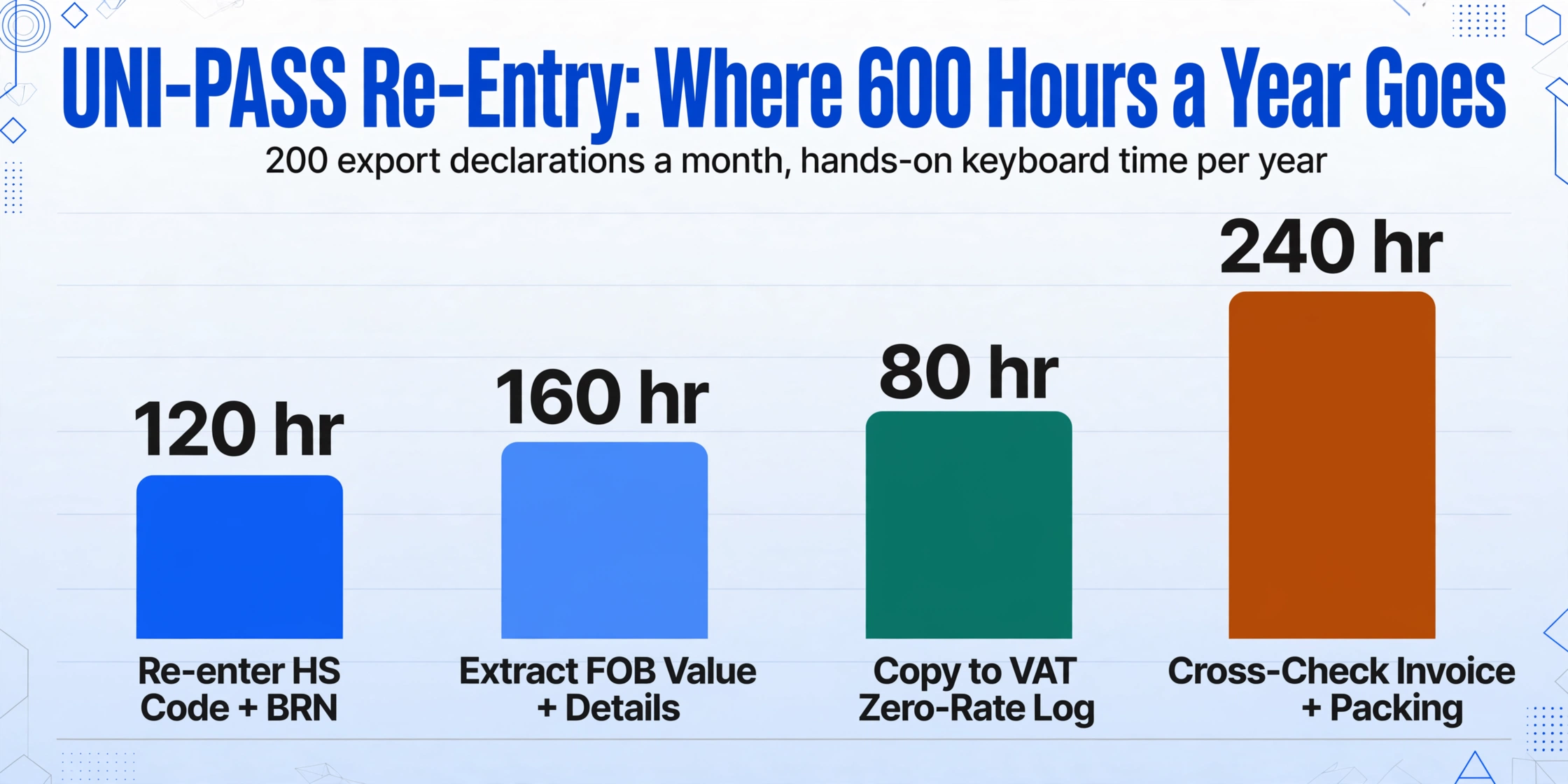
Six hundred hours per year — the equivalent of 15 full-time work weeks — spent re-entering data that already exists in UNI-PASS. At a fully loaded cost of approximately KRW 35,000 per hour for a trade specialist in Korea (based on average salary + overhead for mid-level trade operations staff), that is KRW 21 million (approximately USD 15,500) annually for a single function in a single department. Across Korea's export ecosystem — where over 70,000 companies filed export declarations in 2025 — the aggregate cost of this manual re-entry runs into the hundreds of billions of won.
These are not hypothetical scenarios. Korean trade forums and professional networks regularly surface cases where an HS code transposition caused a shipment to be held at destination customs, where a value discrepancy between the declaration and the invoice triggered a KCS audit, or where a typo in the exporter's BRN delayed a VAT refund by an entire reporting quarter. The common thread is not that the trade team was careless — it is that manual re-entry makes errors inevitable at scale.
Why Traditional OCR Cannot Solve the UNI-PASS Paper Gap
If the problem is that printed declaration data needs to be digitized, the obvious question is: why not scan the printed declaration and run OCR on it? The answer is that a printed UNI-PASS declaration receipt has three characteristics that defeat traditional OCR tools.
First, the format is not standardized at the visual level. While the data schema is fixed under KCS regulations, the visual rendering of a UNI-PASS declaration varies depending on how the declarant prints or exports it. Some print directly from the UNI-PASS web portal (a compact, dense layout optimized for A4), others receive a formatted PDF from their customs broker (which may add a broker header or rearrange field groups), and still others work from a photocopy of the original declaration that has been faxed between offices. A zonal OCR system that draws extraction boxes at pixel coordinates (x: 420, y: 680) fails on the second layout and produces garbage on the third.
Second, the declaration is bilingual in a way that confuses character-based extraction. Many fields appear in both Korean (한글) and English, with field labels in one language and data values that may switch between the two. A traditional OCR engine trained primarily on English text may correctly recognize the Latin characters of "FOB Value" while misreading the Korean script in the corresponding value column — or vice versa. The language boundary shifts mid-document, and template-based OCR tools do not handle mid-document language switching gracefully.
Third, the physical declaration accumulates post-printing artifacts. Printed declarations are often stamped with company seals (도장), signed in ballpoint pen, or annotated with handwritten corrections by the customs broker. These artifacts overlay the printed data — a red stamp can overlap the HS code field, a handwritten note can obscure the net weight, and a signature can cross over the declaration number. Conventional OCR reads these as noise and produces a result where critical fields are either lost or garbled.
Template-based OCR tools — including those marketed as "AI-powered" but built on traditional layout analysis — fail on all three counts because they try to identify data by where it sits. If the position of a field changes, if the language mix confuses the character recognition, or if a physical artifact covers part of the text, the extraction fails without warning. The trade team ends up spending more time fixing OCR errors than they would have spent typing the data by hand — which is why most teams do not bother with OCR for declaration processing at all.
How Semantic Extraction Bridges the Gap
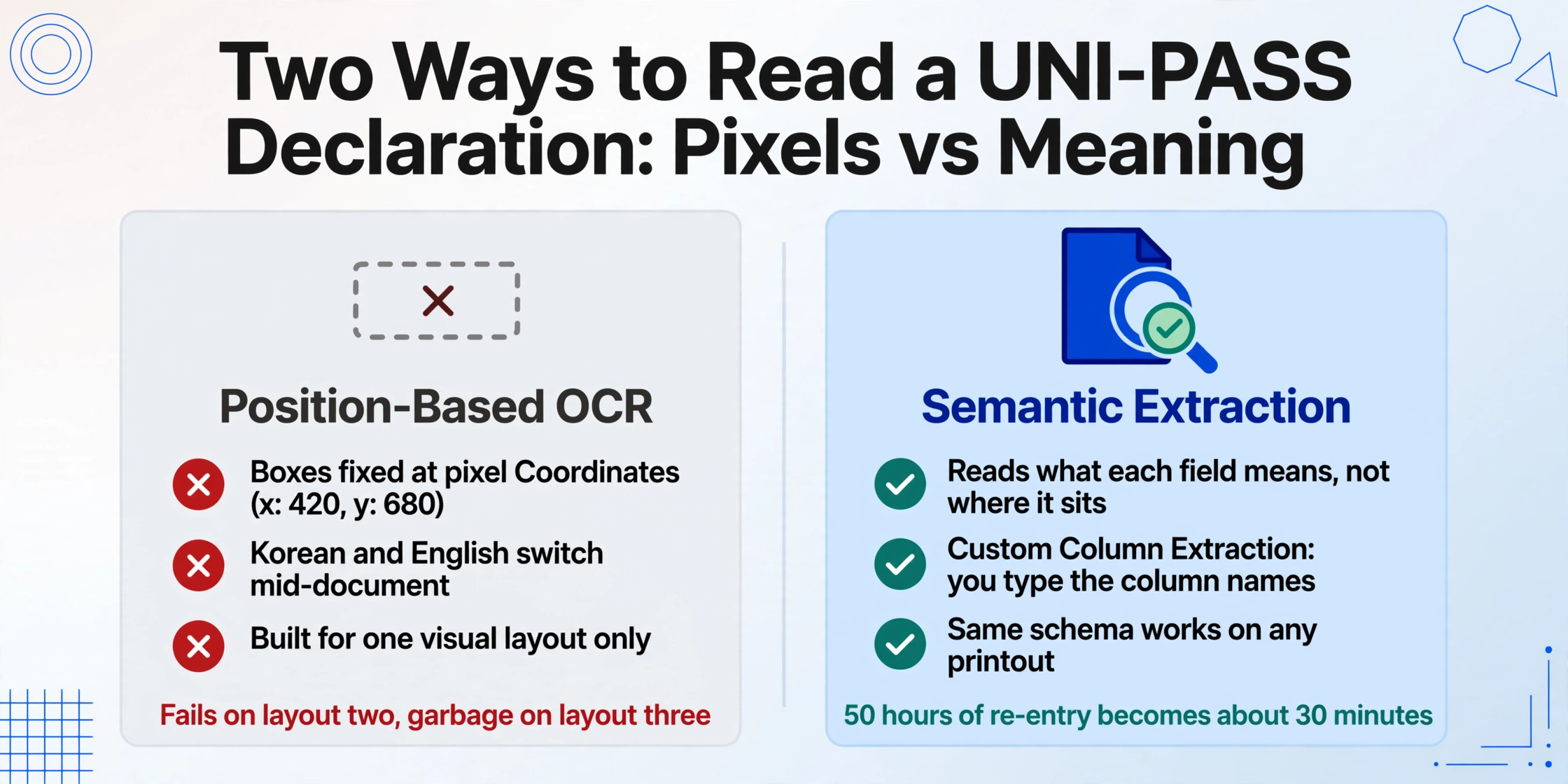
A different approach starts from a different question. Instead of asking "where on this page is the HS code?", it asks "what does an HS code look like, and which value in this document matches that description?" This is the distinction between position-based extraction and semantic-based extraction — and it is the reason vision-language models (VLMs) can read a printed UNI-PASS declaration the same way a trade specialist reads it: by understanding what each field means, not where it sits.
ImageToTable.ai was built on this semantic extraction paradigm — what the product calls Custom Column Extraction. You define the columns you want in your output spreadsheet by typing their names: "Declaration Number," "HS Code (10-digit)," "FOB Value," "Exporter BRN," "Net Weight." The AI reads each printed declaration page, locates the values that correspond to each column by understanding their semantic role in the document, and populates the spreadsheet. No template training, no zone drawing, no per-layout configuration — and the same paradigm powers our Korean VAT document extraction for the tax side of the same workflows.
For a Korean trade team processing 200 declarations per month, the workflow shifts from 50 hours of re-entry to a process that takes roughly 30 minutes:
Define your column schema once.
Create a template with the exact field names your downstream systems need — in English or Korean column headers, whichever your internal processes use. The column names become your output spreadsheet headers.
Upload all printed declarations in one batch.
Scan or photograph the printed UNI-PASS receipts — the tool accepts JPG, PNG, and PDF in a single batch upload. No pre-sorting by format or source. The AI reads each page independently and identifies the column-matching values.
Review and export one merged spreadsheet.
The output presents all 200 declarations as rows in a single table — every declaration number, HS code, FOB value, and BRN aligned in the columns you defined. Export to XLSX for ERP import or CSV for direct data loading into Douzone, iCUBE, or your internal trade management system.
The output is not a photocopy of the declaration — it is structured data that can feed into compliance registries, trade finance applications, VAT evidence folders, and three-way matching worksheets without a single keystroke of re-entry. The field that used to require 15 minutes across four separate manual steps is now extracted once, verified in the preview, and used across all downstream processes from a single data source.
For companies that also process commercial invoices or packing lists in the same trade workflow, the same extraction approach applies to those documents too — enabling the three-way comparison to happen entirely within the spreadsheet, with declaration data, invoice data, and packing list data each populating their own set of columns in a unified reconciliation sheet.
FAQ
Is it legal to extract data from printed UNI-PASS declarations?
Yes. The data on an approved export declaration is your company's own trade data — the declaration number, HS codes, values, weights, and parties are all transaction information that your company submitted to KCS through its customs broker. Extracting that data from a printed receipt for internal record-keeping, trade finance applications, or VAT reporting is a standard business practice. Exporters are required by the Customs Act to retain export declaration records for five years anyway — digitizing those records for internal use falls within normal compliance documentation. There is no restriction on how you process your own approved declaration data.
Can UNI-PASS be connected directly to our ERP?
KCS offers a data exchange interface for large-volume filers, but it requires dedicated EDI development, annual service agreements, and ongoing maintenance. It is designed for customs brokers and very large trading houses that file tens of thousands of declarations per year. For the majority of Korean exporters — companies filing hundreds rather than tens of thousands of declarations per month — building and maintaining a direct UNI-PASS-to-ERP connection is not cost-justifiable. Semantic extraction from the printed declaration is a practical middle ground: it requires no integration development, no ongoing service contract, and no KCS approval.
What if the declaration is entirely in Korean?
Vision-language models used in semantic extraction are trained on multilingual document corpora and can read Korean script (한글) with the same accuracy as Latin text. The extraction works whether the declaration labels and values are in Korean, English, or a mix of both — the AI identifies field meaning from semantic context, not from language matching. You can define column headers in English (e.g., "수출자 BRN") or Korean (e.g., "수출자 사업자등록번호") depending on your internal processes; the AI maps the column to the corresponding value on the declaration regardless of which language the column header uses.
Does extraction work with the simplified export declaration format?
Yes. Korean export regulations allow a simplified export declaration (간이수출신고) for shipments valued under USD 2,000, which has fewer required fields than a general declaration. The same semantic extraction approach handles both formats — the columns you define are populated with whatever fields the declaration contains. If a simplified declaration omits certain fields (like detailed product specifications or transport route information), those columns remain blank in the output rather than producing incorrect values. The AI does not fabricate data to fill gaps.
How does this compare to using a customs broker's data export service?
Some customs brokers offer periodic data reports of their clients' declarations as a value-added service — typically monthly CSV exports aggregated from the broker's own filing records. This can be useful for high-level export volume tracking, but the data arrives on the broker's schedule (not yours), covers only the declarations that broker handled (not declarations filed through other brokers), and usually lacks the field-level granularity needed for three-way matching or trade finance documentation. Semantic extraction from the printed declaration gives you immediate access to every declaration your company files, regardless of which broker handled it, at the field level of detail, on your own processing schedule.
The UNI-PASS paper gap is not a criticism of Korea's customs system — UNI-PASS is genuinely world-class at what it was designed to do. The gap is a consequence of a system built for customs clearance being asked to also serve as a data delivery mechanism for internal business processes that it was never connected to. That gap will not close by waiting for KCS to add an ERP export button. It will close when trade teams have a way to extract declaration data as easily as they can now print it — without typing, without templates, without integration contracts.
Try it on your own UNI-PASS declarations.
Upload a printed export declaration — see if the fields you type every month appear in a spreadsheet in under 10 seconds.
Try It Now →No sign-up required · No credit card · Results in 10 seconds