How to Fit AI Contract Clause Extraction Into Your
German Legal Due Diligence Workflow
A legal team does not need a new workflow for contract due diligence. It needs the existing workflow to spend fewer hours on the part that requires no legal expertise. The standard German M&A due diligence process already has a defined sequence: collect contracts from the data room, review each one for key clauses, produce a risk-ranked findings memo, and present it to the client before the transaction closes. Adding AI clause extraction does not replace any of these steps — it compresses the first review pass, the one that answers "what's in these contracts" so the team can get to "what does it mean for the deal." Here is how to insert extraction into each phase of the workflow without disrupting what comes after it.
Key Takeaways
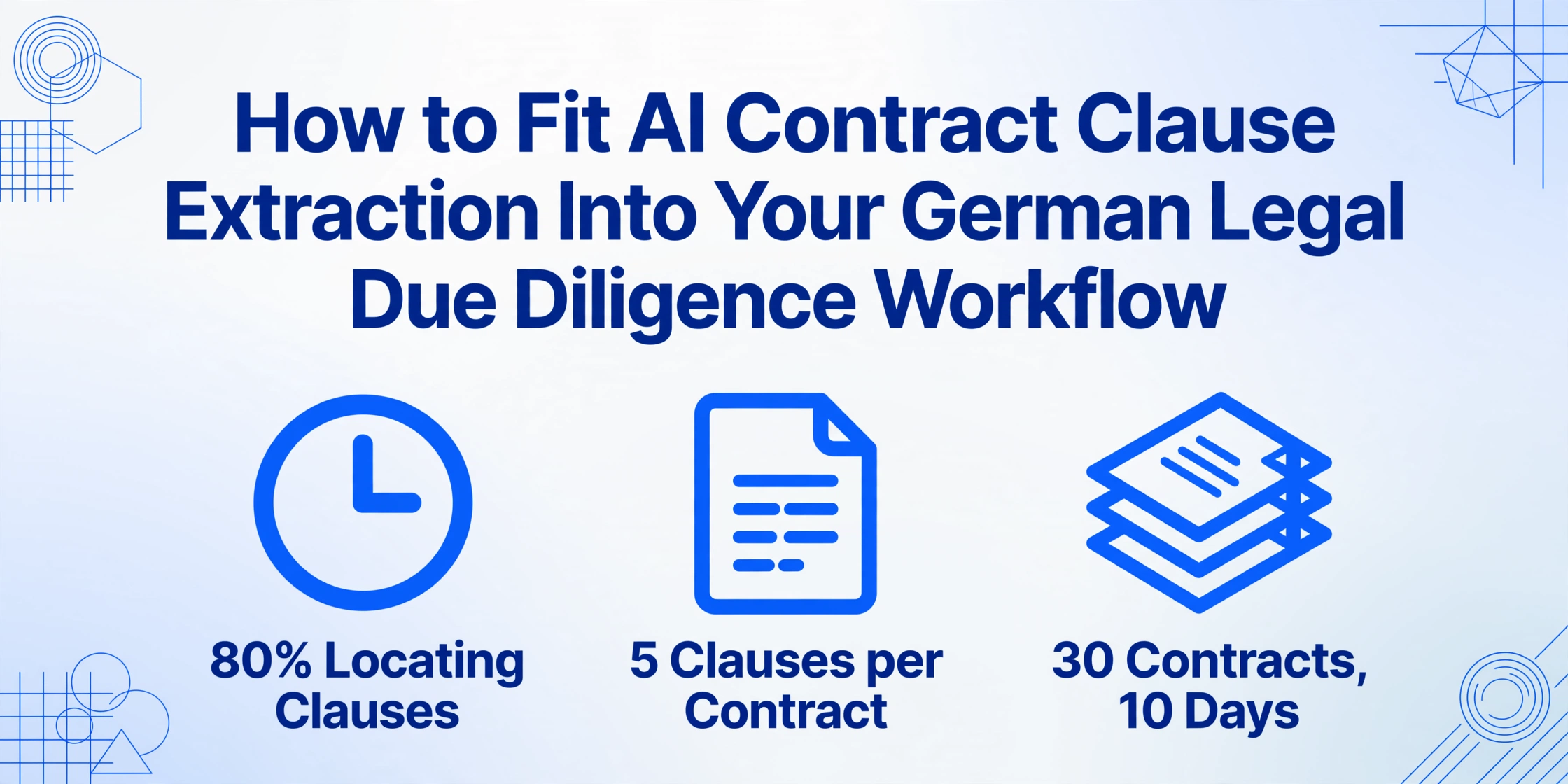
- A German M&A due diligence with 30 Werkverträge burns a person-week on data entry — finding clauses in PDFs and typing values — before a single word of legal analysis reaches the findings memo.
- The flag review that identifies anomaly contracts — near-expiry warranties, disproportionate liability caps, ambiguous contract types — is exactly what senior reviewers should be doing, but comparison across 30 separate PDFs is mental arithmetic against the limits of working memory.
- A 15-minute pre-diligence inventory plus batch extraction turns 30 PDFs into one sortable clause registry — and the same columns that power due diligence become your post-closing contract management system with warranty-tracking built in.
The Existing Workflow — and Where It Spends Its Hours
Before inserting anything new, it's worth being precise about what the existing workflow looks like — not the idealised version in a process document, but the one that actually happens in a transaction with a 10-business-day due diligence window. The team receives a data room index listing 30 Werkverträge (contracts to produce a work, governed by BGB §631) and related service agreements. A junior associate opens each contract, locates the five clauses that determine financial and legal exposure — Auftraggeber/Auftragnehmer (parties), Leistungsbeschreibung (scope of work), Vergütung (remuneration under §632 BGB), Abnahme and Gewährleistungsfrist (acceptance and warranty period under §634a, §640 BGB), and Haftungsbeschränkung (liability limitation) — and types the values into a spreadsheet. A senior associate or partner reviews the spreadsheet, flags anomalies, and directs deeper review of specific contracts. The findings are compiled into a memo for the client.
The part of this sequence that consumes the most hours and requires the least legal expertise is the first step: opening 30 contracts and extracting five data points from each. As detailed in the analysis of the Werkvertrag manual review bottleneck, roughly 80% of the associate's time goes to locating clauses within the contract — scrolling, matching section headings, resolving inconsistent terminology across contracts drafted by different law firms. The remaining 20% goes to reading the clauses and typing the values. The locating overhead is the part extraction removes, and the reading-and-typing is the part it replaces with verification.
Phase 1: Pre-Diligence Contract Inventory — Know What You Have Before You Read It
The extraction workflow begins before a single contract is opened. The associate opens the data room index — typically an Excel spreadsheet listing every document by filename, date, and counterparty — and performs a triage that takes 15 minutes and saves hours later. The triage has three steps:
Step 1: Separate contracts from ancillary documents. A data room for a German Mittelstand company will contain Werkverträge, Dienstleistungsverträge (service contracts, BGB §611), Rahmenvereinbarungen (framework agreements), Änderungsvereinbarungen (amendments), and possibly Auftragsbestätigungen (order confirmations) that reference but do not replace the underlying contract. The extraction columns are designed for the main contracts — amendments and confirmations are supporting documents that the reviewer will reference during verification, not separate extraction targets. Remove them from the upload batch and place them in a separate folder for later reference.
Step 2: Group by contract type — or by uncertainty. If the data room index clearly labels each document as a Werkvertrag or Dienstleistungsvertrag, group them accordingly. If the index is ambiguous — "Service Agreement," "Dienstleistungsvereinbarung," "Werkvertrag/Dienstvertrag (to be determined)" — leave the contracts in one batch and add an Inferred Column during extraction: "Vertragstyp (options: Werkvertrag/Dienstleistungsvertrag/Unclear)." The AI reads the Leistungsbeschreibung and classifies the contract type during extraction. The reviewer verifies the classification during the flag review phase, not during the inventory phase. This reverses the normal sequence — instead of classifying contracts manually before reading them, the AI proposes a classification that the reviewer confirms or corrects.
Step 3: Note the outliers. Contracts that are scanned (not born-digital), contain handwritten amendments, are in a mix of German and English, or are visibly incomplete (missing signature pages) should be flagged in the inventory. These will be the reviewer's priority verification targets because extraction quality follows input quality. A contract photographed in low light from a binder will produce less reliable extraction than a flatbed-scanned PDF, and the reviewer should know which contracts to check first before the verification pass begins.
The inventory phase takes 15 minutes and replaces the hour the associate would otherwise spend opening each contract individually to figure out what kind of document it is. The inventory is a map of the batch; the batch extraction populates the map with data.
Phase 2: Batch Extraction — Define Once, Extract Everywhere
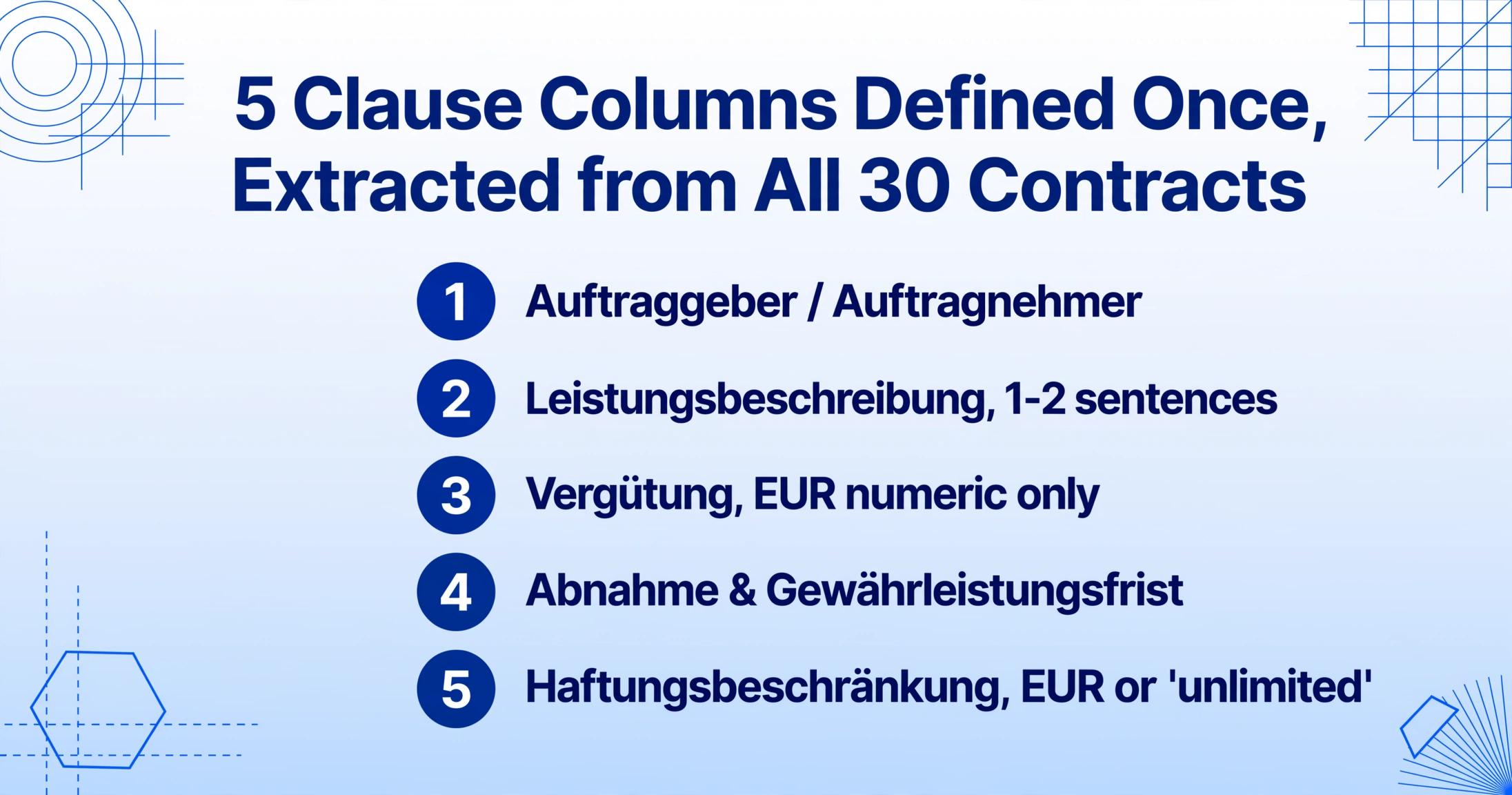
The extraction phase is where the column definitions become the instructions for the AI. This is the step detailed in the Werkvertrag clause extraction guide, but the workflow-integration perspective adds one consideration: the column definitions should be designed not just for extraction accuracy, but for the downstream review steps that follow.
The columns are: "Auftraggeber," "Auftragnehmer," "Leistungsbeschreibung (Scope of Work Summary, 1–2 sentences)," "Vergütung (EUR, numeric only)," "Abnahmedatum (DD.MM.YYYY)," "Gewährleistungsfrist (Years, numeric only)," "Haftungsbeschränkung (EUR numeric or 'unlimited' if no cap or '3x' if multiple of contract value)." The parenthetical format instructions serve the downstream review: numeric-only Vergütung columns can be summed and sorted; date-formatted Abnahmedatum columns enable computed expiry columns; categorised Haftungsbeschränkung values allow filtering by cap type.
A Computed Column — "Gewährleistungsablauf (Abnahmedatum + Gewährleistungsfrist Years, output as DD.MM.YYYY)" — gives the reviewer a sortable warranty expiry date without manual calculation. An Inferred Column — "Vertragstyp (options: Werkvertrag/Dienstleistungsvertrag/Unclear)" — proposes a contract type classification that feeds into the flag review. These columns are not "nice to have" — they are the inputs the reviewer needs for the three-pass analysis described in the batch clause registry guide. Define them during extraction setup, not after the spreadsheet arrives.
Every due diligence has deal-specific concerns. If the buyer is particularly worried about change-of-control provisions, add "Change-of-Control Klausel (yes/no, extract relevant text if yes)." If the target company's contracts are assignable matters for the deal structure, add "Abtretbarkeit/Übertragbarkeit (freely assignable/consent required/prohibited)." If the contracts reference specific subcontractors whose performance risk matters, add "Wesentliche Subunternehmer (list names if specified)." These are not part of the standard five clauses, but the column-based extraction model means you define whatever matters to your specific due diligence scope. The engine extracts what you ask for, not what a pre-built template includes.
Drop every Werkvertrag, Dienstleistungsvertrag, and service agreement from the pre-diligence inventory into the upload area. The batch engine processes all files simultaneously and outputs one spreadsheet — one row per contract, the columns you defined as headers. The output is not 30 separate extractions that need merging; it is one file that can be exported as Excel (XLSX) for the review phases that follow. The time from upload to completed spreadsheet is roughly the time it takes to read one of the contracts manually — but the output contains all 30.
Files are processed securely and not stored.
Phase 3: The Clause Registry — One Spreadsheet, Not 30 Documents
The output of batch extraction is what the batch clause registry guide calls a clause registry: a spreadsheet where every row is a contract and every column is a clause. This spreadsheet is the hub of the remaining due diligence workflow. Every subsequent review step uses it as the starting point, and every contract that requires deeper reading is identified from it, not from manually opening 30 PDFs.
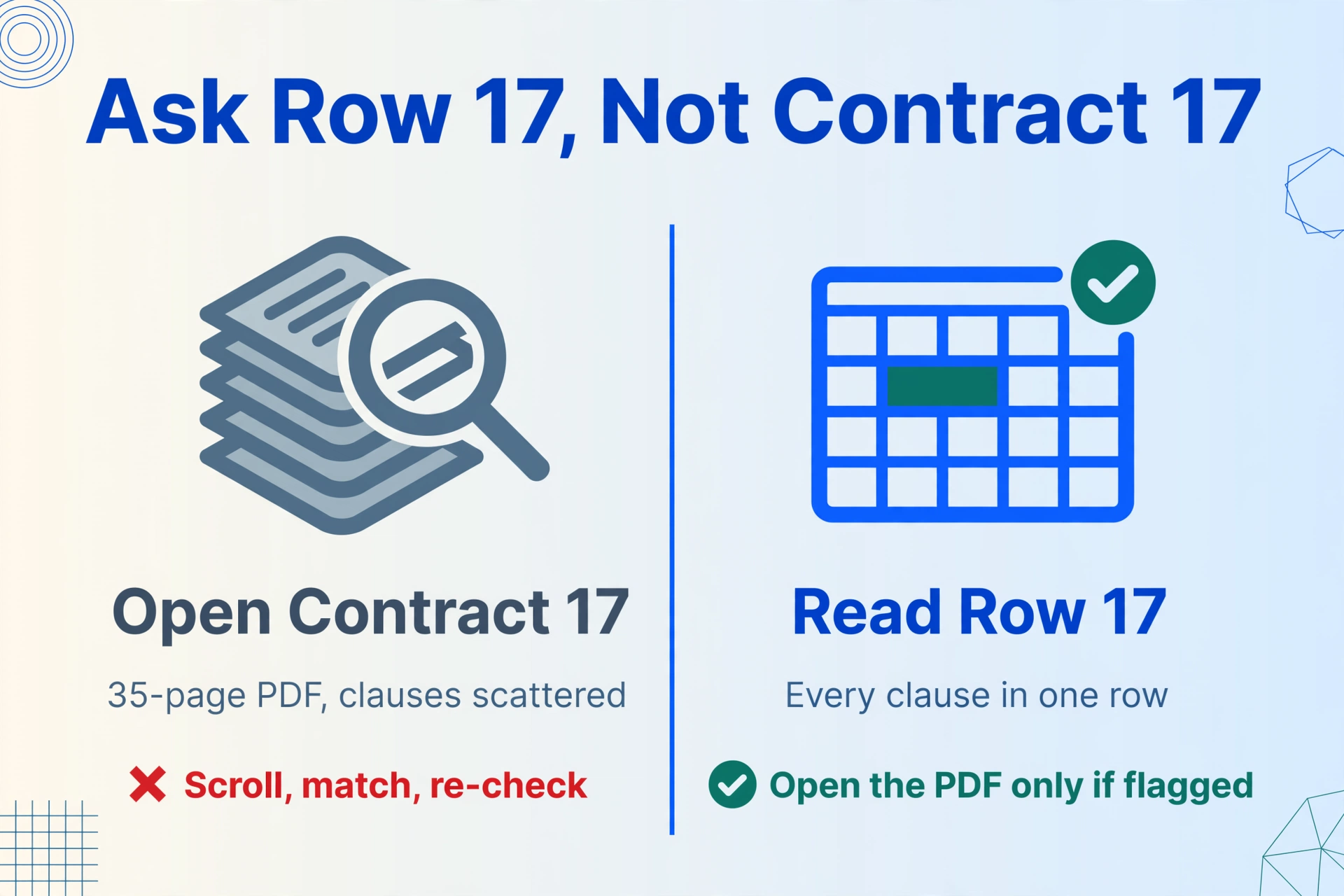
The registry replaces the individual contract files as the primary review document. The team no longer asks "what's in contract 17?" by opening contract 17. They ask it by looking at row 17 of the registry. The contract PDF is opened only when the registry flags something that requires source verification — a Gewährleistungsfrist that deviates from the statutory default, a liability cap disproportionate to the contract value, a Vertragstyp classification of "Unclear." The registry is not the final work product; it is the navigation layer that tells the reviewer which contracts need a deeper look and which ones can be accepted as standard.
This is the single most important workflow integration point: the senior associate no longer opens 30 PDFs to find out what is in them. The junior associate — or the extraction engine — has already done that. The senior opens the registry, scans the columns for anomalies, and opens the 5 contracts that the registry indicates are worth the time. The remaining 25 contracts are verified by spot-check — open 3 or 4 at random, confirm the extracted values match, and accept the rest. This is not a reduction in diligence; it is a reallocation of diligence from the standard contracts (where nothing is wrong) to the anomalous ones (where the risk lives).
Phase 4: Flag Review — Priority Contracts with Expiring Warranties, Disproportionate Caps, and Ambiguous Types
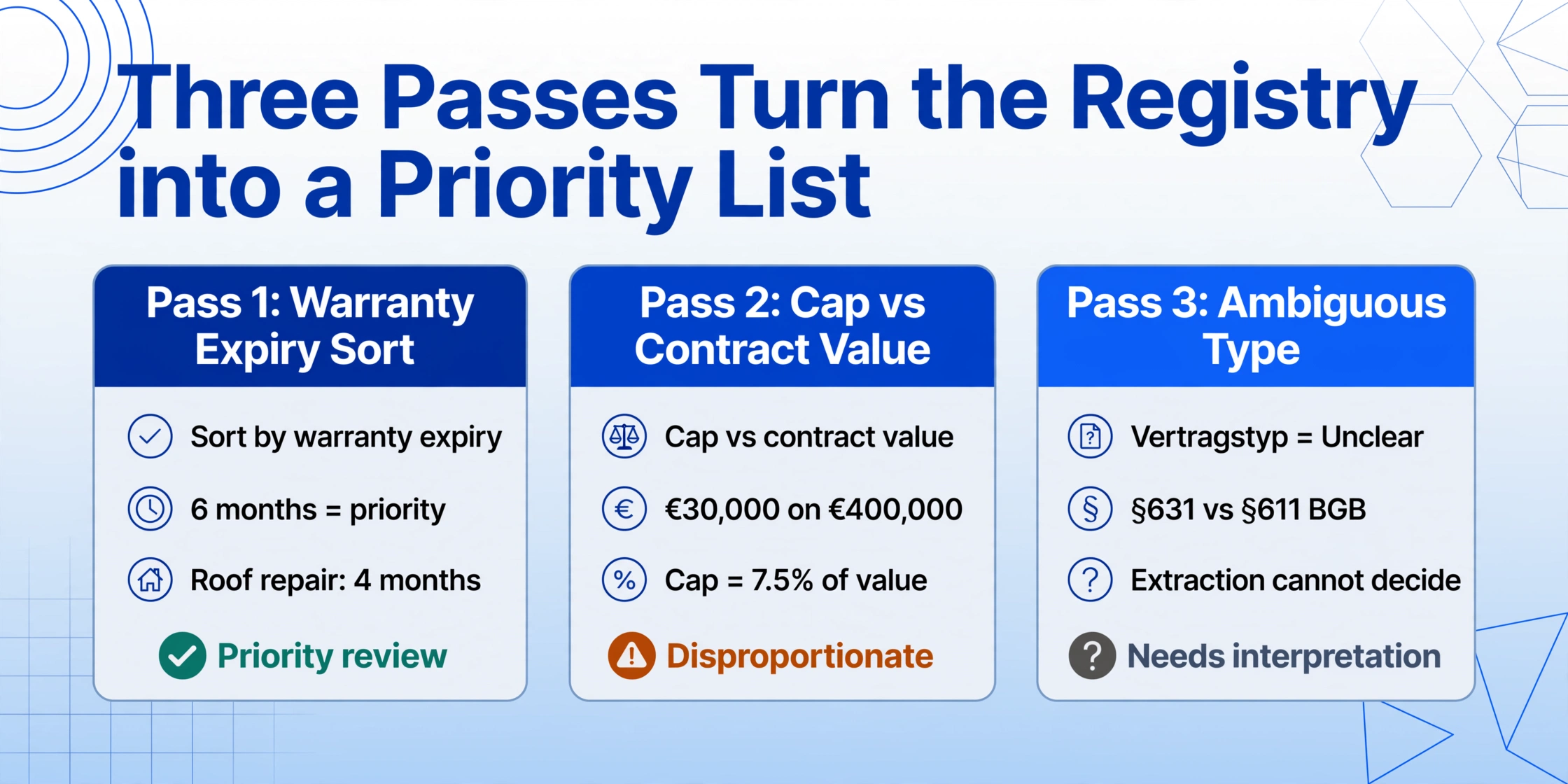
The flag review is a structured three-pass analysis of the registry — the same three passes described in the batch clause registry guide, but integrated here as part of the broader due diligence workflow. The passes are performed by a senior associate or partner, not by the junior who configured the extraction. The extraction engine reads the contracts; the senior reads the registry; the junior's role shifts from data entry to extraction configuration and verification support.
Pass 1 — Warranty expiry sort. Sort the registry by the "Gewährleistungsablauf" computed column, ascending. The contracts at the top — warranties expiring within the next 6 months — are the priority review targets. These are the contracts where a post-closing defect claim window is narrowest, and where the buyer needs the most specific disclosure from the seller about known defects. A Werkvertrag for roof repair with a warranty expiring in 4 months and a Vergütung of €180,000 is a materially different negotiation problem from an IT maintenance contract with a warranty expiring in 4 years and a Vergütung of €12,000. The sorted column makes the difference visible at a glance — no mental comparison across 30 separate documents required.
Pass 2 — Liability cap vs contract value. For each row, compare the "Haftungsbeschränkung" column against the "Vergütung" column. A liability cap of €30,000 on a contract worth €400,000 — the cap is 7.5% of the contract value — means the contractor's exposure for defective performance is limited to a fraction of the contract's financial significance. Flag these rows. If the contractor is critical to the target company's operations — the sole facility maintenance provider across three production sites — the cap is a material risk for the buyer. The seller must be asked about the commercial rationale for the cap and whether the contractor has a track record of performance that mitigates the exposure.
Pass 3 — Contract type classification. Filter the "Vertragstyp" column to "Unclear." These contracts have a Leistungsbeschreibung that does not clearly establish whether the obligation is result-oriented (Werkvertrag, BGB §631) or effort-oriented (Dienstleistungsvertrag, BGB §611). An ambiguous contract type in German law means the warranty regime is also ambiguous — a Werkvertrag carries the 5-year Gewährleistungsfrist for Bauwerke under §634a Abs. 1 Nr. 2 BGB, while a Dienstleistungsvertrag follows the regular 3-year limitation period under §§195, 199 BGB. The counterparty will argue for whichever interpretation limits their liability. Each "Unclear" contract must be opened, the Leistungsbeschreibung read in full by a qualified reviewer (Rechtsanwalt), and the classification resolved before the findings memo is finalised.
Three passes, each answering one question for all 30 contracts simultaneously. The same analysis performed on 30 individually-reviewed contracts would take days — not because the analysis is complex, but because the data is scattered across 30 documents and the reviewer's working memory cannot hold 30 comparisons at once. The registry collapses the data into one screen; the analysis follows naturally.
Phase 5: Full Diligence — Using the Registry to Inform, Not Replace, Legal Review
The flag review identifies the contracts that need a deeper look. The full diligence phase is where the legal team reads those contracts — but reads them with a question, not to discover what is in them. The question comes from the registry. For each flagged contract, the reviewer already knows what the spreadsheet says. The purpose of opening the PDF is to confirm it and to read the surrounding context that the extraction deliberately excluded — the boilerplate, the recitals, the definitions that might qualify or override the extracted clause.
This is the boundary between extraction and legal judgment, and keeping it clear is what preserves the integrity of the legal review. Extraction reads the contract and populates a spreadsheet. It does not interpret the BGB, assess commercial reasonableness, or advise on legal risk. These judgments remain the lawyer's responsibility — and the flag review exists precisely to identify where those judgments are needed. A Haftungsbeschränkung cap of €50,000 on a €500,000 contract is a spreadsheet value. Whether that cap is commercially unreasonable, whether it might be invalid under AGB control (§§307–309 BGB) because the contract is standard terms rather than individually negotiated, whether the buyer should demand a specific indemnity for it — these are legal questions. Extraction gets the data onto the table; the lawyer decides what it means.
The full diligence phase also handles the outlier contracts flagged during the pre-diligence inventory — the scanned PDFs, the handwritten amendments, the multi-language contracts. For these, the reviewer verifies the extracted values with extra care and supplements the spreadsheet with manual notes where the extraction is unreliable. The registry is the primary document; the contract PDF is the reference for verification and context. This is the reversal of the traditional workflow — where the contract PDF was the primary document and the spreadsheet was the secondary record — and it is the reversal that produces the time saving.
Downstream Integration: Feeding the Registry into the Findings Memo and Post-Closing
The workflow does not end with the legal review. The findings from the flag review and full diligence must be compiled into the due diligence memo for the client, and the clause registry itself becomes a post-closing reference document. The integration points are straightforward because the registry is already in spreadsheet format — the same format the rest of the deal team uses for financial models, disclosure schedules, and post-closing integration planning.
Findings memo. The flagged contracts from the three-pass analysis become the core of the "Key Contract Risks" section of the due diligence memo. Each flagged contract gets a one-paragraph entry: the contract description (Auftraggeber/Auftragnehmer, Leistungsbeschreibung summary, Vergütung), the finding (warranty expiring in 4 months, liability cap disproportionate at 7.5% of contract value, contract type ambiguous), and the recommended action (request specific disclosure from seller, negotiate indemnity, obtain legal interpretation of contract type). The paragraph is written from the registry data plus the reviewer's notes from the full diligence reading — the registry provides the facts, the reviewer provides the analysis.
Disclosure schedule. The buyer's counsel uses the registry to draft the disclosure schedule — the seller's list of exceptions to the representations and warranties in the purchase agreement. The contracts with near-expiry warranties and disproportionate liability caps are the ones the buyer wants the seller to specifically disclose, because a general disclosure ("all contracts in the data room") may not suffice to put the buyer on notice of a specific risk. The registry provides the contract-by-contract specificity the disclosure schedule requires.
Post-closing contract management. After the transaction closes, the buyer inherits the target company's contracts — and the clause registry becomes the foundation of the buyer's contract management system. The Gewährleistungsablauf column tells the buyer's legal team which warranties are about to expire and need a defect inspection before the deadline. The Haftungsbeschränkung column tells the risk management team which contractors carry the lowest financial accountability for defective performance. The registry built for due diligence becomes the registry used for ongoing contract administration — the same data, repurposed for a different phase of the contract lifecycle.
Why Integration Is Additive, Not a Replacement
The recurring concern when introducing automation into a legal workflow is that it will replace the judgment work that lawyers are trained and paid to do. The concern is misplaced for clause extraction, because extraction does not touch the judgment work. It replaces the locating-and-typing step — the 80% of review time that requires zero legal expertise — and leaves the analysis step untouched. The legal team that integrates extraction into its workflow does not review fewer contracts or spend less time on legal analysis. It spends the same amount of analytical time on a better foundation: a spreadsheet that arrived already populated, already sortable, already cross-comparable, rather than an empty spreadsheet the associate is still filling in when the findings memo is already overdue.
This is the same principle that applies to any workflow integration: the new step should reduce the friction in the existing workflow, not add a parallel workflow that the team must maintain alongside the old one. The pre-diligence inventory, the batch extraction, the clause registry, the flag review, and the full diligence are not a new process bolted onto the existing one. They are the existing process with the locating overhead removed — the same sequence of contract review, anomaly flagging, legal analysis, and memo writing, performed on a registry that the extraction engine built in the time the associate used to spend scrolling through PDFs.
FAQ — Integrating Clause Extraction into German Legal Due Diligence
Does AI clause extraction replace the legal review step in due diligence?
No. Extraction replaces the manual locating and typing of contract clauses — the step where an associate scrolls through a 35-page PDF to find five specific provisions and types their values into a spreadsheet. It does not interpret the clauses, assess their legal significance, or advise on risk. The legal review step — where a qualified reviewer (Rechtsanwalt) reads the flagged contracts, interprets the clauses in the context of the BGB and the transaction, and determines what the findings mean for the client — remains unchanged. Extraction compresses the data-entry step so the review step starts sooner and runs on more complete data.
How does the clause registry fit into the existing document management system?
The registry is an extraction output, not a storage system. It is exported as Excel (XLSX) or CSV and can be imported into the team's existing due diligence platform, contract management system (CLM), or shared drive. The registry does not replace the original contract PDFs — it sits alongside them as the structured index that tells the reviewer which PDFs to open and what to look for in each one. The PDFs remain the authoritative source documents; the registry is the navigation layer that makes them searchable, sortable, and comparable.
What happens if the AI misclassifies a contract type or extracts an incorrect value?
The verification step exists precisely to catch these cases — and the workflow is designed to make verification efficient by directing the reviewer's attention to the contracts most likely to contain anomalies. The reviewer spot-checks the registry against the original PDFs, with priority on: contracts flagged as "Unclear" in the Vertragstyp column, contracts with a Gewährleistungsfrist that deviates from the statutory default (anything other than 2 or 5 years), contracts with a Haftungsbeschränkung that appears disproportionate to the Vergütung, and the outlier contracts flagged during the pre-diligence inventory (scanned, handwritten, multi-language). If extraction accuracy varies across the batch, the verification step absorbs the variance — the reviewer reads more contracts from a low-quality batch and fewer from a high-quality one. Extraction reduces the verification burden; it does not eliminate it.
Can this workflow handle contracts in multiple languages within the same batch?
Yes. The column names — written in English — tell the AI what to find, and the AI reads each document in its own language to locate the matching provision. A Werkvertrag drafted in German by a Munich firm and a service agreement drafted in English by a London firm (but governed by German law) can both be in the same batch. A column named "Vergütung (EUR)" extracts the remuneration from the German contract's "§5 Vergütung" section and the English contract's "Clause 5 — Remuneration" section equally. The AI does not require language consistency across the batch — each document is processed independently.
How long does it take to go from data room index to populated clause registry?
The pre-diligence inventory takes approximately 15 minutes — sorting contracts from ancillary documents, grouping by contract type or uncertainty, and flagging outliers. The column definition and batch upload takes roughly 10 minutes — typing the five standard clause columns plus any deal-specific columns, uploading the contracts, and starting the extraction. The extraction itself completes in the time it takes to read approximately one contract — a few minutes for a batch of 30 contracts. The reviewer receives a populated registry within 30 minutes of opening the data room index. The remaining time in the due diligence window goes to verification, flag review, legal analysis, and memo writing — the steps that require legal expertise, now starting from a populated spreadsheet rather than an empty one.
Does the registry need to be rebuilt if new contracts are added to the data room mid-review?
No. The extraction is batch-based — each batch produces one spreadsheet. If the seller adds five contracts to the data room on day 4 of the review, the team runs a second extraction batch for the new contracts and appends the rows to the existing registry. The column definitions are already established from the first batch; the second batch uses the same columns and produces rows that are directly comparable to the first batch. The three-pass flag review is re-run on the expanded registry. This is faster than opening five new contracts manually — and the cross-contract comparison power of the registry means the new contracts are immediately visible alongside the existing ones, sorted and filterable by the same columns.
The legal due diligence workflow doesn't need to change — it needs the data-entry step to stop consuming the hours the legal analysis should get. Build the registry first; let the review start from there.
Add Extraction to Your Workflow