Match Chargeback Evidence
to One Order Before You Submit
The strongest chargeback evidence is a set of documents that agree on which order they describe. A packet can hold a clean signed delivery, a receipt with the right total, and a transaction line for the same money, and still contradict itself. The delivery belongs to a replacement parcel. The receipt prints the billing address. The transaction line sits in the settlement currency while the dispute notice sits in the presentment currency. Each record is genuine. The packet reads as three different orders.
The issuer, the cardholder's bank, decides on the claim, not on the thickness of the folder. The work that changes the outcome happens before the upload: matching every record to one order and finding the contradictions while there is still time to fix them.
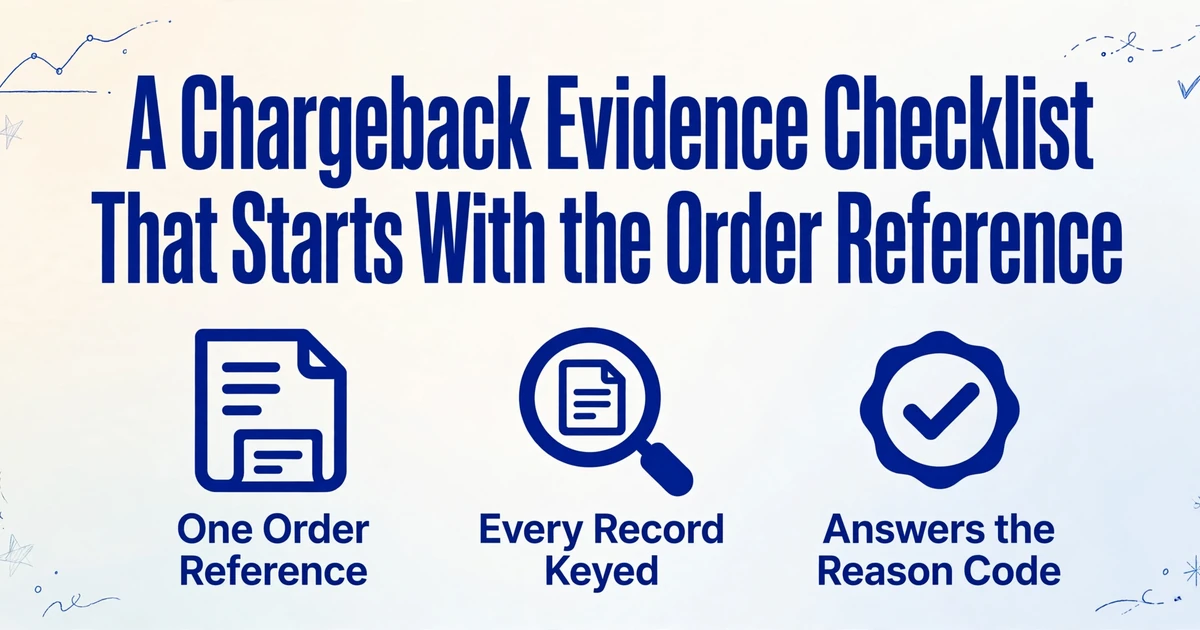
Key Takeaways
- A complete folder can lose to a thin one when the thin one answers the reason code.
- Every document can be genuine and the packet can still read as three different orders.
- Key every record to one order reference before you write the rebuttal.
The Issuer Grades the Packet Against the Claim, Not the Folder
A complete folder can lose to a thin one when the thin one answers the reason code. The chargeback notice defines the question. The dashboard may be Shopify Payments, Stripe, or Adyen, but the notice carries the same core fields: the dispute ID, the reason code, the disputed amount and its currency, and the date by which your acquirer, the merchant bank that submits on your behalf, needs a response. The reason code is the short label for what the cardholder says went wrong: merchandise not received, not as described, an unauthorized charge, a duplicate, a wrong currency.
The merchant's clock is shorter than the cardholder's. Visa's rules set a 30-calendar-day window from the dispute processing date for the acquirer's response. Mastercard's chargeback guide gives the acquirer 45 calendar days from the chargeback settlement date for a second presentment in most cases. Your processor usually sets an earlier internal cutoff so it can review and file on time. Missing the date ends the case before anyone reads the evidence, and Mastercard's merchant guidance treats that deadline as part of the case, not as admin around it.
The evidence standard is narrower than "everything I have." Compelling evidence is documentation that directly contradicts the specific claim. The response itself is the representment, the merchant's formal re-presentation of the transaction to the issuer. A signed delivery is strong against "never arrived" and beside the point against "not as described." A receipt with the right total does nothing for an unauthorized-charge claim if it cannot show who authorized the payment. Before pulling a single document, write five fields at the top of a blank sheet: dispute ID, order reference, reason code, disputed amount with its currency, and the response due date. Those five fields are the specification for the packet.
Evidence for a different claim is not weak evidence. It is an unanswered claim.
Which Address Has to Match Is Set by the Reason Code
Two common e-commerce disputes ask about two different addresses, and one ship-to versus bill-to check cannot answer both. For a claim that the goods never arrived, Visa condition 13.1 asks for proof of delivery that shows the full delivery address, and that address has to match the one on the invoice or purchase agreement. The question is whether the buyer received the goods where the order said they would.
For a card-absent fraud claim, the question is different. One accepted route under Mastercard's e-commerce compelling evidence rules asks for an address verification service (AVS) response of X or Y and documentation that the merchandise was sent to the AVS-confirmed billing address. The card network is testing whether the person at the billing address participated in the purchase, not whether the parcel reached a gift recipient.
One shipment can satisfy the first rule and fail the second. If a customer asks for delivery to a work address, the delivery record can match the order perfectly and still sit outside the billing address that the fraud condition names. That is a limit of the rule, and the packet has to be built around the claim that is actually open. Both requirements sit inside the condition that raises them, not in a separate rule about addresses.
Merchants have turned this into folklore. A merchant in a 2022 r/smallbusiness thread put it plainly: "it's fairly standard to chargebacks to automatically lose when shipping and billing addresses are different." The mismatch does matter. Which mismatch matters depends on the claim. A blanket check flags a legitimate gift order as a problem and misses the real gap in a fraud case where the parcel went to a third address.
Add four columns to the case table: address on the order, address on the delivery record, AVS result, and the source of any address instruction. When the first two differ, the explaining document is the written request: the customer email, the support chat, or the carrier redirect confirmation. Attach it and say what it changed. Without that document, a 13.1 response is arguing against its own delivery record, and a card-absent fraud response has no path to the billing address the rule asks for.
The correct address is the one the reason code names, not the one your order system treats as primary.
The Disputed Amount, the Settlement Amount, and the Receipt Total Are Three Numbers
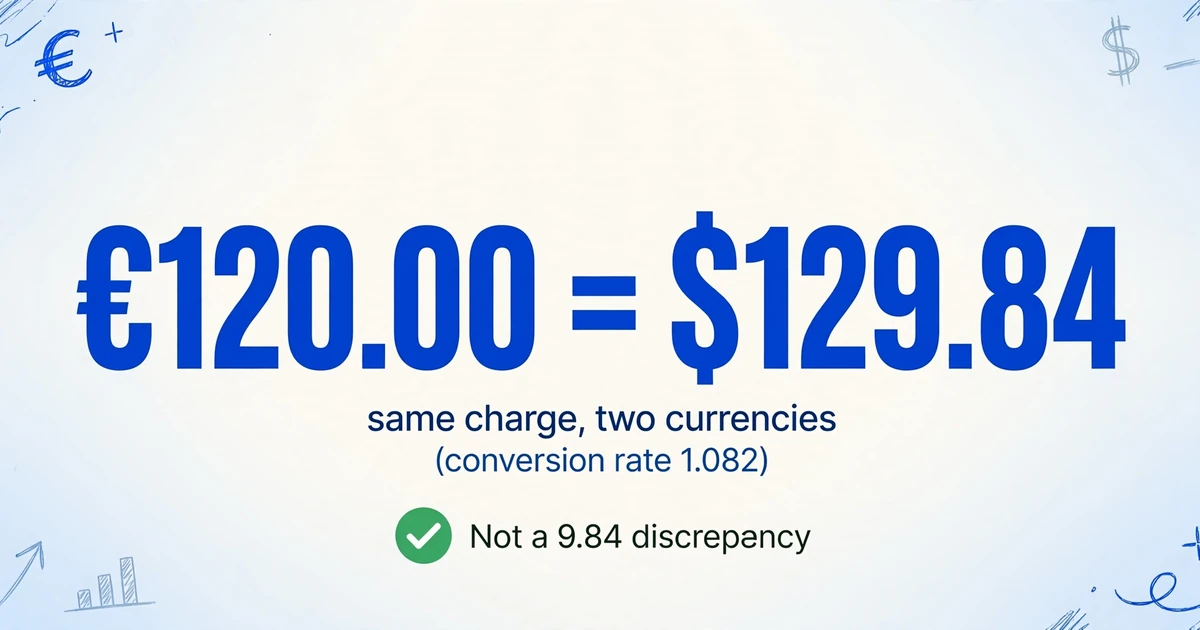
A chargeback can be stated in one currency, settled in another, and supported by a receipt that breaks the same money into tax and shipping, and all three records can be correct. The amount on the dispute notice is stated in the currency the transaction was presented in, sometimes called the presentment currency. The line in your gateway export is often the amount that settled in your own currency after conversion.
Take a €120.00 order settled at 1.082 for $129.84. The notice says €120.00. The receipt says €120.00, including €20.00 VAT. The gateway line says $129.84. Compared as bare numbers, 120.00 and 129.84 look like a 9.84 discrepancy. With the currency codes attached, they describe the same charge. If an analyst "fixes" the receipt to match the settlement figure, the VAT breakdown no longer adds up and the packet now contains a document that has been altered to agree with a different number.
Three other amount differences are normal. A dispute can cover only part of an order, so the disputed amount is lower than the charge. An authorization can differ from the captured amount after a tip, a fuel hold, or an adjustment. A refund can land after the dispute opens. Stripe's dispute documentation notes that the disputed amount can differ from the charge because of currency fluctuation or a partial dispute, which is a useful warning against treating every difference as an error.
Currency can also be the claim itself. Visa condition 12.3 covers an incorrect currency, including a transaction processed in a currency the cardholder did not agree to, such as a dynamic currency conversion. In that case the receipt or transaction record that shows the intended currency is the defense, and a settlement line in another currency is not a substitute. Record the amount as printed, the currency code, the amount in the case currency, and the basis of each amount: authorized, captured, refunded, or disputed.
An amount without a currency code is a number, not evidence.
One Order Can Produce Two Delivery Records, and Only One Belongs in the Packet
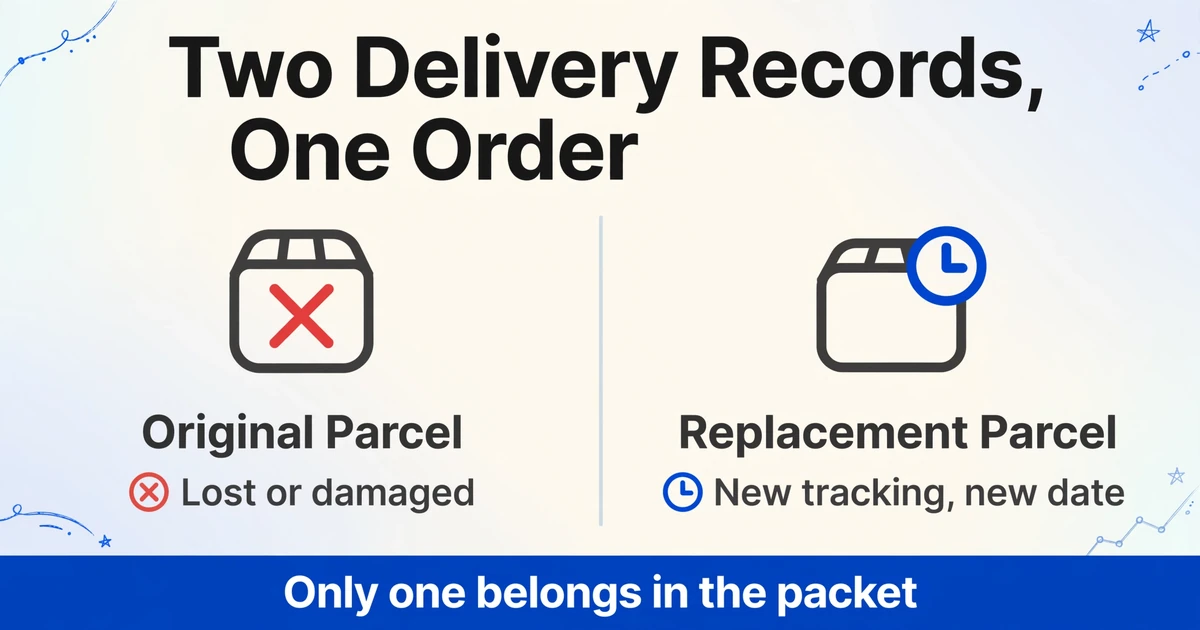
A reshipment, a carrier redirect, or a split order leaves more than one delivery record against one order number, and the wrong record can turn a winnable case into a misleading one. The most common version is a replacement. The first parcel is lost or damaged, so fulfillment sends another one. The replacement has a new tracking number and a new delivery date. Attaching it as proof of the original delivery answers a question nobody asked.
A replacement record can still belong in the packet, but it needs a label and a sentence. It shows that you remedied the failure. It does not show that the original shipment arrived on time. If the replacement landed after the promised delivery date, presenting it as the original proof invites the issuer to read the timeline against you. If the claim is about the replacement, then it is the relevant record, and the original should be labeled as the earlier attempt.
A carrier redirect creates a second version of the same problem. The delivery record shows an address that differs from the order, because the customer asked the carrier to send the parcel somewhere else. Without the redirect request, the packet looks like a delivery to the wrong address. With it, the difference is explained and the delivery becomes relevant again.
Split orders need a finer key. One order number can cover two parcels, and a delivered scan for the first parcel does not answer a claim about an item in the second. The table has to carry the parcel or shipment reference next to the order reference, so a row can be matched to the part of the order it actually covers. The same logic applies to partial fulfillment, backorders, and drop-ship items that never share a tracking number.
Two delivery records are not a contradiction until you know which parcel each one covers.
This is also where the preflight earns its keep by telling you not to fight. If the only delivery record covers a different parcel, or the replacement arrived after the promised date, the case may have no defense worth the fee and the staff time. Accepting a weak case is a legitimate outcome. Finding that out before drafting a rebuttal is the point.
The Analyst Misses It Because Three Systems Use Three Different Keys
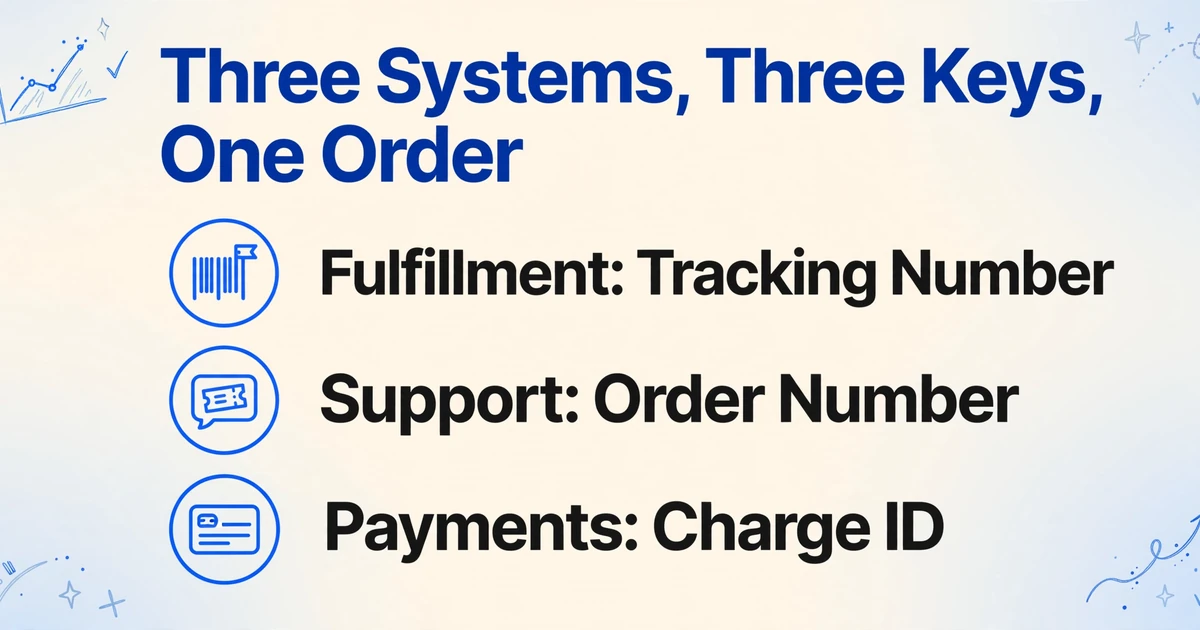
The records usually arrive from fulfillment, support, and payments, and each system labels the same order with a different identifier. The fulfillment team works from tracking numbers and shipment IDs. Support works from the order number and the ticket. Payments works from the charge ID, the payment intent, or the acquirer reference number (ARN). The dispute notice may show the merchant order number, the acquirer reference number, or both, depending on the processor.
| Who holds the record | Key they use | What the case needs |
|---|---|---|
| Fulfillment team or third-party logistics provider (3PL) | Tracking number, shipment ID, reship log | The delivery record for the disputed parcel, plus any replacement shipment |
| Customer support | Order number, ticket, email thread | Any address change, delivery complaint, or acknowledgment of receipt |
| Payments or gateway | Charge ID, payment intent, ARN, settlement line | The captured amount, currency, date, and authorization result |
| Acquirer or processor | Dispute ID, reason code, due date | A response that answers the specific claim before the cutoff |
The dispute analyst is the only role that needs all four kinds of record in one place, and usually the only one working against the case deadline. Under that deadline, matching by amount and date feels sufficient. It is sufficient until two orders share an amount and a date. Two $49.00 orders on the same afternoon produce two gateway lines, two order numbers, and two delivery records. The analyst grabs the line that looks right, attaches the delivery record that looks right, and the packet now contains a delivery to another customer's city. The issuer sees a contradiction the merchant never intended. The join-key discipline is the same one behind three-way matching for purchase orders, invoices, and goods receipts, where the order number has to survive three systems before any comparison means anything.
The fix is a crosswalk. One case row carries the order reference, the charge ID, the ARN or dispute ID, every tracking number, and the parcel each tracking number covers. Once that row exists, every other record can be attached to it with a reason. Without it, the packet is a pile of genuine documents with no shared identity.
The Preflight: One Row per Document, Keyed by Order Reference
The preflight puts every record for a case into one table before anyone writes a rebuttal. The table has one row per document, not one row per order. A receipt, an order confirmation, a delivery record, a reshipment note, and a transaction printout for the same order become five rows that can be sorted, filtered, and read against each other.
Copy the case header first
Dispute ID, order reference (or the ARN if the notice carries no order number), reason code, disputed amount with currency, response due date. This header is the only source of truth for what the evidence has to prove. Do not start from the folder you already have.
Pull one record per document
Collect the order confirmation, the payment receipt, the delivery record for the disputed parcel, the reship log, and the support thread. Include the documents that make the merchant look bad, such as a late replacement or an address change. The preflight is the safer place to find them.
Define one column set for mixed documents
Order Reference, Document Type, Amount, Currency, Address on Document, Delivery Date, Carrier, Tracking Number, Source System. Custom Column Extraction means you type those column names and the AI locates each value by what it means, not by where it sits, so a receipt and a delivery note with different layouts land in the same columns. An inferred Document Type column with options such as order confirmation, receipt, delivery record, and transaction record labels each row as it is read.
Extract the folder as one batch
Upload the whole case folder and let batch processing merge the files into one Excel sheet. Different formats and layouts keep the same columns. If a carrier statement or delivery record spans several pages, Multi-Page Merge groups those pages into one row when they share a reference such as a tracking number. A gateway export that is already a CSV can stay in the sheet; use extraction for the PDFs, scans, screenshots, and phone photos. The same batch approach works for a month of POS receipts collected across stores.
Verify the key fields on the source
In Review Mode, click the Order Reference cell and the source region highlights on the original scan. Do the same for the amount and the delivery address on every thermal receipt and phone photo. The whole comparison rests on the key. A misread character in an order number produces a table that looks complete and joins nothing.
Compare only rows with the same order reference
Sort by Order Reference, then read across. A computed column can check arithmetic inside one document, for example summing the line items and outputting OK or the difference from the printed total. Comparing fields across two different documents stays with a spreadsheet formula or a person. The same one-to-many problem appears when expense claims are matched to a folder of receipts.
Files are processed securely and not stored.
What the table produces is not a verdict. It is a short list of rows that claim to describe the same order and do not agree. That list is the real input to the rebuttal, because each item on it is either a contradiction you can explain or a reason to stop.
Where the Table Stops
The table tells you what each document says; it does not decide which document is right or whether the case is worth fighting. The boundary is worth stating before the workflow sounds more capable than it is.
- There is no payment gateway integration. The dispute record and settlement line are still exported from your processor and added to the sheet.
- There is no automatic representment submission. The packet is uploaded through the processor's dispute dashboard, under the processor's file limits and deadlines.
- There is no dispute decision. The reason code and the network rules decide what is relevant, and a person decides whether the evidence is strong enough to file.
- There is no cross-document judgment. The tool fills the columns; the comparison formula, the interpretation, and the rebuttal remain with your team.
- A CSV export is already structured. Extraction earns its place on the PDFs, scans, screenshots, and photos that do not arrive as rows.
Turn the Contradiction List Into an Exhibit List
A packet should answer the claim on page one and label every exhibit with the order reference and the point it proves. The chargeback representment documents are read in sequence, so the order that works is transaction record, order record, fulfillment record for the disputed parcel, then communications. Each exhibit gets one sentence: what it shows and which part of the claim it answers.
The core evidence set is smaller than most folders suggest: the transaction record with its authorization and AVS result, the order or purchase agreement, the fulfillment record for the disputed item, and any communication about the delivery. Service and digital-goods cases swap the fulfillment record for the access log and the terms accepted at purchase. The reason code decides which of these leads and which can be left out.
| What the preflight found | What to attach | What to write |
|---|---|---|
| The delivery address differs from the order | The written address change, support message, or carrier redirect confirmation | The buyer asked for delivery to this address on this date, and the delivery record matches that instruction |
| Two delivery records for one order | The reship log and both tracking numbers, labeled original and replacement | The original shipment failed, the replacement arrived on this date, and the claim concerns the original parcel |
| The amount or currency differs | The transaction record showing the currency, captured amount, and conversion date | The disputed amount is EUR 120.00; the USD line is the settlement of that same charge at the stated rate |
| The line items do not sum to the printed total | The receipt plus the computed check | The printed total differs from the line items by this amount, and that difference explains the disputed figure |
Keep the packet to the records that answer the claim. A folder of generic policy PDFs and unrelated terms pages dilutes the two documents that matter. Screenshot the tracking result with the full address and delivery date instead of pasting a tracking link, since the issuer reviews the file, not the carrier's website.
Treat the submission as final. Stripe's dispute documentation states that a merchant gets one opportunity to submit a response and cannot edit it or add files afterward. Mastercard's guide says documentation received at or after a pre-arbitration or arbitration filing is not considered. Those rules are why the preflight happens before the rebuttal, not after the issuer asks a follow-up question.
If the fulfillment evidence is a stack of delivery notes, turn them into rows before choosing exhibits. Extracting delivery note data into a spreadsheet gives you the date, address, and tracking number in a form you can compare with the order and the transaction record.
Every exhibit needs one sentence that says which claim element it answers.
Frequently Asked Questions
Does proof of delivery win a merchandise-not-received chargeback?
Not by itself. The proof has to show the full delivery address, match the address on the order, and cover the parcel or item the cardholder disputed. A delivered scan for a different parcel in the same order does not answer the claim. A signature helps, but the address and the parcel identity come first.
What if the shipping address is different from the billing address?
Read the reason code before deciding which address matters. A not-received claim under Visa condition 13.1 turns on the delivery address in the order. A card-absent fraud claim under Mastercard's compelling evidence condition turns on the AVS-confirmed billing address. If the buyer asked for a different delivery address, attach the written instruction. If there is no written instruction and the parcel went to a third address, the compelling-evidence route may be closed, and that is a reason to reassess the case rather than add more documents.
Which amount should the rebuttal use?
Use the disputed amount in the currency shown on the dispute notice. Show the settlement amount and the conversion separately if the processor's record uses another currency. Do not substitute the settlement figure for the disputed figure, and do not alter the receipt to make the numbers match.
Can I add evidence after I submit?
Usually no. Stripe allows one submission with no edits or additional files. Mastercard does not consider documentation received at or after a pre-arbitration or arbitration filing. Assume the first complete packet is the only one the issuer will read.
Can ImageToTable.ai submit the representment or connect to my gateway?
No. It extracts the fields from the evidence documents into one table, so the records can be compared by order reference. The gateway export, the dispute case, the submission, and the decision to fight stay with you and your processor.
Do I need every document for every case?
No. Start from the reason code and the claim, then attach the records that answer it. A not-received case usually needs the order, the delivery record for the disputed parcel, and any communication about the address or the delay. A fraud case needs the authorization and identity records the condition names. Extra documents that do not answer the claim make the packet longer, not stronger.
The Packet Is an Argument About One Order
A chargeback packet is an argument about one order. If the documents cannot agree on which order they describe, the issuer has no argument to follow, even when every document is genuine. The currency code, the address the reason code names, the parcel behind each delivery record, and the identifier that survives three systems all do the same job: they keep the packet on one case.
Start with the order reference. The rest of the checklist gets shorter once every row belongs to the same case.