Outsourcing AP or Automating In-House?
Five Variables Decide
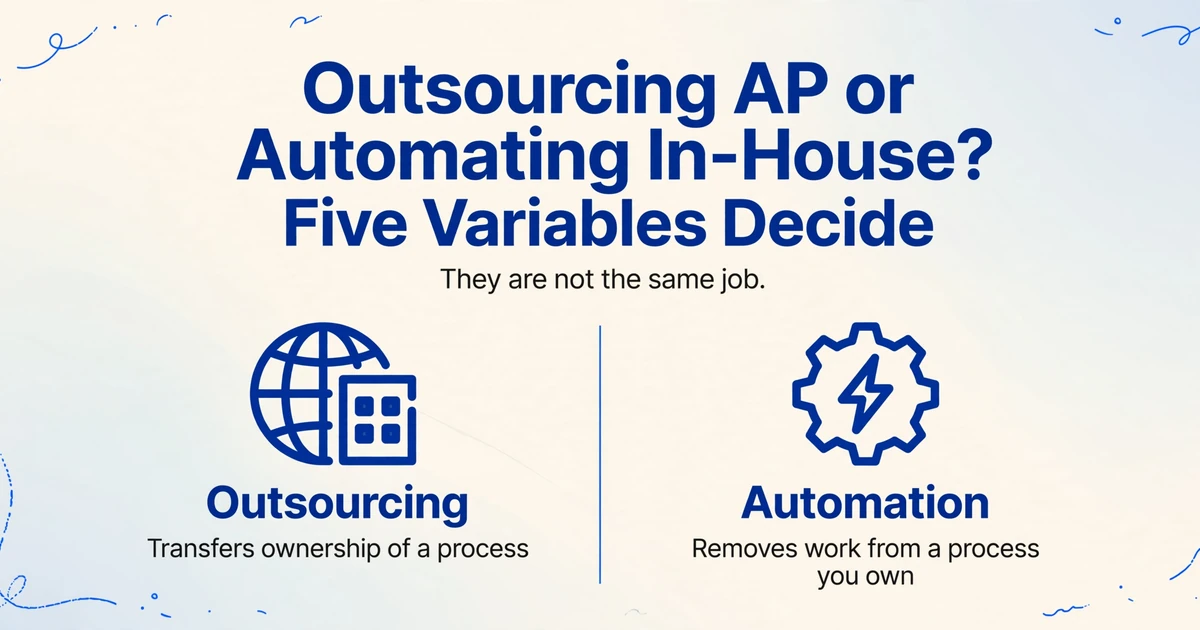
AP outsourcing and AP automation are usually priced as two ways to do the same job. They are not the same job. A provider takes over an invoice from receipt through payment, including the staff, the follow-up, and the evidence your auditor asks for. An in-house extraction tool removes the typing from a process you still run. That difference in scope is larger than the difference in price, and it explains why two finance teams with the same invoice volume can reach opposite conclusions.
Key Takeaways
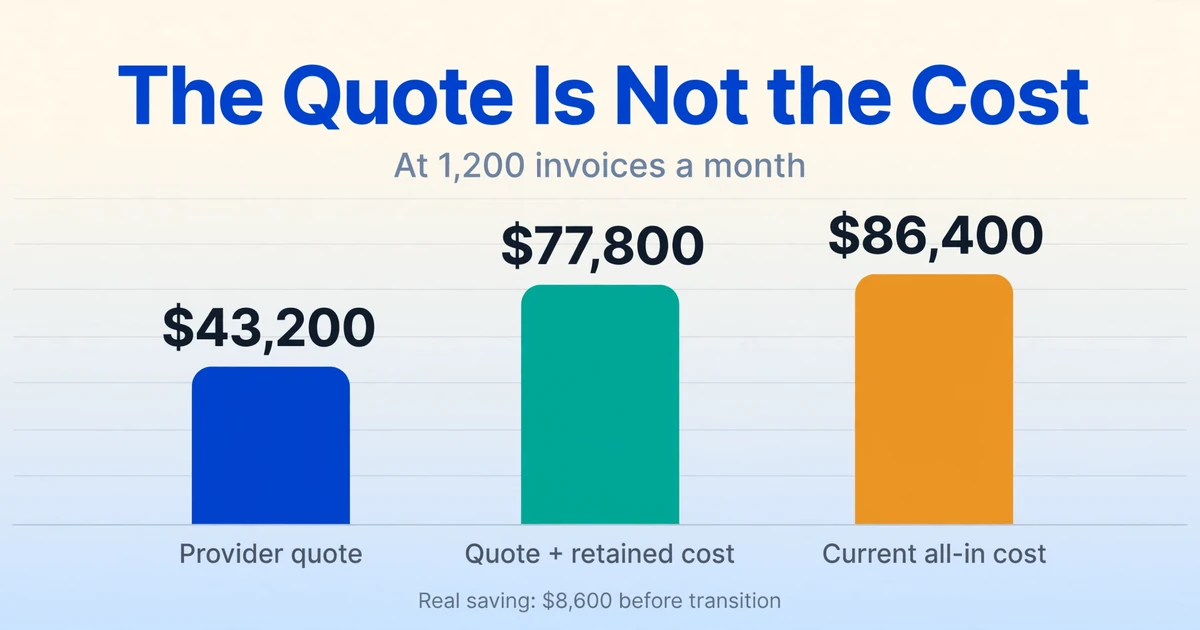
- A $3-per-invoice quote is $43,200 a year at 1,200 invoices a month, and it covers only the 60% of the work a provider takes over.
- The 40% you keep still costs about $34,600, so the real comparison is $77,800 against $86,400 and the saving drops to $8,600.
- At 5,000 invoices a month, removing 75% of keying is worth about $78,800, which is the number to compare against any quote.
The Real Question Behind Outsourcing AP vs Automating In-House
AP is a stack of tasks, and this decision is really about which tasks you want to keep. An invoice passes through intake, extraction, coding and purchase order matching, exception resolution, approval, payment execution, vendor master maintenance, and audit evidence. A business process outsourcer (BPO) can take ownership of most of that stack. An extraction tool touches one layer.
Software that also routes approvals, matches purchase orders, and pays vendors exists, but it is a platform purchase with its own implementation bill. Most comparisons skip that distinction. They put a per-invoice outsourcing quote beside a per-invoice software cost, and the numbers look comparable because both are divided by the same invoice count. The work behind them is not.
Outsourcing transfers ownership of a process. Automation removes work from a process you still own.
What AP Outsourcing Actually Buys
Accounts payable outsourcing buys capacity and accountability, and increasingly it buys technology you would otherwise have to operate yourself.
Capacity without a hiring decision. A provider already has trained staff, a supervisor, a replacement pipeline, and a documented exception process. For a team that has just lost its only AP clerk, keeping suppliers paid next month matters more than the unit price.
A provider that touches your payables should also give you a SOC 1 report, which examines controls relevant to your internal control over financial reporting (AICPA). Your auditor will still ask how those controls operate across the boundary. The report helps, but it does not move the responsibility.
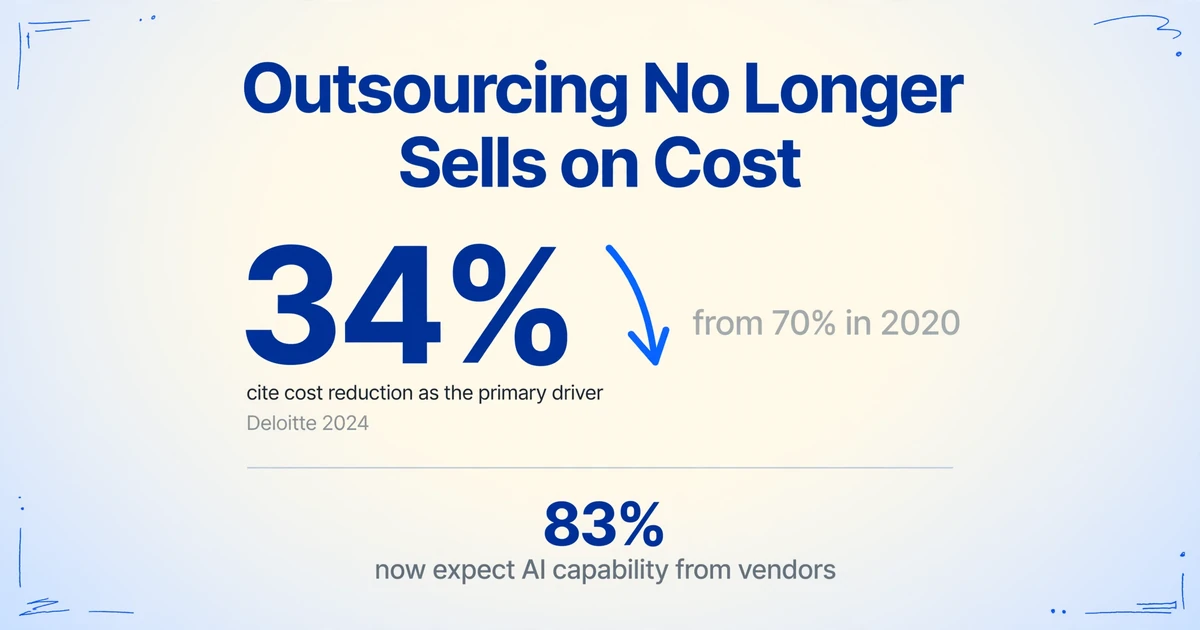
The buyer's motive has shifted. Deloitte's 2024 survey of more than 500 executives found that cost reduction as a primary driver fell to 34%, from 70% in 2020. 83% now expect vendors to bring AI capability, while only 25% report an actual reduction in vendor service cost (Deloitte Global Outsourcing Survey 2024). Buyers are paying for talent, quality, and agility. The fee does not automatically fall when the provider automates.
What stays with you. The provider does not take your approval authority, your vendor relationships, or the judgment calls. Ardent Partners puts the average exception rate at 14%, so roughly one invoice in seven needs a person to decide something (Ardent Partners, 2025 AP benchmarks). If the contract excludes exceptions, you have outsourced the routine 86% and kept the part that fills your AP manager's day. One r/Accounting thread captures the result: "The amount is entered as $8000 but the invoice states $500" (r/Accounting). The invoice still gets fixed in-house, on a system you do not control.
Payments fraud sharpens the control question. AFP's 2025 survey found 45% of organizations faced vendor imposter fraud in 2024, up from 34% the year before (Association for Financial Professionals). A provider adds a party to the vendor master and bank-change process. Callbacks and segregation of duties make that manageable. They do not make it free.
What In-House Automation Actually Costs
The software subscription is the smallest line in an in-house automation budget, and data entry is a smaller share of AP labor than most business cases assume.
A realistic budget includes the subscription, implementation, column design, review labor, exception handling, integration with the ledger (QuickBooks, Xero, NetSuite, or an ERP), and change management.
Extraction is one layer. It reads the invoice and returns structured fields. It does not approve the invoice, match it to a purchase order, choose a general ledger account, execute a payment, or post to the ERP.
Custom Column Extraction is the mechanism at that layer. You type the column names you want, such as Vendor, Invoice Number, PO Number, Due Date, and Total, and the model locates each value by meaning rather than by position. The same column set works across suppliers because layout is not part of the instruction.
Our measurement puts manual keying at about 3 minutes for a one-page invoice and extraction at 5 to 10 seconds, an 18x difference on that step. APQC's median AP function processes 12,000 invoices per FTE per year (APQC), or about 10.4 minutes of AP labor per invoice. Three minutes of keying is roughly 29% of that. Even perfect extraction would address less than a third of AP labor.
At 1,200 invoices a month, the keying time is about 720 hours a year, or 0.35 of a full-time equivalent (FTE). Remove 75% of it and the remaining 0.26 FTE is worth roughly $19,000 a year at $35 an hour. That is a real saving. It is not a headcount.
The 18x speedup applies to the 3 minutes of keying, not the 10 minutes of AP work.
Why AP Outsourcing Cost vs Automation Comparisons Mislead
A provider quote and a cost-per-invoice benchmark are different measurements, even when both are expressed per invoice.
APQC's cross-industry median is $6.00 per invoice, based on 5,846 organizations. The definition includes personnel, systems, overhead, other internal costs, and outsourced costs (APQC). Because outsourced cost is already inside the total, the benchmark describes the whole AP function, not an in-house alternative. Comparing it with a provider's rate is comparing a total with a subset.
Ardent's 2025 benchmarks show the spread: $9.40 average all-in cost per invoice, $2.78 for best-in-class teams, and 32.6% of invoices processed straight through. The gap is mostly process design and exception handling; reading characters is the cheap part.
The arithmetic: at 1,200 invoices a month and an all-in cost near the APQC median, you spend about $86,400 a year. A provider quotes $3 per invoice, or $43,200. If it takes 60% of the work and you keep 40%, your retained cost is about $34,600. The real comparison is $77,800 against $86,400, a saving of about $8,600 before transition and governance. The headline looked like $43,200.
Compare the quote with the cost you remove, not the cost you have.
The Break-Even Is Volume Times Variability
Volume sets the size of the prize, while document variability and error cost decide whether you can collect it. Five variables move the answer.
| Variable | What it changes |
|---|---|
| Monthly invoice volume | Value scales almost linearly. Oversight, governance, and implementation costs do not, so below a few hundred invoices a month, oversight dominates. |
| Document format variability | Clean PDFs from ten vendors are a different problem from 400 scans from 200 vendors. Review labor rises with variability, and review survives automation. |
| Cost of an error | A duplicate payment or missed early-payment discount has a price. High error cost favors whichever option gives you stronger controls and evidence. |
| Labor cost and implementation time | The BLS median clerk wage is $50,670, and benefits bring the loaded cost to roughly $73,500 (BLS; BLS ECEC). Hiring and implementation both take weeks. |
| Whether AP is core | A cost center can be transferred. Strategic payment timing and vendor terms should stay close, with the reading automated. |
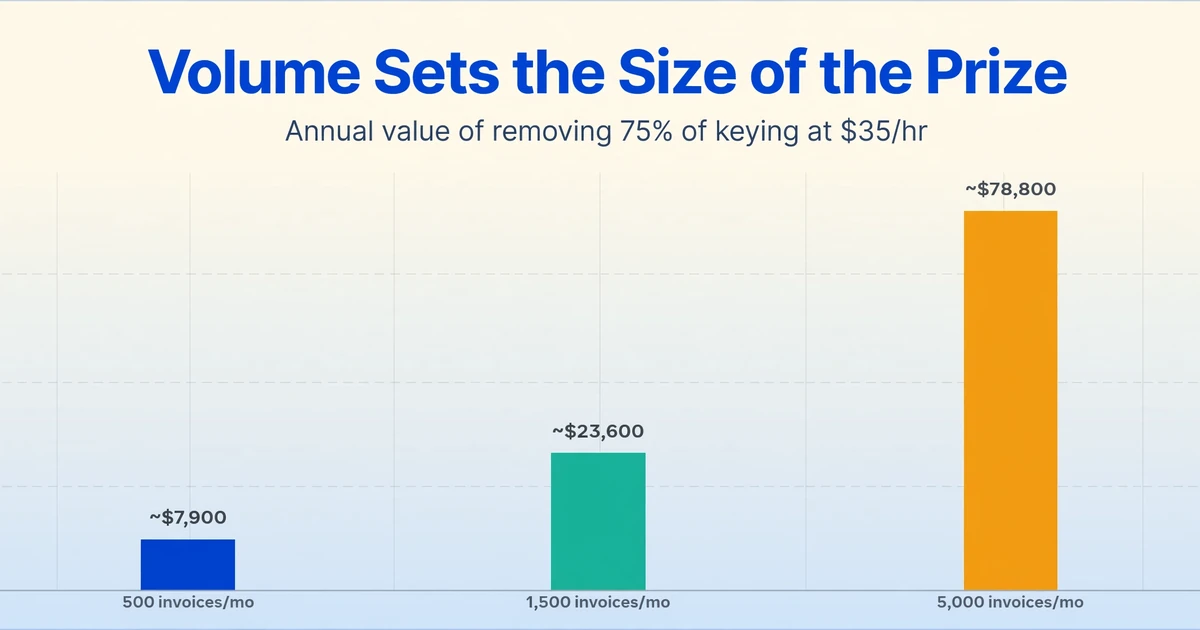
Using 3 minutes of keying, a $35 loaded hourly cost, and 75% of keying removed, the annual value looks like this:
| Monthly invoices | AP FTE at 12,000/yr | Keying hours/yr | 75% removed | Value at $35/hr |
|---|---|---|---|---|
| 500 | 0.5 | 300 | 225 | ~$7,900 |
| 1,500 | 1.5 | 900 | 675 | ~$23,600 |
| 5,000 | 5.0 | 3,000 | 2,250 | ~$78,800 |
Assumptions: one page per invoice, 3 minutes of keying, 75% removed, $35 loaded hourly cost. Replace them with your own measurements before budgeting.
At 500 invoices a month the annual value is about $7,900. That is too small to justify a headcount decision, but large enough to avoid one. At 5,000 the same math produces about $78,800 and starts to change the operating model. The crossover sits wherever removed keying covers the software, the implementation, and the review time. The volume inflection points in AP are worth reading alongside this model.
Who Does Each Step After You Choose
The layer you transfer determines the contract you need, and most failed engagements transfer a layer nobody named.
| AP layer | Typical BPO scope | In-house automation | What stays with you |
|---|---|---|---|
| Intake | Provider mailbox or portal | Email inbox, collection link, upload | Supplier communication |
| Data extraction | Provider staff plus its tools | Extraction tool | Column and schema choice |
| Coding and PO matching | Only if written into scope | Usually the ERP or AP platform | Coding rules and match tolerances |
| Exception resolution | Only if priced in | Your AP team | Judgment and vendor contact |
| Approval | Rarely | Your workflow or ERP | Approval authority |
| Payment execution | Full-service deals only | Your bank or ERP | Signatories and payment run |
| Vendor master and bank changes | Rarely | Your ERP | Verification and callbacks |
| Audit evidence | Provider SOC 1 plus your oversight | Your own review trail | Sign-off |
In practice the AP clerk runs intake and review, the controller owns coding rules, vendor master changes, and sign-off, and the CFO owns the service level and the exit terms. The provider owns only what the contract names.
ImageToTable.ai sits in the extraction layer. It reads invoices into a table using your columns, processes a batch into one spreadsheet, and shows the source of each value on hover. Email Inbox turns a dedicated address into an upload queue, and Collection Link gives suppliers a no-login page to submit invoices. Output goes to Excel, CSV, JSON, Word, Google Sheets, or the v1 API for your own systems.
It does not approve invoices, match purchase orders, execute payments, maintain the vendor master, or post to an ERP. If those layers are the problem, you need a platform or a provider. The extraction layer versus ERP module decision is separate from this one.
The hybrid most teams land on. Extraction and coding stay in-house on one schema, approvals stay in the ERP, vendor master changes belong to a named controller, and a BPO handles the exception tail and seasonal peaks. The routine volume is handled once at a low marginal cost. The seam is where these models fail: handoffs create duplicate keying, unclear ownership, and a correction loop. Deloitte found poor integration with the operating model cited by 47% of executives, which in AP looks like an invoice the provider thinks is closed and your team thinks is open. A 2026 r/Accounting thread describes offshore work producing "a large amount of error corrections" that create "more delays and inefficiencies" (r/Accounting). A hybrid works when one person owns the queue across the boundary and every handoff carries a timestamp.
A Decision Checklist for the CFO Conversation
Eight questions separate a defensible decision from a procurement exercise.
- Can you name the layers you are transferring, in the contract? "AP processing" is not specific enough to price or audit.
- What is your all-in cost per invoice, and which part of it actually disappears?
- What is your exception rate, and who resolves exceptions? If the answer is "us," the provider is pricing the easy volume.
- Who owns vendor master and bank-change verification? Name the person, not the department.
- What does your auditor need? Check that the SOC 1 report's period and control scope cover your process.
- What happens at twice your volume? Ask for the rate and the notice period for scope changes.
- How long is the exit, and who owns the process documentation?
- Is AP core to how you compete? If vendor terms and cash timing are strategic, keep the decisions close.
If you cannot answer the first three, you are not ready to sign either contract. Measure volume, formats, and exceptions for two months first.
Where Outsourcing Genuinely Wins
Outsourcing wins when AP has no owner and no staff, when compliance spans entities or jurisdictions, when a vacancy leaves you with a deadline, when you want a service level rather than another tool to administer, or when volume is seasonal. At 75 invoices a month, a part-time hire can cost more than the work is worth; one controller on r/Accounting described exactly that, with no clerk under $75,000 a year and automation tools that still assumed an AP department (r/Accounting).
None of this makes outsourcing the default. If formats are highly variable, if exceptions require your institutional knowledge, or if real-time cash visibility is the point, a provider will struggle to beat a team that owns the process and reads documents well. The same test applies to invoice processing software: it has to remove a cost you can name.
Frequently Asked Questions
Is outsourcing AP cheaper than automating in-house?
It depends on how much of the process you transfer. A provider quote covers only the work it takes over; your retained costs for approvals, vendor master, audit evidence, and oversight continue. Compare the quote with the cost you remove. At low volume, fixed oversight can erase the per-invoice saving.
How much does AP outsourcing cost per invoice?
Published ranges usually exclude transition fees, exception surcharges, reporting, and the time spent managing the provider. Ask for a fully loaded quote at your volume and exception rate, including setup, scope changes, and exit terms.
Can AI invoice extraction replace an AP team?
No. Extraction replaces the keying step, roughly 3 of the 10 minutes of AP labor per invoice at the APQC median. Approvals, exceptions, vendor master, payments, and audit sign-off remain.
What is a hybrid AP model?
A hybrid assigns each layer to its best owner: automation for intake and extraction, your team for coding and exceptions, your ERP for approvals, and a provider for the exception tail or peaks. One person must own the queue across the boundary.
Does ImageToTable.ai handle approvals or payments?
No. It is an extraction layer: invoices become structured rows, batch output lands in one spreadsheet, and review shows each value's source. Output goes to Excel, CSV, JSON, Word, Google Sheets, or the v1 API. It does not approve, match, pay, or post.
What a Defensible Decision Looks Like
The decision is reversible in one direction and sticky in the other, and that asymmetry should drive the sequence.
Automating extraction is easy to reverse. You keep the process, the data, and the vendor relationships, and you can stop paying for a tool. Outsourcing is harder to reverse. Process knowledge, vendor contacts, and control evidence move to the provider, and bringing them back takes a project. That does not mean automate first in every case. If the function has no owner, no staff, and a compliance burden, a provider is the faster route to control.
The defensible answer is usually a sequence: measure volume, formats, and exceptions; automate the layer you can own; outsource the layer you cannot staff; write down who owns the seam. If typing is the layer to remove first, test it on your own invoices before changing any process.