Why Korean Business KYC
Costs More Than Most Procurement Teams Realize
South Korea's National Tax Service (NTS) transmits over 99% of all B2B tax invoices electronically and offers a public API that can verify a business registration number (BRN) in real time, free, up to one million times a day. Yet when a new Korean supplier sends their 사업자등록증 (Business Registration Certificate) during KYC onboarding, that digitally-verifiable document still arrives as a scanned PDF or a phone photo. Someone on the receiving end opens the Hometax portal, types the 10-digit BRN by hand, reads the tax type status, and copies the result into a spreadsheet. The API exists. The manual process persists. This article traces why — and what that gap costs in won and hours.
Key Takeaways
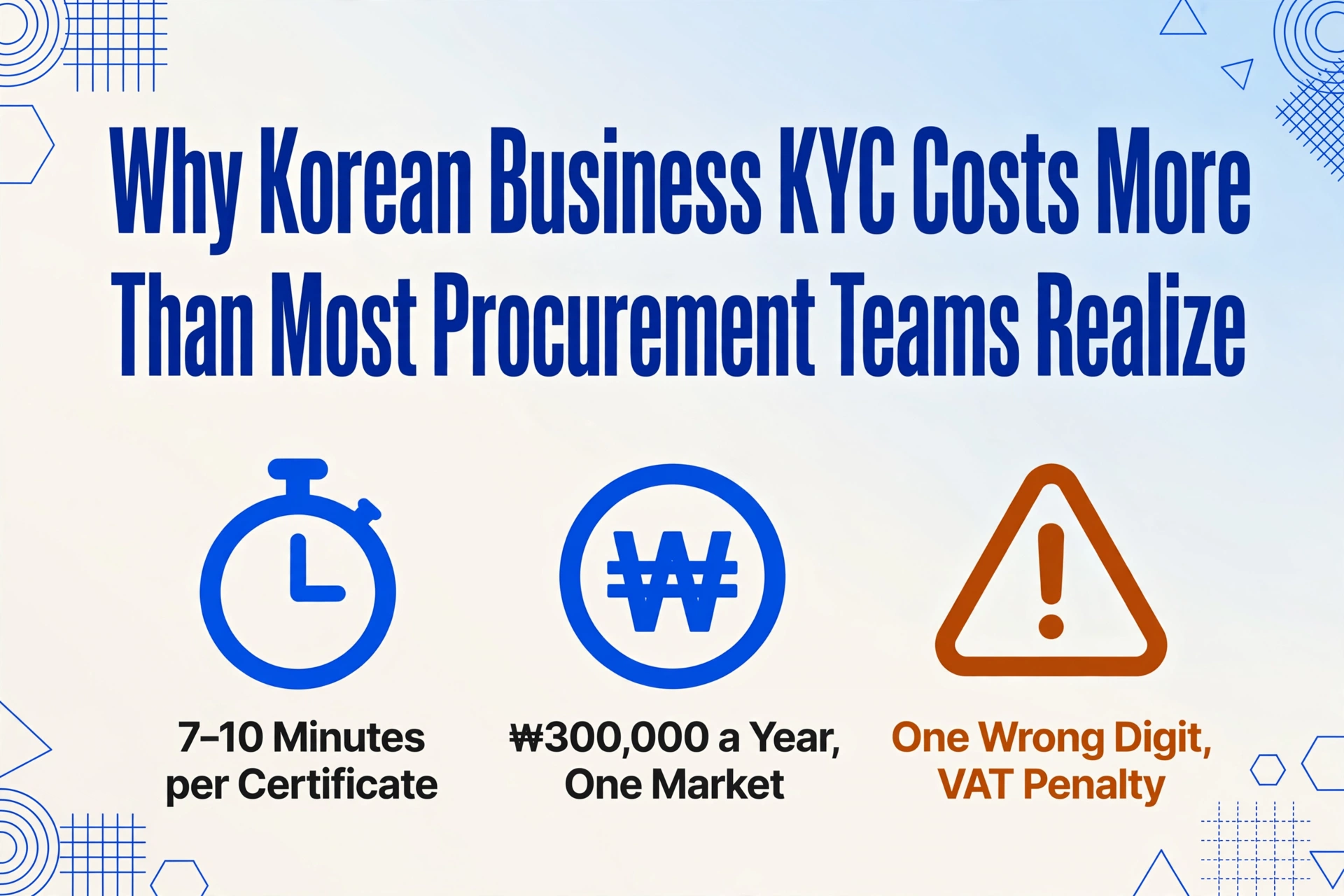
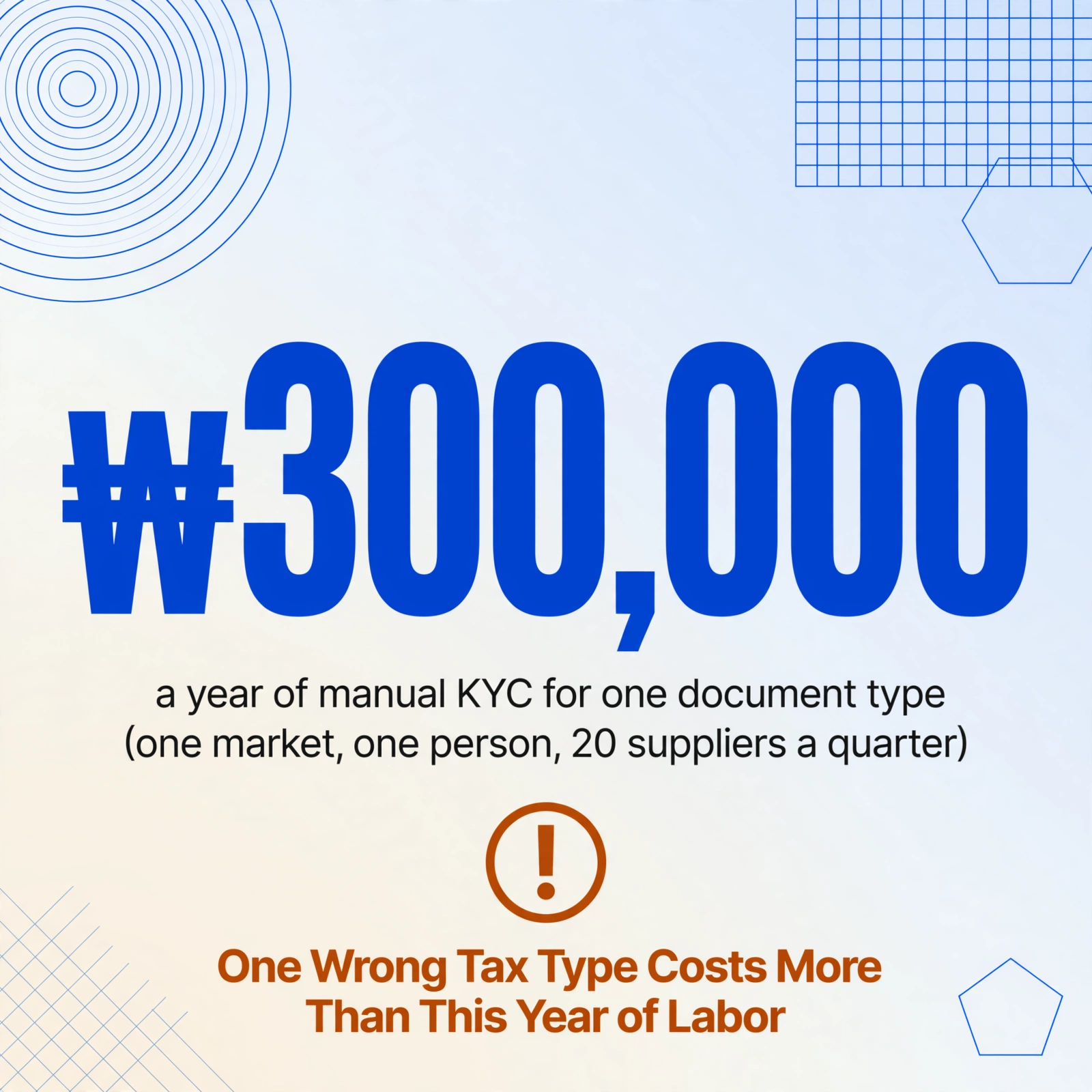
- ₩300,000 a year per person — that's what manual Korean BRN verification costs in labor alone, for one market, one document type, one human eye.
- One mistyped digit and a single VAT penalty cancels those entire annual savings — no amount of careful typing fixes a structural asymmetry between error cost and error frequency.
- The NTS API is free and handles a million calls a day — the bottleneck isn't verification technology, it's getting the BRN off a scanned certificate into that API without a keystroke.
The Paper Trail That Shouldn't Exist
Here is a scene that plays out thousands of times a week across procurement and compliance teams that work with Korean suppliers. A new vendor passes internal screening. The procurement lead sends a standard KYC request. The Korean supplier replies with a PDF attachment — a scanned copy of their 사업자등록증 (Business Registration Certificate) — or, in many cases still, a faxed printout. The recipient opens the document, finds the 10-digit registration number in the top field, opens the NTS Hometax website, enters the number manually into the Business Registration Status Inquiry (사업자등록상태조회) tool, reads the result — "부가가치세 일반과세자입니다" (general VAT taxpayer) — and records the tax type in a spreadsheet alongside the supplier's name, opening date, and representative name.
The task is small. Five to ten minutes per supplier. But it is a task that should not exist at all.
The NTS has maintained a public open API for BRN verification since 2021. It accepts up to 100 registration numbers per call, returns JSON or XML with the entity's operational status (active, closed, suspended), tax type (general, simplified, exempt), and closure date if applicable. The API is free, with a daily limit of one million calls. The technical infrastructure for automated verification has been in place for half a decade.
What hasn't changed is the document itself. The 사업자등록증 is not a public record — you cannot look up a company's certificate the way you might check a U.S. EIN registration. Privacy regulations under the Act on Real Name Financial Transactions (금융실명법) mean the certificate circulates only at the discretion of the business that holds it. So it arrives as an image — and that image has to be read by a person before the BRN can be entered into the system that could have verified it automatically.
The paradox of Korean supplier KYC: the data exists, verified, in the NTS database — reachable by API. But getting the starting identifier (the BRN) from the certificate into the API is still a manual transcription task. The verification gap is not technical. It is a data-entry bottleneck dressed up as compliance work.
What's at Stake When You Verify Manually
The 사업자등록증 is not a one-field document. It encodes at least five pieces of information that carry downstream consequences if misread:
- Business Registration Number (사업자등록번호, BRN) — 10 digits in the format XXX-XX-XXXXX. The 4th and 5th digits encode the entity type:
01–79for individual sole proprietors liable for VAT,81–84for corporate entities,90–99for exempt sole proprietors. A typo in any digit — and the verification result comes back for the wrong entity. - Tax Type (과세유형) — the single most consequential field for downstream finance. Three values exist: 일반과세자 (general VAT taxpayer), 간이과세자 (simplified taxpayer, with two sub-categories — eligible and ineligible to issue tax invoices), and 면세사업자 (exempt). This determines whether a transaction generates a 세금계산서 (tax invoice) or a 계산서 (non-VAT invoice) — and whether the buyer can deduct input VAT.
- Opening Date (개업연월일) — the date the business commenced operations. Used to verify that the certificate is current and the entity has been active for a minimum period.
- Representative Name (대표자) — the legal representative. Must match bank account signatory and contract signatory for AML compliance under FTRA Article 5-2.
- Business Address (사업장소재지) — the registered place of business. Used for tax jurisdiction and delivery verification.
Each of these fields has a distinct verification path. The BRN can be checked against the NTS API — but only after someone has extracted it from the document image. The tax type can be read from the status inquiry result — but only if the person performing the check knows that "간이과세자(세금계산서 발급사업자)" and "간이과세자" are different answers with different VAT implications. The representative name must be cross-checked against the company registry — a separate lookup on a separate platform.
The real risk is not that one field gets typed wrong. It is that a wrong tax type classification — treating a 간이과세자 supplier as a 일반과세자 and issuing a tax invoice — leads to the buyer's input VAT deduction being disallowed. In a transaction of ₩50 million, that is ₩5 million of VAT suddenly in dispute, plus penalties for incorrect reporting. The NTS does not accept "the supplier sent us the wrong certificate" as a defense.
The Hidden Costs No One Adds Up
Most budget discussions around supplier onboarding focus on the direct cost of KYC software or the subscription fee of an automated verification tool. The cost they overlook is the one hidden inside the manual step: the person, the minutes, the rework, and the downstream tax consequences. Three cost dimensions matter.
Time Cost: The Five-Minute Tax
Consider a procurement team that onboards 20 new Korean suppliers per quarter. Each certificate requires:
- Opening the emailed PDF or fax (1 min)
- Navigating to the NTS Hometax status inquiry page (1 min)
- Reading and typing the 10-digit BRN (1 min)
- Interpreting the Korean-language result (1 min)
- Copying the status, tax type, and date into a spreadsheet (1 min)
- Cross-checking the representative name against other onboarding documents (2-3 min)
Total: approximately 7–10 minutes per certificate per supplier. For 20 suppliers, that is 140–200 minutes per quarter — roughly 2.5 to 3.5 hours. A Korean AP specialist with a fully-loaded annual salary of ₩40 million costs approximately ₩20,000 per hour. The quarterly labor cost for this single manual step: ₩50,000–70,000. Across a year, it approaches ₩300,000 — for one document type, for one market, for one person.
Scale up: a regional procurement hub onboarding 200 Korean suppliers per year spends ₩1.4–2.8 million annually on the manual act of reading, typing, and verifying these certificates. That is before any error costs.
Error Cost: The VAT Penalty That Scales
A single mistyped BRN digit or a missed tax type signal has a disproportionately large financial consequence because Korean VAT law links invoice validity tightly to supplier registration status.
If your supplier is 폐업 (closed) but you issue a tax invoice against their BRN, the NTS treats the invoice as invalid. The buyer's input VAT deduction is reversed, plus a penalty of 1% of the supply value per the relevant provision of the Value-Added Tax Act. For a ₩10 million transaction, that is ₩100,000 in penalties — instantly offsetting a quarter's worth of labor savings on manual verification.
The more common error is subtler: a supplier transitions from 일반과세자 to 간이과세자 (or vice versa) without the procurement team knowing. The NTS query shows the current status — but only if someone re-runs it at the time of each transaction, not just at onboarding. Manual systems rarely do this. A supplier certified as 일반과세자 six months ago may now be 간이과세자, making the last three months of tax invoices invalid for input VAT deduction.
Rule of thumb from Korean VAT practice: the cost of verifying a 사업자등록증 manually is negligible per document — but the cost of verifying it wrong once can exceed the annual labor savings of the entire KYC process. This asymmetry makes accuracy more valuable than speed, yet manual processes optimize for neither.
Delay Cost: The Opportunity Cost of a Frozen Supplier Record
A supplier whose 사업자등록증 is received but not yet verified cannot be activated in the ERP. They cannot submit tax invoices. Payments cannot be scheduled. In an international supply chain where a Korean parts supplier is the sole source for a component, each day of delay cascades into production scheduling gaps, expedite fees, or missed delivery windows.
The manual verification step is rarely the only bottleneck in supplier onboarding, but it is one of the few that involves an external dependency: the compliance team cannot verify the certificate until the supplier sends it, and they cannot accelerate the process by doing it faster — the Hometax portal responds at a fixed speed. The wait compounds across every supplier in the queue.
Why Korea's Own Digital Systems Don't End the Paper Chase
The gap between "digitally verifiable" and "manually processed" is not an oversight by the NTS. The public API exists and works. The bottleneck is upstream of the API: getting the data from the document into a machine-readable form before the API call can happen.
1. The certificate is an image, not a data record
The 사업자등록증 is a physical document issued by the district tax office. It is printed on paper with a serial number. The digital version that circulates is a scanned image or a phone photo. Nothing in that image is structured data — not the BRN, not the representative name, not the opening date. Every field must be read by a human eye before it can be entered into any system.
2. Hometax verification is per-number, not per-document
The NTS API verifies a BRN, not a certificate. It tells you whether the BRN is active and what tax type it carries. It does not return the representative name, the business address, or the opening date as printed on the certificate — those require a separate lookup. A team that wants to cross-check all five fields against independent registries must perform two separate verification workflows (NTS for status, Supreme Court registry for corporate details), each with its own interface and authentication requirements.
3. Korean-language interface for human checkers
The Hometax status inquiry page is in Korean. For Korean-speaking staff this is not a barrier. For international procurement teams managing Korean suppliers from regional hubs in Singapore, Tokyo, or London, the Korean UI adds friction — or gets outsourced to a colleague who reads Korean, introducing a handoff delay. The org-id.guide entry for the KR-BRN notes that the certificate authenticity check on Hometax requires either Internet Explorer or a user-agent switcher — a technical constraint that has not aged well.
4. Joint Certificate double-authentication for anything beyond status inquiry
A simple BRN status inquiry (사업자등록상태조회) does not require login on Hometax. But anything beyond that — downloading the certificate's issuance confirmation, checking certificate authenticity against the issuance number — requires a Joint Certificate (공동인증서) and a multi-step authentication cycle that is described by users as a "double-lock" process. This barrier means teams often settle for the bare minimum status check and skip deeper verification steps, precisely because the authentication hurdle is too high for routine use.
5. No batch cross-reference interface for multi-supplier checks
The NTS API supports batch queries (up to 100 BRNs per call), but the Hometax web portal does not offer a user-friendly batch upload interface for the average procurement team. The API is designed for developer integration, not for a compliance analyst who wants to upload a spreadsheet of 50 supplier BRNs and get back a status report. The publicly available third-party Korean business registration inquiry apps that do offer CSV batch upload exist precisely because this gap exists.
Each of these barriers individually is minor. Together, they form a system where manual processing is the path of least resistance — not because digital tools don't exist, but because the document itself sits outside the digital system, and bridging that gap requires effort that no single tool fully addresses.
Manual vs. Automated: Three Ways to Verify a Korean Business Registration Certificate
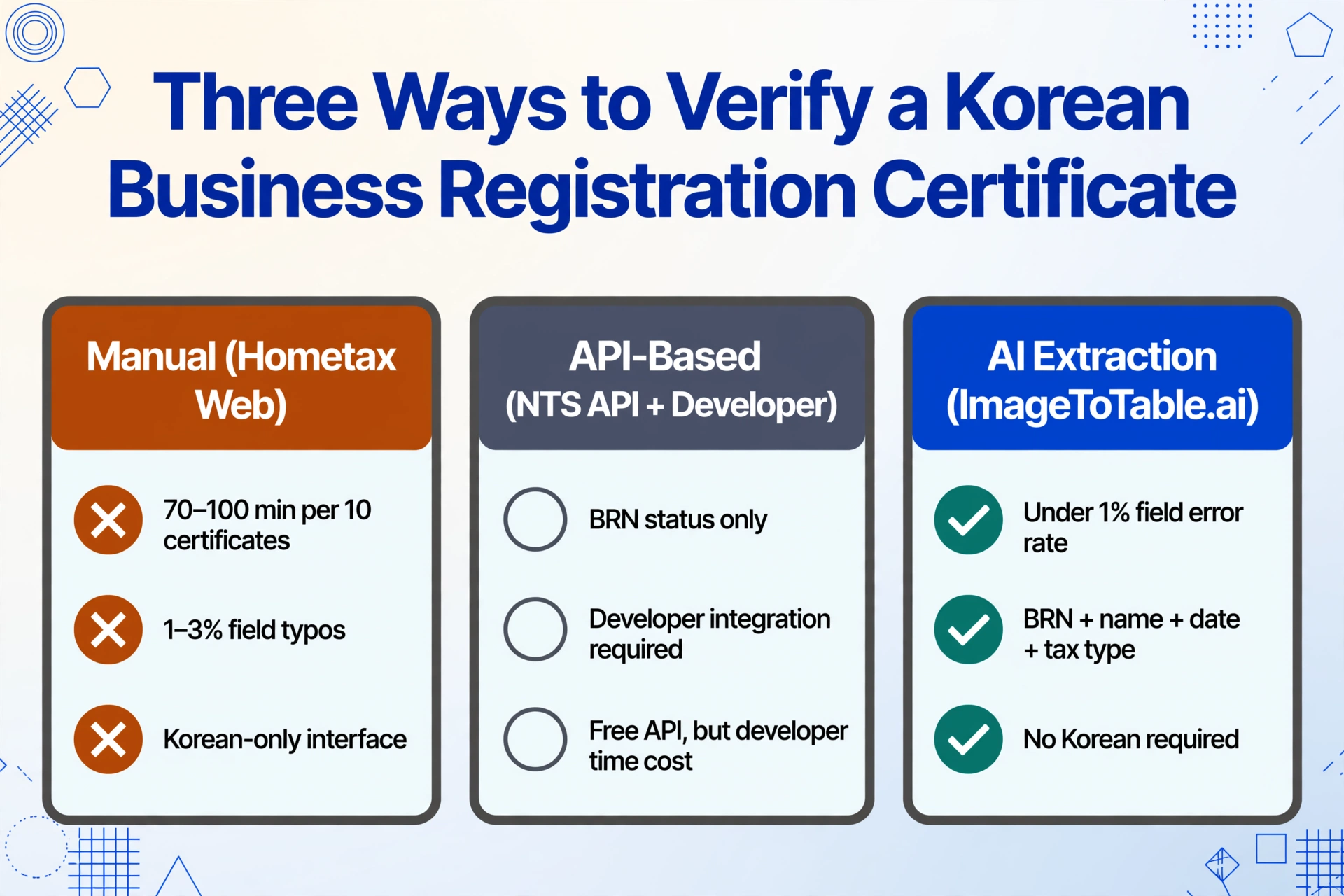
The table below compares three approaches to the same task: verifying 10 Korean supplier 사업자등록증 certificates. The first approach is the most common; the second requires development resources; the third is the path this article is building toward.
| Dimension | Manual (Hometax Web) | API-Based (NTS API + Developer) | AI Extraction (ImageToTable.ai) |
|---|---|---|---|
| Time for 10 certificates | 70–100 min | 5 min (write + test script) + 2 sec API call | 5 min upload + 10 sec processing each |
| Error rate (fields) | 1–3% typo/transcription | 0% (machine-read BRN) | <1% (AI vision extraction) |
| Multi-field verification | Manual cross-check each field | BRN only (unless extended) | BRN + name + date + tax type |
| Korean language required | Yes (Hometax UI + certificate) | No (API returns structured data) | No (AI reads Korean text) |
| Audit trail | Spreadsheet, no timestamp proof | API logs, queryable | Extraction result + original image linked |
| Integration difficulty | None (manual browser) | High (need developer + Joint Certificate for some endpoints) | Low (web upload or API) |
| Cost per 10 verifications | ~₩23,000 (labor, no tool cost) | Free (API) + dev time cost | ~10 credits (~$0.10 equivalent at scale) |
| Scalable to 100+ suppliers? | No — linear labor | Yes | Yes |
The API path is the most technically efficient option — if you have the developer resources to integrate with the NTS Hometax endpoint, handle XML responses, set up authentication, and build a front-end for your compliance team. For most procurement teams — especially those managing Korean suppliers as one market among many in Asia — the development investment is hard to justify. The manual path is what fills the gap.
A Practical Path Forward
The core problem is not that Korean supplier data is hard to verify. The NTS has made it verifiable — the API, the status inquiry service, the public data portal are all operational. The problem is structural: the certificate enters your workflow as an image, and every field on that image must be read and transcribed by a person before any automated system can act on it. The transcription step is where the cost lives.
This is where the extraction paradigm — Custom Column Extraction — changes the flow. Instead of a person reading the certificate, typing the BRN into Hometax, writing the result into a spreadsheet, and repeating for every supplier, the same end-to-end process can be completed in one pass — and the same one-pass flow applies to the rest of the Korean tax document family in our Korean tax invoice scanning:
- Upload the 사업자등록증 scans or photos — JPG, PNG, or PDF accepted, including phone-captured images of printed certificates.
- Define the output columns — Business Registration Number, Company Name, Representative, Opening Date, Address, Tax Type. The market cost comparison for Korean document extraction covers how this compares with domestic Korean ERP pricing.
- AI reads and extracts — the vision model locates each field on the certificate by understanding what it means, not by template matching. A certificate issued in Seoul looks different from one issued in Busan — the AI adapts.
- Export to Excel — all extracted fields in one table, one row per supplier. The BRNs can then be batch-verified against the NTS API in a single automated call.
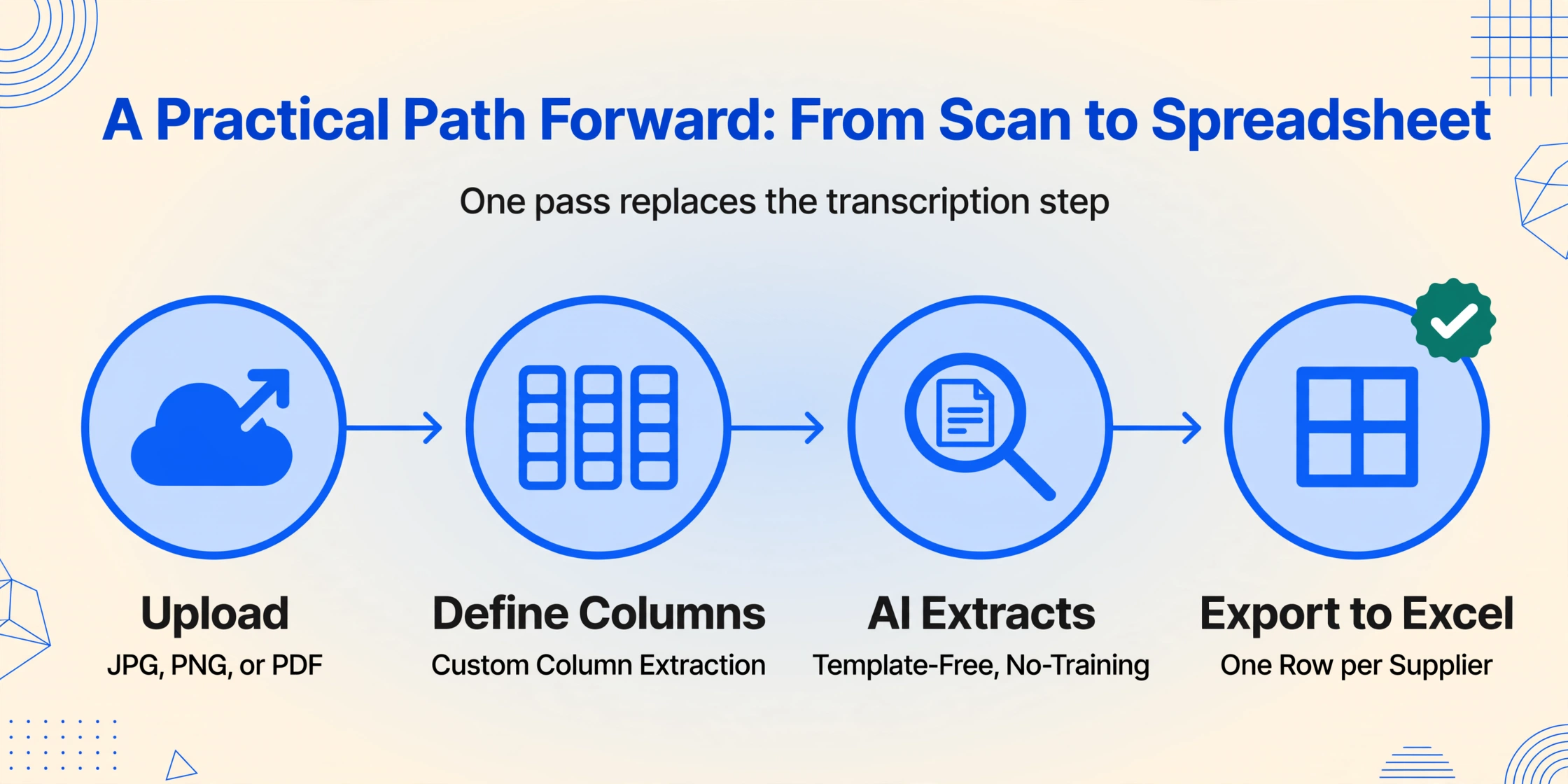
This approach does not replace the NTS verification step. It replaces the transcription step that currently feeds into verification. Instead of a person spending 7–10 minutes per certificate to read and type, the AI extracts the BRN, representative name, opening date, and tax type in roughly 10 seconds per page, at a 99% accuracy rate for printed text fields.
For teams managing larger onboarding volumes, the batch-processing workflow for Korean supplier KYC shows how to scale: upload 50 certificates simultaneously, extract all fields into a single structured table, then feed the BRN column into a one-call NTS API verification. The threshold at which this approach pays for itself is lower than most teams assume.
A step-by-step walkthrough of the extraction process from a single 사업자등록증 is covered in the dedicated extraction guide for Korean Business Registration Certificates. The focus there is on column design, handling the Korean-language fields, and structuring the output table for downstream ERP import.
Frequently Asked Questions
How do I verify a Korean business registration number (BRN)?
The NTS Hometax portal offers two free methods. The Business Registration Status Inquiry (사업자등록상태조회) requires only the 10-digit BRN — no login needed — and returns whether the business is active, closed, or suspended, plus the tax type. The Certificate Authenticity Check (증명서 진위확인) requires both the BRN and the issuance number from the certificate, plus a Joint Certificate login. The simpler status inquiry covers 90% of KYC use cases. For batch verification, the NTS public API accepts up to 100 BRNs per request.
Can AI extract data from a faxed or photocopied 사업자등록증?
Yes — the vision model used by tools like ImageToTable.ai reads text from scanned images and phone photos, including lower-resolution fax copies, as long as the printed characters are legible to the human eye. A generation loss from fax transmission does reduce confidence on stylized characters or light text, but the BRN field — printed in a standard fixed-width font — remains the most reliably extractable field even on poor-quality copies. Handwritten annotations on the certificate (common on faxed versions) are read with lower accuracy and should be flagged for manual review.
What if the certificate is only in Korean — no English translation?
The standard 사업자등록증 is issued in Korean only. English translations are available upon request from the district tax office but are not common. International procurement teams receiving a Korean-only certificate face the additional burden of reading and interpreting Korean-language field labels. AI extraction tools that use vision models trained on Korean text bypass this language barrier — the model reads the Korean characters and outputs the extracted data in English-labeled columns, without requiring the verification team to read Korean.
How does tax type (과세유형) affect VAT reporting?
The tax type determines what kind of invoice a supplier can issue. 일반과세자 (general taxpayer) issues 세금계산서 (tax invoice) — the buyer deducts 10% input VAT. 간이과세자 (simplified taxpayer) issues 계산서 (simplified invoice) in most cases — the buyer cannot claim input VAT from a 간이과세자 invoice. 면세사업자 (exempt) issues 계산서 — no VAT involved. If you record a supplier as 일반과세자 but they are actually 간이과세자, any tax invoices you process against that supplier's BRN will be treated as invalid by the NTS, reversing your input VAT deduction and triggering a 1% penalty per the Value-Added Tax Act. Always verify the tax type at onboarding and re-verify it periodically — tax status can change when a business's annual revenue crosses the threshold (approximately ₩48 million for individual businesses).
Is the NTS BRN verification API free to use?
Yes. The NTS open API for business registration information (사업자등록정보 진위확인 및 상태조회 서비스) is free, with a daily limit of 1 million calls and a per-request batch limit of 100 BRNs. It requires registration on the Korean public data portal (data.go.kr) to obtain an API key. The API returns data in JSON or XML. Development teams should note that the authentication endpoint and some supplementary verification services require Joint Certificate integration, which adds implementation complexity.
The Takeaway
Korean supplier KYC carries a hidden cost that most procurement teams never quantify because each instance of it is small: 7 minutes per certificate, a ₩20,000 labor cost here, a one-digit typo there. But the asymmetry of the risk — a single incorrect tax type classification can trigger a VAT penalty larger than a year's worth of manual verification labor — makes this one of the highest-ROI process improvements available to teams onboarding Korean suppliers.
The data infrastructure exists. The NTS built the API, the public portal, and the real-time status inquiry system. What is missing is the bridge between the document — the 사업자등록증 that arrives as an image — and the digital verification layer that could validate it in seconds. That bridge is document extraction: reading the certificate's fields automatically, so that the verification steps that follow can run on structured data instead of manual keystrokes.