GST/HST Quarter-End Filing Checklist:
CRA Return Ready Before the Deadline
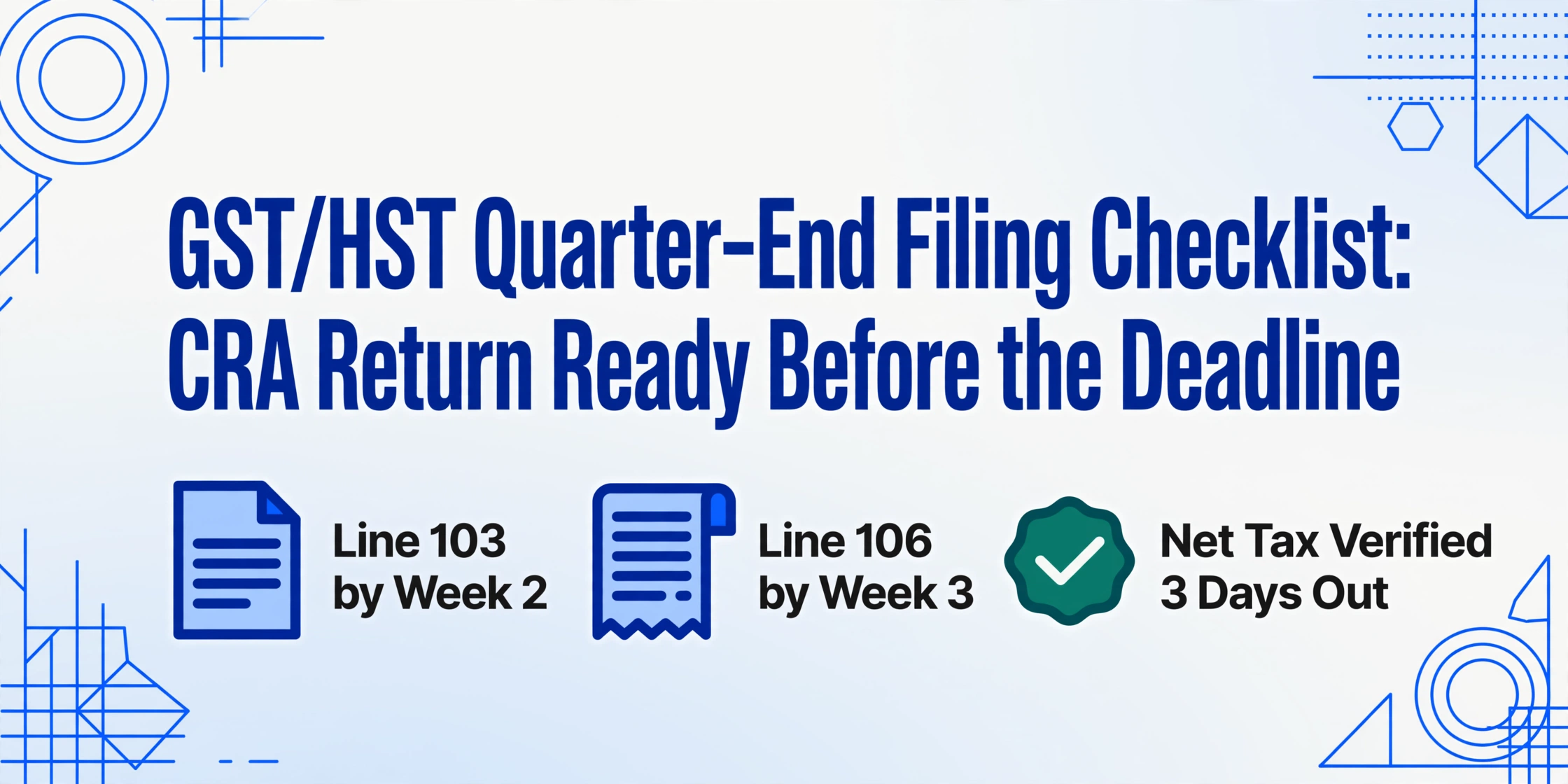
Every Canadian business registered for GST/HST under Part IX of the Excise Tax Act files a return at the end of each reporting period — monthly, quarterly, or annually. The CRA's published deadline is one month after the period ends. What the calendar does not say is that the deadline is not the day you complete the return. It is the day the CRA expects it filed and paid. The work of preparing the numbers for the GST34-2 — gathering sales invoices, extracting ITC figures from supplier PDFs, verifying provincial tax rates, calculating net tax — must be finished before the deadline, and every day you lose to manual data assembly is a day the margin for error shrinks. This is the quarter-end checklist that gets you from "the quarter just ended" to "the return is lodged" — with every step mapped to the documents you actually need to open and the numbers you actually need to verify.
What the Quarterly GST/HST Filing Window Actually Means
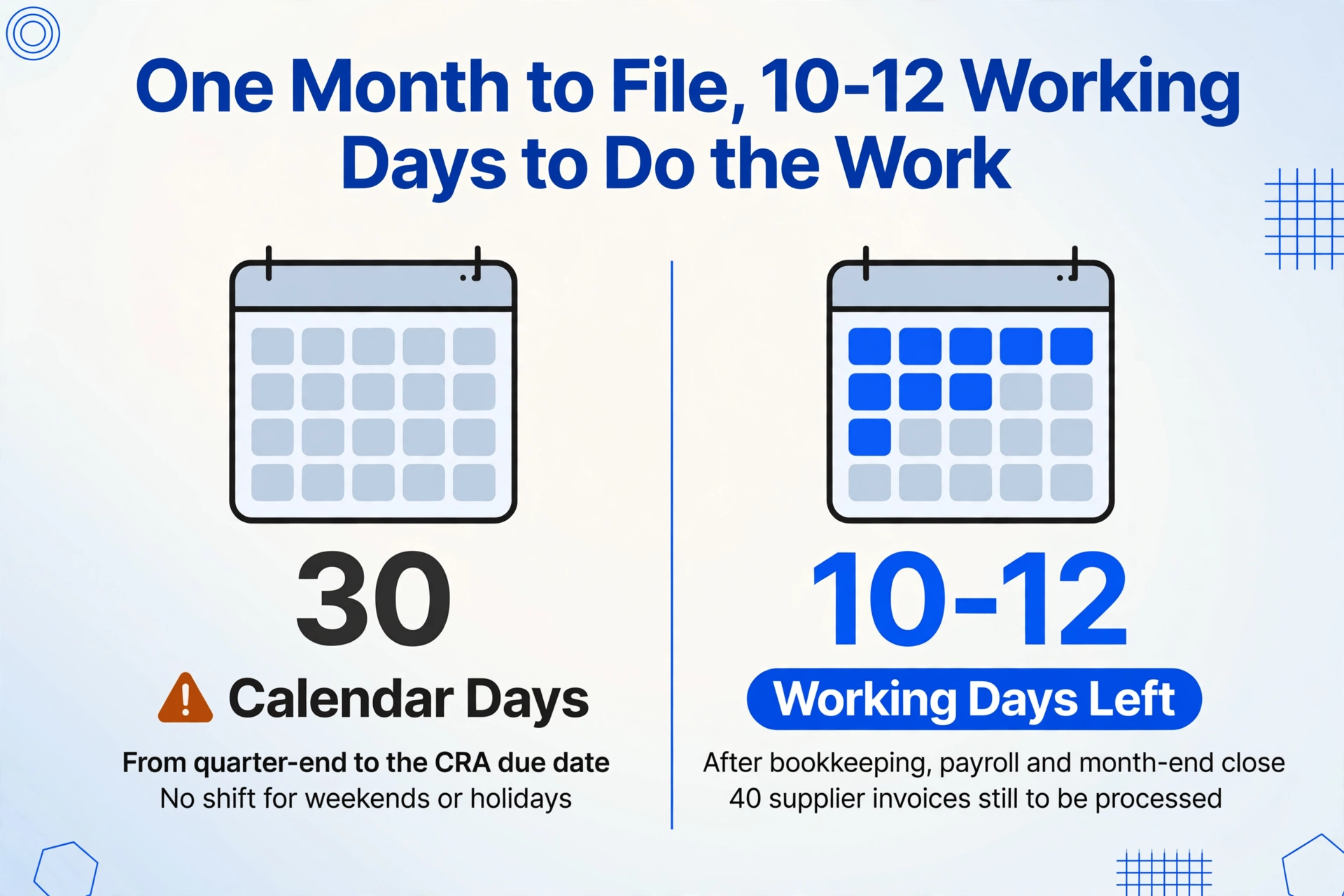
The CRA gives quarterly filers one month after the reporting period ends to file and remit. For a standard calendar quarter — January to March — the deadline is April 30. For April to June, it is July 31. For July to September, October 31. For October to December, January 31. These dates are statutory, not suggestions, and they do not shift for weekends or holidays. If April 30 falls on a Saturday, the deadline remains April 30 — the CRA's electronic filing systems accept returns on weekends, and the payment must be initiated such that the CRA receives it by the due date.
One month sounds generous until you map it against the actual work. A small business with 40 supplier purchase invoices per quarter and suppliers in four provinces needs to: extract the GST/HST figure from each supplier PDF, verify the rate against the supplier's province, distinguish federal GST/HST from provincial QST on Quebec invoices, sum the ITC totals, reconcile against the general ledger, prepare the net tax calculation, and file. If the bookkeeper starts on day one after quarter-end — April 1 for a Q1 filer — the calendar says 30 days. The actual number of working days inside that window, after accounting for regular bookkeeping workload, payroll processing, and other month-end close activities, is closer to 10 to 12. That is why the quarter-end checklist starts not on the deadline day but at the quarter-end close: the moment the books for the quarter are complete, the GST/HST preparation clock starts ticking.
The cost of manual GST/HST processing rises sharply when the preparation window compresses — the error rate on manual ITC extraction increases under deadline pressure, and the opportunity cost of the owner's weekend consumed by data entry is disproportionately high compared to the visible bookkeeping expense. The checklist that follows is designed to spread the work across the full window, locking each section before moving to the next.
The one-month window is not evenly distributed. The first two weeks are about gathering and reconciling — work that can be done in small batches. The third week is verification — the step that requires focused attention on each supplier invoice's tax breakdown. The final week is calculation, cross-checking, and filing. If you compress the gathering and verification into the same weekend, you are doing them with the same tired eyes.
Week 1–2 After Quarter-End: Reconcile Sales Invoices and Lock Line 103
Line 103 on the GST34-2 — "GST/HST collected or collectible on sales" — is the first number the CRA sees on your return and the one most likely to be checked against your reported revenue. Getting it right starts with a complete picture of every sale in the quarter.
The first task is not arithmetic. It is completeness. Every sales invoice issued during the quarter — whether sent as a PDF, a QuickBooks-generated invoice, or a handwritten receipt — must be accounted for before any tax figure is calculated. Start with the accounting software's sales report filtered to the quarter's date range. If you use QuickBooks Online Canada, generate the "Transaction List by Customer" report. If you use Xero, run the "Account Transactions" report for all income accounts. Confirm that the total sales figure in this report matches the total of individually listed sales invoices. A missing invoice — one that was issued but never entered into the system, or entered in the wrong period — will understate Line 103.
Next, classify each sale by GST/HST status. Not every sale carries the same tax treatment:
- Taxable supplies at the standard rate: Most goods and services sold in Canada. The GST/HST rate depends on the province of supply — not where your business is registered, but where the goods are delivered or the service is performed. A sale to an Ontario customer carries 13% HST. A sale to a BC customer carries 5% GST. A sale to a Nova Scotia customer carries 15% HST. The rate is determined by the customer's location, and you need to confirm the correct rate was applied at the time of invoicing.
- Zero-rated supplies: Exports, basic groceries, prescription drugs, medical devices, and certain agricultural and fishing products. These are taxable at 0% — they go on Line 103 but contribute zero to the GST/HST collected figure. Zero-rated is not the same as exempt: zero-rated suppliers can still claim ITCs on their purchases; exempt suppliers cannot.
- Exempt supplies: Financial services, residential rent, health and education services provided by public institutions, and certain other categories. These do not appear on the GST/HST return at all — they are not reported on Line 103 and no ITCs can be claimed on purchases related to making exempt supplies.
Sales Reconciliation Checklist (Week 1–2)
- ✓ All sales invoices for the quarter are entered in the accounting system and match supporting documents
- ✓ GST/HST rate on each invoice matches the customer's province of supply
- ✓ Zero-rated sales (exports, basic groceries) are separately identified — included on Line 103 but excluded from tax collected
- ✓ Exempt sales are excluded from the GST/HST return entirely
- ✓ Sales to Quebec customers correctly apply 5% GST (federal) — QST is remitted separately to Revenu Québec
- ✓ Total sales figure matches the general ledger for the quarter
The sales reconciliation is the foundation. Every subsequent step — ITC calculation, net tax, and the final filing — depends on Line 103 being correct. If you discover a misclassified sale during the ITC verification step in week three, you have to go back and recalculate Line 103, which shifts every number that follows. Lock sales first, then move to purchases.
Week 2–3: Assemble Purchase Invoices and Calculate ITCs for Line 106
Line 106 — "Input tax credits (ITCs)" — is where the GST/HST you paid on business purchases is claimed back. It is also the line on the GST34-2 most sensitive to the format of the documents that feed it. Every supplier invoice in the quarter's purchase folder contains a GST/HST figure somewhere on the page. Finding it, verifying it, and entering it into the ITC calculation is the step that consumes more time than any other in the quarter-end checklist — and it is the step with the most structural margin for error.
The CRA's ITC eligibility requirements are specific: you need a supporting document — an invoice, receipt, or contract — that shows the supplier's name, the GST/HST registration number, the date of the invoice, the total amount paid or payable, and the GST/HST amount charged or a clear statement that GST/HST is included in the total. For purchases over $30, the supplier's GST/HST registration number must be on the document. For purchases over $150, you need the full invoice detail — not just a receipt.
The ITC verification checklist breaks into three passes through the quarter's purchase invoices:
Pass 1 — Completeness check. Confirm you have a supporting document for every purchase entered in the accounting system during the quarter. A supplier invoice that was paid but the PDF was never saved, or was saved in a different folder, creates a gap: the expense is in the ledger, but the GST/HST amount cannot be verified. If the duplicate is missing, contact the supplier for a copy before the filing deadline — chasing missing invoices during the final week is the primary reason returns are filed late.
Pass 2 — Rate verification by province. Read the GST/HST line on each supplier invoice and confirm the rate matches the supplier's province. A Home Depot invoice from Ontario charges 13% HST. A BC plumbing supplier's receipt shows 5% GST. A Nova Scotia hardware wholesaler's PDF shows 15% HST. A Quebec lumber supplier's invoice splits TPS (5% — federal, claimable as ITC) and TVQ (9.975% — provincial, administered by Revenu Québec, not claimable as a federal ITC). This is the step the manual GST/HST data entry problem is built around: 40 invoices, five provincial rates, and a verification that fatigues before the last row. You are looking at roughly one minute per invoice for the rate check alone — and after 30 invoices, the default mental model of "most of my suppliers charge 13%" starts overriding the actual rate printed on the page.
Pass 3 — ITC calculation and reconciliation. With every purchase invoice verified and the GST/HST amount extracted, sum the ITC-eligible GST/HST paid. Cross-check this total against the GST/HST paid account in the general ledger. A variance of more than a few dollars usually traces to one of three sources: a Quebec supplier whose TVQ was mistakenly included in the federal ITC figure, a purchase from a non-registrant (no GST/HST charged, so no ITC), or a personal-use portion of a mixed-use expense that was incorrectly treated as 100% business. Trace and correct before moving to the net tax calculation.
Quebec supplier invoices are the most common ITC error source. A Quebec lumber supplier's invoice showing "TPS 5%: $47.50" and "TVQ 9.975%: $94.76" — only the TPS amount is claimable as a federal ITC. The TVQ amount has no place in the federal GST/HST return. If the bookkeeper, processing 40 invoices, copies the combined tax figure instead of only the TPS, the ITC is overstated by $94.76 on a single invoice. Across three Quebec suppliers per quarter, that is a systematic overstatement the CRA's automated reconciliation will eventually detect — and the ITC will be reversed with interest calculated back to the original filing date.
For businesses processing a high volume of supplier invoices across multiple quarters, batch-processing quarterly GST/HST returns into one annual tax summary turns this three-pass manual verification into a formula-driven workflow — but only once the data is in a spreadsheet. The checklist step above is about getting it there.
Week 3: Provincial Rate Verification — The Step That Only Exists in Canada
Most countries with a value-added tax have a single national rate. Australia's GST is 10% everywhere. The UK's VAT is 20% on standard-rated supplies. In Canada, a business with suppliers in five provinces processes documents with five different federal tax rates — and each must be verified against the supplier's location, not assumed.
| Province/Territory | Tax Type | Federal Rate | Verification Check |
|---|---|---|---|
| Ontario (ON) | HST | 13% | Confirm supplier is in Ontario — not just shipping from an Ontario warehouse |
| Nova Scotia (NS), New Brunswick (NB), Newfoundland & Labrador (NL), Prince Edward Island (PE) | HST | 15% | 15% HST is the highest federal rate — entering 13% (the Ontario default) understates ITC by ~2% of invoice value |
| British Columbia (BC), Alberta (AB), Manitoba (MB), Saskatchewan (SK), Northwest Territories (NT), Nunavut (NU), Yukon (YT) | GST only | 5% | Most likely to be entered at 13% (the default mental rate), overstating ITC by 8% of invoice value — the error pattern that triggers CRA review |
| Quebec (QC) | GST + QST (separate) | 5% (federal GST only) | Only the TPS line is federal ITC. TVQ (9.975%) is provincial — including it in the federal ITC claim is an overstatement the CRA will reverse |
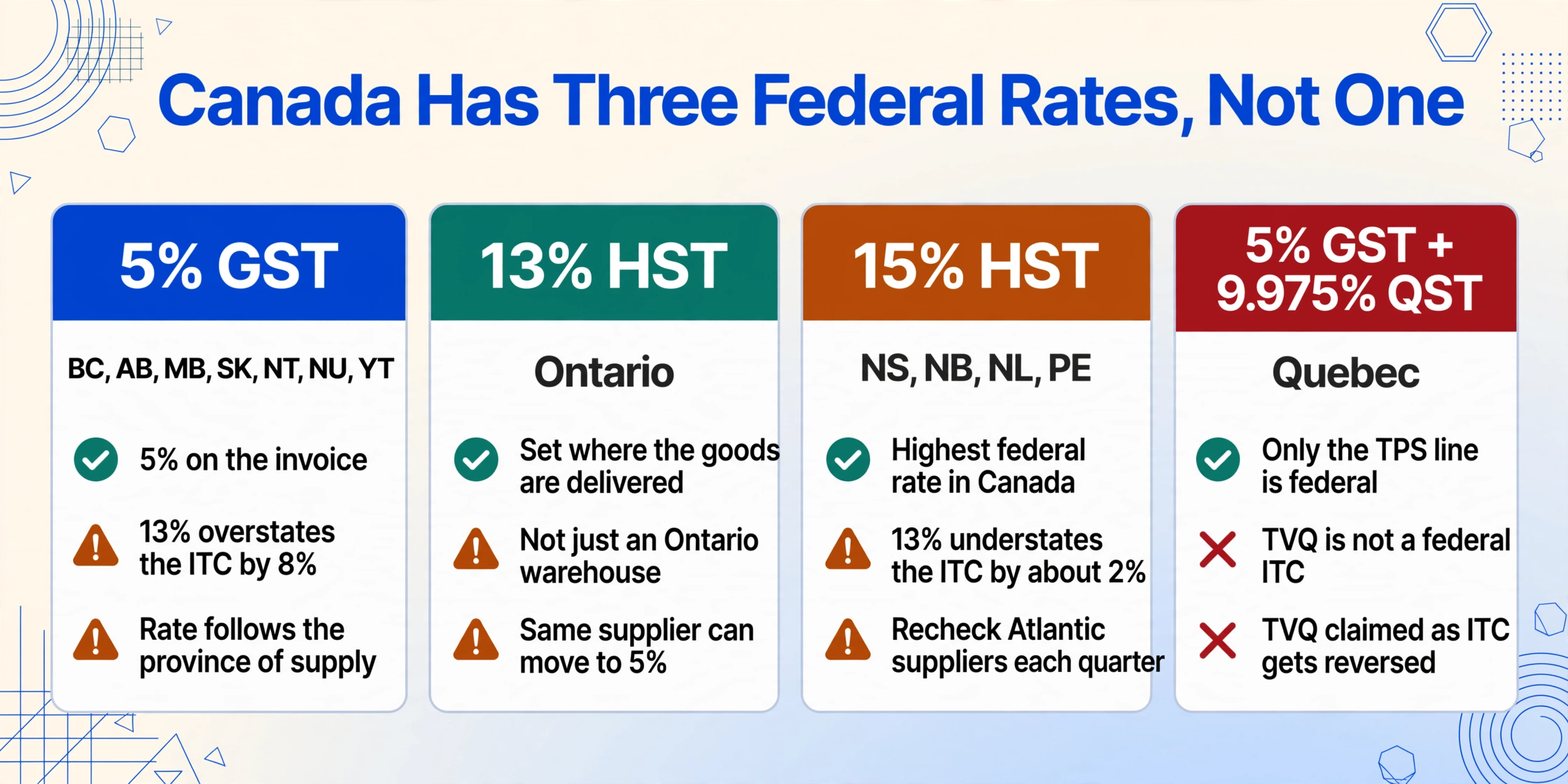
The rate verification is not a one-time check applied globally. It is a per-invoice check — and the same supplier who charged 13% HST in Q1 because they shipped from their Ontario warehouse might charge 5% GST in Q3 because they shipped from their BC warehouse. The tax rate follows the point of supply, not the supplier's head office. The verification step must be repeated for every invoice, in every quarter, and the person doing it is the same person who has already been reading tax lines off PDFs for two hours. That is the structural reason the provincial rate check is the step most likely to be skipped — and the step whose absence produces the most expensive errors.
Week 3–4: Filing Method Decision — Quick Method vs Regular Method
Before calculating net tax, confirm which filing method applies for the current quarter. The Quick Method and the Regular Method are not interchangeable — they are distinct elections with different data requirements, different remittance calculations, and different deadlines for switching between them.
Quick Method filers remit a fixed percentage of their GST/HST-included sales to the CRA. The rate depends on the type of business and the province — typically 3.6% to 8.8% of GST/HST-included sales. Under the Quick Method, you do not claim ITCs on individual purchases. Instead, the CRA builds an implicit ITC into the remittance rate. The data assembly work shifts entirely to the sales side: you must total your GST/HST-included sales for the period, but you do not need to extract individual GST/HST amounts from supplier invoices. Eligibility requires annual worldwide taxable supplies of $400,000 or less, and you cannot use the Quick Method if you provide legal, accounting, actuarial, bookkeeping, or consulting services.
Regular Method filers calculate the GST/HST collected on sales (Line 103), subtract ITCs claimed on purchases (Line 106), and remit the difference (Line 109 — net tax). This is the full workflow: both sales-side and purchase-side data assembly are required, and the accuracy of Line 106 depends on the accuracy of the ITC extraction from every supplier invoice.
The transition trigger: If your annual taxable supplies cross the $400,000 threshold, you must switch from the Quick Method to the Regular Method. The switch takes effect at the start of the next fiscal year — but the data assembly workload changes immediately. A business that has never tracked individual ITCs because it filed under the Quick Method for years suddenly needs to extract the GST/HST amount from every supplier PDF, starting with the first quarter under the Regular Method. This is a structural shift in the quarterly workload — and it arrives at the same moment the business crosses the threshold where manual ITC tracking becomes impractical at scale.
The single-quarter GST/HST extraction guide covers the Regular Method workflow in detail — defining six columns, uploading supplier PDFs in one batch, and receiving a spreadsheet with every ITC figure already extracted and every province already verified. For businesses transitioning from Quick Method to Regular Method, this workflow is what prevents the first Regular Method quarter from becoming a data-entry bottleneck.
3 Days Before Filing: Calculate Net Tax and Cross-Check the Numbers
Three days before the deadline, you should have: all sales invoices reconciled, all purchase invoices verified for ITC eligibility, all provincial rates confirmed, and the filing method determined. The remaining work is arithmetic — but arithmetic with consequences.
Line 109 — "Net tax" — is calculated as Line 105 (total GST/HST collected, which equals Line 103) minus Line 108 (total ITCs, which equals Line 106 plus any Line 107 ITC adjustments). If Line 105 exceeds Line 108, the difference is the amount you remit to the CRA. If Line 108 exceeds Line 105, the difference is your refund. The CRA pays refund interest at a prescribed rate — but only if the refund is issued more than 30 days after the filing date. Filing early does not accelerate the refund; filing accurately prevents the refund from being held for verification.
Before entering these numbers on the GST34-2, run the cross-checks that catch errors the arithmetic alone will miss:
Pre-Filing Cross-Check Checklist (3 Days Before Deadline)
- ✓ Line 103 (GST/HST collected) ÷ total sales = your effective tax rate. If this ratio is 13% and you have suppliers in BC (5%) and NS (15%), the ratio should be a weighted average — not a single rate
- ✓ Line 106 (ITCs) ÷ total purchases = your effective ITC rate. This ratio should also be a weighted average of supplier provinces — not a round number implying a single rate
- ✓ Net tax (Line 109) compared to the same quarter last year — a variance of more than 25% should have an identifiable business reason (revenue change, large capital purchase, supplier mix shift)
- ✓ GST/HST collected and ITC totals match the GST/HST control accounts in the general ledger
- ✓ No Quebec QST amounts included in federal ITC total — check specifically for Quebec supplier lines
- ✓ If using Quick Method, the remittance percentage matches your business type and the rate for the province where you have your permanent establishment
The year-over-year comparison is the quietest signal on this checklist — and the one most small businesses skip. The CRA's data-matching algorithms are trained to flag exactly this kind of anomaly: a Line 103 that jumps 40% year-over-year with no corresponding revenue increase in the corporate tax return, or a Line 106 that drops 30% when the business's supplier base hasn't changed. If your number passes the year-over-year sanity check, it will pass the CRA's. If it fails, find the reason before the CRA finds it for you.
Filing Day: Final Verification Before CRA Submission
The return is prepared. The numbers have been cross-checked. The only remaining step is filing — and the only remaining risk is filing the wrong return.
If you file electronically through the CRA's My Business Account or NETFILE, confirm the reporting period displayed on the filing screen matches the quarter you intend to file. Selecting the wrong period — Q3 instead of Q2 — is a common mistake when catching up on late filings, and the CRA's processing system will either reject the return (if the period doesn't match) or accept it and create a mismatch that requires an adjustment filing later.
If you file through an accountant or a registered tax preparer, the internal deadline shifts earlier — your preparer needs the reconciled figures at least a week before the CRA deadline to allow time for review. The checklist timeline compresses: weeks 1–3 become weeks 1–2 internally, and the third week is the preparer's review window. Communicate your internal deadline to the preparer at the start of the quarter-end period — not the week before the CRA deadline.
Even if you had zero business activity in the quarter, you still file. A nil GST/HST return must be filed by the deadline. Failing to file a nil return triggers the same penalty framework as a return with amounts owing. In the CRA's portal, select "Nil return" — this populates the fields with zeros and submits a compliant filing.
If you owe money on the return and cannot pay in full by the deadline, file on time anyway and arrange a payment plan with the CRA before the due date. The CRA charges two separate penalties: a late-filing penalty for returns filed after the deadline, and prescribed interest on amounts paid late. Filing on time eliminates the first penalty. Contacting the CRA proactively to arrange payment terms reduces the likelihood of collection action.
What Happens If You Miss the Quarterly Filing Deadline
The CRA's penalty framework for late GST/HST returns is enforced automatically — there is no grace period, no warning letter, and no discretion applied at the processing stage. The penalties compound on a calendar basis, not a business-day basis.
Day 1 after the deadline: The CRA's systems flag the overdue return. No penalty issues immediately, but prescribed interest begins accruing on any unpaid net tax from the original due date. The prescribed interest rate is set quarterly and compounds daily. For 2026, the rate for overdue remittances has been in the 9–10% range — meaning a $2,500 quarterly remittance paid 30 days late accrues approximately $20–$25 in interest, a figure small enough to ignore but large enough to notice if it repeats across four consecutive quarters.
4 weeks after the deadline: The first late-filing penalty is assessed. For a first offence, the CRA typically issues a reminder before formal penalty application — but this is an administrative practice, not a statutory right. The late-filing penalty for GST/HST returns is 1% of the net tax owing plus 25% of that 1% multiplied by the number of months the return is late, up to 12 months. If the return shows a refund or nil balance, there is no late-filing penalty — but the failure-to-file designation remains on the account, and repeated late filings can trigger a demand to file under subsection 298(1) of the Excise Tax Act.
Repeated late filings: The CRA's enforcement escalates. A business that files four consecutive quarterly returns late — even if every one of them shows a refund position — may be moved to monthly filing at the CRA's discretion. Monthly filing means the quarter-end checklist becomes a month-end checklist, with the same data assembly work compressed into an even shorter window. The penalty for structural late filing is shorter deadlines — which is exactly what created the late filing in the first place.
If quarterly GST/HST filing consistently goes to the deadline because the data-gathering phase eats more time than the calendar allows, the bottleneck is not the filing step. It is the document-to-data step — the hours spent opening supplier PDFs, locating tax lines, verifying provincial rates, and typing figures into a spreadsheet. The Australian BAS quarter-end checklist traces the same pattern in a single-rate GST jurisdiction — the deadline is the same, the document formats are the problem, and the seasonal scramble is structurally identical even when the tax rate complexity is simpler.
How Extraction Reshapes the Quarter-End Checklist
The checklist above maps to a reality where every supplier invoice must be opened individually, every GST/HST line must be located, every provincial rate must be verified, and every figure must be typed into a spreadsheet. That reality consumes the first three weeks of the one-month window. Remove the manual entry step — the step where a person reads a PDF and types what it says — and the checklist collapses into a different shape.
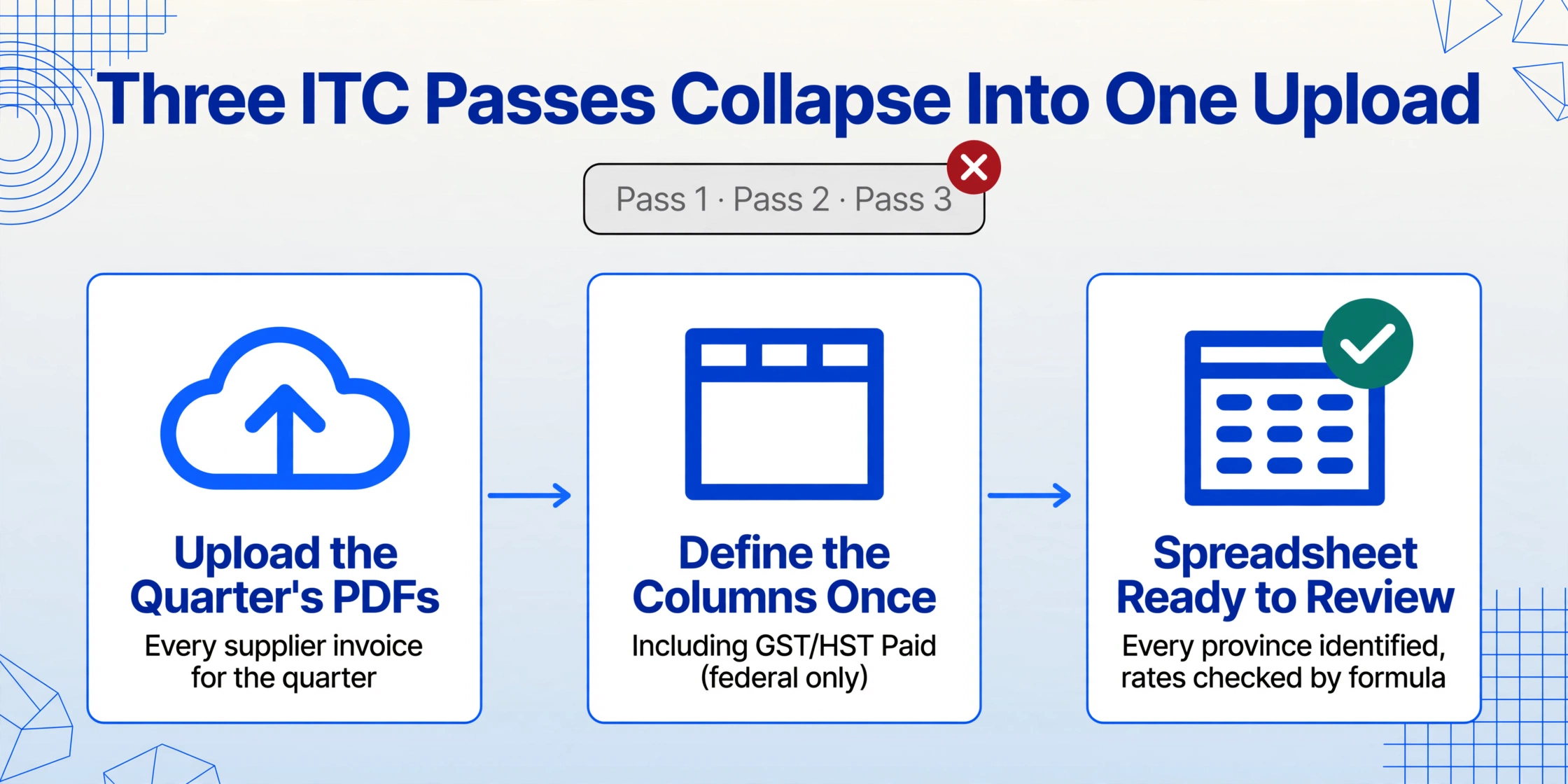
Instead of Pass 1, Pass 2, and Pass 3 through the quarter's purchase folder — completeness check, rate verification, ITC extraction — the workflow becomes a single action: upload the quarter's supplier PDFs, define the output columns once, and receive a spreadsheet with every GST/HST figure already extracted, every province already identified, and every rate ready for verification by formula rather than by eye. The three hours of document reading per quarter become a few minutes of upload and a review pass over the output.
The columns you define are the columns you get. For a Regular Method filer: "Supplier Name," "Invoice Date," "Invoice Total," "GST/HST Paid," "Tax Rate Applied," "Province of Supplier." The AI reads each document by field meaning — it finds the GST/HST line on a Home Depot PDF the same way it reads "GST $12.80" handwritten on a BC plumber's receipt, and it extracts only the TPS (federal) line from a Quebec supplier invoice because the column name — "GST/HST Paid (federal only)" — tells it explicitly to ignore the TVQ.
What changes is not your filing workflow, your accounting software, or your relationship with the CRA. What changes is that the most time-consuming step on the checklist — reading 40 supplier PDFs and typing tax figures into a spreadsheet — no longer exists. The remaining steps — sales reconciliation, net tax calculation, cross-checking, and filing — are the steps that require judgment. They are also the steps that, without the document-reading bottleneck, can be completed in hours instead of days.
Files are processed securely and not stored.
The extraction workflow does not change how the CRA calculates your return or how your accountant reviews it. It changes the one step that was never supposed to be manual in the first place — reading formatted data off a page and retyping it into another page. The quarter-end checklist still runs on the same timeline. The difference is that the items on the checklist that used to consume entire weekends now consume minutes — and the deadline is a date you meet, not a date you race.
FAQ: GST/HST Quarter-End Filing
How do the deadlines differ between monthly, quarterly, and annual filers?
Quarterly filers must file and remit within one month after the end of each reporting period. Monthly filers have the same one-month window — a February return is due March 31. Annual filers have three months after the fiscal year-end — December 31 year-ends must file by March 31 of the following year. Monthly filing is mandatory for businesses with annual taxable supplies above $6 million; quarterly is the default for most businesses; annual is available only for businesses with annual taxable supplies of $1.5 million or less who have elected annual filing. The checklist structure is the same regardless of filing frequency — only the cadence changes. A monthly filer runs the same steps every month, which means the data assembly burden is spread across 12 cycles instead of 4 but the per-cycle window is proportionally tighter.
Can I file my GST/HST return before the quarter-end if my data is ready?
No. The CRA only accepts GST/HST returns for a reporting period after that period has ended. You can prepare the numbers in advance — running the sales reconciliation and ITC extraction as each month closes rather than waiting for quarter-end — but the filing itself must wait until the period is complete. Businesses that close their books monthly and run a running GST/HST ledger are the ones least likely to scramble at quarter-end: the data assembly is already done, the filing is a validation step rather than a data-gathering exercise.
What is the difference between ITCs and ITC adjustments on the GST34-2?
Line 106 is ITCs claimed on current-period purchases. Line 107 is ITC adjustments — corrections to ITC claims from previous reporting periods. The most common adjustment: a supplier invoice from Q1 arrives in Q2 after the Q1 return was already filed, and the GST/HST on that invoice was not claimed in Q1. You claim it as a Line 107 adjustment in Q2 rather than amending the Q1 return. ITC adjustments can also be negative — if a previous period's ITC was overstated, the correction goes on Line 107 as a reduction. The CRA allows ITC claims within four years of the original due date, so adjustments can span multiple years.
I switched from Quick Method to Regular Method mid-year — how does the checklist change?
The switch takes effect at the start of the fiscal year — you do not switch mid-quarter. When the new fiscal year begins, the purchase-side checklist (ITC extraction from supplier invoices) activates immediately. For the first quarter under the Regular Method, you need to extract the GST/HST from every supplier purchase invoice — something you have never done before because the Quick Method did not require it. The volume of supplier invoices has not changed; only the data you need to extract from them has. The extraction workflow — define six columns, upload the folder of supplier PDFs in one batch — is designed for exactly this transition: you go from extracting nothing to extracting everything in one quarter, without adding hours of manual data entry to the bookkeeper's workload.
How do I handle supplier invoices that arrive after the filing deadline?
File the return on time with the data you have. ITCs on late-arriving supplier invoices are claimed as Line 107 adjustments in the next filing period. Do not delay filing to wait for a missing invoice — the late-filing penalty for the entire return will almost certainly exceed the ITC value of the single invoice you are waiting for. The CRA allows ITC claims within four years, so the incentive is always to file on time with what you have and adjust later, rather than file late in hopes of being complete.
Does the extraction workflow handle Quebec supplier invoices where TPS and TVQ appear on separate lines?
Yes — provided the column name is specific. A column named "GST/HST Paid" on a Quebec supplier invoice will extract the TPS (5% federal) amount and ignore the TVQ (9.975% provincial) line because the column name tells the AI to extract the federal component only. If the column is named ambiguously — "Tax Paid" — the AI may combine both, overstating the federal ITC. For Quebec suppliers, the column name is the instruction — and naming precision is the difference between a correct ITC claim and an overstated one the CRA will eventually reverse.
The quarter-end deadline is not a surprise. It arrives every three months, on the same calendar schedule, carrying the same data-assembly requirements. The only variable is how much of the time between quarter-end and the deadline is spent on the task that adds no judgment and no value — reading numbers off PDFs and typing them into another page. The checklist tells you what to verify and when. What you do with the step between "open the supplier PDF" and "the figure is in the spreadsheet" determines whether the checklist is a guide or an indictment.