Can AI Read Veterinary Records?
Yes — But Handwriting Makes It Complex
Yes. Modern vision AI can extract data from veterinary records — including handwritten notes, printed forms, and prescription labels — at significantly higher accuracy than traditional OCR. But veterinary records are among the hardest document types for AI to process, because they combine an unusually high rate of handwriting with specialized medical terminology and almost no format standardization across clinics.
Key Takeaways
- An AI that hits 96.9% sensitivity on electronic vet records drops to 65-80% on the handwritten SOAP notes that most independent clinics actually generate — because OD: mod gingivitis, stage 2 dental dz written in rushed cursive defeats even the best vision models.
- The hardest field on any veterinary record is the prescription — a misread dosage is a patient safety event not a data entry error, and cursive drug names like Clavamox combined with abbreviations like BID x 14d push accuracy below 70% on rushed scripts.
- The real value is not perfect extraction but the shift from 45 minutes of typing per record to 5 minutes of verification — let the AI extract the printed portions and structured tables, and spend your attention on the 10-15% of fields where handwriting crosses the legibility threshold.
What Makes Veterinary Records So Hard to Read
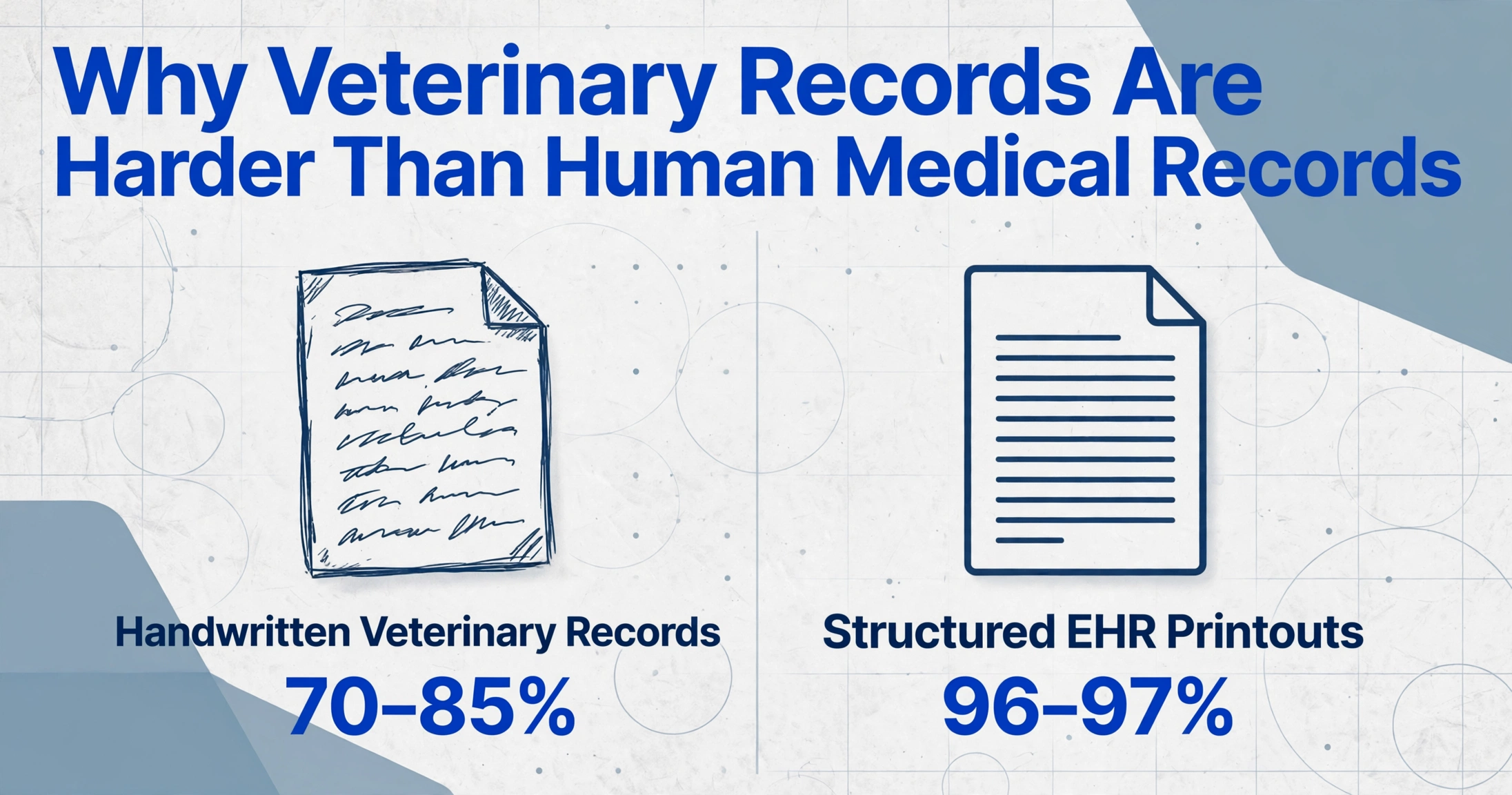
Veterinary medicine lags human healthcare in digitization. Many independent clinics still rely on handwritten SOAP notes, printed lab results taped into folders, and prescription labels scribbled in pen. That creates a unique set of challenges:
- High handwriting rate — Unlike human hospitals where most records are typed into EHRs, many veterinary clinics generate records by hand. The cursive, abbreviations, and occasional illegible scrawl that results is something traditional OCR simply cannot read.
- Non-standardized formats — Every clinic uses its own record layout. One clinic's vaccination page looks completely different from another's — there's no equivalent of human healthcare's HL7 or FHIR standards.
- Medical terminology + abbreviations — Veterinary records mix Latin drug names, species-specific terminology, and clinic-specific shorthand ("FIV/FeLV neg," "dkm: 1/2 tab BID × 10d").
- Variable document quality — Records arrive as photocopies, faxes, low-resolution phone photos, or faded thermal paper. Each degradation type trips up a different part of the extraction pipeline.
This makes veterinary records arguably harder for AI to process than human medical records, which benefit from structured EHR printouts. Yet veterinary clinics process thousands of records daily for healthcare documentation, insurance claims, and referrals — manually taking 15–45 minutes per record.
A Field-by-Field Breakdown: What AI Actually Reads
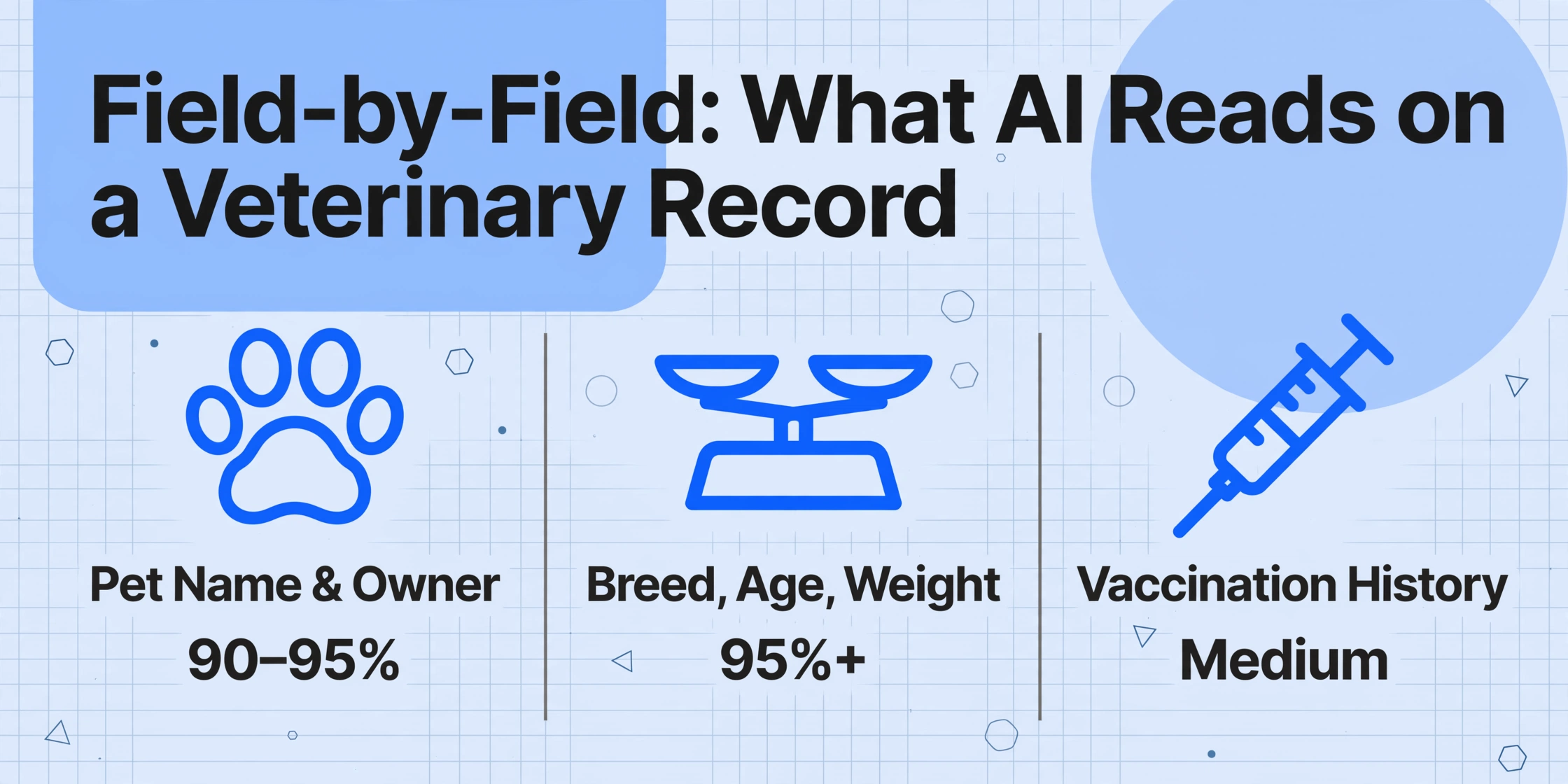
Not all fields on a veterinary record are equally hard. Some are consistently easy for AI; others push the edge of what's possible today. Here's a realistic assessment field by field.
Pet Name and Owner Information
Difficulty: Low to Medium. Pet names are usually handwritten on intake forms, but they're short, often printed clearly, and follow predictable patterns ("Max," "Bella," "Luna"). Owner names and contact details on the same form are similarly extractable. Modern vision-language models (VLMs) handle these comfortably at 90–95% accuracy when the handwriting is legible. Problems arise only when the ink is faint or the name is written in cursive that loops into the next line.
Breed, Age, and Weight
Difficulty: Low. These are among the easiest fields. Breed is often printed on the form header (checkboxes or predefined fields). Age and weight are short numeric values — "3 yr," "14.2 kg" — written in digits that VLMs read with high reliability. Even when handwritten, numbers are more consistent than cursive text. Expect 95%+ accuracy here on reasonable-quality records.
Vaccination History
Difficulty: Medium. Vaccination records come in two flavors: structured tables (date, vaccine name, lot number, next due date) and free-form handwritten notes. The table format is straightforward — AI extracts rows column by column much like it handles any structured table. Handwritten vaccination notes are harder because they mix abbreviations ("DHPP," "FeLV," "rabies"), dates, and lot numbers in unpredictable arrangements. Expect 85–90% on table-formatted records and 70–80% on free-form handwritten entries.
Diagnosis and Clinical Notes
Difficulty: High. A diagnosis note might read: "OD: moderate gingivitis, stage 2 dental dz. Plan: dental prophy under GA, full mouth rads." The mix of abbreviations ("OD" = right eye, "dz" = disease, "GA" = general anesthesia), Latin terms, and species-specific conditions requires domain knowledge — not just character recognition. Research by Wulcan et al. (Frontiers in Veterinary Science, 2025) found GPT-4 Omni achieves 96.9% sensitivity and 97.6% specificity for extracting clinical signs from electronic vet records. But on handwritten diagnostic notes, real-world accuracy drops to an estimated 65–80%, depending heavily on legibility.
Prescription and Dosage Instructions
Difficulty: Highest. Prescriptions combine handwritten drug names ("Clavamox," "Metronidazole"), numeric dosages ("12.5 mg/kg"), and dosing frequencies ("BID × 14d"). A misread dosage is a patient safety risk, not just a data entry error. This field demands the highest accuracy bar. On clear handwriting, expect 80–85% accuracy. On rushed scripts, it can fall to 60–70%.
The honest take: Veterinary record OCR is not a solved problem across the board. For printed or table-formatted content, accuracy is excellent. For heavily handwritten clinical notes and prescriptions, current AI performs best as an assistive tool — it extracts what it can and flags the rest for human review.
Where AI Extraction Excels
Despite the challenges, several parts of veterinary records are handled well by modern vision AI — in some cases better than traditional OCR by a wide margin.
Printed forms and checkboxes. Pre-printed intake forms, consent forms, and vaccination records with printed labels and checkboxes are trivial for AI to read. Checkboxes — ticked, crossed, or circled — are recognized reliably, something traditional OCR never handled well.
Lab results and diagnostic printouts. Blood work and urinalysis results printed from analyzers are clean and structured. The extraction of lab report data follows the same patterns as human medical labs — AI reads analyte names, values, and reference ranges with 95%+ accuracy.
Digital records from practice management systems. Clinics using ezyVet, Vetspire, Avimark, Cornerstone, or similar PMS produce clean digital printouts. AI extraction on these is near-perfect — consistent with the Wulcan et al. finding of 96–97% accuracy on electronic records.
The key insight: the more structured the record, the higher the accuracy. Template-free AI extraction handles unstructured cases better than template-based tools (which would need a separate template per clinic layout), but structure still helps.
Where It Still Struggles
Honesty about limitations builds trust. Here are the scenarios where veterinary record extraction is most likely to falter — and why.
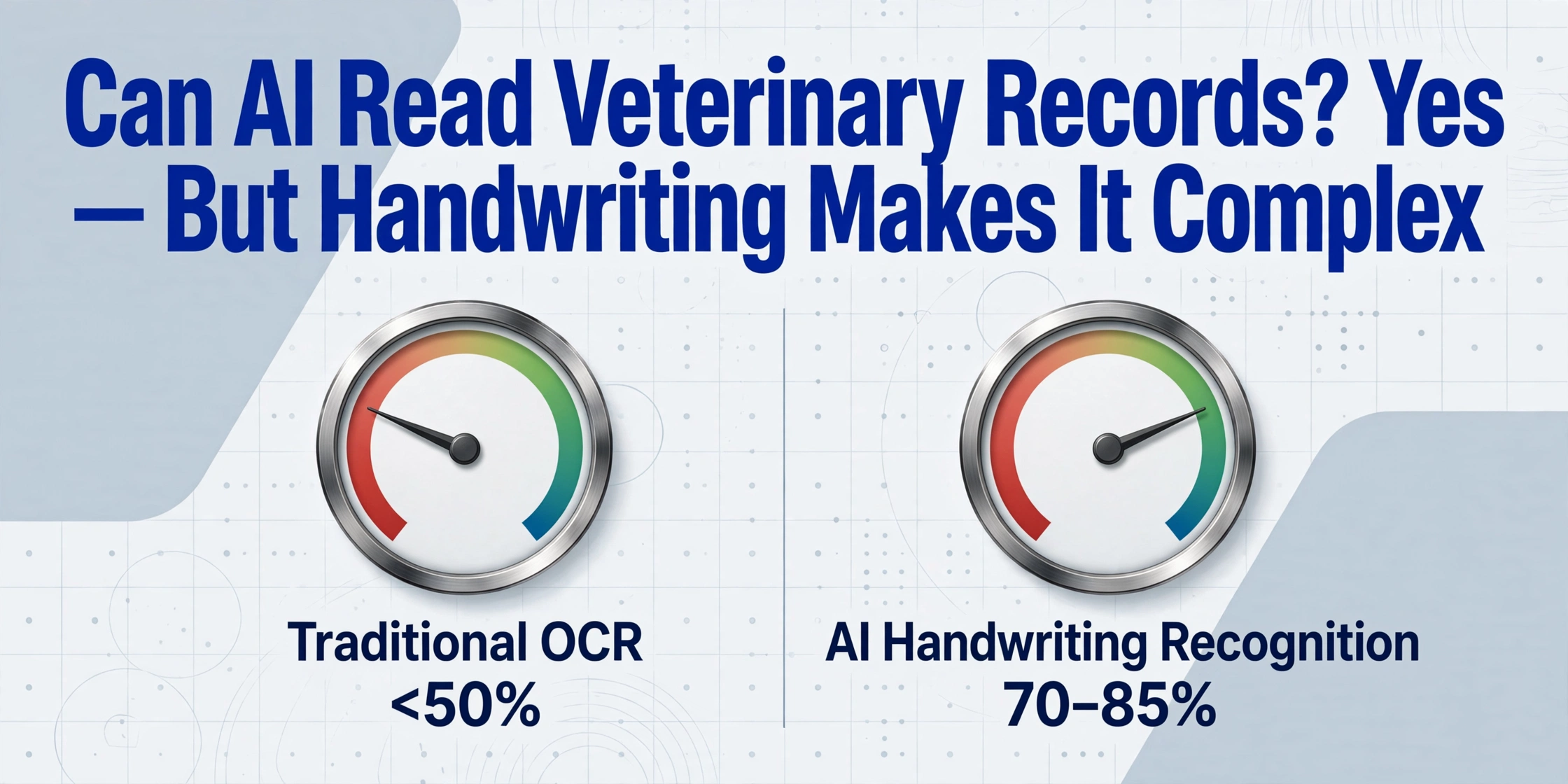
Illegible cursive handwriting. This is the single biggest barrier. A veterinarian's rushed notes — loops without clear letter boundaries, overlapping words — can defeat even the best vision models. Traditional OCR drops below 50% on cursive. Modern VLMs do better (70–85% on moderate cursive), but if a pharmacist can't read the original note, the AI won't either.
Poor quality scans and faxes. Records transmitted between clinics via fax at 150 DPI introduce artifacts that confuse character boundaries. Thermal paper fades over time, turning black text into gray-on-light-gray.
Non-standard abbreviations. Unlike human medicine's standardized ICD-10 and CPT codes, veterinary medicine relies on clinic-specific shorthand. "R/O" (rule out), "DJD" (degenerative joint disease), "HBC" (hit by car) — these are legible as characters but their meaning depends on context a general-purpose AI may not resolve correctly.
How to Get Better Results from Veterinary Record Extraction
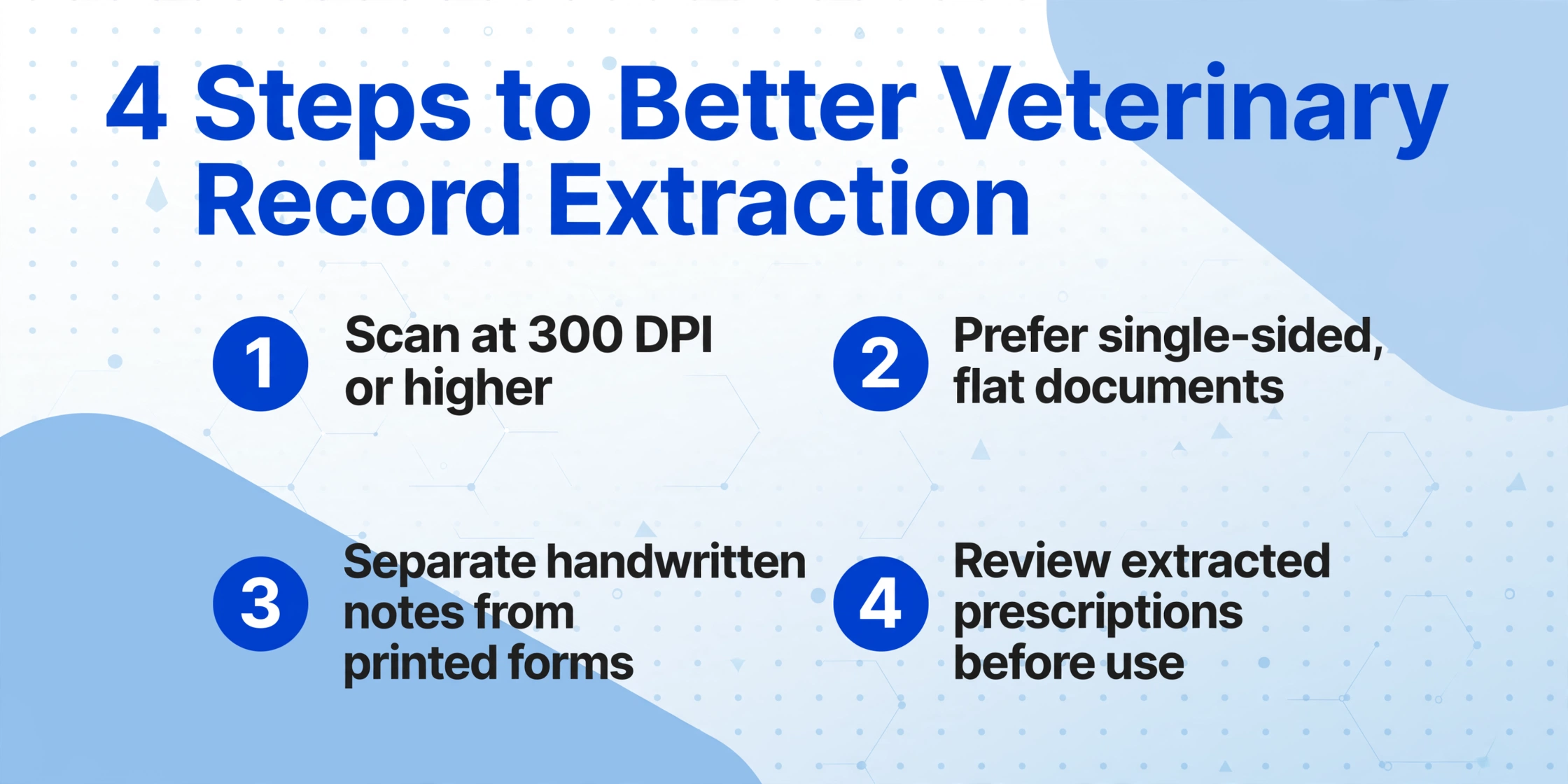
If you're a clinic manager or veterinary professional looking to digitize records, these practical steps will significantly improve AI extraction accuracy:
These steps don't eliminate the need for review, but they shift the balance from "AI needs everything rechecked" to "AI got 85–90% right, I only need to fix the tricky parts." That's the difference between 45 minutes of manual data entry and 5 minutes of verification.
Frequently Asked Questions
Can AI read handwritten veterinary records as accurately as printed ones?
No. Printed text extraction achieves 95–99% accuracy on clean documents. Handwritten content ranges from 70–90% depending on legibility, with cursive medical notes at the lower end and block-letter forms at the higher end. The Wulcan et al. 2025 study showing 96–97% accuracy applies to electronic veterinary health records, not handwritten paper records.
Does the AI need to be trained on veterinary-specific terminology?
No. Modern vision-language models include general medical knowledge from their training data, covering common veterinary drug names, abbreviations (BID, TID, PO, SQ), and species-specific conditions. No additional training or sample collection is needed. Widely used abbreviations will be recognized easily, though clinic-specific shorthand may not be.
Can I extract data from faxed veterinary records?
Partially. Faxes at 200 DPI lose detail for handwriting. Printed text is still readable, but handwritten notes on faxes are significantly harder. Request direct scans or photos when possible.
Is AI extraction of veterinary records compliant with regulations?
Most state veterinary practice acts are format-neutral. The AAVSB's 2025 AI guidance confirms that AI-assisted records follow the same regulations as manually created ones: the veterinarian remains responsible for accuracy, completeness, and proper retention (3–5 years depending on the state). Reviewed and verified AI-extracted data is generally compliant.
How is AI extraction different from AI scribing tools?
AI scribing tools (PawfectNotes, ScribbleVet, VetGeni) listen to the veterinarian-client conversation and generate SOAP notes from audio. AI extraction reads existing documents — handwritten records, printed forms, lab results — and converts them into structured data. A clinic can use both: an AI scribe to generate new records and AI extraction to digitize the paper backlog from previous years.
The Bottom Line
Veterinary records are among the hardest document types for AI extraction. The handwriting, medical terminology, non-standard formats, and variable quality create challenges that simpler documents don't approach. But "hard" doesn't mean "impossible."
Modern vision AI reliably extracts structured and printed portions, handles clear handwriting on forms, and assists with complex clinical notes. The 15–45 minutes per record currently spent on manual data entry can be cut to 5–10 minutes of AI-assisted verification.
The honest boundary: cursive diagnostic notes and complex prescriptions still need human review. But that boundary is shifting as vision models improve. What you can do today: test on your own records. Upload a sample — a printed vaccination record, a handwritten SOAP note, a lab printout — and see where AI extraction works for your clinic's specific documents.