What Is Government PO Data Extraction?
A Federal Contractor's Guide
Government purchase order data extraction is the automated process of reading key fields — including contract number, CLIN/SLIN structure, funding obligation amounts, and socio-economic designation — from federal, state, and municipal purchase orders and outputting them as structured data for contractor fulfillment and compliance tracking. It differs fundamentally from commercial PO extraction because government PO documents operate within the Federal Acquisition Regulation (FAR), carry contract type-specific data elements, and feed directly into compliance workflows that commercial procurement teams never encounter.
What Government PO Extraction Actually Is
Government PO data extraction takes a purchase order document issued by a public sector buyer — federal agency, state government, municipality, or school district — and converts the procurement data it contains into a structured format your team can use. The output is typically a spreadsheet or CSV containing PO number, contract reference, line items with CLIN designations, obligated funding amounts, period of performance dates, and any set-aside or socio-economic designations the PO carries.
The critical difference from commercial PO extraction: a government PO is not just a purchasing document. It is a compliance artifact carrying FAR clauses, funding citations, and contract-specific data elements that determine how you must perform, invoice, and report against the order.
For example, a commercial PO typically contains vendor name, ship-to address, item descriptions, quantities, unit prices, and a total. A government PO contains all of that plus a contract number referencing the underlying award, a CLIN (Contract Line Item Number) or SLIN (Sub-Line Item Number) structure that mirrors the contract's pricing, an obligated funding amount that may differ from the PO total, a NAICS code, and often a socio-economic program designation like SDVOSB or HUBZone that determines eligibility and subcontracting requirements. These extra fields are not optional metadata — they are legally operative data elements written into every federal acquisition.
Why Government PO Extraction Matters for Federal Contractors
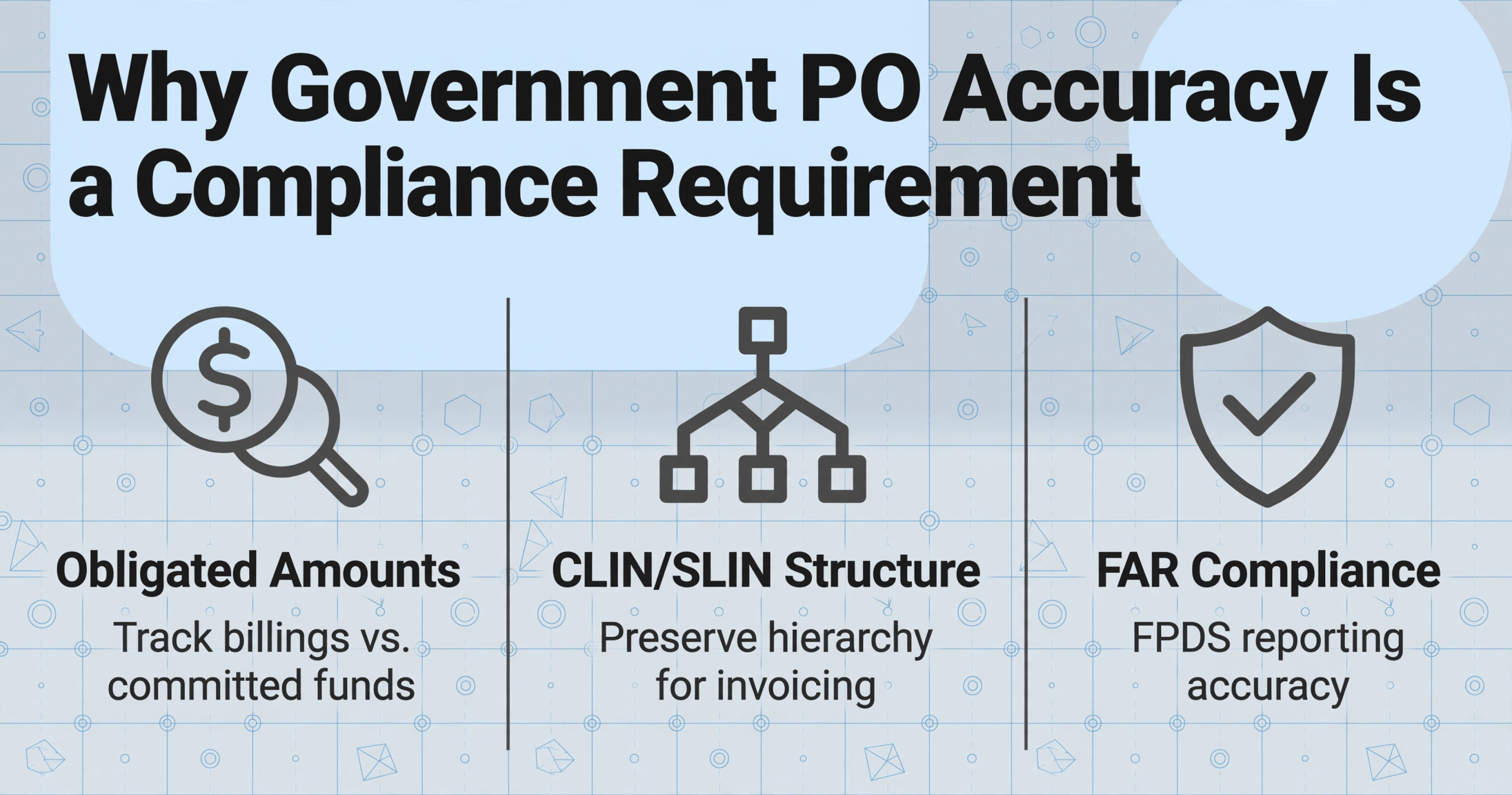
For contractors working with the federal government, PO data accuracy is not just an operational concern — it is a compliance requirement. The FAR Part 4, Subpart 4.6 establishes contract reporting obligations, and the Federal Procurement Data System (FPDS) requires accurate contract action reporting for every award and modification. PO data feeds directly into these reports.
Three aspects of government contracting make PO extraction uniquely important:
1. Funding Tracking Against Obligated Amounts
Every government PO carries an obligated funding amount — the dollar value the government has committed from an appropriation. For contractors, tracking cumulative billings against this obligated amount is essential: exceeding it means billing against unfunded work (a DCAA audit finding), while underbilling leaves money on the table. PO extraction enables automated comparison of obligated amounts against progress invoices, which is far more complex than commercial open-PO tracking because government funding is often incremental (multiple modifications adding or decrementing funds).
2. CLIN/SLIN-Level Performance Tracking
Government POs are structured around Contract Line Item Numbers (CLINs) and their sub-elements. A single PO may reference five CLINs, each with its own unit price, quantity, period of performance, and funding source. Extracting this structure accurately — preserving the CLIN hierarchy rather than flattening it into a generic "line items" table — is critical for progress reporting, invoicing (each invoice line must reference the correct CLIN per FAR 32.905), and contract closeout.
3. Set-Aside Designation Compliance
When a government PO carries a set-aside designation — 8(a), HUBZone, SDVOSB, WOSB, or EDWOSB — the designation comes with compliance obligations. For the prime contractor, it may mean subcontracting plan requirements under FAR Part 19, reporting obligations under the Small Business Subcontracting Program, or limitations on subcontracting percentages. Capturing this designation from the PO ensures it is reflected in the contractor's compliance tracking.
The Government PO Landscape: More Than a Purchase Order
In the commercial world, "purchase order" means one thing: a buyer sends a document with items and prices, the seller accepts it. In government contracting, the term covers multiple procurement instruments that look different, follow different rules, and require different handling during extraction.
| Instrument Type | FAR Authority | When Used | Extraction Nuance |
|---|---|---|---|
| Standalone Purchase Order | FAR Part 13 (Simplified Acquisition) | Single, one-time purchase under the simplified acquisition threshold ($250K for most agencies) | Simplest format; resembles a commercial PO but carries contract number and FAR clauses |
| Delivery Order | FAR Part 16 (IDIQ contracts) | Order for specific supplies/services placed against an existing IDIQ contract | Must reference the base contract number; CLINs often pre-defined in the contract |
| Task Order | FAR Part 16 (IDIQ contracts) | Service-specific order placed against an IDIQ contract | Usually includes a Performance Work Statement (PWS) attachment; extraction must separate the order form from the SOW |
| BPA Call | FAR Part 13 / FAR 8.405-3 | Order placed against a Blanket Purchase Agreement | References the BPA number; often includes delivery-order-level pricing terms negotiated separately from the BPA |
| GSA Schedule Order | FAR Part 8 (MAS Program) | Order placed against a GSA Multiple Award Schedule contract | Includes Schedule-specific contract number and SIN (Special Item Number); may reference GSA Advantage! catalog pricing |
| Modification | FAR Part 43 | Changes to an existing PO: funding add, scope change, option exercise | Not a standalone PO but often received as a document; must be linked to the original order; incremental funding amounts are the critical extraction target |
Each of these instruments has a different document structure. A standalone PO under FAR Part 13 may be a single-page SF1449 form. A delivery order against a large IDIQ contract might run 20 pages including the attached statement of work, with the actual order data embedded on page one. An AI extraction tool that reads the document semantically — understanding what each field represents rather than looking for it at a fixed coordinate — handles this variety naturally. A template-based tool would require a separate parsing configuration for each instrument type.
Key Data Fields in Government PO Extraction
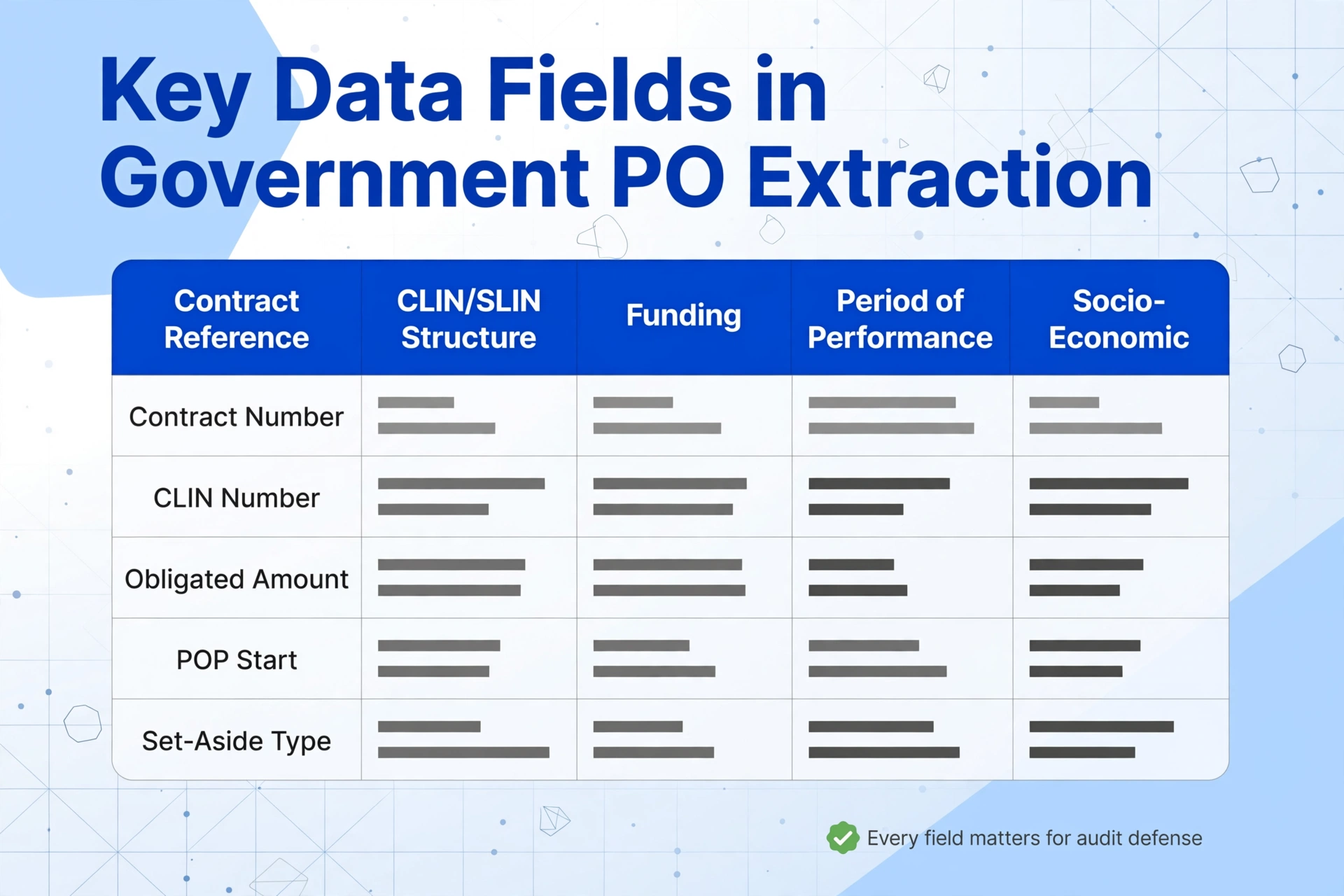
While a commercial PO extraction typically targets 6-8 fields (PO number, vendor, date, item code, description, quantity, unit price, total), government PO extraction needs to capture a broader set of fields that reflect the regulatory framework. These are the fields that matter for compliance, invoicing, and audit defense:
| Field Group | Specific Fields | Why It Matters |
|---|---|---|
| Contract Reference | Contract Number, Order Number, Modification Number, DUNS/CAGE Code | Every invoice must reference these; FPDS reporting requires contract-level accuracy |
| CLIN/SLIN Structure | CLIN Number, CLIN Description, SLIN, Unit Price, Qty, Amount | Invoicing against the wrong CLIN is a FAR 32.905 compliance issue; extraction must preserve the hierarchy |
| Funding | Obligated Amount, Appropriation Number, fiscal year, funding increment | Critical for cumulative billing tracking; DCAA auditors verify billings against obligated amounts |
| Period of Performance | POP Start, POP End, Option Period Indicator | Determines what work is within scope; expiration mismatches trigger billing disputes |
| Socio-Economic Designation | Set-Aside Type (8(a)/SDVOSB/HUBZone/WOSB), Small Business Status | Determines subcontracting compliance requirements and reporting obligations under FAR Part 19 |
| Administrative | NAICS Code, PSC/FSC Code, Place of Performance, Delivery Terms | Used for contract reporting, subcontract plan monitoring, and delivery compliance |
These fields are interrelated in ways that matter for extraction accuracy. For example, the obligated amount on a PO modification is not a "new total" — it is an incremental amount that must be added to the previous total to determine the current ceiling. An extraction tool that treats every PO document in isolation, without understanding that modifications carry incremental funding, will produce data that leads to billing errors.
How Government PO Extraction Works
The operational process for extracting government PO data follows the same general arc as commercial document extraction, but with validation steps specific to public procurement. Here is how it works with a modern AI-powered, template-free tool like ImageToTable.ai:
The key difference between this flow and template-based alternatives: a template tool requires you to pre-configure a parsing template for each PO format — a separate template for GSA Schedule orders, another for BPA calls, another for each agency's SF1449 variant. With semantic extraction, you define columns once and the AI adapts to whatever format each government PO arrives in. For contractors receiving POs from multiple agencies (each using slightly different forms), this eliminates the configuration bottleneck that makes template-based PO extraction impractical.
What to Look For in a Government PO Extraction Tool
Not every document extraction tool is suited for government POs. Commercial OCR tools and template-based parsers were designed for predictable commercial invoices and POs, where format variation is limited and compliance fields like CLIN structure and funding obligation are not required. Here are the specific capabilities a tool needs to handle government PO extraction effectively:
Template-Free Architecture
Government POs arrive in dozens of format variations — SF1449, agency-specific forms, GSA Schedule order forms, IDIQ task order coversheets, modification documents — and no two agencies format them identically. A template-based tool requires a separate configuration for each format, making it impractical for contractors who work with multiple agencies. A template-free tool reads meaning, not position, so the same extraction setup works across all PO variants.
CLIN/SLIN Hierarchy Preservation
Government PO line items are not flat — they exist in a hierarchy of CLINs, SLINs, and sometimes further sub-elements. An extraction tool must preserve this structure, keeping the CLIN number, description, unit price, quantity extended amount, and any SLIN breakdown together in the output. Flattening this hierarchy into a generic "line items" table makes the extracted data unusable for invoicing.
Funding Modification Awareness
PO modifications add or decrement funding incrementally. The tool should capture the change amount, not just present it as a new total. Some contractors handle this as a post-extraction calculation step, but the cleaner approach is an extraction tool that recognizes modification documents and flags the funding delta as a distinct field.
Batch Processing Across Contracts
A prime contractor managing 50 active contracts may receive hundreds of POs and modifications per month. The extraction tool must support batch-first processing — uploading multiple PO documents at once and merging all extracted data into a single structured output. Batch merging by contract number or CLIN group allows teams to see their full procurement pipeline at a glance rather than processing each PO individually.
Spreadsheet-Native Output
Government contract management teams typically work in Excel or Google Sheets for PO tracking, cumulative billing reports, and audit schedules. An extraction tool that outputs directly to these formats — especially via a Google Sheets add-on that appends data without leaving the spreadsheet — eliminates the intermediate export-import step that introduces version control issues.
Common Misconceptions About Government PO Extraction
"A commercial OCR tool can handle government POs — a PO is a PO." This is the most common mistake contractors make. Commercial OCR tools are optimized for predictable layouts and standard commercial fields. They typically cannot distinguish a CLIN from a generic line item number, cannot recognize funding modification increments, and do not preserve the socio-economic designation that determines subcontracting compliance requirements. The field taxonomy of a government PO is fundamentally different from a commercial PO — and the extraction tool must understand that taxonomy.
"Our ERP has a PO import function — we just need the raw text." ERP import functions require structured, normalized data, not raw OCR text. A PO number extracted as "PO-24-1234" on one document and "Order 1234" on another needs normalization. Line items need to be associated with the correct CLIN. Obligated amounts need to be labeled as such, not confused with the PO total. An extraction layer that handles this normalization before the ERP import is essential — most government contractors find that their ERP's native document handling is designed for structured EDI transactions, not the PDF POs that most agencies still send.
"We only need PO number and total amount — the rest we enter manually." For a contractor processing 10 POs per month, this may be viable. For a mid-size prime contractor receiving 100+ POs and modifications monthly across 20+ contracts, partial extraction misses the point: the compliance value of PO extraction comes from having the full structured dataset — CLINs, obligated amounts, funding modifications, period of performance — available for cumulative billing tracking and audit defense. Extracting only two fields eliminates the re-keying of those two fields but does not give you the compliance infrastructure.
Getting Started with Government PO Extraction
If your team is evaluating PO extraction for government contracting, the practical starting point is mapping your current PO pipeline. Which agencies do you receive POs from? What formats do their POs arrive in — standardized forms or custom formats? How many POs and modifications do you process per month currently? The answers determine whether a lightweight template-free approach is sufficient or whether you need an enterprise-level document processing platform. For the broader picture — how document extraction tools are evaluated across the full range of government documents, from FOIA requests to legacy paper archives — see our guide to document extraction for government agencies, which covers the FedRAMP, Section 508, and procurement-cycle dimensions that sit outside a PO-focused evaluation.
For most small to mid-size government contractors processing 20-200 POs per month across multiple agencies, a template-free AI extraction tool like ImageToTable.ai is the right fit. The tool requires no setup per PO format, handles batch processing with merged output, and integrates with the Excel/Sheets environment where most contract teams already manage their PO tracking.
For contractors who already have an ERP with PO import capabilities, the extraction output feeds directly into the import pipeline. The key is not to expect the ERP to extract PO data from PDFs — that is not what ERPs are designed to do. The extraction tool handles the PDF-to-structured-data conversion, and the structured output feeds the ERP. This separation of concerns is the architecture that mature government contractors use.
Frequently Asked Questions
What is the difference between government PO extraction and commercial PO extraction?
Government PO extraction captures additional fields that commercial extraction does not: contract number, CLIN/SLIN structure, obligated funding amounts (which may differ from the PO total), socio-economic set-aside designations, and period of performance dates. It also requires awareness of funding modifications — incremental changes to obligated amounts — which have no equivalent in commercial PO processing. The compliance framework (FAR, DCAA audit requirements, FPDS reporting) means that accuracy requirements are higher and field definitions are standardized by regulation rather than by individual company preference.
Can AI extract CLIN and SLIN data accurately from government POs?
Yes, modern vision AI models can identify and extract CLIN/SLIN structures by understanding the hierarchical relationship between contract line items. The AI recognizes that CLIN 0001 contains sub-elements like unit price, quantity, and total amount, and preserves this relationship in the output. Accuracy depends on the quality of the source document — clearly structured tabular CLIN data on a clean PDF extracts at a high accuracy rate, while handwritten annotations or complex multi-page attachment structures may require manual verification of specific fields.
Does government PO extraction work with GSA Schedule orders and BPAs?
Yes. GSA Schedule orders, BPA calls, delivery orders, and task orders are all variations of government procurement instruments that carry the same core field types (contract reference, CLIN structure, funding information). A template-free extraction tool handles all of these from the same column definition because it reads fields by meaning rather than by position. The only requirement is that the document is a readable PDF, scan, or image — electronic formats like EDI 850 transactions require a different integration approach.
How does PO extraction relate to three-way matching for government contracts?
Three-way matching in government contracting compares the PO (what was ordered and funded), the goods receipt or service acceptance (what was delivered), and the invoice (what was billed). PO extraction provides the reference side of this comparison — the structured data that tells your matching system what was ordered, at what CLIN, for what obligated amount. The matching itself happens in your ERP or matching tool; the extraction layer's job is to deliver clean, structured PO data that can be compared against receipt and invoice data without manual re-entry. Learn more about the fundamentals of PO data extraction and how it differs from three-way matching, and see our guide to government invoice extraction for the invoice side of the same compliance framework.
Is template-free extraction better than template-based for government POs?
For government contractors working with multiple agencies, template-free extraction is generally more practical. Government POs come in many formats — SF1449s, agency-specific order forms, GSA Schedule order forms, IDIQ task order coversheets — and template-based tools require a separate configuration for each. Template-free AI extraction adapts to each format automatically, which means a contractor processing POs from the VA, the Army Corps of Engineers, and GSA can use the same column definition for all three. The trade-off is that template-based tools can be more predictable when all POs come in a single, consistent format and volume is very high.