Why AIA G702 Data Entry Slows Down
Construction Payment Cycles
The construction industry loses an estimated $280 billion each year to slow payment processes, according to Rabbet's 2024 Construction Payment Report. That number has more than doubled since 2020. What makes it especially striking is that the form at the center of most of these payments — the AIA G702 Application and Certificate for Payment — is one of the most standardized documents in American business. Every field has a defined meaning. Every column has a prescribed purpose. The form has barely changed since 1992. Yet the data on the form gets manually retyped three, four, sometimes five times before a single dollar moves. Standardization of format never reached standardization of workflow — and the gap between the two is where the money disappears.
Key Takeaways
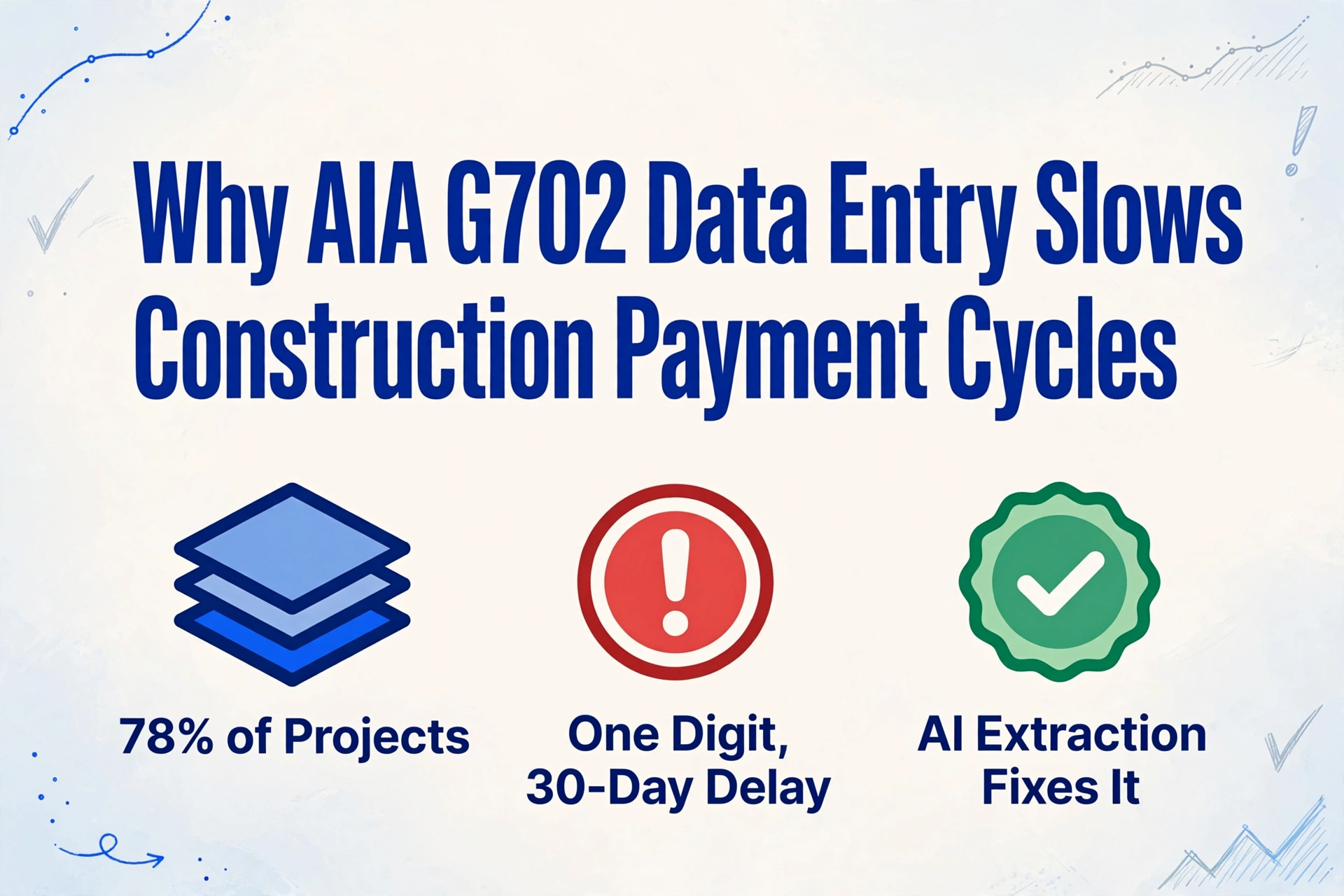
- The most standardized document in American construction — the AIA G702, unchanged since 1992 — triggers the industry's least standardized process: 300 values retyped three to five times by hand, where a single wrong digit resets a 30-day payment cycle.
- Subcontractors wait 56 days for payment while general contractors estimate it at 30 — and 75% pay for materials out of their own cash reserves, covering weekly payroll with money they haven't received yet.
- ImageToTable.ai reads a G702/G703 PDF by understanding what column headers mean — not where they sit on the page — and outputs every line item, scheduled value, and retainage calculation as a spreadsheet, eliminating the manual re-keying that causes both errors and payment delays.
The Forms Are Standard. The Data Entry Isn't.
The AIA G702 and its companion G703 Continuation Sheet appear on 78% of commercial construction projects in the United States. Developed by the American Institute of Architects, these forms provide a rigorous structure for progress billing: the G702 summarizes contract value, approved change orders, previous payments, retainage held, and the current amount due, while the G703 breaks every dollar down into line items organized by a schedule of values. Their purpose is to create a single, verifiable record of what work was done and what payment is owed. In that sense, they succeed — the forms themselves are unambiguous.
What the forms do not standardize is what happens to the data after it lands on the page. The typical payment application workflow on an AIA-billed project follows a well-worn path: a subcontractor fills out the G703, entering the value of work completed this period, materials stored, percentage complete, and cumulative totals for each of 20 to 50 line items. The G702 summary is then populated from those G703 totals. The subcontractor submits the package — typically as a PDF — to the general contractor. The GC's project manager or accountant re-enters those numbers into the company's payment tracking system, whether that's Procore, Sage 300 CRE, Viewpoint Vista, or a shared Excel workbook. If the project owner or architect requires independent review before certification — as most contracts under AIA A201 General Conditions do — the data is transcribed a third time into the owner's system. In some cases, an owner's lender requires a fourth entry into a separate draw request platform.
A single G703 with 30 line items and 10 columns of financial data contains approximately 300 discrete numeric values. At 12 to 15 applications per month across five active projects, a general contractor's project management team handles roughly 4,500 numbers per billing cycle — every one of which must be reviewed for accuracy, and most of which must be manually typed into a different system than the one it arrived in. The form standardizes what the numbers mean, not how they move.
The AIA G702 and G703 solved the problem of presentation standardization decades ago. What they never addressed — and what the industry has been working around ever since — is the data re-entry chain that begins the moment the first version of the form is filled out.
When a Small Data Entry Error Triggers a 30-Day Payment Delay
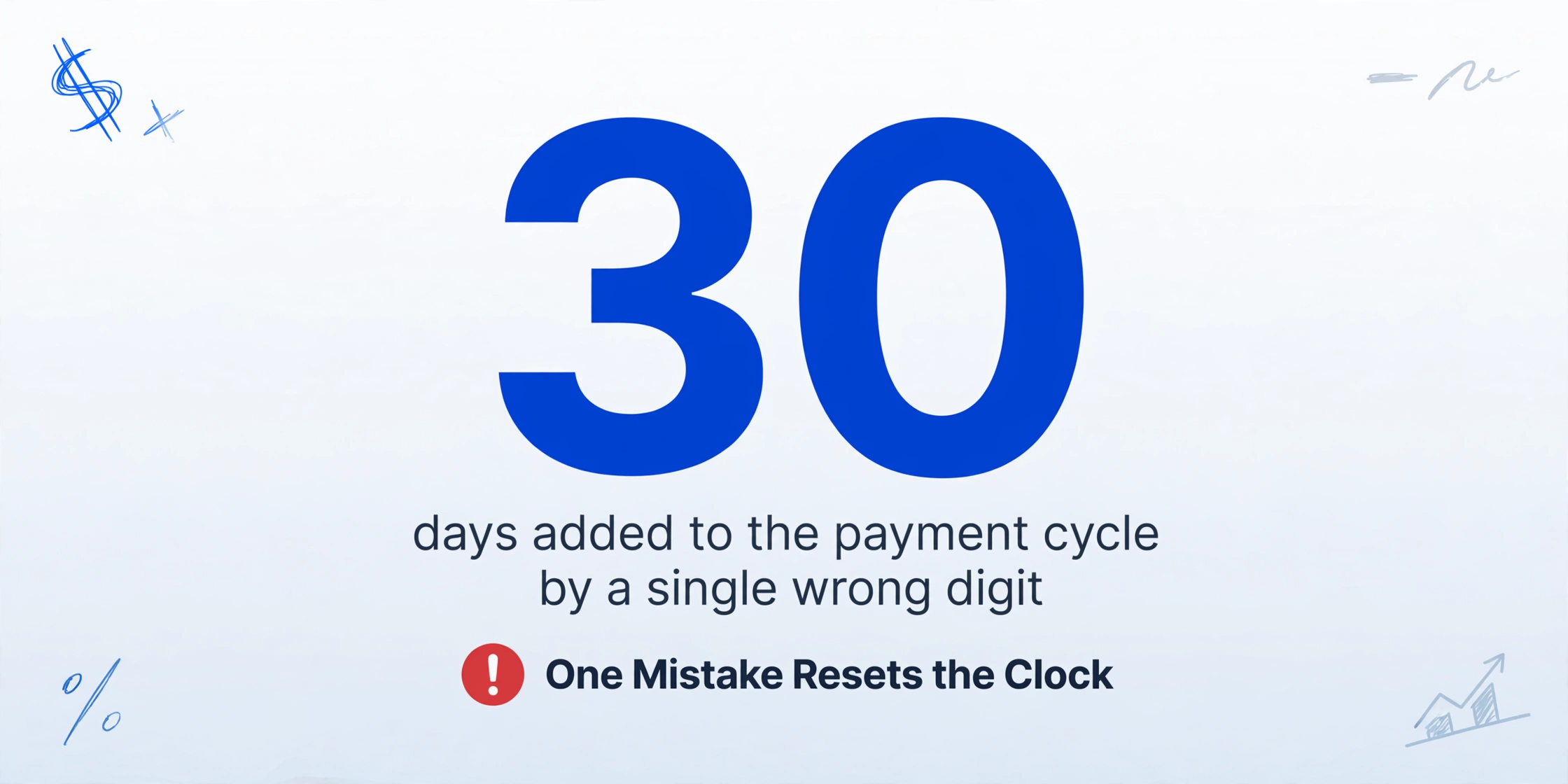
A rejected payment application does not simply get corrected and resubmitted the next day. In most construction contracts, the billing window is fixed — applications are due by a specific date each month, often the 20th or 25th. If an architect or owner rejects a pay application for any reason — a math error, a G702 total that does not match the G703, a retainage rate applied incorrectly — the contractor has to fix the error and resubmit. But by the time the revision is prepared, reviewed, and sent back through the approval chain, the billing window has usually closed. The payment moves to the following month's cycle. A single data entry mistake — one wrong digit in a 300-value spreadsheet — can create a 30-day cash flow gap.
Some errors are even more insidious because they compound across billing periods. The G703 is structured as a cumulative form: line 6 ("Total Completed and Stored to Date") on the G702 must match the grand total on the G703, and each line item's cumulative total in the current period must equal the prior period's cumulative total plus the current period's completed work. If a subcontractor copies last month's G703 to start this month's billing and updates the "this period" column but forgets to carry forward last month's actual approved figures, every line item is now wrong. The architect rejects the entire application — not just the line with the error. The clock resets. And because the error is in the carry-forward, it also means the subcontractor's internal records are out of sync with what the GC has on file, creating a reconciliation problem that persists into the next billing cycle.
This is not a rare edge case. A subcontractor on r/Construction described the monthly arithmetic of staying solvent under exactly these conditions: submit the first pay application on January 15, expect the first payment around March 15 — a 60-day float. During that gap, materials are ordered on net-30 terms, which means 25 days where the subcontractor is financing purchases out of pocket with no incoming payment to cover them. "I've been finding it difficult to stay ahead of cash flow," they wrote, "and we end up getting uncomfortably close to breaking the bank."
A rejected pay application is not a correction event. It is a payment cycle reset. And because rejection is triggered by the very thing the form cannot prevent — data entry errors — the form itself becomes a silent partner in the delay.
The 56-Day Gap That Nobody on the GC Side Sees
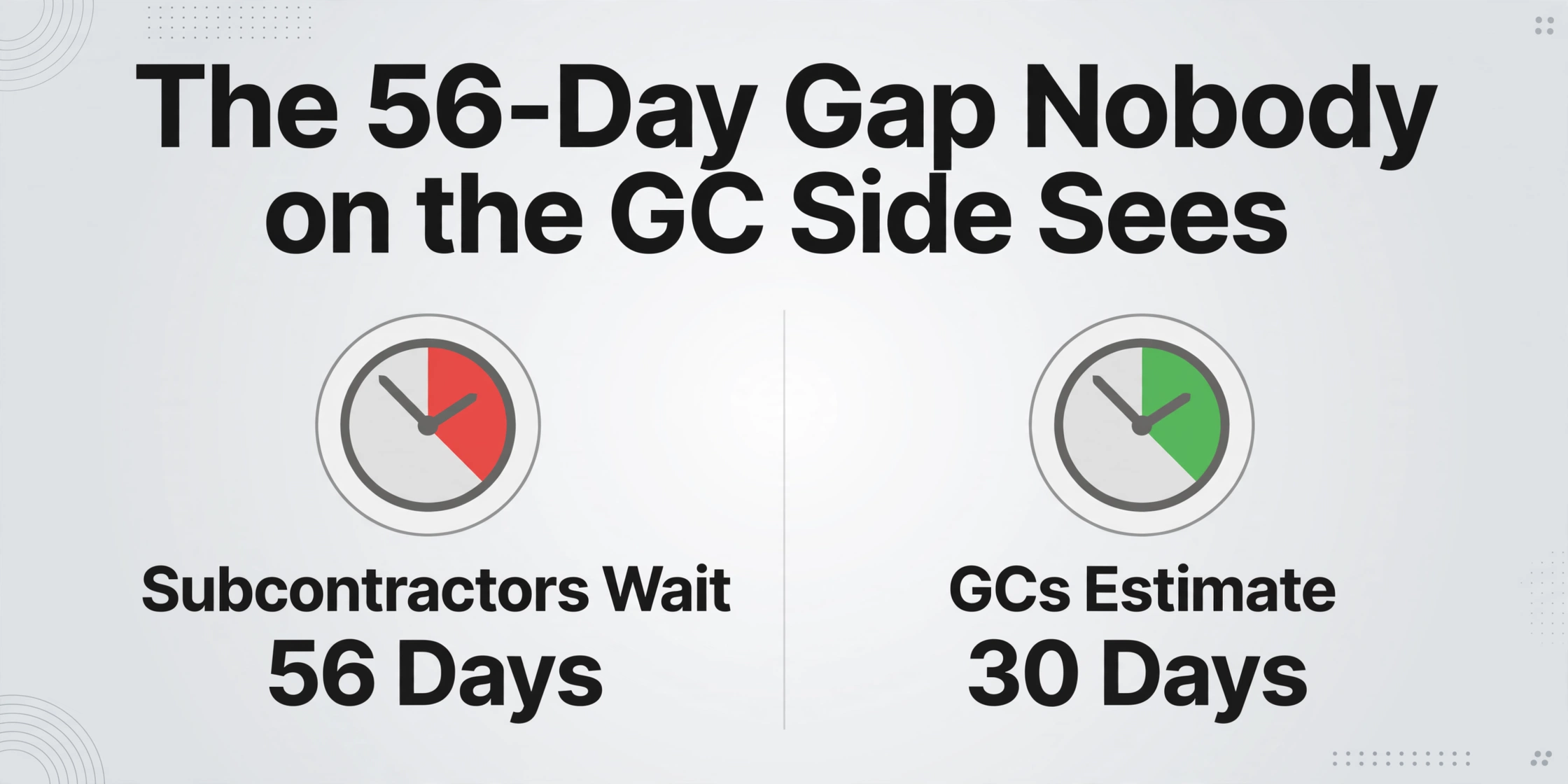
According to Billd's 2025 National Subcontractor Market Report, subcontractors wait an average of 56 days after submitting a payment application before receiving payment. General contractors, when asked the same question, estimate the wait at 30 days. That 26-day perception gap is not trivial — it means the people controlling the payment timeline genuinely do not understand how long the people waiting for payment are actually waiting. The pipeline looks shorter from the top than from the bottom.
The gap widens when you look beyond a single pay cycle. Siteline's State of Subcontractor Billing in 2025 report found that only 5% of subcontractors are consistently paid on time. The remaining 95% wait an average of 96 days — more than three months — from work completion to payment receipt. The Construction Financial Management Association (CFMA) tracks Days Sales Outstanding (DSO) as a core financial health KPI for contractors. CreditPulse's 2025 industry benchmarks place the average construction DSO at 83 days, compared to roughly 60 days across all U.S. industries. Building finishing contractors average 77 days. Engineering and construction firms reach 100 days. For context, the healthy target DSO benchmark cited by construction financial analysts is 45 days — roughly half the industry average.
What connects these numbers back to the data entry problem is the chain reaction built into every billing cycle. Each manual re-entry of a number — from subcontractor's spreadsheet to GC's Procore instance, from GC's system to owner's draw request, from owner's review to lender's verification — introduces a new opportunity for discrepancy. Each discrepancy requires a clarification email. Each clarification email adds a day or two to the review timeline. At the end of the chain, the subcontractor who submitted the original G703 56 days ago has no visibility into which of those re-entries introduced the delay — only that the payment hasn't arrived.
The PYMNTS and American Express 2025 report on construction delayed payments found that 69% of construction companies still make payments using paper checks. Manual payment systems, the report notes, "magnify cash flow challenges across construction projects." Each printed check also carries a remittance stub naming the pay applications it settles, and that stub has to be keyed into the payables ledger before the cash can be applied. General contractors in the same survey cited lender-related delays (38%) and process management issues (27%) as their top two barriers to timely payments — both categories that include the time spent reconciling data across multiple system entries.
Who Actually Pays for All This Delay
It is tempting to frame slow payment cycles as an industry-wide inefficiency — an abstract $280 billion number that belongs to the sector as a whole. But inefficiency in construction payment does not distribute evenly. It concentrates at the bottom of the payment chain. Subcontractors buy materials, pay labor, and carry insurance before receiving a single dollar from the GC. They are, in effect, extending credit to every project they work on — credit they did not choose to extend and cannot price into their bids without becoming uncompetitive.
Billd's 2025 survey quantifies what this looks like in practice: 75% of subcontractors pay for materials out of their own cash reserves while waiting for payment. One in three subcontractors have pulled from personal or retirement savings to cover cash flow gaps created by delayed payments. The share of subcontractors covering material costs out of pocket rose from 66% in 2021 to 73% in 2023, and has remained above 75% since — a trend line pointing in the wrong direction even as the broader economy has stabilized. And 86% of subcontractors cover labor expenses — weekly payroll for crews — while waiting on receivables that are 56 to 96 days out. Subs are essentially functioning as the construction industry's working capital lender, without the interest rate.
State prompt payment laws exist to address this asymmetry. California's Prompt Payment Act requires private project owners to pay prime contractors within 30 days of a proper invoice, with a 2% monthly interest penalty on late payments. As of January 2026, California also capped retainage at 5% on private projects — a recognition that withholding 10% of every progress payment for years represents an enormous drag on subcontractor working capital. Texas, under Chapter 28 of its Property Code, requires owners to pay within 35 days and mandates that contractors pass payment down to subcontractors within 7 days of receipt. Both states allow contractors to suspend work if undisputed amounts go unpaid. But these laws govern payment after a correct application is submitted and approved. They do not address the weeks of latency introduced before the application qualifies as correct — the data entry and verification bottleneck that most contractors experience as "the billing cycle" itself.
The statutory protections kick in at the finish line, not at the starting blocks. And the starting blocks — where a subcontractor sits down with last month's G703, a new spreadsheet, and 300 values to transcribe — are entirely invisible to the law.
The Extraction Layer That the Forms Themselves Missed
When the AIA designed the G702 and G703 in the early 1990s — the 1992 edition remains the most widely used version — the problem the forms needed to solve was consistency. A standard format meant every party on a project spoke the same billing language, reducing disputes about what constituted a proper payment request. The assumption underlying the design was that the forms themselves, once standardized, would be the single authoritative record — filled out once, reviewed once, certified once.
What the designers could not have anticipated was the proliferation of software systems that would each need their own copy of the same data. The G702/G703 form became the presentation layer — the PDF that travels between parties — but every party still needed the data inside that PDF to live in their own system: the subcontractor's QuickBooks or Jonas Premier, the GC's Procore or Viewpoint Vista, the owner's Acumatica Construction Edition, the lender's draw management platform. The standard form standardized the surface, but not the substrate. And bridging the gap between the two — reading the form and putting its data into another system — remained an entirely manual operation.
This is where AI-powered document extraction, rather than another project management platform, becomes the missing piece. Instead of asking every party in the payment chain to adopt the same software — a coordination problem that has resisted solution for three decades — extraction tools insert a lightweight data layer between the form and the system. You specify the column names you want to capture — "Line Item Description," "Scheduled Value," "Work Completed This Period," "Total Completed and Stored to Date," "Retainage Held" — and the tool reads the PDF, locates each value by understanding what the column headers mean rather than where they sit on the page, and outputs a structured table. This approach, called column-name extraction, works differently from template-based OCR: instead of requiring you to draw boxes around each field on every form, you type the field names you need, and the AI finds the corresponding values anywhere in the document based on semantic understanding of the form's layout. The output is a spreadsheet — Excel or CSV — that drops directly into whatever system each party already uses.
The form doesn't change. The submission workflow doesn't change. The subcontractor still fills out the G703 and submits the PDF. The GC still reviews it. What changes is that nobody has to type 300 numbers from one screen into another. The extraction layer reads the PDF and delivers the data as structured columns, eliminating the manual re-keying step that introduces both errors and delay. For a detailed walkthrough of how this works specifically with G702 and G703 forms — including contract sums, retainage calculations, and line-item extraction — see our step-by-step guide to extracting AIA G702 payment application data into spreadsheets. If you're looking to automate document data entry more broadly, our automated data entry page covers how column-name extraction works across document types.
The AIA forms standardize what the data says. An extraction layer standardizes how the data moves. Combining the two turns a payment application from a document that has to be retyped into a data source that can be read — and that is the difference between a 56-day payment cycle and one measured in days, not weeks.
FAQ
Why does a rejected G702/G703 payment application cause such a long delay?
Most construction contracts specify a fixed monthly billing window — applications submitted after the deadline, or resubmitted after rejection, typically wait until the next month's cycle. A rejection caused by a math error or a mismatch between G702 and G703 totals doesn't just require a correction; it effectively resets the 30-to-45-day approval clock. By the time the corrected application is resubmitted, reviewed, certified, and paid, the original work may have been completed 90 days or more prior.
Do general contractors cause these delays intentionally?
Most delays are not intentional — they are procedural. GC project managers and accountants are processing pay applications from multiple subcontractors across multiple projects each month. Each application requires verification: checking that G703 line items sum to the G702 grand total, that carry-forward figures match the previous period, that retainage is applied at the correct rate per the contract, and that supporting documents (lien waivers, change orders, insurance certificates) are complete. The verification itself is necessary. What makes it slow is that the data being verified lives in a PDF while the verification tools live in a spreadsheet — and bridging that gap requires manual entry.
How is document extraction different from construction project management software like Procore?
Procore, Viewpoint Vista, Sage 300 CRE, and similar platforms are full project management ecosystems — they handle estimating, scheduling, document control, field communication, and billing all in one system. Document extraction is a narrower, lighter-weight tool: it reads a PDF (like a G702/G703 package), extracts the structured data, and outputs it as a spreadsheet. It does not replace a PM platform; it sits between the PDF and whatever system you already use, eliminating the manual data re-entry step. This is especially useful when different parties on the same project use different PM platforms — the extraction tool works with the PDF itself, regardless of which system ultimately receives the data.
Do prompt payment laws actually help subcontractors get paid faster?
State prompt payment acts establish statutory deadlines and interest penalties for late payment. California's Prompt Payment Act, for example, requires private project owners to pay within 30 days and imposes 2% monthly interest on late payments. Texas requires 35-day owner payment and 7-day downstream pass-through. These laws provide important recourse after a properly submitted application has been certified. But they do not address the pre-certification latency — the weeks spent correcting data entry errors, reconciling carry-forward discrepancies, and waiting for multiple layers of review. That latency exists outside the scope of prompt payment statutes, in the gap between form submission and form certification.
What is the difference between pay-if-paid and pay-when-paid clauses in construction contracts?
A pay-when-paid clause establishes timing: the GC must pay the subcontractor within a reasonable time after receiving payment from the owner — it governs when payment happens. A pay-if-paid clause goes further, making the GC's receipt of payment from the owner a condition precedent to any obligation to pay the subcontractor — it shifts the risk of owner non-payment entirely onto the subcontractor. States treat pay-if-paid clauses differently: California courts have found them unenforceable because they effectively waive mechanic's lien rights, while Texas allows them if they are explicit and unambiguous. In practice, both clause types extend the subcontractor's payment wait — and both amplify the cost of any data entry error that adds days or weeks to the upstream approval process.
Is this only a problem for large commercial contractors, or does it affect smaller subcontractors too?
Smaller subcontractors are disproportionately affected. Large GCs and specialty contractors with dedicated accounting staff can absorb 56-to-96-day payment cycles through lines of credit, cash reserves, or supplier relationships that allow extended terms. A small subcontractor with three crews, weekly payroll, and no credit line has no such buffer. Data from Billd's 2025 National Subcontractor Market Report shows that 75% of subcontractors pay for materials out of pocket while waiting for payment — and the smaller the firm, the more likely it is to rely on personal savings or retirement funds to bridge the gap. For a subcontractor with $400,000 under contract spread across multiple projects, a single 30-day payment delay caused by a rejected pay application can mean missing payroll.
Can off-the-shelf AI extraction tools handle both the G702 summary and the G703 line items?
The G702 and G703 present different extraction challenges. The G702 is a single-page summary with approximately 10 discrete fields — contract sum, change orders, retainage, previous payments, current amount due. These are relatively straightforward to extract. The G703 is a multi-page continuation sheet with potentially hundreds of line-item rows, each containing values across multiple columns that must maintain row integrity — Column D's value in row 12 must be correctly associated with Column B's line item description in row 12. General-purpose AI extraction tools may handle the G702 fields but lose row alignment on the G703. Tools designed for structured document extraction, like ImageToTable.ai's column-name extraction, preserve row integrity by treating each column as a named field across all rows — so "Work Completed This Period" extracts as a single column with one value per line item. For a complete walkthrough, see our guide on extracting AIA G702/G703 payment application data automatically.