What Is Real Estate Lease
Extraction? Portfolio-Wide Data Without Manual Abstraction
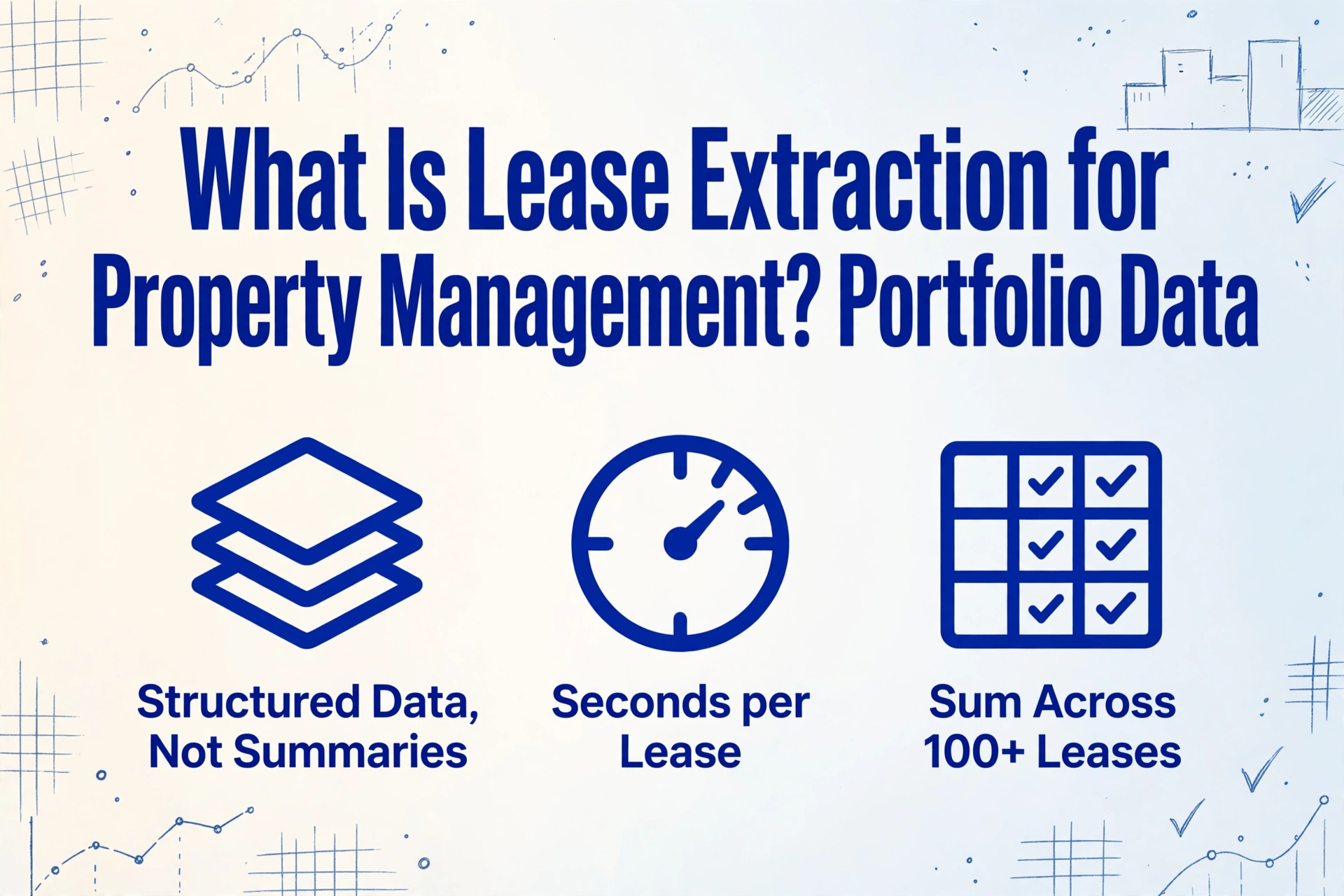
Real estate lease extraction is the automated process of reading key fields — rent amounts, escalation clauses, CAM charges, renewal options, security deposits, lease terms, and tenant or landlord obligations — from PDF, scanned, or photographed lease agreements and outputting them as structured rows in a single spreadsheet. For a property manager or portfolio administrator, this means turning a stack of 100+ leases across multiple properties into a searchable, sortable database where any question — "which leases expire in January?" or "which properties have 3% annual escalations?" — can be answered in seconds instead of hours of file-by-file review.
What Real Estate Lease Extraction Actually Is
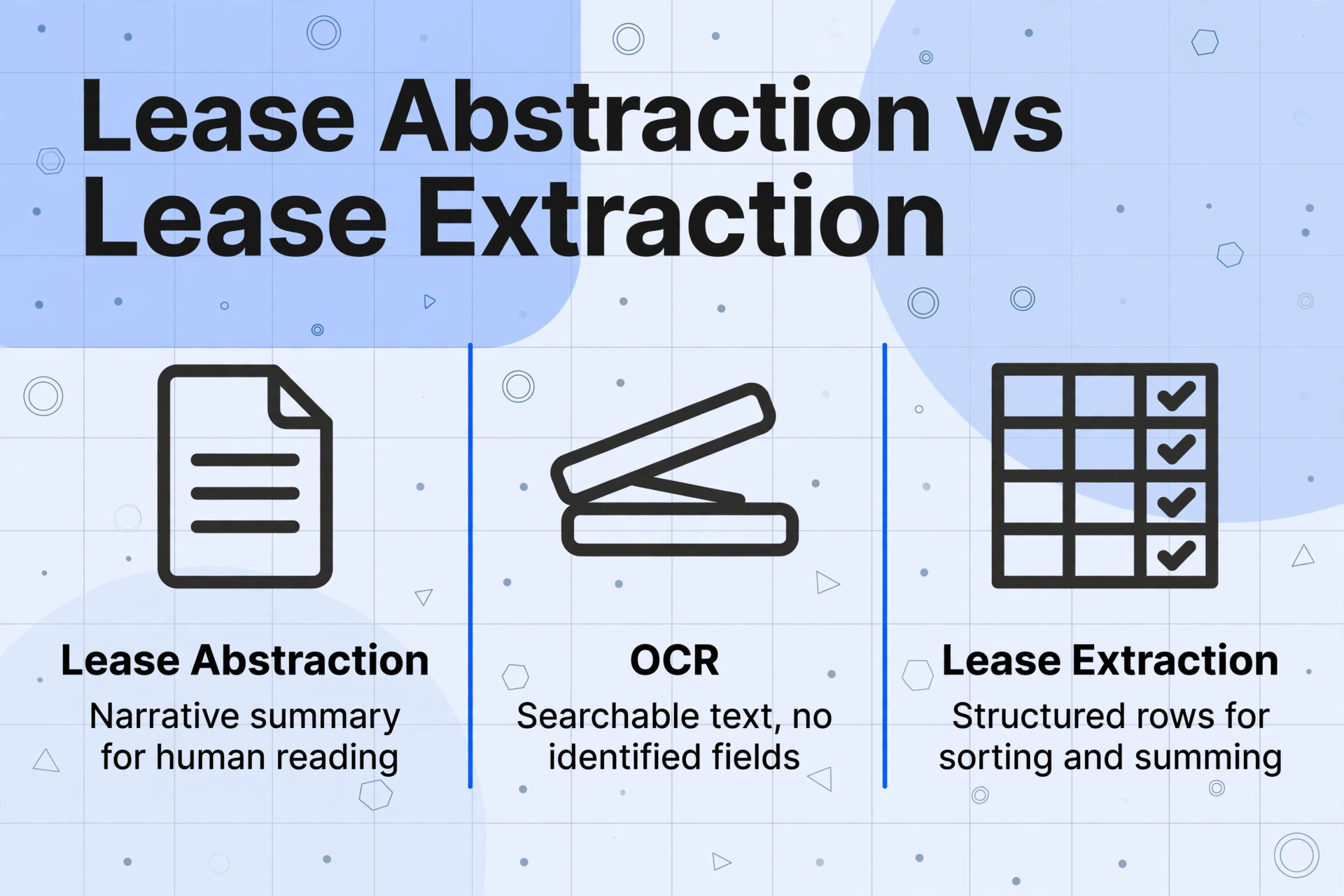
Lease extraction is often conflated with a few related but distinct activities, including general contract data extraction. Knowing the difference matters because what you extract depends on what question you are answering — and the answer changes at portfolio scale.
Lease abstraction is the traditional term used in commercial real estate. It means condensing a lease into a summary document — a "lease abstract" — that a human reads to understand the key terms. The output is a narrative or bullet-point summary. It is typically done by a paralegal or lease administration specialist, takes four to eight hours per lease for a complex document, and produces a file designed for human consumption, not for sorting or filtering.
Lease extraction differs in three ways. First, it outputs structured data — individual fields in individual cells — not paragraphs of text. Second, it operates at machine speed: seconds to minutes per document, not hours. Third, it is designed for aggregation: the output of one lease is a row in a spreadsheet where every column can be sorted, filtered, summed, or compared against every other lease in the portfolio.
Document scanning and OCR are related but insufficient. Scanning a lease gives you a picture of each page. OCR turns the picture into searchable text. Neither produces identified fields — a column called "Monthly Rent" with numerical values that can be summed across 100 leases. Extraction does the identification step: it reads the text, recognizes which value is the rent amount (as opposed to a late fee or a security deposit amount), and places it in the correct column.
The mechanism that makes this possible is semantic extraction — the AI reads the document by understanding what each field means, not where it sits on the page. A rent amount might appear in a table on page 2 of one lease and in a paragraph on page 12 of another. A traditional template-based tool requires you to tell it where to look. Semantic extraction finds the value because it understands what "rent" is, regardless of location.
Portfolio reality check: If you manage 100 leases from 50 property owners, no two lease agreements use the same layout. Title companies, state realtor associations, and individual landlords each produce agreements with different section headings, different table structures, and different page lengths. Template-based extraction breaks on this variability. Semantic extraction does not.
The Fields That Matter When You Extract at Portfolio Scale
Individual fields are straightforward to name. The challenge is knowing which fields carry operational weight when you have 100+ leases simultaneously. The following table organizes lease data into three categories based on how they behave at portfolio scale — which ones you can sum, which ones you need to alert on, and which ones drive renewal decisions.
| Category | Fields | Portfolio Use |
|---|---|---|
| Financial Obligations | Base rent amount, security deposit, late fee structure, prepaid rent, parking fees, utility responsibilities | Sum across all leases for total receivables. Identify outliers — a lease with an unusually low or high deposit relative to rent. |
| Variable & Recurring Charges | Escalation clause (percentage or CPI-linked), CAM charges, property tax pass-through, insurance cost pass-through, common area maintenance caps | Model future income under different escalation scenarios. Flag leases with uncapped CAM — these create expense risk. |
| Term & Options | Lease commencement date, lease expiration date, renewal options (number and term), termination rights, notice period, rent commencement date | Build an expiration calendar sorted by month. Identify leases approaching renewal windows. Flag month-to-month tenancies that require separate tracking. |
| Party & Obligation | Tenant name, landlord/property owner, guarantor, use clause, permitted uses, maintenance obligations, insurance requirements, subletting restrictions | Group by tenant for portfolio exposure analysis. Flag single-tenant concentration risk. Track which tenants carry which maintenance duties. |
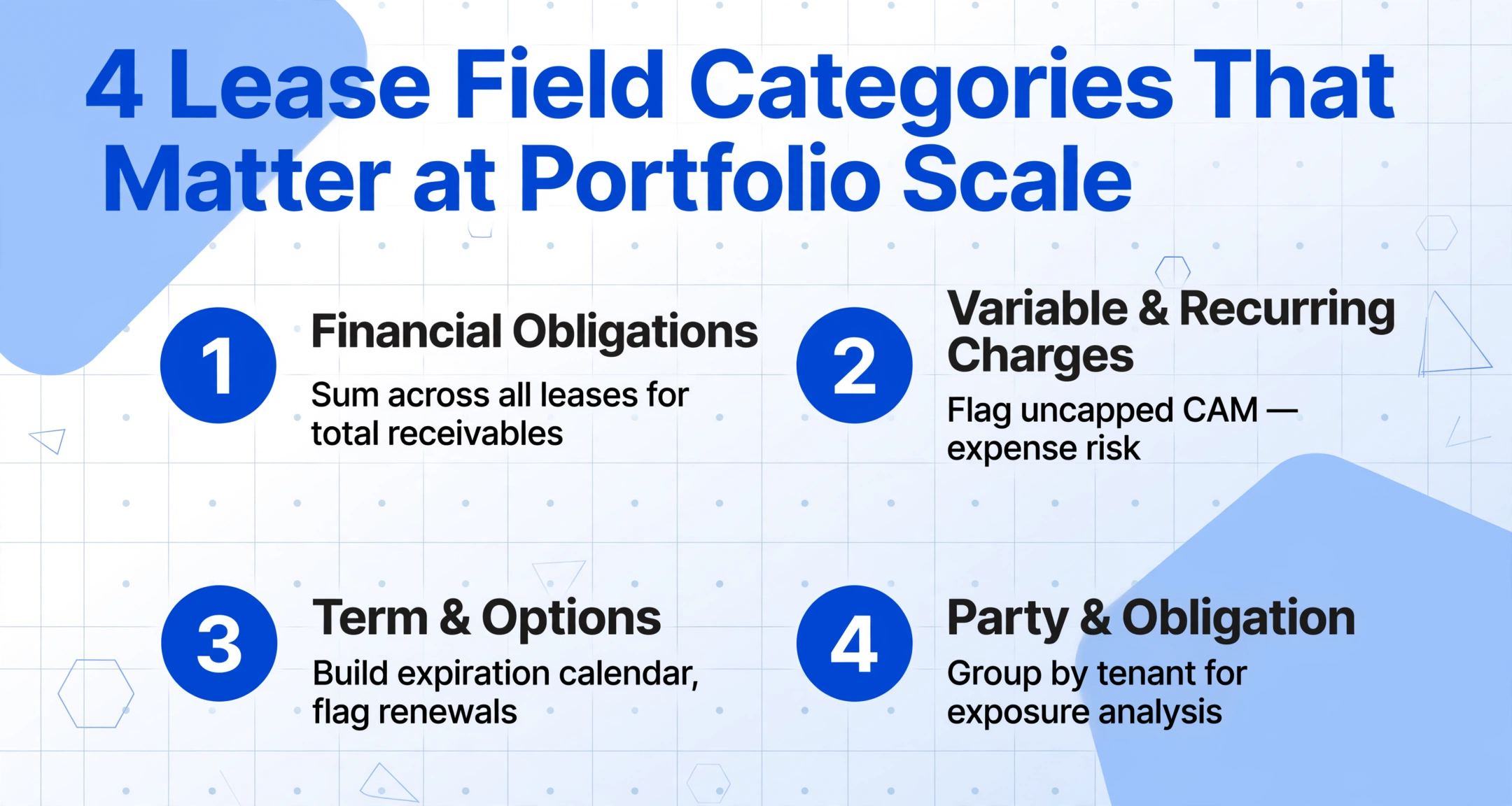
Each category answers a different portfolio question. Financial fields answer "what is coming in." Variable charges answer "how does that change over time." Term fields answer "when does this end." Party fields answer "who is responsible for what." Extraction that captures across all four categories turns a static document collection into an operational dashboard. For legal teams that need clause-level analysis — such as identifying which leases contain uncapped indemnification or unusual assignment restrictions — legal contract extraction extends this approach to the specific provisions that carry litigation risk rather than operational weight.
What Changes When Extraction Covers 100+ Leases
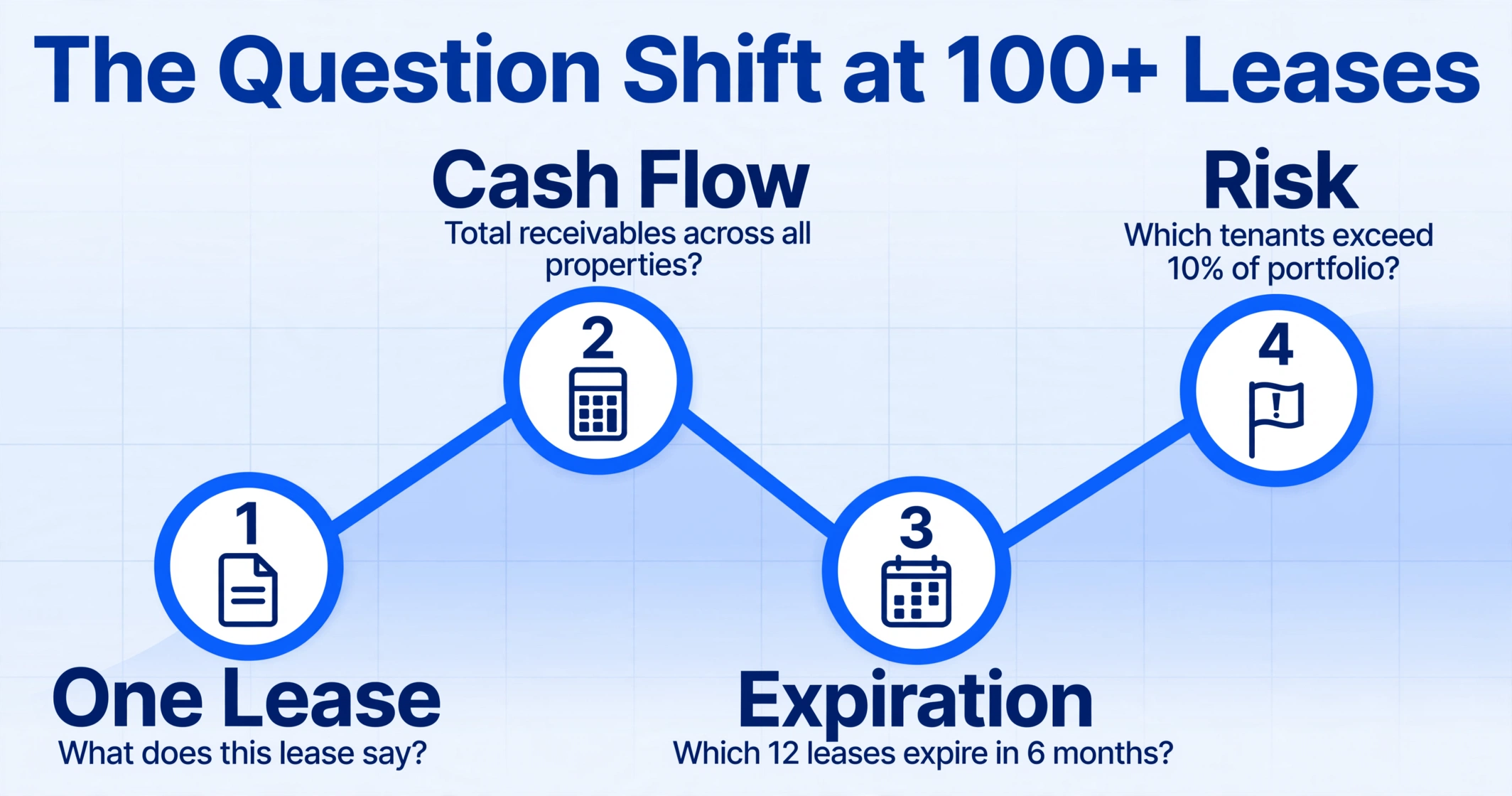
Extracting data from one lease is straightforward — you open the document and read. Extracting from 100 leases simultaneously is a fundamentally different problem. The difference is not the number of documents. It is the number of cross-document questions that become possible once the data is structured and the number of manual errors that become inevitable if it is not.
The question shift
With one lease, the question is: "what does this lease say?" With 100 leases, the questions change entirely:
- Cash flow modeling: What is the total monthly rent receivables across all properties? How does that change if every lease with a 3% annual escalation steps up this quarter?
- Expiration management: Which 12 leases expire in the next six months? Which of those have renewal options, and what is the notice deadline for each? Missing a single notice window on a 50,000-square-foot anchor tenant can create months of vacancy.
- Expense reconciliation: Which leases pass through CAM charges? Is the CAM cap fixed or proportional to the tenant's share? Without extraction, answering this across 100 leases requires opening each PDF and searching for "CAM" — and then manually deciding which mention is the cap versus the current charge.
- Risk concentration: Which tenants occupy more than 10% of the portfolio's total rentable square footage? How many leases are personally guaranteed? A portfolio with high tenant concentration needs different renewal strategies than one with broad diversification.
- Compliance reporting: Under ASC 842, every lease with a term longer than 12 months must be recognized on the balance sheet. The data needed — lease commencement, term length, payment schedule, renewal options that are reasonably certain to be exercised — is exactly the data that structured extraction captures.
The error multiplier
A single data entry error in a lease abstraction — recording $3,250 as $3,520, for example — is a mistake in one field. On a single lease, it gets caught or corrected. When a property manager manually transcribes 100 leases with 15 fields each, the error rate compounds. Studies of manual data entry across repetitive document types consistently show error rates of 1-4% per field entry. At 1,500 field entries (100 leases × 15 fields), a 2% error rate means 30 incorrect values sitting in your portfolio database. The problem is that human-review-based checking of 1,500 fields against 100 source documents takes as long as the original transcription — most teams don't do it.
The leap that extraction enables is not just speed. It is the shift from a filing cabinet you search to a database you query. A property manager with 100 leases in a folder cannot ask "what is my total CAM pass-through exposure?" or "which leases need rent step-ups this month" without opening every file. With extraction, those questions are column filters.
Extraction vs. Traditional Lease Abstraction Services
The lease abstraction industry — firms like LevelShift, Scribcor, and Docugami — built a business around manual and semi-automated abstraction of commercial leases. Their model works for transactions where a single lease abstract feeds into a due diligence package or an investment memo. The abstraction is a service, delivered by people who read the lease and produce a summary. For a side-by-side comparison of extraction tools and abstraction platforms, see our roundup of property management document extraction tools.
Lease extraction by AI takes a different path. Instead of producing a human-readable summary, it produces structured data that a machine can read. The output is not a narrative — it is a spreadsheet row. This matters when the goal is portfolio-wide analysis rather than single-document understanding.
Traditional Abstraction Service
- 4–8 hours per complex lease
- $100–$4,000 per lease depending on complexity
- Output: narrative abstract document
- Best for: due diligence, single-lease review, legal context
- Scaling limitation: linear with leases — 100 leases = 100 units of time and cost
AI Lease Extraction
- Seconds to minutes per lease
- No per-lease service cost (tool subscription)
- Output: structured spreadsheet rows
- Best for: portfolio management, expiration tracking, financial modeling
- Scaling advantage: 100 leases extracted in one batch pass
Each approach has its place. A law firm preparing a lease opinion for a single 50,000-square-foot office lease may prefer a manual abstract that captures legal nuance a general-purpose AI might miss. A property manager tracking rent rolls and expirations across 200 residential units needs structured extraction — not a stack of narrative summaries that must be manually re-read to find the data buried inside.
When Extraction Becomes a Compliance Necessity
ASC 842 and IFRS 16, both effective since 2019, changed lease data from an operational convenience to a reporting requirement. Under these standards, lessees must recognize right-of-use assets and lease liabilities on the balance sheet for all leases with terms longer than 12 months. The data required for compliance is exactly the data that lease extraction produces: lease commencement date, lease term length, renewal options that are reasonably certain to be exercised, payment schedules, and escalation terms.
A 2024 Deloitte survey found that 62% of companies ranked extracting data from contracts as one of their top compliance challenges under the new lease accounting standards. The difficulty is not that companies lack the documents — it is that the data is locked inside PDFs that no one has the time to open and transcribe one by one. Extraction solves this by pulling the compliance-relevant fields into a spreadsheet that feeds directly into lease accounting calculations.
Source: Deloitte, "ASC 842 Readiness Survey," 2024. Available at deloitte.com.
Frequently Asked Questions
What is the difference between lease extraction and lease abstraction?
Lease abstraction produces a narrative summary — a document a human reads. Lease extraction produces structured spreadsheet data — fields in cells that can be sorted, filtered, and summed. Abstraction is review-oriented; extraction is analysis-oriented.
Does lease extraction work with residential leases or only commercial?
It works with both. Residential leases (multi-family rental agreements, tenant leases) tend to be shorter and more standardized — they share fields like rent, deposit, lease term, and pet/addendum clauses across most properties. Commercial leases are longer and more varied, with fields like CAM charges, escalation formulas, and use clauses that differ per tenant. AI extraction handles both formats because it reads by meaning, not by template.
Can extraction capture non-financial terms like maintenance obligations or subletting restrictions?
Yes, but these require specific column names in the extraction setup. The AI reads the document and locates the relevant clause text or a summary judgment. For example, a column named "Maintenance Responsibility" with the rule "who is responsible for HVAC, roof, and common area maintenance" will return the relevant party from each lease. The same approach works for use clauses, guarantor information, subletting restrictions, and insurance requirements.
What if my lease documents are scanned PDFs or photos — not digital originals?
Extraction works from images, too. Modern vision AI reads the document the same way regardless of whether it originated as a digital PDF, a scan of a signed paper copy, or a smartphone photograph of the signature page. There is no requirement for machine-readable text — the AI processes the visual page content. The only limitation is image quality: very low resolution or extreme glare can reduce accuracy.
How many leases do I need before extraction makes sense?
There is no minimum, but the ROI changes at different scales. For fewer than 10 leases, manual entry in a spreadsheet may be faster than any setup process. At 20–50 leases, the time saved on a single expiration or escalation analysis often justifies extraction. At 100+ leases, extraction becomes a structural necessity — the manual approach simply cannot answer portfolio-level questions without prohibitive effort.
Does lease extraction require software that integrates with Yardi, AppFolio, or Buildium?
Many property management systems accept import via CSV or direct spreadsheet upload. Extraction tools that output to Excel or Google Sheets produce files that can be imported into most platforms. ImageToTable.ai also offers a Google Sheets add-on that writes extraction results directly into the active sheet — no intermediate export step needed.
What extraction accuracy can I expect with lease documents?
Printed lease terms — rent amounts, dates, party names, clause text — typically extract at 95-99% accuracy from good-quality scans or digital PDFs. Handwritten amendments, strike-through edits, or very poor-quality photocopies reduce accuracy. For compliance-critical fields, a review pass against the 3-5% of fields flagged at lower confidence is a standard practice. ImageToTable.ai processes each document in 5-10 seconds, and a person can review an entire portfolio's extracted data in less time than it would take to open a single lease PDF.