Self-Service Document AI vs Managed IDP:
A Decision Framework
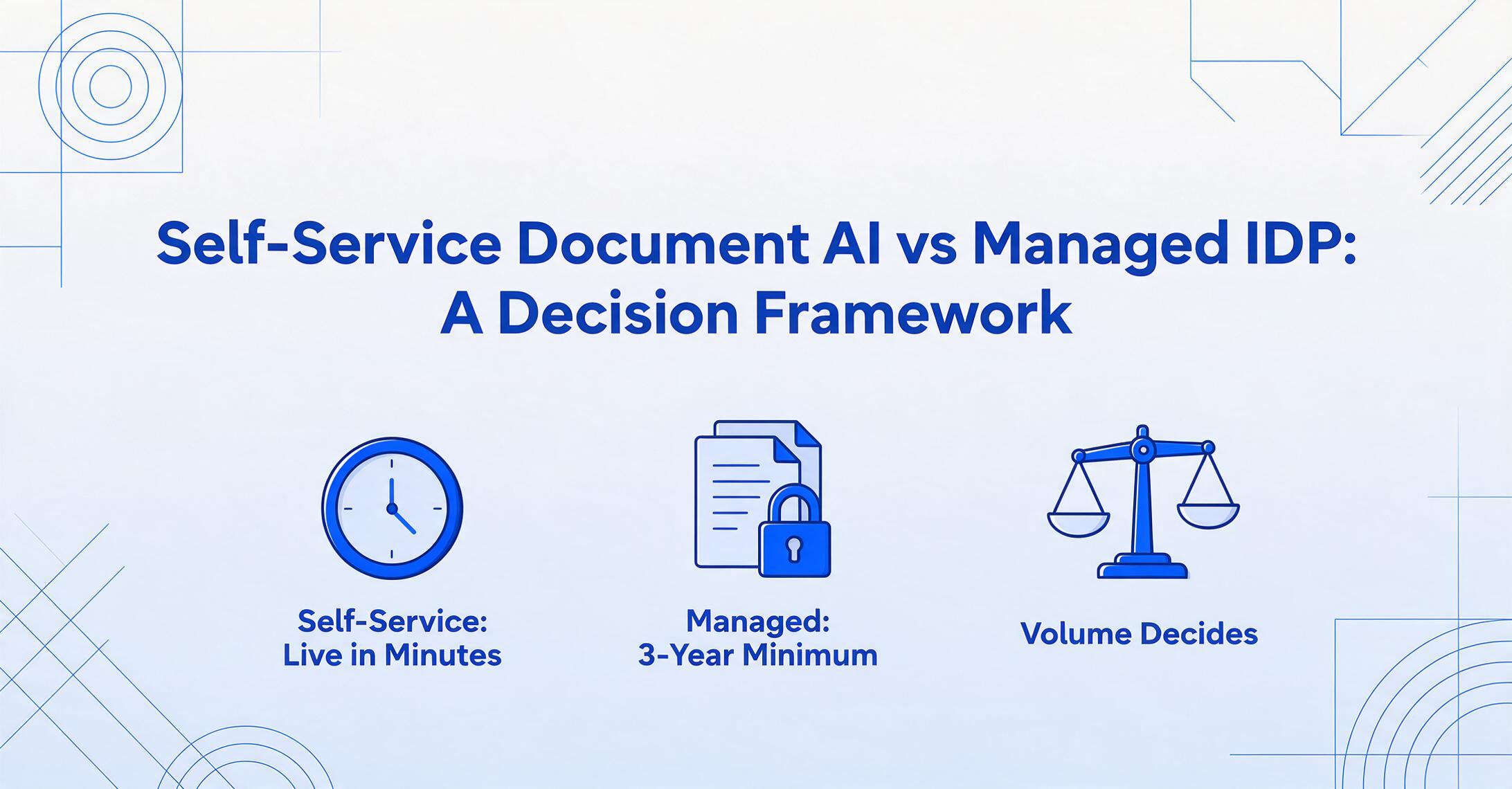
The global intelligent document processing market hit $2.3 billion in 2024 and is growing at nearly 25% per year, according to Global Market Insights. But "IDP" isn't one product category — it's two fundamentally different delivery models sold under the same label. One asks you to sign up and start extracting data this afternoon. The other asks you to sign a contract, wait through an implementation cycle, and start extracting data in three to six months. Choosing the wrong model doesn't just waste budget — it misaligns your team's capabilities with the vendor's expectations, and the mismatch compounds over time.
Key Takeaways
- $25,000 vs $240 — the first-year cost gap between managed IDP (vendor-operated document extraction) and self-service document AI isn't a quality difference, it's two fundamentally different delivery models sold under the same label.
- 66% of new IDP projects replace an existing system, and the most common mistake wasn't picking the wrong vendor — it was committing to a delivery model before knowing actual document volume and complexity.
- ImageToTable.ai processes your first document in minutes with zero setup, giving you real accuracy data that turns any future managed platform evaluation from guesswork into a benchmark.
Two Delivery Models, One Outcome — But Very Different Paths
Both self-service document AI and managed IDP solve the same problem: turning unstructured documents — invoices, receipts, contracts, bank statements — into structured, queryable data. The difference is in how the technology reaches your team and who operates it once it's running.
Self-service document AI is SaaS you configure yourself. You sign up, upload a document, define the fields you want extracted, and get results — typically within minutes of creating an account. No implementation partner. No training data labeling. No multi-month onboarding. You pay monthly, scale usage up or down, and cancel when you want.
Managed IDP is a vendor-operated engagement. The vendor's team (or their implementation partner) analyzes your document portfolio, configures extraction models, labels training data, builds integrations into your ERP or accounting system, and hands you a production-ready pipeline. The implementation takes weeks to months. You sign an annual or multi-year contract, and the vendor maintains the system.
These aren't quality tiers — one isn't "better" than the other. They're different delivery models designed for different organizational contexts. The question isn't which is superior. The question is which one matches your document volume, budget, timeline, integration needs, and team capacity. If you're still establishing what intelligent document processing actually involves, start there — this article assumes you already know you need it and are deciding how to acquire it.
What Managed IDP Actually Costs
Managed IDP pricing is rarely published. Vendors gate it behind sales conversations because the total cost depends heavily on document volume, document types, integration complexity, and contract length. But enough data exists from procurement analysis platforms and customer reports to build a realistic picture.
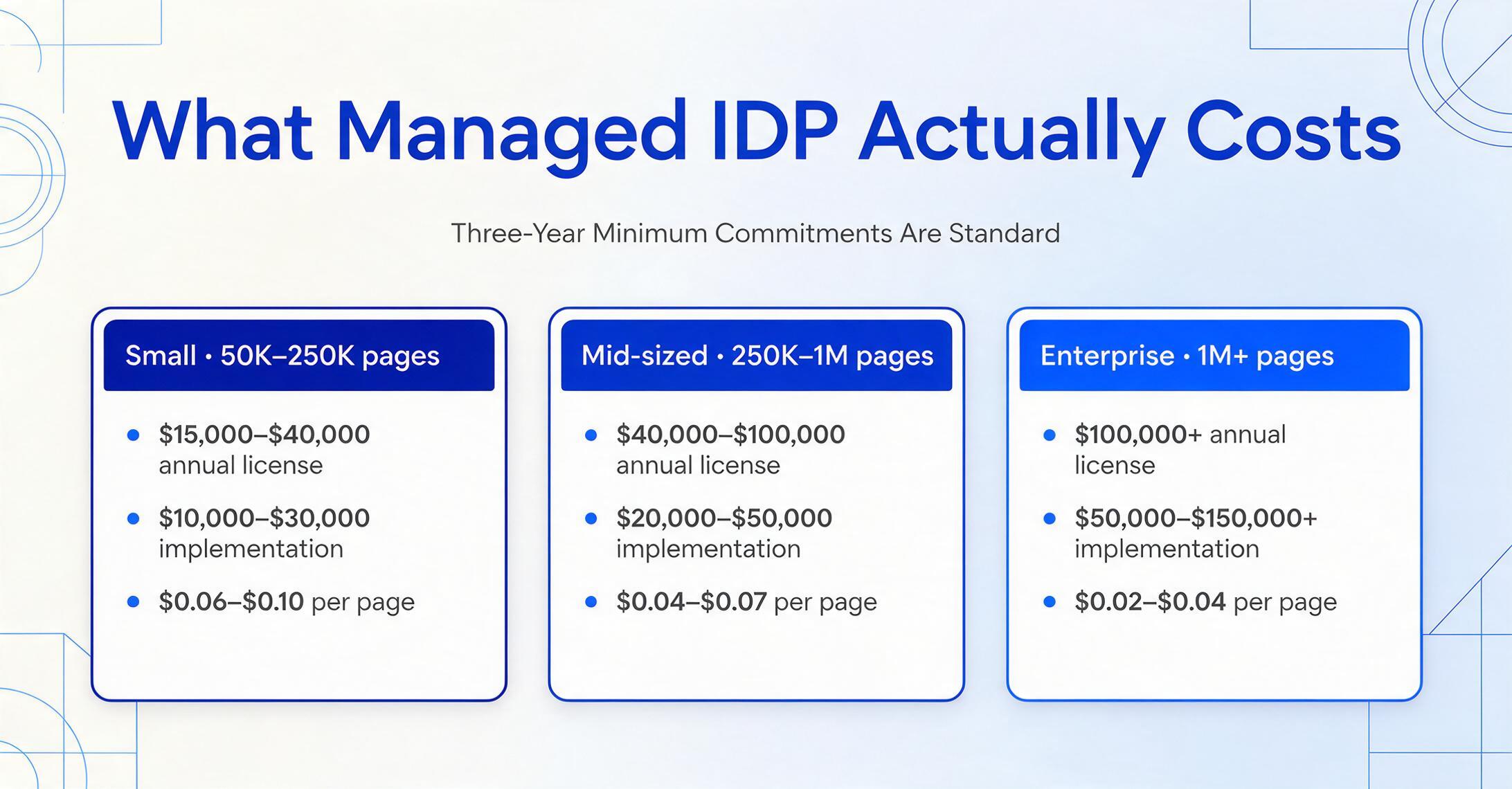
ABBYY Vantage, one of the most established managed IDP platforms — named a Leader in both the 2025 Gartner Magic Quadrant for IDP and the Everest Group PEAK Matrix 2025 — illustrates the cost structure. Per-page pricing ranges from $0.02 to $0.10 depending on volume. Professional services for implementation add $10,000 to $30,000 for small deployments, and $20,000 to $150,000 or more for complex, multi-use-case projects, according to pricing analysis by Vendr. Three-year minimum commitments are standard.
| Deployment Scale | Annual Pages | Annual License | Implementation (Year 1) | Per-Page Rate |
|---|---|---|---|---|
| Small | 50K–250K | $15,000–$40,000 | $10,000–$30,000 | $0.06–$0.10 |
| Mid-sized | 250K–1M | $40,000–$100,000 | $20,000–$50,000 | $0.04–$0.07 |
| Enterprise | 1M+ | $100,000+ | $50,000–$150,000+ | $0.02–$0.04 |
Source: Vendr pricing analysis for ABBYY Vantage. Other managed IDP vendors (Hyperscience, Tungsten, WorkFusion) follow similar structures.
Implementation timelines compound the cost picture. Standard accounts payable workflows can be put into production on modern managed IDP platforms in 4 to 8 weeks. Complex migrations with multiple document types, custom approval workflows, and deep ERP integration require 2 to 4 months. Enterprise-wide rollouts — the kind that touch invoices, contracts, HR documents, and compliance paperwork across multiple business units — can stretch to 6 months before the first production document is processed.
None of this is inherently unreasonable. If you're processing a million pages a year through SAP, and each extraction error triggers a reconciliation cascade, a $100,000 managed implementation that achieves 99.5% accuracy is a good investment. The cost only becomes a problem when the scale doesn't justify it — and that's where most mid-market teams find themselves.
What Self-Service Document AI Actually Delivers
Self-service document AI flips every variable in the managed IDP cost table. No implementation fee. No annual contract. No minimum commitment measured in years. You pay monthly, and you configure extraction yourself through a web interface rather than through a vendor's professional services team.
The onboarding experience is the core differentiator. With a self-service tool, you sign up, upload a document, and see extracted data — not a sales demo, not a proof of concept scheduled for next quarter, but your actual document processed against your actual fields. A developer who built a document extraction platform reported on Reddit that moving from template-based OCR to AI-driven extraction cut new vendor onboarding from roughly 4 hours of template building per vendor to zero — the model handles layout variation out of the box.
This is where no-code vs API-driven extraction matters. Self-service tools tend to be no-code by design: you type field names, upload files, and download results. Managed IDP platforms tend to be API-integrated: they pipe extracted data directly into your ERP, which is powerful but requires engineering work to set up. The delivery model and the interface model are correlated, though not identical.
What are the boundaries? Self-service tools are designed for standard document types with standard accuracy requirements. They work well for invoices, receipts, purchase orders, bank statements, and similar semi-structured documents where 95–99% accuracy is acceptable and output goes into a spreadsheet or a lightweight integration. They may not be the right fit if you need 99.5%+ accuracy on complex multi-page contracts, or if extraction results must trigger automated decisions inside an ERP with no human review step.
Files are processed securely and not stored.
Side-by-Side: Self-Service vs Managed on Eight Dimensions
The following comparison isn't a scorecard — neither model "wins" across all dimensions. The right model depends on where your organization falls on each criterion. If you're still building your evaluation framework for document extraction software, this table is the starting point.
| Dimension | Self-Service Document AI | Managed IDP |
|---|---|---|
| Time to first extraction | Minutes (sign up → upload → results) | 4–24 weeks (scoping → implementation → production) |
| First-year cost (small scale) | $240–$1,200 ($20–$100/month) | $25,000–$70,000 (license + implementation) |
| Contract commitment | Monthly, cancel anytime | 1–3 year annual commitment |
| Configuration owner | Your team (no-code interface) | Vendor's professional services team |
| Accuracy ceiling | 95–99% on standard document types | 99–99.5%+ with custom-trained models |
| ERP/system integration | Export to Excel/CSV/JSON; some API access | Direct pipeline into SAP, Oracle, NetSuite |
| Document type flexibility | Handles new layouts without retraining | Requires new "skills" or model training per type |
| Ideal volume range | 100–50,000 pages/month | 50,000–1,000,000+ pages/month |
The volume overlap zone — roughly 20,000 to 80,000 pages per month — is where the decision gets genuinely difficult. At this scale, self-service tools work but start to feel manual at the edges (exporting to Excel, then importing into your system). Managed IDP works but may be oversized for the actual complexity. This is exactly the zone where the decision criteria below matter most.
Five Criteria That Determine Your Delivery Model
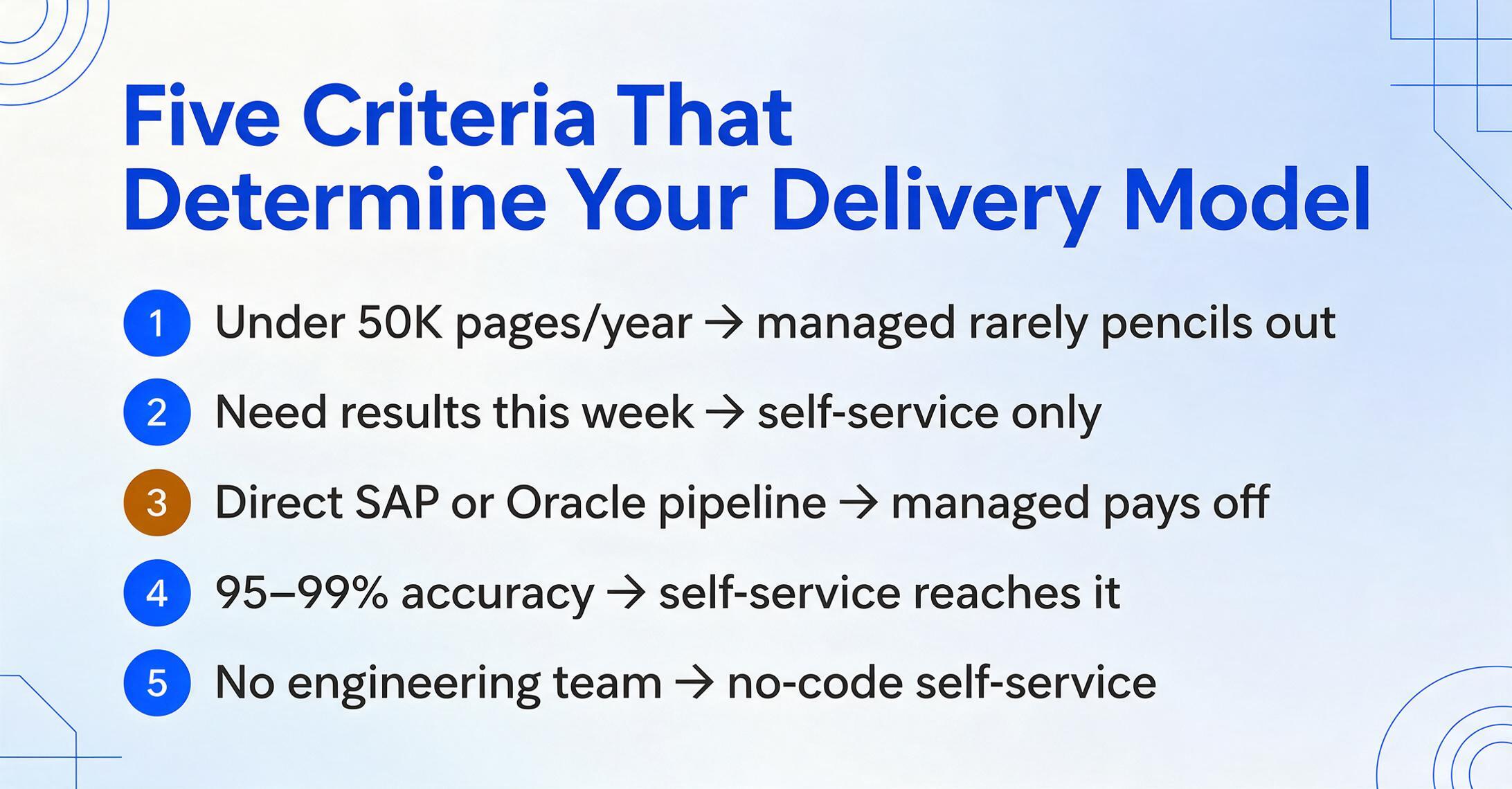
Volume and budget are the obvious variables. But three other criteria — time pressure, integration depth, and team technical capacity — shape the decision just as much and get discussed far less often in vendor materials.
Document Volume
Under 50,000 pages per year, managed IDP's implementation cost rarely pencils out — the per-page economics require scale to amortize the upfront investment. Above 500,000 pages per year, the per-page cost advantage of managed IDP (as low as $0.02/page) starts to dominate. Between these thresholds, both models are viable.
Time to Value
If you need extraction results this week — not this quarter — the answer is self-service. No managed IDP engagement delivers production results in under a month. If you're planning a 2027 digital transformation and extraction is one module in a broader ERP migration, managed IDP's longer timeline is a non-issue.
Integration Depth
If extracted data needs to flow directly into SAP, Oracle, or a custom ERP through validated API pipelines with automated error handling, managed IDP's integration engineering is the value you're paying for. If your workflow is "extract → download Excel → review → upload to accounting software," self-service handles this natively and the integration gap is zero.
Accuracy Requirements
Standard business document processing — invoices, receipts, purchase orders — typically needs 95–99% accuracy, which self-service AI tools achieve on standard layouts. If your use case demands 99.5%+ accuracy with zero human review (automated claims adjudication, regulatory filing), managed IDP's custom-trained models and human-in-the-loop validation are worth the premium.
Team Technical Capacity
Self-service document AI assumes someone on your team will configure fields, review outputs, and manage the extraction workflow. That person doesn't need to be an engineer — the interface is designed for operations staff and finance teams. Managed IDP, counterintuitively, may require more internal technical capacity: someone needs to manage the vendor relationship, validate model outputs during the implementation, and maintain the integration once it's live. An enterprise vs SMB breakdown of extraction needs illuminates this further.
A useful heuristic: if you can describe your extraction need in one sentence ("I need to pull invoice number, date, vendor name, line items, and total from supplier invoices into a spreadsheet"), self-service handles it. If describing the need takes a multi-page requirements document with integration diagrams and approval workflows, managed IDP earns its implementation fee.
The Hybrid Path: Start Self-Service, Add Managed Later
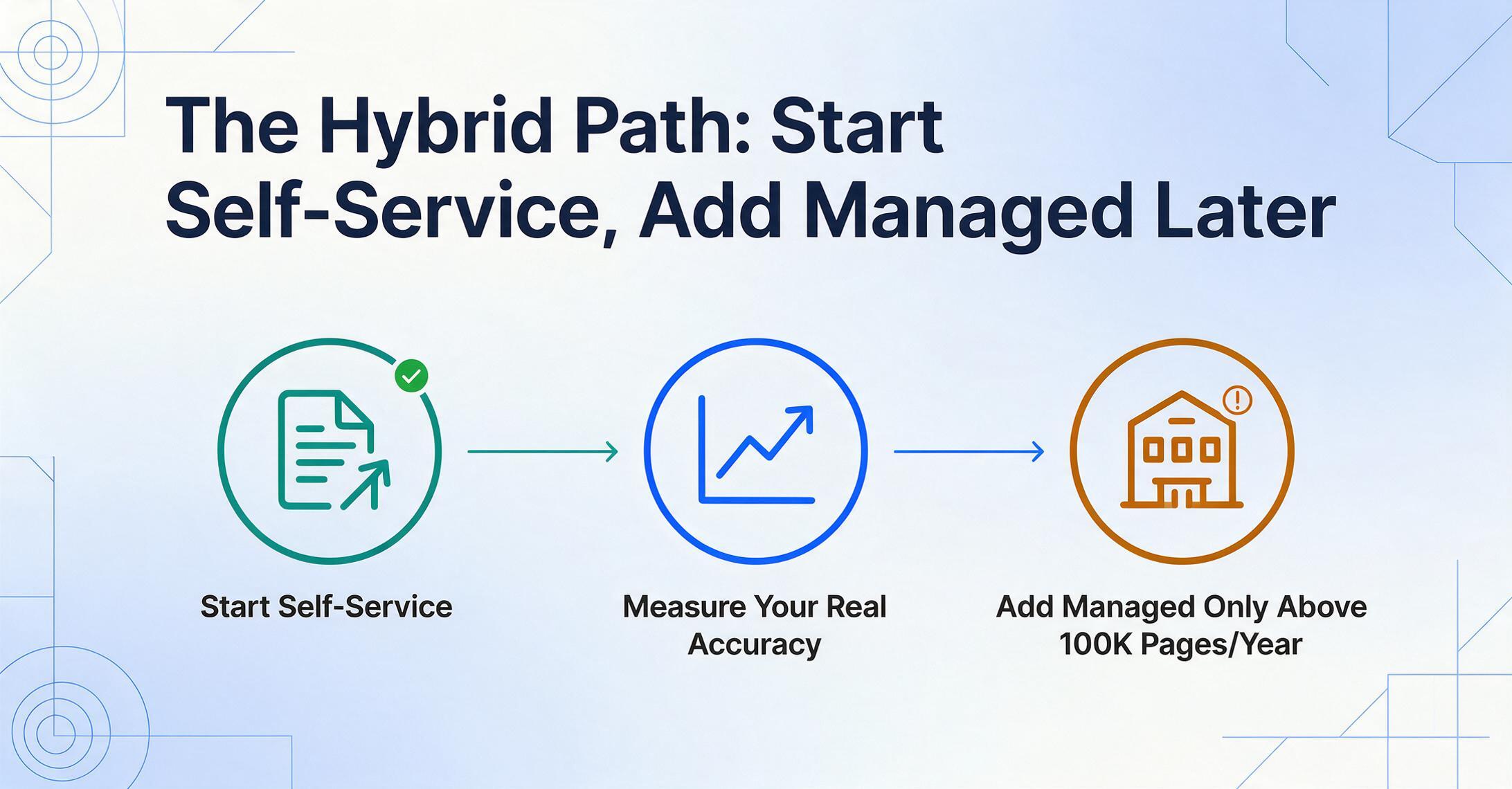
The self-service vs managed framing implies a binary choice, but a third pattern is emerging: teams start with self-service document AI to solve the immediate problem, then evaluate managed IDP only when (and if) their volume and complexity outgrow the self-service model.
This path makes sense for two reasons. First, it eliminates the risk of over-investing. A $25,000 managed IDP implementation for a team that processes 500 invoices per month is a procurement mistake — but you might not know your actual volume and complexity until you've been processing documents for a few months. Self-service gives you production data (actual accuracy rates, actual processing times, actual failure patterns) that makes the managed IDP evaluation far more informed.
Second, it sets a concrete performance baseline. When a managed IDP vendor tells you their platform achieves 99.2% accuracy, you can compare that against the 96.8% you're already getting from self-service and decide whether the 2.4-point difference justifies a 20x cost increase. Without the baseline, you're evaluating vendor claims against nothing.
The hybrid path reframes the decision: you're not choosing between self-service and managed. You're choosing whether to start with self-service (low risk, fast value, real data) or skip straight to managed (higher cost, longer timeline, but potentially higher ceiling). Most teams under 100,000 pages per year should start self-service and let their own data tell them when — or whether — to graduate.
This is also how the build vs buy decision intersects with the delivery model question. Building in-house is a third option on the same spectrum — maximum control, maximum cost, maximum timeline. The build-vs-buy analysis maps directly onto the managed IDP end of the delivery model spectrum, where you're trading cost and time for control.
Where ImageToTable.ai Sits on This Spectrum
ImageToTable.ai is a self-service document AI tool built on vision large models. You upload a document — PDF, image, screenshot — and define the fields you want extracted by typing column names. The AI locates each value by understanding what the field name means in context, not by matching coordinates or templates. This approach, called Custom Column Extraction, means you don't build templates per vendor or per document layout. You type "Invoice Number," "Vendor Name," "Line Item Description," "Amount" — and the model finds those values regardless of where they appear on the page.
Three capabilities position it specifically for teams that need extraction now, not next quarter:
Zero-configuration onboarding. No implementation period, no training data labeling, no professional services engagement. You sign up, upload your first document, and see structured output within minutes. The tool processes each page in 5–10 seconds, compared to roughly 3 minutes of manual data entry per page.
Batch processing with merged output. Upload 50 invoices from 50 different suppliers, define your column names once, and get a single consolidated Excel file with every invoice's data in one table. This is where self-service extraction replaces the "open each PDF → copy → paste → repeat" workflow that manual processing requires and that AI-powered data entry eliminates.
Computed columns. Beyond extracting fields that exist on the document, you can define calculated fields — "Line Total (Qty × Unit Price)" or "Tax Amount (Subtotal × 0.08)" — and the AI performs the calculation during extraction. This eliminates a post-extraction step that most tools leave to you in Excel.
What it doesn't do: ImageToTable.ai doesn't replace a managed IDP platform for teams that need direct ERP integration, custom-trained models for non-standard document types, or human-in-the-loop validation workflows managed by the vendor. Those are genuine managed IDP capabilities — and if you need them, our intelligent document processing platforms guide compares the vendors that operate in that category. The data extraction software landscape is wide enough for both models to coexist.
Market Context: Where the Industry Is Heading
The IDP market is consolidating around two poles. On the managed end, the 2025 Gartner Magic Quadrant for IDP identified ABBYY, Hyperscience, Infrrd, Tungsten Automation, and UiPath as Leaders — all enterprise-focused platforms with professional services organizations attached. The Everest Group PEAK Matrix 2025 added HCLTech, Microsoft, and WorkFusion to the Leaders tier. These vendors are competing for enterprise contracts measured in hundreds of thousands of dollars annually.
On the self-service end, a survey conducted by AIIM and Deep Analysis found that 78% of companies are now using AI for document processing — a massive jump from the prior year. The survey also found that 66% of new IDP projects will replace an existing system, not introduce IDP for the first time. This suggests that the market is maturing: organizations that tried managed IDP and found it overbuilt for their needs are looking for lighter alternatives, while organizations that have been doing manual processing are entering the market through self-service tools that match their scale.
The distinction between Document AI, IDP, and OCR maps onto this same spectrum. Traditional OCR is the tool layer. IDP is the managed platform layer. Document AI — the newer term — increasingly refers to self-service, AI-native tools that don't require the template infrastructure or vendor engagement that legacy IDP assumed. Understanding the evolution from document scanning to document understanding makes the self-service model's emergence look less like a trend and more like an inevitability.
Frequently Asked Questions
Is self-service document AI less accurate than managed IDP?
Not inherently. Self-service tools built on modern vision models achieve 95–99% accuracy on standard business documents — invoices, receipts, purchase orders, bank statements. Managed IDP can push accuracy to 99.5%+ through custom model training and human-in-the-loop validation, but that last percentage point comes at a significant cost premium and requires weeks of training data preparation. For most document types at most organizations, the accuracy difference doesn't justify a 20x–50x cost difference.
Can I switch from self-service to managed IDP later?
Yes, and this is the advantage of the hybrid path. Your self-service tool gives you concrete production data — actual accuracy rates, actual document volumes, actual failure patterns — that makes a managed IDP evaluation far more informed. You also keep processing documents during the transition, so there's no gap in service. The reverse switch (managed to self-service) is harder because you've already invested in implementation and built organizational processes around the vendor's workflow.
What document volume makes managed IDP cost-effective?
Based on published pricing data, managed IDP's per-page cost advantage typically justifies the implementation investment at roughly 100,000+ pages per year. Below that threshold, the implementation cost ($10,000–$50,000+) divided across a smaller page count produces a per-document cost that exceeds self-service subscription pricing. This threshold varies by vendor and use-case complexity, but 100K pages/year is a reasonable inflection point for initial planning.
Does self-service document AI work for regulated industries?
It depends on the regulation. If compliance requires the document to be processed and the data to be accurate — which covers most accounting, tax, and procurement regulations — self-service tools handle this well because the compliance obligation is on the data quality, not the delivery model. If compliance requires the vendor to hold specific certifications (FedRAMP, SOC 2 Type II for the extraction platform itself, HIPAA BAA), you need to verify that the specific self-service tool meets those requirements. Some do; some don't. Managed IDP vendors in the Gartner Leaders quadrant generally hold these certifications as table stakes for enterprise sales.
How does this relate to the build-vs-buy decision?
Build, buy self-service, and buy managed are three points on the same spectrum of control vs effort. Building in-house gives maximum control but takes months of engineering and costs $60,000–$95,000+ in year one. Buying self-service gives fast results with moderate control. Buying managed gives high accuracy and deep integration but at enterprise cost and timeline. The build vs buy analysis covers the first and third options in depth.
Start With Your Documents, Not a Vendor Demo
The most expensive mistake in document AI adoption isn't choosing the wrong vendor — it's choosing the wrong delivery model. A $50,000 managed IDP implementation for a team processing 200 invoices per month is an organizational error that takes 18 months and a contract termination to unwind. A self-service tool that can't handle your accuracy requirements at scale is a smaller error that surfaces in weeks, not years, and costs months of subscription fees, not years of contract obligation.
Test self-service first. Upload your own documents — not the vendor's demo samples, yours — and measure what you actually get. That data is worth more than any analyst quadrant or vendor slide deck.