Why Mexican CFDI Invoice Processing
Is Harder Than Most Teams Expect
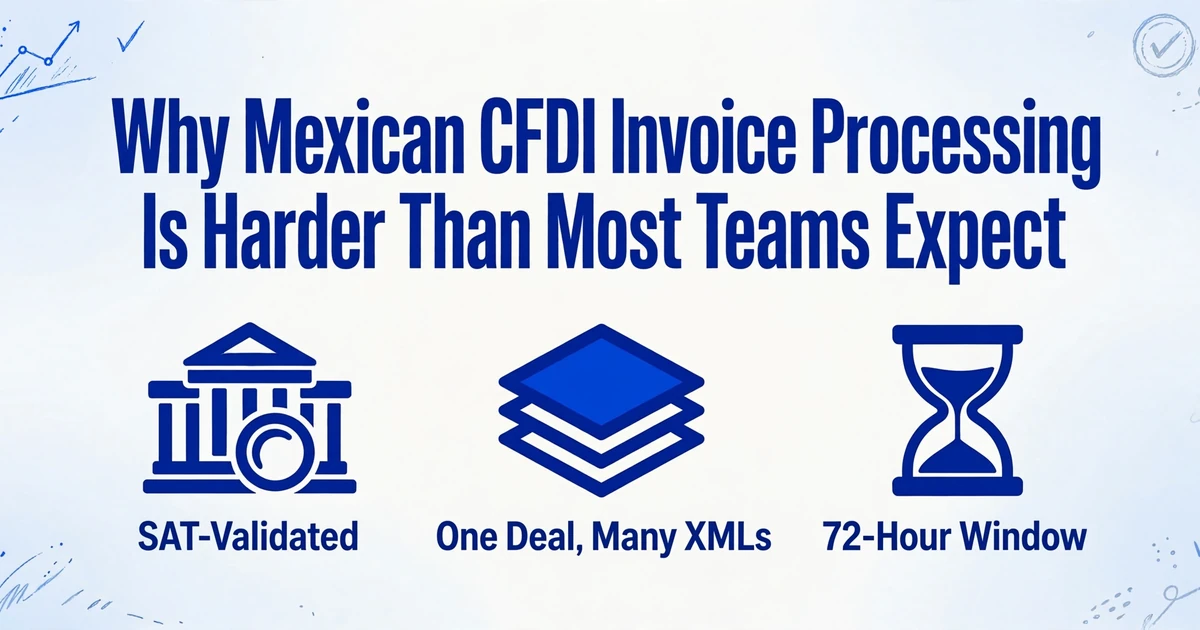
A Mexican supplier emails your AP inbox two files: a PDF and an XML. The PDF looks like an invoice. The XML looks like something only a developer should touch. Processing that invoice — extracting its data into your ERP, reconciling the payment, filing it for audit — will take your team more than three times longer than any other foreign invoice in the queue. The format itself is the bottleneck, and most of the reasons why are not visible on the printed page.
New to CFDI? This article assumes you know what a CFDI is and focuses on why processing it is difficult. For the beginner's introduction to Mexico's electronic invoice system — what a CFDI is, how PAC validation works, and what each field means — start with our What Is a CFDI? beginner's guide. If you are here to build an extraction workflow rather than understand the difficulty, the complete CFDI extraction guide covers every method end to end.
Key Takeaways
- A Mexican CFDI invoice takes your AP team more than three times longer to process than any other foreign invoice — and most of the reasons are not visible on the printed page.
- The system was built for SAT's real-time tax enforcement, not your operational efficiency — one business transaction with PPD terms can generate four separate XMLs that your AP workflow has no native way to connect.
- ImageToTable.ai reads CFDI content by semantic meaning rather than page coordinates, handling regulatory fields, dual-document PPD tracking, and multi-format input in a single pass — regardless of which supplier's invoicing software generated the PDF.
More Than Just a Long Invoice: The Surface Problem
A CFF Article 29-A compliant CFDI (Comprobante Fiscal Digital por Internet, or Digital Tax Receipt via Internet) is not merely a long invoice. It is a government-mandated XML document whose structure is defined by the Anexo 20 technical standard — a specification that, in its current CFDI 4.0 version, defines over 100 possible XML elements and multiple conditional validation chains. But pointing to the field count as the problem misses what actually slows down processing. The difficulty is not that there are many fields. The difficulty is that the fields relate to each other in ways that create tracking obligations across separate documents, separate systems, and separate points in time.
Symptoms are easy to spot. An invoice is rejected by your supplier's PAC (Proveedor Autorizado de Certificación, or Authorized Certification Provider) because the receiver's RFC (Registro Federal de Contribuyentes — Mexico's tax ID) doesn't match SAT's taxpayer registry exactly — a mismatch as small as a missing accent mark. A payment that cleared the bank last week shows up on none of the open invoices in your ledger, because the payment was issued as a separate CFDI of type Pago referencing the original invoice's UUID (Universally Unique Identifier) rather than appearing as a line item on the original document. An invoice your team processed three weeks ago turns out to have been canceled by the supplier — but nobody at your company accepted or rejected the cancellation request within the 72-hour window, so it was automatically approved. Your AP entry now references a voided document.
These are not edge cases. They are the normal operating conditions of processing Mexican supplier invoices at any scale above a handful per month. And they stem not from poor supplier practices or inadequate AP tools, but from the architecture of the CFDI system itself — a system whose design goals were regulatory visibility and tax enforcement, not operational efficiency for the receiving side of the transaction.
Core argument: CFDI processing complexity has three independent structural layers — regulatory, document, and operational — and each layer compounds the one below it. Understanding why each layer exists is the first step toward building a workflow that can handle all three.
Layer 1: The Regulatory Architecture That Makes Every CFDI a Mini Tax Filing
In most countries, an invoice is a commercial document: it records what was sold, to whom, and for how much. Tax reporting happens later — when the seller files a VAT return, when the buyer books the expense. In Mexico, the invoice is the tax filing. The distinction is not academic. It changes what information must be present at the moment of creation and who must verify it before the document has legal force.
Mexico operates what tax systems researchers call a real-time clearance model. Under CFF Article 29, Section IV, every CFDI must be transmitted to SAT (Servicio de Administración Tributaria, Mexico's federal tax authority) before it can be issued to the recipient. The transmission goes through a PAC — an SAT-certified intermediary — which validates the XML structure against Anexo 20 rules, verifies that both issuer and recipient RFCs exist in SAT's active taxpayer registry, confirms that the issuer's CSD (Certificado de Sello Digital, or Digital Seal Certificate) is valid and not revoked, checks that the tax calculations are internally consistent, and only then applies the timbre fiscal digital (digital tax stamp) and returns the validated CFDI with its assigned UUID.
What this means for your AP team is that every CFDI you receive has already passed through a government validation checkpoint. The data on it is not a supplier's claim — it is a claim that SAT has seen. This makes the data more authoritative than a typical invoice. It also means that errors in the data — an incorrect RFC, a wrong fiscal regime code — cannot be corrected by your supplier with a quick updated PDF. The incorrect CFDI must be canceled through a formal cancellation process, and a new one must be issued from scratch.
The required data itself is not just "name, date, amount." CFF Article 29-A mandates that every CFDI of type Ingreso (income invoice) contain: the issuer's RFC, legal name (razón social), and fiscal regime code (régimen fiscal); the receiver's RFC, legal name, postal code of the fiscal domicile, and the Uso CFDI code declaring how the recipient will use the invoice for tax purposes; the place and date of issuance; a unique folio number; the digital seal of the issuer; detailed line items with quantities, unit measures, SAT product/service classification codes (ClaveProdServ), unit prices, and totals; a complete tax breakdown by type (IVA — Impuesto al Valor Agregado, or Value Added Tax — transfers and withholdings); payment form (Forma de Pago) and method (Método de Pago, coded as PUE for single payment or PPD for deferred/installment payments); and the UUID and certification timestamp.
Each of these fields matters not just for your records but for SAT's cross-referencing engines. The receiver's RFC and name are cross-checked against SAT's taxpayer registry. The fiscal regime code — a numeric identifier like 601 for corporations, 612 for individuals with business activities, 605 for salaried employees — determines what tax treatment applies to both sides of the transaction. A mismatch between the issuer's declared regime and the type of income reported can trigger an automatic audit flag. This is why your Mexican suppliers are so rigid about getting your correct RFC and fiscal regime code before issuing an invoice: they are not being bureaucratic. They are complying with a system that rejects invoices containing data that does not match SAT's records.
The 2026 tax reform added a new dimension to this layer. A new provision (Fracción IX) was added to CFF Article 29-A, effective January 1, 2026, requiring that CFDIs reflect real and truthful transactions. If a CFDI does not represent an actual legal act or operation, it will be considered false — with consequences that now include criminal liability for issuers, recipients, and intermediaries. This raises the stakes of every CFDI your company receives: a supplier who issues you an invoice for services not actually rendered is not just committing a reporting error. They are creating a document that SAT may presume false, and your company's name and RFC may be published as a recipient of a false CFDI, with 30 days to correct your tax filings.
Layer 1 complexity, in summary: the document you are processing was not built for you. It was built for SAT's real-time monitoring infrastructure. Your AP workflow inherits every field and every validation that SAT requires — whether or not those fields are relevant to your accounting.
Layer 2: The Document Architecture — Why One Transaction Creates Two (or More) XMLs
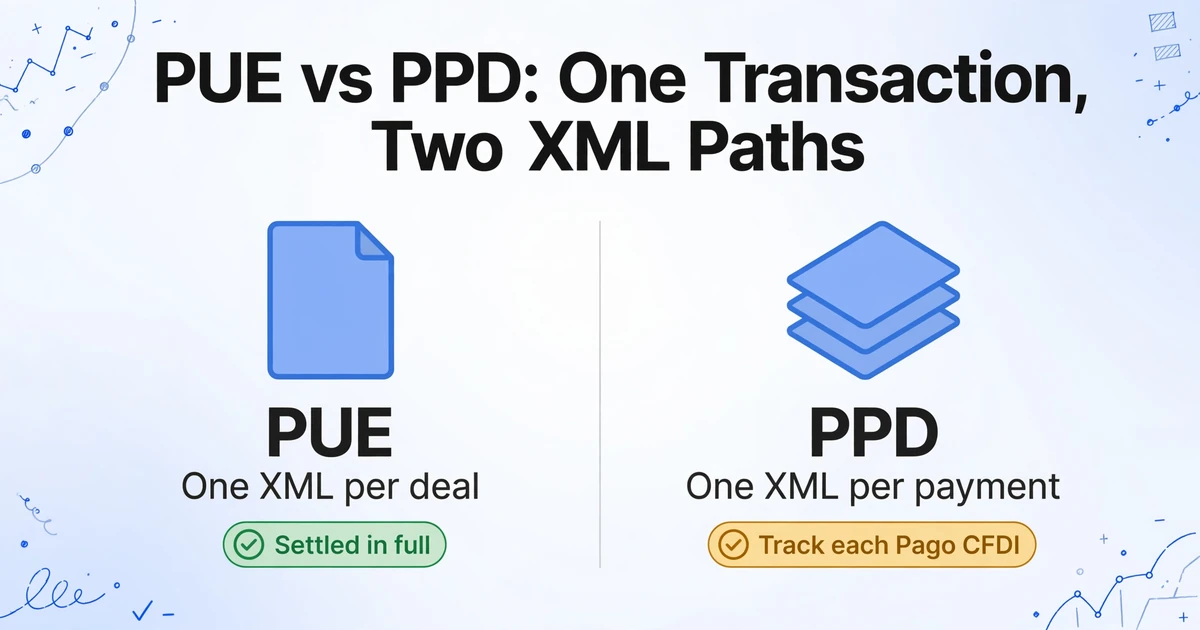
If the regulatory layer adds mandatory fields, the document architecture layer splits the transaction itself across multiple files. This is where CFDI processing diverges most sharply from what an AP team trained on US or European invoice formats expects.
The split begins with a field called Método de Pago. When the value is PUE (Pago en Una Sola Exhibición — payment in a single installment), the CFDI Ingreso itself records the complete transaction: goods or services, amounts, taxes, and the fact that payment is settled in full at the time of issuance. One document, one transaction. This is the closest a CFDI gets to an ordinary invoice.
When the value is PPD (Pago en Parcialidades o Diferido — payment in installments or deferred), the Ingreso CFDI records only the obligation. The actual payment — when it occurs, how much, by what method — is recorded in a separate CFDI of type Pago (payment), which carries the Complemento de Recepción de Pagos (Payment Receipt Complement, sometimes called Complemento de Pago). This complement references the original Ingreso CFDI's UUID and records: the payment date, the amount paid, the payment method (transfer, check, cash, electronic wallet), the currency and exchange rate if applicable, and the remaining balance after this payment.
One business transaction now generates two XMLs that must be tracked together. If the payment is made in three installments, it generates four XMLs: one Ingreso and three Pago CFDIs, each with its own UUID, each referencing the original via the complement structure. Reconciling these means matching the UUID on each Pago complement to the UUID on the original Ingreso, summing the partial payments, and confirming the balance reaches zero. Miss one Pago CFDI in your inbox, and the Ingreso appears unpaid in your ledger indefinitely — even though the bank shows the debit.
What this means in practice: A supplier sends you a PPD Ingreso CFDI on March 1st for MXN 150,000. You receive and process it. On March 15th, the supplier sends you a Pago CFDI for MXN 75,000 — but the email subject line reads "complemento de pago" and the attachment is another XML. If your AP team doesn't know to open this XML and read the Complemento de Pago node to find the referenced UUID, that MXN 75,000 payment never gets linked to the original invoice in your system. The invoice stays open. The supplier calls asking why they haven't been paid. You've already paid them. Both sides have correct records. They just live in two separate documents that nothing in your AP workflow connects.
This dual-document structure creates downstream problems that compound with volume. At month-end close, an AP team processing 50 Mexican supplier invoices that use PPD terms potentially has 100 or more XMLs to reconcile — each requiring a UUID cross-reference between the Ingreso and its Pago complement(s). A manual reconciliation means opening each Pago XML, finding the referenced UUID node, searching the processed Ingreso database for a match, verifying the amounts align, and marking both as reconciled. At three minutes per reconciliation, 50 PPD pairs consume two and a half hours of AP staff time — every month, for one country's worth of suppliers.
There is another document-splitting dimension: the relationship between the XML and the PDF representation. Under Mexican law, the XML file — digitally signed and PAC-stamped — is the legally authoritative document. The PDF is a visual representation regulated by SAT (it must include a two-dimensional barcode encoding a link to SAT's verification portal), but it carries no independent legal weight. If the data on the PDF differs from the data in the corresponding XML — which can happen when supplier ERP systems render the PDF from a template that truncates or reformats fields — the XML is what SAT considers correct. An AP team that enters data from the PDF without checking the XML is, from a compliance standpoint, processing a decorative printout.
For more on the workflow of extracting CFDI data from both XML and PDF into Excel, see our CFDI extraction how-to guide. For handling CFDI invoices at batch scale — especially the UUID cross-referencing across Pago complements — see our batch CFDI processing guide.
Layer 3: The Cancellation Trap — Why Fixing an Error Takes 72 Hours and Two Signatures
In most invoice processing environments, correcting an error means the supplier sends a credit note or a revised PDF, and the buyer books the adjustment. In the CFDI system, an issued and stamped invoice cannot be edited. It can only be canceled — and cancellation is itself a regulated process that involves both parties, a government system, and a clock.
Under the current rules, canceling a CFDI requires the issuer to submit a cancellation request through the SAT Tax Mailbox (Buzón Tributario) specifying one of four standardized reason codes: 01 — voucher issued with errors in relation (meaning the canceled CFDI will be replaced by a related document); 02 — voucher issued with unrelated errors; 03 — the transaction was not carried out; 04 — related nominative operation in a global invoice. Code 01 is the most common for business corrections, and it requires the issuer to specify the UUID of the replacement CFDI that substitutes the canceled one.
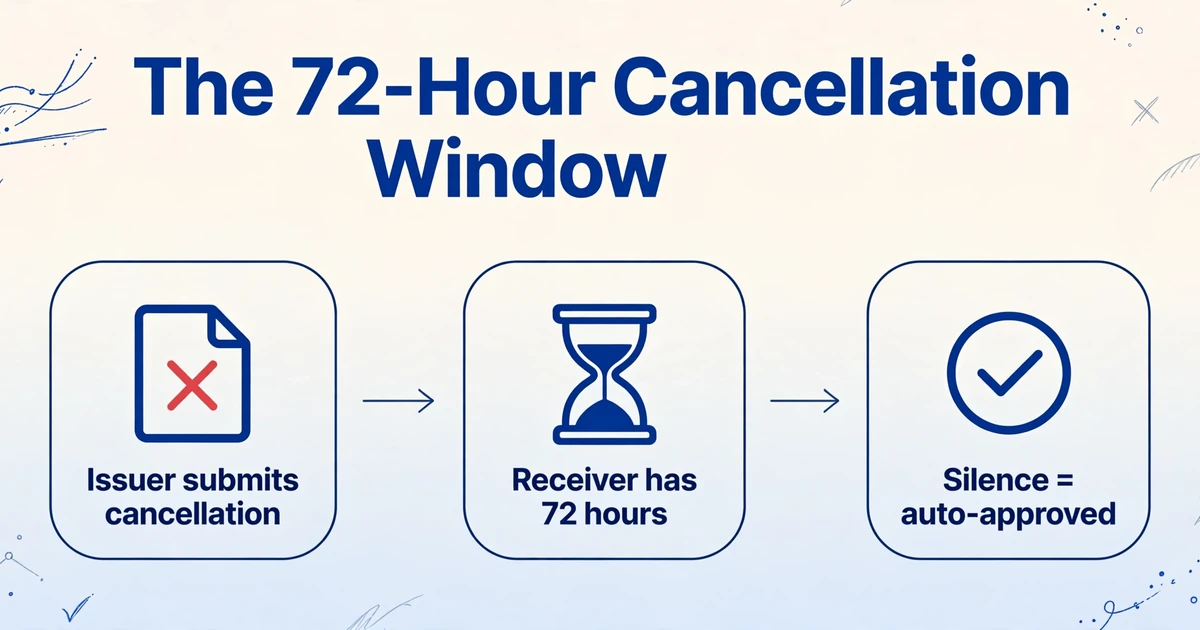
Once the cancellation request is submitted, the receiver has 72 hours (three business days) to accept or reject it. If the receiver takes no action, the cancellation is automatically approved by timeout. If the receiver rejects it, the CFDI remains legally active, and the issuer must either renegotiate with the receiver or escalate through SAT's dispute resolution channels.
There are limited exceptions where receiver approval is not required: payroll CFDIs (Nómina), invoices below MXN 1,000, transactions with the general public (using the generic RFC XAXX010101000), and cancellations performed within 72 hours of the original issuance. For everything else — every commercial Ingreso CFDI above MXN 1,000 — the receiver's 72-hour acceptance window applies.
For the receiving AP team, this creates two operational hazards. The first is the voided document risk: a CFDI you processed and booked three weeks ago may have been canceled by the supplier, and because nobody in your organization logged into the SAT Tax Mailbox to accept or reject the request, it was silently approved. Your books now contain an entry backed by a voided tax document — a finding that SAT will treat as an expense supported by an invalid CFDI, disallowing the deduction and potentially triggering back taxes and penalties.
The second is the replacement tracking gap: when a supplier cancels a CFDI with reason code 01, they issue a replacement CFDI with a new UUID. Your AP team now needs to locate the original entry, void it, and re-enter the replacement — matching the new UUID to the old one. If the replacement arrives in a different email thread, with a slightly different subject line, processed by a different team member, the link between the original and the replacement is lost, and both versions may end up in your system simultaneously.
Structural consequence: The cancellation mechanism transforms invoice processing from a one-time data entry task into a stateful monitoring obligation. You cannot process a CFDI once and forget it. You must maintain awareness of its cancellation status — potentially for the entire fiscal year, since under certain conditions cancellations can be performed up to the month in which the annual ISR (Impuesto Sobre la Renta, or Income Tax) declaration is filed for the fiscal year in which the CFDI was originally issued.
Layer 4: Multi-RFC and Cross-Border Headaches
The three layers above apply to any organization receiving Mexican CFDI invoices. For multinational companies, there is a fourth complication specific to how the RFC system interacts with cross-border operations.
A company with multiple legal entities in Mexico — a manufacturing subsidiary, a distribution subsidiary, a services entity — will have a separate RFC for each. CFDI invoices sent to the wrong RFC are legally addressed to the wrong taxpayer. A supplier issues the invoice to the manufacturing subsidiary's RFC, but the goods were delivered to and consumed by the distribution entity. The manufacturing entity cannot legally deduct the expense because the transaction did not occur under its tax registration — and the distribution entity has no CFDI to support its cost of goods. Fixing this requires a cancellation and reissuance cycle, with all the 72-hour receiver acceptance implications described above.
For foreign companies that receive CFDI invoices from Mexican suppliers but have no RFC of their own, the generic foreign recipient RFC — XEXX010101000 — can be used. This RFC has important limitations. It does not allow the recipient to claim IVA credits or deduct the expense for Mexican tax purposes (which, for a foreign company with no Mexican tax filing obligation, is usually irrelevant). More operationally significant: because XEXX010101000 is a generic identifier used by thousands of unrelated entities, it provides no traceability back to a specific corporate entity. If your company has three regional offices, each receiving CFDI invoices from different Mexican suppliers, all using XEXX010101000, there is no RFC-level way to route invoices to the correct entity during processing. The routing logic must be built into your AP workflow — relying on the supplier name, the description field, or the email recipient — none of which have the structural reliability of a tax ID.
There is also the regime fiscal mismatch problem on the receiving side. When a Mexican supplier issues a CFDI, they must record the receiver's fiscal regime code. If your company has obtained an RFC for a Mexican entity, that entity is registered under a specific regime — say, 601 (General Regime for Legal Entities). If the supplier mistakenly enters 612 (Individuals with Business Activities) because someone provided the wrong code during onboarding, the CFDI may still pass PAC validation (since 612 is a valid regime code), but it will contain a structural data error that SAT can flag during a future audit. The CFDI is valid but incorrect — the hardest type of error to catch before it becomes a problem.
For an analysis of the broader challenge of processing documents across Spanish-speaking markets, see our overview of document extraction across Spanish markets.
Why Template-Based Approaches Break on CFDI
A common response to invoice processing complexity is template-based OCR: define a template for each supplier's layout, map fields to positions, and extract data by coordinates. This approach assumes the document format is consistent enough that a template trained on one sample will work on the next hundred. CFDI breaks this assumption on two fronts.
First, the PDF representation varies by supplier. Even though every CFDI contains the same mandatory fields defined by Anexo 20, each supplier's ERP or invoicing system renders the PDF differently. One supplier places the UUID in the upper-right corner as a 36-character string. Another embeds it only in the QR code barcode at the bottom. A third prints it in a condensed font in the footer. A template built for Supplier A's layout fails entirely on Supplier B's invoice.
Second, the PDF and the XML can carry different data. A supplier's ERP might render the PDF from a subset of the XML fields — showing the line-item total but not the IVA breakdown, displaying the supplier's trade name instead of the registered razón social. If your extraction tool reads the PDF, it captures the simplified printed data. If your compliance obligation requires the XML's full tax detail, the PDF is insufficient. An AP team reconciling to the PDF is reconciling to less data than SAT considers the authoritative record.
The approach that handles this structural variability is one that reads the document's content — the semantic meaning of fields like UUID, RFC, IVA 16%, Régimen Fiscal — regardless of where they appear on the page and regardless of whether the source is a PDF or an XML. Semantic extraction identifies an RFC not because it sits at coordinates (200, 450) but because it matches the pattern of a 12- or 13-character alphanumeric identifier labeled "RFC" in the surrounding text. This is the difference between mapping visual positions and understanding document content — and it is the difference that makes CFDI processing viable at scale rather than a per-supplier template maintenance burden.
What This Means for Your Mexican AP Workflow
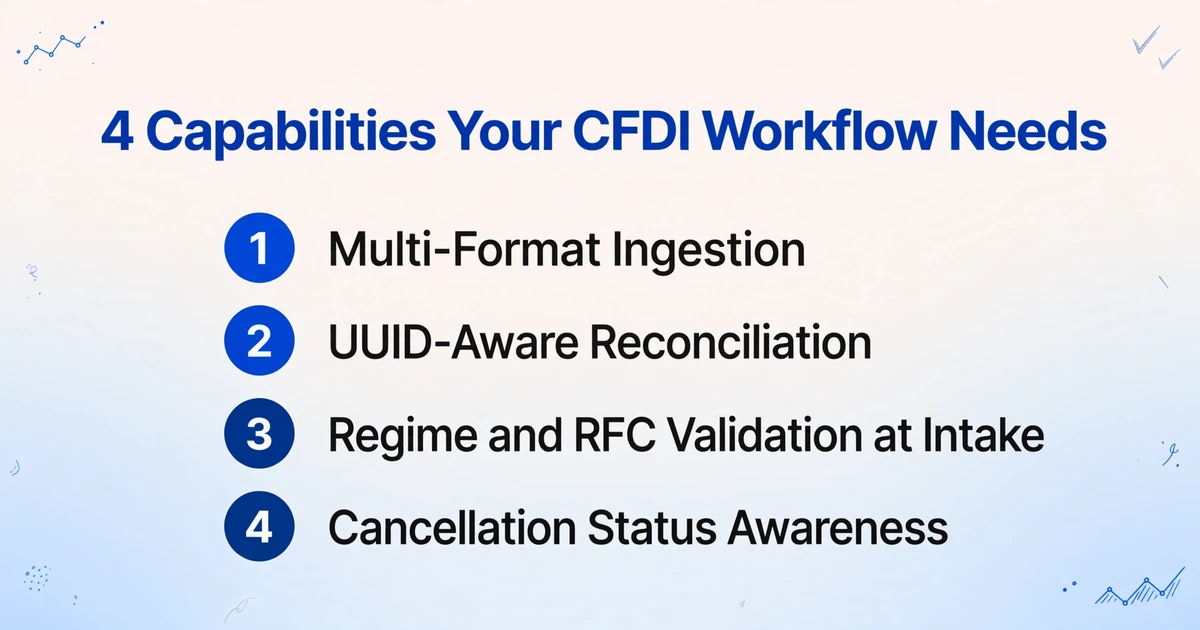
Pulling the four layers together, a CFDI processing workflow that accounts for all of them needs capabilities that most standard AP systems — built around the assumption that an invoice is a single, self-contained, non-stateful document — do not provide natively.
Multi-format ingestion. The workflow must accept both XML and PDF as input, because suppliers deliver both and the authoritative data lives in the XML. Extracting from the XML alone discards the visual verification step (does the printed document match the structured data?). Extracting from the PDF alone discards the legal record. Both formats should feed into the same extraction pipeline, producing a unified output row per CFDI.
UUID-aware reconciliation. The UUID — the 36-character identifier embedded in every CFDI — is the permanent key that links Ingreso invoices to their Pago complements, tracks cancellations, and connects each document to SAT's verification portal. A CFDI workflow that does not capture, store, and cross-reference UUIDs across batches cannot perform PPD payment reconciliation without manual lookups. For batch reconciliation workflows, see our batch CFDI processing guide.
Regime and RFC validation at intake. Before a CFDI enters your accounting system, the receiver's RFC and regime fiscal code should be validated against your company's registered data. A mismatch caught at intake prevents a cascade: the expense gets booked under the wrong entity, the tax team discovers the error during audit prep, and the correction involves a cancellation-reissuance cycle with a supplier who may no longer be responsive.
Cancelation status awareness. A CFDI once processed is not a CFDI permanently settled. Workflows that include periodic UUID status checks against SAT's verification portal — or that require suppliers to notify your team of cancellation requests through a defined channel — reduce the risk of holding voided documents in your ledger.
None of this requires an enterprise-scale PAC integration or a dedicated Mexican tax compliance platform. What it requires is a processing step that understands what a CFDI is — a multi-document, stateful, government-validated record — and extracts its data accordingly, rather than treating it as a long PDF with extra numbers.
Frequently Asked Questions
Why can't Mexican suppliers just issue a normal PDF invoice?
Because Mexican law does not recognize a PDF as a valid tax document. Since 2014, all taxpayers in Mexico — companies, independent professionals, and individuals engaged in commercial activities — are required to issue CFDI XML invoices validated by a PAC and registered with SAT in real time. A supplier issuing only a PDF is not producing a legally valid invoice under Mexican tax law, and you cannot use such a document to support a tax deduction in Mexico.
What's the difference between PUE and PPD in practice?
PUE (single payment) means the invoice is settled in full at the time of issuance — one CFDI covers the entire transaction. PPD (deferred/installment) means the invoice records the obligation, and each subsequent payment generates a separate CFDI of type Pago with its own UUID and a Complemento de Pago referencing the original. PPD requires tracking at least two XMLs per transaction; PUE requires one. The payment method code (PUE or PPD) appears in the Método de Pago field on the Ingreso CFDI.
Do I need to keep the XML or is the PDF enough for our records?
You need the XML. Under CFF Article 30, both issuer and receiver must retain CFDI XML files for at least five years. The PDF is a regulated visual representation — it must include a QR code linking to SAT's verification portal — but it carries no independent legal weight. In an audit, SAT will ask for the XML, not the PDF.
What happens if I ignore a cancellation request from a supplier?
If you do not respond within 72 hours (three business days), the cancellation is automatically approved by timeout. The CFDI becomes void, and any tax deduction or expense entry in your system backed by that CFDI is no longer supported by a valid tax document. If your company files taxes in Mexico, this creates a compliance exposure. If your company does not file in Mexico, the operational risk is paying against a voided invoice without realizing it.
Can I use the generic RFC XEXX010101000 for all our Mexican supplier invoices?
Yes, if your company has no Mexican tax registration and no Mexican RFC of its own. However, XEXX010101000 is a generic identifier shared by all foreign recipients — it provides no entity-level traceability. If your company has multiple offices, departments, or entities receiving CFDI invoices, you will need an internal routing mechanism (based on supplier name, description, or email) to direct each invoice to the correct processing queue.
Is CFDI complexity worse than other countries' e-invoicing systems?
Mexico's system is among the world's most tightly controlled, alongside Brazil's NF-e. Both use real-time government clearance, both require structured XML with digital signatures, and both create reconciliation obligations between original invoices and subsequent payment or transport documents. The specific complexity of Mexico's system lies in the dual-document PPD/Pago structure and the cancellation-with-receiver-acceptance mechanism — features that have no direct equivalent in most European e-invoicing mandates.
Processing CFDI invoices at scale requires a workflow that understands the structure underneath the document — not one that treats it as another PDF with extra fields. The difference shows up in your month-end close timeline: 50 CFDI invoices with PPD terms, processed with UUID-aware reconciliation, take minutes. Processed without it, the same 50 invoices consume hours of manual cross-referencing — every month.